Disney and Pixar: Evaluating Acquisition, Integration and Strategy
VerifiedAdded on 2023/04/11
|7
|1717
|174
Case Study
AI Summary
This case study examines Disney's acquisition of Pixar, analyzing the strategic rationale, benefits, and challenges of the merger. It explores the strengths of both companies, the potential value creation through common ownership versus contractual alliances, and the implications for Disney's market position and competitive advantage. The analysis includes a discussion of cultural integration, leadership considerations, and the potential impact on Disney's stock and creative output. The study concludes with recommendations for ensuring the success of the acquisition by preserving Pixar's innovative culture and fostering collaboration between the two entities. Desklib provides access to similar case studies and resources for students.
Running header: Pixar and Disney 1
Pixar and Disney
Student Name
Institutional Affiliation
Pixar and Disney
Student Name
Institutional Affiliation

Paraphrase This Document
Need a fresh take? Get an instant paraphrase of this document with our AI Paraphraser
Pixar and Disney 2
Question 1.
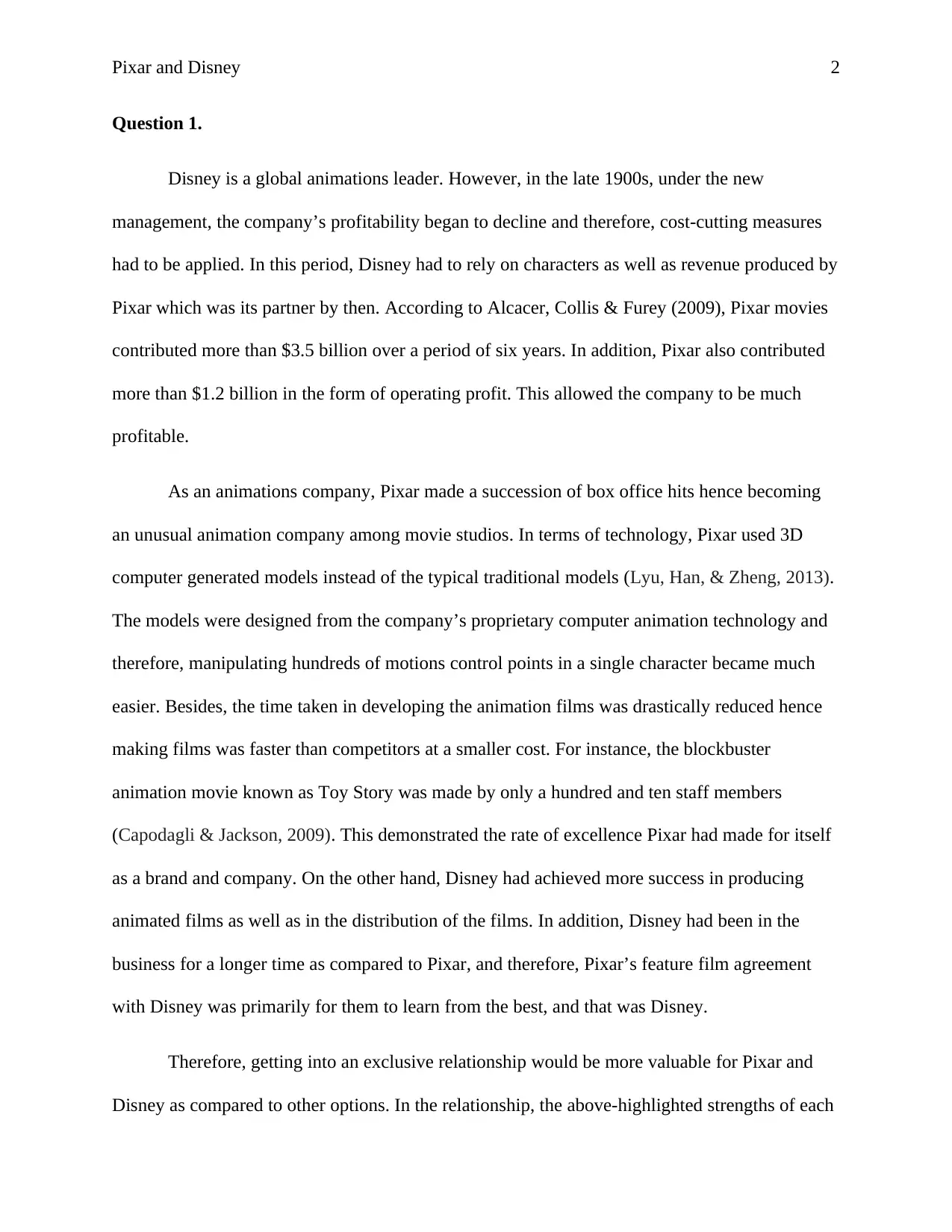
Disney is a global animations leader. However, in the late 1900s, under the new
management, the company’s profitability began to decline and therefore, cost-cutting measures
had to be applied. In this period, Disney had to rely on characters as well as revenue produced by
Pixar which was its partner by then. According to Alcacer, Collis & Furey (2009), Pixar movies
contributed more than $3.5 billion over a period of six years. In addition, Pixar also contributed
more than $1.2 billion in the form of operating profit. This allowed the company to be much
profitable.
As an animations company, Pixar made a succession of box office hits hence becoming
an unusual animation company among movie studios. In terms of technology, Pixar used 3D
computer generated models instead of the typical traditional models (Lyu, Han, & Zheng, 2013).
The models were designed from the company’s proprietary computer animation technology and
therefore, manipulating hundreds of motions control points in a single character became much
easier. Besides, the time taken in developing the animation films was drastically reduced hence
making films was faster than competitors at a smaller cost. For instance, the blockbuster
animation movie known as Toy Story was made by only a hundred and ten staff members
(Capodagli & Jackson, 2009). This demonstrated the rate of excellence Pixar had made for itself
as a brand and company. On the other hand, Disney had achieved more success in producing
animated films as well as in the distribution of the films. In addition, Disney had been in the
business for a longer time as compared to Pixar, and therefore, Pixar’s feature film agreement
with Disney was primarily for them to learn from the best, and that was Disney.
Therefore, getting into an exclusive relationship would be more valuable for Pixar and
Disney as compared to other options. In the relationship, the above-highlighted strengths of each
Question 1.
Disney is a global animations leader. However, in the late 1900s, under the new
management, the company’s profitability began to decline and therefore, cost-cutting measures
had to be applied. In this period, Disney had to rely on characters as well as revenue produced by
Pixar which was its partner by then. According to Alcacer, Collis & Furey (2009), Pixar movies
contributed more than $3.5 billion over a period of six years. In addition, Pixar also contributed
more than $1.2 billion in the form of operating profit. This allowed the company to be much
profitable.
As an animations company, Pixar made a succession of box office hits hence becoming
an unusual animation company among movie studios. In terms of technology, Pixar used 3D
computer generated models instead of the typical traditional models (Lyu, Han, & Zheng, 2013).
The models were designed from the company’s proprietary computer animation technology and
therefore, manipulating hundreds of motions control points in a single character became much
easier. Besides, the time taken in developing the animation films was drastically reduced hence
making films was faster than competitors at a smaller cost. For instance, the blockbuster
animation movie known as Toy Story was made by only a hundred and ten staff members
(Capodagli & Jackson, 2009). This demonstrated the rate of excellence Pixar had made for itself
as a brand and company. On the other hand, Disney had achieved more success in producing
animated films as well as in the distribution of the films. In addition, Disney had been in the
business for a longer time as compared to Pixar, and therefore, Pixar’s feature film agreement
with Disney was primarily for them to learn from the best, and that was Disney.
Therefore, getting into an exclusive relationship would be more valuable for Pixar and
Disney as compared to other options. In the relationship, the above-highlighted strengths of each
Pixar and Disney 3
company would complement each other. For instance, Disney is successful in distribution its
animations films; however, the company has weak conservative techniques as well as high
operating costs. On the other hand, Pixar has strengths in terms of its technology and brand
success (Capodagli & Jackson, 2009). However, the brand needs to expand, and therefore,
Disney would be the best option. In this point, it is better to evaluate the “alliance outperform”
which mainly includes attributes of performance, trust, and commitment. Part of this can be
demonstrated in the working relationship in which both the companies had before dissolving
their partnership. Based on this history, making both companies a combined entity would make
performance much better because each company has its competencies bringing into the table. In
addition, profits would increase exponentially since there would not be any division in terms of
production and ownership rights.
Question 2.
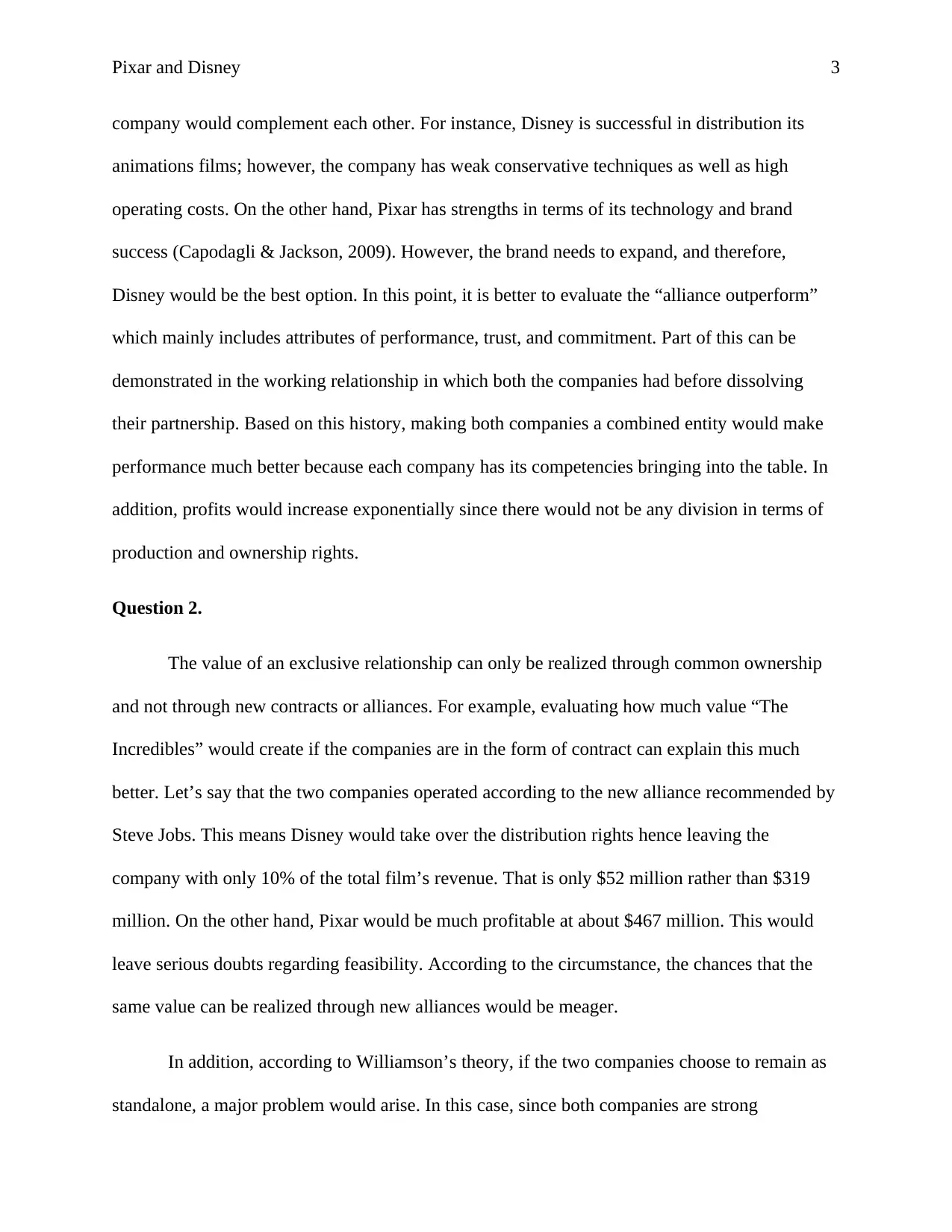
The value of an exclusive relationship can only be realized through common ownership
and not through new contracts or alliances. For example, evaluating how much value “The
Incredibles” would create if the companies are in the form of contract can explain this much
better. Let’s say that the two companies operated according to the new alliance recommended by
Steve Jobs. This means Disney would take over the distribution rights hence leaving the
company with only 10% of the total film’s revenue. That is only $52 million rather than $319
million. On the other hand, Pixar would be much profitable at about $467 million. This would
leave serious doubts regarding feasibility. According to the circumstance, the chances that the
same value can be realized through new alliances would be meager.
In addition, according to Williamson’s theory, if the two companies choose to remain as
standalone, a major problem would arise. In this case, since both companies are strong
company would complement each other. For instance, Disney is successful in distribution its
animations films; however, the company has weak conservative techniques as well as high
operating costs. On the other hand, Pixar has strengths in terms of its technology and brand
success (Capodagli & Jackson, 2009). However, the brand needs to expand, and therefore,
Disney would be the best option. In this point, it is better to evaluate the “alliance outperform”
which mainly includes attributes of performance, trust, and commitment. Part of this can be
demonstrated in the working relationship in which both the companies had before dissolving
their partnership. Based on this history, making both companies a combined entity would make
performance much better because each company has its competencies bringing into the table. In
addition, profits would increase exponentially since there would not be any division in terms of
production and ownership rights.
Question 2.
The value of an exclusive relationship can only be realized through common ownership
and not through new contracts or alliances. For example, evaluating how much value “The
Incredibles” would create if the companies are in the form of contract can explain this much
better. Let’s say that the two companies operated according to the new alliance recommended by
Steve Jobs. This means Disney would take over the distribution rights hence leaving the
company with only 10% of the total film’s revenue. That is only $52 million rather than $319
million. On the other hand, Pixar would be much profitable at about $467 million. This would
leave serious doubts regarding feasibility. According to the circumstance, the chances that the
same value can be realized through new alliances would be meager.
In addition, according to Williamson’s theory, if the two companies choose to remain as
standalone, a major problem would arise. In this case, since both companies are strong
⊘ This is a preview!⊘
Do you want full access?
Subscribe today to unlock all pages.

Trusted by 1+ million students worldwide
Pixar and Disney 4
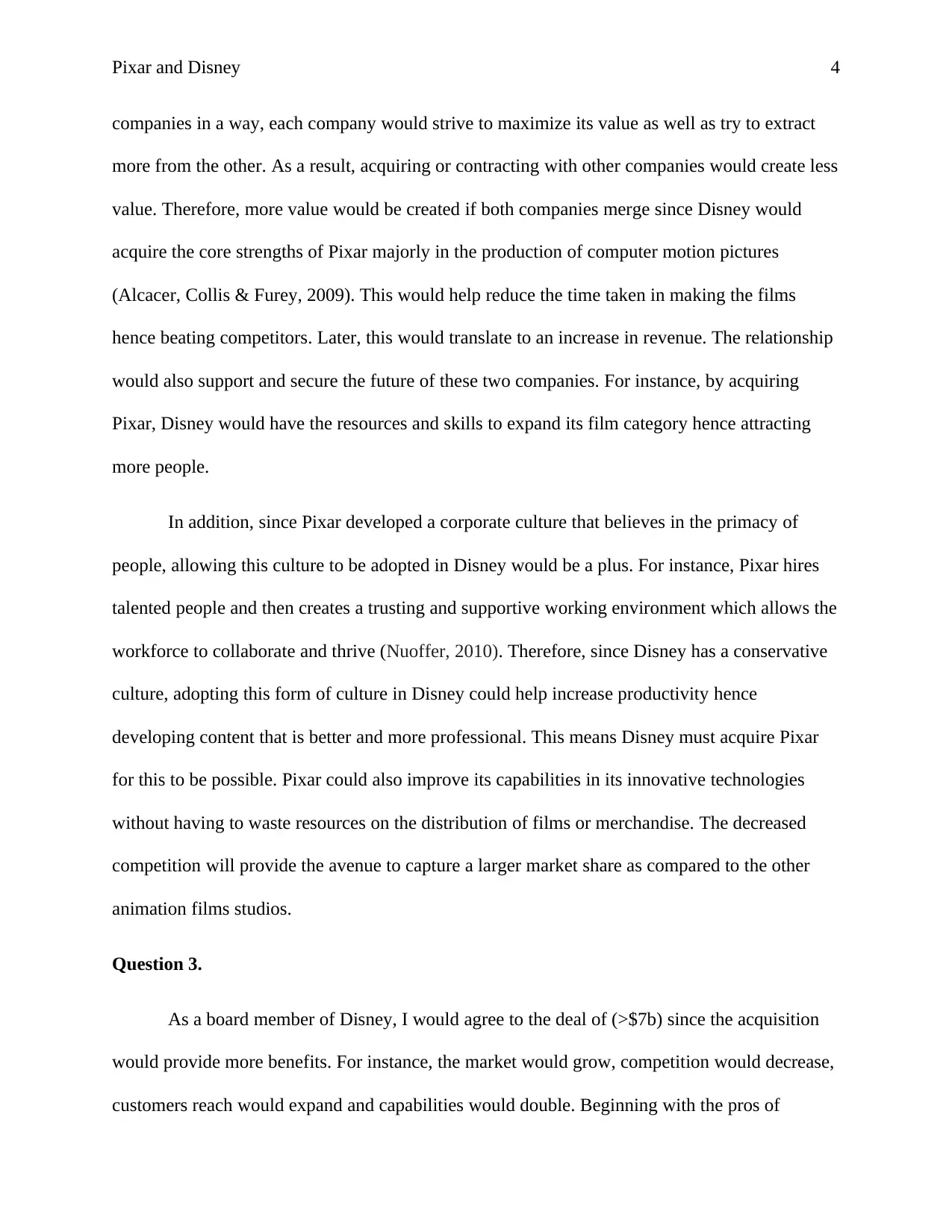
companies in a way, each company would strive to maximize its value as well as try to extract
more from the other. As a result, acquiring or contracting with other companies would create less
value. Therefore, more value would be created if both companies merge since Disney would
acquire the core strengths of Pixar majorly in the production of computer motion pictures
(Alcacer, Collis & Furey, 2009). This would help reduce the time taken in making the films
hence beating competitors. Later, this would translate to an increase in revenue. The relationship
would also support and secure the future of these two companies. For instance, by acquiring
Pixar, Disney would have the resources and skills to expand its film category hence attracting
more people.
In addition, since Pixar developed a corporate culture that believes in the primacy of
people, allowing this culture to be adopted in Disney would be a plus. For instance, Pixar hires
talented people and then creates a trusting and supportive working environment which allows the
workforce to collaborate and thrive (Nuoffer, 2010). Therefore, since Disney has a conservative
culture, adopting this form of culture in Disney could help increase productivity hence
developing content that is better and more professional. This means Disney must acquire Pixar
for this to be possible. Pixar could also improve its capabilities in its innovative technologies
without having to waste resources on the distribution of films or merchandise. The decreased
competition will provide the avenue to capture a larger market share as compared to the other
animation films studios.
Question 3.
As a board member of Disney, I would agree to the deal of (>$7b) since the acquisition
would provide more benefits. For instance, the market would grow, competition would decrease,
customers reach would expand and capabilities would double. Beginning with the pros of
companies in a way, each company would strive to maximize its value as well as try to extract
more from the other. As a result, acquiring or contracting with other companies would create less
value. Therefore, more value would be created if both companies merge since Disney would
acquire the core strengths of Pixar majorly in the production of computer motion pictures
(Alcacer, Collis & Furey, 2009). This would help reduce the time taken in making the films
hence beating competitors. Later, this would translate to an increase in revenue. The relationship
would also support and secure the future of these two companies. For instance, by acquiring
Pixar, Disney would have the resources and skills to expand its film category hence attracting
more people.
In addition, since Pixar developed a corporate culture that believes in the primacy of
people, allowing this culture to be adopted in Disney would be a plus. For instance, Pixar hires
talented people and then creates a trusting and supportive working environment which allows the
workforce to collaborate and thrive (Nuoffer, 2010). Therefore, since Disney has a conservative
culture, adopting this form of culture in Disney could help increase productivity hence
developing content that is better and more professional. This means Disney must acquire Pixar
for this to be possible. Pixar could also improve its capabilities in its innovative technologies
without having to waste resources on the distribution of films or merchandise. The decreased
competition will provide the avenue to capture a larger market share as compared to the other
animation films studios.
Question 3.
As a board member of Disney, I would agree to the deal of (>$7b) since the acquisition
would provide more benefits. For instance, the market would grow, competition would decrease,
customers reach would expand and capabilities would double. Beginning with the pros of
Paraphrase This Document
Need a fresh take? Get an instant paraphrase of this document with our AI Paraphraser
Pixar and Disney 5
acquisition, Disney will be able to acquire the core strengths of Pixar majorly in the production
of computerized motion pictures. In addition, since Pixar has generated more money in its
animation motion pictures, the acquisition may be of great benefit to Disney since the company
will have access to Pixar’s proprietary technology (Capodagli & Jackson, 2009). As a result,
Disney will able to make high quality and innovative films that attract more customers as well as
generate more revenues for the company. Besides, merchandise sales with the inclusion of theme
park tickets would increase exponentially.
Secondly, the acquisition will result in decreased competition since Pixar is a leading
player in terms of quality animated films. This means Disney can significantly increase its
market share hence becoming more profitable. Thirdly, Pixar talented leadership and team would
be instrumental in ensuring better content and films are produced. Pixar gives priority to its
employees and also create a better environment for them to thrive and work better. This makes it
easy to develop movies in short periods. Disney can leverage on this aspect since it takes a lot of
time to develop movies and also its costs of producing are much higher than Pixar’s (Stein,
2009)
On the cons of the acquisition, it argued that the acquisition might affect Disney’s stock
since the stock split may dilute the earnings per share of Disney’s shares. In addition, given that
both organizations have different organizational cultures, cultural clashes can be present after the
acquisition process. For instance, Pixar employees may lose their independence and style of
work after the merger happens. They may, therefore, decide to leave the company hence posing
great losses for Disney since, without the skills needed, the merger would be insignificant.
Besides, Pixar is opposed to producing low budget sequels which have been a practice for
Disney since it’s a primary source of revenue. In conclusion, after the acquisition, Steve Jobs
acquisition, Disney will be able to acquire the core strengths of Pixar majorly in the production
of computerized motion pictures. In addition, since Pixar has generated more money in its
animation motion pictures, the acquisition may be of great benefit to Disney since the company
will have access to Pixar’s proprietary technology (Capodagli & Jackson, 2009). As a result,
Disney will able to make high quality and innovative films that attract more customers as well as
generate more revenues for the company. Besides, merchandise sales with the inclusion of theme
park tickets would increase exponentially.
Secondly, the acquisition will result in decreased competition since Pixar is a leading
player in terms of quality animated films. This means Disney can significantly increase its
market share hence becoming more profitable. Thirdly, Pixar talented leadership and team would
be instrumental in ensuring better content and films are produced. Pixar gives priority to its
employees and also create a better environment for them to thrive and work better. This makes it
easy to develop movies in short periods. Disney can leverage on this aspect since it takes a lot of
time to develop movies and also its costs of producing are much higher than Pixar’s (Stein,
2009)
On the cons of the acquisition, it argued that the acquisition might affect Disney’s stock
since the stock split may dilute the earnings per share of Disney’s shares. In addition, given that
both organizations have different organizational cultures, cultural clashes can be present after the
acquisition process. For instance, Pixar employees may lose their independence and style of
work after the merger happens. They may, therefore, decide to leave the company hence posing
great losses for Disney since, without the skills needed, the merger would be insignificant.
Besides, Pixar is opposed to producing low budget sequels which have been a practice for
Disney since it’s a primary source of revenue. In conclusion, after the acquisition, Steve Jobs
Pixar and Disney 6
might become the largest single shareholder in Disney since he owns about 50% of Pixar (Finkle,
& Mallin, 2010). This means Disney would have to find new ways of restructuring the
ownership structure in order to offer a position to Steve Jobs.
Question 4.
As the CEO of Disney, I would begin by ensuring the corporate culture of Pixar is intact.
This would be crucial in ensuring Pixar’s employees maintain their own identity (Barthélemy,
2011). In addition, the employee’s productivity and work culture would remain undisturbed
hence allowing the presence of creativity and innovation. Secondly, as the CEO, I would ensure
that every promise laid out in the merger is fulfilled. For instance, in case the employees had
benefits such as health benefits before the merger, as a CEO, I would ensure nothing changes so
as to keep at par with the Pixar executives. This would assist develop more trust and
performance in Pixar (Buckley, 2011).
Thirdly, since Pixar would be much involved in the creativity part, I would ask Senior
Pixar talent to guide Disney to perform better by allowing them to examine and improve the
underperforming Disney departments rather than dictating new work practices on them. This
would allow Pixar to give their best in terms of innovative ideas and solutions that drive both
productivity and profitability. Lastly, I would work with the executives to ensure that Pixar is at
the forefront of achieving high-quality programs and content by providing any resources needed.
I believe this would ensure the company stretches itself in terms of performance hence
benefitting Disney in a major way.
might become the largest single shareholder in Disney since he owns about 50% of Pixar (Finkle,
& Mallin, 2010). This means Disney would have to find new ways of restructuring the
ownership structure in order to offer a position to Steve Jobs.
Question 4.
As the CEO of Disney, I would begin by ensuring the corporate culture of Pixar is intact.
This would be crucial in ensuring Pixar’s employees maintain their own identity (Barthélemy,
2011). In addition, the employee’s productivity and work culture would remain undisturbed
hence allowing the presence of creativity and innovation. Secondly, as the CEO, I would ensure
that every promise laid out in the merger is fulfilled. For instance, in case the employees had
benefits such as health benefits before the merger, as a CEO, I would ensure nothing changes so
as to keep at par with the Pixar executives. This would assist develop more trust and
performance in Pixar (Buckley, 2011).
Thirdly, since Pixar would be much involved in the creativity part, I would ask Senior
Pixar talent to guide Disney to perform better by allowing them to examine and improve the
underperforming Disney departments rather than dictating new work practices on them. This
would allow Pixar to give their best in terms of innovative ideas and solutions that drive both
productivity and profitability. Lastly, I would work with the executives to ensure that Pixar is at
the forefront of achieving high-quality programs and content by providing any resources needed.
I believe this would ensure the company stretches itself in terms of performance hence
benefitting Disney in a major way.
⊘ This is a preview!⊘
Do you want full access?
Subscribe today to unlock all pages.
Trusted by 1+ million students worldwide
Pixar and Disney 7
References
Alcacer, J., Collis, D. J., & Furey, M. (2009). The Walt Disney Company and Pixar Inc.: To
Acquire or Not to Acquire? Harvard Business School Case, 709-462.
Barthélemy, J. (2011). The Disney–Pixar relationship dynamics: Lessons for outsourcing vs.
vertical integration. Organizational Dynamics, 40(1), 43-48.
Buckley, A. M. (2011). PIXAR: The company and its founders. ABDO Publishing Company.
Capodagli, B., & Jackson, L. (2009). Innovate the Pixar way: Business lessons from the world’s
most creative corporate playground. McGraw Hill Professional.
Finkle, T. A., & Mallin, M. L. (2010). Steve Jobs and Apple, Inc. Journal of the International
Academy for Case Studies, 16(7), 31.
Lyu, M., Han, Y., & Zheng, W. (2013). Evolution of the business ecosystem: A case study of the
Walt Disney Company. In 2013 6th International Conference on Information
Management, Innovation Management and Industrial Engineering (Vol. 2, pp. 479-483).
Nuoffer, M. (2010). The way they do things around there: An analysis of the ‘Pixar culture’.
GRIN Verlag.
Stein, A. (2009). The Mouse Machine: Disney and Technology. Journalism and Mass
Communication Quarterly, 86(4), 954.
References
Alcacer, J., Collis, D. J., & Furey, M. (2009). The Walt Disney Company and Pixar Inc.: To
Acquire or Not to Acquire? Harvard Business School Case, 709-462.
Barthélemy, J. (2011). The Disney–Pixar relationship dynamics: Lessons for outsourcing vs.
vertical integration. Organizational Dynamics, 40(1), 43-48.
Buckley, A. M. (2011). PIXAR: The company and its founders. ABDO Publishing Company.
Capodagli, B., & Jackson, L. (2009). Innovate the Pixar way: Business lessons from the world’s
most creative corporate playground. McGraw Hill Professional.
Finkle, T. A., & Mallin, M. L. (2010). Steve Jobs and Apple, Inc. Journal of the International
Academy for Case Studies, 16(7), 31.
Lyu, M., Han, Y., & Zheng, W. (2013). Evolution of the business ecosystem: A case study of the
Walt Disney Company. In 2013 6th International Conference on Information
Management, Innovation Management and Industrial Engineering (Vol. 2, pp. 479-483).
Nuoffer, M. (2010). The way they do things around there: An analysis of the ‘Pixar culture’.
GRIN Verlag.
Stein, A. (2009). The Mouse Machine: Disney and Technology. Journalism and Mass
Communication Quarterly, 86(4), 954.

1 out of 7


Related Documents


Your All-in-One AI-Powered Toolkit for Academic Success.
+13062052269
info@desklib.com
Available 24*7 on WhatsApp / Email
![[object Object]](/_next/static/media/star-bottom.7253800d.svg)
Unlock your academic potential
Copyright © 2020–2026 A2Z Services. All Rights Reserved. Developed and managed by ZUCOL.