La Trobe: Entrepreneurial Business Planning & Disruptive Technology
VerifiedAdded on 2023/04/11
|12
|3037
|436
Report
AI Summary
This report explores the impact of disruptive technology on entrepreneurial business planning, focusing on its relevance to entrepreneurs and the challenges it presents. It defines disruptive technology, links the theory to real-world examples, and analyzes the challenges entrepreneurs face in adapting to technological changes. The report highlights the benefits of disruptive technology, such as market expansion and improved decision-making through real-time data collection. It also addresses the risks and drawbacks, like security concerns and the limitations of robotics. The report concludes by emphasizing the importance of adapting business models to integrate innovation and navigate the challenges posed by rapidly evolving technology. Desklib provides a platform to access similar solved assignments and past papers.
ENTREPRENEURIAL BUSINESS PLANNING 1
ENTREPRENEURIAL BUSINESS PLANNING
Student’s Name
Course Name
Professor’s Name
University Name
City, State
Submission Date
Word Count: 2463
ENTREPRENEURIAL BUSINESS PLANNING
Student’s Name
Course Name
Professor’s Name
University Name
City, State
Submission Date
Word Count: 2463

Paraphrase This Document
Need a fresh take? Get an instant paraphrase of this document with our AI Paraphraser
ENTREPRENEURIAL BUSINESS PLANNING 1
Executive summary
According to the Cambridge English direction, disruption can be defined as an
interruption in the usual way that a system, process or event works. A disruptive
technology can be defined as innovation or technology that has a significant impact
on the surrounding business environment (Wade and Rigden, 2000). In recent years,
there has been significant progress in technological innovation. These innovations
have contributed greatly to making businesses effective and in increasing efficiency in
carrying out businesses. The technological innovations have occurred across all
disciplines including healthcare, accounting, marketing, transportation as well as
communication. The innovations have significantly interfered with how things were
being done before the innovations. As a result of this, there are many industries which
have been disrupted by this technology. The disruptions have failed some the
companies such as Kodak and Nokia, and it has resulted in rising of giants such as
Amazon, Google, and Airbnb. It is therefore important to carry out research to
identify the impact that current and future disruptive technologies may have on
entrepreneurs and various businesses. The objective of this research is therefore to
identify ways in which disruptive technology has impacted on various companies and
make recommendations on what entrepreneurs should do in the future.
Executive summary
According to the Cambridge English direction, disruption can be defined as an
interruption in the usual way that a system, process or event works. A disruptive
technology can be defined as innovation or technology that has a significant impact
on the surrounding business environment (Wade and Rigden, 2000). In recent years,
there has been significant progress in technological innovation. These innovations
have contributed greatly to making businesses effective and in increasing efficiency in
carrying out businesses. The technological innovations have occurred across all
disciplines including healthcare, accounting, marketing, transportation as well as
communication. The innovations have significantly interfered with how things were
being done before the innovations. As a result of this, there are many industries which
have been disrupted by this technology. The disruptions have failed some the
companies such as Kodak and Nokia, and it has resulted in rising of giants such as
Amazon, Google, and Airbnb. It is therefore important to carry out research to
identify the impact that current and future disruptive technologies may have on
entrepreneurs and various businesses. The objective of this research is therefore to
identify ways in which disruptive technology has impacted on various companies and
make recommendations on what entrepreneurs should do in the future.
ENTREPRENEURIAL BUSINESS PLANNING 1
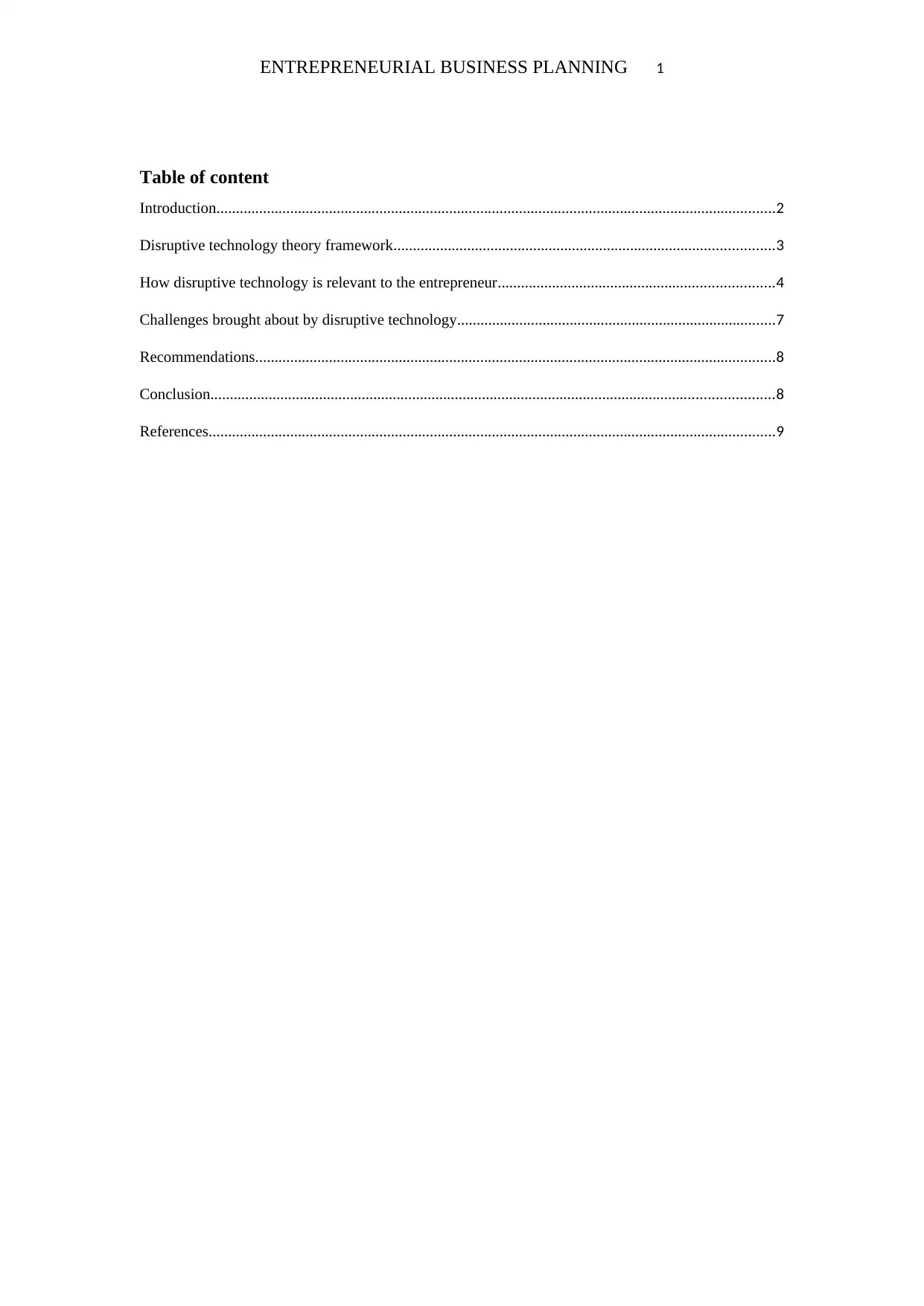
Table of content
Introduction................................................................................................................................................2
Disruptive technology theory framework..................................................................................................3
How disruptive technology is relevant to the entrepreneur.......................................................................4
Challenges brought about by disruptive technology..................................................................................7
Recommendations......................................................................................................................................8
Conclusion.................................................................................................................................................8
References..................................................................................................................................................9
Table of content
Introduction................................................................................................................................................2
Disruptive technology theory framework..................................................................................................3
How disruptive technology is relevant to the entrepreneur.......................................................................4
Challenges brought about by disruptive technology..................................................................................7
Recommendations......................................................................................................................................8
Conclusion.................................................................................................................................................8
References..................................................................................................................................................9
⊘ This is a preview!⊘
Do you want full access?
Subscribe today to unlock all pages.

Trusted by 1+ million students worldwide
Introduction
Disruptive technology is one of the most relevant contemporary issues for
entrepreneurs in the 21st century. According to the Cambridge English direction,
disruption can be defined as an interruption in the usual way that a system, process or
event works. A disruptive technology can be defined as innovation or technology that
has a significant impact on the surrounding business environment (Kim, 2010).
Disruptive technology alters ways in which business and processes are carried out
globally. Christensen,(2009) describes disruptive technology as the type of innovation
that brings about a great change in the way things are done and therefore rendering
the previous technology or method of doing something obsolete. The objective of this
paper is to define the theory of disruptive technology or digital disruption. In addition
to this, the report links the theory of digital disruption to real life situation and how
disruptive technology has impacted on entrepreneurship. The paper analyzes the
challenges that an entrepreneur faces in relation to disruptive technology.
Justification of the topic
Since the innovation of the computer, the world has seen a rapid rise in
technological innovations. These innovations in technology have resulted in life
becoming easier for human beings and other tremendous benefits have come with
these innovations(Boccardi, Heath Jr Lozano, Marzetta,and Popovski, 2013).
Disruptive technology has had a huge impact on entrepreneurs especially at the
beginning and growth stage of the business. Diruptive technology has forced business
to change their business models. This is because, disruptive technology has brought a
big change in the way businesses operates. It has therefore become a must for
businesses to adapt and develop business models which integrates innovation. For
example, as an entrepreneur in the supermarket retail business, I cannot continue
operating using the same model I used where there was non online retailers.Disruptive
technology has also resulted to many businesses close down because the technology
they had been using became obsolete. In light of the many challenges associated with
disruptive technology, it is therefore critical to evaluate and establish the various
challenges that entrepreneurs face as a result of disruptive technology. This paper
Disruptive technology is one of the most relevant contemporary issues for
entrepreneurs in the 21st century. According to the Cambridge English direction,
disruption can be defined as an interruption in the usual way that a system, process or
event works. A disruptive technology can be defined as innovation or technology that
has a significant impact on the surrounding business environment (Kim, 2010).
Disruptive technology alters ways in which business and processes are carried out
globally. Christensen,(2009) describes disruptive technology as the type of innovation
that brings about a great change in the way things are done and therefore rendering
the previous technology or method of doing something obsolete. The objective of this
paper is to define the theory of disruptive technology or digital disruption. In addition
to this, the report links the theory of digital disruption to real life situation and how
disruptive technology has impacted on entrepreneurship. The paper analyzes the
challenges that an entrepreneur faces in relation to disruptive technology.
Justification of the topic
Since the innovation of the computer, the world has seen a rapid rise in
technological innovations. These innovations in technology have resulted in life
becoming easier for human beings and other tremendous benefits have come with
these innovations(Boccardi, Heath Jr Lozano, Marzetta,and Popovski, 2013).
Disruptive technology has had a huge impact on entrepreneurs especially at the
beginning and growth stage of the business. Diruptive technology has forced business
to change their business models. This is because, disruptive technology has brought a
big change in the way businesses operates. It has therefore become a must for
businesses to adapt and develop business models which integrates innovation. For
example, as an entrepreneur in the supermarket retail business, I cannot continue
operating using the same model I used where there was non online retailers.Disruptive
technology has also resulted to many businesses close down because the technology
they had been using became obsolete. In light of the many challenges associated with
disruptive technology, it is therefore critical to evaluate and establish the various
challenges that entrepreneurs face as a result of disruptive technology. This paper
Paraphrase This Document
Need a fresh take? Get an instant paraphrase of this document with our AI Paraphraser
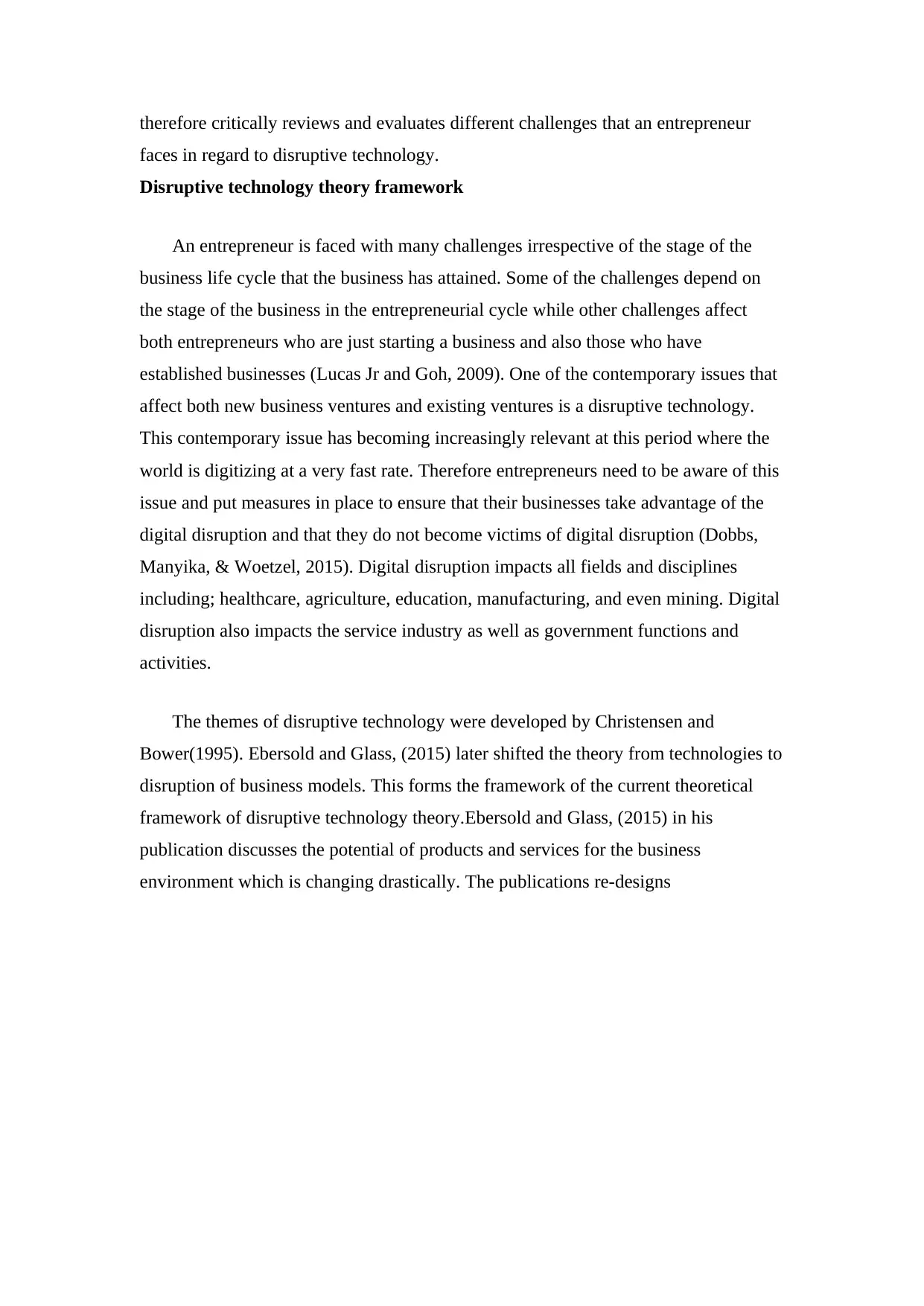
therefore critically reviews and evaluates different challenges that an entrepreneur
faces in regard to disruptive technology.
Disruptive technology theory framework
An entrepreneur is faced with many challenges irrespective of the stage of the
business life cycle that the business has attained. Some of the challenges depend on
the stage of the business in the entrepreneurial cycle while other challenges affect
both entrepreneurs who are just starting a business and also those who have
established businesses (Lucas Jr and Goh, 2009). One of the contemporary issues that
affect both new business ventures and existing ventures is a disruptive technology.
This contemporary issue has becoming increasingly relevant at this period where the
world is digitizing at a very fast rate. Therefore entrepreneurs need to be aware of this
issue and put measures in place to ensure that their businesses take advantage of the
digital disruption and that they do not become victims of digital disruption (Dobbs,
Manyika, & Woetzel, 2015). Digital disruption impacts all fields and disciplines
including; healthcare, agriculture, education, manufacturing, and even mining. Digital
disruption also impacts the service industry as well as government functions and
activities.
The themes of disruptive technology were developed by Christensen and
Bower(1995). Ebersold and Glass, (2015) later shifted the theory from technologies to
disruption of business models. This forms the framework of the current theoretical
framework of disruptive technology theory.Ebersold and Glass, (2015) in his
publication discusses the potential of products and services for the business
environment which is changing drastically. The publications re-designs
faces in regard to disruptive technology.
Disruptive technology theory framework
An entrepreneur is faced with many challenges irrespective of the stage of the
business life cycle that the business has attained. Some of the challenges depend on
the stage of the business in the entrepreneurial cycle while other challenges affect
both entrepreneurs who are just starting a business and also those who have
established businesses (Lucas Jr and Goh, 2009). One of the contemporary issues that
affect both new business ventures and existing ventures is a disruptive technology.
This contemporary issue has becoming increasingly relevant at this period where the
world is digitizing at a very fast rate. Therefore entrepreneurs need to be aware of this
issue and put measures in place to ensure that their businesses take advantage of the
digital disruption and that they do not become victims of digital disruption (Dobbs,
Manyika, & Woetzel, 2015). Digital disruption impacts all fields and disciplines
including; healthcare, agriculture, education, manufacturing, and even mining. Digital
disruption also impacts the service industry as well as government functions and
activities.
The themes of disruptive technology were developed by Christensen and
Bower(1995). Ebersold and Glass, (2015) later shifted the theory from technologies to
disruption of business models. This forms the framework of the current theoretical
framework of disruptive technology theory.Ebersold and Glass, (2015) in his
publication discusses the potential of products and services for the business
environment which is changing drastically. The publications re-designs
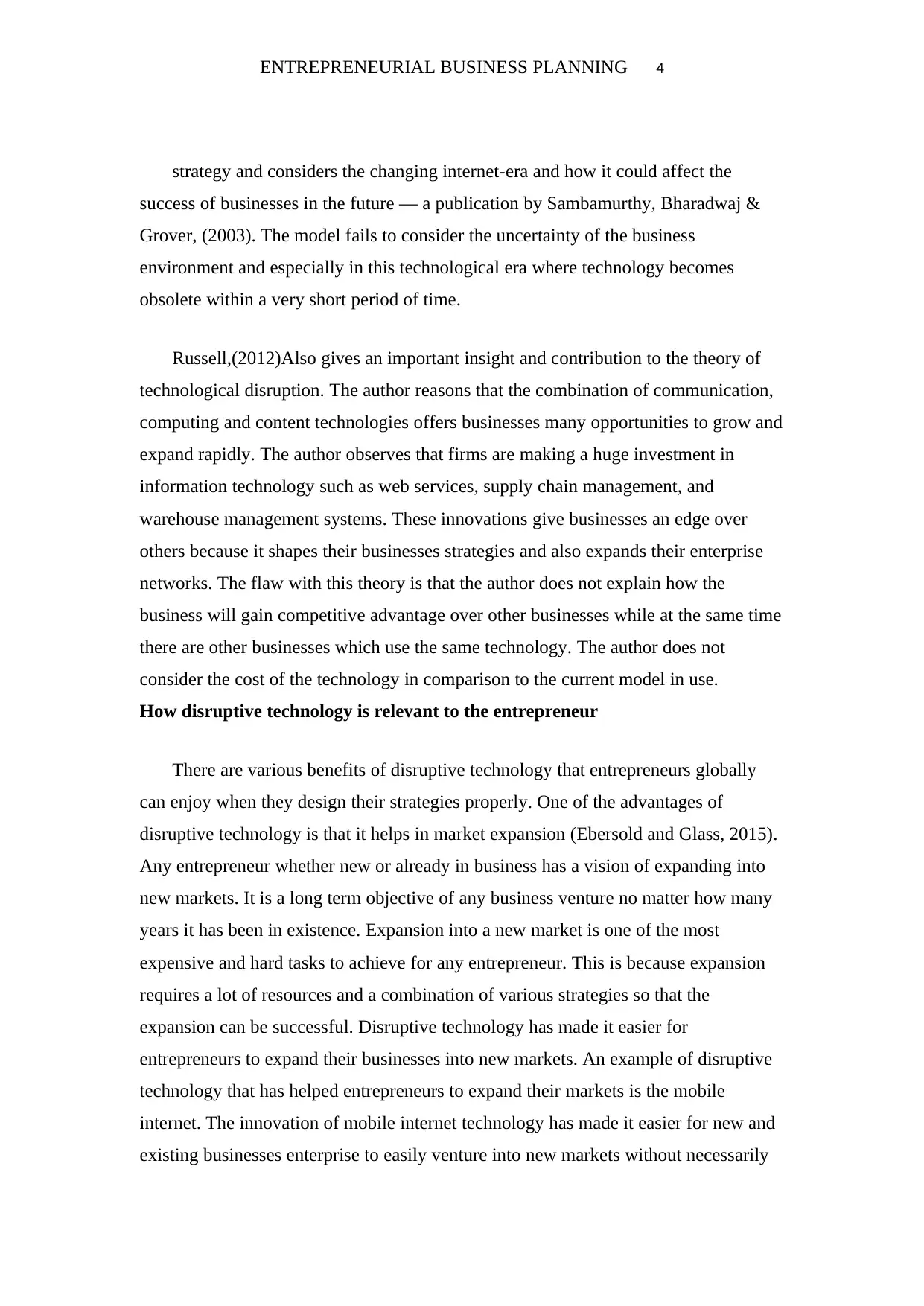
ENTREPRENEURIAL BUSINESS PLANNING 4
strategy and considers the changing internet-era and how it could affect the
success of businesses in the future — a publication by Sambamurthy, Bharadwaj &
Grover, (2003). The model fails to consider the uncertainty of the business
environment and especially in this technological era where technology becomes
obsolete within a very short period of time.
Russell,(2012)Also gives an important insight and contribution to the theory of
technological disruption. The author reasons that the combination of communication,
computing and content technologies offers businesses many opportunities to grow and
expand rapidly. The author observes that firms are making a huge investment in
information technology such as web services, supply chain management, and
warehouse management systems. These innovations give businesses an edge over
others because it shapes their businesses strategies and also expands their enterprise
networks. The flaw with this theory is that the author does not explain how the
business will gain competitive advantage over other businesses while at the same time
there are other businesses which use the same technology. The author does not
consider the cost of the technology in comparison to the current model in use.
How disruptive technology is relevant to the entrepreneur
There are various benefits of disruptive technology that entrepreneurs globally
can enjoy when they design their strategies properly. One of the advantages of
disruptive technology is that it helps in market expansion (Ebersold and Glass, 2015).
Any entrepreneur whether new or already in business has a vision of expanding into
new markets. It is a long term objective of any business venture no matter how many
years it has been in existence. Expansion into a new market is one of the most
expensive and hard tasks to achieve for any entrepreneur. This is because expansion
requires a lot of resources and a combination of various strategies so that the
expansion can be successful. Disruptive technology has made it easier for
entrepreneurs to expand their businesses into new markets. An example of disruptive
technology that has helped entrepreneurs to expand their markets is the mobile
internet. The innovation of mobile internet technology has made it easier for new and
existing businesses enterprise to easily venture into new markets without necessarily
strategy and considers the changing internet-era and how it could affect the
success of businesses in the future — a publication by Sambamurthy, Bharadwaj &
Grover, (2003). The model fails to consider the uncertainty of the business
environment and especially in this technological era where technology becomes
obsolete within a very short period of time.
Russell,(2012)Also gives an important insight and contribution to the theory of
technological disruption. The author reasons that the combination of communication,
computing and content technologies offers businesses many opportunities to grow and
expand rapidly. The author observes that firms are making a huge investment in
information technology such as web services, supply chain management, and
warehouse management systems. These innovations give businesses an edge over
others because it shapes their businesses strategies and also expands their enterprise
networks. The flaw with this theory is that the author does not explain how the
business will gain competitive advantage over other businesses while at the same time
there are other businesses which use the same technology. The author does not
consider the cost of the technology in comparison to the current model in use.
How disruptive technology is relevant to the entrepreneur
There are various benefits of disruptive technology that entrepreneurs globally
can enjoy when they design their strategies properly. One of the advantages of
disruptive technology is that it helps in market expansion (Ebersold and Glass, 2015).
Any entrepreneur whether new or already in business has a vision of expanding into
new markets. It is a long term objective of any business venture no matter how many
years it has been in existence. Expansion into a new market is one of the most
expensive and hard tasks to achieve for any entrepreneur. This is because expansion
requires a lot of resources and a combination of various strategies so that the
expansion can be successful. Disruptive technology has made it easier for
entrepreneurs to expand their businesses into new markets. An example of disruptive
technology that has helped entrepreneurs to expand their markets is the mobile
internet. The innovation of mobile internet technology has made it easier for new and
existing businesses enterprise to easily venture into new markets without necessarily
⊘ This is a preview!⊘
Do you want full access?
Subscribe today to unlock all pages.
Trusted by 1+ million students worldwide
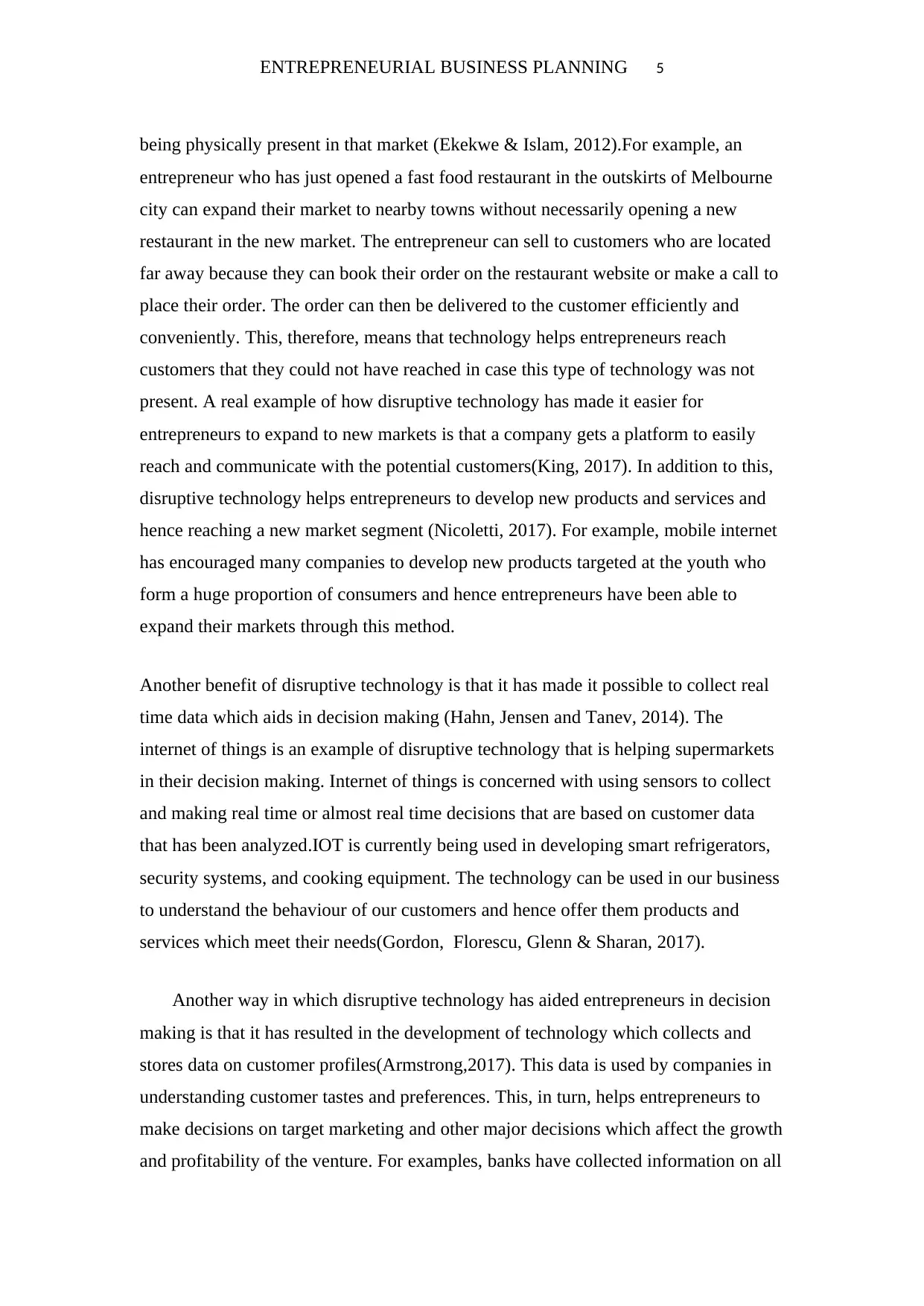
ENTREPRENEURIAL BUSINESS PLANNING 5
being physically present in that market (Ekekwe & Islam, 2012).For example, an
entrepreneur who has just opened a fast food restaurant in the outskirts of Melbourne
city can expand their market to nearby towns without necessarily opening a new
restaurant in the new market. The entrepreneur can sell to customers who are located
far away because they can book their order on the restaurant website or make a call to
place their order. The order can then be delivered to the customer efficiently and
conveniently. This, therefore, means that technology helps entrepreneurs reach
customers that they could not have reached in case this type of technology was not
present. A real example of how disruptive technology has made it easier for
entrepreneurs to expand to new markets is that a company gets a platform to easily
reach and communicate with the potential customers(King, 2017). In addition to this,
disruptive technology helps entrepreneurs to develop new products and services and
hence reaching a new market segment (Nicoletti, 2017). For example, mobile internet
has encouraged many companies to develop new products targeted at the youth who
form a huge proportion of consumers and hence entrepreneurs have been able to
expand their markets through this method.
Another benefit of disruptive technology is that it has made it possible to collect real
time data which aids in decision making (Hahn, Jensen and Tanev, 2014). The
internet of things is an example of disruptive technology that is helping supermarkets
in their decision making. Internet of things is concerned with using sensors to collect
and making real time or almost real time decisions that are based on customer data
that has been analyzed.IOT is currently being used in developing smart refrigerators,
security systems, and cooking equipment. The technology can be used in our business
to understand the behaviour of our customers and hence offer them products and
services which meet their needs(Gordon, Florescu, Glenn & Sharan, 2017).
Another way in which disruptive technology has aided entrepreneurs in decision
making is that it has resulted in the development of technology which collects and
stores data on customer profiles(Armstrong,2017). This data is used by companies in
understanding customer tastes and preferences. This, in turn, helps entrepreneurs to
make decisions on target marketing and other major decisions which affect the growth
and profitability of the venture. For examples, banks have collected information on all
being physically present in that market (Ekekwe & Islam, 2012).For example, an
entrepreneur who has just opened a fast food restaurant in the outskirts of Melbourne
city can expand their market to nearby towns without necessarily opening a new
restaurant in the new market. The entrepreneur can sell to customers who are located
far away because they can book their order on the restaurant website or make a call to
place their order. The order can then be delivered to the customer efficiently and
conveniently. This, therefore, means that technology helps entrepreneurs reach
customers that they could not have reached in case this type of technology was not
present. A real example of how disruptive technology has made it easier for
entrepreneurs to expand to new markets is that a company gets a platform to easily
reach and communicate with the potential customers(King, 2017). In addition to this,
disruptive technology helps entrepreneurs to develop new products and services and
hence reaching a new market segment (Nicoletti, 2017). For example, mobile internet
has encouraged many companies to develop new products targeted at the youth who
form a huge proportion of consumers and hence entrepreneurs have been able to
expand their markets through this method.
Another benefit of disruptive technology is that it has made it possible to collect real
time data which aids in decision making (Hahn, Jensen and Tanev, 2014). The
internet of things is an example of disruptive technology that is helping supermarkets
in their decision making. Internet of things is concerned with using sensors to collect
and making real time or almost real time decisions that are based on customer data
that has been analyzed.IOT is currently being used in developing smart refrigerators,
security systems, and cooking equipment. The technology can be used in our business
to understand the behaviour of our customers and hence offer them products and
services which meet their needs(Gordon, Florescu, Glenn & Sharan, 2017).
Another way in which disruptive technology has aided entrepreneurs in decision
making is that it has resulted in the development of technology which collects and
stores data on customer profiles(Armstrong,2017). This data is used by companies in
understanding customer tastes and preferences. This, in turn, helps entrepreneurs to
make decisions on target marketing and other major decisions which affect the growth
and profitability of the venture. For examples, banks have collected information on all
Paraphrase This Document
Need a fresh take? Get an instant paraphrase of this document with our AI Paraphraser
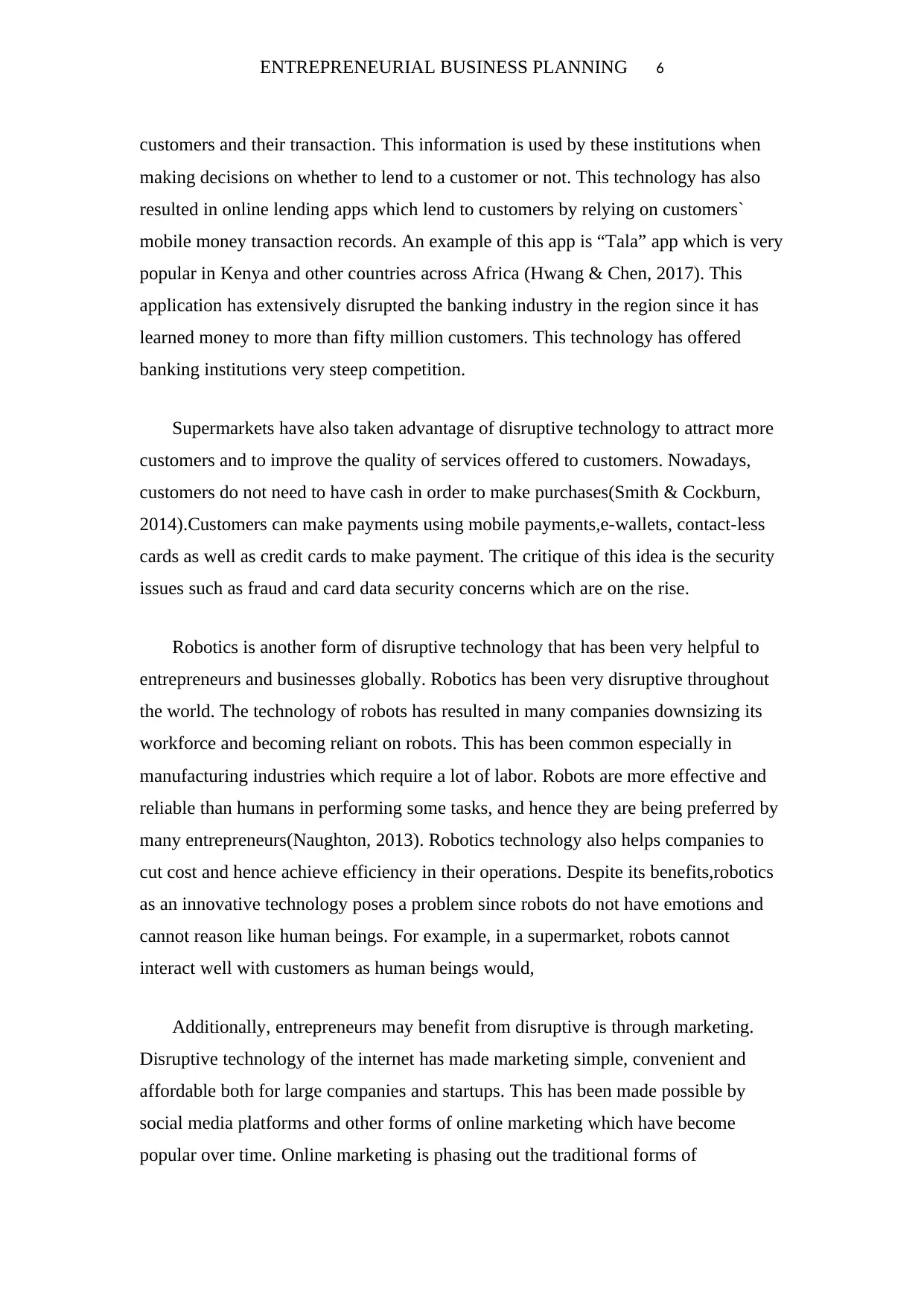
ENTREPRENEURIAL BUSINESS PLANNING 6
customers and their transaction. This information is used by these institutions when
making decisions on whether to lend to a customer or not. This technology has also
resulted in online lending apps which lend to customers by relying on customers`
mobile money transaction records. An example of this app is “Tala” app which is very
popular in Kenya and other countries across Africa (Hwang & Chen, 2017). This
application has extensively disrupted the banking industry in the region since it has
learned money to more than fifty million customers. This technology has offered
banking institutions very steep competition.
Supermarkets have also taken advantage of disruptive technology to attract more
customers and to improve the quality of services offered to customers. Nowadays,
customers do not need to have cash in order to make purchases(Smith & Cockburn,
2014).Customers can make payments using mobile payments,e-wallets, contact-less
cards as well as credit cards to make payment. The critique of this idea is the security
issues such as fraud and card data security concerns which are on the rise.
Robotics is another form of disruptive technology that has been very helpful to
entrepreneurs and businesses globally. Robotics has been very disruptive throughout
the world. The technology of robots has resulted in many companies downsizing its
workforce and becoming reliant on robots. This has been common especially in
manufacturing industries which require a lot of labor. Robots are more effective and
reliable than humans in performing some tasks, and hence they are being preferred by
many entrepreneurs(Naughton, 2013). Robotics technology also helps companies to
cut cost and hence achieve efficiency in their operations. Despite its benefits,robotics
as an innovative technology poses a problem since robots do not have emotions and
cannot reason like human beings. For example, in a supermarket, robots cannot
interact well with customers as human beings would,
Additionally, entrepreneurs may benefit from disruptive is through marketing.
Disruptive technology of the internet has made marketing simple, convenient and
affordable both for large companies and startups. This has been made possible by
social media platforms and other forms of online marketing which have become
popular over time. Online marketing is phasing out the traditional forms of
customers and their transaction. This information is used by these institutions when
making decisions on whether to lend to a customer or not. This technology has also
resulted in online lending apps which lend to customers by relying on customers`
mobile money transaction records. An example of this app is “Tala” app which is very
popular in Kenya and other countries across Africa (Hwang & Chen, 2017). This
application has extensively disrupted the banking industry in the region since it has
learned money to more than fifty million customers. This technology has offered
banking institutions very steep competition.
Supermarkets have also taken advantage of disruptive technology to attract more
customers and to improve the quality of services offered to customers. Nowadays,
customers do not need to have cash in order to make purchases(Smith & Cockburn,
2014).Customers can make payments using mobile payments,e-wallets, contact-less
cards as well as credit cards to make payment. The critique of this idea is the security
issues such as fraud and card data security concerns which are on the rise.
Robotics is another form of disruptive technology that has been very helpful to
entrepreneurs and businesses globally. Robotics has been very disruptive throughout
the world. The technology of robots has resulted in many companies downsizing its
workforce and becoming reliant on robots. This has been common especially in
manufacturing industries which require a lot of labor. Robots are more effective and
reliable than humans in performing some tasks, and hence they are being preferred by
many entrepreneurs(Naughton, 2013). Robotics technology also helps companies to
cut cost and hence achieve efficiency in their operations. Despite its benefits,robotics
as an innovative technology poses a problem since robots do not have emotions and
cannot reason like human beings. For example, in a supermarket, robots cannot
interact well with customers as human beings would,
Additionally, entrepreneurs may benefit from disruptive is through marketing.
Disruptive technology of the internet has made marketing simple, convenient and
affordable both for large companies and startups. This has been made possible by
social media platforms and other forms of online marketing which have become
popular over time. Online marketing is phasing out the traditional forms of
ENTREPRENEURIAL BUSINESS PLANNING 7
advertising at a very high pace. Advertising through the internet has disrupted
marketing since it has the potential to reach more people within a short period and it is
easy to target a particular market segment (Naughton, 2013). For example companies
such as Amazon and Alibaba have disrupted the retail industry to a very large extent.
The companies can easily market and sell their products online at very little cost.
Entrepreneurs, therefore, have a great opportunity to market their products and
services through the internet and hence grow and achieve their goals.
Challenges brought about by disruptive technology
Despite the many advantages of disruptive technology that have been highlighted
above. Disruptive technology has brought about various negative outcomes which
have affected various companies negatively. As an entrepreneur in supermarket retail,
disruptive technology has brought about many challenges. One of the challenges that
E-commerce will bring to my business is that it may bring increased competition to
my thriving business. E-Commerce has become increasingly popular over the past
decade. Most customers prefer to buy their items online. With the establishment of
online retail stores, competition has become stiffer for retailers and it has resulted to
decline in revenues and profits. Online retail has become popular because it offers
customers convenience in terms of payment for the goods(Burbank, 2013). Customers
can also have their items delivered to their doorstep at a very low cost . The
technology is therefore a challenge for my business because it has brought
competition which have led to decrease in revenue.
Another way in which disruptive technology may affect entrepreneurs negatively is
that it leads to some technology becoming obsolete and hence resulting to the collapse
of some businesses (Armstrong, 2017). For example, I may invest in expensive
imaging technology in my store. After some two years, another more efficient
technology may arise even before recouping the amount I had invested in the previous
technology.This means that the business will have suffered a huge loss due to the new
technology. Due to the changing trends as well as customer tastes and preferences, I
may also be forced to purchase the new imaging technology. Failure to do this may
advertising at a very high pace. Advertising through the internet has disrupted
marketing since it has the potential to reach more people within a short period and it is
easy to target a particular market segment (Naughton, 2013). For example companies
such as Amazon and Alibaba have disrupted the retail industry to a very large extent.
The companies can easily market and sell their products online at very little cost.
Entrepreneurs, therefore, have a great opportunity to market their products and
services through the internet and hence grow and achieve their goals.
Challenges brought about by disruptive technology
Despite the many advantages of disruptive technology that have been highlighted
above. Disruptive technology has brought about various negative outcomes which
have affected various companies negatively. As an entrepreneur in supermarket retail,
disruptive technology has brought about many challenges. One of the challenges that
E-commerce will bring to my business is that it may bring increased competition to
my thriving business. E-Commerce has become increasingly popular over the past
decade. Most customers prefer to buy their items online. With the establishment of
online retail stores, competition has become stiffer for retailers and it has resulted to
decline in revenues and profits. Online retail has become popular because it offers
customers convenience in terms of payment for the goods(Burbank, 2013). Customers
can also have their items delivered to their doorstep at a very low cost . The
technology is therefore a challenge for my business because it has brought
competition which have led to decrease in revenue.
Another way in which disruptive technology may affect entrepreneurs negatively is
that it leads to some technology becoming obsolete and hence resulting to the collapse
of some businesses (Armstrong, 2017). For example, I may invest in expensive
imaging technology in my store. After some two years, another more efficient
technology may arise even before recouping the amount I had invested in the previous
technology.This means that the business will have suffered a huge loss due to the new
technology. Due to the changing trends as well as customer tastes and preferences, I
may also be forced to purchase the new imaging technology. Failure to do this may
⊘ This is a preview!⊘
Do you want full access?
Subscribe today to unlock all pages.
Trusted by 1+ million students worldwide
ENTREPRENEURIAL BUSINESS PLANNING 8
lead to loss of business due to stiff competition.An example of a company whose
failure can be attributed to disruptive technology is Kodak. Kodak was a high flying
photo industry company in the 1980s and 1990s until technological innovations made
the products of the company obsolete (Noam & Steinbock, 2013). Failure by the
management of the company to focus on digital cameras led to the decline of the
company. Another example of a company whose decline can be attributed to
disruptive technology is a Nokia mobile.
From a human resource point of view, disruptive technology may result to many
employees who work at the supermarket to lose their jobs. For example, the
innovative technology of automated payment and checkout system will result to
redundancy. The technology will enable customers to pick items, pay and leave the
store without being attended by anybody. This will bring operational challenges to the
business because, it will bring issues of shoplifting and customers not paying the right
amounts for an item. The technology may also lead to loss of personal appeal that
supermarket attendants have on the customers and hence reduce the level of customer
satisfaction.
Recommendations
Entrepreneurs need to be innovators or first movers to reap the benefits of disruptive
technology.
Entrepreneurs need to build their strategies around technology to avoid the negative
repercussions of disruptive technology for businesses that are caught unaware.
Conclusion
The theory of disruptive technology describes and explains how new
technological innovation may affect businesses either positively or negatively.
Disruptive technology results in unexpected changes in processes or businesses
models and results in the previous technology becoming obsolete. This report
discusses the literature review of disruptive technology and compares the arguments
of different researchers who have written on this subject. Clayton Christen is the main
who came up with the theory of disruptive technology in 1997. The theory has been
developed since then with many writers contributing to this theory. However, more
lead to loss of business due to stiff competition.An example of a company whose
failure can be attributed to disruptive technology is Kodak. Kodak was a high flying
photo industry company in the 1980s and 1990s until technological innovations made
the products of the company obsolete (Noam & Steinbock, 2013). Failure by the
management of the company to focus on digital cameras led to the decline of the
company. Another example of a company whose decline can be attributed to
disruptive technology is a Nokia mobile.
From a human resource point of view, disruptive technology may result to many
employees who work at the supermarket to lose their jobs. For example, the
innovative technology of automated payment and checkout system will result to
redundancy. The technology will enable customers to pick items, pay and leave the
store without being attended by anybody. This will bring operational challenges to the
business because, it will bring issues of shoplifting and customers not paying the right
amounts for an item. The technology may also lead to loss of personal appeal that
supermarket attendants have on the customers and hence reduce the level of customer
satisfaction.
Recommendations
Entrepreneurs need to be innovators or first movers to reap the benefits of disruptive
technology.
Entrepreneurs need to build their strategies around technology to avoid the negative
repercussions of disruptive technology for businesses that are caught unaware.
Conclusion
The theory of disruptive technology describes and explains how new
technological innovation may affect businesses either positively or negatively.
Disruptive technology results in unexpected changes in processes or businesses
models and results in the previous technology becoming obsolete. This report
discusses the literature review of disruptive technology and compares the arguments
of different researchers who have written on this subject. Clayton Christen is the main
who came up with the theory of disruptive technology in 1997. The theory has been
developed since then with many writers contributing to this theory. However, more
Paraphrase This Document
Need a fresh take? Get an instant paraphrase of this document with our AI Paraphraser
ENTREPRENEURIAL BUSINESS PLANNING 9
researcher needs to be conducted since it is a relatively new contemporary issue in
business. The report also discusses the positive and negative impact of technology
disruption on entrepreneurs. Recommendations on how entrepreneurs should deal
with disruptive technology are also discussed in this paper.
References
Armstrong, P. (2017). Disruptive technologies: Understand, evaluate, respond.
Boccardi, F., Heath Jr, R.W., Lozano, A., Marzetta, T.L. and Popovski, P., 2013. Five
disruptive technology directions for 5G. arXiv preprint arXiv:1312.0229.
Burbank, J. L. (2013). Wireless networking: Understanding internetworking
challenges. Hoboken, NJ: John Wiley.
Dobbs, R., Manyika, J., & Woetzel, J. R. (2015). No ordinary disruption: The four
global forces breaking all the trends.
Ekekwe, N., & Islam, N. (2012). Disruptive technologies, innovation, and global
redesign: Emerging implications. Hershey, PA: Information Science Reference.
Ebersold, K. and Glass, R., 2015. The impact of disruptive technology: the internet of
things. Issues in Information Systems, 16(4).
Hahn, F., Jensen, S. and Tanev, S. (2014). Disruptive Innovation vs. Disruptive
researcher needs to be conducted since it is a relatively new contemporary issue in
business. The report also discusses the positive and negative impact of technology
disruption on entrepreneurs. Recommendations on how entrepreneurs should deal
with disruptive technology are also discussed in this paper.
References
Armstrong, P. (2017). Disruptive technologies: Understand, evaluate, respond.
Boccardi, F., Heath Jr, R.W., Lozano, A., Marzetta, T.L. and Popovski, P., 2013. Five
disruptive technology directions for 5G. arXiv preprint arXiv:1312.0229.
Burbank, J. L. (2013). Wireless networking: Understanding internetworking
challenges. Hoboken, NJ: John Wiley.
Dobbs, R., Manyika, J., & Woetzel, J. R. (2015). No ordinary disruption: The four
global forces breaking all the trends.
Ekekwe, N., & Islam, N. (2012). Disruptive technologies, innovation, and global
redesign: Emerging implications. Hershey, PA: Information Science Reference.
Ebersold, K. and Glass, R., 2015. The impact of disruptive technology: the internet of
things. Issues in Information Systems, 16(4).
Hahn, F., Jensen, S. and Tanev, S. (2014). Disruptive Innovation vs. Disruptive
ENTREPRENEURIAL BUSINESS PLANNING 10
Technology: The Disruptive Potential of the Value Propositions of 3D
PrintingTechnology Startups. Technology Innovation Management Review, 4(12),
pp.27-36.
Hwang, K., & Chen, M. (2017). Big-data analytics for a cloud, IoT and cognitive
computing.
Kim, T. (2010). Future generation information technology. Berlin: Springer
King, A. (2017). The Theory of Disruptive Innovation: Science or Allegory?.
Entrepreneur and Innovation Exchange.Boston:Springer
Lucas Jr, H.C. and Goh, J.M., 2009. Disruptive technology: How Kodak missed the
digital photography revolution. The Journal of Strategic Information Systems, 18(1),
pp.46-55.
Naughton, J. (2013). From Gutenberg to Zuckerberg: What you need to know about
the Internet. London: Quercus.
Gordon, T. J., Florescu, E., Glenn, J. C., & Sharan, Y. (2017). Identification of
potential terrorists and adversary planning: Emerging technologies and new counter-
terror strategies.London; Penguin publishers
Nicoletti, B. (2017). The Future of FinTech. Cham: Springer International Publishing.
Noam, E. M., & Steinbock, D. (2013). Competition for the Mobile Internet. Boston,
MA: Springer US.
Russell, A. (2012). Embracing Debate to Promote Disruptive Science and
Technology. Disruptive Science and Technology, 1(2), pp.63-64.
Smith, P. A. C., & Cockburn, T. (2014). Impact of emerging digital technologies on
leadership in global business.
Technology: The Disruptive Potential of the Value Propositions of 3D
PrintingTechnology Startups. Technology Innovation Management Review, 4(12),
pp.27-36.
Hwang, K., & Chen, M. (2017). Big-data analytics for a cloud, IoT and cognitive
computing.
Kim, T. (2010). Future generation information technology. Berlin: Springer
King, A. (2017). The Theory of Disruptive Innovation: Science or Allegory?.
Entrepreneur and Innovation Exchange.Boston:Springer
Lucas Jr, H.C. and Goh, J.M., 2009. Disruptive technology: How Kodak missed the
digital photography revolution. The Journal of Strategic Information Systems, 18(1),
pp.46-55.
Naughton, J. (2013). From Gutenberg to Zuckerberg: What you need to know about
the Internet. London: Quercus.
Gordon, T. J., Florescu, E., Glenn, J. C., & Sharan, Y. (2017). Identification of
potential terrorists and adversary planning: Emerging technologies and new counter-
terror strategies.London; Penguin publishers
Nicoletti, B. (2017). The Future of FinTech. Cham: Springer International Publishing.
Noam, E. M., & Steinbock, D. (2013). Competition for the Mobile Internet. Boston,
MA: Springer US.
Russell, A. (2012). Embracing Debate to Promote Disruptive Science and
Technology. Disruptive Science and Technology, 1(2), pp.63-64.
Smith, P. A. C., & Cockburn, T. (2014). Impact of emerging digital technologies on
leadership in global business.
⊘ This is a preview!⊘
Do you want full access?
Subscribe today to unlock all pages.
Trusted by 1+ million students worldwide

1 out of 12


Related Documents


Your All-in-One AI-Powered Toolkit for Academic Success.
+13062052269
info@desklib.com
Available 24*7 on WhatsApp / Email
![[object Object]](/_next/static/media/star-bottom.7253800d.svg)
Unlock your academic potential
Copyright © 2020–2026 A2Z Services. All Rights Reserved. Developed and managed by ZUCOL.