Impact of Organizational Stress on Employee Performance in Malaysia
VerifiedAdded on 2021/02/20
|38
|13355
|36
Thesis and Dissertation
AI Summary
This dissertation explores the impact of organizational stress on employee performance, mediated by employee motivation, within the context of Malaysia. The study investigates the concept of employee performance, identifies factors contributing to organizational stress, and assesses their impact on employee outcomes. The research aims to determine how employee motivation can be used to mitigate stress and improve performance. The dissertation includes a literature review defining key terms like employee performance, satisfaction, and motivation, as well as an evaluation of relevant theories such as Herzberg's two-factor theory. The research methodology chapter outlines the approach, followed by data analysis, discussion, and analysis of findings. The study seeks to answer questions about the concept of employee performance, the factors of organizational stress, and the ways in which stress impacts employee performance. The research is structured to provide insights into how organizations can manage stress, improve employee motivation, and enhance overall performance, including recommendations for stress reduction strategies.

Dissertation

Paraphrase This Document
Need a fresh take? Get an instant paraphrase of this document with our AI Paraphraser
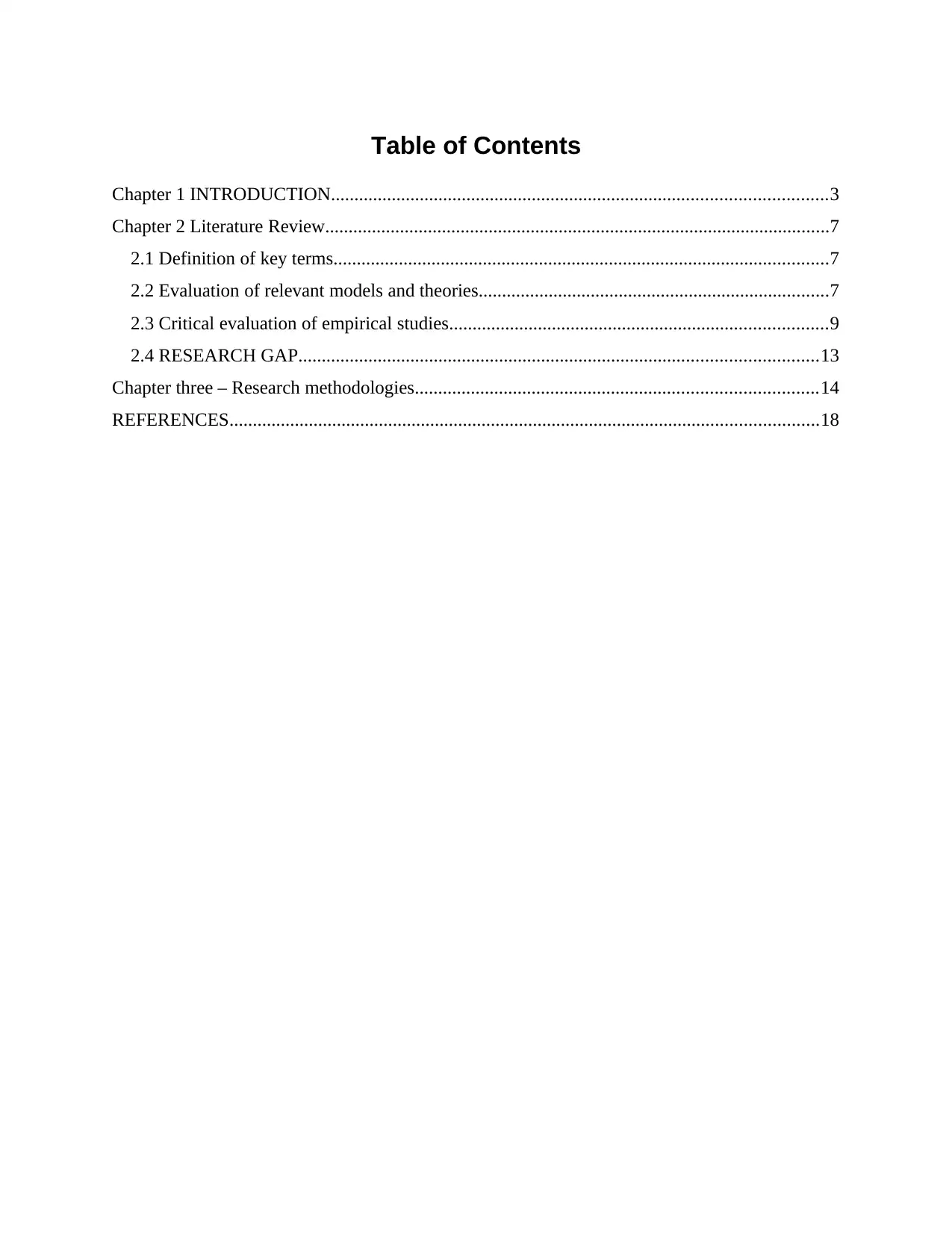
Table of Contents
Chapter 1 INTRODUCTION..........................................................................................................3
Chapter 2 Literature Review............................................................................................................7
2.1 Definition of key terms..........................................................................................................7
2.2 Evaluation of relevant models and theories...........................................................................7
2.3 Critical evaluation of empirical studies.................................................................................9
2.4 RESEARCH GAP...............................................................................................................13
Chapter three – Research methodologies......................................................................................14
REFERENCES..............................................................................................................................18
Chapter 1 INTRODUCTION..........................................................................................................3
Chapter 2 Literature Review............................................................................................................7
2.1 Definition of key terms..........................................................................................................7
2.2 Evaluation of relevant models and theories...........................................................................7
2.3 Critical evaluation of empirical studies.................................................................................9
2.4 RESEARCH GAP...............................................................................................................13
Chapter three – Research methodologies......................................................................................14
REFERENCES..............................................................................................................................18
Chapter 1 INTRODUCTION
Background of study
Employees are lifeline of every organisation. It is because they perform all operations and
activities. So, it is important for business to satisfy their employees and make them work in stress
free environment. By eliminating those factors which lead to developing stress, manager in turn
increases their ability. This enables in improving their productivity and allowing to take proper
decisions. It has been observed that in professional life worker faces a lot of problems which
they have to deal with (Karatepe and Aga, 2016). The problems are directly related to their work
schedule and impact on mental as well as physical health. A company culture is developed by
employees. It allows in maintaining positive culture in firm which leads to increase in overall
work performance. The main task of management is to manage stress so that employee
productivity is not affected. It is because if this occurs than goals are not attained and work
environment gets disturbed.
The definition of stress has changed over past years. It is not covering all other variables
which can are related to personal life. Now, it included job satisfaction, salary, etc. and other
things. These all have an adverse affect on individuals life. In such a dynamic business culture it
has become difficult for mangers to manage stress and eliminate all other variables. They have to
focus on motivating staff in order to create a stress free working environment.
In recent times there has been a high impact of organisational stress on employee
performance. This is because of change in dynamics and various other factors such as culture,
political factors, etc. It has become important for organisation to manage stress among employee
so that their productivity is not affected (Park, Song and Lim, 2016). Alongside it, career
development, family pressure, workload, etc. are some other factors as well due to which staff
motivation is impacted. For an organisation it is require to manage staff personal as well as
professional life. They have to take into consideration regarding staff management, concerns, etc.
There is a great impact on employee physical, emotional and mental health due to immense work
pressure.
If organisational stress is not managed it can result in generating negative consequences.
There are some other criteria due to which also organisation stress in built up. They are job
satisfaction, growth opportunities, working environment, etc. due to which employee
productivity is affected.
1
Background of study
Employees are lifeline of every organisation. It is because they perform all operations and
activities. So, it is important for business to satisfy their employees and make them work in stress
free environment. By eliminating those factors which lead to developing stress, manager in turn
increases their ability. This enables in improving their productivity and allowing to take proper
decisions. It has been observed that in professional life worker faces a lot of problems which
they have to deal with (Karatepe and Aga, 2016). The problems are directly related to their work
schedule and impact on mental as well as physical health. A company culture is developed by
employees. It allows in maintaining positive culture in firm which leads to increase in overall
work performance. The main task of management is to manage stress so that employee
productivity is not affected. It is because if this occurs than goals are not attained and work
environment gets disturbed.
The definition of stress has changed over past years. It is not covering all other variables
which can are related to personal life. Now, it included job satisfaction, salary, etc. and other
things. These all have an adverse affect on individuals life. In such a dynamic business culture it
has become difficult for mangers to manage stress and eliminate all other variables. They have to
focus on motivating staff in order to create a stress free working environment.
In recent times there has been a high impact of organisational stress on employee
performance. This is because of change in dynamics and various other factors such as culture,
political factors, etc. It has become important for organisation to manage stress among employee
so that their productivity is not affected (Park, Song and Lim, 2016). Alongside it, career
development, family pressure, workload, etc. are some other factors as well due to which staff
motivation is impacted. For an organisation it is require to manage staff personal as well as
professional life. They have to take into consideration regarding staff management, concerns, etc.
There is a great impact on employee physical, emotional and mental health due to immense work
pressure.
If organisational stress is not managed it can result in generating negative consequences.
There are some other criteria due to which also organisation stress in built up. They are job
satisfaction, growth opportunities, working environment, etc. due to which employee
productivity is affected.
1
⊘ This is a preview!⊘
Do you want full access?
Subscribe today to unlock all pages.

Trusted by 1+ million students worldwide
Due to immense work load and stress there is rise in employee turnover as well. This is
also a concern for many organisations. There is impact on staff performance which also
influence organisational culture. Moreover, it also frustrate staff mental stability. In stressful
culture staff is not able to work in effective way. There always remain high pressure on the
related to work completion. With this they are not able to manage personal life. In addition it is
observed that there occur rise in conflicts between managers and staff. But there are some other
reasons which become a stress. However, when things are not in control it may result in high
turnover. This becomes difficult for firm to retain staff. In employee a sense of motivation comes
from job satisfaction. So, if there is no job satisfaction it will lead to rise in stress level.
It becomes necessary for business to maintain stress free environment in order to satisfy
employees. This also benefit in allowing them to develop strong relations with co workers.
Research rationale
For a business it is essential to regularly motivate employee so that they are able to work
in effective way. Also, with this their performance is improved and goals are attained in efficient
way. The main element that impact on employee performance is motivation. If they are not
motivated then it lead to affect on their performance. Sometimes, it also happens that there are
some variables which directly impact on their productivity. They are not related to organisation
but personal as well (Jayaweera, 2015). The most common way through which stress can be
mediated is by motivation.
In order to manage stress many business motivate employees. This is because it enables
in boosting their morale and allowing to work freely. Motivation is major source of removing
stress and handling work load in effective way. Other than it, with motivation employee
performance is enhanced. They work in creative manner and with enthusiasm. Moreover, with
this their satisfaction can be gained and providing tips to maintain work life balance. So,
motivation is used to mediate stress.
It is necessary for organisation to understand different aspect of stress on employee
performance so that it can be reduced. The study will explore variables which will impact on
employee performance. It will also describe that how overload of job impact on employee
motivation. Furthermore, it will discuss lack of career development in impact on motivation.
Also, the study will aim at finding out how low salary and wages results in lack of motivation. At
last why lack of decision making power influence employee motivation. So, all these variables
2
also a concern for many organisations. There is impact on staff performance which also
influence organisational culture. Moreover, it also frustrate staff mental stability. In stressful
culture staff is not able to work in effective way. There always remain high pressure on the
related to work completion. With this they are not able to manage personal life. In addition it is
observed that there occur rise in conflicts between managers and staff. But there are some other
reasons which become a stress. However, when things are not in control it may result in high
turnover. This becomes difficult for firm to retain staff. In employee a sense of motivation comes
from job satisfaction. So, if there is no job satisfaction it will lead to rise in stress level.
It becomes necessary for business to maintain stress free environment in order to satisfy
employees. This also benefit in allowing them to develop strong relations with co workers.
Research rationale
For a business it is essential to regularly motivate employee so that they are able to work
in effective way. Also, with this their performance is improved and goals are attained in efficient
way. The main element that impact on employee performance is motivation. If they are not
motivated then it lead to affect on their performance. Sometimes, it also happens that there are
some variables which directly impact on their productivity. They are not related to organisation
but personal as well (Jayaweera, 2015). The most common way through which stress can be
mediated is by motivation.
In order to manage stress many business motivate employees. This is because it enables
in boosting their morale and allowing to work freely. Motivation is major source of removing
stress and handling work load in effective way. Other than it, with motivation employee
performance is enhanced. They work in creative manner and with enthusiasm. Moreover, with
this their satisfaction can be gained and providing tips to maintain work life balance. So,
motivation is used to mediate stress.
It is necessary for organisation to understand different aspect of stress on employee
performance so that it can be reduced. The study will explore variables which will impact on
employee performance. It will also describe that how overload of job impact on employee
motivation. Furthermore, it will discuss lack of career development in impact on motivation.
Also, the study will aim at finding out how low salary and wages results in lack of motivation. At
last why lack of decision making power influence employee motivation. So, all these variables
2
Paraphrase This Document
Need a fresh take? Get an instant paraphrase of this document with our AI Paraphraser
will be discussed in research and how they become reason of impact on employee productivity
and what can be done to mediate it. Alongside, it, in report it will describe about why it is
necessary to manage organisational stress.
Aims and objectives
Aim- To analyse the impact of organisational stress on employee performance mediated by
employee motivation in Malaysia
Objectives
To determine concept of employee performance in organisation
To identify the factors of organisational stress which impact on employee performance
To evaluate impact of organisational stress on employee performance
To recommend how employee motivation can be used as tool to reduce stress.
Research questions
What is the concept of employee performance in organisation?
What are factors of organisational stress which impact on employee performance?
How organisational stress impact on employee performance?
Significance of study
It is primary objective to determine significance of research so that it scope can be fixed.
It reflects the area where outcomes can be used (Sharma and Dhar, 2016). Generally, these types
of studies are utilised in order to find out factors of stress and to what extent it is impacting on
employee productivity. In similar way, the main purpose of study is to determine different
factors of organisational stress. It will also be helpful for other companies to evaluate that how
factors such as salary, growth, etc. impact on employee performance. Beside this, it will be
useful in finding out that how motivation can be used as measure to mediate stress among
employees. Furthermore, the study results can be used by other firms to reduce and eliminate
factors that results in organisational stress. However, there will be change in way of motivation
that leads to improving employee performance.
Thesis structure
It describes the overall structure of project and its different chapters. They are discussed
in a systematic way which makes it easy for user to understand each chapter in a proper manner.
Also, it is easy to evaluate what is included in each chapter.
3
and what can be done to mediate it. Alongside, it, in report it will describe about why it is
necessary to manage organisational stress.
Aims and objectives
Aim- To analyse the impact of organisational stress on employee performance mediated by
employee motivation in Malaysia
Objectives
To determine concept of employee performance in organisation
To identify the factors of organisational stress which impact on employee performance
To evaluate impact of organisational stress on employee performance
To recommend how employee motivation can be used as tool to reduce stress.
Research questions
What is the concept of employee performance in organisation?
What are factors of organisational stress which impact on employee performance?
How organisational stress impact on employee performance?
Significance of study
It is primary objective to determine significance of research so that it scope can be fixed.
It reflects the area where outcomes can be used (Sharma and Dhar, 2016). Generally, these types
of studies are utilised in order to find out factors of stress and to what extent it is impacting on
employee productivity. In similar way, the main purpose of study is to determine different
factors of organisational stress. It will also be helpful for other companies to evaluate that how
factors such as salary, growth, etc. impact on employee performance. Beside this, it will be
useful in finding out that how motivation can be used as measure to mediate stress among
employees. Furthermore, the study results can be used by other firms to reduce and eliminate
factors that results in organisational stress. However, there will be change in way of motivation
that leads to improving employee performance.
Thesis structure
It describes the overall structure of project and its different chapters. They are discussed
in a systematic way which makes it easy for user to understand each chapter in a proper manner.
Also, it is easy to evaluate what is included in each chapter.
3
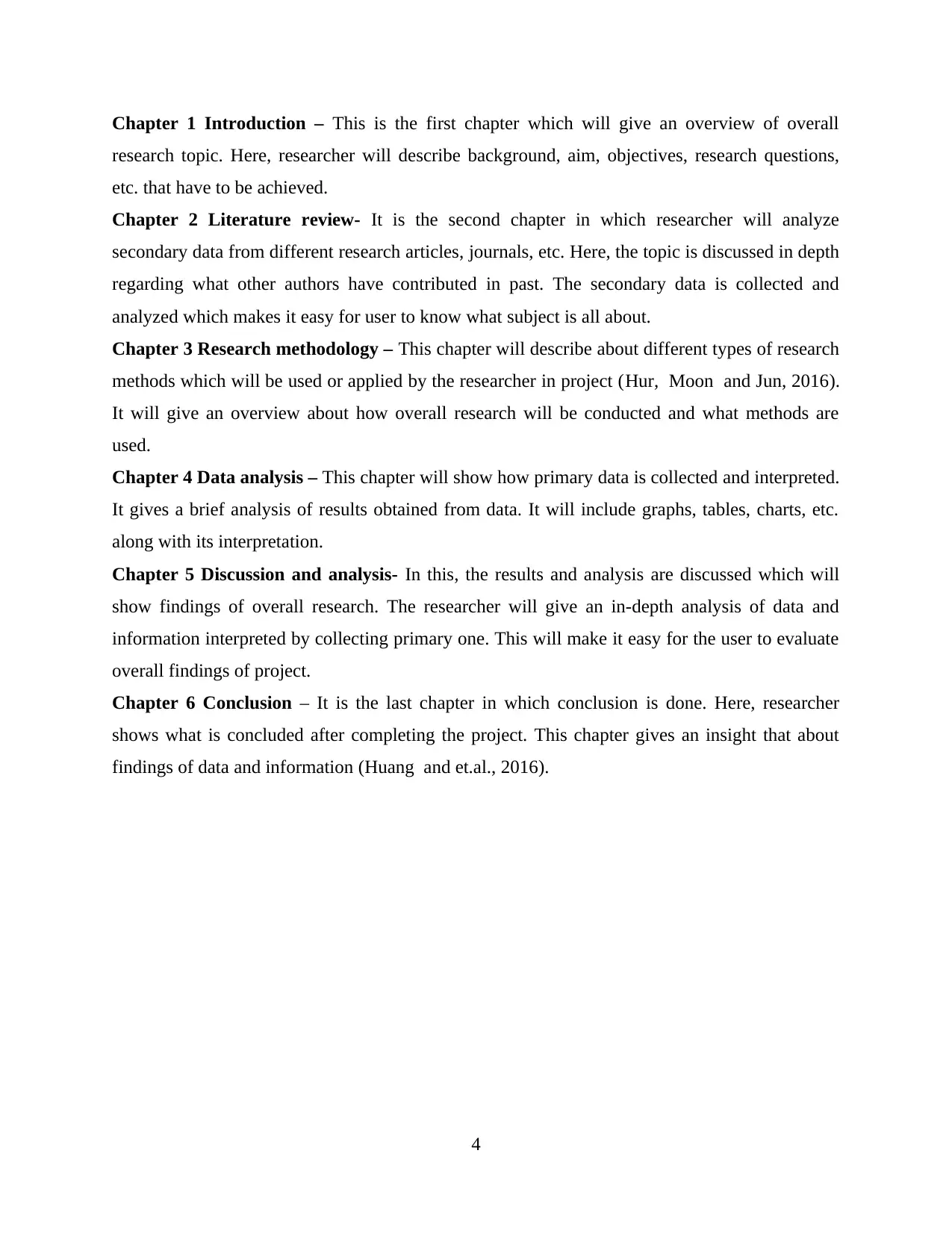
Chapter 1 Introduction – This is the first chapter which will give an overview of overall
research topic. Here, researcher will describe background, aim, objectives, research questions,
etc. that have to be achieved.
Chapter 2 Literature review- It is the second chapter in which researcher will analyze
secondary data from different research articles, journals, etc. Here, the topic is discussed in depth
regarding what other authors have contributed in past. The secondary data is collected and
analyzed which makes it easy for user to know what subject is all about.
Chapter 3 Research methodology – This chapter will describe about different types of research
methods which will be used or applied by the researcher in project (Hur, Moon and Jun, 2016).
It will give an overview about how overall research will be conducted and what methods are
used.
Chapter 4 Data analysis – This chapter will show how primary data is collected and interpreted.
It gives a brief analysis of results obtained from data. It will include graphs, tables, charts, etc.
along with its interpretation.
Chapter 5 Discussion and analysis- In this, the results and analysis are discussed which will
show findings of overall research. The researcher will give an in-depth analysis of data and
information interpreted by collecting primary one. This will make it easy for the user to evaluate
overall findings of project.
Chapter 6 Conclusion – It is the last chapter in which conclusion is done. Here, researcher
shows what is concluded after completing the project. This chapter gives an insight that about
findings of data and information (Huang and et.al., 2016).
4
research topic. Here, researcher will describe background, aim, objectives, research questions,
etc. that have to be achieved.
Chapter 2 Literature review- It is the second chapter in which researcher will analyze
secondary data from different research articles, journals, etc. Here, the topic is discussed in depth
regarding what other authors have contributed in past. The secondary data is collected and
analyzed which makes it easy for user to know what subject is all about.
Chapter 3 Research methodology – This chapter will describe about different types of research
methods which will be used or applied by the researcher in project (Hur, Moon and Jun, 2016).
It will give an overview about how overall research will be conducted and what methods are
used.
Chapter 4 Data analysis – This chapter will show how primary data is collected and interpreted.
It gives a brief analysis of results obtained from data. It will include graphs, tables, charts, etc.
along with its interpretation.
Chapter 5 Discussion and analysis- In this, the results and analysis are discussed which will
show findings of overall research. The researcher will give an in-depth analysis of data and
information interpreted by collecting primary one. This will make it easy for the user to evaluate
overall findings of project.
Chapter 6 Conclusion – It is the last chapter in which conclusion is done. Here, researcher
shows what is concluded after completing the project. This chapter gives an insight that about
findings of data and information (Huang and et.al., 2016).
4
⊘ This is a preview!⊘
Do you want full access?
Subscribe today to unlock all pages.
Trusted by 1+ million students worldwide
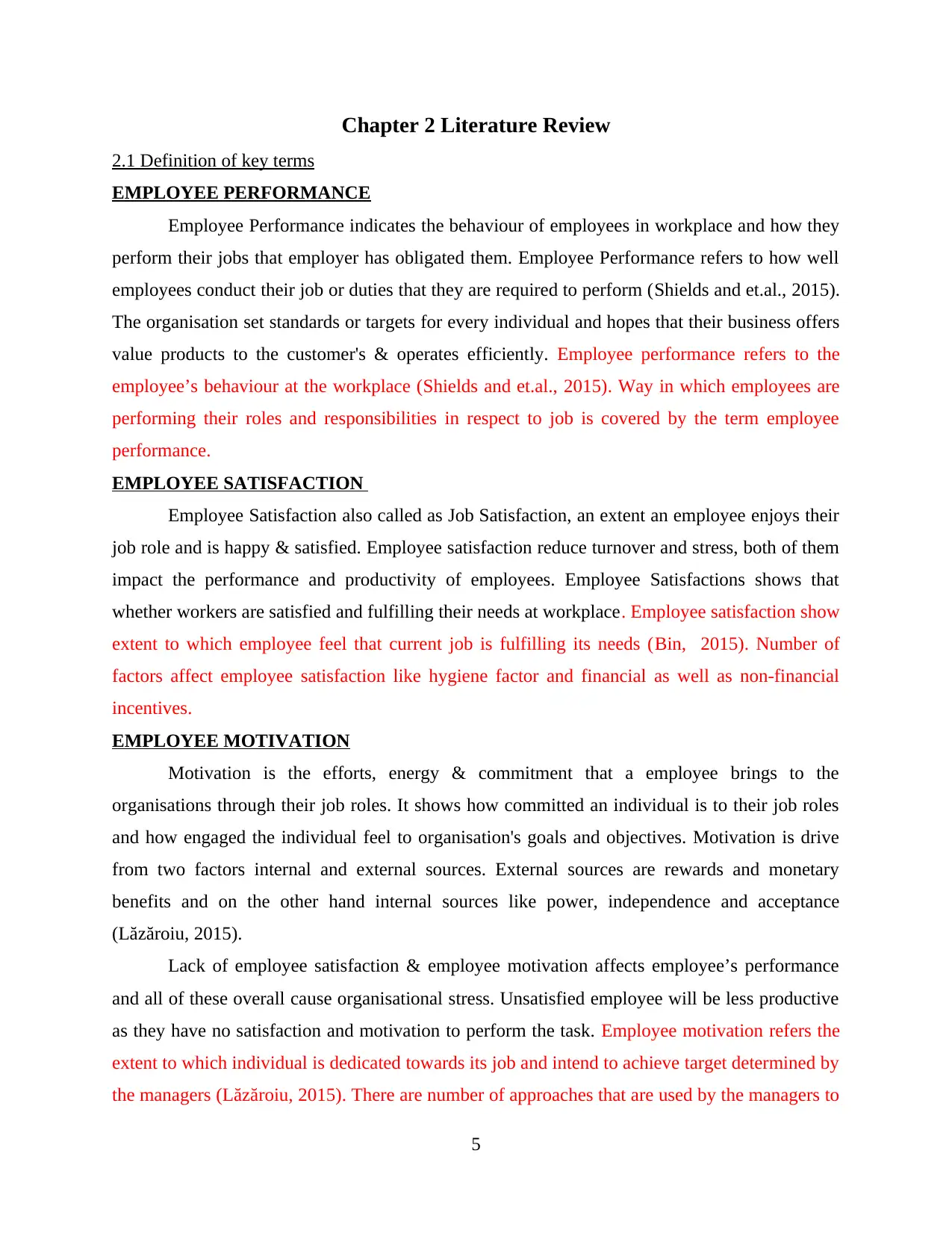
Chapter 2 Literature Review
2.1 Definition of key terms
EMPLOYEE PERFORMANCE
Employee Performance indicates the behaviour of employees in workplace and how they
perform their jobs that employer has obligated them. Employee Performance refers to how well
employees conduct their job or duties that they are required to perform (Shields and et.al., 2015).
The organisation set standards or targets for every individual and hopes that their business offers
value products to the customer's & operates efficiently. Employee performance refers to the
employee’s behaviour at the workplace (Shields and et.al., 2015). Way in which employees are
performing their roles and responsibilities in respect to job is covered by the term employee
performance.
EMPLOYEE SATISFACTION
Employee Satisfaction also called as Job Satisfaction, an extent an employee enjoys their
job role and is happy & satisfied. Employee satisfaction reduce turnover and stress, both of them
impact the performance and productivity of employees. Employee Satisfactions shows that
whether workers are satisfied and fulfilling their needs at workplace. Employee satisfaction show
extent to which employee feel that current job is fulfilling its needs (Bin, 2015). Number of
factors affect employee satisfaction like hygiene factor and financial as well as non-financial
incentives.
EMPLOYEE MOTIVATION
Motivation is the efforts, energy & commitment that a employee brings to the
organisations through their job roles. It shows how committed an individual is to their job roles
and how engaged the individual feel to organisation's goals and objectives. Motivation is drive
from two factors internal and external sources. External sources are rewards and monetary
benefits and on the other hand internal sources like power, independence and acceptance
(Lăzăroiu, 2015).
Lack of employee satisfaction & employee motivation affects employee’s performance
and all of these overall cause organisational stress. Unsatisfied employee will be less productive
as they have no satisfaction and motivation to perform the task. Employee motivation refers the
extent to which individual is dedicated towards its job and intend to achieve target determined by
the managers (Lăzăroiu, 2015). There are number of approaches that are used by the managers to
5
2.1 Definition of key terms
EMPLOYEE PERFORMANCE
Employee Performance indicates the behaviour of employees in workplace and how they
perform their jobs that employer has obligated them. Employee Performance refers to how well
employees conduct their job or duties that they are required to perform (Shields and et.al., 2015).
The organisation set standards or targets for every individual and hopes that their business offers
value products to the customer's & operates efficiently. Employee performance refers to the
employee’s behaviour at the workplace (Shields and et.al., 2015). Way in which employees are
performing their roles and responsibilities in respect to job is covered by the term employee
performance.
EMPLOYEE SATISFACTION
Employee Satisfaction also called as Job Satisfaction, an extent an employee enjoys their
job role and is happy & satisfied. Employee satisfaction reduce turnover and stress, both of them
impact the performance and productivity of employees. Employee Satisfactions shows that
whether workers are satisfied and fulfilling their needs at workplace. Employee satisfaction show
extent to which employee feel that current job is fulfilling its needs (Bin, 2015). Number of
factors affect employee satisfaction like hygiene factor and financial as well as non-financial
incentives.
EMPLOYEE MOTIVATION
Motivation is the efforts, energy & commitment that a employee brings to the
organisations through their job roles. It shows how committed an individual is to their job roles
and how engaged the individual feel to organisation's goals and objectives. Motivation is drive
from two factors internal and external sources. External sources are rewards and monetary
benefits and on the other hand internal sources like power, independence and acceptance
(Lăzăroiu, 2015).
Lack of employee satisfaction & employee motivation affects employee’s performance
and all of these overall cause organisational stress. Unsatisfied employee will be less productive
as they have no satisfaction and motivation to perform the task. Employee motivation refers the
extent to which individual is dedicated towards its job and intend to achieve target determined by
the managers (Lăzăroiu, 2015). There are number of approaches that are used by the managers to
5
Paraphrase This Document
Need a fresh take? Get an instant paraphrase of this document with our AI Paraphraser
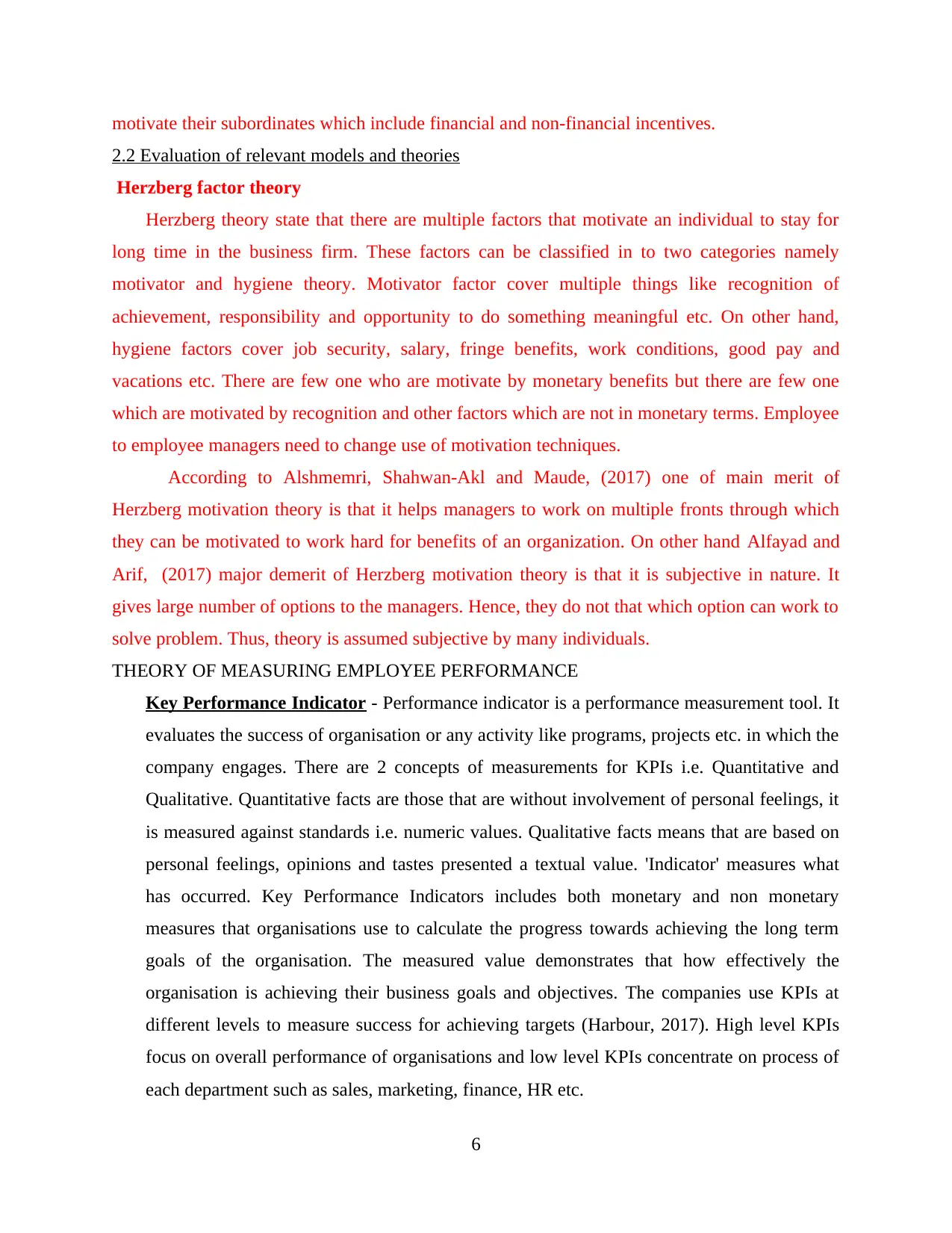
motivate their subordinates which include financial and non-financial incentives.
2.2 Evaluation of relevant models and theories
Herzberg factor theory
Herzberg theory state that there are multiple factors that motivate an individual to stay for
long time in the business firm. These factors can be classified in to two categories namely
motivator and hygiene theory. Motivator factor cover multiple things like recognition of
achievement, responsibility and opportunity to do something meaningful etc. On other hand,
hygiene factors cover job security, salary, fringe benefits, work conditions, good pay and
vacations etc. There are few one who are motivate by monetary benefits but there are few one
which are motivated by recognition and other factors which are not in monetary terms. Employee
to employee managers need to change use of motivation techniques.
According to Alshmemri, Shahwan-Akl and Maude, (2017) one of main merit of
Herzberg motivation theory is that it helps managers to work on multiple fronts through which
they can be motivated to work hard for benefits of an organization. On other hand Alfayad and
Arif, (2017) major demerit of Herzberg motivation theory is that it is subjective in nature. It
gives large number of options to the managers. Hence, they do not that which option can work to
solve problem. Thus, theory is assumed subjective by many individuals.
THEORY OF MEASURING EMPLOYEE PERFORMANCE
Key Performance Indicator - Performance indicator is a performance measurement tool. It
evaluates the success of organisation or any activity like programs, projects etc. in which the
company engages. There are 2 concepts of measurements for KPIs i.e. Quantitative and
Qualitative. Quantitative facts are those that are without involvement of personal feelings, it
is measured against standards i.e. numeric values. Qualitative facts means that are based on
personal feelings, opinions and tastes presented a textual value. 'Indicator' measures what
has occurred. Key Performance Indicators includes both monetary and non monetary
measures that organisations use to calculate the progress towards achieving the long term
goals of the organisation. The measured value demonstrates that how effectively the
organisation is achieving their business goals and objectives. The companies use KPIs at
different levels to measure success for achieving targets (Harbour, 2017). High level KPIs
focus on overall performance of organisations and low level KPIs concentrate on process of
each department such as sales, marketing, finance, HR etc.
6
2.2 Evaluation of relevant models and theories
Herzberg factor theory
Herzberg theory state that there are multiple factors that motivate an individual to stay for
long time in the business firm. These factors can be classified in to two categories namely
motivator and hygiene theory. Motivator factor cover multiple things like recognition of
achievement, responsibility and opportunity to do something meaningful etc. On other hand,
hygiene factors cover job security, salary, fringe benefits, work conditions, good pay and
vacations etc. There are few one who are motivate by monetary benefits but there are few one
which are motivated by recognition and other factors which are not in monetary terms. Employee
to employee managers need to change use of motivation techniques.
According to Alshmemri, Shahwan-Akl and Maude, (2017) one of main merit of
Herzberg motivation theory is that it helps managers to work on multiple fronts through which
they can be motivated to work hard for benefits of an organization. On other hand Alfayad and
Arif, (2017) major demerit of Herzberg motivation theory is that it is subjective in nature. It
gives large number of options to the managers. Hence, they do not that which option can work to
solve problem. Thus, theory is assumed subjective by many individuals.
THEORY OF MEASURING EMPLOYEE PERFORMANCE
Key Performance Indicator - Performance indicator is a performance measurement tool. It
evaluates the success of organisation or any activity like programs, projects etc. in which the
company engages. There are 2 concepts of measurements for KPIs i.e. Quantitative and
Qualitative. Quantitative facts are those that are without involvement of personal feelings, it
is measured against standards i.e. numeric values. Qualitative facts means that are based on
personal feelings, opinions and tastes presented a textual value. 'Indicator' measures what
has occurred. Key Performance Indicators includes both monetary and non monetary
measures that organisations use to calculate the progress towards achieving the long term
goals of the organisation. The measured value demonstrates that how effectively the
organisation is achieving their business goals and objectives. The companies use KPIs at
different levels to measure success for achieving targets (Harbour, 2017). High level KPIs
focus on overall performance of organisations and low level KPIs concentrate on process of
each department such as sales, marketing, finance, HR etc.
6
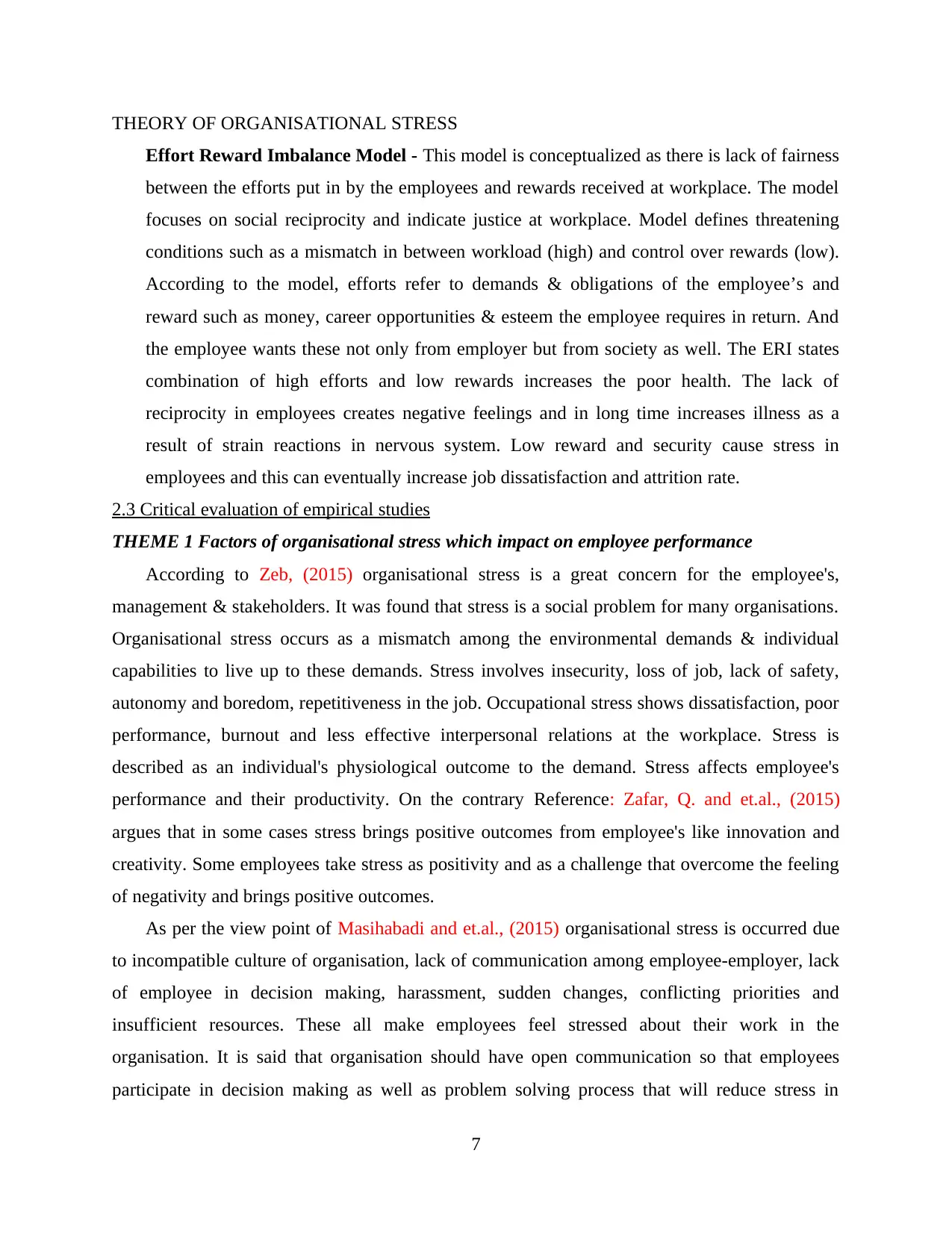
THEORY OF ORGANISATIONAL STRESS
Effort Reward Imbalance Model - This model is conceptualized as there is lack of fairness
between the efforts put in by the employees and rewards received at workplace. The model
focuses on social reciprocity and indicate justice at workplace. Model defines threatening
conditions such as a mismatch in between workload (high) and control over rewards (low).
According to the model, efforts refer to demands & obligations of the employee’s and
reward such as money, career opportunities & esteem the employee requires in return. And
the employee wants these not only from employer but from society as well. The ERI states
combination of high efforts and low rewards increases the poor health. The lack of
reciprocity in employees creates negative feelings and in long time increases illness as a
result of strain reactions in nervous system. Low reward and security cause stress in
employees and this can eventually increase job dissatisfaction and attrition rate.
2.3 Critical evaluation of empirical studies
THEME 1 Factors of organisational stress which impact on employee performance
According to Zeb, (2015) organisational stress is a great concern for the employee's,
management & stakeholders. It was found that stress is a social problem for many organisations.
Organisational stress occurs as a mismatch among the environmental demands & individual
capabilities to live up to these demands. Stress involves insecurity, loss of job, lack of safety,
autonomy and boredom, repetitiveness in the job. Occupational stress shows dissatisfaction, poor
performance, burnout and less effective interpersonal relations at the workplace. Stress is
described as an individual's physiological outcome to the demand. Stress affects employee's
performance and their productivity. On the contrary Reference: Zafar, Q. and et.al., (2015)
argues that in some cases stress brings positive outcomes from employee's like innovation and
creativity. Some employees take stress as positivity and as a challenge that overcome the feeling
of negativity and brings positive outcomes.
As per the view point of Masihabadi and et.al., (2015) organisational stress is occurred due
to incompatible culture of organisation, lack of communication among employee-employer, lack
of employee in decision making, harassment, sudden changes, conflicting priorities and
insufficient resources. These all make employees feel stressed about their work in the
organisation. It is said that organisation should have open communication so that employees
participate in decision making as well as problem solving process that will reduce stress in
7
Effort Reward Imbalance Model - This model is conceptualized as there is lack of fairness
between the efforts put in by the employees and rewards received at workplace. The model
focuses on social reciprocity and indicate justice at workplace. Model defines threatening
conditions such as a mismatch in between workload (high) and control over rewards (low).
According to the model, efforts refer to demands & obligations of the employee’s and
reward such as money, career opportunities & esteem the employee requires in return. And
the employee wants these not only from employer but from society as well. The ERI states
combination of high efforts and low rewards increases the poor health. The lack of
reciprocity in employees creates negative feelings and in long time increases illness as a
result of strain reactions in nervous system. Low reward and security cause stress in
employees and this can eventually increase job dissatisfaction and attrition rate.
2.3 Critical evaluation of empirical studies
THEME 1 Factors of organisational stress which impact on employee performance
According to Zeb, (2015) organisational stress is a great concern for the employee's,
management & stakeholders. It was found that stress is a social problem for many organisations.
Organisational stress occurs as a mismatch among the environmental demands & individual
capabilities to live up to these demands. Stress involves insecurity, loss of job, lack of safety,
autonomy and boredom, repetitiveness in the job. Occupational stress shows dissatisfaction, poor
performance, burnout and less effective interpersonal relations at the workplace. Stress is
described as an individual's physiological outcome to the demand. Stress affects employee's
performance and their productivity. On the contrary Reference: Zafar, Q. and et.al., (2015)
argues that in some cases stress brings positive outcomes from employee's like innovation and
creativity. Some employees take stress as positivity and as a challenge that overcome the feeling
of negativity and brings positive outcomes.
As per the view point of Masihabadi and et.al., (2015) organisational stress is occurred due
to incompatible culture of organisation, lack of communication among employee-employer, lack
of employee in decision making, harassment, sudden changes, conflicting priorities and
insufficient resources. These all make employees feel stressed about their work in the
organisation. It is said that organisation should have open communication so that employees
participate in decision making as well as problem solving process that will reduce stress in
7
⊘ This is a preview!⊘
Do you want full access?
Subscribe today to unlock all pages.
Trusted by 1+ million students worldwide
employee's. Akgunduz, (2015) argued that cause of stress can be employee's themselves as they
don't take initiative to involve in any activity in the organisation and doesn't take step forward
towards building relationship with their superiors. So the author states that if the employee's
themselves won't take a step forward towards building relations then it will affect them.
According to Wanyama Wanjala and Kimutai, (2015) opinion stress at workplace is caused
due to change in technology, unexpected change, sudden reorganization, competition for
opportunities regarding promotions, lack of employee empowerment. All these factors cause
reduction in efficiency, reduce interest in working, decrease capacity to perform. Organisational
stress contributes in low motivation & morale, low performance, high attrition, accidents, low
job satisfaction, sick leaves and conflicts. These all factors will lead to organisational loss, so
within the given time the organisation must take corrective actions to reduce stress by
implementing some strategies else it will lead to low performance and productivity. And mental
and physical health of employee's will also be affected.
As far as, is concerned, there are different causes of work stress including, role in the
organisation, factor intrinsic to the job, career development and climate and structure of
organisation. The physical surroundings of the job which have a high level of the noise or low
lighting, heat, poor ventilation systems, fumes, smells, and all the stimuli which bombard the
senses of worker can directly effete the overall mental state of employees. The physical design
of the workplace also comes under the poor working condition and this creates poor
communication networks ad develops a poor and ineffective working relationship which causes
stress to the employees.
On the other had it is stated by that the factor which leads to create stress among employee
is related with the shifts at the work place. This create anxiety in them and they are always in
tension of going to shift on time and change in the shift on regular intervals. This is where
workers have jobs requiring them to work in shifts. Some of the jobs involves working in odd
hours, which yhave a direct impact on the blood temperature of the worker, blood sugar levels,
metabolic rate, sleep patterns, mental efficiency, resulting in mild diabetes hypertension, and
peptic ulcers.
However, have an opinion that job which includes more danger and risk put employees in
higher stress level. This is due the reason that when an employee is continuously alerted about
possible danger and he/she have to be prepared to respond immediately. This lead to the situation
8
don't take initiative to involve in any activity in the organisation and doesn't take step forward
towards building relationship with their superiors. So the author states that if the employee's
themselves won't take a step forward towards building relations then it will affect them.
According to Wanyama Wanjala and Kimutai, (2015) opinion stress at workplace is caused
due to change in technology, unexpected change, sudden reorganization, competition for
opportunities regarding promotions, lack of employee empowerment. All these factors cause
reduction in efficiency, reduce interest in working, decrease capacity to perform. Organisational
stress contributes in low motivation & morale, low performance, high attrition, accidents, low
job satisfaction, sick leaves and conflicts. These all factors will lead to organisational loss, so
within the given time the organisation must take corrective actions to reduce stress by
implementing some strategies else it will lead to low performance and productivity. And mental
and physical health of employee's will also be affected.
As far as, is concerned, there are different causes of work stress including, role in the
organisation, factor intrinsic to the job, career development and climate and structure of
organisation. The physical surroundings of the job which have a high level of the noise or low
lighting, heat, poor ventilation systems, fumes, smells, and all the stimuli which bombard the
senses of worker can directly effete the overall mental state of employees. The physical design
of the workplace also comes under the poor working condition and this creates poor
communication networks ad develops a poor and ineffective working relationship which causes
stress to the employees.
On the other had it is stated by that the factor which leads to create stress among employee
is related with the shifts at the work place. This create anxiety in them and they are always in
tension of going to shift on time and change in the shift on regular intervals. This is where
workers have jobs requiring them to work in shifts. Some of the jobs involves working in odd
hours, which yhave a direct impact on the blood temperature of the worker, blood sugar levels,
metabolic rate, sleep patterns, mental efficiency, resulting in mild diabetes hypertension, and
peptic ulcers.
However, have an opinion that job which includes more danger and risk put employees in
higher stress level. This is due the reason that when an employee is continuously alerted about
possible danger and he/she have to be prepared to respond immediately. This lead to the situation
8
Paraphrase This Document
Need a fresh take? Get an instant paraphrase of this document with our AI Paraphraser
of rush, muscles tension and respiration changes which are all seen as potentially threatening to
long-term health. The factor of risk and danger involved in the performance of specific job
create tension and anxiety among the employee involved in such job, this directly have a
negative impact on their mental as well as physical health.
It is stated by that, the long working hours at the workplace is another work stress factor
affecting employee to a greater extent. The requirement of long working hours includes taking
tolls on the health of the employees as well as making them suffer at a high rate of stress. This
means that many individual employees are at stage where they need medications for sleeping as
many of them take medics who haven’t slept for more than 36 hours. This effect their quality of
work, their mental and physical health as well. The long working hours is a situation leaving the
employee sleep less and hamper their professional quality of performance.
As per the opinion of George. and Zakkariya, (2015) organisational stress has negative
impact on the employee performance, as employee under stress are demotivated and feel
dissatisfied, this affects their performance and productivity. Stress cause mental illness that affect
employee's mentally and physically and these problems effect the employee's performance at
workplace. This can even cause conflicts or misunderstanding between employer and employee
that will adversely affect the employee's performance. On the contrary Inuwa, (2016) argues that
organisational stress can be positive as well, some employee's take stress as a challenge and have
the capability to overcome that stress. And so it brings out creativity and innovation in
employee's and they will positively motivate them towards the achievement of organisational
goals. This way this will right affect their performance and productivity, as they will be more
efficient and effective at the workplace.
According to Raza, Khan and Mujtaba, (2018) stress cause dissatisfaction among
employee's, due to work pressure on employee's and no proper guidance and support of
superiors. This cause demotivation in employees and this impact their performance and even
bring a feeling of leaving the organisation. Demotivated employee's will be least productive and
efficient towards their work or can even tend to leave the organisation. This will increase
attrition rate in the organisations and will affect the goodwill of the firm. On the contrary LePine,
and et.al,. (2016) it might happen that employee's doesn't quit their jobs but become least
interested in achieving any goals for the organisation. They will come and work with no
involvement and enthusiasm and go back this will impact the organisations as no employee
9
long-term health. The factor of risk and danger involved in the performance of specific job
create tension and anxiety among the employee involved in such job, this directly have a
negative impact on their mental as well as physical health.
It is stated by that, the long working hours at the workplace is another work stress factor
affecting employee to a greater extent. The requirement of long working hours includes taking
tolls on the health of the employees as well as making them suffer at a high rate of stress. This
means that many individual employees are at stage where they need medications for sleeping as
many of them take medics who haven’t slept for more than 36 hours. This effect their quality of
work, their mental and physical health as well. The long working hours is a situation leaving the
employee sleep less and hamper their professional quality of performance.
As per the opinion of George. and Zakkariya, (2015) organisational stress has negative
impact on the employee performance, as employee under stress are demotivated and feel
dissatisfied, this affects their performance and productivity. Stress cause mental illness that affect
employee's mentally and physically and these problems effect the employee's performance at
workplace. This can even cause conflicts or misunderstanding between employer and employee
that will adversely affect the employee's performance. On the contrary Inuwa, (2016) argues that
organisational stress can be positive as well, some employee's take stress as a challenge and have
the capability to overcome that stress. And so it brings out creativity and innovation in
employee's and they will positively motivate them towards the achievement of organisational
goals. This way this will right affect their performance and productivity, as they will be more
efficient and effective at the workplace.
According to Raza, Khan and Mujtaba, (2018) stress cause dissatisfaction among
employee's, due to work pressure on employee's and no proper guidance and support of
superiors. This cause demotivation in employees and this impact their performance and even
bring a feeling of leaving the organisation. Demotivated employee's will be least productive and
efficient towards their work or can even tend to leave the organisation. This will increase
attrition rate in the organisations and will affect the goodwill of the firm. On the contrary LePine,
and et.al,. (2016) it might happen that employee's doesn't quit their jobs but become least
interested in achieving any goals for the organisation. They will come and work with no
involvement and enthusiasm and go back this will impact the organisations as no employee
9
engagement will lead to any innovation and creation. Employee's will come perform their task
and will work for their own motive only. They will seek personal benefit with zero involvement
in the organisational benefit. They will be least bothered about their work if it is up-to mark or
not. This might result in poor concentration and poor decision-making skills. Organisations need
quick actions to resolve this issue of stress else it will lead to completely closure of the firm.
In the view of, pressure can be seen as a factor which is acceptable by an individual
which makes that person alter and keeps him/her motivated and even help them to learn. When
this kind of pressure becomes unmanageable in personal and professional life it directly leads to
stress to that person. This is impossible to avoid pressure at work place under the requirement of
contemporary modern work environment. The direct on an employee can be seen in the form of
deterioration in the health of employee as well their business performance. The stress sometimes
leads to major health issues which lead the person to leave the job, some of them even get
hospitalised due to diseases.
As far is concerned, due to the stress and lack of mental calmness of the employee an
organisation can suffer a variety of negative effects dues to its stressed workers. An increase has
been seen in the instances where an employee becomes argumentative or easily agitated. An
employee may exhibit a change in the behaviour such as smoking heavily, drinking and
developing irregular eating habit. The employee working under strass are prone to make more
irregularities, mistake and demonstration of a general decline in the performance. This can lead
to frequent absenteeism and coming late to the work. The business can directly suffer from such
factors if continued on a long term and with increasing number of employees under stress.
However, it is stated by that with more employees dissatisfied at the workplace due to
higher tension level and working under the stress, the employee retention of the organisation
become weak. This means that the employee turnover of the business incresed to a higher level
which directly increases the cost of organisation. The increased cost is related with recruitment
and selection and this build pressure on the HR department of the company as well. This can be
stated that one of the major and worst factor of work stress is leaving the job. When an employee
leaves a job due to job, the cost of training and replacement increases to a great extent.
On the other have, presented a viewpoint that Stress related with work, can have a deep
effect on the organizational morale and working climate. Most of the people suffers with a
moderate amount of stress which can prove to be beneficial and is termed as positive stress. But
10
and will work for their own motive only. They will seek personal benefit with zero involvement
in the organisational benefit. They will be least bothered about their work if it is up-to mark or
not. This might result in poor concentration and poor decision-making skills. Organisations need
quick actions to resolve this issue of stress else it will lead to completely closure of the firm.
In the view of, pressure can be seen as a factor which is acceptable by an individual
which makes that person alter and keeps him/her motivated and even help them to learn. When
this kind of pressure becomes unmanageable in personal and professional life it directly leads to
stress to that person. This is impossible to avoid pressure at work place under the requirement of
contemporary modern work environment. The direct on an employee can be seen in the form of
deterioration in the health of employee as well their business performance. The stress sometimes
leads to major health issues which lead the person to leave the job, some of them even get
hospitalised due to diseases.
As far is concerned, due to the stress and lack of mental calmness of the employee an
organisation can suffer a variety of negative effects dues to its stressed workers. An increase has
been seen in the instances where an employee becomes argumentative or easily agitated. An
employee may exhibit a change in the behaviour such as smoking heavily, drinking and
developing irregular eating habit. The employee working under strass are prone to make more
irregularities, mistake and demonstration of a general decline in the performance. This can lead
to frequent absenteeism and coming late to the work. The business can directly suffer from such
factors if continued on a long term and with increasing number of employees under stress.
However, it is stated by that with more employees dissatisfied at the workplace due to
higher tension level and working under the stress, the employee retention of the organisation
become weak. This means that the employee turnover of the business incresed to a higher level
which directly increases the cost of organisation. The increased cost is related with recruitment
and selection and this build pressure on the HR department of the company as well. This can be
stated that one of the major and worst factor of work stress is leaving the job. When an employee
leaves a job due to job, the cost of training and replacement increases to a great extent.
On the other have, presented a viewpoint that Stress related with work, can have a deep
effect on the organizational morale and working climate. Most of the people suffers with a
moderate amount of stress which can prove to be beneficial and is termed as positive stress. But
10
⊘ This is a preview!⊘
Do you want full access?
Subscribe today to unlock all pages.
Trusted by 1+ million students worldwide

1 out of 38


Related Documents


Your All-in-One AI-Powered Toolkit for Academic Success.
+13062052269
info@desklib.com
Available 24*7 on WhatsApp / Email
![[object Object]](/_next/static/media/star-bottom.7253800d.svg)
Unlock your academic potential
Copyright © 2020–2026 A2Z Services. All Rights Reserved. Developed and managed by ZUCOL.