Risk Factors of Health Anxiety: Dissertation Ethical Approval Form

Verified

Added on  2022/07/28

|5
|1233
|12
Report
AI Summary
This document presents a student's ethical approval form for a dissertation exploring the risk factors of health anxiety among young adults in the UK. The form includes sections for student information, supervisor details, and a working title. The background literature highlights the prevalence of health anxiety, particularly in young adults, and the limited research on its specific risk factors within this population. The research aims to identify and examine the major risk factors associated with health anxiety in young adults, using a cross-sectional inferential research design with a survey-based data collection method. The methodology outlines the participant selection, design, materials, and procedure, including the use of questionnaires and statistical analysis. The ethical considerations address data privacy and informed consent. The proposed analysis involves linear regression to assess the association between independent and dependent variables. The form also includes a timetable and a risk assessment record sheet. The study aims to recruit 84 participants aged 18-25 and will use SPSS for data analysis.
Document Page
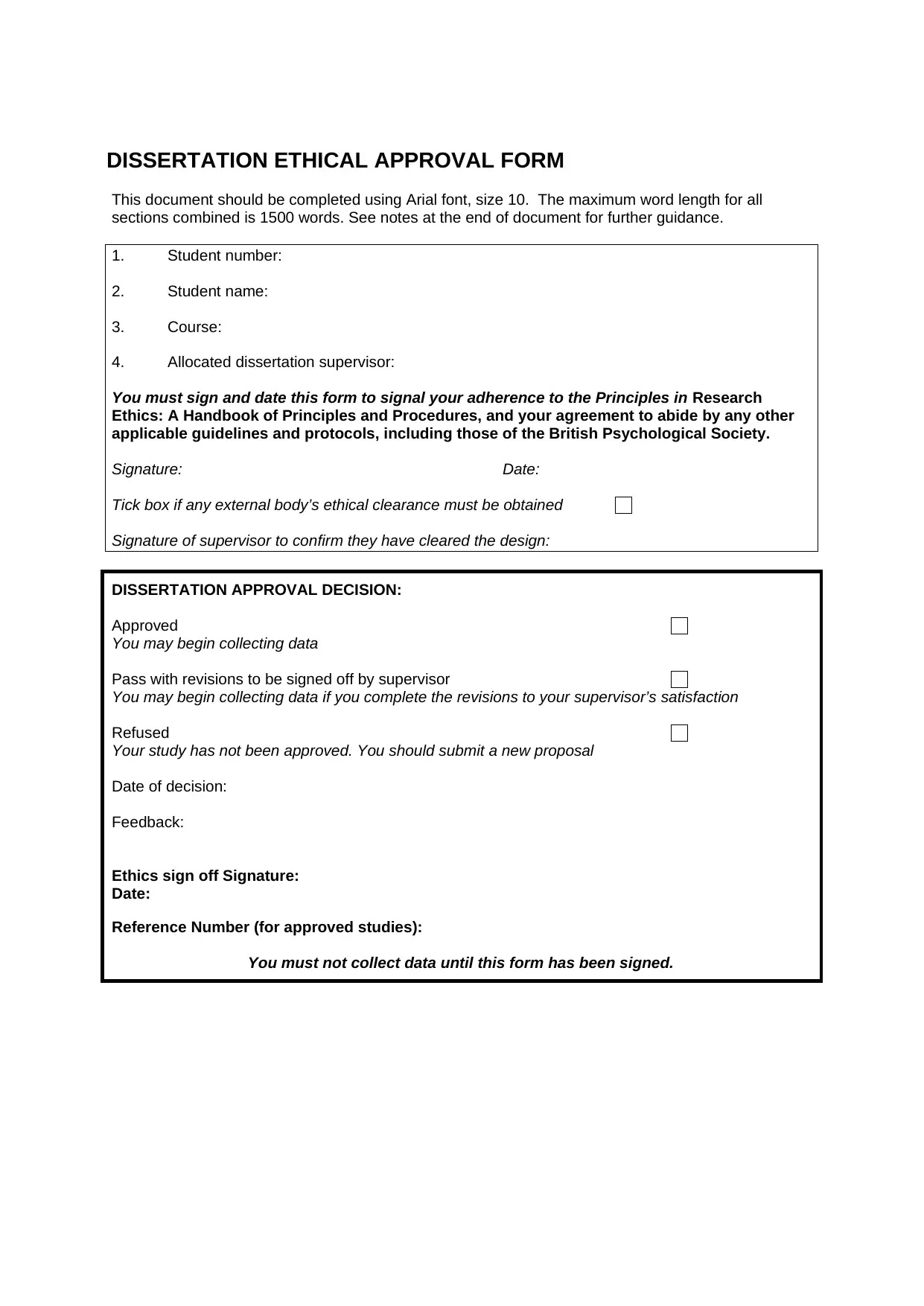
DISSERTATION ETHICAL APPROVAL FORM
This document should be completed using Arial font, size 10. The maximum word length for all
sections combined is 1500 words. See notes at the end of document for further guidance.
1. Student number:
2. Student name:
3. Course:
4. Allocated dissertation supervisor:
You must sign and date this form to signal your adherence to the Principles in Research
Ethics: A Handbook of Principles and Procedures, and your agreement to abide by any other
applicable guidelines and protocols, including those of the British Psychological Society.
Signature: Date:
Tick box if any external body’s ethical clearance must be obtained
Signature of supervisor to confirm they have cleared the design:
DISSERTATION APPROVAL DECISION:
Approved
You may begin collecting data
Pass with revisions to be signed off by supervisor
You may begin collecting data if you complete the revisions to your supervisor’s satisfaction
Refused
Your study has not been approved. You should submit a new proposal
Date of decision:
Feedback:
Ethics sign off Signature:
Date:
Reference Number (for approved studies):
You must not collect data until this form has been signed.
tabler-icon-diamond-filled.svg

Paraphrase This Document

Need a fresh take? Get an instant paraphrase of this document with our AI Paraphraser
Document Page
Your Proposed Study
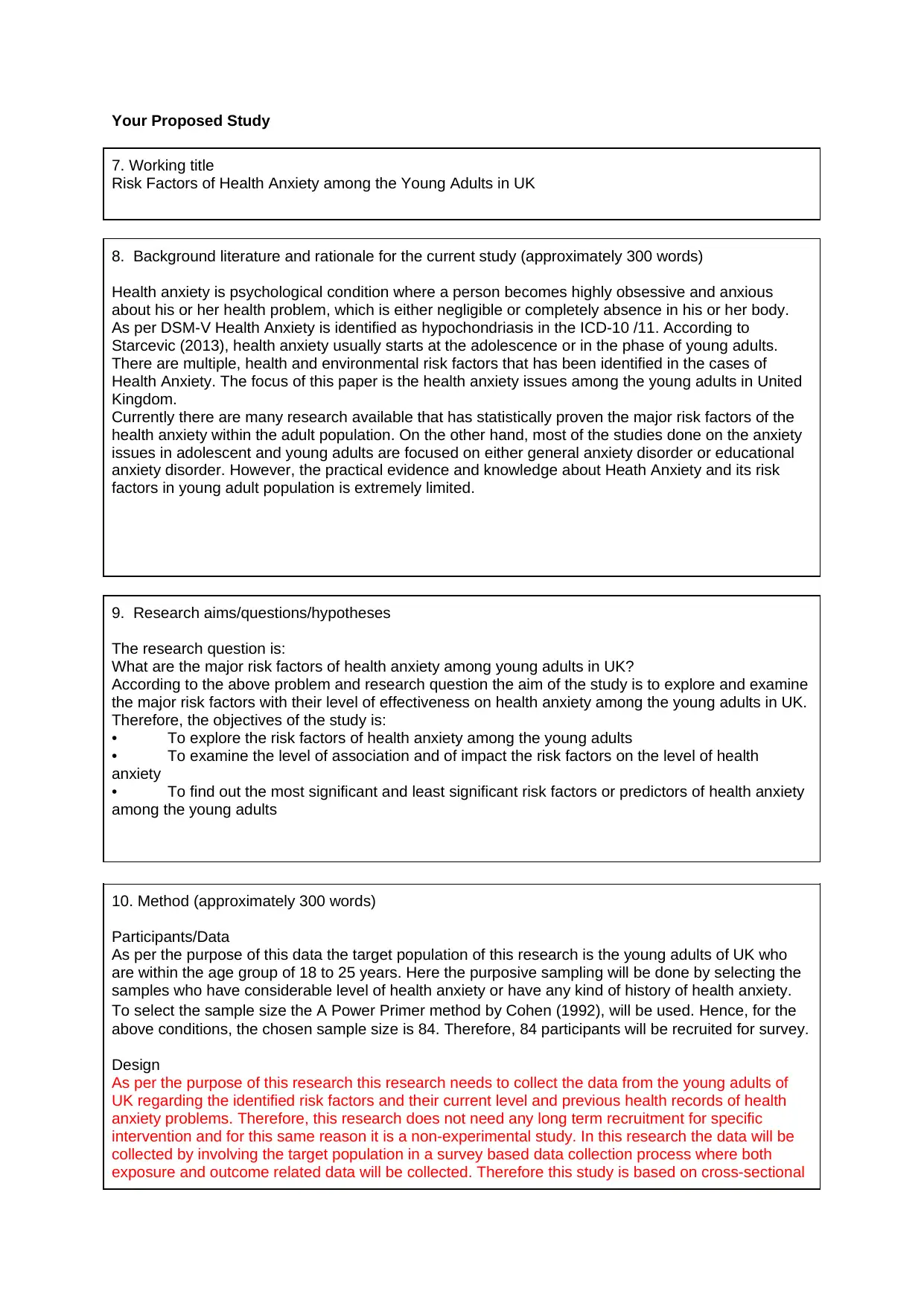
7. Working title
Risk Factors of Health Anxiety among the Young Adults in UK
8. Background literature and rationale for the current study (approximately 300 words)
Health anxiety is psychological condition where a person becomes highly obsessive and anxious
about his or her health problem, which is either negligible or completely absence in his or her body.
As per DSM-V Health Anxiety is identified as hypochondriasis in the ICD-10 /11. According to
Starcevic (2013), health anxiety usually starts at the adolescence or in the phase of young adults.
There are multiple, health and environmental risk factors that has been identified in the cases of
Health Anxiety. The focus of this paper is the health anxiety issues among the young adults in United
Kingdom.
Currently there are many research available that has statistically proven the major risk factors of the
health anxiety within the adult population. On the other hand, most of the studies done on the anxiety
issues in adolescent and young adults are focused on either general anxiety disorder or educational
anxiety disorder. However, the practical evidence and knowledge about Heath Anxiety and its risk
factors in young adult population is extremely limited.
9. Research aims/questions/hypotheses
The research question is:
What are the major risk factors of health anxiety among young adults in UK?
According to the above problem and research question the aim of the study is to explore and examine
the major risk factors with their level of effectiveness on health anxiety among the young adults in UK.
Therefore, the objectives of the study is:
• To explore the risk factors of health anxiety among the young adults
• To examine the level of association and of impact the risk factors on the level of health
anxiety
• To find out the most significant and least significant risk factors or predictors of health anxiety
among the young adults
10. Method (approximately 300 words)
Participants/Data
As per the purpose of this data the target population of this research is the young adults of UK who
are within the age group of 18 to 25 years. Here the purposive sampling will be done by selecting the
samples who have considerable level of health anxiety or have any kind of history of health anxiety.
To select the sample size the A Power Primer method by Cohen (1992), will be used. Hence, for the
above conditions, the chosen sample size is 84. Therefore, 84 participants will be recruited for survey.
Design
As per the purpose of this research this research needs to collect the data from the young adults of
UK regarding the identified risk factors and their current level and previous health records of health
anxiety problems. Therefore, this research does not need any long term recruitment for specific
intervention and for this same reason it is a non-experimental study. In this research the data will be
collected by involving the target population in a survey based data collection process where both
exposure and outcome related data will be collected. Therefore this study is based on cross-sectional
Document Page
design. As per the purpose of this research the association of risk factors with the health anxiety level
will be measured by inferential analysis. Therefore, the chosen research design is cross sectional
inferential research design.
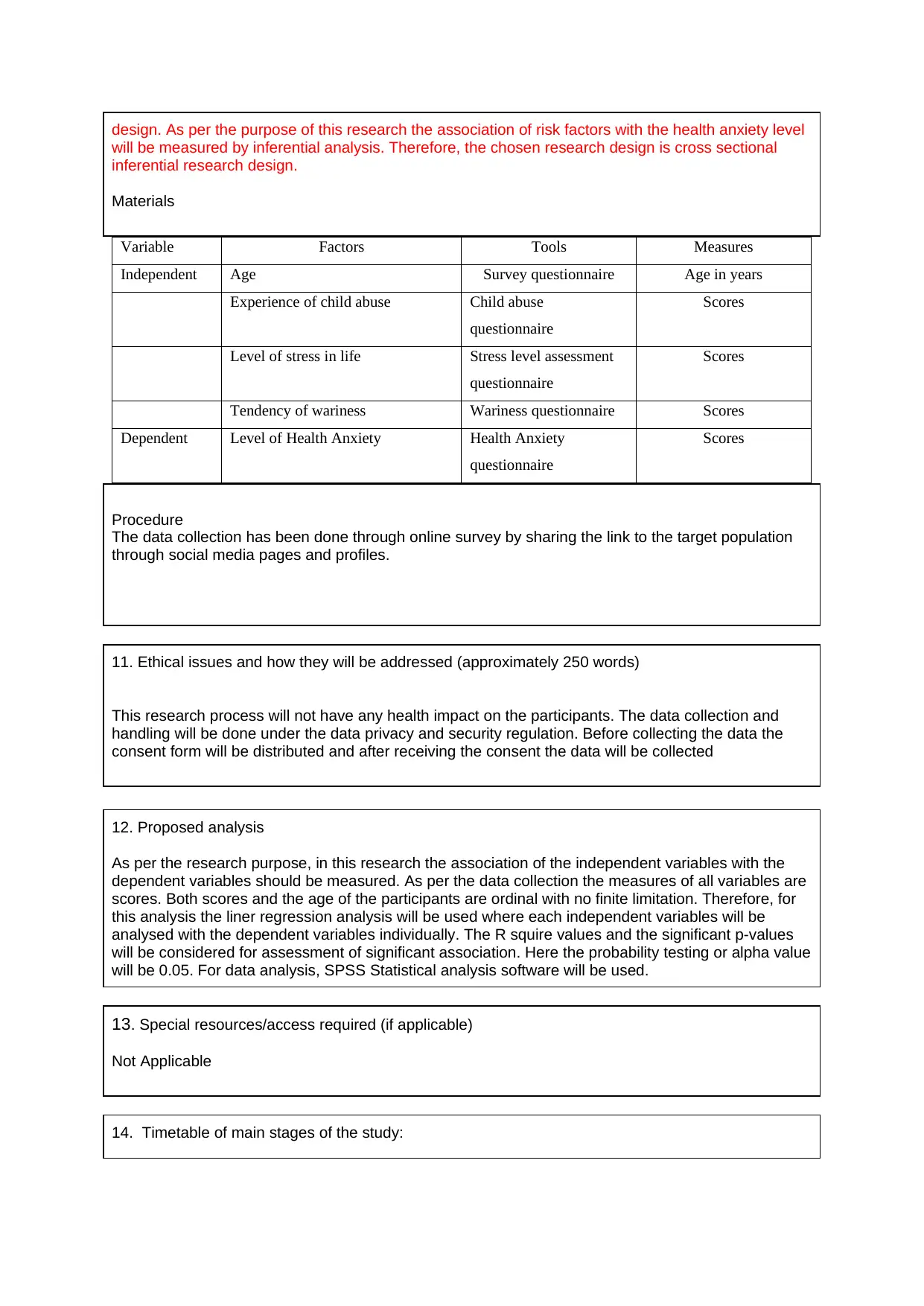
Materials
Variable Factors Tools Measures
Independent Age Survey questionnaire Age in years
Experience of child abuse Child abuse
questionnaire
Scores
Level of stress in life Stress level assessment
questionnaire
Scores
Tendency of wariness Wariness questionnaire Scores
Dependent Level of Health Anxiety Health Anxiety
questionnaire
Scores
Procedure
The data collection has been done through online survey by sharing the link to the target population
through social media pages and profiles.
11. Ethical issues and how they will be addressed (approximately 250 words)
This research process will not have any health impact on the participants. The data collection and
handling will be done under the data privacy and security regulation. Before collecting the data the
consent form will be distributed and after receiving the consent the data will be collected
12. Proposed analysis
As per the research purpose, in this research the association of the independent variables with the
dependent variables should be measured. As per the data collection the measures of all variables are
scores. Both scores and the age of the participants are ordinal with no finite limitation. Therefore, for
this analysis the liner regression analysis will be used where each independent variables will be
analysed with the dependent variables individually. The R squire values and the significant p-values
will be considered for assessment of significant association. Here the probability testing or alpha value
will be 0.05. For data analysis, SPSS Statistical analysis software will be used.
13. Special resources/access required (if applicable)
Not Applicable
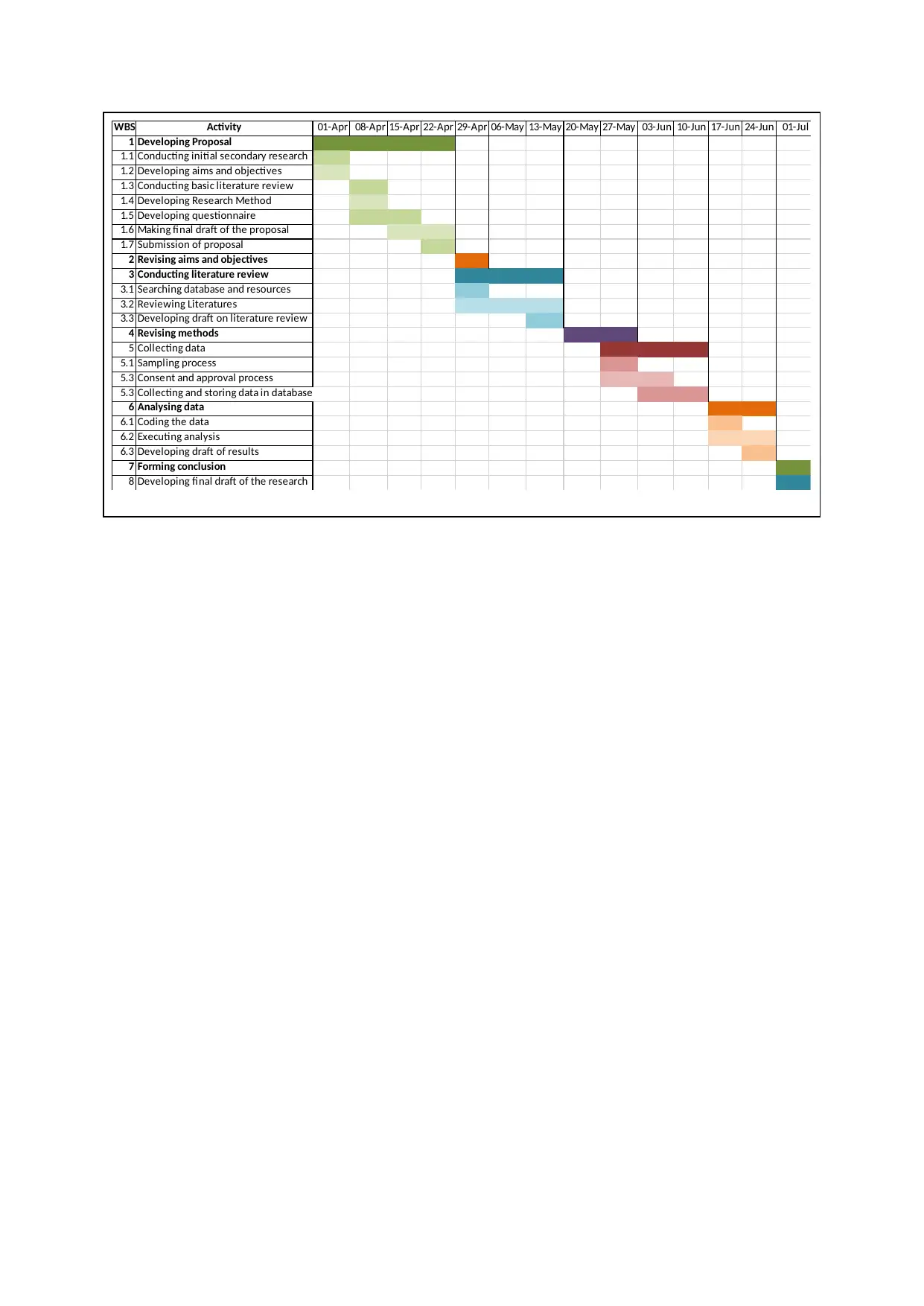
14. Timetable of main stages of the study:
Document Page
WBS Activity 01-Apr 08-Apr 15-Apr 22-Apr 29-Apr 06-May 13-May 20-May 27-May 03-Jun 10-Jun 17-Jun 24-Jun 01-Jul
1 Developing Proposal
1.1 Conducting initial secondary research
1.2 Developing aims and objectives
1.3 Conducting basic literature review
1.4 Developing Research Method
1.5 Developing questionnaire
1.6 Making final draft of the proposal
1.7 Submission of proposal
2 Revising aims and objectives
3 Conducting literature review
3.1 Searching database and resources
3.2 Reviewing Literatures
3.3 Developing draft on literature review
4 Revising methods
5 Collecting data
5.1 Sampling process
5.3 Consent and approval process
5.3 Collecting and storing data in database
6 Analysing data
6.1 Coding the data
6.2 Executing analysis
6.3 Developing draft of results
7 Forming conclusion
8 Developing final draft of the research
tabler-icon-diamond-filled.svg

Paraphrase This Document

Need a fresh take? Get an instant paraphrase of this document with our AI Paraphraser
Document Page
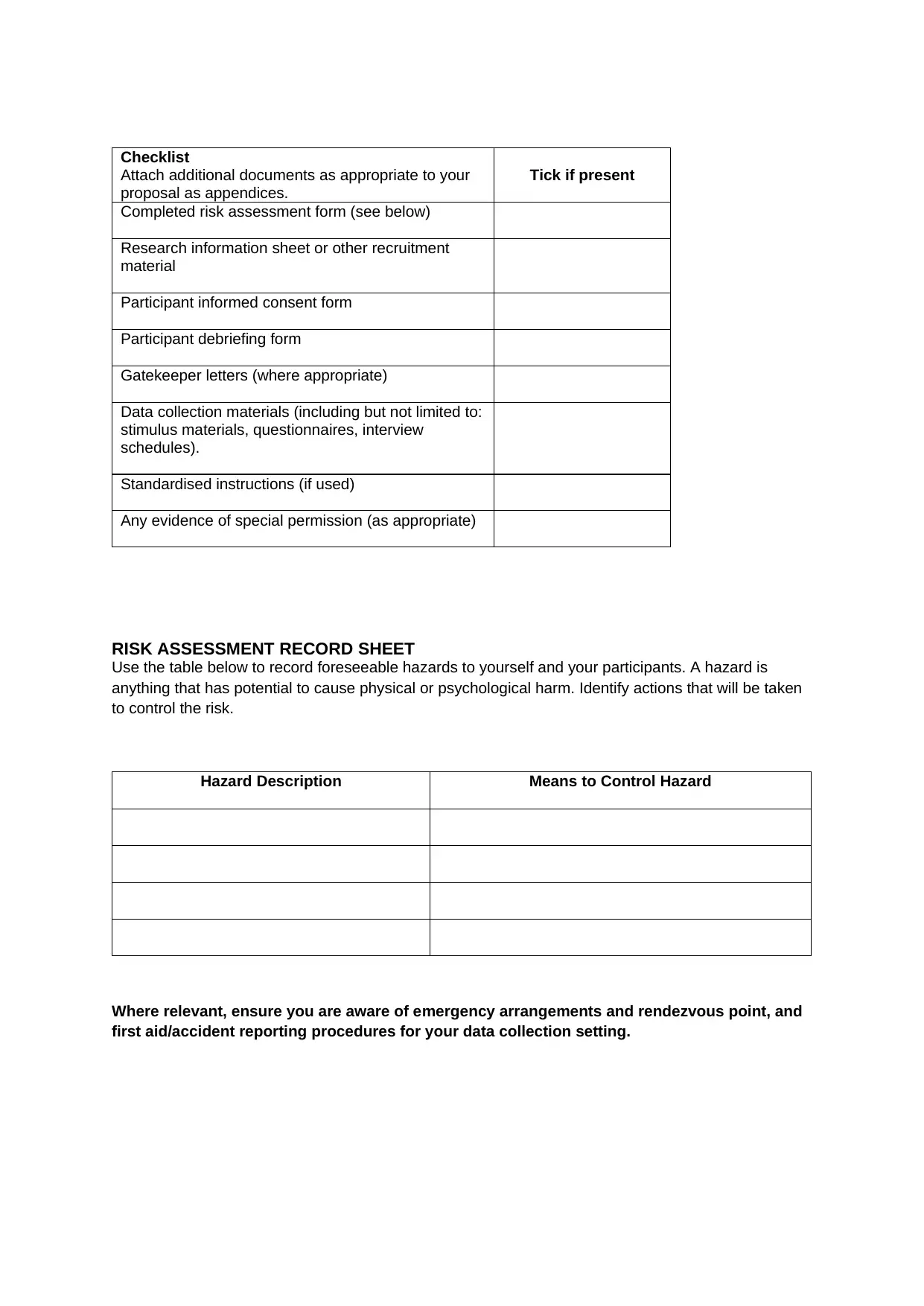
Checklist
Attach additional documents as appropriate to your
proposal as appendices.
Tick if present
Completed risk assessment form (see below)
Research information sheet or other recruitment
material
Participant informed consent form
Participant debriefing form
Gatekeeper letters (where appropriate)
Data collection materials (including but not limited to:
stimulus materials, questionnaires, interview
schedules).
Standardised instructions (if used)
Any evidence of special permission (as appropriate)
RISK ASSESSMENT RECORD SHEET
Use the table below to record foreseeable hazards to yourself and your participants. A hazard is
anything that has potential to cause physical or psychological harm. Identify actions that will be taken
to control the risk.
Hazard Description Means to Control Hazard
Where relevant, ensure you are aware of emergency arrangements and rendezvous point, and
first aid/accident reporting procedures for your data collection setting.
chevron_up_icon
1 out of 5
circle_padding
hide_on_mobile
zoom_out_icon
[object Object]