Workforce Diversity in the 21st Century: Challenges and Opportunities
VerifiedAdded on 2023/06/13
|8
|2549
|445
Essay
AI Summary
This essay examines the increasing emphasis on diversity in the workplace, highlighting the challenges and opportunities confronting new managers in the 21st century. It discusses historical issues like gender inequality and discrimination against minorities, noting how these have evolved with changing societal perspectives and the recognition of talent across all demographics. The essay further explores the benefits of a diverse workforce, including increased innovation, better employee relations, and improved financial performance, while also addressing potential challenges such as conflicts arising from cultural differences and communication barriers. The importance of diversity training, inclusive policies, and open communication systems are emphasized as strategies for creating a more equitable and productive work environment. The essay references real-world examples of companies that have successfully implemented diversity programs, demonstrating the positive impact of diversification on organizational success. Desklib provides access to this essay and many other resources for students.
Running head: DIVERSITY IN WORKPLACE
Diversity in workplace
Name of the Student
Name of the University
Author Note
Diversity in workplace
Name of the Student
Name of the University
Author Note

Paraphrase This Document
Need a fresh take? Get an instant paraphrase of this document with our AI Paraphraser
2DIVERSITY IN WORKPLACE
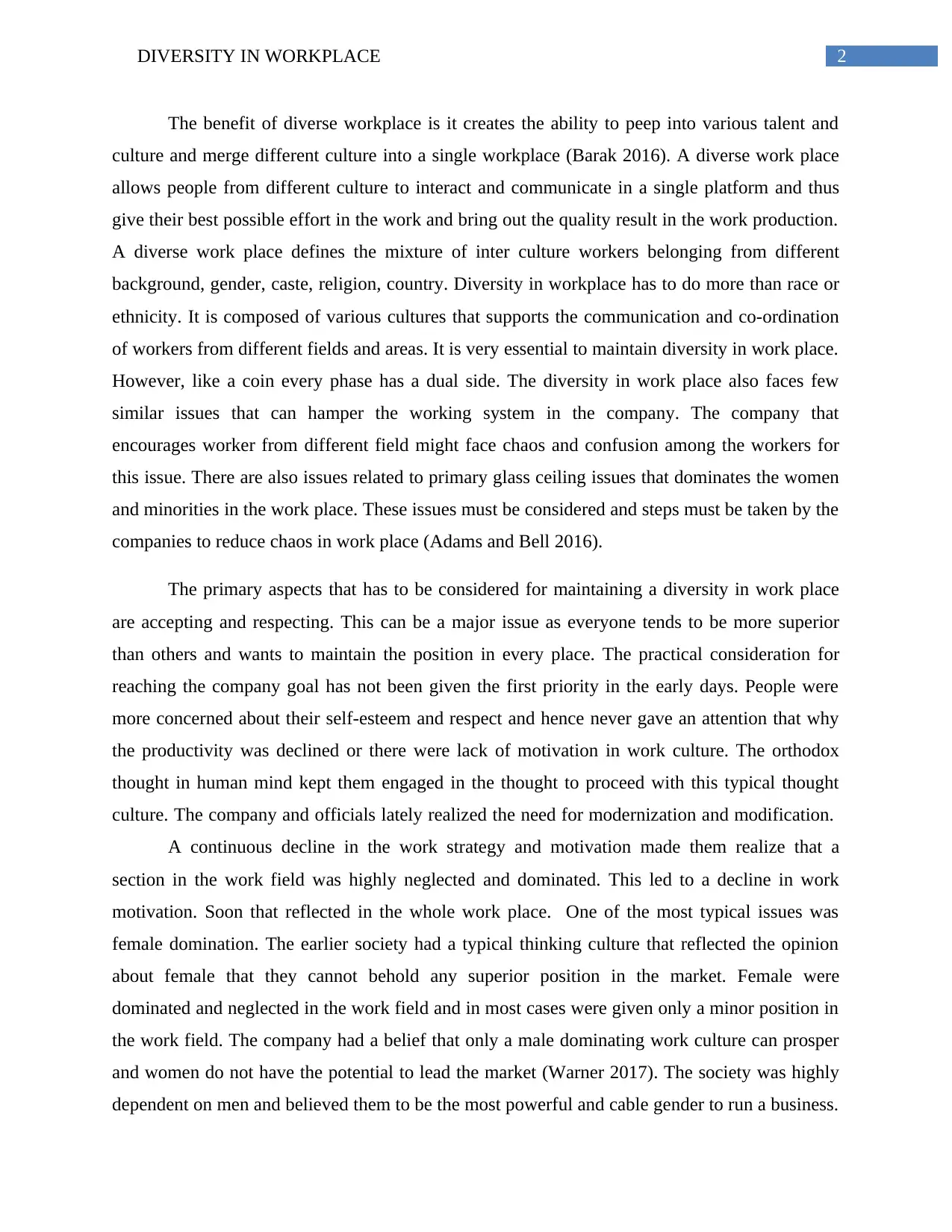
The benefit of diverse workplace is it creates the ability to peep into various talent and
culture and merge different culture into a single workplace (Barak 2016). A diverse work place
allows people from different culture to interact and communicate in a single platform and thus
give their best possible effort in the work and bring out the quality result in the work production.
A diverse work place defines the mixture of inter culture workers belonging from different
background, gender, caste, religion, country. Diversity in workplace has to do more than race or
ethnicity. It is composed of various cultures that supports the communication and co-ordination
of workers from different fields and areas. It is very essential to maintain diversity in work place.
However, like a coin every phase has a dual side. The diversity in work place also faces few
similar issues that can hamper the working system in the company. The company that
encourages worker from different field might face chaos and confusion among the workers for
this issue. There are also issues related to primary glass ceiling issues that dominates the women
and minorities in the work place. These issues must be considered and steps must be taken by the
companies to reduce chaos in work place (Adams and Bell 2016).
The primary aspects that has to be considered for maintaining a diversity in work place
are accepting and respecting. This can be a major issue as everyone tends to be more superior
than others and wants to maintain the position in every place. The practical consideration for
reaching the company goal has not been given the first priority in the early days. People were
more concerned about their self-esteem and respect and hence never gave an attention that why
the productivity was declined or there were lack of motivation in work culture. The orthodox
thought in human mind kept them engaged in the thought to proceed with this typical thought
culture. The company and officials lately realized the need for modernization and modification.
A continuous decline in the work strategy and motivation made them realize that a
section in the work field was highly neglected and dominated. This led to a decline in work
motivation. Soon that reflected in the whole work place. One of the most typical issues was
female domination. The earlier society had a typical thinking culture that reflected the opinion
about female that they cannot behold any superior position in the market. Female were
dominated and neglected in the work field and in most cases were given only a minor position in
the work field. The company had a belief that only a male dominating work culture can prosper
and women do not have the potential to lead the market (Warner 2017). The society was highly
dependent on men and believed them to be the most powerful and cable gender to run a business.
The benefit of diverse workplace is it creates the ability to peep into various talent and
culture and merge different culture into a single workplace (Barak 2016). A diverse work place
allows people from different culture to interact and communicate in a single platform and thus
give their best possible effort in the work and bring out the quality result in the work production.
A diverse work place defines the mixture of inter culture workers belonging from different
background, gender, caste, religion, country. Diversity in workplace has to do more than race or
ethnicity. It is composed of various cultures that supports the communication and co-ordination
of workers from different fields and areas. It is very essential to maintain diversity in work place.
However, like a coin every phase has a dual side. The diversity in work place also faces few
similar issues that can hamper the working system in the company. The company that
encourages worker from different field might face chaos and confusion among the workers for
this issue. There are also issues related to primary glass ceiling issues that dominates the women
and minorities in the work place. These issues must be considered and steps must be taken by the
companies to reduce chaos in work place (Adams and Bell 2016).
The primary aspects that has to be considered for maintaining a diversity in work place
are accepting and respecting. This can be a major issue as everyone tends to be more superior
than others and wants to maintain the position in every place. The practical consideration for
reaching the company goal has not been given the first priority in the early days. People were
more concerned about their self-esteem and respect and hence never gave an attention that why
the productivity was declined or there were lack of motivation in work culture. The orthodox
thought in human mind kept them engaged in the thought to proceed with this typical thought
culture. The company and officials lately realized the need for modernization and modification.
A continuous decline in the work strategy and motivation made them realize that a
section in the work field was highly neglected and dominated. This led to a decline in work
motivation. Soon that reflected in the whole work place. One of the most typical issues was
female domination. The earlier society had a typical thinking culture that reflected the opinion
about female that they cannot behold any superior position in the market. Female were
dominated and neglected in the work field and in most cases were given only a minor position in
the work field. The company had a belief that only a male dominating work culture can prosper
and women do not have the potential to lead the market (Warner 2017). The society was highly
dependent on men and believed them to be the most powerful and cable gender to run a business.
3DIVERSITY IN WORKPLACE
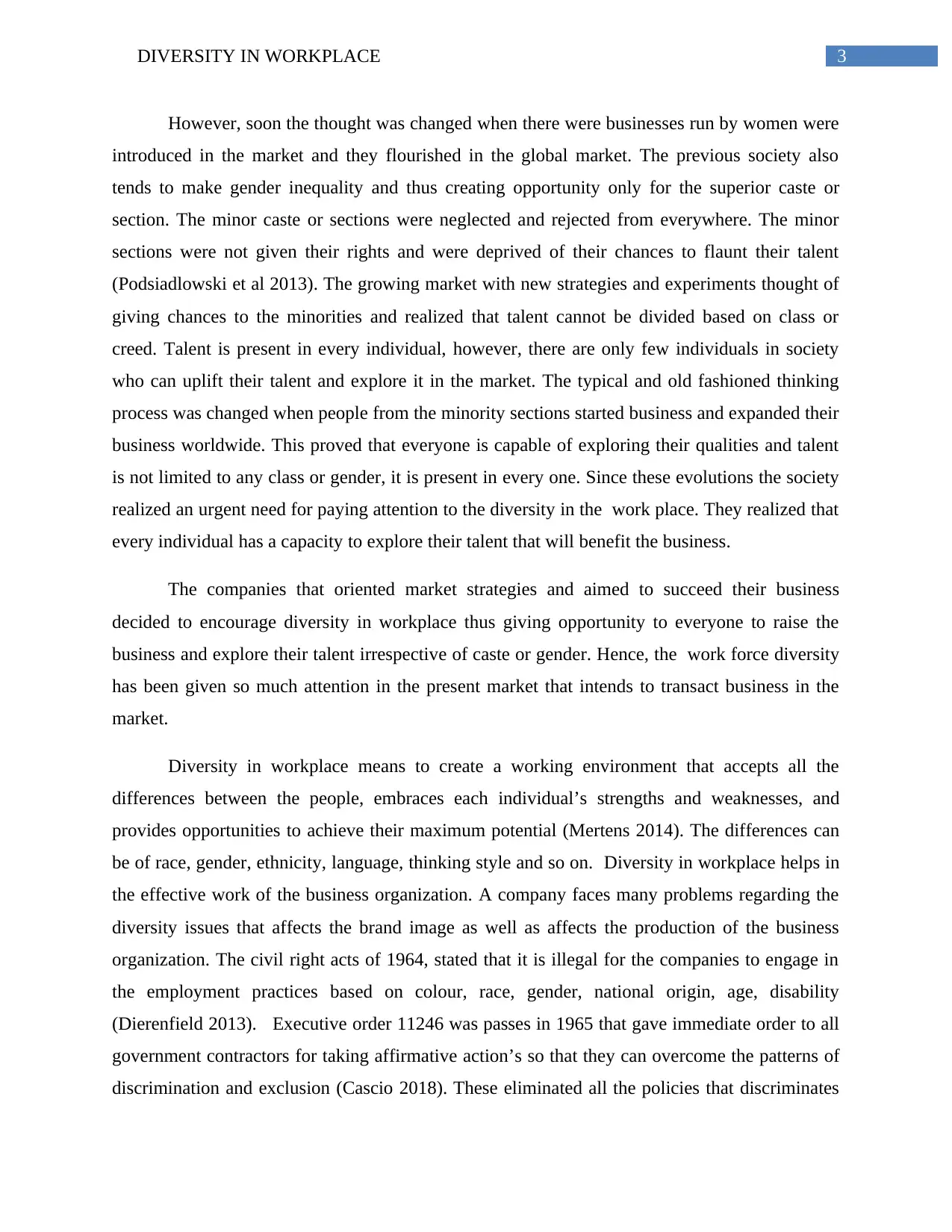
However, soon the thought was changed when there were businesses run by women were
introduced in the market and they flourished in the global market. The previous society also
tends to make gender inequality and thus creating opportunity only for the superior caste or
section. The minor caste or sections were neglected and rejected from everywhere. The minor
sections were not given their rights and were deprived of their chances to flaunt their talent
(Podsiadlowski et al 2013). The growing market with new strategies and experiments thought of
giving chances to the minorities and realized that talent cannot be divided based on class or
creed. Talent is present in every individual, however, there are only few individuals in society
who can uplift their talent and explore it in the market. The typical and old fashioned thinking
process was changed when people from the minority sections started business and expanded their
business worldwide. This proved that everyone is capable of exploring their qualities and talent
is not limited to any class or gender, it is present in every one. Since these evolutions the society
realized an urgent need for paying attention to the diversity in the work place. They realized that
every individual has a capacity to explore their talent that will benefit the business.
The companies that oriented market strategies and aimed to succeed their business
decided to encourage diversity in workplace thus giving opportunity to everyone to raise the
business and explore their talent irrespective of caste or gender. Hence, the work force diversity
has been given so much attention in the present market that intends to transact business in the
market.
Diversity in workplace means to create a working environment that accepts all the
differences between the people, embraces each individual’s strengths and weaknesses, and
provides opportunities to achieve their maximum potential (Mertens 2014). The differences can
be of race, gender, ethnicity, language, thinking style and so on. Diversity in workplace helps in
the effective work of the business organization. A company faces many problems regarding the
diversity issues that affects the brand image as well as affects the production of the business
organization. The civil right acts of 1964, stated that it is illegal for the companies to engage in
the employment practices based on colour, race, gender, national origin, age, disability
(Dierenfield 2013). Executive order 11246 was passes in 1965 that gave immediate order to all
government contractors for taking affirmative action’s so that they can overcome the patterns of
discrimination and exclusion (Cascio 2018). These eliminated all the policies that discriminates
However, soon the thought was changed when there were businesses run by women were
introduced in the market and they flourished in the global market. The previous society also
tends to make gender inequality and thus creating opportunity only for the superior caste or
section. The minor caste or sections were neglected and rejected from everywhere. The minor
sections were not given their rights and were deprived of their chances to flaunt their talent
(Podsiadlowski et al 2013). The growing market with new strategies and experiments thought of
giving chances to the minorities and realized that talent cannot be divided based on class or
creed. Talent is present in every individual, however, there are only few individuals in society
who can uplift their talent and explore it in the market. The typical and old fashioned thinking
process was changed when people from the minority sections started business and expanded their
business worldwide. This proved that everyone is capable of exploring their qualities and talent
is not limited to any class or gender, it is present in every one. Since these evolutions the society
realized an urgent need for paying attention to the diversity in the work place. They realized that
every individual has a capacity to explore their talent that will benefit the business.
The companies that oriented market strategies and aimed to succeed their business
decided to encourage diversity in workplace thus giving opportunity to everyone to raise the
business and explore their talent irrespective of caste or gender. Hence, the work force diversity
has been given so much attention in the present market that intends to transact business in the
market.
Diversity in workplace means to create a working environment that accepts all the
differences between the people, embraces each individual’s strengths and weaknesses, and
provides opportunities to achieve their maximum potential (Mertens 2014). The differences can
be of race, gender, ethnicity, language, thinking style and so on. Diversity in workplace helps in
the effective work of the business organization. A company faces many problems regarding the
diversity issues that affects the brand image as well as affects the production of the business
organization. The civil right acts of 1964, stated that it is illegal for the companies to engage in
the employment practices based on colour, race, gender, national origin, age, disability
(Dierenfield 2013). Executive order 11246 was passes in 1965 that gave immediate order to all
government contractors for taking affirmative action’s so that they can overcome the patterns of
discrimination and exclusion (Cascio 2018). These eliminated all the policies that discriminates
⊘ This is a preview!⊘
Do you want full access?
Subscribe today to unlock all pages.

Trusted by 1+ million students worldwide
4DIVERSITY IN WORKPLACE
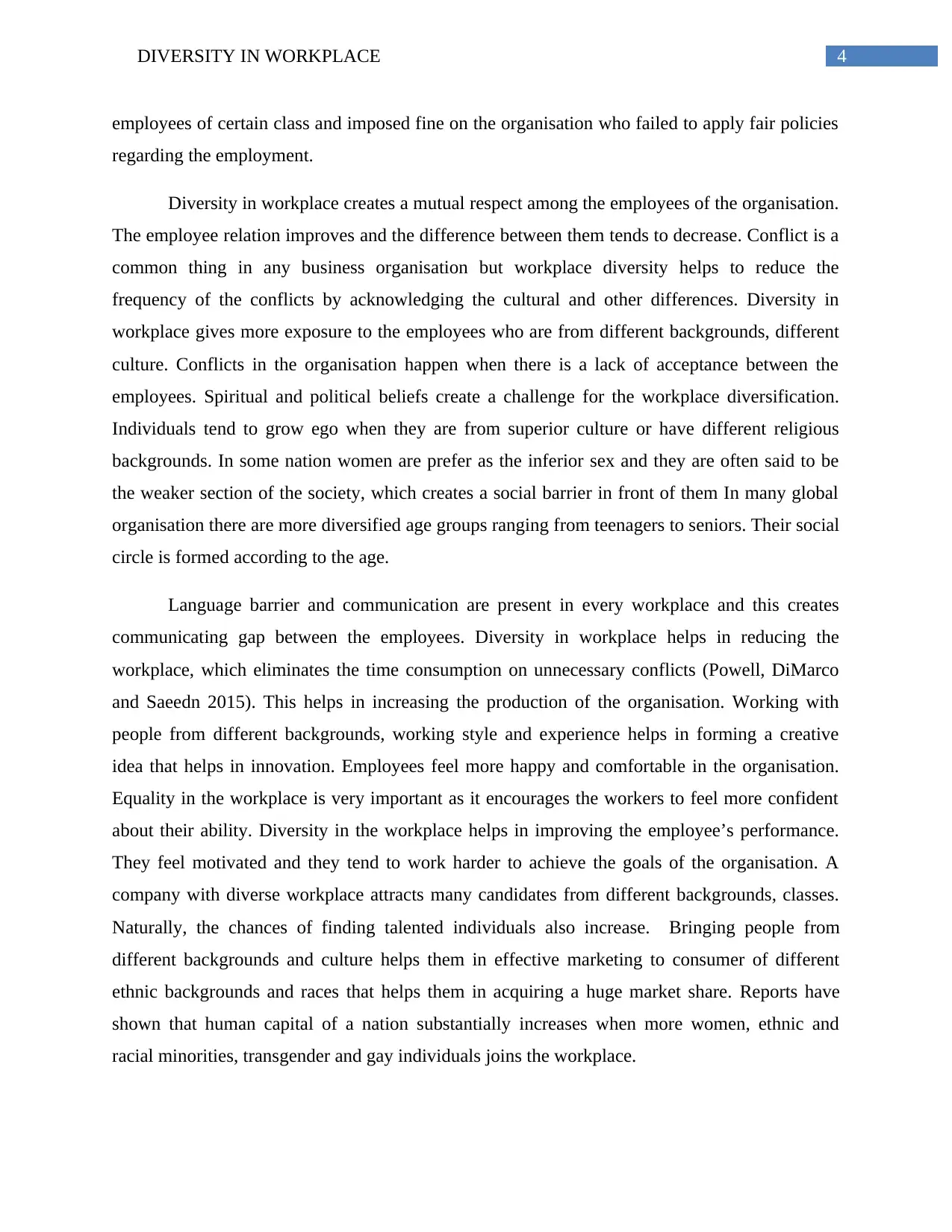
employees of certain class and imposed fine on the organisation who failed to apply fair policies
regarding the employment.
Diversity in workplace creates a mutual respect among the employees of the organisation.
The employee relation improves and the difference between them tends to decrease. Conflict is a
common thing in any business organisation but workplace diversity helps to reduce the
frequency of the conflicts by acknowledging the cultural and other differences. Diversity in
workplace gives more exposure to the employees who are from different backgrounds, different
culture. Conflicts in the organisation happen when there is a lack of acceptance between the
employees. Spiritual and political beliefs create a challenge for the workplace diversification.
Individuals tend to grow ego when they are from superior culture or have different religious
backgrounds. In some nation women are prefer as the inferior sex and they are often said to be
the weaker section of the society, which creates a social barrier in front of them In many global
organisation there are more diversified age groups ranging from teenagers to seniors. Their social
circle is formed according to the age.
Language barrier and communication are present in every workplace and this creates
communicating gap between the employees. Diversity in workplace helps in reducing the
workplace, which eliminates the time consumption on unnecessary conflicts (Powell, DiMarco
and Saeedn 2015). This helps in increasing the production of the organisation. Working with
people from different backgrounds, working style and experience helps in forming a creative
idea that helps in innovation. Employees feel more happy and comfortable in the organisation.
Equality in the workplace is very important as it encourages the workers to feel more confident
about their ability. Diversity in the workplace helps in improving the employee’s performance.
They feel motivated and they tend to work harder to achieve the goals of the organisation. A
company with diverse workplace attracts many candidates from different backgrounds, classes.
Naturally, the chances of finding talented individuals also increase. Bringing people from
different backgrounds and culture helps them in effective marketing to consumer of different
ethnic backgrounds and races that helps them in acquiring a huge market share. Reports have
shown that human capital of a nation substantially increases when more women, ethnic and
racial minorities, transgender and gay individuals joins the workplace.
employees of certain class and imposed fine on the organisation who failed to apply fair policies
regarding the employment.
Diversity in workplace creates a mutual respect among the employees of the organisation.
The employee relation improves and the difference between them tends to decrease. Conflict is a
common thing in any business organisation but workplace diversity helps to reduce the
frequency of the conflicts by acknowledging the cultural and other differences. Diversity in
workplace gives more exposure to the employees who are from different backgrounds, different
culture. Conflicts in the organisation happen when there is a lack of acceptance between the
employees. Spiritual and political beliefs create a challenge for the workplace diversification.
Individuals tend to grow ego when they are from superior culture or have different religious
backgrounds. In some nation women are prefer as the inferior sex and they are often said to be
the weaker section of the society, which creates a social barrier in front of them In many global
organisation there are more diversified age groups ranging from teenagers to seniors. Their social
circle is formed according to the age.
Language barrier and communication are present in every workplace and this creates
communicating gap between the employees. Diversity in workplace helps in reducing the
workplace, which eliminates the time consumption on unnecessary conflicts (Powell, DiMarco
and Saeedn 2015). This helps in increasing the production of the organisation. Working with
people from different backgrounds, working style and experience helps in forming a creative
idea that helps in innovation. Employees feel more happy and comfortable in the organisation.
Equality in the workplace is very important as it encourages the workers to feel more confident
about their ability. Diversity in the workplace helps in improving the employee’s performance.
They feel motivated and they tend to work harder to achieve the goals of the organisation. A
company with diverse workplace attracts many candidates from different backgrounds, classes.
Naturally, the chances of finding talented individuals also increase. Bringing people from
different backgrounds and culture helps them in effective marketing to consumer of different
ethnic backgrounds and races that helps them in acquiring a huge market share. Reports have
shown that human capital of a nation substantially increases when more women, ethnic and
racial minorities, transgender and gay individuals joins the workplace.
Paraphrase This Document
Need a fresh take? Get an instant paraphrase of this document with our AI Paraphraser
5DIVERSITY IN WORKPLACE
A diverse workplace helps in sustaining and creating competitive market in the
globalized world. A diverse workplace brings out the full potential of the organisation. It helps
the company in increasing the revenue of the company. Diversity training can help the employee
to understand and accept each other’s difference and will also provide them opportunity to
achieve their full potential. Diversity awareness programmes and cultural sensitivities practices
in the workplace can help them reducing the problems caused by cultural differences. Employees
should prevent the gender discrimination and should increase equality in terms of salary,
opportunities, hiring and promotions. Creating an open communication system between the
people of different age group can help in diversifying the age group (Mason 2013). Diversity in
workplace helps in better financial results of the organisation. Number of researches has shown
that companies that have a diverse team are much more profitable than the business with
homogeneous teams. In 2015, report published by McKinsey has shown that companies with
more racial and ethnic diversity have a 35% more chances to be financially successful
(Mourshed, Farrell and Barton 2013).
The foreign companies presently employ millions of American citizen. Companies that
have topped the list of fortune 500 are global companies and they are the perfect example why
diversification in the organisation is necessary. Diversification is important as it helps in
gathering people from different culture, backgrounds. That gives information about their culture
and by this way the organisation becomes successful. Understanding others decision, choices
influence the work process and environment of the organisation. Lack of diversification
increases the conflict between the employees of the organisation. It increases the labour turnover
ratio. Employee of the organisation tends to leave the organisation due to the conflicts, which
affects the production of the organisation (Redpath et al. 2013). Diversity in the organisation is
necessary as it develops a good relation between the employees.
There are many organizations that have worked for diversifying their workplaces and that
have helped them in improving the relationship between the employees. Diversity in workplace
helped them in increasing the productivity and also helped them in retaining their employees
(Huston 2014). Good diversified workplace also helped them in attracting more skilled employee
into their organization. It has also helped them in innovating more and that have attracted more
and more customer. Global companies highly required a diversified workplace as they recruit
A diverse workplace helps in sustaining and creating competitive market in the
globalized world. A diverse workplace brings out the full potential of the organisation. It helps
the company in increasing the revenue of the company. Diversity training can help the employee
to understand and accept each other’s difference and will also provide them opportunity to
achieve their full potential. Diversity awareness programmes and cultural sensitivities practices
in the workplace can help them reducing the problems caused by cultural differences. Employees
should prevent the gender discrimination and should increase equality in terms of salary,
opportunities, hiring and promotions. Creating an open communication system between the
people of different age group can help in diversifying the age group (Mason 2013). Diversity in
workplace helps in better financial results of the organisation. Number of researches has shown
that companies that have a diverse team are much more profitable than the business with
homogeneous teams. In 2015, report published by McKinsey has shown that companies with
more racial and ethnic diversity have a 35% more chances to be financially successful
(Mourshed, Farrell and Barton 2013).
The foreign companies presently employ millions of American citizen. Companies that
have topped the list of fortune 500 are global companies and they are the perfect example why
diversification in the organisation is necessary. Diversification is important as it helps in
gathering people from different culture, backgrounds. That gives information about their culture
and by this way the organisation becomes successful. Understanding others decision, choices
influence the work process and environment of the organisation. Lack of diversification
increases the conflict between the employees of the organisation. It increases the labour turnover
ratio. Employee of the organisation tends to leave the organisation due to the conflicts, which
affects the production of the organisation (Redpath et al. 2013). Diversity in the organisation is
necessary as it develops a good relation between the employees.
There are many organizations that have worked for diversifying their workplaces and that
have helped them in improving the relationship between the employees. Diversity in workplace
helped them in increasing the productivity and also helped them in retaining their employees
(Huston 2014). Good diversified workplace also helped them in attracting more skilled employee
into their organization. It has also helped them in innovating more and that have attracted more
and more customer. Global companies highly required a diversified workplace as they recruit
6DIVERSITY IN WORKPLACE
from different parts of the world and there may contain many differences like language barrier,
cultural barrier, which will affect them, but a diversified working place can change that into their
advantage. Northern trust, a banking and financial sector has a large success by adopting
diversity programs in their organization (Davenport and Low 2013). They have a global presence
and they recruit from many foreign countries, they faced many problems but diversity in their
workplace made it easier for them. People from different countries helped them in knowing the
requirements of the people of their individual countries. Harvard university also created a diverse
environment that helped their student in interacting between them and which increased their
education level (Commons, Kacelink and Shettleworth 2013). Apart from this two, there are
many organizations like Smithsonian, Levy restaurants, Intuit, Wegmans that have worked for
diversifying their workplace, which helped them in increasing their goodwill.
The managers are trying to expand their business anyhow and their main aim is to
globalize their business (Yeung 2017). To globalize their business they are focusing on
diversifying their workplace.
from different parts of the world and there may contain many differences like language barrier,
cultural barrier, which will affect them, but a diversified working place can change that into their
advantage. Northern trust, a banking and financial sector has a large success by adopting
diversity programs in their organization (Davenport and Low 2013). They have a global presence
and they recruit from many foreign countries, they faced many problems but diversity in their
workplace made it easier for them. People from different countries helped them in knowing the
requirements of the people of their individual countries. Harvard university also created a diverse
environment that helped their student in interacting between them and which increased their
education level (Commons, Kacelink and Shettleworth 2013). Apart from this two, there are
many organizations like Smithsonian, Levy restaurants, Intuit, Wegmans that have worked for
diversifying their workplace, which helped them in increasing their goodwill.
The managers are trying to expand their business anyhow and their main aim is to
globalize their business (Yeung 2017). To globalize their business they are focusing on
diversifying their workplace.
⊘ This is a preview!⊘
Do you want full access?
Subscribe today to unlock all pages.
Trusted by 1+ million students worldwide
7DIVERSITY IN WORKPLACE
References:
Adams, M. and Bell, L.A. eds., 2016. Teaching for diversity and social justice. Routledge.
Barak, M.E.M., 2016. Managing diversity: Toward a globally inclusive workplace. Sage
Publications.
Commons, M.L., Kacelnik, A. and Shettleworth, S.J. eds., 2013. Foraging: Quantitative
Analyses of Behavior (Vol. 6). Psychology Press.
Davenport, E. and Low, W., 2013. From trust to compliance: accountability in the fair trade
movement. Social Enterprise Journal, 9(1), pp.88-101.
Dierenfield, B.J., 2013. The civil rights movement: Revised edition. Routledge.
Huston, M.A., 2014. Disturbance, productivity, and species diversity: empiricism vs. logic in
ecological theory. Ecology, 95(9), pp.2382-2396.
Mason, R., 2013. Using communications media in open and flexible learning. Routledge.
Mertens, D.M., 2014. Research and evaluation in education and psychology: Integrating
diversity with quantitative, qualitative, and mixed methods. Sage publications.
Mourshed, M., Farrell, D. and Barton, D., 2013. Education to employment: Designing a system
that works. McKinsey Center for Government.
Podsiadlowski, A., Gröschke, D., Kogler, M., Springer, C. and Van Der Zee, K., 2013.
Managing a culturally diverse workforce: Diversity perspectives in organizations. International
Journal of Intercultural Relations, 37(2), pp.159-175.
References:
Adams, M. and Bell, L.A. eds., 2016. Teaching for diversity and social justice. Routledge.
Barak, M.E.M., 2016. Managing diversity: Toward a globally inclusive workplace. Sage
Publications.
Commons, M.L., Kacelnik, A. and Shettleworth, S.J. eds., 2013. Foraging: Quantitative
Analyses of Behavior (Vol. 6). Psychology Press.
Davenport, E. and Low, W., 2013. From trust to compliance: accountability in the fair trade
movement. Social Enterprise Journal, 9(1), pp.88-101.
Dierenfield, B.J., 2013. The civil rights movement: Revised edition. Routledge.
Huston, M.A., 2014. Disturbance, productivity, and species diversity: empiricism vs. logic in
ecological theory. Ecology, 95(9), pp.2382-2396.
Mason, R., 2013. Using communications media in open and flexible learning. Routledge.
Mertens, D.M., 2014. Research and evaluation in education and psychology: Integrating
diversity with quantitative, qualitative, and mixed methods. Sage publications.
Mourshed, M., Farrell, D. and Barton, D., 2013. Education to employment: Designing a system
that works. McKinsey Center for Government.
Podsiadlowski, A., Gröschke, D., Kogler, M., Springer, C. and Van Der Zee, K., 2013.
Managing a culturally diverse workforce: Diversity perspectives in organizations. International
Journal of Intercultural Relations, 37(2), pp.159-175.
Paraphrase This Document
Need a fresh take? Get an instant paraphrase of this document with our AI Paraphraser
8DIVERSITY IN WORKPLACE
Powell, H.R.F., DiMarco, A.N. and Saeed, S.R., 2015. Trainee and trainer opinion on increasing
numbers of workplace-based assessments. The Bulletin of the Royal College of Surgeons of
England.
Redpath, S.M., Young, J., Evely, A., Adams, W.M., Sutherland, W.J., Whitehouse, A., Amar,
A., Lambert, R.A., Linnell, J.D., Watt, A. and Gutierrez, R.J., 2013. Understanding and
managing conservation conflicts. Trends in ecology & evolution, 28(2), pp.100-109.
Warner, P.J., Jensen, H.B. and Balducci, T., 2017. Introduction. In " Interior Portraiture and
Masculine Identity in France, 1789 1914" (pp. 17-30). Routledge.
Yeung, H.W.C., 2017. Managing crisis in a globalising era: the case of Chinese business firms
from Singapore. In Chinese Business and the Asian Crisis (pp. 87-113). Routledge
Powell, H.R.F., DiMarco, A.N. and Saeed, S.R., 2015. Trainee and trainer opinion on increasing
numbers of workplace-based assessments. The Bulletin of the Royal College of Surgeons of
England.
Redpath, S.M., Young, J., Evely, A., Adams, W.M., Sutherland, W.J., Whitehouse, A., Amar,
A., Lambert, R.A., Linnell, J.D., Watt, A. and Gutierrez, R.J., 2013. Understanding and
managing conservation conflicts. Trends in ecology & evolution, 28(2), pp.100-109.
Warner, P.J., Jensen, H.B. and Balducci, T., 2017. Introduction. In " Interior Portraiture and
Masculine Identity in France, 1789 1914" (pp. 17-30). Routledge.
Yeung, H.W.C., 2017. Managing crisis in a globalising era: the case of Chinese business firms
from Singapore. In Chinese Business and the Asian Crisis (pp. 87-113). Routledge

1 out of 8


Related Documents


Your All-in-One AI-Powered Toolkit for Academic Success.
+13062052269
info@desklib.com
Available 24*7 on WhatsApp / Email
![[object Object]](/_next/static/media/star-bottom.7253800d.svg)
Unlock your academic potential
Copyright © 2020–2026 A2Z Services. All Rights Reserved. Developed and managed by ZUCOL.