Report: Analyzing and Developing Diversity Strategies for CareShore
VerifiedAdded on 2020/06/03
|37
|7292
|352
Report
AI Summary
This report analyzes workplace diversity and communication strategies for CareShore, a not-for-profit organization in the community services sector. The assessment requires the student to investigate how to promote workplace diversity and develop communication strategies. It involves researching and gathering qualitative and quantitative data, analyzing this data to develop workplace diversity and communication strategies, considering potential barriers and solutions, and discussing the benefits of diversity. The student analyzes community diversity data, identifies communication needs, and develops strategies for a diverse staff and community. The report includes an analysis of the CareShore staff profile, identifies potential benefits, strengths, weaknesses, opportunities, and threats related to diversity. The student also proposes strategies for promoting diversity through various work practices and resources. Finally, the report considers the positive and negative impacts of diversity practices on staff and clients.
Community Services Sector

Paraphrase This Document
Need a fresh take? Get an instant paraphrase of this document with our AI Paraphraser
1. Background/Overview
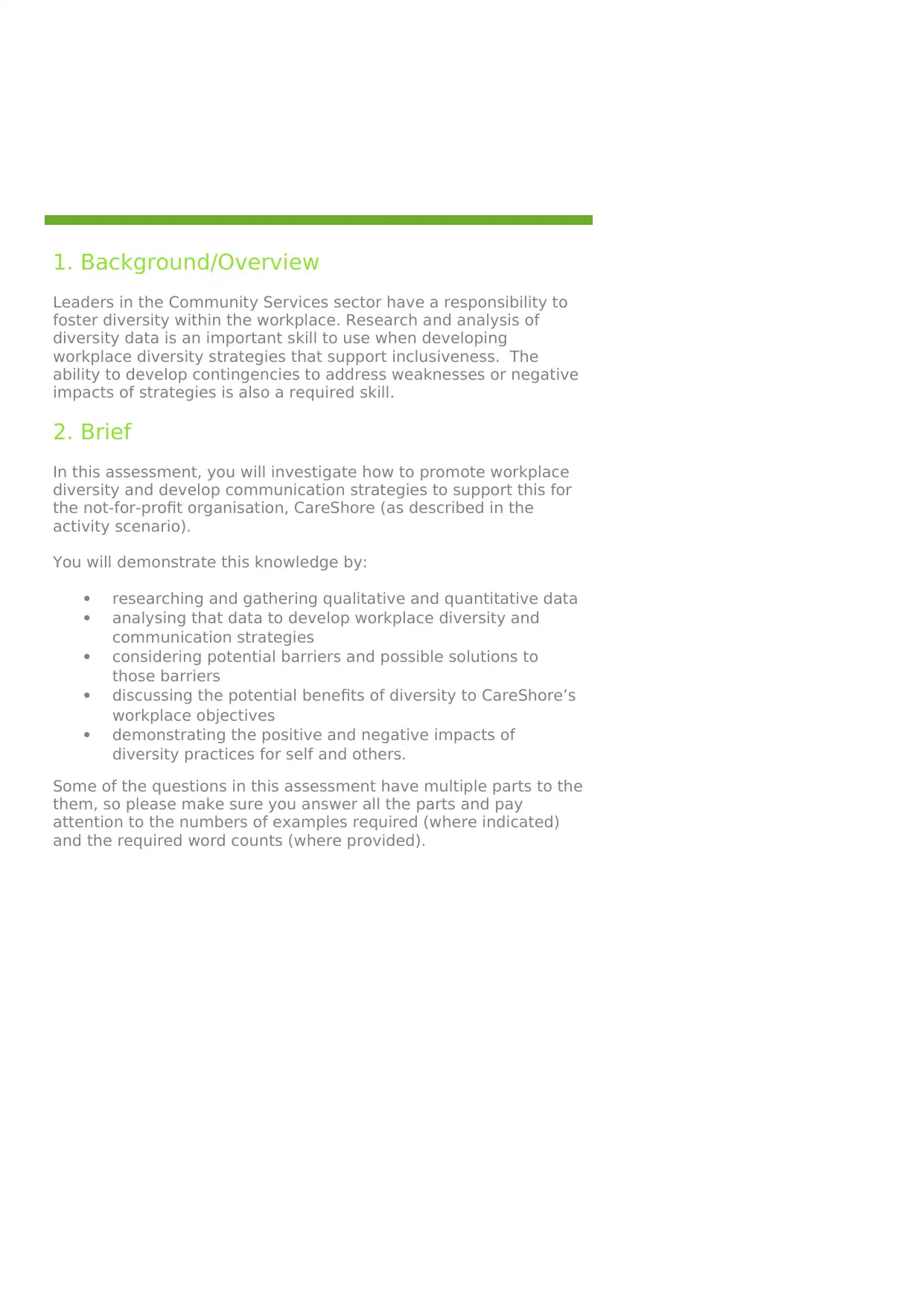
Leaders in the Community Services sector have a responsibility to
foster diversity within the workplace. Research and analysis of
diversity data is an important skill to use when developing
workplace diversity strategies that support inclusiveness. The
ability to develop contingencies to address weaknesses or negative
impacts of strategies is also a required skill.
2. Brief
In this assessment, you will investigate how to promote workplace
diversity and develop communication strategies to support this for
the not-for-profit organisation, CareShore (as described in the
activity scenario).
You will demonstrate this knowledge by:
researching and gathering qualitative and quantitative data
analysing that data to develop workplace diversity and
communication strategies
considering potential barriers and possible solutions to
those barriers
discussing the potential benefits of diversity to CareShore’s
workplace objectives
demonstrating the positive and negative impacts of
diversity practices for self and others.
Some of the questions in this assessment have multiple parts to the
them, so please make sure you answer all the parts and pay
attention to the numbers of examples required (where indicated)
and the required word counts (where provided).
Leaders in the Community Services sector have a responsibility to
foster diversity within the workplace. Research and analysis of
diversity data is an important skill to use when developing
workplace diversity strategies that support inclusiveness. The
ability to develop contingencies to address weaknesses or negative
impacts of strategies is also a required skill.
2. Brief
In this assessment, you will investigate how to promote workplace
diversity and develop communication strategies to support this for
the not-for-profit organisation, CareShore (as described in the
activity scenario).
You will demonstrate this knowledge by:
researching and gathering qualitative and quantitative data
analysing that data to develop workplace diversity and
communication strategies
considering potential barriers and possible solutions to
those barriers
discussing the potential benefits of diversity to CareShore’s
workplace objectives
demonstrating the positive and negative impacts of
diversity practices for self and others.
Some of the questions in this assessment have multiple parts to the
them, so please make sure you answer all the parts and pay
attention to the numbers of examples required (where indicated)
and the required word counts (where provided).
3. Activities
Investigation
Scenario
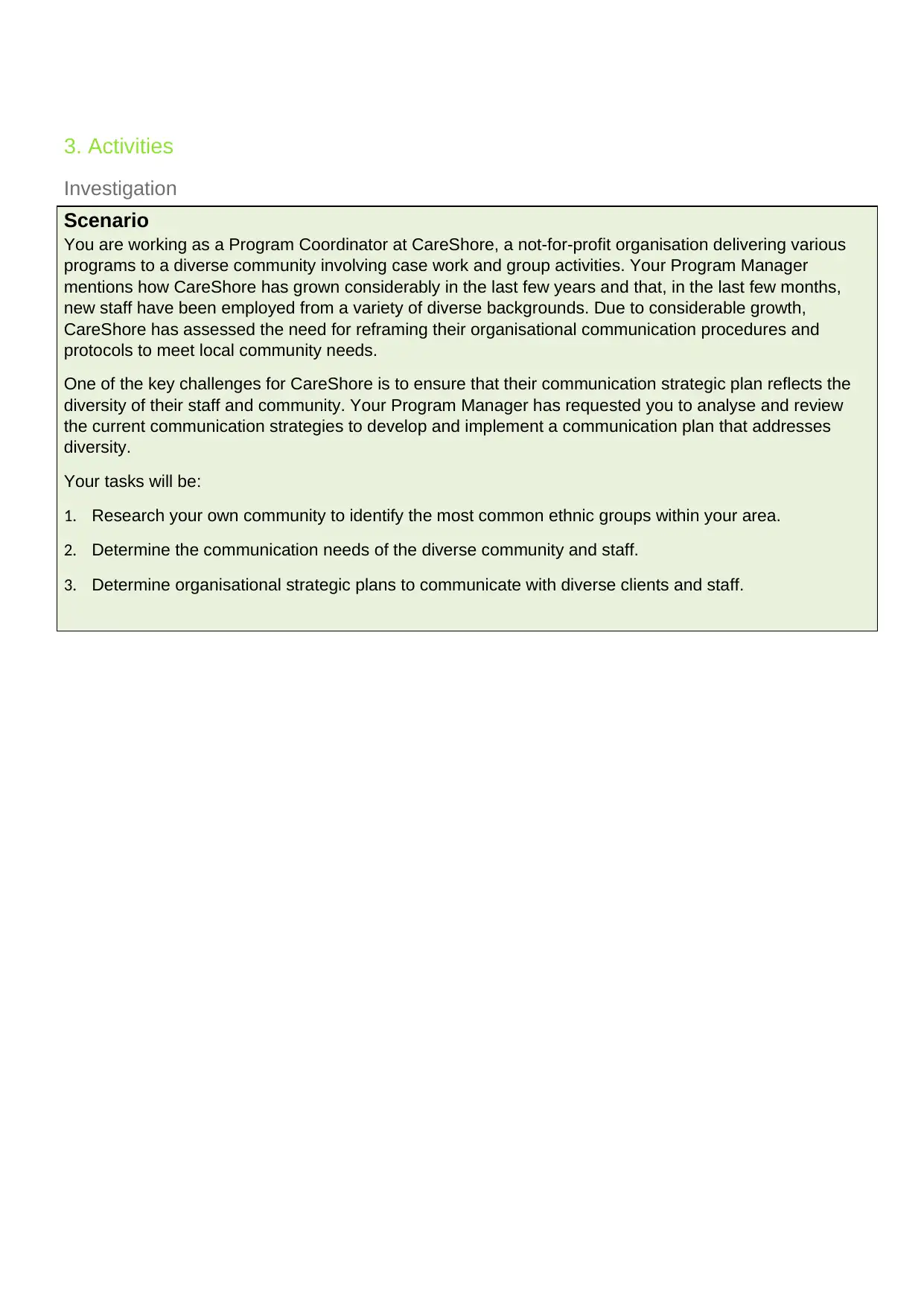
You are working as a Program Coordinator at CareShore, a not-for-profit organisation delivering various
programs to a diverse community involving case work and group activities. Your Program Manager
mentions how CareShore has grown considerably in the last few years and that, in the last few months,
new staff have been employed from a variety of diverse backgrounds. Due to considerable growth,
CareShore has assessed the need for reframing their organisational communication procedures and
protocols to meet local community needs.
One of the key challenges for CareShore is to ensure that their communication strategic plan reflects the
diversity of their staff and community. Your Program Manager has requested you to analyse and review
the current communication strategies to develop and implement a communication plan that addresses
diversity.
Your tasks will be:
1. Research your own community to identify the most common ethnic groups within your area.
2. Determine the communication needs of the diverse community and staff.
3. Determine organisational strategic plans to communicate with diverse clients and staff.
Investigation
Scenario
You are working as a Program Coordinator at CareShore, a not-for-profit organisation delivering various
programs to a diverse community involving case work and group activities. Your Program Manager
mentions how CareShore has grown considerably in the last few years and that, in the last few months,
new staff have been employed from a variety of diverse backgrounds. Due to considerable growth,
CareShore has assessed the need for reframing their organisational communication procedures and
protocols to meet local community needs.
One of the key challenges for CareShore is to ensure that their communication strategic plan reflects the
diversity of their staff and community. Your Program Manager has requested you to analyse and review
the current communication strategies to develop and implement a communication plan that addresses
diversity.
Your tasks will be:
1. Research your own community to identify the most common ethnic groups within your area.
2. Determine the communication needs of the diverse community and staff.
3. Determine organisational strategic plans to communicate with diverse clients and staff.
⊘ This is a preview!⊘
Do you want full access?
Subscribe today to unlock all pages.

Trusted by 1+ million students worldwide
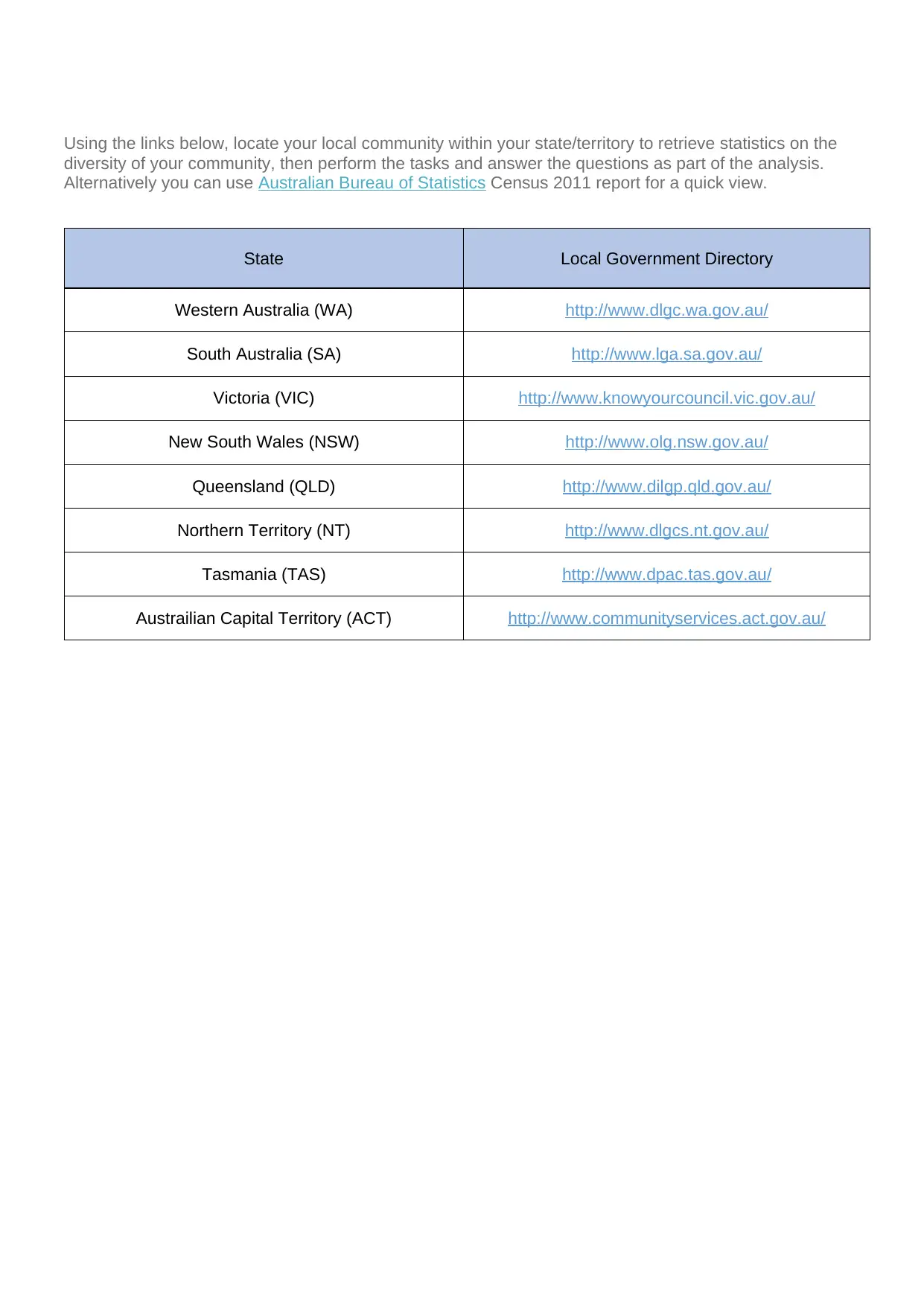
Using the links below, locate your local community within your state/territory to retrieve statistics on the
diversity of your community, then perform the tasks and answer the questions as part of the analysis.
Alternatively you can use Australian Bureau of Statistics Census 2011 report for a quick view.
State Local Government Directory
Western Australia (WA) http://www.dlgc.wa.gov.au/
South Australia (SA) http://www.lga.sa.gov.au/
Victoria (VIC) http://www.knowyourcouncil.vic.gov.au/
New South Wales (NSW) http://www.olg.nsw.gov.au/
Queensland (QLD) http://www.dilgp.qld.gov.au/
Northern Territory (NT) http://www.dlgcs.nt.gov.au/
Tasmania (TAS) http://www.dpac.tas.gov.au/
Austrailian Capital Territory (ACT) http://www.communityservices.act.gov.au/
diversity of your community, then perform the tasks and answer the questions as part of the analysis.
Alternatively you can use Australian Bureau of Statistics Census 2011 report for a quick view.
State Local Government Directory
Western Australia (WA) http://www.dlgc.wa.gov.au/
South Australia (SA) http://www.lga.sa.gov.au/
Victoria (VIC) http://www.knowyourcouncil.vic.gov.au/
New South Wales (NSW) http://www.olg.nsw.gov.au/
Queensland (QLD) http://www.dilgp.qld.gov.au/
Northern Territory (NT) http://www.dlgcs.nt.gov.au/
Tasmania (TAS) http://www.dpac.tas.gov.au/
Austrailian Capital Territory (ACT) http://www.communityservices.act.gov.au/
Paraphrase This Document
Need a fresh take? Get an instant paraphrase of this document with our AI Paraphraser
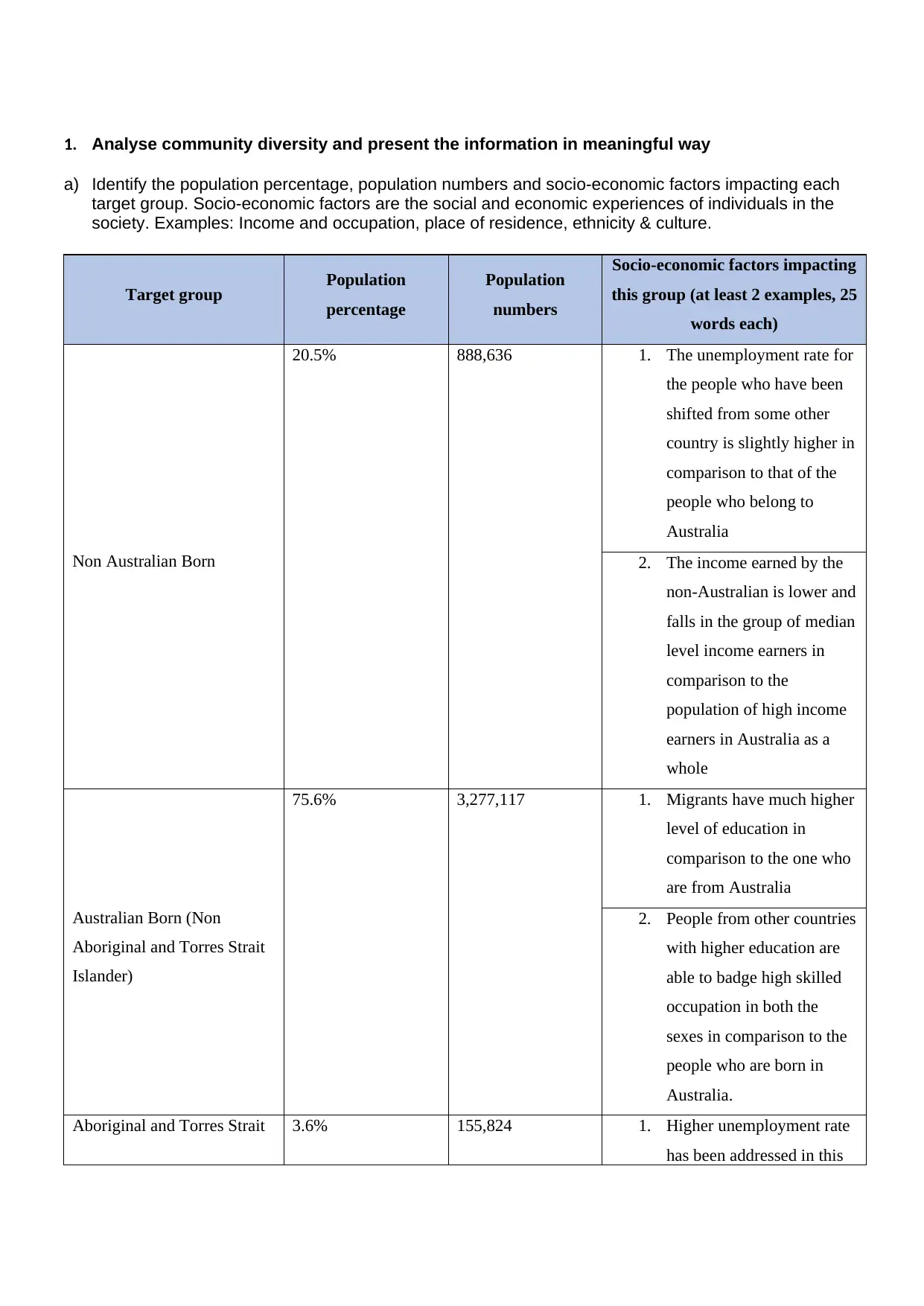
1. Analyse community diversity and present the information in meaningful way
a) Identify the population percentage, population numbers and socio-economic factors impacting each
target group. Socio-economic factors are the social and economic experiences of individuals in the
society. Examples: Income and occupation, place of residence, ethnicity & culture.
Target group Population
percentage
Population
numbers
Socio-economic factors impacting
this group (at least 2 examples, 25
words each)
Non Australian Born
20.5% 888,636 1. The unemployment rate for
the people who have been
shifted from some other
country is slightly higher in
comparison to that of the
people who belong to
Australia
2. The income earned by the
non-Australian is lower and
falls in the group of median
level income earners in
comparison to the
population of high income
earners in Australia as a
whole
Australian Born (Non
Aboriginal and Torres Strait
Islander)
75.6% 3,277,117 1. Migrants have much higher
level of education in
comparison to the one who
are from Australia
2. People from other countries
with higher education are
able to badge high skilled
occupation in both the
sexes in comparison to the
people who are born in
Australia.
Aboriginal and Torres Strait 3.6% 155,824 1. Higher unemployment rate
has been addressed in this
a) Identify the population percentage, population numbers and socio-economic factors impacting each
target group. Socio-economic factors are the social and economic experiences of individuals in the
society. Examples: Income and occupation, place of residence, ethnicity & culture.
Target group Population
percentage
Population
numbers
Socio-economic factors impacting
this group (at least 2 examples, 25
words each)
Non Australian Born
20.5% 888,636 1. The unemployment rate for
the people who have been
shifted from some other
country is slightly higher in
comparison to that of the
people who belong to
Australia
2. The income earned by the
non-Australian is lower and
falls in the group of median
level income earners in
comparison to the
population of high income
earners in Australia as a
whole
Australian Born (Non
Aboriginal and Torres Strait
Islander)
75.6% 3,277,117 1. Migrants have much higher
level of education in
comparison to the one who
are from Australia
2. People from other countries
with higher education are
able to badge high skilled
occupation in both the
sexes in comparison to the
people who are born in
Australia.
Aboriginal and Torres Strait 3.6% 155,824 1. Higher unemployment rate
has been addressed in this
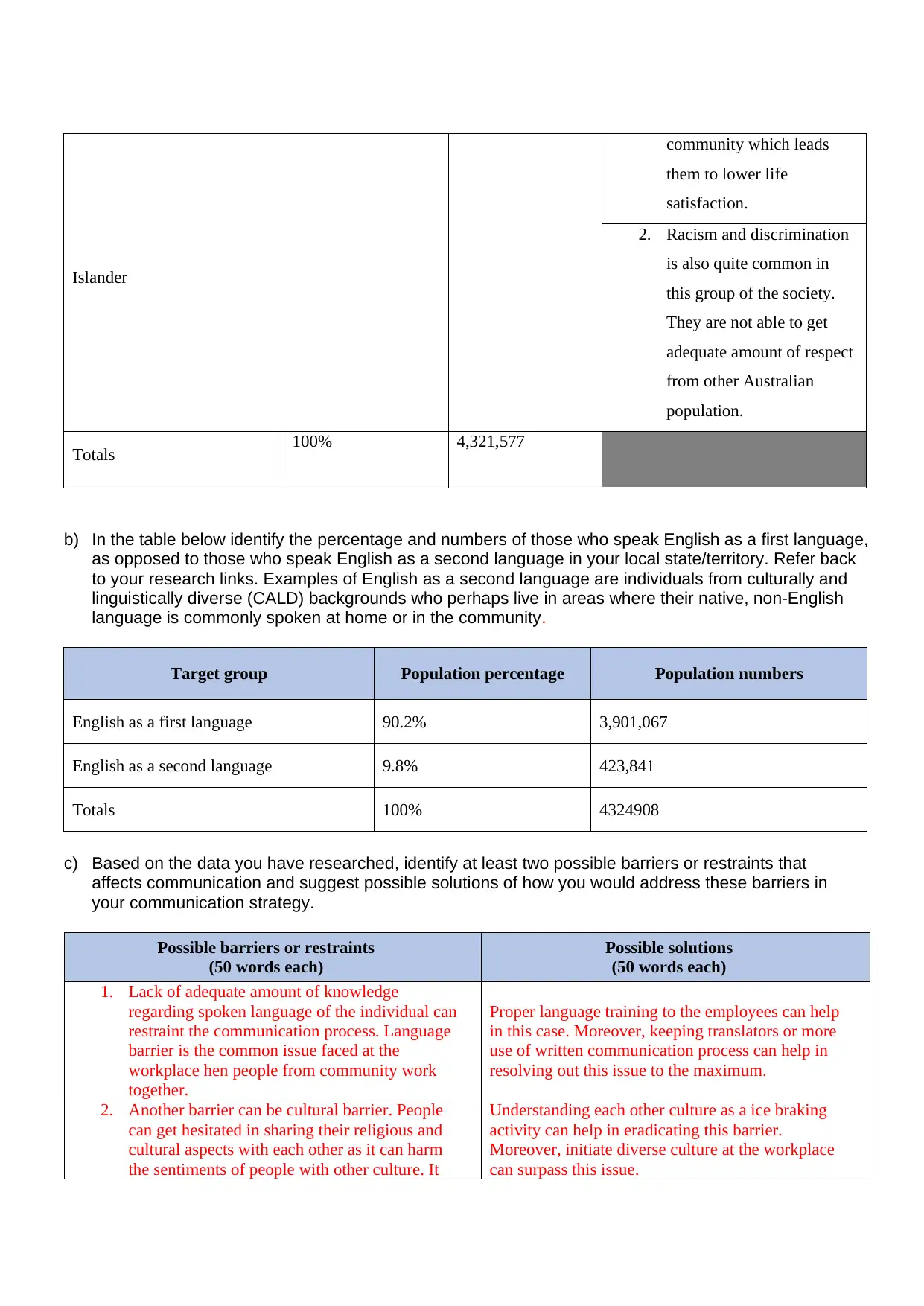
Islander
community which leads
them to lower life
satisfaction.
2. Racism and discrimination
is also quite common in
this group of the society.
They are not able to get
adequate amount of respect
from other Australian
population.
Totals 100% 4,321,577
b) In the table below identify the percentage and numbers of those who speak English as a first language,
as opposed to those who speak English as a second language in your local state/territory. Refer back
to your research links. Examples of English as a second language are individuals from culturally and
linguistically diverse (CALD) backgrounds who perhaps live in areas where their native, non-English
language is commonly spoken at home or in the community.
Target group Population percentage Population numbers
English as a first language 90.2% 3,901,067
English as a second language 9.8% 423,841
Totals 100% 4324908
c) Based on the data you have researched, identify at least two possible barriers or restraints that
affects communication and suggest possible solutions of how you would address these barriers in
your communication strategy.
Possible barriers or restraints
(50 words each)
Possible solutions
(50 words each)
1. Lack of adequate amount of knowledge
regarding spoken language of the individual can
restraint the communication process. Language
barrier is the common issue faced at the
workplace hen people from community work
together.
Proper language training to the employees can help
in this case. Moreover, keeping translators or more
use of written communication process can help in
resolving out this issue to the maximum.
2. Another barrier can be cultural barrier. People
can get hesitated in sharing their religious and
cultural aspects with each other as it can harm
the sentiments of people with other culture. It
Understanding each other culture as a ice braking
activity can help in eradicating this barrier.
Moreover, initiate diverse culture at the workplace
can surpass this issue.
community which leads
them to lower life
satisfaction.
2. Racism and discrimination
is also quite common in
this group of the society.
They are not able to get
adequate amount of respect
from other Australian
population.
Totals 100% 4,321,577
b) In the table below identify the percentage and numbers of those who speak English as a first language,
as opposed to those who speak English as a second language in your local state/territory. Refer back
to your research links. Examples of English as a second language are individuals from culturally and
linguistically diverse (CALD) backgrounds who perhaps live in areas where their native, non-English
language is commonly spoken at home or in the community.
Target group Population percentage Population numbers
English as a first language 90.2% 3,901,067
English as a second language 9.8% 423,841
Totals 100% 4324908
c) Based on the data you have researched, identify at least two possible barriers or restraints that
affects communication and suggest possible solutions of how you would address these barriers in
your communication strategy.
Possible barriers or restraints
(50 words each)
Possible solutions
(50 words each)
1. Lack of adequate amount of knowledge
regarding spoken language of the individual can
restraint the communication process. Language
barrier is the common issue faced at the
workplace hen people from community work
together.
Proper language training to the employees can help
in this case. Moreover, keeping translators or more
use of written communication process can help in
resolving out this issue to the maximum.
2. Another barrier can be cultural barrier. People
can get hesitated in sharing their religious and
cultural aspects with each other as it can harm
the sentiments of people with other culture. It
Understanding each other culture as a ice braking
activity can help in eradicating this barrier.
Moreover, initiate diverse culture at the workplace
can surpass this issue.
⊘ This is a preview!⊘
Do you want full access?
Subscribe today to unlock all pages.
Trusted by 1+ million students worldwide
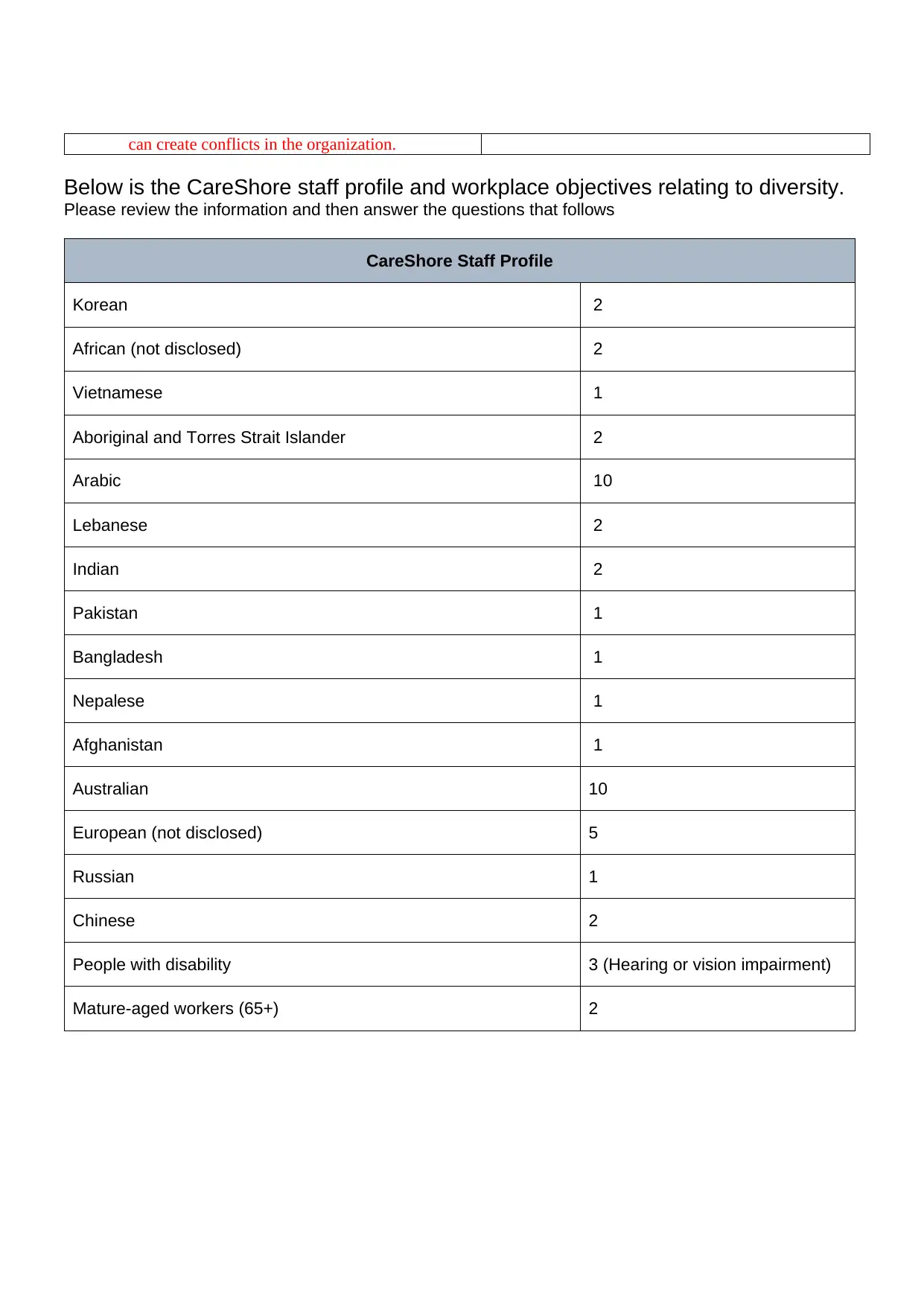
can create conflicts in the organization.
Below is the CareShore staff profile and workplace objectives relating to diversity.
Please review the information and then answer the questions that follows
CareShore Staff Profile
Korean 2
African (not disclosed) 2
Vietnamese 1
Aboriginal and Torres Strait Islander 2
Arabic 10
Lebanese 2
Indian 2
Pakistan 1
Bangladesh 1
Nepalese 1
Afghanistan 1
Australian 10
European (not disclosed) 5
Russian 1
Chinese 2
People with disability 3 (Hearing or vision impairment)
Mature-aged workers (65+) 2
Below is the CareShore staff profile and workplace objectives relating to diversity.
Please review the information and then answer the questions that follows
CareShore Staff Profile
Korean 2
African (not disclosed) 2
Vietnamese 1
Aboriginal and Torres Strait Islander 2
Arabic 10
Lebanese 2
Indian 2
Pakistan 1
Bangladesh 1
Nepalese 1
Afghanistan 1
Australian 10
European (not disclosed) 5
Russian 1
Chinese 2
People with disability 3 (Hearing or vision impairment)
Mature-aged workers (65+) 2
Paraphrase This Document
Need a fresh take? Get an instant paraphrase of this document with our AI Paraphraser
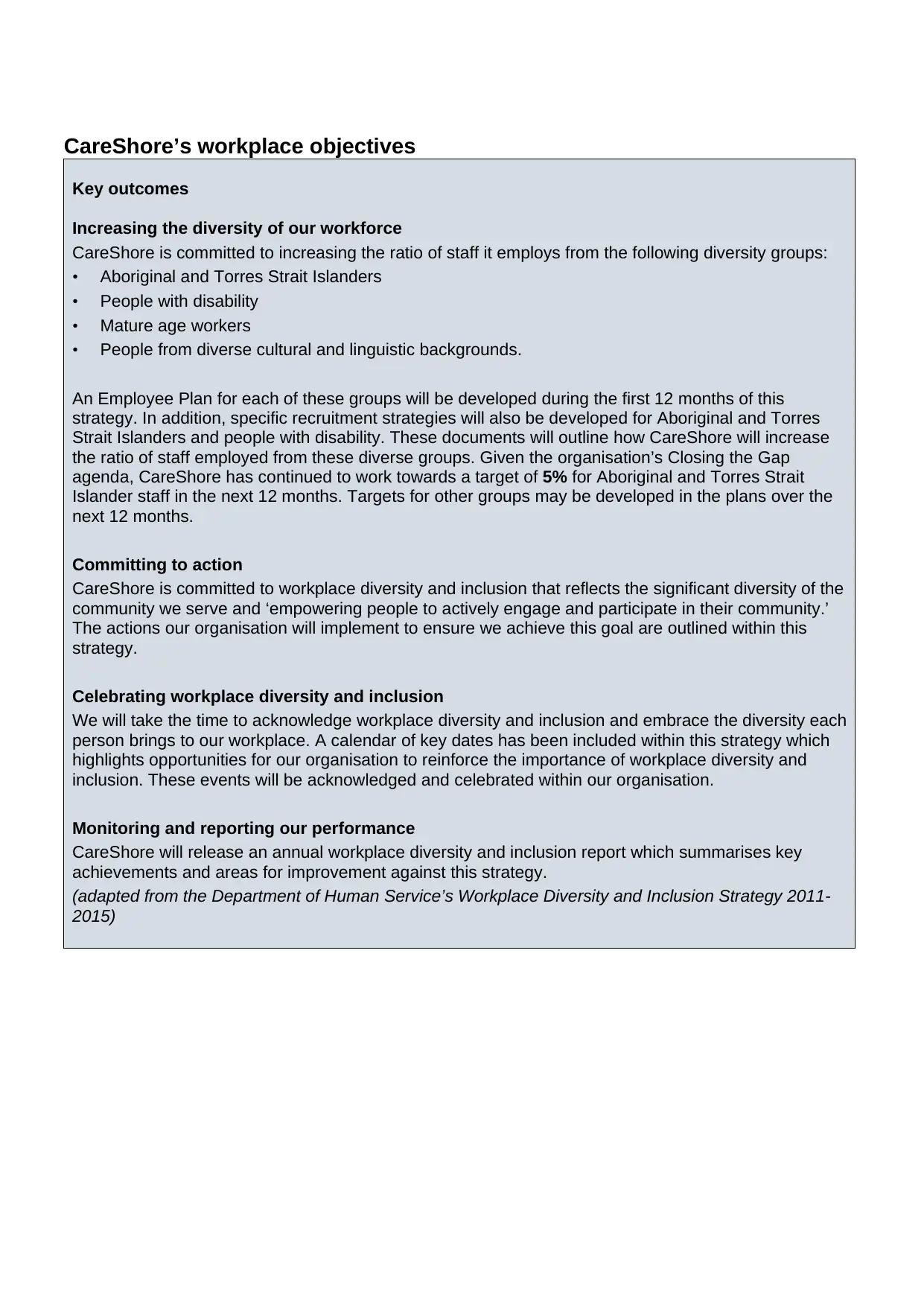
CareShore’s workplace objectives
Key outcomes
Increasing the diversity of our workforce
CareShore is committed to increasing the ratio of staff it employs from the following diversity groups:
• Aboriginal and Torres Strait Islanders
• People with disability
• Mature age workers
• People from diverse cultural and linguistic backgrounds.
An Employee Plan for each of these groups will be developed during the first 12 months of this
strategy. In addition, specific recruitment strategies will also be developed for Aboriginal and Torres
Strait Islanders and people with disability. These documents will outline how CareShore will increase
the ratio of staff employed from these diverse groups. Given the organisation’s Closing the Gap
agenda, CareShore has continued to work towards a target of 5% for Aboriginal and Torres Strait
Islander staff in the next 12 months. Targets for other groups may be developed in the plans over the
next 12 months.
Committing to action
CareShore is committed to workplace diversity and inclusion that reflects the significant diversity of the
community we serve and ‘empowering people to actively engage and participate in their community.’
The actions our organisation will implement to ensure we achieve this goal are outlined within this
strategy.
Celebrating workplace diversity and inclusion
We will take the time to acknowledge workplace diversity and inclusion and embrace the diversity each
person brings to our workplace. A calendar of key dates has been included within this strategy which
highlights opportunities for our organisation to reinforce the importance of workplace diversity and
inclusion. These events will be acknowledged and celebrated within our organisation.
Monitoring and reporting our performance
CareShore will release an annual workplace diversity and inclusion report which summarises key
achievements and areas for improvement against this strategy.
(adapted from the Department of Human Service’s Workplace Diversity and Inclusion Strategy 2011-
2015)
Key outcomes
Increasing the diversity of our workforce
CareShore is committed to increasing the ratio of staff it employs from the following diversity groups:
• Aboriginal and Torres Strait Islanders
• People with disability
• Mature age workers
• People from diverse cultural and linguistic backgrounds.
An Employee Plan for each of these groups will be developed during the first 12 months of this
strategy. In addition, specific recruitment strategies will also be developed for Aboriginal and Torres
Strait Islanders and people with disability. These documents will outline how CareShore will increase
the ratio of staff employed from these diverse groups. Given the organisation’s Closing the Gap
agenda, CareShore has continued to work towards a target of 5% for Aboriginal and Torres Strait
Islander staff in the next 12 months. Targets for other groups may be developed in the plans over the
next 12 months.
Committing to action
CareShore is committed to workplace diversity and inclusion that reflects the significant diversity of the
community we serve and ‘empowering people to actively engage and participate in their community.’
The actions our organisation will implement to ensure we achieve this goal are outlined within this
strategy.
Celebrating workplace diversity and inclusion
We will take the time to acknowledge workplace diversity and inclusion and embrace the diversity each
person brings to our workplace. A calendar of key dates has been included within this strategy which
highlights opportunities for our organisation to reinforce the importance of workplace diversity and
inclusion. These events will be acknowledged and celebrated within our organisation.
Monitoring and reporting our performance
CareShore will release an annual workplace diversity and inclusion report which summarises key
achievements and areas for improvement against this strategy.
(adapted from the Department of Human Service’s Workplace Diversity and Inclusion Strategy 2011-
2015)
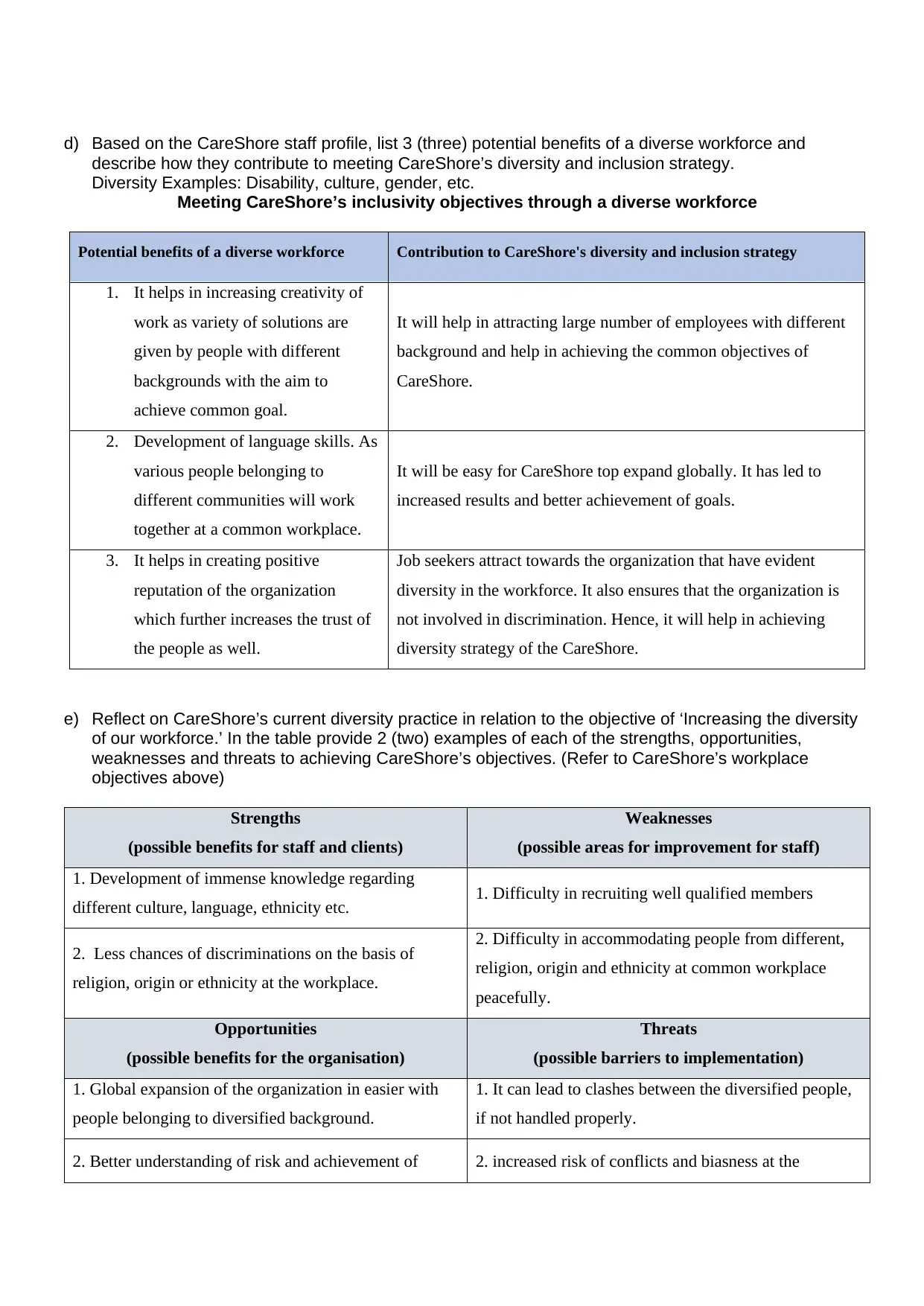
d) Based on the CareShore staff profile, list 3 (three) potential benefits of a diverse workforce and
describe how they contribute to meeting CareShore’s diversity and inclusion strategy.
Diversity Examples: Disability, culture, gender, etc.
Meeting CareShore’s inclusivity objectives through a diverse workforce
Potential benefits of a diverse workforce Contribution to CareShore's diversity and inclusion strategy
1. It helps in increasing creativity of
work as variety of solutions are
given by people with different
backgrounds with the aim to
achieve common goal.
It will help in attracting large number of employees with different
background and help in achieving the common objectives of
CareShore.
2. Development of language skills. As
various people belonging to
different communities will work
together at a common workplace.
It will be easy for CareShore top expand globally. It has led to
increased results and better achievement of goals.
3. It helps in creating positive
reputation of the organization
which further increases the trust of
the people as well.
Job seekers attract towards the organization that have evident
diversity in the workforce. It also ensures that the organization is
not involved in discrimination. Hence, it will help in achieving
diversity strategy of the CareShore.
e) Reflect on CareShore’s current diversity practice in relation to the objective of ‘Increasing the diversity
of our workforce.’ In the table provide 2 (two) examples of each of the strengths, opportunities,
weaknesses and threats to achieving CareShore’s objectives. (Refer to CareShore’s workplace
objectives above)
Strengths
(possible benefits for staff and clients)
Weaknesses
(possible areas for improvement for staff)
1. Development of immense knowledge regarding
different culture, language, ethnicity etc. 1. Difficulty in recruiting well qualified members
2. Less chances of discriminations on the basis of
religion, origin or ethnicity at the workplace.
2. Difficulty in accommodating people from different,
religion, origin and ethnicity at common workplace
peacefully.
Opportunities
(possible benefits for the organisation)
Threats
(possible barriers to implementation)
1. Global expansion of the organization in easier with
people belonging to diversified background.
1. It can lead to clashes between the diversified people,
if not handled properly.
2. Better understanding of risk and achievement of 2. increased risk of conflicts and biasness at the
describe how they contribute to meeting CareShore’s diversity and inclusion strategy.
Diversity Examples: Disability, culture, gender, etc.
Meeting CareShore’s inclusivity objectives through a diverse workforce
Potential benefits of a diverse workforce Contribution to CareShore's diversity and inclusion strategy
1. It helps in increasing creativity of
work as variety of solutions are
given by people with different
backgrounds with the aim to
achieve common goal.
It will help in attracting large number of employees with different
background and help in achieving the common objectives of
CareShore.
2. Development of language skills. As
various people belonging to
different communities will work
together at a common workplace.
It will be easy for CareShore top expand globally. It has led to
increased results and better achievement of goals.
3. It helps in creating positive
reputation of the organization
which further increases the trust of
the people as well.
Job seekers attract towards the organization that have evident
diversity in the workforce. It also ensures that the organization is
not involved in discrimination. Hence, it will help in achieving
diversity strategy of the CareShore.
e) Reflect on CareShore’s current diversity practice in relation to the objective of ‘Increasing the diversity
of our workforce.’ In the table provide 2 (two) examples of each of the strengths, opportunities,
weaknesses and threats to achieving CareShore’s objectives. (Refer to CareShore’s workplace
objectives above)
Strengths
(possible benefits for staff and clients)
Weaknesses
(possible areas for improvement for staff)
1. Development of immense knowledge regarding
different culture, language, ethnicity etc. 1. Difficulty in recruiting well qualified members
2. Less chances of discriminations on the basis of
religion, origin or ethnicity at the workplace.
2. Difficulty in accommodating people from different,
religion, origin and ethnicity at common workplace
peacefully.
Opportunities
(possible benefits for the organisation)
Threats
(possible barriers to implementation)
1. Global expansion of the organization in easier with
people belonging to diversified background.
1. It can lead to clashes between the diversified people,
if not handled properly.
2. Better understanding of risk and achievement of 2. increased risk of conflicts and biasness at the
⊘ This is a preview!⊘
Do you want full access?
Subscribe today to unlock all pages.
Trusted by 1+ million students worldwide

upcoming goals. workplace.
Paraphrase This Document
Need a fresh take? Get an instant paraphrase of this document with our AI Paraphraser
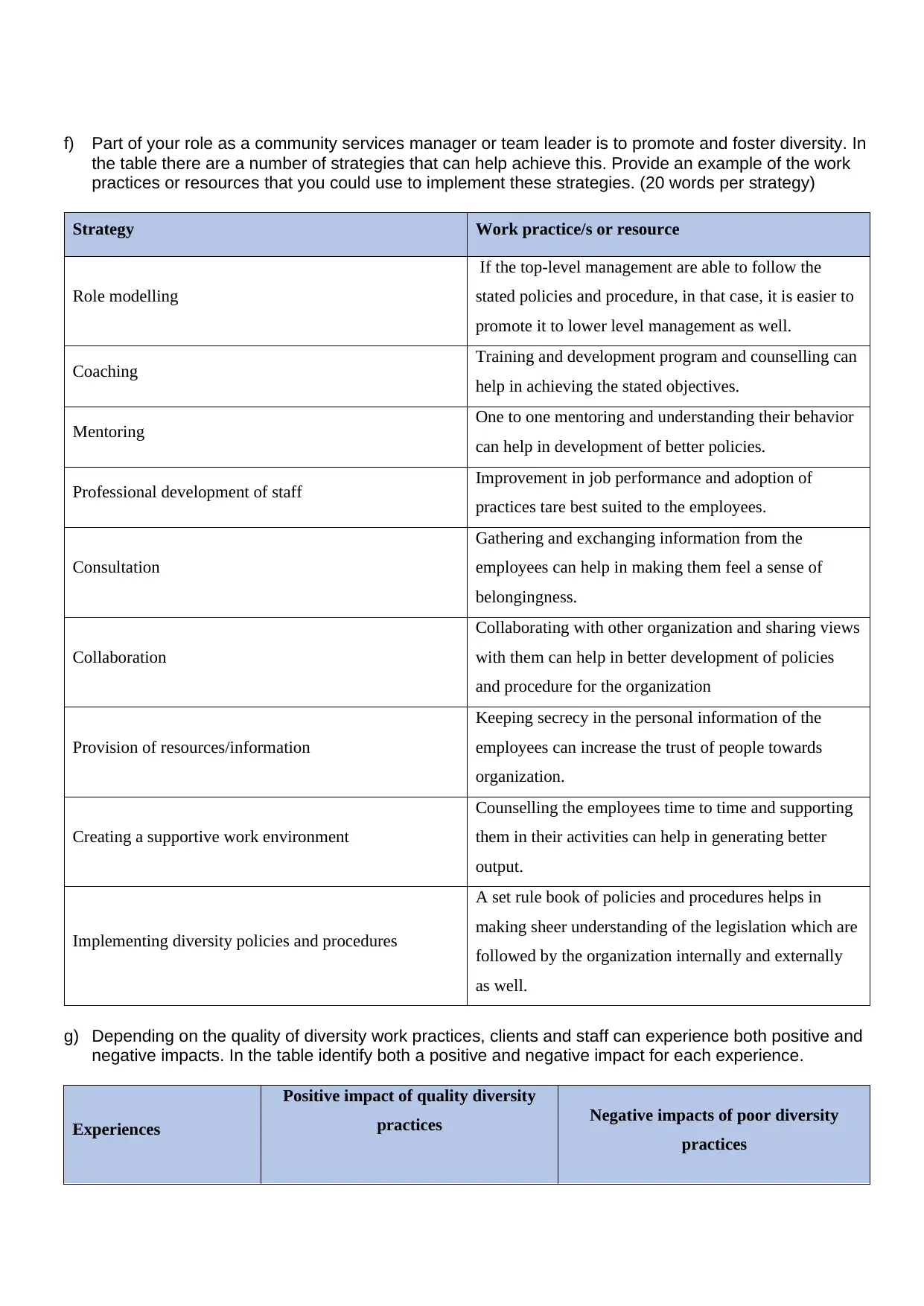
f) Part of your role as a community services manager or team leader is to promote and foster diversity. In
the table there are a number of strategies that can help achieve this. Provide an example of the work
practices or resources that you could use to implement these strategies. (20 words per strategy)
Strategy Work practice/s or resource
Role modelling
If the top-level management are able to follow the
stated policies and procedure, in that case, it is easier to
promote it to lower level management as well.
Coaching Training and development program and counselling can
help in achieving the stated objectives.
Mentoring One to one mentoring and understanding their behavior
can help in development of better policies.
Professional development of staff Improvement in job performance and adoption of
practices tare best suited to the employees.
Consultation
Gathering and exchanging information from the
employees can help in making them feel a sense of
belongingness.
Collaboration
Collaborating with other organization and sharing views
with them can help in better development of policies
and procedure for the organization
Provision of resources/information
Keeping secrecy in the personal information of the
employees can increase the trust of people towards
organization.
Creating a supportive work environment
Counselling the employees time to time and supporting
them in their activities can help in generating better
output.
Implementing diversity policies and procedures
A set rule book of policies and procedures helps in
making sheer understanding of the legislation which are
followed by the organization internally and externally
as well.
g) Depending on the quality of diversity work practices, clients and staff can experience both positive and
negative impacts. In the table identify both a positive and negative impact for each experience.
Experiences
Positive impact of quality diversity
practices Negative impacts of poor diversity
practices
the table there are a number of strategies that can help achieve this. Provide an example of the work
practices or resources that you could use to implement these strategies. (20 words per strategy)
Strategy Work practice/s or resource
Role modelling
If the top-level management are able to follow the
stated policies and procedure, in that case, it is easier to
promote it to lower level management as well.
Coaching Training and development program and counselling can
help in achieving the stated objectives.
Mentoring One to one mentoring and understanding their behavior
can help in development of better policies.
Professional development of staff Improvement in job performance and adoption of
practices tare best suited to the employees.
Consultation
Gathering and exchanging information from the
employees can help in making them feel a sense of
belongingness.
Collaboration
Collaborating with other organization and sharing views
with them can help in better development of policies
and procedure for the organization
Provision of resources/information
Keeping secrecy in the personal information of the
employees can increase the trust of people towards
organization.
Creating a supportive work environment
Counselling the employees time to time and supporting
them in their activities can help in generating better
output.
Implementing diversity policies and procedures
A set rule book of policies and procedures helps in
making sheer understanding of the legislation which are
followed by the organization internally and externally
as well.
g) Depending on the quality of diversity work practices, clients and staff can experience both positive and
negative impacts. In the table identify both a positive and negative impact for each experience.
Experiences
Positive impact of quality diversity
practices Negative impacts of poor diversity
practices
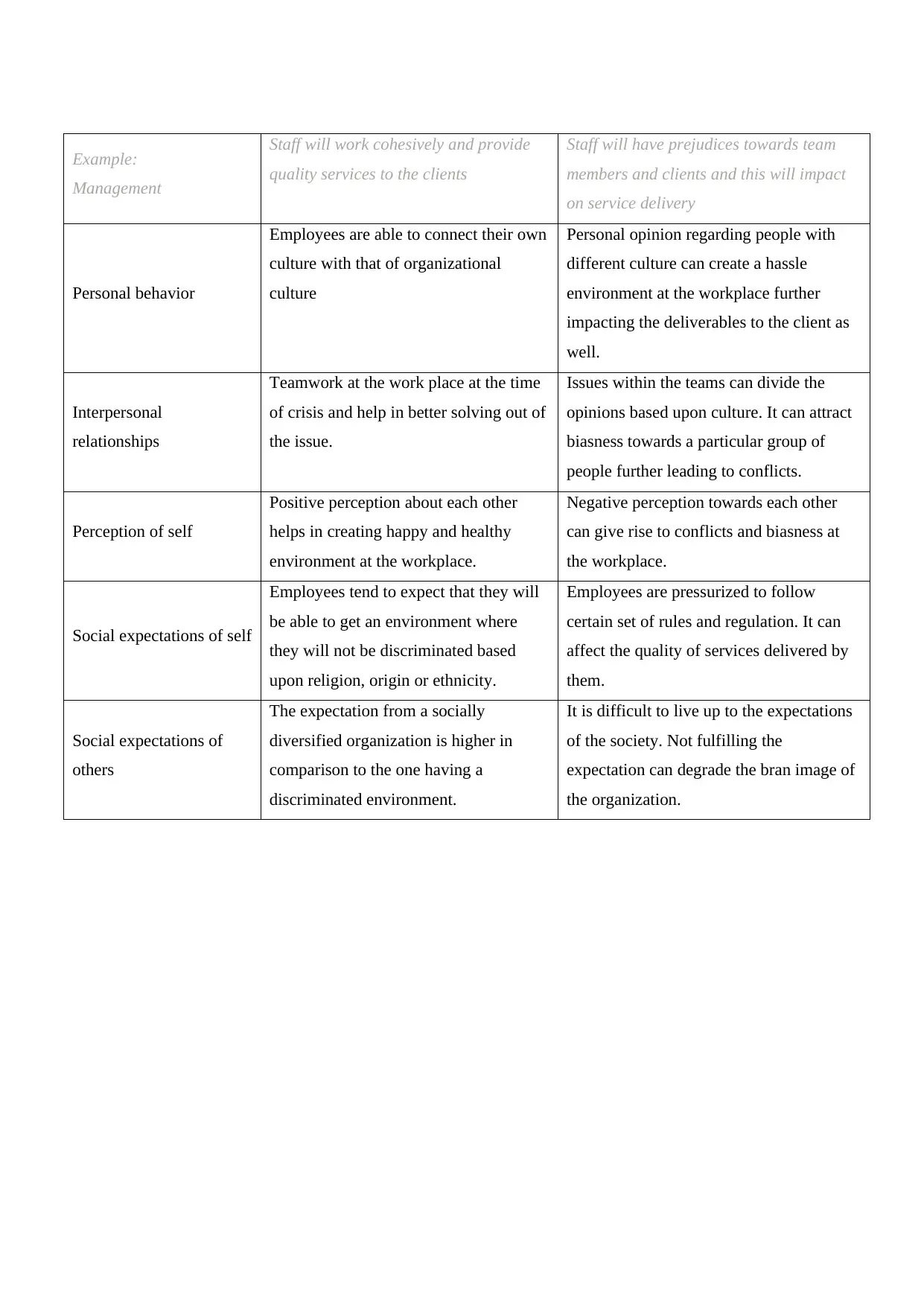
Example:
Management
Staff will work cohesively and provide
quality services to the clients
Staff will have prejudices towards team
members and clients and this will impact
on service delivery
Personal behavior
Employees are able to connect their own
culture with that of organizational
culture
Personal opinion regarding people with
different culture can create a hassle
environment at the workplace further
impacting the deliverables to the client as
well.
Interpersonal
relationships
Teamwork at the work place at the time
of crisis and help in better solving out of
the issue.
Issues within the teams can divide the
opinions based upon culture. It can attract
biasness towards a particular group of
people further leading to conflicts.
Perception of self
Positive perception about each other
helps in creating happy and healthy
environment at the workplace.
Negative perception towards each other
can give rise to conflicts and biasness at
the workplace.
Social expectations of self
Employees tend to expect that they will
be able to get an environment where
they will not be discriminated based
upon religion, origin or ethnicity.
Employees are pressurized to follow
certain set of rules and regulation. It can
affect the quality of services delivered by
them.
Social expectations of
others
The expectation from a socially
diversified organization is higher in
comparison to the one having a
discriminated environment.
It is difficult to live up to the expectations
of the society. Not fulfilling the
expectation can degrade the bran image of
the organization.
Management
Staff will work cohesively and provide
quality services to the clients
Staff will have prejudices towards team
members and clients and this will impact
on service delivery
Personal behavior
Employees are able to connect their own
culture with that of organizational
culture
Personal opinion regarding people with
different culture can create a hassle
environment at the workplace further
impacting the deliverables to the client as
well.
Interpersonal
relationships
Teamwork at the work place at the time
of crisis and help in better solving out of
the issue.
Issues within the teams can divide the
opinions based upon culture. It can attract
biasness towards a particular group of
people further leading to conflicts.
Perception of self
Positive perception about each other
helps in creating happy and healthy
environment at the workplace.
Negative perception towards each other
can give rise to conflicts and biasness at
the workplace.
Social expectations of self
Employees tend to expect that they will
be able to get an environment where
they will not be discriminated based
upon religion, origin or ethnicity.
Employees are pressurized to follow
certain set of rules and regulation. It can
affect the quality of services delivered by
them.
Social expectations of
others
The expectation from a socially
diversified organization is higher in
comparison to the one having a
discriminated environment.
It is difficult to live up to the expectations
of the society. Not fulfilling the
expectation can degrade the bran image of
the organization.
⊘ This is a preview!⊘
Do you want full access?
Subscribe today to unlock all pages.
Trusted by 1+ million students worldwide

1 out of 37


Related Documents


Your All-in-One AI-Powered Toolkit for Academic Success.
+13062052269
info@desklib.com
Available 24*7 on WhatsApp / Email
![[object Object]](/_next/static/media/star-bottom.7253800d.svg)
Unlock your academic potential
Copyright © 2020–2026 A2Z Services. All Rights Reserved. Developed and managed by ZUCOL.