Report on Diversity in Organisation: Social Group Dynamics Analysis
VerifiedAdded on 2021/06/14
|10
|2873
|24
Report
AI Summary
This report delves into the complexities of diversity within organizations, examining the experiences of both socially advantaged and disadvantaged groups. The author, drawing from personal experiences, highlights the disparities in treatment and opportunities faced by these groups, emphasizing the prevalence of social demarcations and the impact of prejudice and discrimination. The report explores the influence of family, religion, and social class on individuals' lives, underscoring the importance of equality and equal opportunities. Furthermore, it examines the cognitive basis of prejudice, including categorization, assimilation, and the search for coherence, as well as the role of social identity theory in understanding group dynamics. The report also touches upon the factors contributing to community disadvantage and the economic and political contexts influencing social advantage and disadvantage, particularly in the context of New Zealand. Overall, the report provides a comprehensive analysis of diversity, social inequality, and the importance of fostering inclusive organizational environments.
Running head: DIVERSITY IN ORGANISATION
Diversity in Organisation
Name of Student:
Name of University:
Author’s Note:
Diversity in Organisation
Name of Student:
Name of University:
Author’s Note:

Paraphrase This Document
Need a fresh take? Get an instant paraphrase of this document with our AI Paraphraser
1DIVERSITY IN ORGANISATION
Task 1:
As a firm believer of social service I have always tried to help people and this has
contributed to my overall faith and belief in the concept of well being. This is because of the
reason that social help cannot be replaced by anything else. I feel immense pleasure and
satisfaction in working for others. I have been a part of both socially advantaged as well as
socially disadvantaged groups. There is a very distinct difference between both the advantaged
groups. The group of people who have a great risk of poverty, social exclusion, discrimination
and violence than the overall general population are socially disadvantaged groups. The socially
disadvantaged group of people might include the ethnic minorities, migrants, people with
disabilities, isolated elderly people and children. These section of the people are extremely
downtrodden and vulnerable and they are not properly cared for. It is needed that people be
conscious towards their needs which can help them in the achievement of a probable bond
between them. There have also been barriers of language, culture and other factors which have
kept this section of the community deprived from even the basic amenities of life.
Being a member of a socially disadvantaged group I had experienced a sense of
detachment from the common people of the community. There is a strange sort of dis-balance
towards the downtrodden and this socially disadvantaged group of people. The experiences of
the members and the thoughts which they share have made me understand clearly that they have
never been able to see the brighter side in their lives. I was going with a few other disadvantaged
people in the local stores where I found an overall interest in the shop owners towards our needs.
It was as if the needs and requirements of socially disadvantaged people do not matter. This was
demonstrated so normally that I was forced to think what led to such a disparity in the society.
Task 1:
As a firm believer of social service I have always tried to help people and this has
contributed to my overall faith and belief in the concept of well being. This is because of the
reason that social help cannot be replaced by anything else. I feel immense pleasure and
satisfaction in working for others. I have been a part of both socially advantaged as well as
socially disadvantaged groups. There is a very distinct difference between both the advantaged
groups. The group of people who have a great risk of poverty, social exclusion, discrimination
and violence than the overall general population are socially disadvantaged groups. The socially
disadvantaged group of people might include the ethnic minorities, migrants, people with
disabilities, isolated elderly people and children. These section of the people are extremely
downtrodden and vulnerable and they are not properly cared for. It is needed that people be
conscious towards their needs which can help them in the achievement of a probable bond
between them. There have also been barriers of language, culture and other factors which have
kept this section of the community deprived from even the basic amenities of life.
Being a member of a socially disadvantaged group I had experienced a sense of
detachment from the common people of the community. There is a strange sort of dis-balance
towards the downtrodden and this socially disadvantaged group of people. The experiences of
the members and the thoughts which they share have made me understand clearly that they have
never been able to see the brighter side in their lives. I was going with a few other disadvantaged
people in the local stores where I found an overall interest in the shop owners towards our needs.
It was as if the needs and requirements of socially disadvantaged people do not matter. This was
demonstrated so normally that I was forced to think what led to such a disparity in the society.
2DIVERSITY IN ORGANISATION
I have also been a member of a socially privileged group. The scenario in this group is
entirely different. The outlook of the people towards the members of such a group is also
different. At the time a member who is socially advantaged needs something there are already
ten people to assist him or her. Such a difference between both the types of social or racial
groups is huge. At the time when I visited a local store with the socially advantaged group of
people a shocking incident was witnessed by me. At the local store the people were buying
things according to their needs. At the time of creation of a line, it was suddenly found that the
people belonging to the line were asked to wait and they were abruptly removed from the line. I
could not understand the situation at first but later found out that the people who were at the
beginning of the line were socially disadvantaged group members and therefore they were not
being given the preference to clear their dues initially. The people who were at the end of the
line, were socially privileged and therefore they were not given the trouble of waiting for their
turn to arrive. This was a remarkable and very wrong and unjust practice according to my moral
and ethical understanding. This made me realise that social demarcations were very much
prevalent in the society. The people who were socially deprived continued to remain deprived
and the people who were socially advantaged were socially advantaged. There is a vast
existential disparity between the two social groups. This is very much prevalent in several parts
of the world which need to be addressed at the earliest (Bonevski et al., 2014).
Task 2:
I am a person who comes from a family where there is always a sense of equality and
there is no discrimination among people on the basis of anything. This has been reflected in my
decisions and my personality in terms of helping me develop to the person I am. I am very liberal
and understanding as a person. Being a student I have never differentiated between people. I do
I have also been a member of a socially privileged group. The scenario in this group is
entirely different. The outlook of the people towards the members of such a group is also
different. At the time a member who is socially advantaged needs something there are already
ten people to assist him or her. Such a difference between both the types of social or racial
groups is huge. At the time when I visited a local store with the socially advantaged group of
people a shocking incident was witnessed by me. At the local store the people were buying
things according to their needs. At the time of creation of a line, it was suddenly found that the
people belonging to the line were asked to wait and they were abruptly removed from the line. I
could not understand the situation at first but later found out that the people who were at the
beginning of the line were socially disadvantaged group members and therefore they were not
being given the preference to clear their dues initially. The people who were at the end of the
line, were socially privileged and therefore they were not given the trouble of waiting for their
turn to arrive. This was a remarkable and very wrong and unjust practice according to my moral
and ethical understanding. This made me realise that social demarcations were very much
prevalent in the society. The people who were socially deprived continued to remain deprived
and the people who were socially advantaged were socially advantaged. There is a vast
existential disparity between the two social groups. This is very much prevalent in several parts
of the world which need to be addressed at the earliest (Bonevski et al., 2014).
Task 2:
I am a person who comes from a family where there is always a sense of equality and
there is no discrimination among people on the basis of anything. This has been reflected in my
decisions and my personality in terms of helping me develop to the person I am. I am very liberal
and understanding as a person. Being a student I have never differentiated between people. I do
⊘ This is a preview!⊘
Do you want full access?
Subscribe today to unlock all pages.

Trusted by 1+ million students worldwide
3DIVERSITY IN ORGANISATION
not advocate the ideas of depriving people from the basic amenities of life. I have never seen too
much of anything in my life. There has never been a situation in my life where things have come
more easily to me than they should. I have had my share of struggles and my share of problems
and responsibilities which I had to face in my life. I feel that unless a person has to deal with
problems or shortcomings in his or her life it will not be possible for the person to understand the
importance of struggle in life. I feel that my struggles have taken me where I am today. I have
always believed that people need to be treated equally despite their shortcomings. I never
misbehave with people depending on their place of origin or whether they have been socially
deprived.
The situations of privilege are connected in a specific situation and it is not possible for
one to exist without the other. It can be stated that these are on opposite ends of a particular
spectrum. The people who have always seen a privileged life do not understand the meaning of
disadvantage. This also causes them to feel that they will always continue to remain privileged in
their whole lives. These people behave with others based on their status or their background
which is not correct. I have met and mixed with people of different cultural backgrounds and this
has impacted my ideas about life. I feel that every person has his or her personal battles to deal
with. This is extremely crucial to understand because the impact of negative behaviour with a
person goes a long way in harming the relationships which we share with people. In countries all
over the world, the impact of social class has several far reaching consequences. The social class
is actually the grouping of individuals in a stratified hierarchy which is based on their wealth,
income, education, occupation and social network. The position in the social class hierarchy has
a chance of considerably impacting the overall situation of a person. Social class is a very strong
determinant of the heath of a person.
not advocate the ideas of depriving people from the basic amenities of life. I have never seen too
much of anything in my life. There has never been a situation in my life where things have come
more easily to me than they should. I have had my share of struggles and my share of problems
and responsibilities which I had to face in my life. I feel that unless a person has to deal with
problems or shortcomings in his or her life it will not be possible for the person to understand the
importance of struggle in life. I feel that my struggles have taken me where I am today. I have
always believed that people need to be treated equally despite their shortcomings. I never
misbehave with people depending on their place of origin or whether they have been socially
deprived.
The situations of privilege are connected in a specific situation and it is not possible for
one to exist without the other. It can be stated that these are on opposite ends of a particular
spectrum. The people who have always seen a privileged life do not understand the meaning of
disadvantage. This also causes them to feel that they will always continue to remain privileged in
their whole lives. These people behave with others based on their status or their background
which is not correct. I have met and mixed with people of different cultural backgrounds and this
has impacted my ideas about life. I feel that every person has his or her personal battles to deal
with. This is extremely crucial to understand because the impact of negative behaviour with a
person goes a long way in harming the relationships which we share with people. In countries all
over the world, the impact of social class has several far reaching consequences. The social class
is actually the grouping of individuals in a stratified hierarchy which is based on their wealth,
income, education, occupation and social network. The position in the social class hierarchy has
a chance of considerably impacting the overall situation of a person. Social class is a very strong
determinant of the heath of a person.
Paraphrase This Document
Need a fresh take? Get an instant paraphrase of this document with our AI Paraphraser
4DIVERSITY IN ORGANISATION
There is also the prevalence of the inequality of health which refers to the unequal
distribution of environmental hazards of heath and also the access to the health services between
the demographic groups including that of social classes. I am of the opinion that the affluent
communities are much more likely to have a certain access to the fresh produce and the
recreational facilities for the exercise, preventative programs of healthcare and the medical visits
which are routine in nature. The affluent communities are much more likely to have better health
outcomes than those which are impoverished. Therefore I feel that there should not at least be
any amount of discrimination in case equal opportunities of service can be provided to the
people.
There is also a considerable impact of the religious practices within the specific society
the religious practices often are seen to promote the well-being of individuals, families as well as
that of overall communities. It is seen that in case religious practices are being followed there is a
noteworthy reduction in the incidents of domestic abuse, crime and any other forms of addiction.
I feel however that there are benefits and drawbacks of both types of situations. In case the
concept of religion is considered, the positive aspects of the concept need to be utilized. The
negative aspects should not be allowed to cause harm to the organisation. There are positive
aspects of religion in the sense that the ideas in several disciplines help people in dealing with
the problems which they are facing in their lives and there is also the possibility of a natural
counselling for those people who seek answers to the most important questions in their
respective lives (Healey & Gunby, 2012).
Another very significant aspect which impacts the lives of the people is the concept of
family. This is because of the reason that family life is responsible for making a person
understand the value of life, values and principles. Community disadvantage is a result of the
There is also the prevalence of the inequality of health which refers to the unequal
distribution of environmental hazards of heath and also the access to the health services between
the demographic groups including that of social classes. I am of the opinion that the affluent
communities are much more likely to have a certain access to the fresh produce and the
recreational facilities for the exercise, preventative programs of healthcare and the medical visits
which are routine in nature. The affluent communities are much more likely to have better health
outcomes than those which are impoverished. Therefore I feel that there should not at least be
any amount of discrimination in case equal opportunities of service can be provided to the
people.
There is also a considerable impact of the religious practices within the specific society
the religious practices often are seen to promote the well-being of individuals, families as well as
that of overall communities. It is seen that in case religious practices are being followed there is a
noteworthy reduction in the incidents of domestic abuse, crime and any other forms of addiction.
I feel however that there are benefits and drawbacks of both types of situations. In case the
concept of religion is considered, the positive aspects of the concept need to be utilized. The
negative aspects should not be allowed to cause harm to the organisation. There are positive
aspects of religion in the sense that the ideas in several disciplines help people in dealing with
the problems which they are facing in their lives and there is also the possibility of a natural
counselling for those people who seek answers to the most important questions in their
respective lives (Healey & Gunby, 2012).
Another very significant aspect which impacts the lives of the people is the concept of
family. This is because of the reason that family life is responsible for making a person
understand the value of life, values and principles. Community disadvantage is a result of the
5DIVERSITY IN ORGANISATION
complex play between the characteristics of the residents who live in a specific community
which can include unemployment, low income and also the effects of issues in social as well as
environmental contexts. It is not true that financial factors alone are the cause of advantage and
disadvantage. There are new perspectives which are true with respect to the concept of society.
Task 3:
It has been seen that there is a cognitive basis for the prejudices which are rooted in the
minds of the people and this is because they need to make sense of the world. There are three
different ideas which govern such thoughts. These ideas are categorization, assimilation and the
search for coherence. There is a certain amount of human thinking by means of which the
objects, people and events are identified and the differences between the categories are
exaggerated. This is known as stereotyping. There is also another process of learning the norms,
values and beliefs of a culture and the world is seen through the lens of a culture. The people also
wish to make sense of a world which constantly changes and then the attitudes and outlook of
their own group or sect to provide a coherent explanation of the world (Major, Mendes &
Dovidio, 2013).
The social identity theory states that the ideas of prejudice and discrimination are
possible only if the people can be categorised into certain groups. This leads to the identification
regarding the development of groups and out-groups. The identification of the groups is
responsible for giving people their individual social identity. The categorisation of people can be
due to social class, ethnicity, religion, nationality, region, orientation, gender, occupation and so
on. The social identity theory also assumes that people desire that they be seen in a positive light
and this is clearly explained by the strive of people to be seen in a positive light. As people tend
complex play between the characteristics of the residents who live in a specific community
which can include unemployment, low income and also the effects of issues in social as well as
environmental contexts. It is not true that financial factors alone are the cause of advantage and
disadvantage. There are new perspectives which are true with respect to the concept of society.
Task 3:
It has been seen that there is a cognitive basis for the prejudices which are rooted in the
minds of the people and this is because they need to make sense of the world. There are three
different ideas which govern such thoughts. These ideas are categorization, assimilation and the
search for coherence. There is a certain amount of human thinking by means of which the
objects, people and events are identified and the differences between the categories are
exaggerated. This is known as stereotyping. There is also another process of learning the norms,
values and beliefs of a culture and the world is seen through the lens of a culture. The people also
wish to make sense of a world which constantly changes and then the attitudes and outlook of
their own group or sect to provide a coherent explanation of the world (Major, Mendes &
Dovidio, 2013).
The social identity theory states that the ideas of prejudice and discrimination are
possible only if the people can be categorised into certain groups. This leads to the identification
regarding the development of groups and out-groups. The identification of the groups is
responsible for giving people their individual social identity. The categorisation of people can be
due to social class, ethnicity, religion, nationality, region, orientation, gender, occupation and so
on. The social identity theory also assumes that people desire that they be seen in a positive light
and this is clearly explained by the strive of people to be seen in a positive light. As people tend
⊘ This is a preview!⊘
Do you want full access?
Subscribe today to unlock all pages.
Trusted by 1+ million students worldwide
6DIVERSITY IN ORGANISATION
to always remain connected to the groups they belong in this also causes a certain degree of
favouritism in the groups (Mares, 2013).
The concept of disadvantage is not very simple as there are several factors of
disadvantage and its indicators. The concept of community disadvantage emerges out of the
complicated interplay between the characteristics of the residents of specific communities.
Usually the ideas of advantage and disadvantage have been considered to be related to the ideas
of financial factors. However there are several reasons and factors which impact the ideas of
socially advantaged and disadvantaged groups. There is a certain level of literacy in the country
of New Zealand and this is because of the reason that majority of the males and females are
educated due to their inclination towards learning (Rowlands & Handy, 2012).
It is seen that there is a certain amount of political change in the country of New Zealand
and there are strong rules and regulations as well. There are strict rules and laws which are
difficult to be understood. Therefore the factors can impact the people who are desirable of
thinking about prospects in their country. The economic situation is also favourable in the
country. Therefore the people who want to forge financial relationships in the country are at a
specific advantage. These people are able to understand and experience the positive outcomes of
their business endeavours. This is however not possible for people of socially disadvantaged
groups. Therefore the economic condition of the country brings about discrimination in the
factors which impact the lives of people belonging to socially advantaged and socially
disadvantaged groups (Dar et al.,2013).
The social system of the country has been found to be good enough and this is dependent
on the business with other countries. There is a constant demand in the financial system and this
to always remain connected to the groups they belong in this also causes a certain degree of
favouritism in the groups (Mares, 2013).
The concept of disadvantage is not very simple as there are several factors of
disadvantage and its indicators. The concept of community disadvantage emerges out of the
complicated interplay between the characteristics of the residents of specific communities.
Usually the ideas of advantage and disadvantage have been considered to be related to the ideas
of financial factors. However there are several reasons and factors which impact the ideas of
socially advantaged and disadvantaged groups. There is a certain level of literacy in the country
of New Zealand and this is because of the reason that majority of the males and females are
educated due to their inclination towards learning (Rowlands & Handy, 2012).
It is seen that there is a certain amount of political change in the country of New Zealand
and there are strong rules and regulations as well. There are strict rules and laws which are
difficult to be understood. Therefore the factors can impact the people who are desirable of
thinking about prospects in their country. The economic situation is also favourable in the
country. Therefore the people who want to forge financial relationships in the country are at a
specific advantage. These people are able to understand and experience the positive outcomes of
their business endeavours. This is however not possible for people of socially disadvantaged
groups. Therefore the economic condition of the country brings about discrimination in the
factors which impact the lives of people belonging to socially advantaged and socially
disadvantaged groups (Dar et al.,2013).
The social system of the country has been found to be good enough and this is dependent
on the business with other countries. There is a constant demand in the financial system and this
Paraphrase This Document
Need a fresh take? Get an instant paraphrase of this document with our AI Paraphraser
7DIVERSITY IN ORGANISATION
is capable of impacting the financial situation in the country. There are several situations where
there are chances of provision of newer and better technology. There is a specific amount of
emphasis on the economic situation in the country. The people who are at a social disadvantage
have to bear the brunt of the problems which crop up due to the reason of being underprivileged.
These demarcations affect the situation in the country.
Privileged people get the best of all situations. This is applicable with respect to the
situations which are prevailing in a particular country in a specific situation. This helps in the
overall understanding of a country and the developments regarding specific situations (Witten et
al., 2012).
It is possible for the service providers and policy makers to make a noteworthy difference
in the disadvantaged communities. It is possible for them to improve the lives of the people who
belong to disadvantaged communities. Therefore it is clear that the people who are socially
disadvantaged have to sacrifice a lot in their lives due to their general existing perceptions. The
poverty line measures have a tendency to belie the complexity and even the scope of
disadvantage.
is capable of impacting the financial situation in the country. There are several situations where
there are chances of provision of newer and better technology. There is a specific amount of
emphasis on the economic situation in the country. The people who are at a social disadvantage
have to bear the brunt of the problems which crop up due to the reason of being underprivileged.
These demarcations affect the situation in the country.
Privileged people get the best of all situations. This is applicable with respect to the
situations which are prevailing in a particular country in a specific situation. This helps in the
overall understanding of a country and the developments regarding specific situations (Witten et
al., 2012).
It is possible for the service providers and policy makers to make a noteworthy difference
in the disadvantaged communities. It is possible for them to improve the lives of the people who
belong to disadvantaged communities. Therefore it is clear that the people who are socially
disadvantaged have to sacrifice a lot in their lives due to their general existing perceptions. The
poverty line measures have a tendency to belie the complexity and even the scope of
disadvantage.
8DIVERSITY IN ORGANISATION
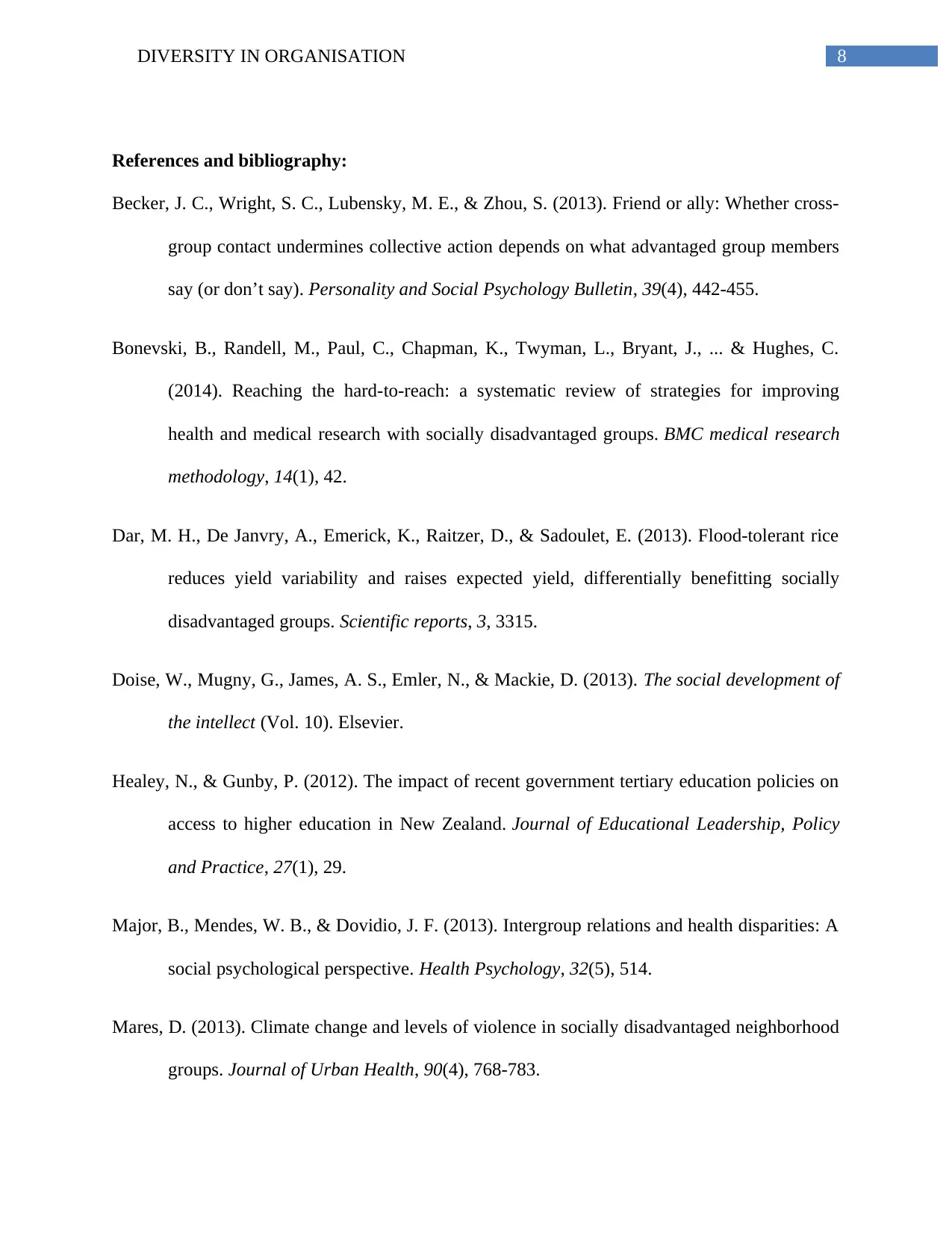
References and bibliography:
Becker, J. C., Wright, S. C., Lubensky, M. E., & Zhou, S. (2013). Friend or ally: Whether cross-
group contact undermines collective action depends on what advantaged group members
say (or don’t say). Personality and Social Psychology Bulletin, 39(4), 442-455.
Bonevski, B., Randell, M., Paul, C., Chapman, K., Twyman, L., Bryant, J., ... & Hughes, C.
(2014). Reaching the hard-to-reach: a systematic review of strategies for improving
health and medical research with socially disadvantaged groups. BMC medical research
methodology, 14(1), 42.
Dar, M. H., De Janvry, A., Emerick, K., Raitzer, D., & Sadoulet, E. (2013). Flood-tolerant rice
reduces yield variability and raises expected yield, differentially benefitting socially
disadvantaged groups. Scientific reports, 3, 3315.
Doise, W., Mugny, G., James, A. S., Emler, N., & Mackie, D. (2013). The social development of
the intellect (Vol. 10). Elsevier.
Healey, N., & Gunby, P. (2012). The impact of recent government tertiary education policies on
access to higher education in New Zealand. Journal of Educational Leadership, Policy
and Practice, 27(1), 29.
Major, B., Mendes, W. B., & Dovidio, J. F. (2013). Intergroup relations and health disparities: A
social psychological perspective. Health Psychology, 32(5), 514.
Mares, D. (2013). Climate change and levels of violence in socially disadvantaged neighborhood
groups. Journal of Urban Health, 90(4), 768-783.
References and bibliography:
Becker, J. C., Wright, S. C., Lubensky, M. E., & Zhou, S. (2013). Friend or ally: Whether cross-
group contact undermines collective action depends on what advantaged group members
say (or don’t say). Personality and Social Psychology Bulletin, 39(4), 442-455.
Bonevski, B., Randell, M., Paul, C., Chapman, K., Twyman, L., Bryant, J., ... & Hughes, C.
(2014). Reaching the hard-to-reach: a systematic review of strategies for improving
health and medical research with socially disadvantaged groups. BMC medical research
methodology, 14(1), 42.
Dar, M. H., De Janvry, A., Emerick, K., Raitzer, D., & Sadoulet, E. (2013). Flood-tolerant rice
reduces yield variability and raises expected yield, differentially benefitting socially
disadvantaged groups. Scientific reports, 3, 3315.
Doise, W., Mugny, G., James, A. S., Emler, N., & Mackie, D. (2013). The social development of
the intellect (Vol. 10). Elsevier.
Healey, N., & Gunby, P. (2012). The impact of recent government tertiary education policies on
access to higher education in New Zealand. Journal of Educational Leadership, Policy
and Practice, 27(1), 29.
Major, B., Mendes, W. B., & Dovidio, J. F. (2013). Intergroup relations and health disparities: A
social psychological perspective. Health Psychology, 32(5), 514.
Mares, D. (2013). Climate change and levels of violence in socially disadvantaged neighborhood
groups. Journal of Urban Health, 90(4), 768-783.
⊘ This is a preview!⊘
Do you want full access?
Subscribe today to unlock all pages.
Trusted by 1+ million students worldwide
9DIVERSITY IN ORGANISATION
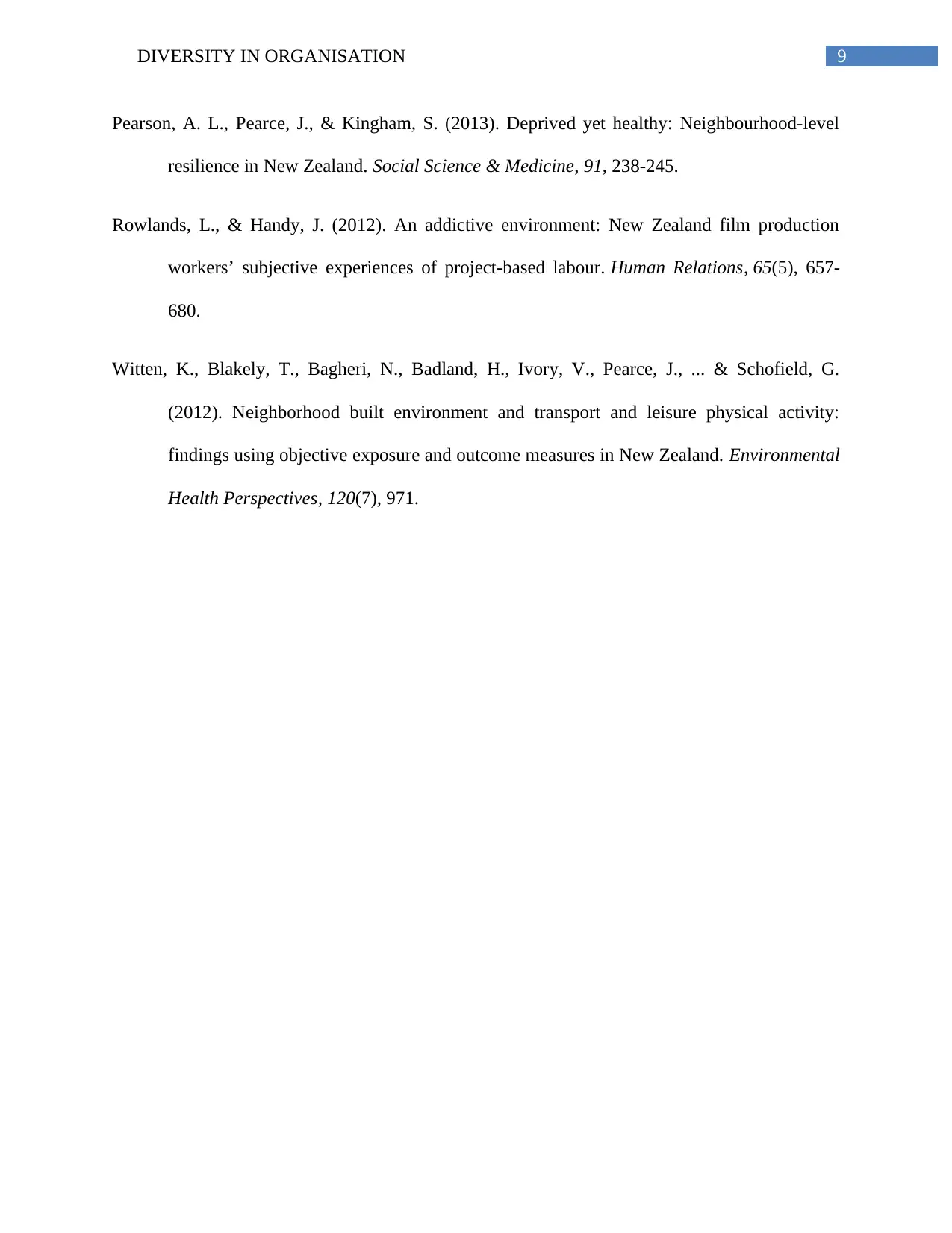
Pearson, A. L., Pearce, J., & Kingham, S. (2013). Deprived yet healthy: Neighbourhood-level
resilience in New Zealand. Social Science & Medicine, 91, 238-245.
Rowlands, L., & Handy, J. (2012). An addictive environment: New Zealand film production
workers’ subjective experiences of project-based labour. Human Relations, 65(5), 657-
680.
Witten, K., Blakely, T., Bagheri, N., Badland, H., Ivory, V., Pearce, J., ... & Schofield, G.
(2012). Neighborhood built environment and transport and leisure physical activity:
findings using objective exposure and outcome measures in New Zealand. Environmental
Health Perspectives, 120(7), 971.
Pearson, A. L., Pearce, J., & Kingham, S. (2013). Deprived yet healthy: Neighbourhood-level
resilience in New Zealand. Social Science & Medicine, 91, 238-245.
Rowlands, L., & Handy, J. (2012). An addictive environment: New Zealand film production
workers’ subjective experiences of project-based labour. Human Relations, 65(5), 657-
680.
Witten, K., Blakely, T., Bagheri, N., Badland, H., Ivory, V., Pearce, J., ... & Schofield, G.
(2012). Neighborhood built environment and transport and leisure physical activity:
findings using objective exposure and outcome measures in New Zealand. Environmental
Health Perspectives, 120(7), 971.

1 out of 10


Related Documents


Your All-in-One AI-Powered Toolkit for Academic Success.
+13062052269
info@desklib.com
Available 24*7 on WhatsApp / Email
![[object Object]](/_next/static/media/star-bottom.7253800d.svg)
Unlock your academic potential
Copyright © 2020–2025 A2Z Services. All Rights Reserved. Developed and managed by ZUCOL.