Analyzing the Impact of Workforce Diversity on Global Leadership
VerifiedAdded on 2020/04/07
|14
|3426
|197
AI Summary
The focus of this research is on understanding workforce diversity in global organizations. Students will analyze existing literature and case studies to examine how diversity influences organizational dynamics, including communication, performance, and productivity. The assignment emphasizes identifying challenges posed by diverse workforces and evaluating management strategies that enhance inclusivity and effectiveness. By exploring these dimensions, students will gain insights into developing culturally competent leadership and fostering an inclusive workplace environment.
Managing Teams and Diversity 1
Motivating and Leading across Borders: Managing Teams and
Diversity
Student Name
Course
Professors Name
University
City
Executive Summary
Motivating and Leading across Borders: Managing Teams and
Diversity
Student Name
Course
Professors Name
University
City
Executive Summary

Paraphrase This Document
Need a fresh take? Get an instant paraphrase of this document with our AI Paraphraser
Managing Teams and Diversity 2
Global leadership can be described as that ability to influence people both inside and out of the
organizations that represent diversity in culture, political and institutional systems while
achieving global organization goals. Leadership can be by individuals or by organizations. It also
requires that there are people or some groups of people who are being led towards achievement
of organization goals. Global leaders need to influence these people or groups of people who are
spread across the world towards the common goal. Global leaders must be capable to influence
the people or groups of people across different regions to achieve the company objectives. The
global leader must recognize that those being led are different and thus the traditional ways of
authority may not be effective. The different people’s cultures are different and so are their world
views. The way to motivate these different people is also different due to their cultural views and
practices (Beechler & Javidan, 2007).
Business borders are also different from the country or culture borders. Business complexities
therefore arise which the effective global leader needs to have skills to handle them. To perform
effectively in different cultural and country borders, the effective leader’s assumptions on other
people and their culture, their language and their values will be put to test. The people being led
are different in many important ways from the global leaders. The leaders therefore need to be
transformed in the way they view themselves and view other people to be effective in order to
appreciate other people’s world view and be able to work and motivate them to perform to their
best (McCall and Hollenbeck, 2002, p. 22).
People belonging to a certain culture seem to have an implicit criteria and attributes of
leadership. The closer a leader is to that criteria, the more they will be accepted by the people.
The effective global leader goes beyond being able to manage across different cultures but also
Global leadership can be described as that ability to influence people both inside and out of the
organizations that represent diversity in culture, political and institutional systems while
achieving global organization goals. Leadership can be by individuals or by organizations. It also
requires that there are people or some groups of people who are being led towards achievement
of organization goals. Global leaders need to influence these people or groups of people who are
spread across the world towards the common goal. Global leaders must be capable to influence
the people or groups of people across different regions to achieve the company objectives. The
global leader must recognize that those being led are different and thus the traditional ways of
authority may not be effective. The different people’s cultures are different and so are their world
views. The way to motivate these different people is also different due to their cultural views and
practices (Beechler & Javidan, 2007).
Business borders are also different from the country or culture borders. Business complexities
therefore arise which the effective global leader needs to have skills to handle them. To perform
effectively in different cultural and country borders, the effective leader’s assumptions on other
people and their culture, their language and their values will be put to test. The people being led
are different in many important ways from the global leaders. The leaders therefore need to be
transformed in the way they view themselves and view other people to be effective in order to
appreciate other people’s world view and be able to work and motivate them to perform to their
best (McCall and Hollenbeck, 2002, p. 22).
People belonging to a certain culture seem to have an implicit criteria and attributes of
leadership. The closer a leader is to that criteria, the more they will be accepted by the people.
The effective global leader goes beyond being able to manage across different cultures but also
Managing Teams and Diversity 3
different political and institutional systems. The leader must also know how to motivate these
people to continue performing at their best.
The global business is a fact of the present world and with it are opportunities and some
challenges (Friedman, 2005 p9). To overcome the challenges, the global leader should be a
global thinker and possess important global leadership competencies. They need to be able
mobilize global resources and influence the people to work towards achievement of the goals of
the organizations they work for. They must therefore appreciate the differences in people and in
different countries and organizations if they are to succeed in their role and become effective
global leaders.
Table of Contents
Executive Summary …………………………………………………………………………….. 2
Introduction …………………………………………………………………………………….. 4
Diversity ………………………………………………………………………………………… 4
Managing Diversity ……………………………………………………………………………... 5
Motivating and Leading across Borders ………………………………………………………… 6
Conclusion ...…………………………………………………………………………………….11
References ……………………………………………………………………………………… 12
Introduction
different political and institutional systems. The leader must also know how to motivate these
people to continue performing at their best.
The global business is a fact of the present world and with it are opportunities and some
challenges (Friedman, 2005 p9). To overcome the challenges, the global leader should be a
global thinker and possess important global leadership competencies. They need to be able
mobilize global resources and influence the people to work towards achievement of the goals of
the organizations they work for. They must therefore appreciate the differences in people and in
different countries and organizations if they are to succeed in their role and become effective
global leaders.
Table of Contents
Executive Summary …………………………………………………………………………….. 2
Introduction …………………………………………………………………………………….. 4
Diversity ………………………………………………………………………………………… 4
Managing Diversity ……………………………………………………………………………... 5
Motivating and Leading across Borders ………………………………………………………… 6
Conclusion ...…………………………………………………………………………………….11
References ……………………………………………………………………………………… 12
Introduction
⊘ This is a preview!⊘
Do you want full access?
Subscribe today to unlock all pages.

Trusted by 1+ million students worldwide
Managing Teams and Diversity 4
Traditional boundaries are disappearing and competition in business now springs from
any corner of the world thus businesses have to become more global to take advantage of
international markets. While this brings with it opportunities, it also presents some complexities
which require new ways of thinking and managing (Beechler and Javidan, 2007). In today’s
global business environment, it is crucial that all leaders understand how to manage across
different cultures. Different cultures determine the way of managing and of doing business.
There is no one best way of managing and sometimes, the best universal management practices
have failed (Trompenaars and Hampden-Turner, 1997 p3). International managers have
challenges operating on different premises from their own culture of origin, to the culture of the
place they are working and also the organization culture where they are working. They must
learn to adapt the organization to manage working in diverse multicultural groups. Leadership
and culture are interconnected and leaders are in fact the main influencers of culture (Schein,
2010 p1). This paper will discuss leading and motivating diverse people across borders in global
organizations.
Diversity
Diversity can be viewed as recognizing, acknowledging, accepting and appreciating the
differences that are there between people and then accept value and celebrate them. These
differences may relate to gender, age, race, gender, class, sexual orientation, religious practice,
culture, physical abilities or disabilities and others (Bedi, Lakra, & Gupta, 2014 p103). Diversity
is a challenge in modern day work places and this means all employees must be equipped with
necessary skills needed to work in a cultural diverse work place. The managers have a more
difficult task of appreciating and valuing multicultural differences in the people they manage and
other stake holders and ensure everybody is treated with dignity. They therefore must be
Traditional boundaries are disappearing and competition in business now springs from
any corner of the world thus businesses have to become more global to take advantage of
international markets. While this brings with it opportunities, it also presents some complexities
which require new ways of thinking and managing (Beechler and Javidan, 2007). In today’s
global business environment, it is crucial that all leaders understand how to manage across
different cultures. Different cultures determine the way of managing and of doing business.
There is no one best way of managing and sometimes, the best universal management practices
have failed (Trompenaars and Hampden-Turner, 1997 p3). International managers have
challenges operating on different premises from their own culture of origin, to the culture of the
place they are working and also the organization culture where they are working. They must
learn to adapt the organization to manage working in diverse multicultural groups. Leadership
and culture are interconnected and leaders are in fact the main influencers of culture (Schein,
2010 p1). This paper will discuss leading and motivating diverse people across borders in global
organizations.
Diversity
Diversity can be viewed as recognizing, acknowledging, accepting and appreciating the
differences that are there between people and then accept value and celebrate them. These
differences may relate to gender, age, race, gender, class, sexual orientation, religious practice,
culture, physical abilities or disabilities and others (Bedi, Lakra, & Gupta, 2014 p103). Diversity
is a challenge in modern day work places and this means all employees must be equipped with
necessary skills needed to work in a cultural diverse work place. The managers have a more
difficult task of appreciating and valuing multicultural differences in the people they manage and
other stake holders and ensure everybody is treated with dignity. They therefore must be
Paraphrase This Document
Need a fresh take? Get an instant paraphrase of this document with our AI Paraphraser
Managing Teams and Diversity 5
culturally competent in order to manage the challenges of diversity well and make the best out of
diverse cultures.
Diversity is increasing becoming an important factor in businesses as companies become
more global and employees more diverse. Organizations that are more inclusive are likely to
benefit more from diverse ideas and creativity from different people thus gain a competitive
advantage (Pitts & Recascino, 2010 p45). Managing diversity is an important skill in people
management and it helps increase employee productivity (Bedi et al., 2014 p104). Diversity
therefore has to be properly managed if any organization is to enjoy its benefits.
Managing Diversity
Management of diversity is a challenging task yet very important especially for
companies that have operations across borders (Bartlett and Paul, 2011 p3). Some changes may
have to be effected in order to accommodate the needs of different people for them to contribute
to the best of their potential for the benefit of an organization in the global business set up.
Organizations must formulate strategies and practices that accommodate diverse people to be
well positioned to meet the demands of the global workplace.
Effective leaders need to start to align the culture of the organization with the diverse
cultures of people in the organization. By use of good management practices, organizations will
be in a position to reap maximum benefits that accrue from diversity. They need to value all
employees so that they feel free to contribute to the achievement of company goals.
Globalization means that all managers must learn how to manage diversity as it will only
continue to increase at the work place in the future (Okoro & Washington, 2012 p57).
culturally competent in order to manage the challenges of diversity well and make the best out of
diverse cultures.
Diversity is increasing becoming an important factor in businesses as companies become
more global and employees more diverse. Organizations that are more inclusive are likely to
benefit more from diverse ideas and creativity from different people thus gain a competitive
advantage (Pitts & Recascino, 2010 p45). Managing diversity is an important skill in people
management and it helps increase employee productivity (Bedi et al., 2014 p104). Diversity
therefore has to be properly managed if any organization is to enjoy its benefits.
Managing Diversity
Management of diversity is a challenging task yet very important especially for
companies that have operations across borders (Bartlett and Paul, 2011 p3). Some changes may
have to be effected in order to accommodate the needs of different people for them to contribute
to the best of their potential for the benefit of an organization in the global business set up.
Organizations must formulate strategies and practices that accommodate diverse people to be
well positioned to meet the demands of the global workplace.
Effective leaders need to start to align the culture of the organization with the diverse
cultures of people in the organization. By use of good management practices, organizations will
be in a position to reap maximum benefits that accrue from diversity. They need to value all
employees so that they feel free to contribute to the achievement of company goals.
Globalization means that all managers must learn how to manage diversity as it will only
continue to increase at the work place in the future (Okoro & Washington, 2012 p57).
Managing Teams and Diversity 6
People’s differences in the world today are reflected in the global work place today.
Managing this diverse work force then becomes a critical component of human resource
management. Managers must therefore possess these skills and be culturally competent in order
to be tolerant of individual uniqueness and take advantage of these differences for productivity
and unique solutions to business problems. Organizations need to invest in the training of all
employees and managers for them to be culturally competent. This equips them with necessary
skills that help them function properly in a diverse work environment (Mujtaba, 2007 p210).
Motivating and Leading across Borders
While domestic leaders deal with individual employees from the domestic country, the
global leaders have to deal with employees from different countries (Hollenbeck, 2001 p16). The
global leader needs to have more skills than what is familiar in the home country. The leader
must be able to overcome the national differences and be able to embrace best practice from all
over the globe. Businesses therefore need a model that can integrate national schemes and that is
crucial for the recruitment and training of effective global leaders and their retention (Morrison,
2000 p120).
There is increased challenges in global leadership and thus need to have leaders who are
culturally understanding. The background characteristics of an individual and organization
including identity, behavior, perceptions and attitudes all have an influence on business success.
Conflicts arising out of the differences may stop an organization from operating efficiently (Egan
& Bendick, 2008 p389). The leader needs to have more knowledge across national and
organization boundaries. The leader also has to consider the many stakeholders while making
business decisions (Bird & Osland, 2004 p4).
People’s differences in the world today are reflected in the global work place today.
Managing this diverse work force then becomes a critical component of human resource
management. Managers must therefore possess these skills and be culturally competent in order
to be tolerant of individual uniqueness and take advantage of these differences for productivity
and unique solutions to business problems. Organizations need to invest in the training of all
employees and managers for them to be culturally competent. This equips them with necessary
skills that help them function properly in a diverse work environment (Mujtaba, 2007 p210).
Motivating and Leading across Borders
While domestic leaders deal with individual employees from the domestic country, the
global leaders have to deal with employees from different countries (Hollenbeck, 2001 p16). The
global leader needs to have more skills than what is familiar in the home country. The leader
must be able to overcome the national differences and be able to embrace best practice from all
over the globe. Businesses therefore need a model that can integrate national schemes and that is
crucial for the recruitment and training of effective global leaders and their retention (Morrison,
2000 p120).
There is increased challenges in global leadership and thus need to have leaders who are
culturally understanding. The background characteristics of an individual and organization
including identity, behavior, perceptions and attitudes all have an influence on business success.
Conflicts arising out of the differences may stop an organization from operating efficiently (Egan
& Bendick, 2008 p389). The leader needs to have more knowledge across national and
organization boundaries. The leader also has to consider the many stakeholders while making
business decisions (Bird & Osland, 2004 p4).
⊘ This is a preview!⊘
Do you want full access?
Subscribe today to unlock all pages.
Trusted by 1+ million students worldwide
Managing Teams and Diversity 7
Bingham, Felin, & Black (2000) provide some characteristics of a global leader as
suggested by the former CEO of Procter & Gamble, John Pepper. These include ability to deal
with uncertainty, to know the customers, have a good balance between being effective globally
and having proper local responsiveness and being able to respond to diversity. Mendenhall &
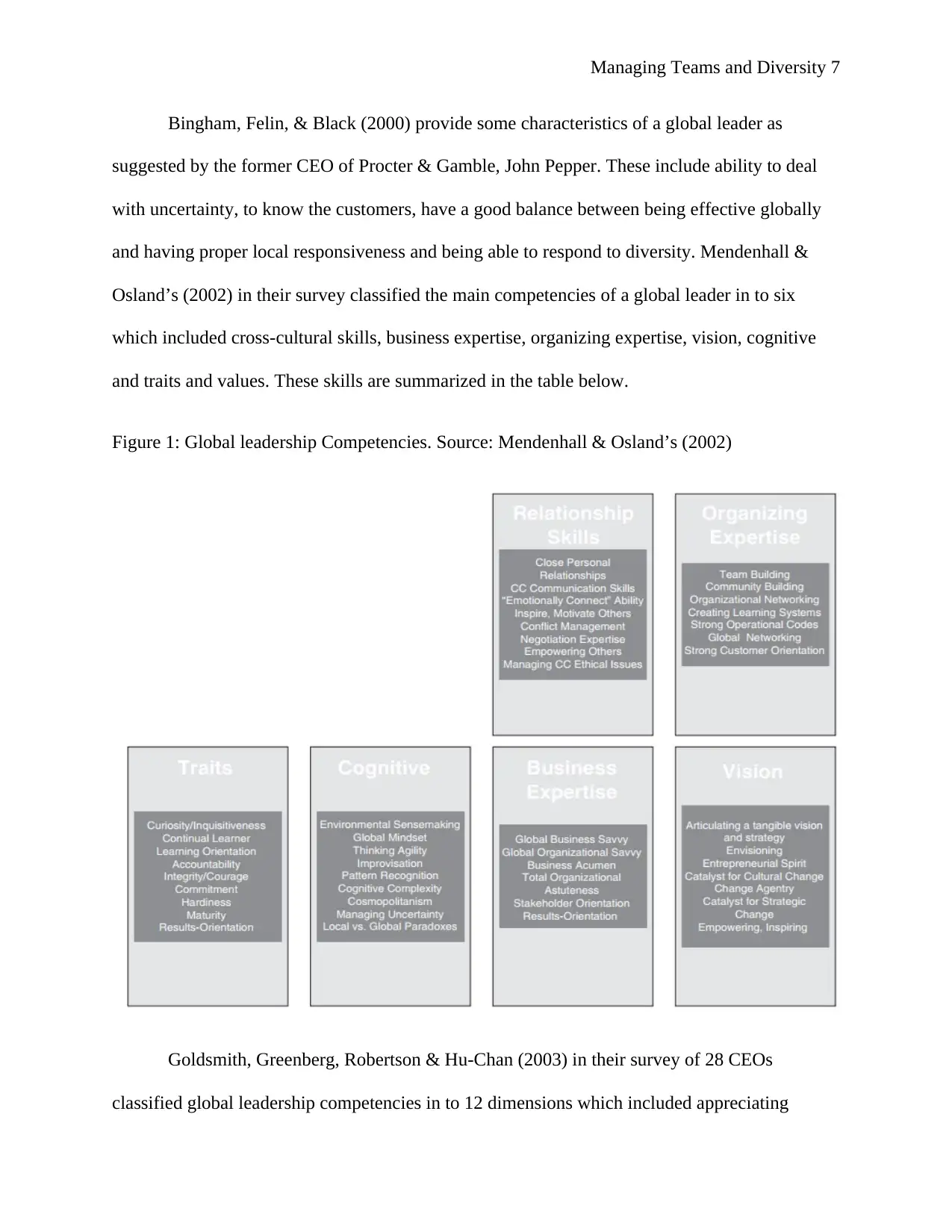
Osland’s (2002) in their survey classified the main competencies of a global leader in to six
which included cross-cultural skills, business expertise, organizing expertise, vision, cognitive
and traits and values. These skills are summarized in the table below.
Figure 1: Global leadership Competencies. Source: Mendenhall & Osland’s (2002)
Goldsmith, Greenberg, Robertson & Hu-Chan (2003) in their survey of 28 CEOs
classified global leadership competencies in to 12 dimensions which included appreciating
Bingham, Felin, & Black (2000) provide some characteristics of a global leader as
suggested by the former CEO of Procter & Gamble, John Pepper. These include ability to deal
with uncertainty, to know the customers, have a good balance between being effective globally
and having proper local responsiveness and being able to respond to diversity. Mendenhall &
Osland’s (2002) in their survey classified the main competencies of a global leader in to six
which included cross-cultural skills, business expertise, organizing expertise, vision, cognitive
and traits and values. These skills are summarized in the table below.
Figure 1: Global leadership Competencies. Source: Mendenhall & Osland’s (2002)
Goldsmith, Greenberg, Robertson & Hu-Chan (2003) in their survey of 28 CEOs
classified global leadership competencies in to 12 dimensions which included appreciating
Paraphrase This Document
Need a fresh take? Get an instant paraphrase of this document with our AI Paraphraser
Managing Teams and Diversity 8
diversity, empowerment and developing people among others. Most of the literature in books
identifies team leadership and management of diversity as key competencies of an effective
global leader today. It is thus clear that leaders have to show interest and respect other people’s
culture and their different views, show genuine interest in and enjoy the way they live and do
things and get along well with them.
Various studies on organizations show that they have there are two cultures within every
organization, the first being the culture of the system and the second being the organization
culture (Berrell, Gloet & Wright, 2001 p84). National culture also impacts on the management of
organizations in international markets. Leaders need to know of the impact the national culture
has on their management behavior as it greatly affects the way they lead. Although intangible,
culture greatly influences the management practices and processes in organizations. Global
leaders can no longer ignore the global complexities and replace it with assumed universalism
and assume only one best way to manage (Adler & Gundersen, 2007 p3).
Culture influences the way a leader relates with the followers (Yukl, 2006 p11). Culture
may be defined as the way the mind programmed which differentiates between members of one
community from another (Hofstede, 1994 p1). There may exist universal management principles
but each different culture has a different management style that is influenced by the culture. The
culture and values of a certain country will determine the expected leadership characteristics for
that particular country. Successful leaders need to act in culturally acceptable ways to be accpted
(Javidan & Carl, 2004 p667).
Global leaders agree that effective management of human resources is important for
business success (Adler & Gundersen, 2007 p11). They also agree that they will have to generate
diversity, empowerment and developing people among others. Most of the literature in books
identifies team leadership and management of diversity as key competencies of an effective
global leader today. It is thus clear that leaders have to show interest and respect other people’s
culture and their different views, show genuine interest in and enjoy the way they live and do
things and get along well with them.
Various studies on organizations show that they have there are two cultures within every
organization, the first being the culture of the system and the second being the organization
culture (Berrell, Gloet & Wright, 2001 p84). National culture also impacts on the management of
organizations in international markets. Leaders need to know of the impact the national culture
has on their management behavior as it greatly affects the way they lead. Although intangible,
culture greatly influences the management practices and processes in organizations. Global
leaders can no longer ignore the global complexities and replace it with assumed universalism
and assume only one best way to manage (Adler & Gundersen, 2007 p3).
Culture influences the way a leader relates with the followers (Yukl, 2006 p11). Culture
may be defined as the way the mind programmed which differentiates between members of one
community from another (Hofstede, 1994 p1). There may exist universal management principles
but each different culture has a different management style that is influenced by the culture. The
culture and values of a certain country will determine the expected leadership characteristics for
that particular country. Successful leaders need to act in culturally acceptable ways to be accpted
(Javidan & Carl, 2004 p667).
Global leaders agree that effective management of human resources is important for
business success (Adler & Gundersen, 2007 p11). They also agree that they will have to generate
Managing Teams and Diversity 9
employment opportunities and business revenues from other markets outside of their
organizations’ home countries. To be successful, they must develop global strategies for
managing and motivating the human resources and thus business success and profits. An
evolution of global human resources management has therefore evolved recently. Global
strategies of managing people and culture helps in understanding how national and ethnic
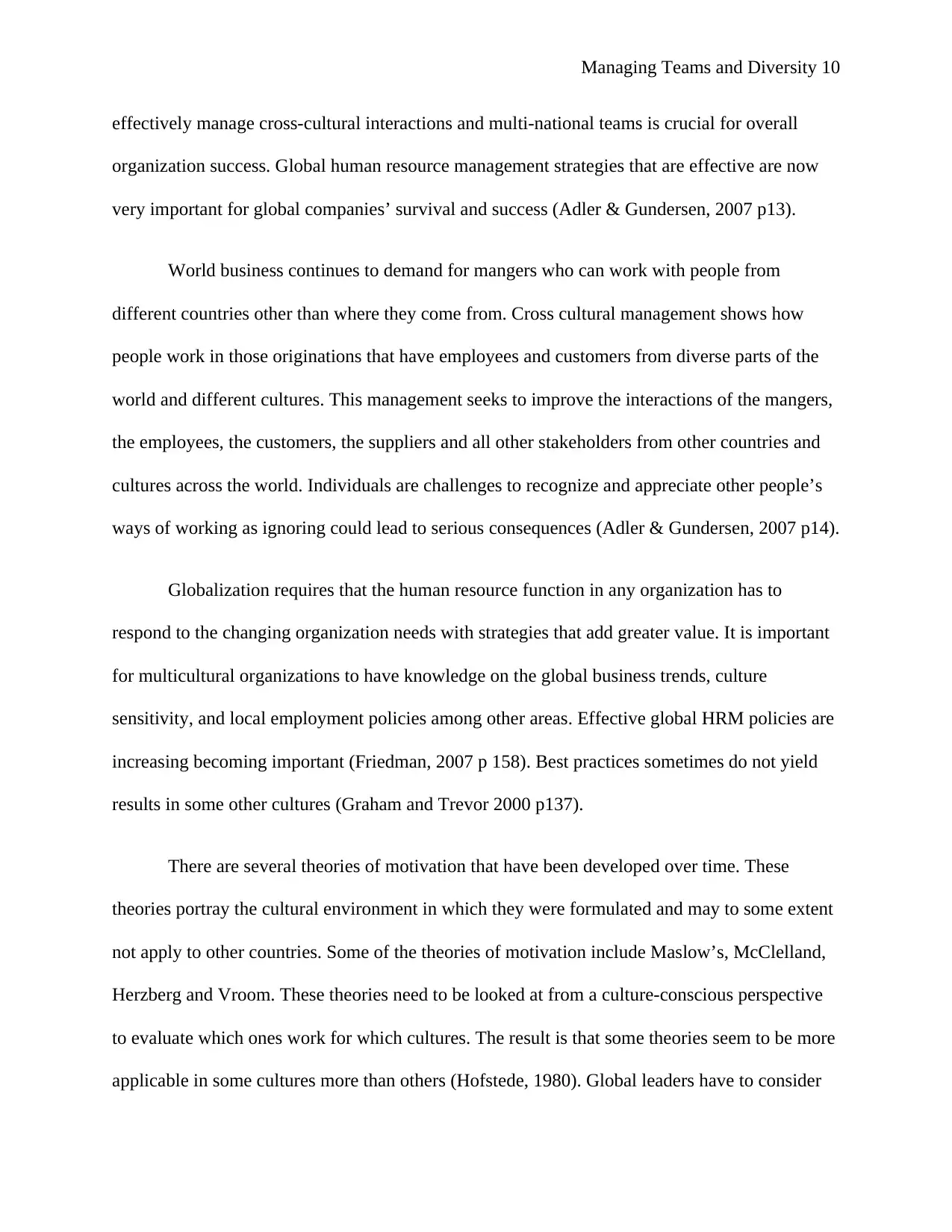
cultures influence the way organizations function. The impact of culture on organizations has led
to evolution of organizations and different approaches in managing people as shown in the figure
below.
Figure 2: Corporate Cross-Cultural Evolution. Source: Adler (2007).
There is rise in demand for culturally sensitive managers and practices within
organizations. Successful global companies consider nationality and ethnicity as critical
components of segmentation. Culture differences in this case become one of the critical factors
of competitive advantage. The products and services in a global company must be delivered in a
culturally sensitive manner to each of the diverse customers across the world. The ability to
employment opportunities and business revenues from other markets outside of their
organizations’ home countries. To be successful, they must develop global strategies for
managing and motivating the human resources and thus business success and profits. An
evolution of global human resources management has therefore evolved recently. Global
strategies of managing people and culture helps in understanding how national and ethnic
cultures influence the way organizations function. The impact of culture on organizations has led
to evolution of organizations and different approaches in managing people as shown in the figure
below.
Figure 2: Corporate Cross-Cultural Evolution. Source: Adler (2007).
There is rise in demand for culturally sensitive managers and practices within
organizations. Successful global companies consider nationality and ethnicity as critical
components of segmentation. Culture differences in this case become one of the critical factors
of competitive advantage. The products and services in a global company must be delivered in a
culturally sensitive manner to each of the diverse customers across the world. The ability to
⊘ This is a preview!⊘
Do you want full access?
Subscribe today to unlock all pages.
Trusted by 1+ million students worldwide
Managing Teams and Diversity 10
effectively manage cross-cultural interactions and multi-national teams is crucial for overall
organization success. Global human resource management strategies that are effective are now
very important for global companies’ survival and success (Adler & Gundersen, 2007 p13).
World business continues to demand for mangers who can work with people from
different countries other than where they come from. Cross cultural management shows how
people work in those originations that have employees and customers from diverse parts of the
world and different cultures. This management seeks to improve the interactions of the mangers,
the employees, the customers, the suppliers and all other stakeholders from other countries and
cultures across the world. Individuals are challenges to recognize and appreciate other people’s
ways of working as ignoring could lead to serious consequences (Adler & Gundersen, 2007 p14).
Globalization requires that the human resource function in any organization has to
respond to the changing organization needs with strategies that add greater value. It is important
for multicultural organizations to have knowledge on the global business trends, culture
sensitivity, and local employment policies among other areas. Effective global HRM policies are
increasing becoming important (Friedman, 2007 p 158). Best practices sometimes do not yield
results in some other cultures (Graham and Trevor 2000 p137).
There are several theories of motivation that have been developed over time. These
theories portray the cultural environment in which they were formulated and may to some extent
not apply to other countries. Some of the theories of motivation include Maslow’s, McClelland,
Herzberg and Vroom. These theories need to be looked at from a culture-conscious perspective
to evaluate which ones work for which cultures. The result is that some theories seem to be more
applicable in some cultures more than others (Hofstede, 1980). Global leaders have to consider
effectively manage cross-cultural interactions and multi-national teams is crucial for overall
organization success. Global human resource management strategies that are effective are now
very important for global companies’ survival and success (Adler & Gundersen, 2007 p13).
World business continues to demand for mangers who can work with people from
different countries other than where they come from. Cross cultural management shows how
people work in those originations that have employees and customers from diverse parts of the
world and different cultures. This management seeks to improve the interactions of the mangers,
the employees, the customers, the suppliers and all other stakeholders from other countries and
cultures across the world. Individuals are challenges to recognize and appreciate other people’s
ways of working as ignoring could lead to serious consequences (Adler & Gundersen, 2007 p14).
Globalization requires that the human resource function in any organization has to
respond to the changing organization needs with strategies that add greater value. It is important
for multicultural organizations to have knowledge on the global business trends, culture
sensitivity, and local employment policies among other areas. Effective global HRM policies are
increasing becoming important (Friedman, 2007 p 158). Best practices sometimes do not yield
results in some other cultures (Graham and Trevor 2000 p137).
There are several theories of motivation that have been developed over time. These
theories portray the cultural environment in which they were formulated and may to some extent
not apply to other countries. Some of the theories of motivation include Maslow’s, McClelland,
Herzberg and Vroom. These theories need to be looked at from a culture-conscious perspective
to evaluate which ones work for which cultures. The result is that some theories seem to be more
applicable in some cultures more than others (Hofstede, 1980). Global leaders have to consider
Paraphrase This Document
Need a fresh take? Get an instant paraphrase of this document with our AI Paraphraser
Managing Teams and Diversity 11
the differences in the people they are managing if they are to motivate them. They cannot use
knowledge from traditionally applicable theories in organizations but must continue to question
this knowledge and its current application in global companies. Only when they do this will they
gain the highest benefits of a motivated diverse team leading to the success of their firms.
Conclusion
Globalization has brought with it business opportunities at the same time challenges. The
opportunities include new markets for the firms and thus new customers and profits. Some of the
challenges include being able to handle the diversity of people from different backgrounds and
cultures. If handled well, diversity can bring advantages to a firm by bringing in new and
innovative ways of solving organization problems thus success. If not well handled, it could lead
to misunderstandings and conflict. Organizations are thus demanding that global leaders have a
global mindset and that they possess key competencies in being able to effectively handle
diversity from employees, customers and other stakeholders. These leaders must have the ability
to acknowledge and appreciate differences in people and have genuine interest in valuing these
differences. This ensures that diversity becomes an asset to organizations and they can get the
maximum benefits that arise from a diverse ideas and business solutions. This paper has
discussed diversity, the management of diversity and leading and motivating people across
borders.
References
the differences in the people they are managing if they are to motivate them. They cannot use
knowledge from traditionally applicable theories in organizations but must continue to question
this knowledge and its current application in global companies. Only when they do this will they
gain the highest benefits of a motivated diverse team leading to the success of their firms.
Conclusion
Globalization has brought with it business opportunities at the same time challenges. The
opportunities include new markets for the firms and thus new customers and profits. Some of the
challenges include being able to handle the diversity of people from different backgrounds and
cultures. If handled well, diversity can bring advantages to a firm by bringing in new and
innovative ways of solving organization problems thus success. If not well handled, it could lead
to misunderstandings and conflict. Organizations are thus demanding that global leaders have a
global mindset and that they possess key competencies in being able to effectively handle
diversity from employees, customers and other stakeholders. These leaders must have the ability
to acknowledge and appreciate differences in people and have genuine interest in valuing these
differences. This ensures that diversity becomes an asset to organizations and they can get the
maximum benefits that arise from a diverse ideas and business solutions. This paper has
discussed diversity, the management of diversity and leading and motivating people across
borders.
References
Managing Teams and Diversity 12
Adler, N. (2007) International Dimensions of Organizational Behaviour, 5th ed., South-Western
College Publishing.
Adler, N. & Gundersen, A. (2007). International Dimensions of Organizational Behavior.
Thomson Learning.
Bartlett, CA. and Paul WB. (2011). Transnational Management: Text Cases and Readings in
Cross Border Management. 6th ed. Burr Ridge, IL: McGraw-Hill/Irwin.
Bedi, P., Lakra, P. and Gupta, E. (2014). Workforce Diversity Management: Biggest Challenge
or Opportunity for 21st Century Organizations. Journal of Business and Management, 16(4),
102-107.
Beechler, S. and Javidan, M. (2007). Leading with a Global Mindset. Emerald Group
Publishing Limited, pp.131 – 169.
Berrell, M., Gloet, M and Wright, P. (2002) Organisational Learning in International Joint Ventures:
Implications for Management Development. Journal of Management Development, Vol. 21 Issue: 2,
pp.83-100.
Bird, A. and Osland, JS. (2004). Global Competencies: An Introduction. Blackwell Publishing
Egan, ML. and Bendick M. (2008). Combining Multicultural Management and Diversity into
One Course on Cultural Competence. Journal of Management Learning & Education.
Friedman, BA. (2007). Globalization Implications for Human Resource Management Roles.
Employ Respons Rights J ,19:157–171.
Friedman, TL. (2005). The World is Flat: A Brief History of the Twentieth Century. New York:
Farrar, Straus and Giroux
Adler, N. (2007) International Dimensions of Organizational Behaviour, 5th ed., South-Western
College Publishing.
Adler, N. & Gundersen, A. (2007). International Dimensions of Organizational Behavior.
Thomson Learning.
Bartlett, CA. and Paul WB. (2011). Transnational Management: Text Cases and Readings in
Cross Border Management. 6th ed. Burr Ridge, IL: McGraw-Hill/Irwin.
Bedi, P., Lakra, P. and Gupta, E. (2014). Workforce Diversity Management: Biggest Challenge
or Opportunity for 21st Century Organizations. Journal of Business and Management, 16(4),
102-107.
Beechler, S. and Javidan, M. (2007). Leading with a Global Mindset. Emerald Group
Publishing Limited, pp.131 – 169.
Berrell, M., Gloet, M and Wright, P. (2002) Organisational Learning in International Joint Ventures:
Implications for Management Development. Journal of Management Development, Vol. 21 Issue: 2,
pp.83-100.
Bird, A. and Osland, JS. (2004). Global Competencies: An Introduction. Blackwell Publishing
Egan, ML. and Bendick M. (2008). Combining Multicultural Management and Diversity into
One Course on Cultural Competence. Journal of Management Learning & Education.
Friedman, BA. (2007). Globalization Implications for Human Resource Management Roles.
Employ Respons Rights J ,19:157–171.
Friedman, TL. (2005). The World is Flat: A Brief History of the Twentieth Century. New York:
Farrar, Straus and Giroux
⊘ This is a preview!⊘
Do you want full access?
Subscribe today to unlock all pages.
Trusted by 1+ million students worldwide

1 out of 14


Related Documents


Your All-in-One AI-Powered Toolkit for Academic Success.
+13062052269
info@desklib.com
Available 24*7 on WhatsApp / Email
![[object Object]](/_next/static/media/star-bottom.7253800d.svg)
Unlock your academic potential
Copyright © 2020–2026 A2Z Services. All Rights Reserved. Developed and managed by ZUCOL.