Financial Management Report: Dividend Policy and Appraisal
VerifiedAdded on 2023/01/09
|14
|3669
|31
Report
AI Summary
This report delves into the realm of financial management, focusing on two key areas: dividend policy and investment appraisal techniques. The first section examines dividend policy, exploring the size of annual dividends distributed to shareholders, practical considerations in dividend decisions, and the calculation and evaluation of different dividend options, including cash dividends, scrip dividends, and share repurchases. The second section concentrates on investment appraisal techniques, calculating and critically evaluating methods such as payback period, accounting rate of return (ARR), net present value (NPV), and internal rate of return (IRR). The report analyzes the benefits and limitations of each technique, providing a comprehensive understanding of financial decision-making processes. The assignment uses Lovewell Limited as a case study to apply these concepts, assessing the potential purchase of new machinery and making informed financial recommendations. The conclusion summarizes the findings, highlighting the importance of these techniques for sound financial management.

Financial
Management
Management

Paraphrase This Document
Need a fresh take? Get an instant paraphrase of this document with our AI Paraphraser
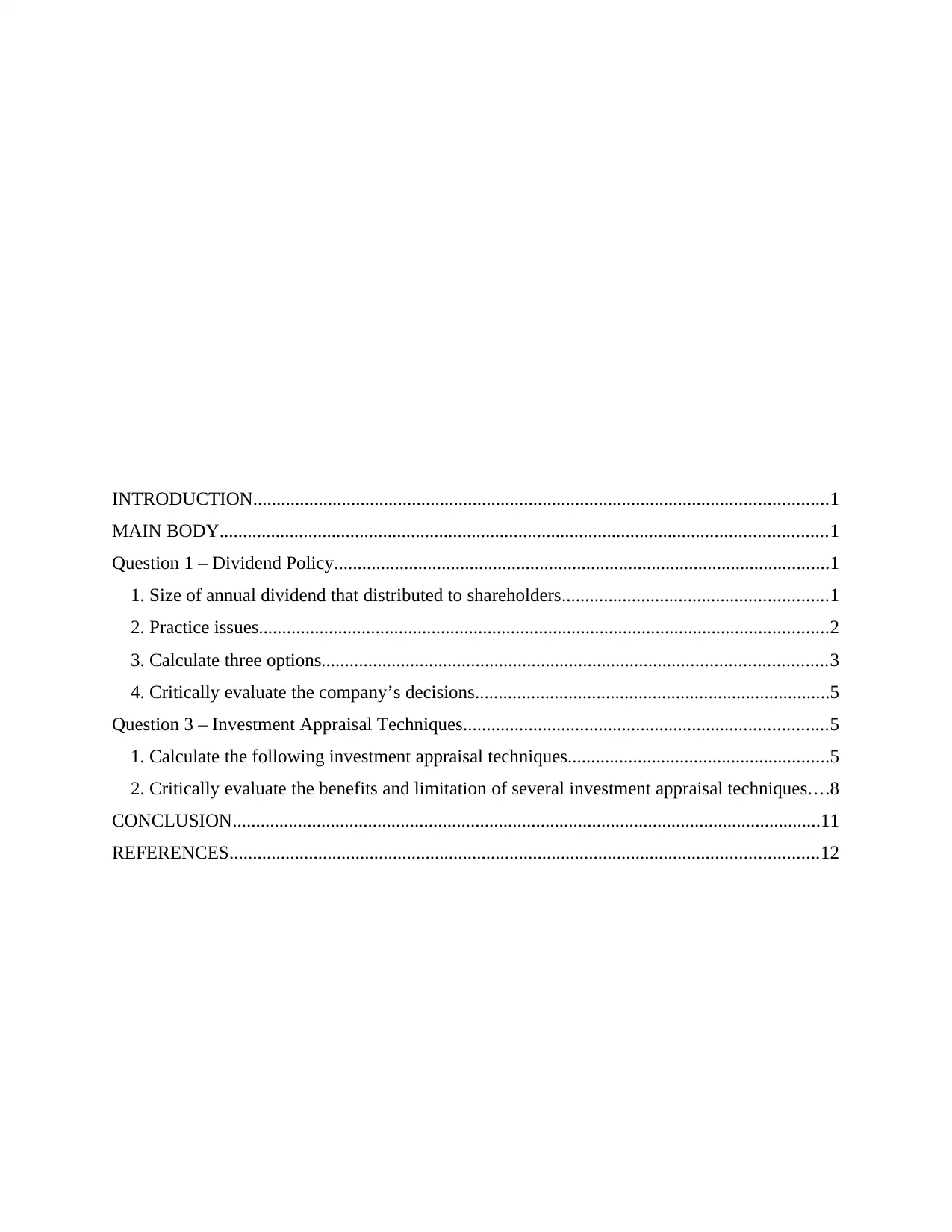
INTRODUCTION...........................................................................................................................1
MAIN BODY..................................................................................................................................1
Question 1 – Dividend Policy..........................................................................................................1
1. Size of annual dividend that distributed to shareholders.........................................................1
2. Practice issues..........................................................................................................................2
3. Calculate three options............................................................................................................3
4. Critically evaluate the company’s decisions............................................................................5
Question 3 – Investment Appraisal Techniques..............................................................................5
1. Calculate the following investment appraisal techniques........................................................5
2. Critically evaluate the benefits and limitation of several investment appraisal techniques....8
CONCLUSION..............................................................................................................................11
REFERENCES..............................................................................................................................12
MAIN BODY..................................................................................................................................1
Question 1 – Dividend Policy..........................................................................................................1
1. Size of annual dividend that distributed to shareholders.........................................................1
2. Practice issues..........................................................................................................................2
3. Calculate three options............................................................................................................3
4. Critically evaluate the company’s decisions............................................................................5
Question 3 – Investment Appraisal Techniques..............................................................................5
1. Calculate the following investment appraisal techniques........................................................5
2. Critically evaluate the benefits and limitation of several investment appraisal techniques....8
CONCLUSION..............................................................................................................................11
REFERENCES..............................................................................................................................12
INTRODUCTION
Financial management is described as working with and evaluating money and finances to
support or make financial decisions for an individual or a company. A definition of financial
reporting is the function done for a firm by an accounting team (Alkaraan, 2020). It includes
knowing and adequately managing, allocating and accessing the resources and liabilities of a
business and management of financial finance products such as spending, sales, payable and
receivables reports, cash balance, and productivity. This assessment based on two different
questions where first one is about dividend policy which includes several topics such as size of
annual dividend which return to its shareholders and some practice issues which required
considering before making dividend payment decisions. In addition, it covers calculation of three
options and in the last critically evaluate the company’s decisions. Second question based on
investment appraisal techniques which help the organization to identify that which proposal is
beneficial for them or they should invent in it or not.
MAIN BODY
Question 1 – Dividend Policy
1. Size of annual dividend that distributed to shareholders
Dividend is simply amount or proportion of a firm's profits, benefit throughout the
assessment and appointment of board members; it is declared and paid as a ratio of par shares or
per securities. In fact, dividend is a percentage of the surplus that exists after adequate allowance
for various forms of utilities and taxes etc. was already rendered after all investment has been
deducted in overall income (Anthony, 2019). Members have such responsibility to make that
benefit, but they cannot agree to the immediate sale. If the corporation needs income so the
organization will keep the full share of the sales even without paying any amount of dividend.
Therefore, in case the overall income is expected to have been in the form of common unit or
surplus, no dividend is recorded. Take into account the normal two items mentioned below when
focusing on dividends paid, owners will:
Fair consideration:
Managers need a realistic estimation of the degree at which shareholders plan to benefit
from capital and take chances in return. If this is not done, it will also be difficult to maintain the
1
Financial management is described as working with and evaluating money and finances to
support or make financial decisions for an individual or a company. A definition of financial
reporting is the function done for a firm by an accounting team (Alkaraan, 2020). It includes
knowing and adequately managing, allocating and accessing the resources and liabilities of a
business and management of financial finance products such as spending, sales, payable and
receivables reports, cash balance, and productivity. This assessment based on two different
questions where first one is about dividend policy which includes several topics such as size of
annual dividend which return to its shareholders and some practice issues which required
considering before making dividend payment decisions. In addition, it covers calculation of three
options and in the last critically evaluate the company’s decisions. Second question based on
investment appraisal techniques which help the organization to identify that which proposal is
beneficial for them or they should invent in it or not.
MAIN BODY
Question 1 – Dividend Policy
1. Size of annual dividend that distributed to shareholders
Dividend is simply amount or proportion of a firm's profits, benefit throughout the
assessment and appointment of board members; it is declared and paid as a ratio of par shares or
per securities. In fact, dividend is a percentage of the surplus that exists after adequate allowance
for various forms of utilities and taxes etc. was already rendered after all investment has been
deducted in overall income (Anthony, 2019). Members have such responsibility to make that
benefit, but they cannot agree to the immediate sale. If the corporation needs income so the
organization will keep the full share of the sales even without paying any amount of dividend.
Therefore, in case the overall income is expected to have been in the form of common unit or
surplus, no dividend is recorded. Take into account the normal two items mentioned below when
focusing on dividends paid, owners will:
Fair consideration:
Managers need a realistic estimation of the degree at which shareholders plan to benefit
from capital and take chances in return. If this is not done, it will also be difficult to maintain the
1
⊘ This is a preview!⊘
Do you want full access?
Subscribe today to unlock all pages.

Trusted by 1+ million students worldwide
investors completely happy as this can have a detrimental impact on the group's trading returns
in goodwill securities.
Requirement of company:
Managing the long term financial role is the key responsibility of managers, especially as
members are required to make other sacrifices to do so. Therefore, it is extremely important for
the investor to really be able to identify just how much extra financing the company requires
growing and succeeding.
Factors affecting dividend distribution decisions:
Legal requirement: A corporation has no moral obligation to pay dividends. There are,
however, other law-imposed provisions regarding how dividends are allocated. There are
essentially three laws pertaining to dividend payments. They are the law of net income,
the law of capital loss and the rule of insolvency.
Liquidity position of the firm: Payment of dividend is influenced by the liquidity status
of the company (Factors affecting dividend distribution strategy, 2019). Despite ample
retained profits, if the profits are not kept in cash the company cannot be capable of
paying cash dividend.
Need of repayment: A business is using multiple forms of debt funding to fulfill its
financing requirements (Ayodele, 2019). At maturity, the obligation must be repaid. If the
company needs to maintain its earnings for debt servicing purposes, the ability to pay
dividends reduces.
Expected rate of return: When the anticipated rate of return mostly on capital funding is
comparatively higher for a company, the firm tends to hold profits for reinvestment
instead of pay cash dividends.
Stability of earning: If a corporation has fairly predictable profits, it is much more
probable than a company with comparatively fluctuating profits to pay relatively larger
dividends.
2. Practice issues
It's not just the factors that affect directors' option regarding payment of dividend. The
company looks at market problems when pursuing benefit policy. A part of such common-sense
problems is mentioned below:
2
in goodwill securities.
Requirement of company:
Managing the long term financial role is the key responsibility of managers, especially as
members are required to make other sacrifices to do so. Therefore, it is extremely important for
the investor to really be able to identify just how much extra financing the company requires
growing and succeeding.
Factors affecting dividend distribution decisions:
Legal requirement: A corporation has no moral obligation to pay dividends. There are,
however, other law-imposed provisions regarding how dividends are allocated. There are
essentially three laws pertaining to dividend payments. They are the law of net income,
the law of capital loss and the rule of insolvency.
Liquidity position of the firm: Payment of dividend is influenced by the liquidity status
of the company (Factors affecting dividend distribution strategy, 2019). Despite ample
retained profits, if the profits are not kept in cash the company cannot be capable of
paying cash dividend.
Need of repayment: A business is using multiple forms of debt funding to fulfill its
financing requirements (Ayodele, 2019). At maturity, the obligation must be repaid. If the
company needs to maintain its earnings for debt servicing purposes, the ability to pay
dividends reduces.
Expected rate of return: When the anticipated rate of return mostly on capital funding is
comparatively higher for a company, the firm tends to hold profits for reinvestment
instead of pay cash dividends.
Stability of earning: If a corporation has fairly predictable profits, it is much more
probable than a company with comparatively fluctuating profits to pay relatively larger
dividends.
2. Practice issues
It's not just the factors that affect directors' option regarding payment of dividend. The
company looks at market problems when pursuing benefit policy. A part of such common-sense
problems is mentioned below:
2
Paraphrase This Document
Need a fresh take? Get an instant paraphrase of this document with our AI Paraphraser
Choice of inventors: The primary concern is investment choice or selection; because
every investor has different preferences and opinions. Often creditors don't worry about money,
they really need to invest these gained rewards to acquire new projects or to grow current
enterprise. As this evolution improves the cost of a proposal just as market cost which increases,
that will benefit the shareholders at the time of selling the proposals.
Alternatives: Fewer than two systems, corporate leaders will generate profits such as cash
income and benefit break. The organization's main issue is to choose which alternative to meet
investors should be picked to satisfying its choices between profit and profit from money.
Customer’s desire: it is impossible for a company to determine the expectations of
consumers for income esteem; shareholders will presume spending more than expected if the
entity does not focus on growth and will expect the expense of the bid to decrease later.
Guidelines Act: The regulatory body has agreed with a number of guidelines for the
entity, after which the corporation will have to spend. For example, it allows the company to
retain a certain amount of revenue for income.
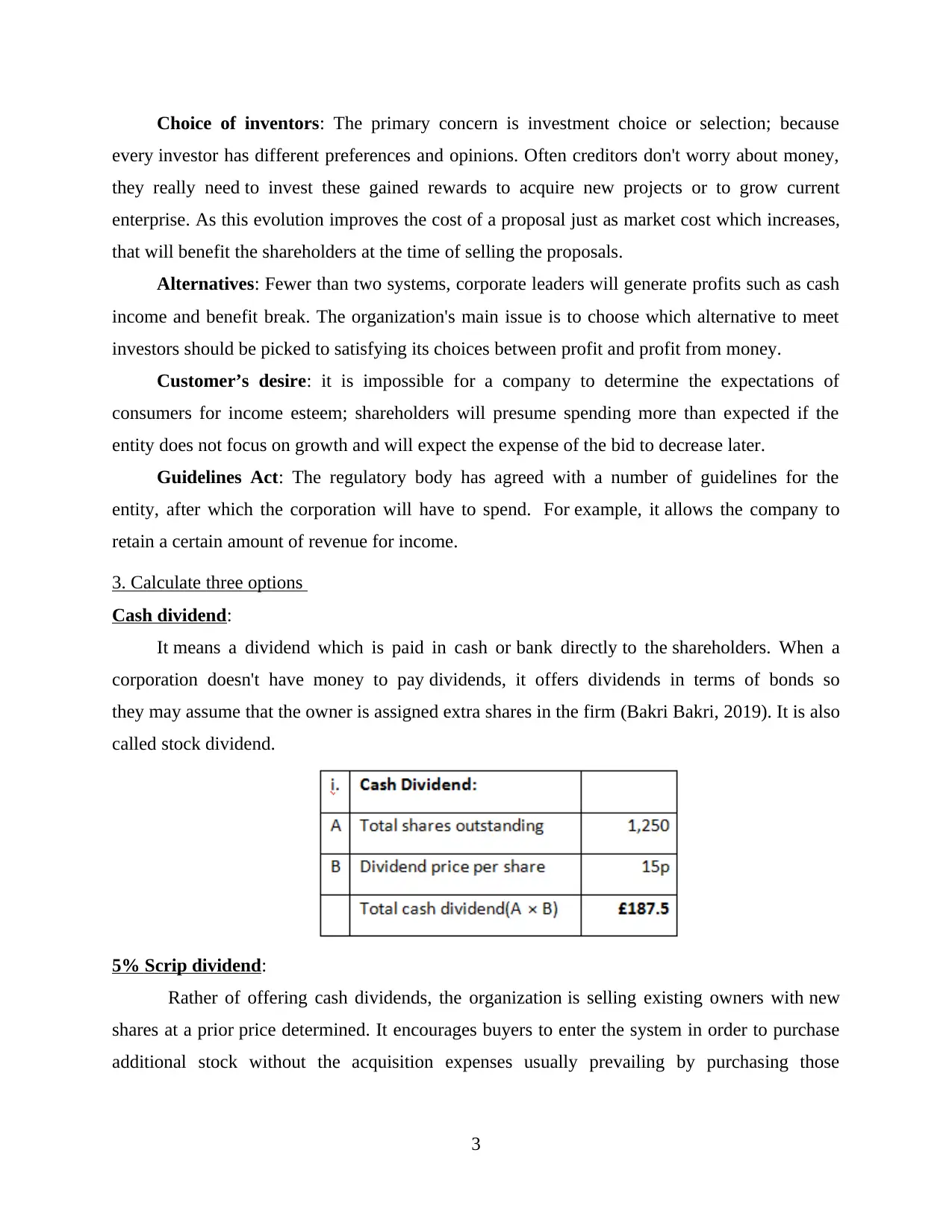
3. Calculate three options
Cash dividend:
It means a dividend which is paid in cash or bank directly to the shareholders. When a
corporation doesn't have money to pay dividends, it offers dividends in terms of bonds so
they may assume that the owner is assigned extra shares in the firm (Bakri Bakri, 2019). It is also
called stock dividend.
5% Scrip dividend:
Rather of offering cash dividends, the organization is selling existing owners with new
shares at a prior price determined. It encourages buyers to enter the system in order to purchase
additional stock without the acquisition expenses usually prevailing by purchasing those
3
every investor has different preferences and opinions. Often creditors don't worry about money,
they really need to invest these gained rewards to acquire new projects or to grow current
enterprise. As this evolution improves the cost of a proposal just as market cost which increases,
that will benefit the shareholders at the time of selling the proposals.
Alternatives: Fewer than two systems, corporate leaders will generate profits such as cash
income and benefit break. The organization's main issue is to choose which alternative to meet
investors should be picked to satisfying its choices between profit and profit from money.
Customer’s desire: it is impossible for a company to determine the expectations of
consumers for income esteem; shareholders will presume spending more than expected if the
entity does not focus on growth and will expect the expense of the bid to decrease later.
Guidelines Act: The regulatory body has agreed with a number of guidelines for the
entity, after which the corporation will have to spend. For example, it allows the company to
retain a certain amount of revenue for income.
3. Calculate three options
Cash dividend:
It means a dividend which is paid in cash or bank directly to the shareholders. When a
corporation doesn't have money to pay dividends, it offers dividends in terms of bonds so
they may assume that the owner is assigned extra shares in the firm (Bakri Bakri, 2019). It is also
called stock dividend.
5% Scrip dividend:
Rather of offering cash dividends, the organization is selling existing owners with new
shares at a prior price determined. It encourages buyers to enter the system in order to purchase
additional stock without the acquisition expenses usually prevailing by purchasing those
3
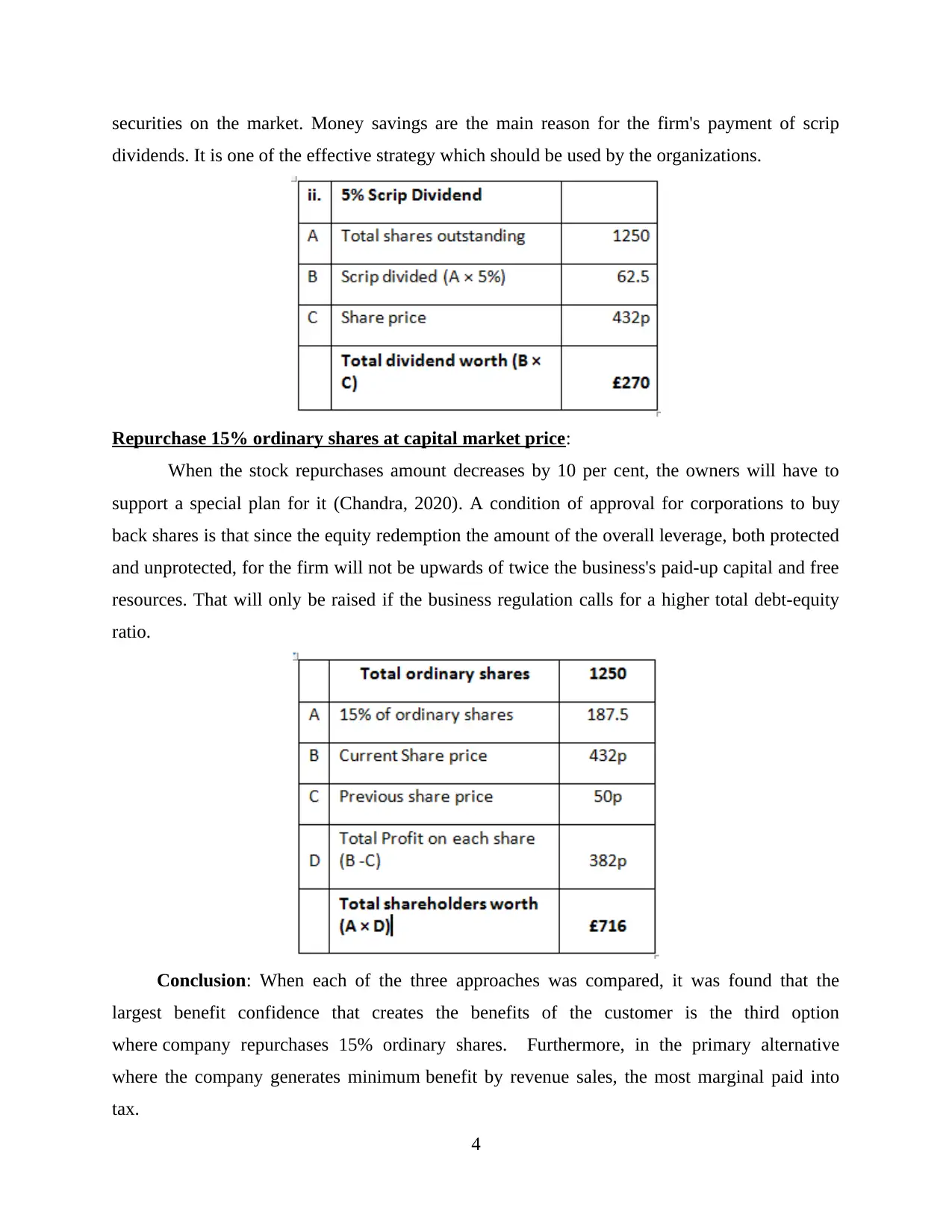
securities on the market. Money savings are the main reason for the firm's payment of scrip
dividends. It is one of the effective strategy which should be used by the organizations.
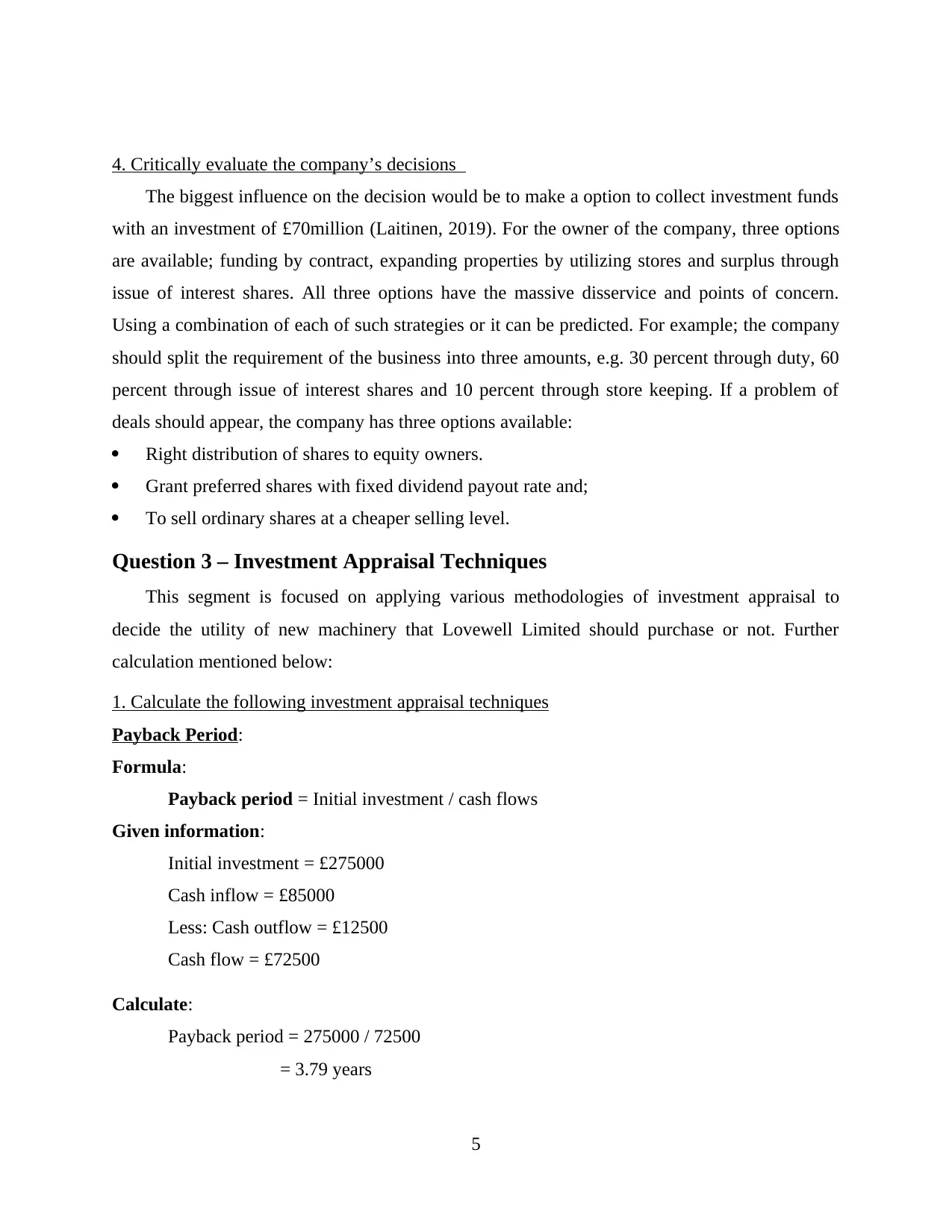
Repurchase 15% ordinary shares at capital market price:
When the stock repurchases amount decreases by 10 per cent, the owners will have to
support a special plan for it (Chandra, 2020). A condition of approval for corporations to buy
back shares is that since the equity redemption the amount of the overall leverage, both protected
and unprotected, for the firm will not be upwards of twice the business's paid-up capital and free
resources. That will only be raised if the business regulation calls for a higher total debt-equity
ratio.
Conclusion: When each of the three approaches was compared, it was found that the
largest benefit confidence that creates the benefits of the customer is the third option
where company repurchases 15% ordinary shares. Furthermore, in the primary alternative
where the company generates minimum benefit by revenue sales, the most marginal paid into
tax.
4
dividends. It is one of the effective strategy which should be used by the organizations.
Repurchase 15% ordinary shares at capital market price:
When the stock repurchases amount decreases by 10 per cent, the owners will have to
support a special plan for it (Chandra, 2020). A condition of approval for corporations to buy
back shares is that since the equity redemption the amount of the overall leverage, both protected
and unprotected, for the firm will not be upwards of twice the business's paid-up capital and free
resources. That will only be raised if the business regulation calls for a higher total debt-equity
ratio.
Conclusion: When each of the three approaches was compared, it was found that the
largest benefit confidence that creates the benefits of the customer is the third option
where company repurchases 15% ordinary shares. Furthermore, in the primary alternative
where the company generates minimum benefit by revenue sales, the most marginal paid into
tax.
4
⊘ This is a preview!⊘
Do you want full access?
Subscribe today to unlock all pages.
Trusted by 1+ million students worldwide
4. Critically evaluate the company’s decisions
The biggest influence on the decision would be to make a option to collect investment funds
with an investment of £70million (Laitinen, 2019). For the owner of the company, three options
are available; funding by contract, expanding properties by utilizing stores and surplus through
issue of interest shares. All three options have the massive disservice and points of concern.
Using a combination of each of such strategies or it can be predicted. For example; the company
should split the requirement of the business into three amounts, e.g. 30 percent through duty, 60
percent through issue of interest shares and 10 percent through store keeping. If a problem of
deals should appear, the company has three options available:
Right distribution of shares to equity owners.
Grant preferred shares with fixed dividend payout rate and;
To sell ordinary shares at a cheaper selling level.
Question 3 – Investment Appraisal Techniques
This segment is focused on applying various methodologies of investment appraisal to
decide the utility of new machinery that Lovewell Limited should purchase or not. Further
calculation mentioned below:
1. Calculate the following investment appraisal techniques
Payback Period:
Formula:
Payback period = Initial investment / cash flows
Given information:
Initial investment = £275000
Cash inflow = £85000
Less: Cash outflow = £12500
Cash flow = £72500
Calculate:
Payback period = 275000 / 72500
= 3.79 years
5
The biggest influence on the decision would be to make a option to collect investment funds
with an investment of £70million (Laitinen, 2019). For the owner of the company, three options
are available; funding by contract, expanding properties by utilizing stores and surplus through
issue of interest shares. All three options have the massive disservice and points of concern.
Using a combination of each of such strategies or it can be predicted. For example; the company
should split the requirement of the business into three amounts, e.g. 30 percent through duty, 60
percent through issue of interest shares and 10 percent through store keeping. If a problem of
deals should appear, the company has three options available:
Right distribution of shares to equity owners.
Grant preferred shares with fixed dividend payout rate and;
To sell ordinary shares at a cheaper selling level.
Question 3 – Investment Appraisal Techniques
This segment is focused on applying various methodologies of investment appraisal to
decide the utility of new machinery that Lovewell Limited should purchase or not. Further
calculation mentioned below:
1. Calculate the following investment appraisal techniques
Payback Period:
Formula:
Payback period = Initial investment / cash flows
Given information:
Initial investment = £275000
Cash inflow = £85000
Less: Cash outflow = £12500
Cash flow = £72500
Calculate:
Payback period = 275000 / 72500
= 3.79 years
5
Paraphrase This Document
Need a fresh take? Get an instant paraphrase of this document with our AI Paraphraser
Interpretation: From the above calculation of payback period, this can be figured out
that initial investment of 275000 pounds will be managed to recover in 3.79 years (Moortgat,
Annaert and Deloof, 2017). Although machinery life is of 6 years all above firm will buy this
machinery as expense will be recovered within machinery life.
Accounting rate of return (ARR):
Formula:
ARR = Average net profit / Average investment *100
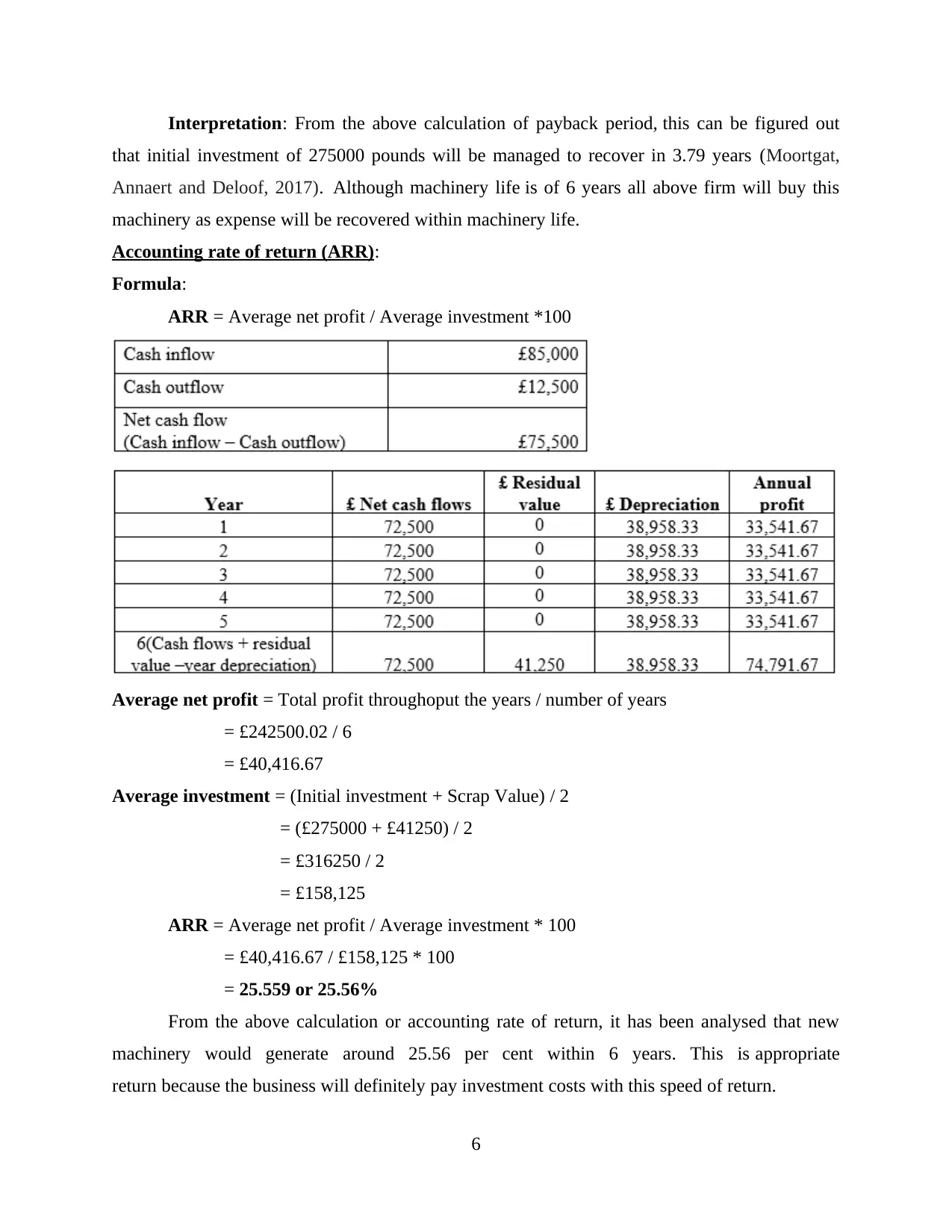
Average net profit = Total profit throughoput the years / number of years
= £242500.02 / 6
= £40,416.67
Average investment = (Initial investment + Scrap Value) / 2
= (£275000 + £41250) / 2
= £316250 / 2
= £158,125
ARR = Average net profit / Average investment * 100
= £40,416.67 / £158,125 * 100
= 25.559 or 25.56%
From the above calculation or accounting rate of return, it has been analysed that new
machinery would generate around 25.56 per cent within 6 years. This is appropriate
return because the business will definitely pay investment costs with this speed of return.
6
that initial investment of 275000 pounds will be managed to recover in 3.79 years (Moortgat,
Annaert and Deloof, 2017). Although machinery life is of 6 years all above firm will buy this
machinery as expense will be recovered within machinery life.
Accounting rate of return (ARR):
Formula:
ARR = Average net profit / Average investment *100
Average net profit = Total profit throughoput the years / number of years
= £242500.02 / 6
= £40,416.67
Average investment = (Initial investment + Scrap Value) / 2
= (£275000 + £41250) / 2
= £316250 / 2
= £158,125
ARR = Average net profit / Average investment * 100
= £40,416.67 / £158,125 * 100
= 25.559 or 25.56%
From the above calculation or accounting rate of return, it has been analysed that new
machinery would generate around 25.56 per cent within 6 years. This is appropriate
return because the business will definitely pay investment costs with this speed of return.
6
Net Present Value (NPV):
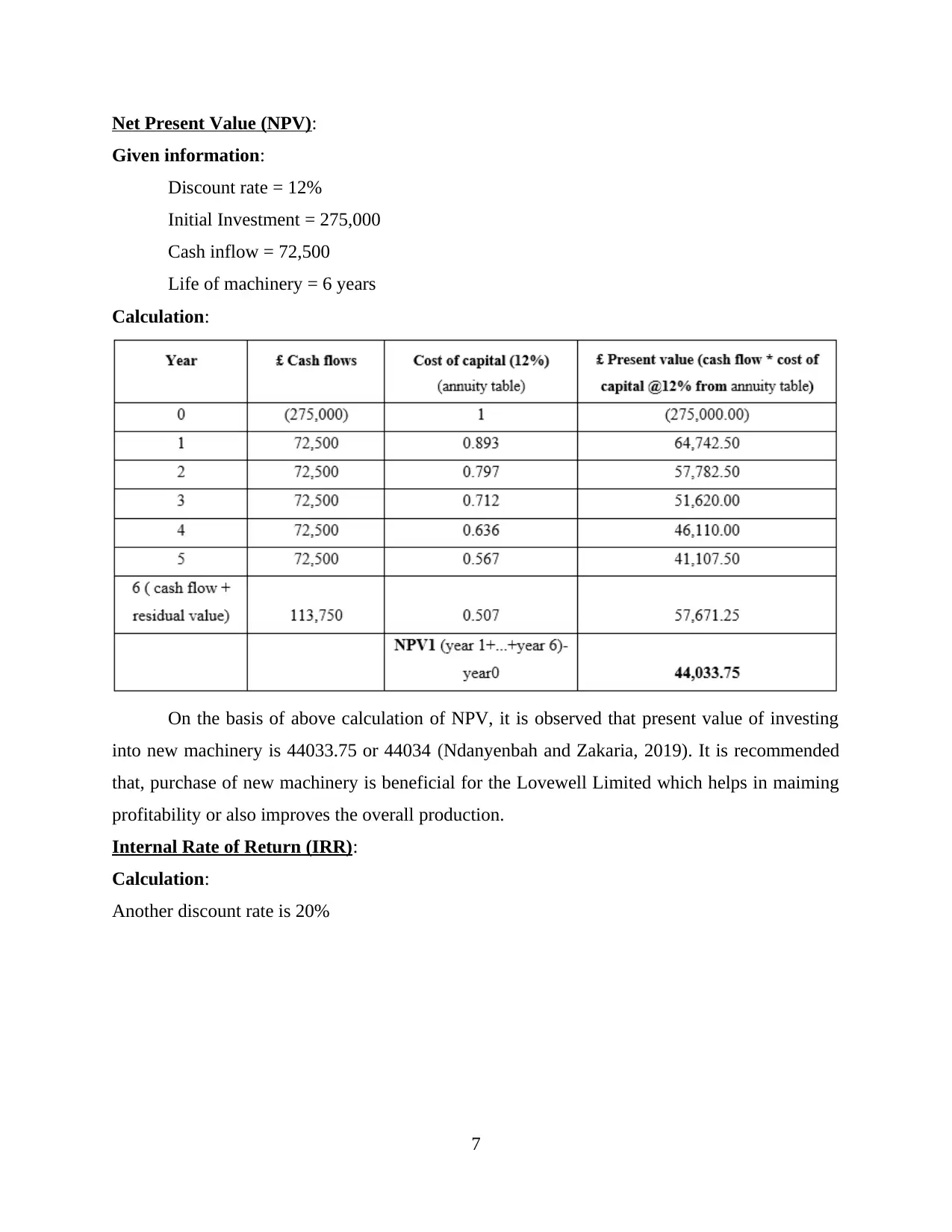
Given information:
Discount rate = 12%
Initial Investment = 275,000
Cash inflow = 72,500
Life of machinery = 6 years
Calculation:
On the basis of above calculation of NPV, it is observed that present value of investing
into new machinery is 44033.75 or 44034 (Ndanyenbah and Zakaria, 2019). It is recommended
that, purchase of new machinery is beneficial for the Lovewell Limited which helps in maiming
profitability or also improves the overall production.
Internal Rate of Return (IRR):
Calculation:
Another discount rate is 20%
7
Given information:
Discount rate = 12%
Initial Investment = 275,000
Cash inflow = 72,500
Life of machinery = 6 years
Calculation:
On the basis of above calculation of NPV, it is observed that present value of investing
into new machinery is 44033.75 or 44034 (Ndanyenbah and Zakaria, 2019). It is recommended
that, purchase of new machinery is beneficial for the Lovewell Limited which helps in maiming
profitability or also improves the overall production.
Internal Rate of Return (IRR):
Calculation:
Another discount rate is 20%
7
⊘ This is a preview!⊘
Do you want full access?
Subscribe today to unlock all pages.
Trusted by 1+ million students worldwide
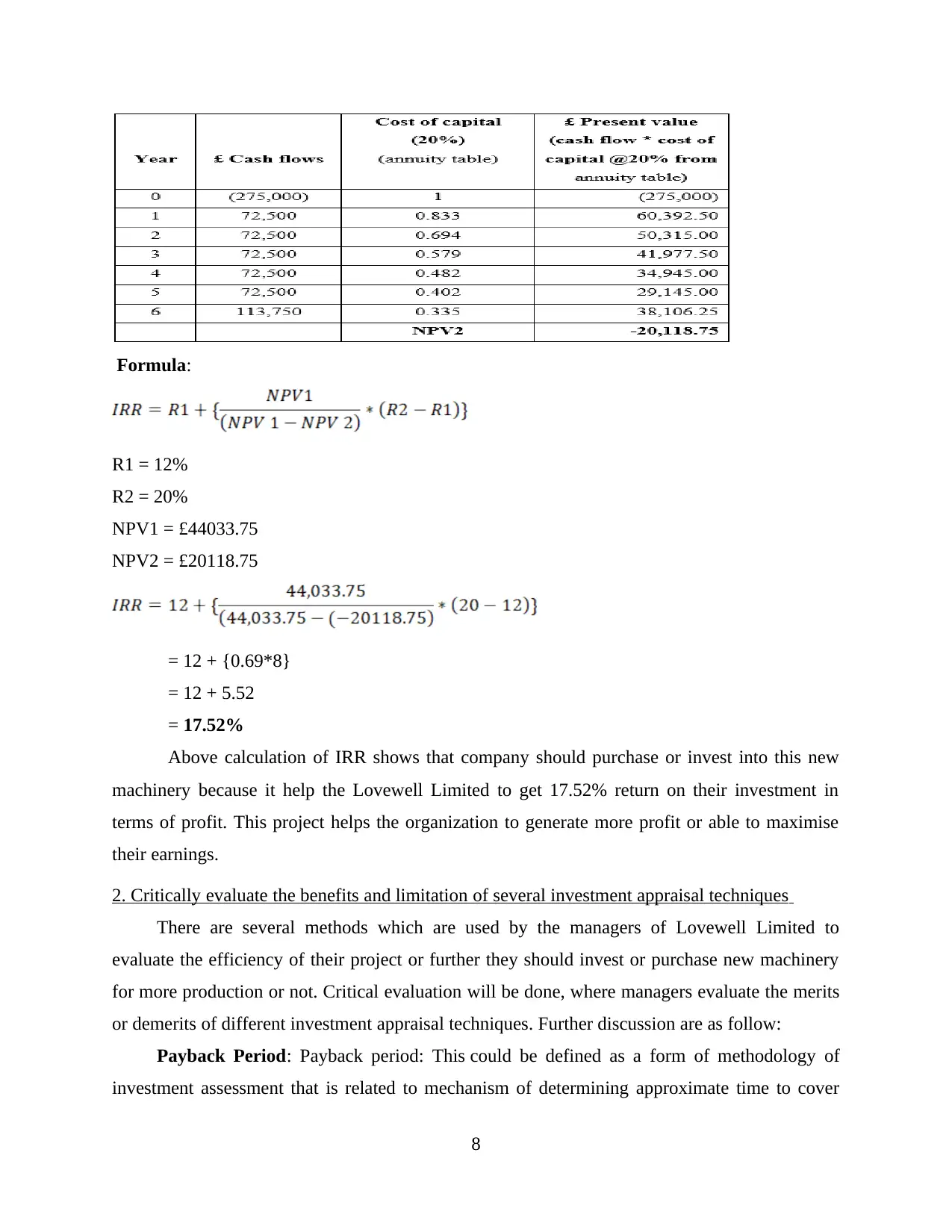
Formula:
R1 = 12%
R2 = 20%
NPV1 = £44033.75
NPV2 = £20118.75
= 12 + {0.69*8}
= 12 + 5.52
= 17.52%
Above calculation of IRR shows that company should purchase or invest into this new
machinery because it help the Lovewell Limited to get 17.52% return on their investment in
terms of profit. This project helps the organization to generate more profit or able to maximise
their earnings.
2. Critically evaluate the benefits and limitation of several investment appraisal techniques
There are several methods which are used by the managers of Lovewell Limited to
evaluate the efficiency of their project or further they should invest or purchase new machinery
for more production or not. Critical evaluation will be done, where managers evaluate the merits
or demerits of different investment appraisal techniques. Further discussion are as follow:
Payback Period: Payback period: This could be defined as a form of methodology of
investment assessment that is related to mechanism of determining approximate time to cover
8
R1 = 12%
R2 = 20%
NPV1 = £44033.75
NPV2 = £20118.75
= 12 + {0.69*8}
= 12 + 5.52
= 17.52%
Above calculation of IRR shows that company should purchase or invest into this new
machinery because it help the Lovewell Limited to get 17.52% return on their investment in
terms of profit. This project helps the organization to generate more profit or able to maximise
their earnings.
2. Critically evaluate the benefits and limitation of several investment appraisal techniques
There are several methods which are used by the managers of Lovewell Limited to
evaluate the efficiency of their project or further they should invest or purchase new machinery
for more production or not. Critical evaluation will be done, where managers evaluate the merits
or demerits of different investment appraisal techniques. Further discussion are as follow:
Payback Period: Payback period: This could be defined as a form of methodology of
investment assessment that is related to mechanism of determining approximate time to cover
8
Paraphrase This Document
Need a fresh take? Get an instant paraphrase of this document with our AI Paraphraser
their total cost of initial investment (Setiawan, Bandi, Phua and Trinugroho, 2016). This
function facilitates the implementation of some project in the organization. As for Lovewell
limited, this method was applied that also claims that total project costs will be recovered in 3.79
years. With the help of evaluating some benefits or limitations, manage is able to get idea that
they should invest in new machinery or not. There are certain advantages and drawbacks which
are discussed below:
Benefits: As stated according to the above discussion, it is simpler to apply this approach
which makes it great for all types of businesses, either small or large. As well as within this
approach, project effectiveness evaluation can be performed in less time and expense. Moreover,
it is used by any employer in an organisation, since this does not required any special experience
and skills in accounting.
Limitation: It has certain demerits that make results less accurate, as factors such as time
value of money are overlooked under this system. Despite of this, depending on generated result
is challenging for users, because time worth of money is among the key considerations to
remember when assessing a project. In this process, cash flows of every years is not included as
cash flows of the remaining years following recovery of investment costs are overlooked.
Accounting rate of return (ARR): It is just another method of investment appraisal
technique. By implementing this strategy, the rate of return company calculated and made their
decision accordingly. Under this process, businesses take appropriate action to purchase or
invest into any project on the basis of determined result. Compared to the approach above, this
also needs little more information to give the final result (Shapiro and Hanouna, 2019). As for
Lovewell Limited, this technique was used to estimate the approximate return that is 25.56
percent. This accounting rate of return effectively contributes to executives in deciding whether
or not they will consider a plan. It has some benefits and limitations which are as follow:
Benefits: This strategy has a variety of benefits which it more effective to use as
accounting profits that are used underneath it while total profit for proposed project are regarded
in several other methods. This factor allows applicability more accurate and convenient. This
approach is very simple to use because this is based on method and it will be calculated by
everyone inside the organization without any specialised information.
Limitations: The ARR approach does not require time value element that is an essential
aspect to consider. This renders decisions less efficient and reliable. Besides this, cash flows
9
function facilitates the implementation of some project in the organization. As for Lovewell
limited, this method was applied that also claims that total project costs will be recovered in 3.79
years. With the help of evaluating some benefits or limitations, manage is able to get idea that
they should invest in new machinery or not. There are certain advantages and drawbacks which
are discussed below:
Benefits: As stated according to the above discussion, it is simpler to apply this approach
which makes it great for all types of businesses, either small or large. As well as within this
approach, project effectiveness evaluation can be performed in less time and expense. Moreover,
it is used by any employer in an organisation, since this does not required any special experience
and skills in accounting.
Limitation: It has certain demerits that make results less accurate, as factors such as time
value of money are overlooked under this system. Despite of this, depending on generated result
is challenging for users, because time worth of money is among the key considerations to
remember when assessing a project. In this process, cash flows of every years is not included as
cash flows of the remaining years following recovery of investment costs are overlooked.
Accounting rate of return (ARR): It is just another method of investment appraisal
technique. By implementing this strategy, the rate of return company calculated and made their
decision accordingly. Under this process, businesses take appropriate action to purchase or
invest into any project on the basis of determined result. Compared to the approach above, this
also needs little more information to give the final result (Shapiro and Hanouna, 2019). As for
Lovewell Limited, this technique was used to estimate the approximate return that is 25.56
percent. This accounting rate of return effectively contributes to executives in deciding whether
or not they will consider a plan. It has some benefits and limitations which are as follow:
Benefits: This strategy has a variety of benefits which it more effective to use as
accounting profits that are used underneath it while total profit for proposed project are regarded
in several other methods. This factor allows applicability more accurate and convenient. This
approach is very simple to use because this is based on method and it will be calculated by
everyone inside the organization without any specialised information.
Limitations: The ARR approach does not require time value element that is an essential
aspect to consider. This renders decisions less efficient and reliable. Besides this, cash flows
9
underneath it is totally neglected which is really not that helpful in terms of a proposal's
computational performance.
Net Present Value (NPV): This type of appraisal technique used to calculate recent value
of a project. Under it, net present value of any proposal is determined by subtracting amount of
initial investment from cash flows of the different time periods. Under it, the net discounted cash
flow valuation is calculated using the expected Present Value (PV) element. The process is
commonly known as NPV (Sinha and Datta, 2020). This approach has been extended in the
sense of the aforementioned business to figure out the net present value of their planned
equipment. Under this approach, higher the NPV project is selected and the lower one rejected
because higher one profit more benefits or profitability to the organization. Many of the benefits
and demerits of this approach are explained in this way below:
Benefits: The main advantage of using this approach is that, it is the method of monitoring
project's current valuation it includes time value of money aspect. It makes it more efficient and
appropriate approach relative to the methods described above, as this aspect has been overlooked
in the above methods. Another major aspect of this approach is that calculating the present value
of the project requires cash flows among all years.
Limitation: It is a difficult to implement making assumptions relating to capital costs. As
well as this presumption, the result makes long-term judgments less accurate and successful. In
relation to this, fixed costs for estimating current project value are not included under it.
Internal Rate of Return (IRR): It could be defined as a form of approach that applies to
the evaluation process of a proposal's rate of return. This technique is found a method that is too
complicated to use because strong accounting information is required. As well as just those
individuals who have adequate knowledge regarding finance will apply this process. With regard
to the above-mentioned business, accountants have applied this approach to learn for the future
about the productivity of new machinery (Zietlow and et.al., 2018). This approach has some
benefits and demerit points which clarified below:
Benefits: The key advantage of this analysis is that it allows accurate outcomes that make it
easy for administrators to take effective action. In particular, all those variables that are
mandatory to move in before assessing a project's success will be included under this method to
evaluate whether project is beneficial or not.
10
computational performance.
Net Present Value (NPV): This type of appraisal technique used to calculate recent value
of a project. Under it, net present value of any proposal is determined by subtracting amount of
initial investment from cash flows of the different time periods. Under it, the net discounted cash
flow valuation is calculated using the expected Present Value (PV) element. The process is
commonly known as NPV (Sinha and Datta, 2020). This approach has been extended in the
sense of the aforementioned business to figure out the net present value of their planned
equipment. Under this approach, higher the NPV project is selected and the lower one rejected
because higher one profit more benefits or profitability to the organization. Many of the benefits
and demerits of this approach are explained in this way below:
Benefits: The main advantage of using this approach is that, it is the method of monitoring
project's current valuation it includes time value of money aspect. It makes it more efficient and
appropriate approach relative to the methods described above, as this aspect has been overlooked
in the above methods. Another major aspect of this approach is that calculating the present value
of the project requires cash flows among all years.
Limitation: It is a difficult to implement making assumptions relating to capital costs. As
well as this presumption, the result makes long-term judgments less accurate and successful. In
relation to this, fixed costs for estimating current project value are not included under it.
Internal Rate of Return (IRR): It could be defined as a form of approach that applies to
the evaluation process of a proposal's rate of return. This technique is found a method that is too
complicated to use because strong accounting information is required. As well as just those
individuals who have adequate knowledge regarding finance will apply this process. With regard
to the above-mentioned business, accountants have applied this approach to learn for the future
about the productivity of new machinery (Zietlow and et.al., 2018). This approach has some
benefits and demerit points which clarified below:
Benefits: The key advantage of this analysis is that it allows accurate outcomes that make it
easy for administrators to take effective action. In particular, all those variables that are
mandatory to move in before assessing a project's success will be included under this method to
evaluate whether project is beneficial or not.
10
⊘ This is a preview!⊘
Do you want full access?
Subscribe today to unlock all pages.
Trusted by 1+ million students worldwide

1 out of 14


Related Documents


Your All-in-One AI-Powered Toolkit for Academic Success.
+13062052269
info@desklib.com
Available 24*7 on WhatsApp / Email
![[object Object]](/_next/static/media/star-bottom.7253800d.svg)
Unlock your academic potential
Copyright © 2020–2026 A2Z Services. All Rights Reserved. Developed and managed by ZUCOL.