Project Management Plan: DIY Outlet Expansion Over Three Years
VerifiedAdded on 2020/03/16
|11
|2463
|65
Project
AI Summary
This project management assignment analyzes the expansion of a DIY outlet chain, detailing the planning and execution of opening six new stores. The report outlines framework agreements with various parties, including marketing agents, finance advisors, and construction firms, to ensure brand consistency and effective stakeholder management. It proposes procurement methods such as open tendering and request for quotations, along with a communication flow chart to streamline project information. The assignment also includes a risk register identifying potential challenges like funding shortages, unskilled employees, and project delays, along with mitigation strategies. Furthermore, it applies project management techniques like the Critical Path Method and Gantt charts to establish a project timeline and allocate resources effectively. The conclusion emphasizes the importance of skilled personnel, technological innovation, and training to ensure the successful and timely completion of the expansion project.
Project Management practice

Paraphrase This Document
Need a fresh take? Get an instant paraphrase of this document with our AI Paraphraser
TABLE OF CONTENTS
EXECUTIVE SUMMARY.............................................................................................................1
INTRODUCTION...........................................................................................................................1
a) Which parties the franchise should enter into ‘framework agreements’ with, in order to
achieve the key objectives on all locations and ‘builds’. Explain which parties would be
independently selected to suit each location................................................................................1
b) Explain the proposed procurement method you will be using for this development,
including a communications flow chart.......................................................................................2
c) Completing a programme of works at the appropriate level...................................................5
CONCLUSION AND RECOMMENDATIONS............................................................................6
REFERENCES................................................................................................................................7
EXECUTIVE SUMMARY.............................................................................................................1
INTRODUCTION...........................................................................................................................1
a) Which parties the franchise should enter into ‘framework agreements’ with, in order to
achieve the key objectives on all locations and ‘builds’. Explain which parties would be
independently selected to suit each location................................................................................1
b) Explain the proposed procurement method you will be using for this development,
including a communications flow chart.......................................................................................2
c) Completing a programme of works at the appropriate level...................................................5
CONCLUSION AND RECOMMENDATIONS............................................................................6
REFERENCES................................................................................................................................7
EXECUTIVE SUMMARY
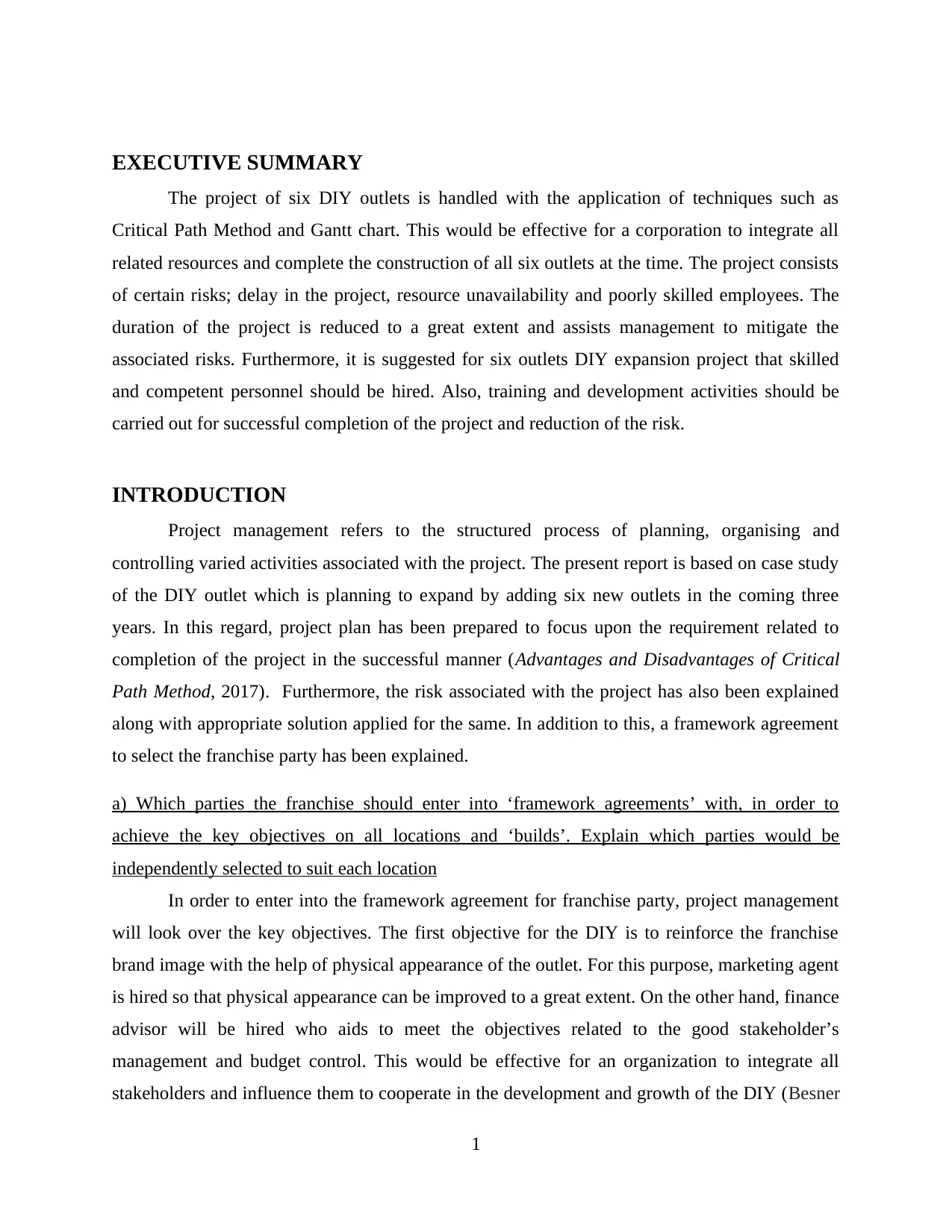
The project of six DIY outlets is handled with the application of techniques such as
Critical Path Method and Gantt chart. This would be effective for a corporation to integrate all
related resources and complete the construction of all six outlets at the time. The project consists
of certain risks; delay in the project, resource unavailability and poorly skilled employees. The
duration of the project is reduced to a great extent and assists management to mitigate the
associated risks. Furthermore, it is suggested for six outlets DIY expansion project that skilled
and competent personnel should be hired. Also, training and development activities should be
carried out for successful completion of the project and reduction of the risk.
INTRODUCTION
Project management refers to the structured process of planning, organising and
controlling varied activities associated with the project. The present report is based on case study
of the DIY outlet which is planning to expand by adding six new outlets in the coming three
years. In this regard, project plan has been prepared to focus upon the requirement related to
completion of the project in the successful manner (Advantages and Disadvantages of Critical
Path Method, 2017). Furthermore, the risk associated with the project has also been explained
along with appropriate solution applied for the same. In addition to this, a framework agreement
to select the franchise party has been explained.
a) Which parties the franchise should enter into ‘framework agreements’ with, in order to
achieve the key objectives on all locations and ‘builds’. Explain which parties would be
independently selected to suit each location
In order to enter into the framework agreement for franchise party, project management
will look over the key objectives. The first objective for the DIY is to reinforce the franchise
brand image with the help of physical appearance of the outlet. For this purpose, marketing agent
is hired so that physical appearance can be improved to a great extent. On the other hand, finance
advisor will be hired who aids to meet the objectives related to the good stakeholder’s
management and budget control. This would be effective for an organization to integrate all
stakeholders and influence them to cooperate in the development and growth of the DIY (Besner
1
The project of six DIY outlets is handled with the application of techniques such as
Critical Path Method and Gantt chart. This would be effective for a corporation to integrate all
related resources and complete the construction of all six outlets at the time. The project consists
of certain risks; delay in the project, resource unavailability and poorly skilled employees. The
duration of the project is reduced to a great extent and assists management to mitigate the
associated risks. Furthermore, it is suggested for six outlets DIY expansion project that skilled
and competent personnel should be hired. Also, training and development activities should be
carried out for successful completion of the project and reduction of the risk.
INTRODUCTION
Project management refers to the structured process of planning, organising and
controlling varied activities associated with the project. The present report is based on case study
of the DIY outlet which is planning to expand by adding six new outlets in the coming three
years. In this regard, project plan has been prepared to focus upon the requirement related to
completion of the project in the successful manner (Advantages and Disadvantages of Critical
Path Method, 2017). Furthermore, the risk associated with the project has also been explained
along with appropriate solution applied for the same. In addition to this, a framework agreement
to select the franchise party has been explained.
a) Which parties the franchise should enter into ‘framework agreements’ with, in order to
achieve the key objectives on all locations and ‘builds’. Explain which parties would be
independently selected to suit each location
In order to enter into the framework agreement for franchise party, project management
will look over the key objectives. The first objective for the DIY is to reinforce the franchise
brand image with the help of physical appearance of the outlet. For this purpose, marketing agent
is hired so that physical appearance can be improved to a great extent. On the other hand, finance
advisor will be hired who aids to meet the objectives related to the good stakeholder’s
management and budget control. This would be effective for an organization to integrate all
stakeholders and influence them to cooperate in the development and growth of the DIY (Besner
1
⊘ This is a preview!⊘
Do you want full access?
Subscribe today to unlock all pages.

Trusted by 1+ million students worldwide
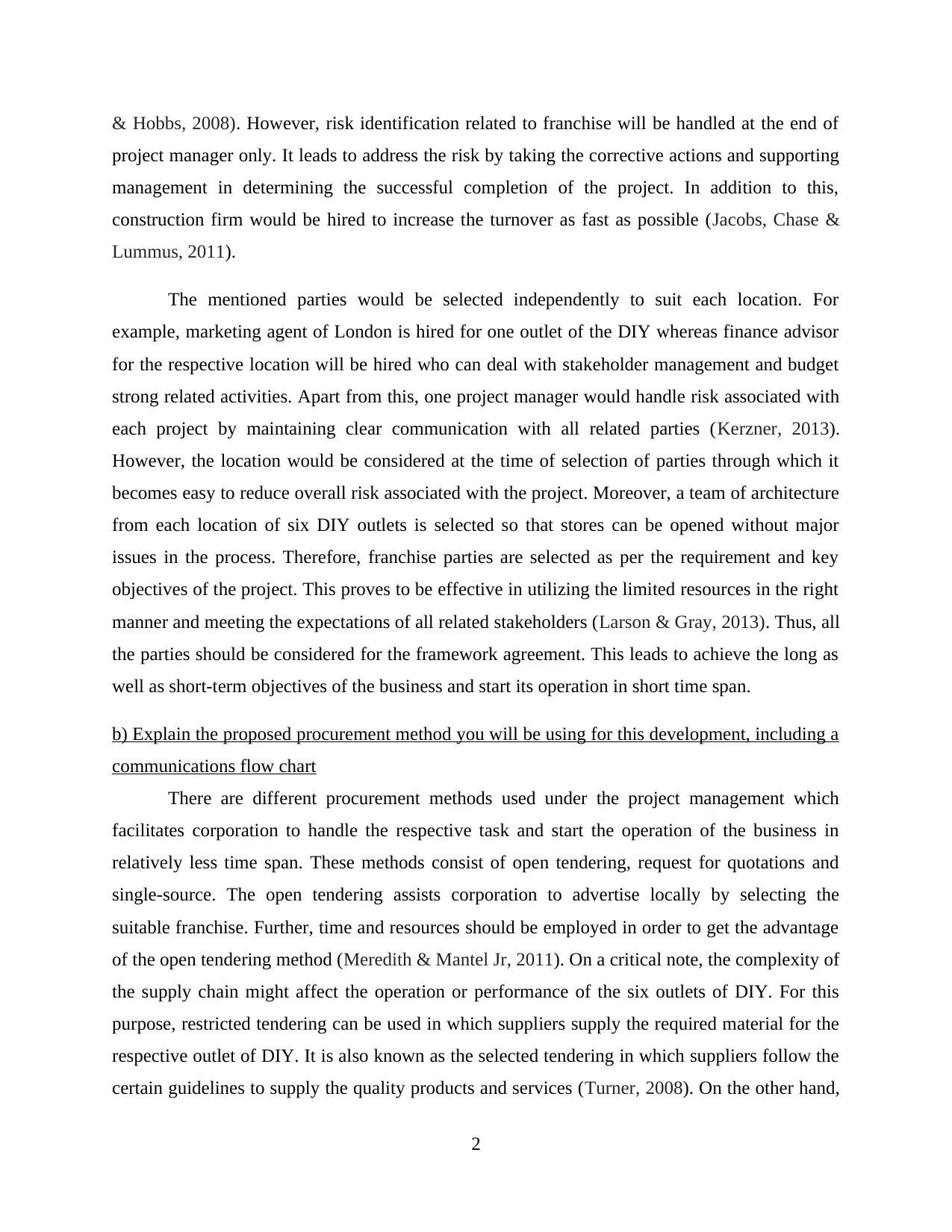
& Hobbs, 2008). However, risk identification related to franchise will be handled at the end of
project manager only. It leads to address the risk by taking the corrective actions and supporting
management in determining the successful completion of the project. In addition to this,
construction firm would be hired to increase the turnover as fast as possible (Jacobs, Chase &
Lummus, 2011).
The mentioned parties would be selected independently to suit each location. For
example, marketing agent of London is hired for one outlet of the DIY whereas finance advisor
for the respective location will be hired who can deal with stakeholder management and budget
strong related activities. Apart from this, one project manager would handle risk associated with
each project by maintaining clear communication with all related parties (Kerzner, 2013).
However, the location would be considered at the time of selection of parties through which it
becomes easy to reduce overall risk associated with the project. Moreover, a team of architecture
from each location of six DIY outlets is selected so that stores can be opened without major
issues in the process. Therefore, franchise parties are selected as per the requirement and key
objectives of the project. This proves to be effective in utilizing the limited resources in the right
manner and meeting the expectations of all related stakeholders (Larson & Gray, 2013). Thus, all
the parties should be considered for the framework agreement. This leads to achieve the long as
well as short-term objectives of the business and start its operation in short time span.
b) Explain the proposed procurement method you will be using for this development, including a
communications flow chart
There are different procurement methods used under the project management which
facilitates corporation to handle the respective task and start the operation of the business in
relatively less time span. These methods consist of open tendering, request for quotations and
single-source. The open tendering assists corporation to advertise locally by selecting the
suitable franchise. Further, time and resources should be employed in order to get the advantage
of the open tendering method (Meredith & Mantel Jr, 2011). On a critical note, the complexity of
the supply chain might affect the operation or performance of the six outlets of DIY. For this
purpose, restricted tendering can be used in which suppliers supply the required material for the
respective outlet of DIY. It is also known as the selected tendering in which suppliers follow the
certain guidelines to supply the quality products and services (Turner, 2008). On the other hand,
2
project manager only. It leads to address the risk by taking the corrective actions and supporting
management in determining the successful completion of the project. In addition to this,
construction firm would be hired to increase the turnover as fast as possible (Jacobs, Chase &
Lummus, 2011).
The mentioned parties would be selected independently to suit each location. For
example, marketing agent of London is hired for one outlet of the DIY whereas finance advisor
for the respective location will be hired who can deal with stakeholder management and budget
strong related activities. Apart from this, one project manager would handle risk associated with
each project by maintaining clear communication with all related parties (Kerzner, 2013).
However, the location would be considered at the time of selection of parties through which it
becomes easy to reduce overall risk associated with the project. Moreover, a team of architecture
from each location of six DIY outlets is selected so that stores can be opened without major
issues in the process. Therefore, franchise parties are selected as per the requirement and key
objectives of the project. This proves to be effective in utilizing the limited resources in the right
manner and meeting the expectations of all related stakeholders (Larson & Gray, 2013). Thus, all
the parties should be considered for the framework agreement. This leads to achieve the long as
well as short-term objectives of the business and start its operation in short time span.
b) Explain the proposed procurement method you will be using for this development, including a
communications flow chart
There are different procurement methods used under the project management which
facilitates corporation to handle the respective task and start the operation of the business in
relatively less time span. These methods consist of open tendering, request for quotations and
single-source. The open tendering assists corporation to advertise locally by selecting the
suitable franchise. Further, time and resources should be employed in order to get the advantage
of the open tendering method (Meredith & Mantel Jr, 2011). On a critical note, the complexity of
the supply chain might affect the operation or performance of the six outlets of DIY. For this
purpose, restricted tendering can be used in which suppliers supply the required material for the
respective outlet of DIY. It is also known as the selected tendering in which suppliers follow the
certain guidelines to supply the quality products and services (Turner, 2008). On the other hand,
2
Paraphrase This Document
Need a fresh take? Get an instant paraphrase of this document with our AI Paraphraser
request for quotations is another method in which selected material can be ordered by the
business. It would be effective for a corporation to get the desired material in order to start six
DIY outlets. At last, single-source is another method whereby situation related to the emergency
can be handled.
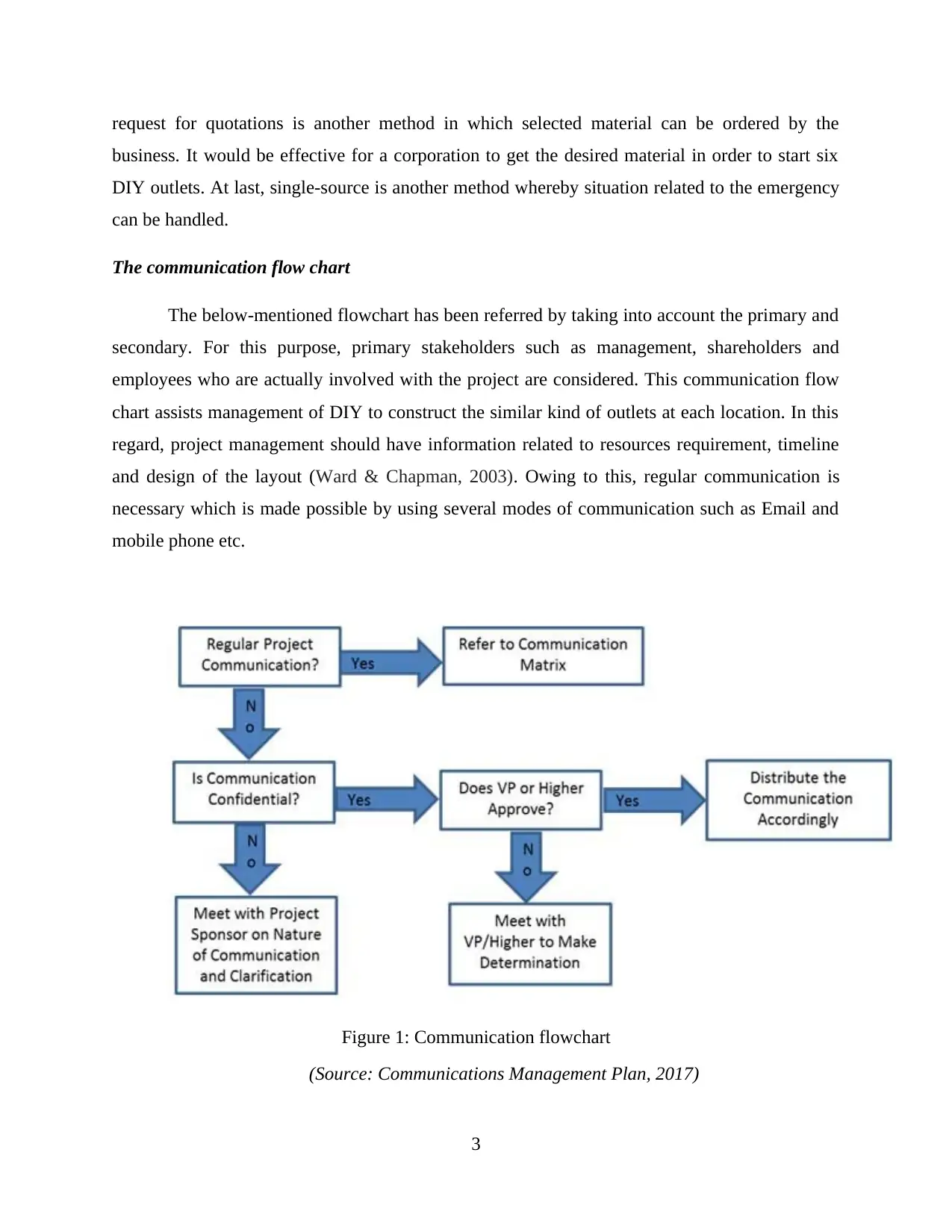
The communication flow chart
The below-mentioned flowchart has been referred by taking into account the primary and
secondary. For this purpose, primary stakeholders such as management, shareholders and
employees who are actually involved with the project are considered. This communication flow
chart assists management of DIY to construct the similar kind of outlets at each location. In this
regard, project management should have information related to resources requirement, timeline
and design of the layout (Ward & Chapman, 2003). Owing to this, regular communication is
necessary which is made possible by using several modes of communication such as Email and
mobile phone etc.
Figure 1: Communication flowchart
(Source: Communications Management Plan, 2017)
3
business. It would be effective for a corporation to get the desired material in order to start six
DIY outlets. At last, single-source is another method whereby situation related to the emergency
can be handled.
The communication flow chart
The below-mentioned flowchart has been referred by taking into account the primary and
secondary. For this purpose, primary stakeholders such as management, shareholders and
employees who are actually involved with the project are considered. This communication flow
chart assists management of DIY to construct the similar kind of outlets at each location. In this
regard, project management should have information related to resources requirement, timeline
and design of the layout (Ward & Chapman, 2003). Owing to this, regular communication is
necessary which is made possible by using several modes of communication such as Email and
mobile phone etc.
Figure 1: Communication flowchart
(Source: Communications Management Plan, 2017)
3
On the other hand, meetings are conducted between the project staff and manager along
with other related staff of the project. At this juncture, all the information is passed to the
manager who can effectively guide staff members and ensure the design all the stores in the same
manner (Chapman & Ward, 2003).
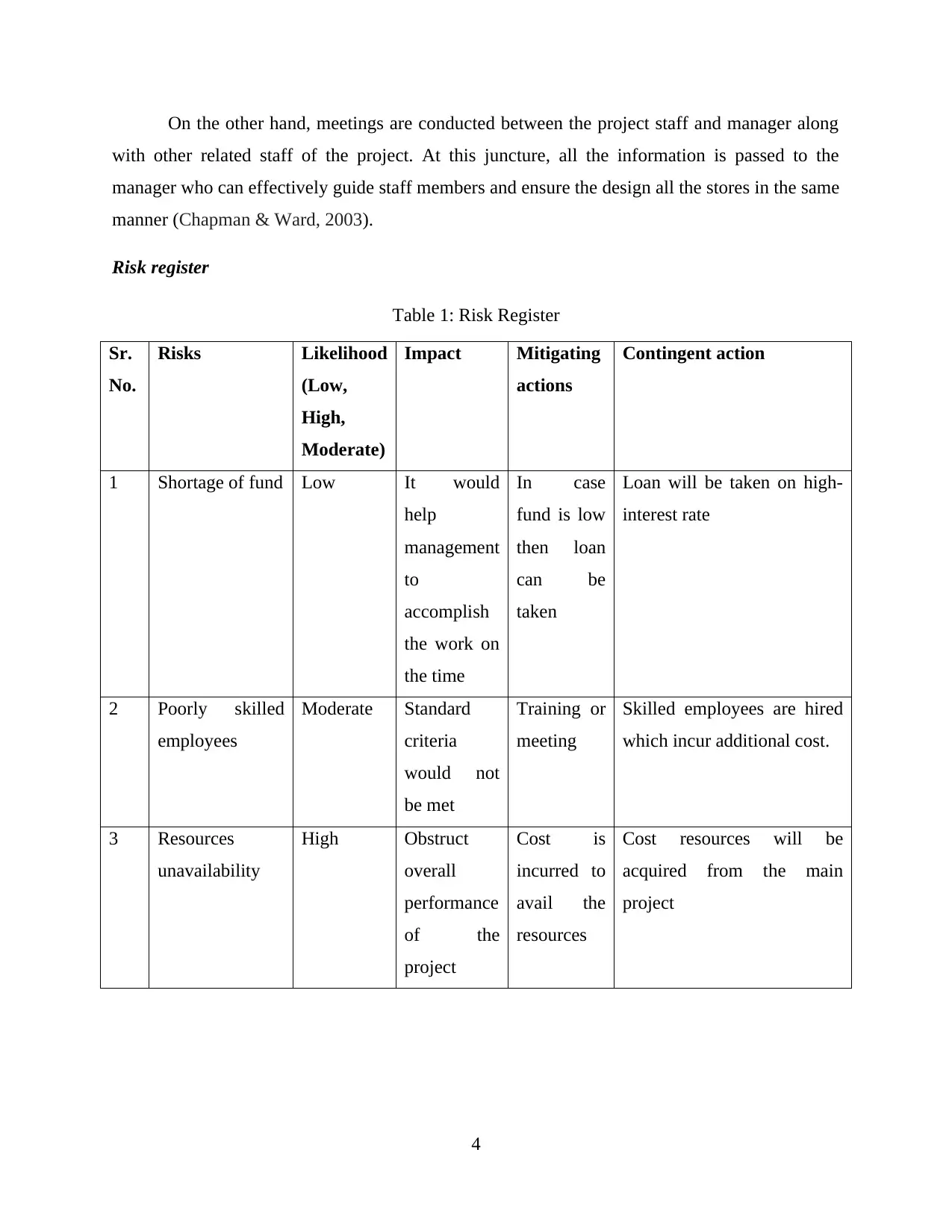
Risk register
Table 1: Risk Register
Sr.
No.
Risks Likelihood
(Low,
High,
Moderate)
Impact Mitigating
actions
Contingent action
1 Shortage of fund Low It would
help
management
to
accomplish
the work on
the time
In case
fund is low
then loan
can be
taken
Loan will be taken on high-
interest rate
2 Poorly skilled
employees
Moderate Standard
criteria
would not
be met
Training or
meeting
Skilled employees are hired
which incur additional cost.
3 Resources
unavailability
High Obstruct
overall
performance
of the
project
Cost is
incurred to
avail the
resources
Cost resources will be
acquired from the main
project
4
with other related staff of the project. At this juncture, all the information is passed to the
manager who can effectively guide staff members and ensure the design all the stores in the same
manner (Chapman & Ward, 2003).
Risk register
Table 1: Risk Register
Sr.
No.
Risks Likelihood
(Low,
High,
Moderate)
Impact Mitigating
actions
Contingent action
1 Shortage of fund Low It would
help
management
to
accomplish
the work on
the time
In case
fund is low
then loan
can be
taken
Loan will be taken on high-
interest rate
2 Poorly skilled
employees
Moderate Standard
criteria
would not
be met
Training or
meeting
Skilled employees are hired
which incur additional cost.
3 Resources
unavailability
High Obstruct
overall
performance
of the
project
Cost is
incurred to
avail the
resources
Cost resources will be
acquired from the main
project
4
⊘ This is a preview!⊘
Do you want full access?
Subscribe today to unlock all pages.
Trusted by 1+ million students worldwide
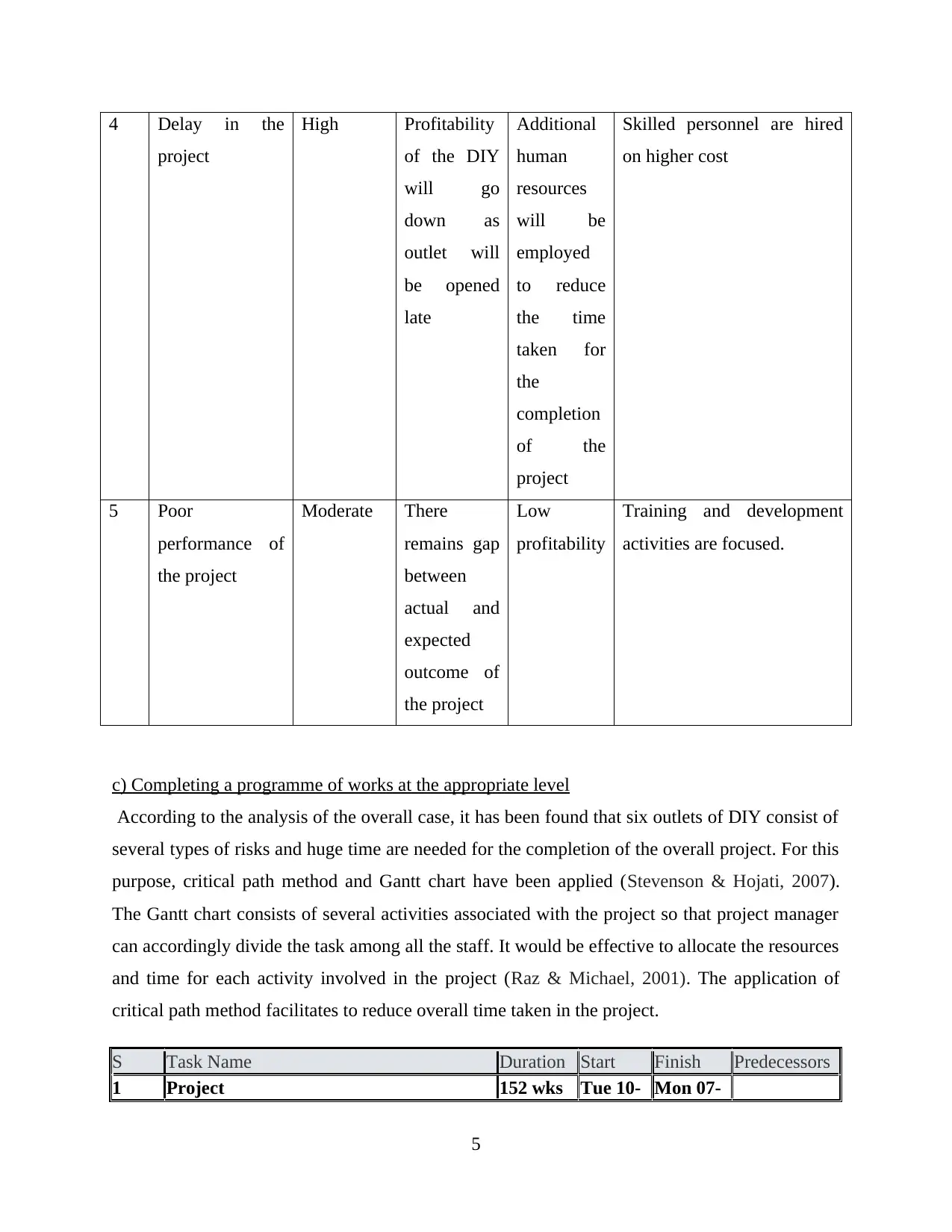
4 Delay in the
project
High Profitability
of the DIY
will go
down as
outlet will
be opened
late
Additional
human
resources
will be
employed
to reduce
the time
taken for
the
completion
of the
project
Skilled personnel are hired
on higher cost
5 Poor
performance of
the project
Moderate There
remains gap
between
actual and
expected
outcome of
the project
Low
profitability
Training and development
activities are focused.
c) Completing a programme of works at the appropriate level
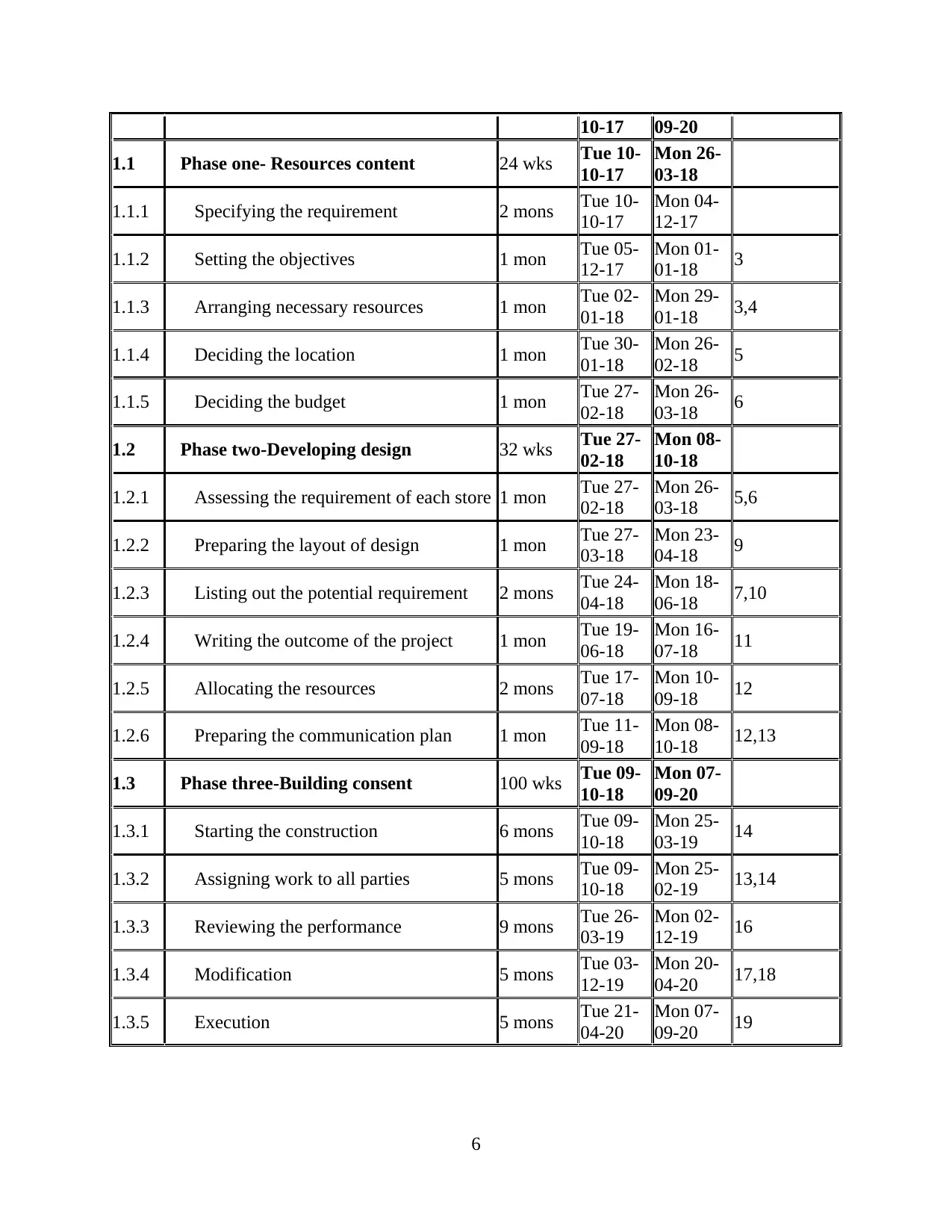
According to the analysis of the overall case, it has been found that six outlets of DIY consist of
several types of risks and huge time are needed for the completion of the overall project. For this
purpose, critical path method and Gantt chart have been applied (Stevenson & Hojati, 2007).
The Gantt chart consists of several activities associated with the project so that project manager
can accordingly divide the task among all the staff. It would be effective to allocate the resources
and time for each activity involved in the project (Raz & Michael, 2001). The application of
critical path method facilitates to reduce overall time taken in the project.
S Task Name Duration Start Finish Predecessors
1 Project 152 wks Tue 10- Mon 07-
5
project
High Profitability
of the DIY
will go
down as
outlet will
be opened
late
Additional
human
resources
will be
employed
to reduce
the time
taken for
the
completion
of the
project
Skilled personnel are hired
on higher cost
5 Poor
performance of
the project
Moderate There
remains gap
between
actual and
expected
outcome of
the project
Low
profitability
Training and development
activities are focused.
c) Completing a programme of works at the appropriate level
According to the analysis of the overall case, it has been found that six outlets of DIY consist of
several types of risks and huge time are needed for the completion of the overall project. For this
purpose, critical path method and Gantt chart have been applied (Stevenson & Hojati, 2007).
The Gantt chart consists of several activities associated with the project so that project manager
can accordingly divide the task among all the staff. It would be effective to allocate the resources
and time for each activity involved in the project (Raz & Michael, 2001). The application of
critical path method facilitates to reduce overall time taken in the project.
S Task Name Duration Start Finish Predecessors
1 Project 152 wks Tue 10- Mon 07-
5
Paraphrase This Document
Need a fresh take? Get an instant paraphrase of this document with our AI Paraphraser
10-17 09-20
1.1 Phase one- Resources content 24 wks Tue 10-
10-17
Mon 26-
03-18
1.1.1 Specifying the requirement 2 mons Tue 10-
10-17
Mon 04-
12-17
1.1.2 Setting the objectives 1 mon Tue 05-
12-17
Mon 01-
01-18 3
1.1.3 Arranging necessary resources 1 mon Tue 02-
01-18
Mon 29-
01-18 3,4
1.1.4 Deciding the location 1 mon Tue 30-
01-18
Mon 26-
02-18 5
1.1.5 Deciding the budget 1 mon Tue 27-
02-18
Mon 26-
03-18 6
1.2 Phase two-Developing design 32 wks Tue 27-
02-18
Mon 08-
10-18
1.2.1 Assessing the requirement of each store 1 mon Tue 27-
02-18
Mon 26-
03-18 5,6
1.2.2 Preparing the layout of design 1 mon Tue 27-
03-18
Mon 23-
04-18 9
1.2.3 Listing out the potential requirement 2 mons Tue 24-
04-18
Mon 18-
06-18 7,10
1.2.4 Writing the outcome of the project 1 mon Tue 19-
06-18
Mon 16-
07-18 11
1.2.5 Allocating the resources 2 mons Tue 17-
07-18
Mon 10-
09-18 12
1.2.6 Preparing the communication plan 1 mon Tue 11-
09-18
Mon 08-
10-18 12,13
1.3 Phase three-Building consent 100 wks Tue 09-
10-18
Mon 07-
09-20
1.3.1 Starting the construction 6 mons Tue 09-
10-18
Mon 25-
03-19 14
1.3.2 Assigning work to all parties 5 mons Tue 09-
10-18
Mon 25-
02-19 13,14
1.3.3 Reviewing the performance 9 mons Tue 26-
03-19
Mon 02-
12-19 16
1.3.4 Modification 5 mons Tue 03-
12-19
Mon 20-
04-20 17,18
1.3.5 Execution 5 mons Tue 21-
04-20
Mon 07-
09-20 19
6
1.1 Phase one- Resources content 24 wks Tue 10-
10-17
Mon 26-
03-18
1.1.1 Specifying the requirement 2 mons Tue 10-
10-17
Mon 04-
12-17
1.1.2 Setting the objectives 1 mon Tue 05-
12-17
Mon 01-
01-18 3
1.1.3 Arranging necessary resources 1 mon Tue 02-
01-18
Mon 29-
01-18 3,4
1.1.4 Deciding the location 1 mon Tue 30-
01-18
Mon 26-
02-18 5
1.1.5 Deciding the budget 1 mon Tue 27-
02-18
Mon 26-
03-18 6
1.2 Phase two-Developing design 32 wks Tue 27-
02-18
Mon 08-
10-18
1.2.1 Assessing the requirement of each store 1 mon Tue 27-
02-18
Mon 26-
03-18 5,6
1.2.2 Preparing the layout of design 1 mon Tue 27-
03-18
Mon 23-
04-18 9
1.2.3 Listing out the potential requirement 2 mons Tue 24-
04-18
Mon 18-
06-18 7,10
1.2.4 Writing the outcome of the project 1 mon Tue 19-
06-18
Mon 16-
07-18 11
1.2.5 Allocating the resources 2 mons Tue 17-
07-18
Mon 10-
09-18 12
1.2.6 Preparing the communication plan 1 mon Tue 11-
09-18
Mon 08-
10-18 12,13
1.3 Phase three-Building consent 100 wks Tue 09-
10-18
Mon 07-
09-20
1.3.1 Starting the construction 6 mons Tue 09-
10-18
Mon 25-
03-19 14
1.3.2 Assigning work to all parties 5 mons Tue 09-
10-18
Mon 25-
02-19 13,14
1.3.3 Reviewing the performance 9 mons Tue 26-
03-19
Mon 02-
12-19 16
1.3.4 Modification 5 mons Tue 03-
12-19
Mon 20-
04-20 17,18
1.3.5 Execution 5 mons Tue 21-
04-20
Mon 07-
09-20 19
6
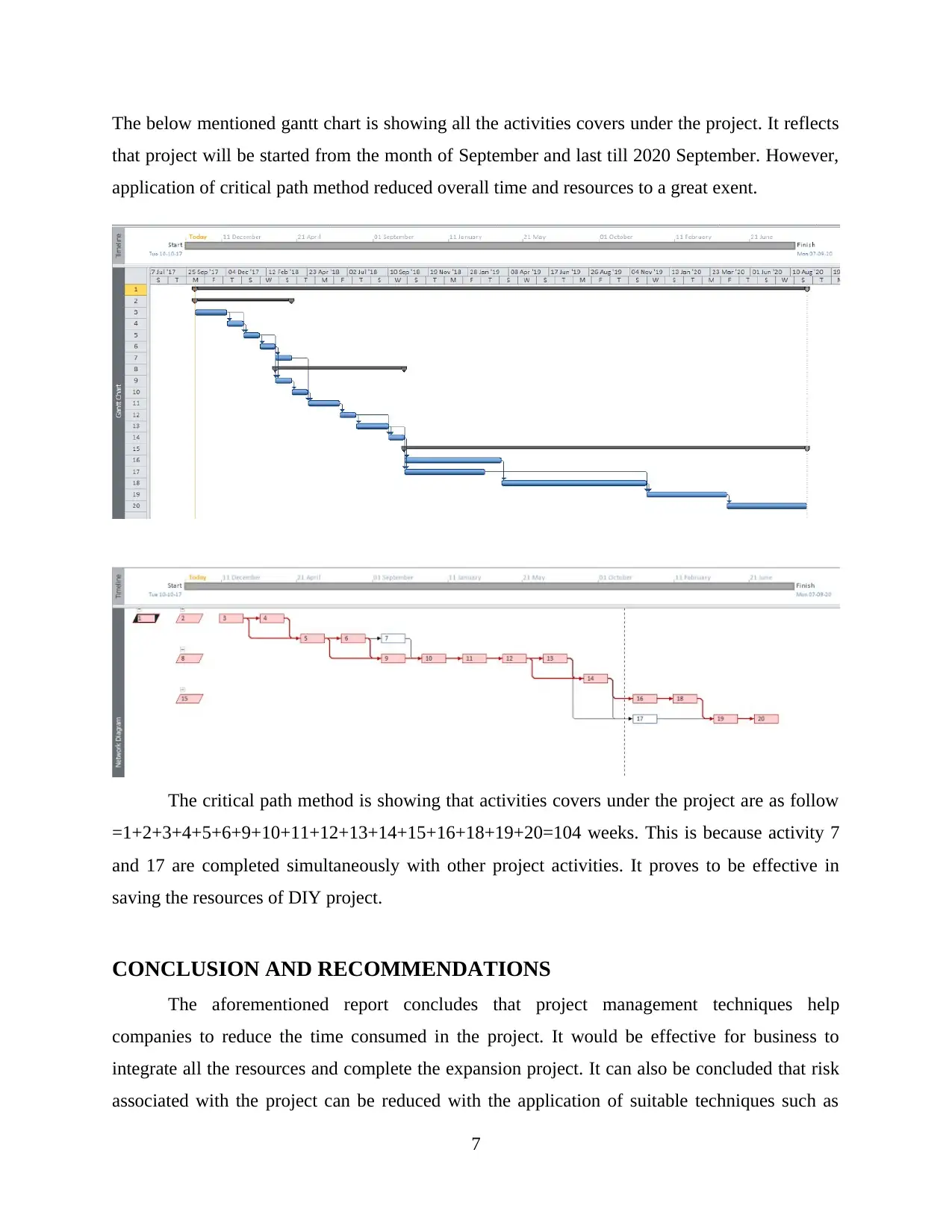
The below mentioned gantt chart is showing all the activities covers under the project. It reflects
that project will be started from the month of September and last till 2020 September. However,
application of critical path method reduced overall time and resources to a great exent.
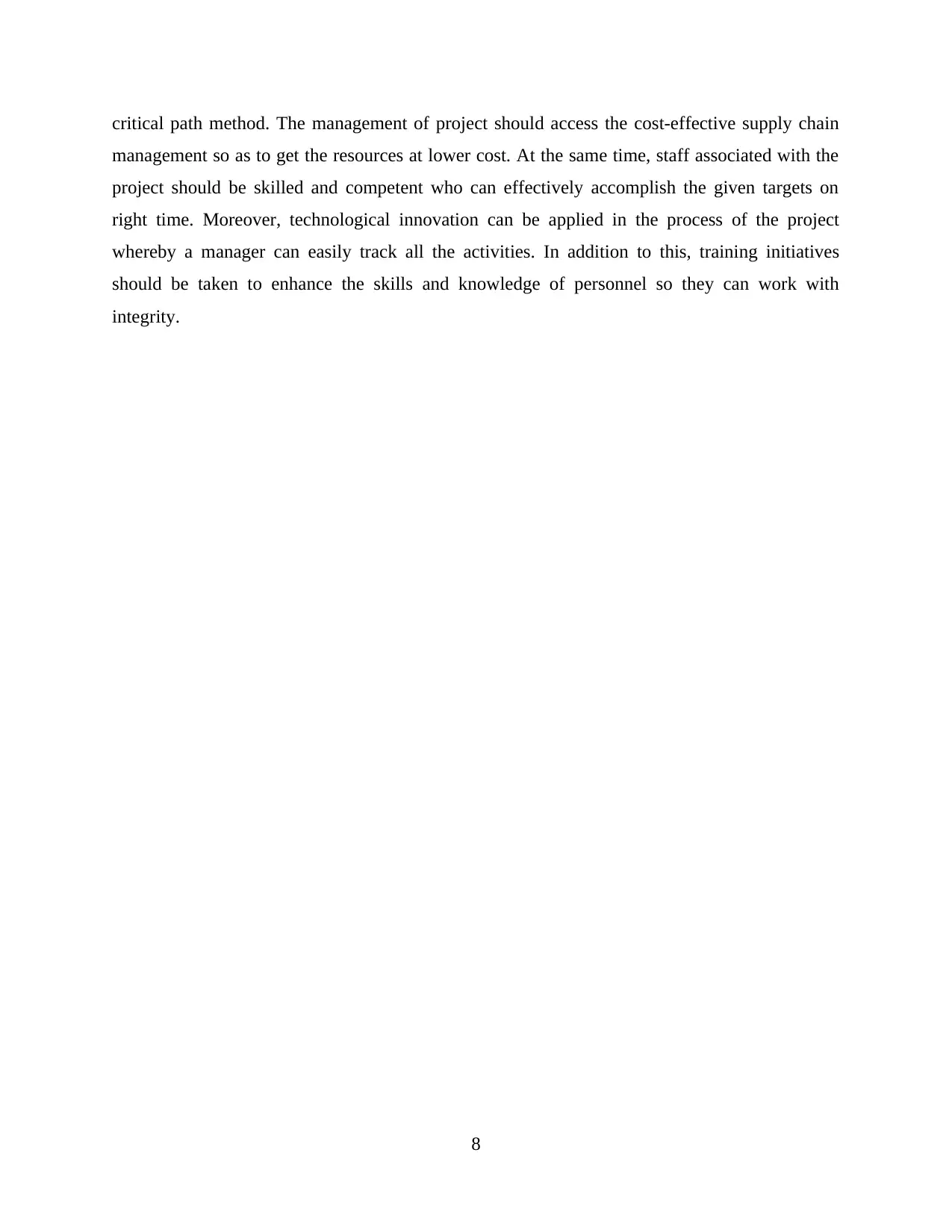
The critical path method is showing that activities covers under the project are as follow
=1+2+3+4+5+6+9+10+11+12+13+14+15+16+18+19+20=104 weeks. This is because activity 7
and 17 are completed simultaneously with other project activities. It proves to be effective in
saving the resources of DIY project.
CONCLUSION AND RECOMMENDATIONS
The aforementioned report concludes that project management techniques help
companies to reduce the time consumed in the project. It would be effective for business to
integrate all the resources and complete the expansion project. It can also be concluded that risk
associated with the project can be reduced with the application of suitable techniques such as
7
that project will be started from the month of September and last till 2020 September. However,
application of critical path method reduced overall time and resources to a great exent.
The critical path method is showing that activities covers under the project are as follow
=1+2+3+4+5+6+9+10+11+12+13+14+15+16+18+19+20=104 weeks. This is because activity 7
and 17 are completed simultaneously with other project activities. It proves to be effective in
saving the resources of DIY project.
CONCLUSION AND RECOMMENDATIONS
The aforementioned report concludes that project management techniques help
companies to reduce the time consumed in the project. It would be effective for business to
integrate all the resources and complete the expansion project. It can also be concluded that risk
associated with the project can be reduced with the application of suitable techniques such as
7
⊘ This is a preview!⊘
Do you want full access?
Subscribe today to unlock all pages.
Trusted by 1+ million students worldwide
critical path method. The management of project should access the cost-effective supply chain
management so as to get the resources at lower cost. At the same time, staff associated with the
project should be skilled and competent who can effectively accomplish the given targets on
right time. Moreover, technological innovation can be applied in the process of the project
whereby a manager can easily track all the activities. In addition to this, training initiatives
should be taken to enhance the skills and knowledge of personnel so they can work with
integrity.
8
management so as to get the resources at lower cost. At the same time, staff associated with the
project should be skilled and competent who can effectively accomplish the given targets on
right time. Moreover, technological innovation can be applied in the process of the project
whereby a manager can easily track all the activities. In addition to this, training initiatives
should be taken to enhance the skills and knowledge of personnel so they can work with
integrity.
8
Paraphrase This Document
Need a fresh take? Get an instant paraphrase of this document with our AI Paraphraser
REFERENCES
Advantages and Disadvantages of Critical Path Method. (2017) [Online]. Available at:
http://www.brighthubpm.com/project-planning/60960-advantages-and-disadvantages-of-
critical-path-method/ [Accessed on 10th October 2017].
Besner, C., & Hobbs, B. (2008). Project management practice, generic or contextual: A reality
check. Project Management Journal, 39(1), pp.16-33.
Jacobs, F.R., Chase, R.B., & Lummus, R.R. (2011). Operations and supply chain
management (Vol. 567). McGraw-Hill Irwin.
Kerzner, H. (2013). Project management: a systems approach to planning, scheduling, and
controlling. John Wiley & Sons.
Larson, E.W., & Gray, C. (2013). Project Management: The Managerial Process with MS
Project. McGraw-Hill.
Meredith, J.R., & Mantel Jr, S.J. (2011). Project management: a managerial approach. John
Wiley & Sons.
Turner, J.R. (2008). Handbook of project-based management. McGraw-Hill Professional
Publishing.
Ward, S., & Chapman, C. (2003). Transforming project risk management into project uncertainty
management. International journal of project management, 21(2), 97-105.
Stevenson, W. J., & Hojati, M. (2007). Operations management(Vol. 8). Boston:
McGraw-Hill/Irwin.
Chapman, C., & Ward, S. (2003). Project risk management: processes, techniques, and insights.
Wiley.
Raz, T., & Michael, E. (2001). Use and benefits of tools for project risk
management. International journal of project management, 19(1), 9-17.
9
Advantages and Disadvantages of Critical Path Method. (2017) [Online]. Available at:
http://www.brighthubpm.com/project-planning/60960-advantages-and-disadvantages-of-
critical-path-method/ [Accessed on 10th October 2017].
Besner, C., & Hobbs, B. (2008). Project management practice, generic or contextual: A reality
check. Project Management Journal, 39(1), pp.16-33.
Jacobs, F.R., Chase, R.B., & Lummus, R.R. (2011). Operations and supply chain
management (Vol. 567). McGraw-Hill Irwin.
Kerzner, H. (2013). Project management: a systems approach to planning, scheduling, and
controlling. John Wiley & Sons.
Larson, E.W., & Gray, C. (2013). Project Management: The Managerial Process with MS
Project. McGraw-Hill.
Meredith, J.R., & Mantel Jr, S.J. (2011). Project management: a managerial approach. John
Wiley & Sons.
Turner, J.R. (2008). Handbook of project-based management. McGraw-Hill Professional
Publishing.
Ward, S., & Chapman, C. (2003). Transforming project risk management into project uncertainty
management. International journal of project management, 21(2), 97-105.
Stevenson, W. J., & Hojati, M. (2007). Operations management(Vol. 8). Boston:
McGraw-Hill/Irwin.
Chapman, C., & Ward, S. (2003). Project risk management: processes, techniques, and insights.
Wiley.
Raz, T., & Michael, E. (2001). Use and benefits of tools for project risk
management. International journal of project management, 19(1), 9-17.
9

1 out of 11


Related Documents


Your All-in-One AI-Powered Toolkit for Academic Success.
+13062052269
info@desklib.com
Available 24*7 on WhatsApp / Email
![[object Object]](/_next/static/media/star-bottom.7253800d.svg)
Unlock your academic potential
Copyright © 2020–2026 A2Z Services. All Rights Reserved. Developed and managed by ZUCOL.