Staffordshire University: Business Process Redesign for DMS Project
VerifiedAdded on 2023/04/10
|31
|10037
|432
Report
AI Summary
This report presents a business process redesign project focused on developing and improving a Document Management System (DMS). The study employs business process improvement and re-engineering methodologies to address inefficiencies within Digital Media Stream's existing documentation management. Through analysis, interviews, and theoretical research, the report identifies key problems such as disorganized folders, multiple file versions, and missing documents. The proposed solutions aim to enhance efficiency, accountability, and consistency by implementing a redesigned process and leveraging the M-Files system. The report outlines the scope, objectives, and methodology, including a literature review of business process reengineering principles and their application within the case company. Ultimately, the project seeks to deliver a well-functioning DMS solution that meets the company's business requirements and improves overall document management practices.
REDESIGN OF BUSINESS PROCESS FOR THE DEVELOPMENT OF DOCUMENT
MANAGEMENT SYSTEM
FINAL YEAR PROJECT REPORT
Muhammed Sarder
Submitted to
Staffordshire University
In accordance with the requirements for the degree of
BSc Business Information Technology
2018/2019
MANAGEMENT SYSTEM
FINAL YEAR PROJECT REPORT
Muhammed Sarder
Submitted to
Staffordshire University
In accordance with the requirements for the degree of
BSc Business Information Technology
2018/2019

Paraphrase This Document
Need a fresh take? Get an instant paraphrase of this document with our AI Paraphraser
Contents
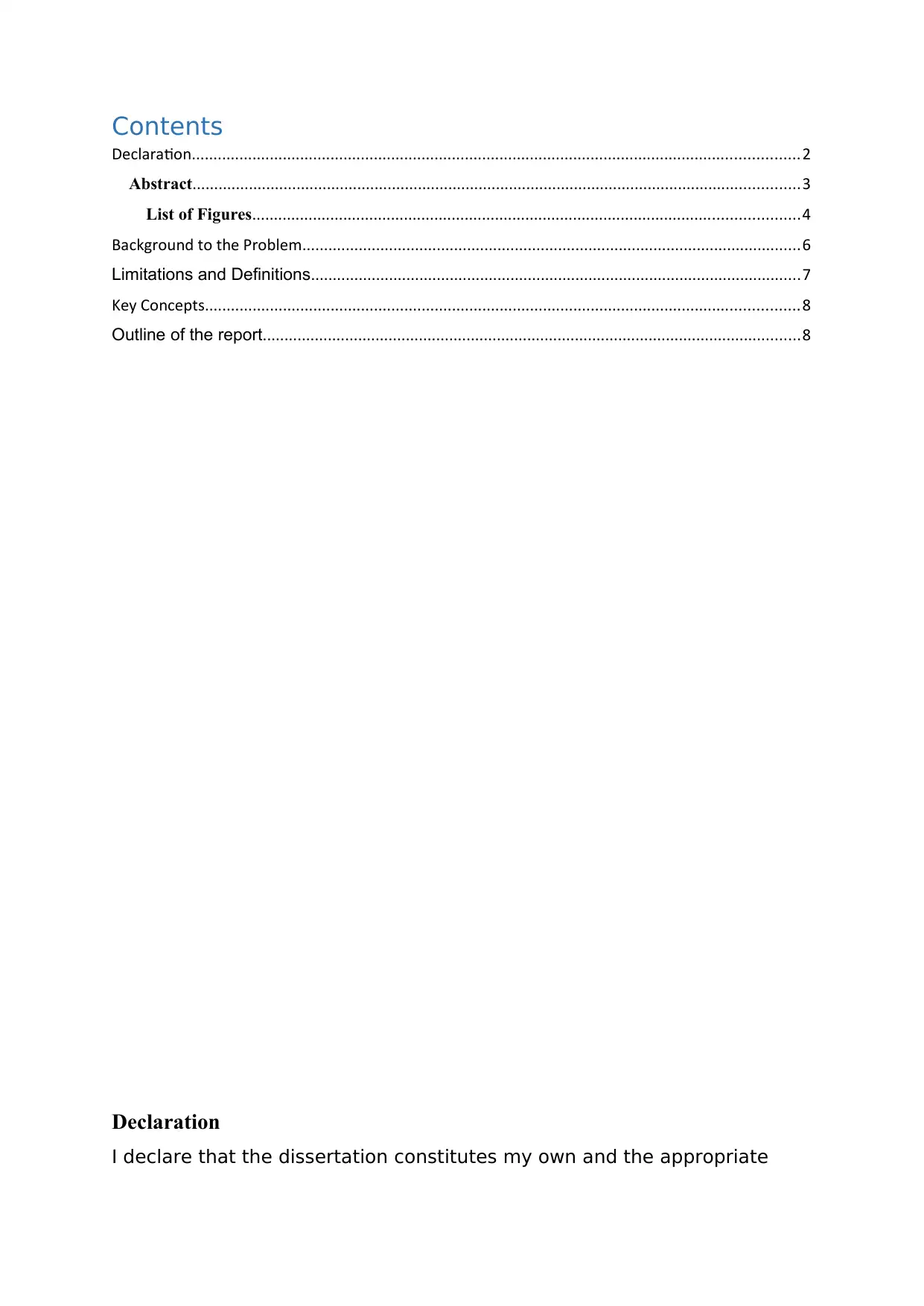
Declaration............................................................................................................................................2
Abstract............................................................................................................................................3
List of Figures..............................................................................................................................4
Background to the Problem...................................................................................................................6
Limitations and Definitions.................................................................................................................7
Key Concepts.........................................................................................................................................8
Outline of the report............................................................................................................................8
Declaration
I declare that the dissertation constitutes my own and the appropriate
Declaration............................................................................................................................................2
Abstract............................................................................................................................................3
List of Figures..............................................................................................................................4
Background to the Problem...................................................................................................................6
Limitations and Definitions.................................................................................................................7
Key Concepts.........................................................................................................................................8
Outline of the report............................................................................................................................8
Declaration
I declare that the dissertation constitutes my own and the appropriate

credit has been given where references has been made to the work of
others.
Signed,
Muhammed Sarder
Abstract
others.
Signed,
Muhammed Sarder
Abstract
⊘ This is a preview!⊘
Do you want full access?
Subscribe today to unlock all pages.

Trusted by 1+ million students worldwide
The purpose of this thesis is to develop, re-engineer and improve the case company’s
Document Management system Processes by applying business process improvement and
business process re-engineering and design methodologies.
The methodology developed to address this problem was Business Process Reengineering,
whose framework entails eight distinct steps. The most important ones include, (i) current
processes description and monitoring, (ii) identification of the processes non-value-adding
activities and main problems, (iii) solutions proposal and documentation, and (iv) gains
evaluation due to the implementation of the proposed redesigned processes.
The data for the theoretical study was collected through relevant literature for the topic. The
main focus was business process improvement and business process re-engineering of
administrational processes. The empirical study was based on the case company’s existing
Document Management Process. A significant part of the data for the empirical study was
gathered by interviewing the key persons involved in the process
The results of this thesis shows how the document management Process at the case
company was developed, re-engineered and improved in order to establish better efficiency,
accountability and consistency within the organisation. The results from the Process
Designing was used for the development of the company’s own M-files System both as a
product of the company and as a tool to support the Document Management Process. The
results also show how this was done through process improvement and process re-
engineering methods and tools included in the theoretical study. Furthermore, the result
chapter describes the possibility for continuous improvement.
List of Figures
Document Management system Processes by applying business process improvement and
business process re-engineering and design methodologies.
The methodology developed to address this problem was Business Process Reengineering,
whose framework entails eight distinct steps. The most important ones include, (i) current
processes description and monitoring, (ii) identification of the processes non-value-adding
activities and main problems, (iii) solutions proposal and documentation, and (iv) gains
evaluation due to the implementation of the proposed redesigned processes.
The data for the theoretical study was collected through relevant literature for the topic. The
main focus was business process improvement and business process re-engineering of
administrational processes. The empirical study was based on the case company’s existing
Document Management Process. A significant part of the data for the empirical study was
gathered by interviewing the key persons involved in the process
The results of this thesis shows how the document management Process at the case
company was developed, re-engineered and improved in order to establish better efficiency,
accountability and consistency within the organisation. The results from the Process
Designing was used for the development of the company’s own M-files System both as a
product of the company and as a tool to support the Document Management Process. The
results also show how this was done through process improvement and process re-
engineering methods and tools included in the theoretical study. Furthermore, the result
chapter describes the possibility for continuous improvement.
List of Figures
Paraphrase This Document
Need a fresh take? Get an instant paraphrase of this document with our AI Paraphraser

Figure 1: Round Trip of Business Process Goals (Bider & Johannesson. 2005)
Figure 2- Business Process Reengineering Cycle, adapted from Mohapatra (2013)
List of Tables
Figure 2- Business Process Reengineering Cycle, adapted from Mohapatra (2013)
List of Tables
Introduction
The efficient management of an organisation’s records and information is pivotal to ensuring
the business runs successfully and is fully compliant with legislation. Without records and
information being compliantly captured and easily available to staff companies will struggle
to find the information they require. Where staff are unable to find the records they need
organisations may miss important details that impact on their business decision making. One
challenge is that today all employees are playing an ever-increasing role in making sure any
records they create or receive are captured and available to all employees within the
business and sometimes beyond. However, at the same time these records need to be kept
compliantly in a records management system to follow all recordkeeping legislation and
The efficient management of an organisation’s records and information is pivotal to ensuring
the business runs successfully and is fully compliant with legislation. Without records and
information being compliantly captured and easily available to staff companies will struggle
to find the information they require. Where staff are unable to find the records they need
organisations may miss important details that impact on their business decision making. One
challenge is that today all employees are playing an ever-increasing role in making sure any
records they create or receive are captured and available to all employees within the
business and sometimes beyond. However, at the same time these records need to be kept
compliantly in a records management system to follow all recordkeeping legislation and
⊘ This is a preview!⊘
Do you want full access?
Subscribe today to unlock all pages.
Trusted by 1+ million students worldwide
standards. These records management systems are called electronic document and records
management systems (EDRMS). Employees often struggle with using EDRMS, because
they are not designed with the end user in mind but for compliance purposes and use by
records professionals. These systems are used predominately in government
establishments and sometimes private enterprise, so the companies ensure they are records
management compliant.
Business Context
Digital Stream is a medium size marketing agency which offers digital marketing strategies
by driving growth, traffic, leads and sales to business. The company has 40 employees and
its structure consists of departments such as Sales, Marketing, and Operations.
Background to the Problem
The documentation management system at Media Stream has seen many problems over
the years which has led to the current structure been complex and unorganised. Folders had
become difficult to find often with the names of employee who are no longer with the
company in the main folder as opposed to being for a particular function, making it unclear
as to what documents were stored where. Multiple file copies of the same document existed
in multiple folders because there was no mechanism to cross-reference items to more than
one location, and it was impossible to tell which the latest version was. The documents were
hardly ever prepared out or moved into an archive area. This meant that there were
hundreds
of old files mixed in with current working documents. The document management system is
having a wide impact for all the departments. This has contributed to many problems such
as
documents gone missing and work getting behind schedule, often working on the wrong
version which ultimately is a huge loss of money for company.
Aims
The aim is to make an analysis of business requirements and processes of Digital Media
Stream. This will be gathered through a group interview, research in order to get an idea of
the methodologies of the current system. To achieve this, aim the research will investigate:
Understanding what the organisation does and look at the way documents is
used/handled for different departments.
Determine the cause of how documents impacting employees’ jobs
management systems (EDRMS). Employees often struggle with using EDRMS, because
they are not designed with the end user in mind but for compliance purposes and use by
records professionals. These systems are used predominately in government
establishments and sometimes private enterprise, so the companies ensure they are records
management compliant.
Business Context
Digital Stream is a medium size marketing agency which offers digital marketing strategies
by driving growth, traffic, leads and sales to business. The company has 40 employees and
its structure consists of departments such as Sales, Marketing, and Operations.
Background to the Problem
The documentation management system at Media Stream has seen many problems over
the years which has led to the current structure been complex and unorganised. Folders had
become difficult to find often with the names of employee who are no longer with the
company in the main folder as opposed to being for a particular function, making it unclear
as to what documents were stored where. Multiple file copies of the same document existed
in multiple folders because there was no mechanism to cross-reference items to more than
one location, and it was impossible to tell which the latest version was. The documents were
hardly ever prepared out or moved into an archive area. This meant that there were
hundreds
of old files mixed in with current working documents. The document management system is
having a wide impact for all the departments. This has contributed to many problems such
as
documents gone missing and work getting behind schedule, often working on the wrong
version which ultimately is a huge loss of money for company.
Aims
The aim is to make an analysis of business requirements and processes of Digital Media
Stream. This will be gathered through a group interview, research in order to get an idea of
the methodologies of the current system. To achieve this, aim the research will investigate:
Understanding what the organisation does and look at the way documents is
used/handled for different departments.
Determine the cause of how documents impacting employees’ jobs
Paraphrase This Document
Need a fresh take? Get an instant paraphrase of this document with our AI Paraphraser
This proposal will be mainly focused on the implementation process of Document
Management System for Digital Media Stream.
Objectives
The main objectives of this thesis are to develop and improve framework of business
process, for the set process, to implement the process and to overall deliver a well-made
functioning project solution for the company. To achieve this objective the following
Identify the Impact of evaluation of implementation of business process on the
change process.
Scope
The scope of work included examining and reporting on:
Whether the key objectives of implementing the DMS as per the original project plan and
business case documentation had been met.
Whether the system is meeting the needs and requirements of users, though evaluation
user requirements.
The purpose of this thesis was to develop, re-engineer and improve the case company’s
Absence and Leave Management Processes by applying business process improvement
and business process re-engineering and design methodologies.
The data for the theoretical study was collected through relevant literature for the topic. The
main focus was business process improvement and business process re-engineering of
administrational processes. The empirical study was based on the case company’s existing
Absence and Leave Management Process. A significant part of the data for the empirical
study was gathered by interviewing the key persons involved in the process.
List of Abbreviations
Explanations for key concepts are listed below to help readers who are not familiar with
them to better understand discussions later in this case study.
BPR Business Process Re-Engineering
M-Files M-Files is a name of an internal system formerly known as
Motive Systems Oy. It is also a name of their most important
information system product. M-Files information system is document
management system. it means the Document Management System
that is built into the M-Files platform uniquely by the case organization.
Keywords: Business Process Improvement, Business Process Re-engineering,
Business Processes, Business Process Design, Administrational Processes,
System Requirement Analysis.
Outline of the report
The different stages of the thesis will be gone through and illustrated according to
mainly the process improvement and process re-engineering methodologies.
Management System for Digital Media Stream.
Objectives
The main objectives of this thesis are to develop and improve framework of business
process, for the set process, to implement the process and to overall deliver a well-made
functioning project solution for the company. To achieve this objective the following
Identify the Impact of evaluation of implementation of business process on the
change process.
Scope
The scope of work included examining and reporting on:
Whether the key objectives of implementing the DMS as per the original project plan and
business case documentation had been met.
Whether the system is meeting the needs and requirements of users, though evaluation
user requirements.
The purpose of this thesis was to develop, re-engineer and improve the case company’s
Absence and Leave Management Processes by applying business process improvement
and business process re-engineering and design methodologies.
The data for the theoretical study was collected through relevant literature for the topic. The
main focus was business process improvement and business process re-engineering of
administrational processes. The empirical study was based on the case company’s existing
Absence and Leave Management Process. A significant part of the data for the empirical
study was gathered by interviewing the key persons involved in the process.
List of Abbreviations
Explanations for key concepts are listed below to help readers who are not familiar with
them to better understand discussions later in this case study.
BPR Business Process Re-Engineering
M-Files M-Files is a name of an internal system formerly known as
Motive Systems Oy. It is also a name of their most important
information system product. M-Files information system is document
management system. it means the Document Management System
that is built into the M-Files platform uniquely by the case organization.
Keywords: Business Process Improvement, Business Process Re-engineering,
Business Processes, Business Process Design, Administrational Processes,
System Requirement Analysis.
Outline of the report
The different stages of the thesis will be gone through and illustrated according to
mainly the process improvement and process re-engineering methodologies.
The thesis consists of seven main chapters: Introduction, Case Company, Methodology,
Business Process Design and Re-design, business process improvement, Improvement
and Re- engineering of the Absence and Leave Management Process, as well as
Recommendations and Conclusions followed by References, Illustrations, Tables,
Abbreviations and Terms, and Appendices.
Chapter one includes the introduction and a general description of the thesis while
mentioning what the theoretical and the empirical framework is based on, the
background to the thesis, the starting point of the thesis, the position that the company
was at when the thesis started, the main targets of the thesis implementation, the main
objectives for the thesis as well as the intermediate objectives and the research
questions for the thesis, followed by a description of the structure of the thesis with
introductions to the overall content of each chapter.
The main research questions for the thesis are:
1. What are the problems with the current Absence and Leave Management Process in
the company?
2. How can the Absence and Leave Management Process in the company be improved
and developed?
3. What are the requirements of the software that supports the redesigned Absence and
Leave Management Process?
Literature Review
This chapter presents the literature review of the theoretical concepts involved in the
current study. It begins by defining and analysing the nature and role of business
process re-engineering in the organisation. This is followed by a discussion
of the organisational readiness for a business process re-engineering initiative,
indicating the importance of several supporting concepts such as information
technology, business strategy, organisational culture. Finally, the criticisms and flaws
associated with the concept of business process re-engineering are presented.
Introduction
In this chapter the relevant literature in the area of business process reengineering which
constitutes the major theme of the current thesis is reviewed. The selection of the literature
is based on the research themes and objectives outlined in the introductory chapter (chapter
1, introduction) and analysed in chapter 3 (research questions). The chapter aims not only to
present and critically evaluate the business process re-engineering literature but also to
provide links with chapter 7 (practical applications of the business process re-engineering
model) and chapter 8 (Evaluation of implementation strategies), where more insights from
literature can be found.
The chapter initially presents the business process re-engineering concept and its
components, and continues by exploring the major concepts associated with the
organisational use of the term. Given the scope of the present thesis and the context in
which the , some of these concepts are more significant than others. Therefore, the
researcher has chosen to give more emphasis to information technology, business strategy,
organisational culture and human resources management. Following this, the criticisms and
the contradictions of the use of business process re-engineering are discussed.
Nature of Business Processes
Business Process Design and Re-design, business process improvement, Improvement
and Re- engineering of the Absence and Leave Management Process, as well as
Recommendations and Conclusions followed by References, Illustrations, Tables,
Abbreviations and Terms, and Appendices.
Chapter one includes the introduction and a general description of the thesis while
mentioning what the theoretical and the empirical framework is based on, the
background to the thesis, the starting point of the thesis, the position that the company
was at when the thesis started, the main targets of the thesis implementation, the main
objectives for the thesis as well as the intermediate objectives and the research
questions for the thesis, followed by a description of the structure of the thesis with
introductions to the overall content of each chapter.
The main research questions for the thesis are:
1. What are the problems with the current Absence and Leave Management Process in
the company?
2. How can the Absence and Leave Management Process in the company be improved
and developed?
3. What are the requirements of the software that supports the redesigned Absence and
Leave Management Process?
Literature Review
This chapter presents the literature review of the theoretical concepts involved in the
current study. It begins by defining and analysing the nature and role of business
process re-engineering in the organisation. This is followed by a discussion
of the organisational readiness for a business process re-engineering initiative,
indicating the importance of several supporting concepts such as information
technology, business strategy, organisational culture. Finally, the criticisms and flaws
associated with the concept of business process re-engineering are presented.
Introduction
In this chapter the relevant literature in the area of business process reengineering which
constitutes the major theme of the current thesis is reviewed. The selection of the literature
is based on the research themes and objectives outlined in the introductory chapter (chapter
1, introduction) and analysed in chapter 3 (research questions). The chapter aims not only to
present and critically evaluate the business process re-engineering literature but also to
provide links with chapter 7 (practical applications of the business process re-engineering
model) and chapter 8 (Evaluation of implementation strategies), where more insights from
literature can be found.
The chapter initially presents the business process re-engineering concept and its
components, and continues by exploring the major concepts associated with the
organisational use of the term. Given the scope of the present thesis and the context in
which the , some of these concepts are more significant than others. Therefore, the
researcher has chosen to give more emphasis to information technology, business strategy,
organisational culture and human resources management. Following this, the criticisms and
the contradictions of the use of business process re-engineering are discussed.
Nature of Business Processes
⊘ This is a preview!⊘
Do you want full access?
Subscribe today to unlock all pages.
Trusted by 1+ million students worldwide
An increasing number of firms are applying business process re-engineering (BPR) to alter
many age-old procedures, to reduce costs, and to improve competitiveness. Business
process re-engineering sets out to make a step change improvement in competitiveness and
then maintain and improve on that competitiveness.
Why B1PR? Because there is need for a company to have processes that minimise delays,
eliminate errors, promote understanding and reduce excesses. These processes must be
adaptable to the changing needs and provide the organisation with a competitive advantage.
In this context, Information Technology (IT) plays an important facilitating role. It is clear that
IT has evolved from its traditional orientation of administrative support role toward a more
strategic role within an organisation and more specifically within the construction industry.
This is the focus of the CONDOR project: investigating a new model-based - as opposed to
file -. based - approach to document production and management, based on recent IT
developments. This model-based approach, supported by information technology, can
provide a powerful lever of change. It can not however produce the benefits alone. The
processes within the organisation and within the building projects must change in order to
adapt in the new environment.
The first principles and elements of business process re-engineering can be found in
Taylorism (task optimisation) and the scientific management theory. Business Process Re-
engineering has been formally defined by Hammer and
Champy (1993) as the 'fundamental
re-thinking and radical redesign of business processes to achieve dramatic improvements in
critical, contemporary measures of performance, such as cost, quality, service and speed".
Hammer and Champy (1993) have highlight four l&y words in this definition, which enable us
to understand the character of BPR.
The first key word is 'fundamental' which means that re-engineering begins with
"no
assumptions and no givens", Hammer and Champy (2011). Fundamental rethinking returns
to basic questions and identifies which activities add value to the product or service being
delivered. Having answered the 'fundamental' questions the next stage is to take 'radical'
corrective action. Consequently, the second keyword is 'radical'. Organisations are
encouraged radically to restructure their operations. Existing structures that are not
compatible with the new vision should be dismantled. The expectation is that radical
changes will be accompanied by 'dramatic' benefits, which is the third keyword. Thus, re-
engineering is not about making marginal or incremental improvements but about major
improvements in performance. The last keyword is 'processes' which is very important since
all BP-R activity is based on process change. BPR starts to envision new ways of working
and organising business processes.
There are four points of interaction in this framework. The first point is related with the
business processes and the second point is concerned with structures of the jobs and the
people needed to fill them. The third point of interaction refers to the role of managers, the
working relationships and the measurement systems and, finally, the fourth point is related
with the employees' values and beliefs.
Consequently, re-engineering a company's processes affects all aspects of that company.
These four points are linked together and re-engineering involves the Redesign lre-planning
of each of the four points on an ongoing basis (Galliers, 2009. Hammer and Champy (2011)
presented the Business System Diamond model, which indicates the changes that occur
when a company re-engineers its business processes (Figure.2. 1). More specifically, the
first point is business processes, which affects structures and jobs. The ways in which work
many age-old procedures, to reduce costs, and to improve competitiveness. Business
process re-engineering sets out to make a step change improvement in competitiveness and
then maintain and improve on that competitiveness.
Why B1PR? Because there is need for a company to have processes that minimise delays,
eliminate errors, promote understanding and reduce excesses. These processes must be
adaptable to the changing needs and provide the organisation with a competitive advantage.
In this context, Information Technology (IT) plays an important facilitating role. It is clear that
IT has evolved from its traditional orientation of administrative support role toward a more
strategic role within an organisation and more specifically within the construction industry.
This is the focus of the CONDOR project: investigating a new model-based - as opposed to
file -. based - approach to document production and management, based on recent IT
developments. This model-based approach, supported by information technology, can
provide a powerful lever of change. It can not however produce the benefits alone. The
processes within the organisation and within the building projects must change in order to
adapt in the new environment.
The first principles and elements of business process re-engineering can be found in
Taylorism (task optimisation) and the scientific management theory. Business Process Re-
engineering has been formally defined by Hammer and
Champy (1993) as the 'fundamental
re-thinking and radical redesign of business processes to achieve dramatic improvements in
critical, contemporary measures of performance, such as cost, quality, service and speed".
Hammer and Champy (1993) have highlight four l&y words in this definition, which enable us
to understand the character of BPR.
The first key word is 'fundamental' which means that re-engineering begins with
"no
assumptions and no givens", Hammer and Champy (2011). Fundamental rethinking returns
to basic questions and identifies which activities add value to the product or service being
delivered. Having answered the 'fundamental' questions the next stage is to take 'radical'
corrective action. Consequently, the second keyword is 'radical'. Organisations are
encouraged radically to restructure their operations. Existing structures that are not
compatible with the new vision should be dismantled. The expectation is that radical
changes will be accompanied by 'dramatic' benefits, which is the third keyword. Thus, re-
engineering is not about making marginal or incremental improvements but about major
improvements in performance. The last keyword is 'processes' which is very important since
all BP-R activity is based on process change. BPR starts to envision new ways of working
and organising business processes.
There are four points of interaction in this framework. The first point is related with the
business processes and the second point is concerned with structures of the jobs and the
people needed to fill them. The third point of interaction refers to the role of managers, the
working relationships and the measurement systems and, finally, the fourth point is related
with the employees' values and beliefs.
Consequently, re-engineering a company's processes affects all aspects of that company.
These four points are linked together and re-engineering involves the Redesign lre-planning
of each of the four points on an ongoing basis (Galliers, 2009. Hammer and Champy (2011)
presented the Business System Diamond model, which indicates the changes that occur
when a company re-engineers its business processes (Figure.2. 1). More specifically, the
first point is business processes, which affects structures and jobs. The ways in which work
Paraphrase This Document
Need a fresh take? Get an instant paraphrase of this document with our AI Paraphraser
is performed determine the way people's jobs are organised. For example, the integrated
processes give rise to multidimensional jobs and the best way of supporting such jobs is to
organise the employees into teams. Consequently, different structures and jobs require
people who have the abilities to adapt themselves in the new working conditions. This
interaction changes the way that employees are recruited, evaluated and paid. The third
point, which is the change of management and measurement systems, determines the fourth
point, which is related with values and beliefs.
Davenport (2009) offers a different perspective of the topic. Davenport refers to the term
'business process re-engineering' as 'process innovation' and business process redesign',
which is an indicator of the plethora of BPR definitions, approaches and methodologies.
Consequently, according to Davenport's business process redesign and later process
innovation, an organisation is aiming at achieving major reductions in process cost or time,
or major improvements in quality, flexibility, service levels, or other business objectives. The
organisation is trying to achieve this goal through the use of innovation tools and work
design which will lead to radical improvement of business process performance.
Depending on the perspective, three different forms of organisational transformation can be
distinguished: infrastructure engineering (macro), which deals with strategic choices about
partners, markets and products, process engineering (meso), which is based on the
redesign of existing processes in order to support the successful implementation of strategic
choices, and task engineering, which deals with job design (micro).
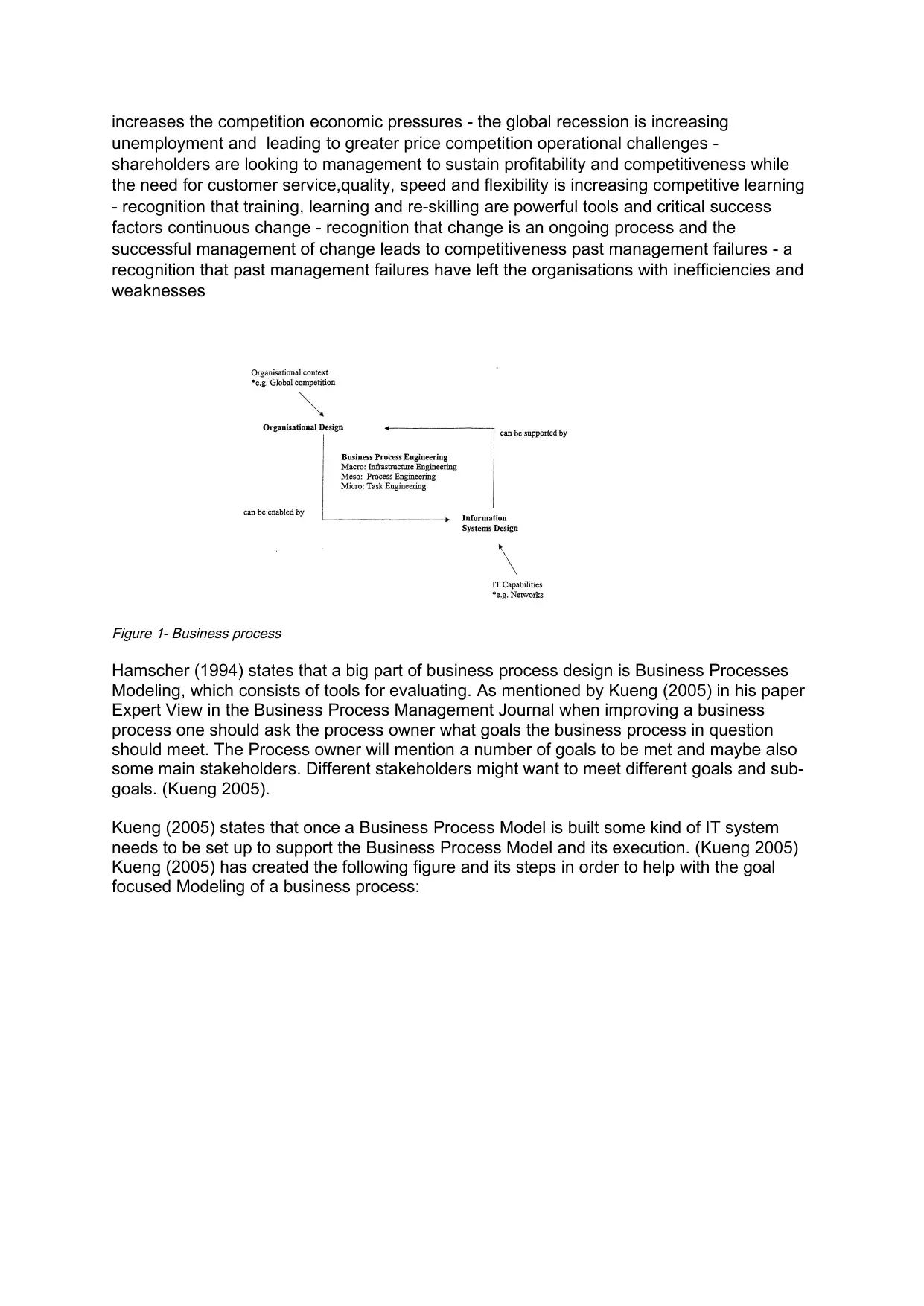
As a result, it is clear that BPR denotes organisational transformation. Botsarid Sol (1988)
distinguish three perspectives with respect to the design of organisations and their technical
information structures (these perspectives can be used to better position the concept of
business process re-engineering as shown in figure 2.2 below):
The macro perspective, concentrating on the co-operation among different
organisations and on supporting and enabling technical infrastructures
The meso, perspective, concentrating on co-ordinating activities that take place
within boundaries of an organisation and on supporting and enabling technical
architectures.
The micro perspective, concentrating on the primary business processes that are
performed at the work place level, typically by an individual or a small group, and on
enabling and supporting work stations
Subsequently, the most important impact of BPR may be observed on the competitive front
of an organisation. Organisations recognise that the world is becoming a more competitive
place and that incremental improvements are not enough. A successful redesign of business
processes leads to improvements in time, quality and cost of products and services offered.
Therefore, BPR enhances an organisation's ability to respond to market conditions and
enables companies to differentiate themselves from their competitors. Consequently, the aim
of BPR is not to keep up with the competition but to leap ahead of the competition (Coulson-
Thomas,
2010).
Several factors encourage a more fundamental, integrated and better managed approach to
planning and designing business activities and explain the current interest in BPR (Taiwar,
1997): the globalisation of business - globalisation, deregulation and liberalisation of markets
processes give rise to multidimensional jobs and the best way of supporting such jobs is to
organise the employees into teams. Consequently, different structures and jobs require
people who have the abilities to adapt themselves in the new working conditions. This
interaction changes the way that employees are recruited, evaluated and paid. The third
point, which is the change of management and measurement systems, determines the fourth
point, which is related with values and beliefs.
Davenport (2009) offers a different perspective of the topic. Davenport refers to the term
'business process re-engineering' as 'process innovation' and business process redesign',
which is an indicator of the plethora of BPR definitions, approaches and methodologies.
Consequently, according to Davenport's business process redesign and later process
innovation, an organisation is aiming at achieving major reductions in process cost or time,
or major improvements in quality, flexibility, service levels, or other business objectives. The
organisation is trying to achieve this goal through the use of innovation tools and work
design which will lead to radical improvement of business process performance.
Depending on the perspective, three different forms of organisational transformation can be
distinguished: infrastructure engineering (macro), which deals with strategic choices about
partners, markets and products, process engineering (meso), which is based on the
redesign of existing processes in order to support the successful implementation of strategic
choices, and task engineering, which deals with job design (micro).
As a result, it is clear that BPR denotes organisational transformation. Botsarid Sol (1988)
distinguish three perspectives with respect to the design of organisations and their technical
information structures (these perspectives can be used to better position the concept of
business process re-engineering as shown in figure 2.2 below):
The macro perspective, concentrating on the co-operation among different
organisations and on supporting and enabling technical infrastructures
The meso, perspective, concentrating on co-ordinating activities that take place
within boundaries of an organisation and on supporting and enabling technical
architectures.
The micro perspective, concentrating on the primary business processes that are
performed at the work place level, typically by an individual or a small group, and on
enabling and supporting work stations
Subsequently, the most important impact of BPR may be observed on the competitive front
of an organisation. Organisations recognise that the world is becoming a more competitive
place and that incremental improvements are not enough. A successful redesign of business
processes leads to improvements in time, quality and cost of products and services offered.
Therefore, BPR enhances an organisation's ability to respond to market conditions and
enables companies to differentiate themselves from their competitors. Consequently, the aim
of BPR is not to keep up with the competition but to leap ahead of the competition (Coulson-
Thomas,
2010).
Several factors encourage a more fundamental, integrated and better managed approach to
planning and designing business activities and explain the current interest in BPR (Taiwar,
1997): the globalisation of business - globalisation, deregulation and liberalisation of markets
increases the competition economic pressures - the global recession is increasing
unemployment and leading to greater price competition operational challenges -
shareholders are looking to management to sustain profitability and competitiveness while
the need for customer service,quality, speed and flexibility is increasing competitive learning
- recognition that training, learning and re-skilling are powerful tools and critical success
factors continuous change - recognition that change is an ongoing process and the
successful management of change leads to competitiveness past management failures - a
recognition that past management failures have left the organisations with inefficiencies and
weaknesses
Figure 1- Business process
Hamscher (1994) states that a big part of business process design is Business Processes
Modeling, which consists of tools for evaluating. As mentioned by Kueng (2005) in his paper
Expert View in the Business Process Management Journal when improving a business
process one should ask the process owner what goals the business process in question
should meet. The Process owner will mention a number of goals to be met and maybe also
some main stakeholders. Different stakeholders might want to meet different goals and sub-
goals. (Kueng 2005).
Kueng (2005) states that once a Business Process Model is built some kind of IT system
needs to be set up to support the Business Process Model and its execution. (Kueng 2005)
Kueng (2005) has created the following figure and its steps in order to help with the goal
focused Modeling of a business process:
unemployment and leading to greater price competition operational challenges -
shareholders are looking to management to sustain profitability and competitiveness while
the need for customer service,quality, speed and flexibility is increasing competitive learning
- recognition that training, learning and re-skilling are powerful tools and critical success
factors continuous change - recognition that change is an ongoing process and the
successful management of change leads to competitiveness past management failures - a
recognition that past management failures have left the organisations with inefficiencies and
weaknesses
Figure 1- Business process
Hamscher (1994) states that a big part of business process design is Business Processes
Modeling, which consists of tools for evaluating. As mentioned by Kueng (2005) in his paper
Expert View in the Business Process Management Journal when improving a business
process one should ask the process owner what goals the business process in question
should meet. The Process owner will mention a number of goals to be met and maybe also
some main stakeholders. Different stakeholders might want to meet different goals and sub-
goals. (Kueng 2005).
Kueng (2005) states that once a Business Process Model is built some kind of IT system
needs to be set up to support the Business Process Model and its execution. (Kueng 2005)
Kueng (2005) has created the following figure and its steps in order to help with the goal
focused Modeling of a business process:
⊘ This is a preview!⊘
Do you want full access?
Subscribe today to unlock all pages.
Trusted by 1+ million students worldwide

1 out of 31


Related Documents


Your All-in-One AI-Powered Toolkit for Academic Success.
+13062052269
info@desklib.com
Available 24*7 on WhatsApp / Email
![[object Object]](/_next/static/media/star-bottom.7253800d.svg)
Unlock your academic potential
Copyright © 2020–2026 A2Z Services. All Rights Reserved. Developed and managed by ZUCOL.