Research Proposal: Improving Doctor's Rounds at Edinburgh Napier
VerifiedAdded on 2023/05/29
|21
|4775
|249
Essay
AI Summary
This essay comprises a research proposal focused on investigating the increasing number of patient complaints regarding the timing of doctor's rounds in a hospital setting. The proposal includes an introduction highlighting the importance of effective ward rounds and the need to address patient concerns, followed by a review of relevant literature and a discussion of the research design. The proposed study employs a qualitative approach, utilizing focus groups and semi-structured interviews to gather data from both doctors and patients. The data analysis method, ethical considerations, and dissemination plans are also outlined, aiming to provide insights into optimizing ward round schedules and improving patient satisfaction. This resource, contributed by a student, is available on Desklib, a platform offering a wide range of study tools and solved assignments.
Running head: NURSING ASSIGNMENT
NURSING ASSIGNMENT
Name of the Student:
Name of the University:
Author Note:
NURSING ASSIGNMENT
Name of the Student:
Name of the University:
Author Note:

Paraphrase This Document
Need a fresh take? Get an instant paraphrase of this document with our AI Paraphraser
1NURSING ASSIGNMENT
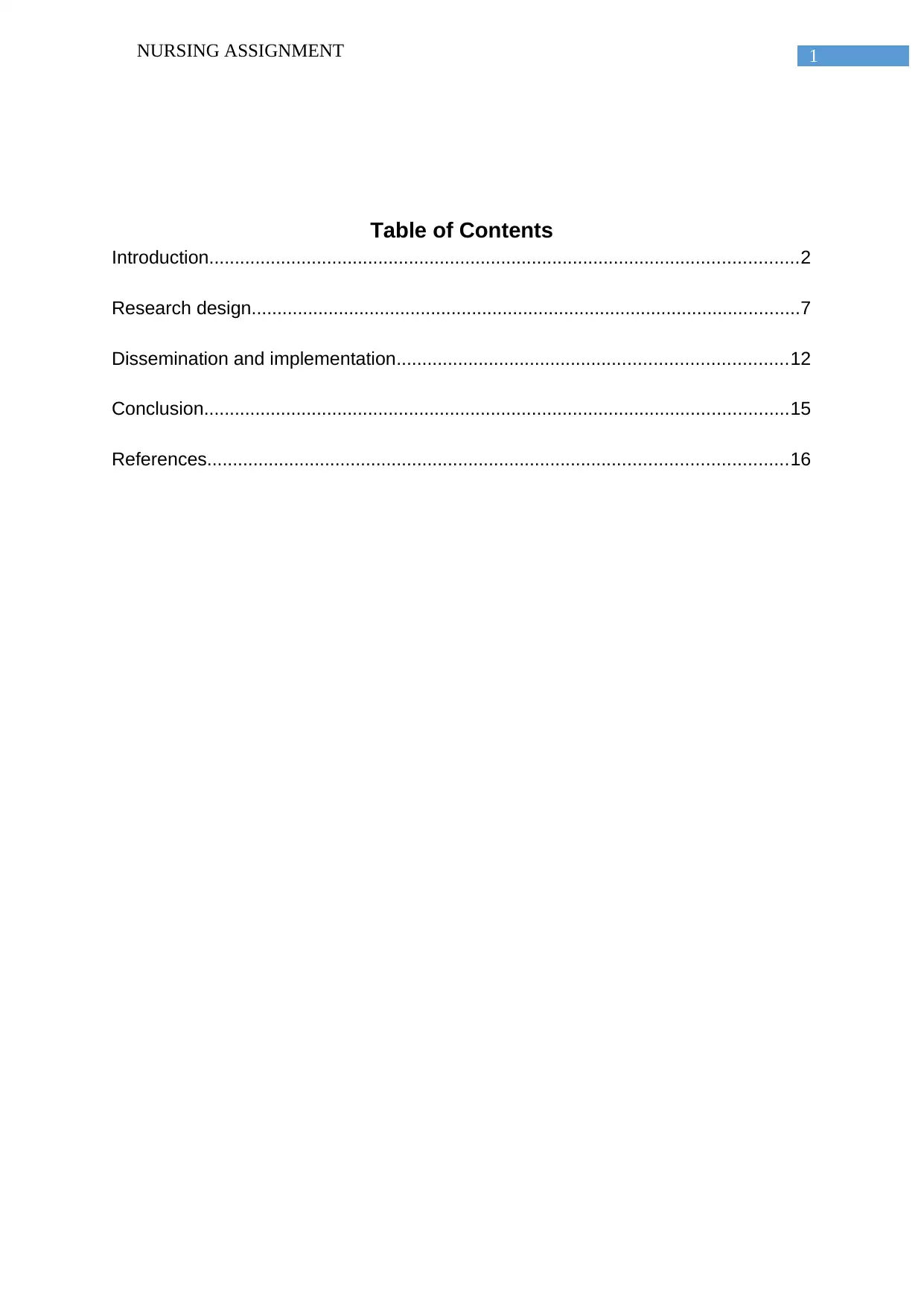
Table of Contents
Introduction...................................................................................................................2
Research design...........................................................................................................7
Dissemination and implementation............................................................................12
Conclusion..................................................................................................................15
References.................................................................................................................16
Table of Contents
Introduction...................................................................................................................2
Research design...........................................................................................................7
Dissemination and implementation............................................................................12
Conclusion..................................................................................................................15
References.................................................................................................................16
2NURSING ASSIGNMENT
Introduction
In the hospital setting, the ward round is central to the major activities of the
hospital. The ward round mainly involves the doctors in white coats appearing at the
bedside of the patient in an unannounced manner. The doctor then speaks to the
patients, listens to the current condition of the patient and then the doctor murmurs
certain jargons in a swift manner which passes on too quickly. Patients' cooperation
is fundamental to their prosperity and feeling of rationality, and in addition to their
comprehension of and adherence to recommended medicines (AlMutar, AlTourah,
HussainSadeq& Marwan, 2013). Ward rounds fill in as a gathering for sharing data
among patient and parental figure. The motivation behind the ward round is to get
data and plan medicinal and nursing care through staff– quiet
correspondence.However there is very little evidence available as to the perspective
of the patient and the professional regarding the ward rounds (Hale &McNab, 2015).
This paper therefore aims to highlight the present dwelling condition which involves
the complaints of the patient regarding the ineffective timing of the doctors for
rounds. This paper will elucidate the condition through a study which through which it
can be pondered upon the dwelling condition in the hospital setting.
Hierarchy of evidence
The concept of hierarchy of evidence refers to one of the core principles of the
evidence based practise (EBP) (Bossen& Jensen, 2014). The hierarchy is useful in
ways that it allows the researcher to undertake a top-down approach for the purpose
of location of the evidence that is best in contrast to the practise where first the
search is conducted for locating a well conducted systematic review. However in
Introduction
In the hospital setting, the ward round is central to the major activities of the
hospital. The ward round mainly involves the doctors in white coats appearing at the
bedside of the patient in an unannounced manner. The doctor then speaks to the
patients, listens to the current condition of the patient and then the doctor murmurs
certain jargons in a swift manner which passes on too quickly. Patients' cooperation
is fundamental to their prosperity and feeling of rationality, and in addition to their
comprehension of and adherence to recommended medicines (AlMutar, AlTourah,
HussainSadeq& Marwan, 2013). Ward rounds fill in as a gathering for sharing data
among patient and parental figure. The motivation behind the ward round is to get
data and plan medicinal and nursing care through staff– quiet
correspondence.However there is very little evidence available as to the perspective
of the patient and the professional regarding the ward rounds (Hale &McNab, 2015).
This paper therefore aims to highlight the present dwelling condition which involves
the complaints of the patient regarding the ineffective timing of the doctors for
rounds. This paper will elucidate the condition through a study which through which it
can be pondered upon the dwelling condition in the hospital setting.
Hierarchy of evidence
The concept of hierarchy of evidence refers to one of the core principles of the
evidence based practise (EBP) (Bossen& Jensen, 2014). The hierarchy is useful in
ways that it allows the researcher to undertake a top-down approach for the purpose
of location of the evidence that is best in contrast to the practise where first the
search is conducted for locating a well conducted systematic review. However in
⊘ This is a preview!⊘
Do you want full access?
Subscribe today to unlock all pages.

Trusted by 1+ million students worldwide
3NURSING ASSIGNMENT
case this is not available, the hierarchy enables to move down to the next level of
evidence in order to answer the concerned question (Cohn, 2013). This hierarchy of
evidence allows the ranking of the types of the study in terms of the rigour of the
study and their methods of research. Different hierarchies are followed for the
different types of the questions.
References
AlMutar, S., AlTourah, L., HussainSadeq, J. K., & Marwan, Y. (2013). Medical and
surgical ward rounds in teaching hospitals of Kuwait University: students’
perceptions. Advances in medical education and practice, 4,
189.doi: [10.2147/AMEP.S52096]
Bossen, C., & Jensen, L. G. (2014, February). How physicians' achieve overview': a
case-based study in a hospital ward. In Proceedings of the 17th ACM
conference on Computer supported cooperative work & social computing(pp.
257-268). ACM.Retrieved from:
Cohn, A. (2013). Restore the prominence of the medical ward round. Bmj, 347,
f6451.
Krautter, M., Koehl-Hackert, N., Nagelmann, L., Jünger, J., Norcini, J., Tekian, A.,
&Nikendei, C. (2014). Improving ward round skills. Medical teacher, 36(9),
783-788. Retrieved from: https://doi.org/10.3109/0142159X.2014.909585
Soliman, A., Riyaz, S., Said, E., Hale, M., Mills, A., &Kapur, K. (2013). Improving the
quality of care for medical inpatients by placing a higher priority on ward
rounds. Clinical Medicine, 13(6), 534-538. Retrieved from:
http://www.clinmed.rcpjournal.org/content/13/6/534.short
case this is not available, the hierarchy enables to move down to the next level of
evidence in order to answer the concerned question (Cohn, 2013). This hierarchy of
evidence allows the ranking of the types of the study in terms of the rigour of the
study and their methods of research. Different hierarchies are followed for the
different types of the questions.
References
AlMutar, S., AlTourah, L., HussainSadeq, J. K., & Marwan, Y. (2013). Medical and
surgical ward rounds in teaching hospitals of Kuwait University: students’
perceptions. Advances in medical education and practice, 4,
189.doi: [10.2147/AMEP.S52096]
Bossen, C., & Jensen, L. G. (2014, February). How physicians' achieve overview': a
case-based study in a hospital ward. In Proceedings of the 17th ACM
conference on Computer supported cooperative work & social computing(pp.
257-268). ACM.Retrieved from:
Cohn, A. (2013). Restore the prominence of the medical ward round. Bmj, 347,
f6451.
Krautter, M., Koehl-Hackert, N., Nagelmann, L., Jünger, J., Norcini, J., Tekian, A.,
&Nikendei, C. (2014). Improving ward round skills. Medical teacher, 36(9),
783-788. Retrieved from: https://doi.org/10.3109/0142159X.2014.909585
Soliman, A., Riyaz, S., Said, E., Hale, M., Mills, A., &Kapur, K. (2013). Improving the
quality of care for medical inpatients by placing a higher priority on ward
rounds. Clinical Medicine, 13(6), 534-538. Retrieved from:
http://www.clinmed.rcpjournal.org/content/13/6/534.short
Paraphrase This Document
Need a fresh take? Get an instant paraphrase of this document with our AI Paraphraser
4NURSING ASSIGNMENT
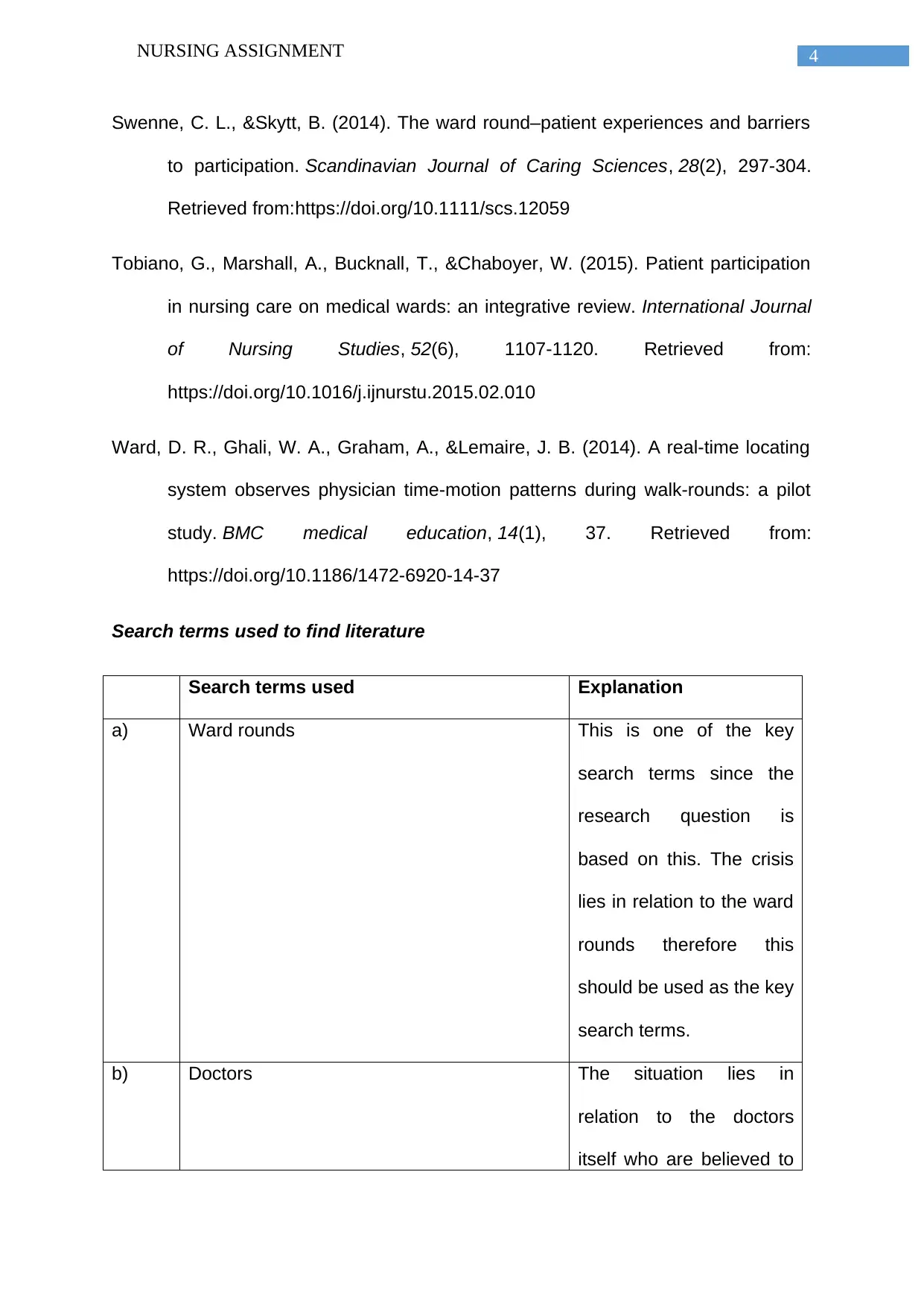
Swenne, C. L., &Skytt, B. (2014). The ward round–patient experiences and barriers
to participation. Scandinavian Journal of Caring Sciences, 28(2), 297-304.
Retrieved from:https://doi.org/10.1111/scs.12059
Tobiano, G., Marshall, A., Bucknall, T., &Chaboyer, W. (2015). Patient participation
in nursing care on medical wards: an integrative review. International Journal
of Nursing Studies, 52(6), 1107-1120. Retrieved from:
https://doi.org/10.1016/j.ijnurstu.2015.02.010
Ward, D. R., Ghali, W. A., Graham, A., &Lemaire, J. B. (2014). A real-time locating
system observes physician time-motion patterns during walk-rounds: a pilot
study. BMC medical education, 14(1), 37. Retrieved from:
https://doi.org/10.1186/1472-6920-14-37
Search terms used to find literature
Search terms used Explanation
a) Ward rounds This is one of the key
search terms since the
research question is
based on this. The crisis
lies in relation to the ward
rounds therefore this
should be used as the key
search terms.
b) Doctors The situation lies in
relation to the doctors
itself who are believed to
Swenne, C. L., &Skytt, B. (2014). The ward round–patient experiences and barriers
to participation. Scandinavian Journal of Caring Sciences, 28(2), 297-304.
Retrieved from:https://doi.org/10.1111/scs.12059
Tobiano, G., Marshall, A., Bucknall, T., &Chaboyer, W. (2015). Patient participation
in nursing care on medical wards: an integrative review. International Journal
of Nursing Studies, 52(6), 1107-1120. Retrieved from:
https://doi.org/10.1016/j.ijnurstu.2015.02.010
Ward, D. R., Ghali, W. A., Graham, A., &Lemaire, J. B. (2014). A real-time locating
system observes physician time-motion patterns during walk-rounds: a pilot
study. BMC medical education, 14(1), 37. Retrieved from:
https://doi.org/10.1186/1472-6920-14-37
Search terms used to find literature
Search terms used Explanation
a) Ward rounds This is one of the key
search terms since the
research question is
based on this. The crisis
lies in relation to the ward
rounds therefore this
should be used as the key
search terms.
b) Doctors The situation lies in
relation to the doctors
itself who are believed to
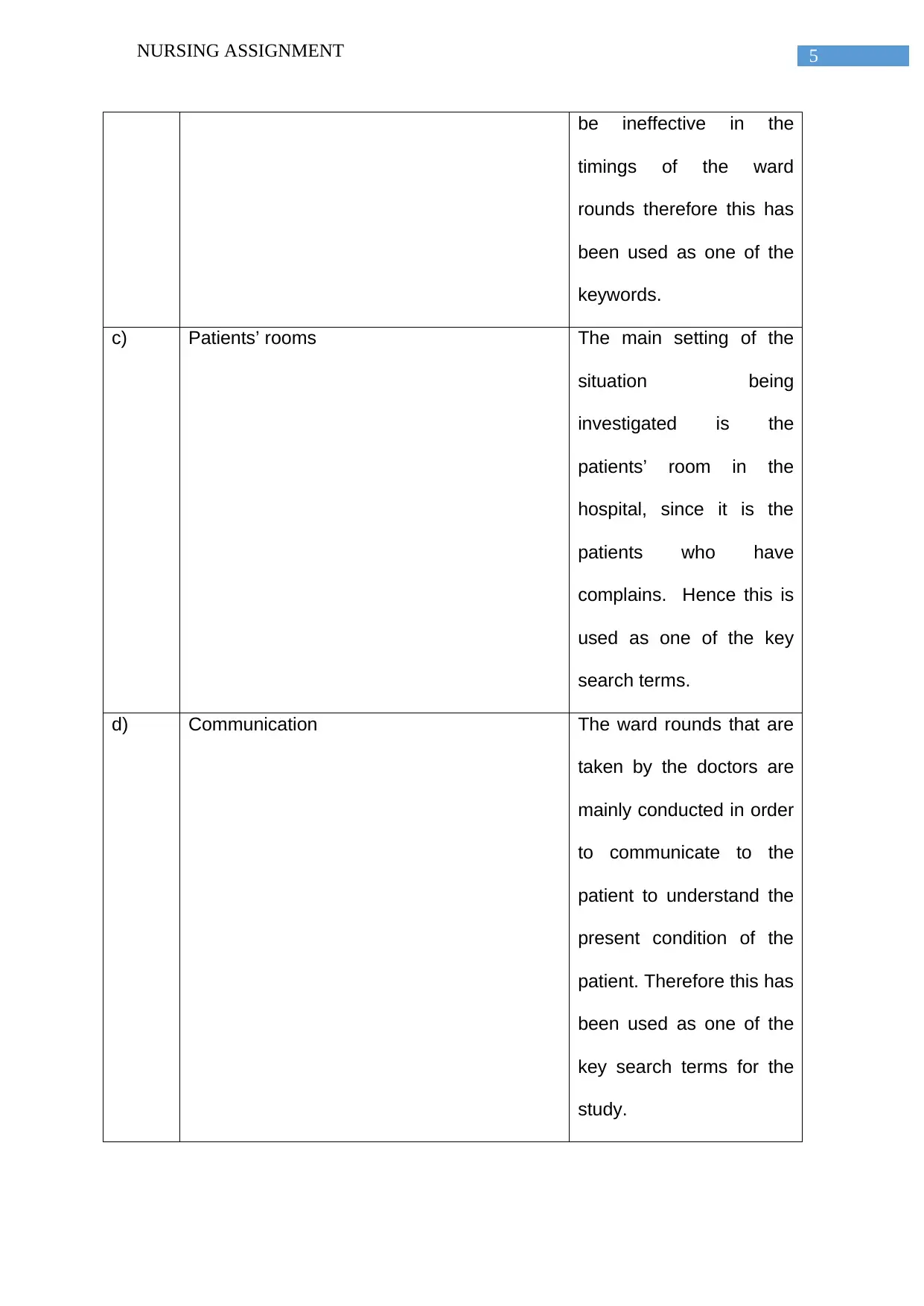
5NURSING ASSIGNMENT
be ineffective in the
timings of the ward
rounds therefore this has
been used as one of the
keywords.
c) Patients’ rooms The main setting of the
situation being
investigated is the
patients’ room in the
hospital, since it is the
patients who have
complains. Hence this is
used as one of the key
search terms.
d) Communication The ward rounds that are
taken by the doctors are
mainly conducted in order
to communicate to the
patient to understand the
present condition of the
patient. Therefore this has
been used as one of the
key search terms for the
study.
be ineffective in the
timings of the ward
rounds therefore this has
been used as one of the
keywords.
c) Patients’ rooms The main setting of the
situation being
investigated is the
patients’ room in the
hospital, since it is the
patients who have
complains. Hence this is
used as one of the key
search terms.
d) Communication The ward rounds that are
taken by the doctors are
mainly conducted in order
to communicate to the
patient to understand the
present condition of the
patient. Therefore this has
been used as one of the
key search terms for the
study.
⊘ This is a preview!⊘
Do you want full access?
Subscribe today to unlock all pages.
Trusted by 1+ million students worldwide
6NURSING ASSIGNMENT
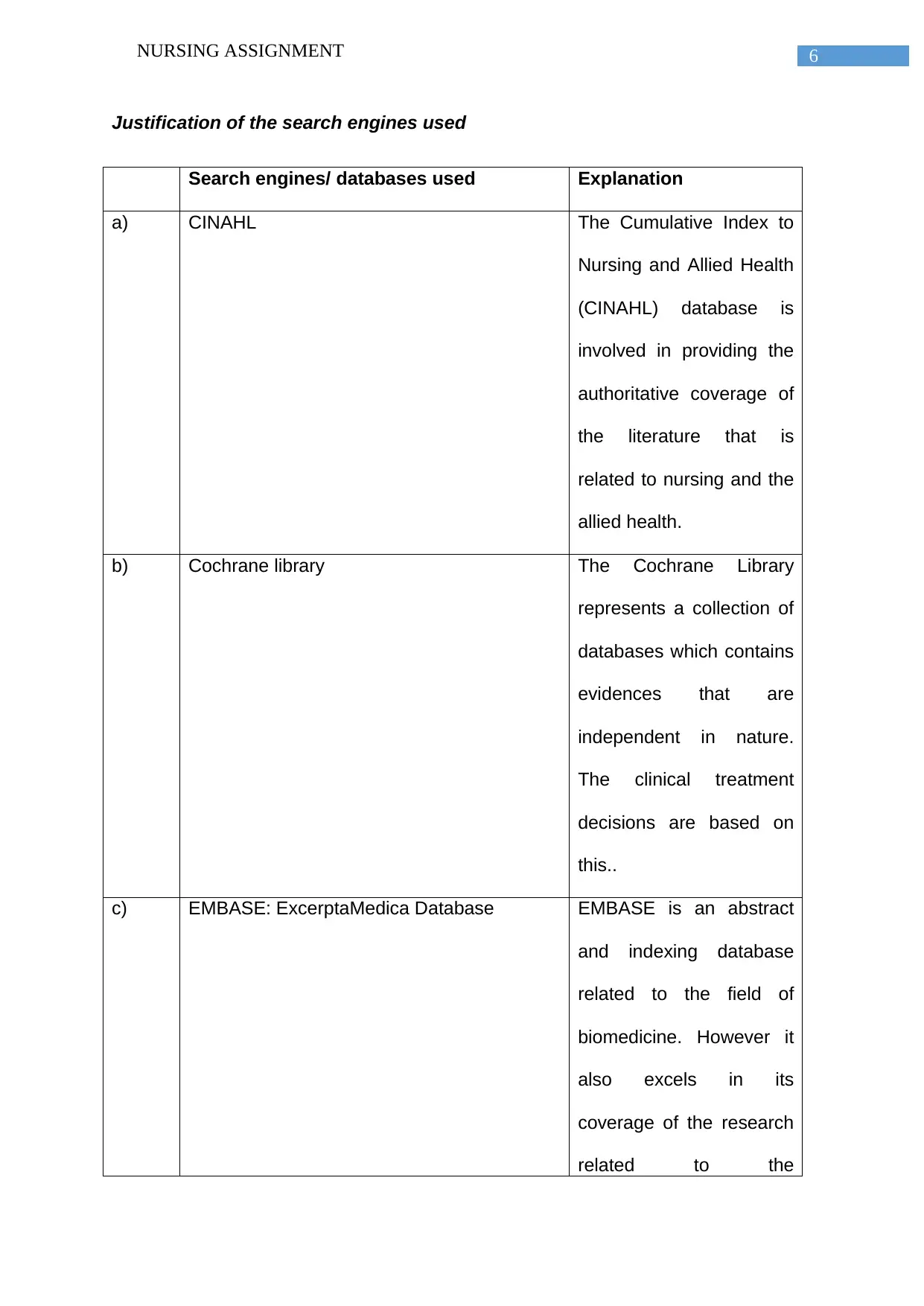
Justification of the search engines used
Search engines/ databases used Explanation
a) CINAHL The Cumulative Index to
Nursing and Allied Health
(CINAHL) database is
involved in providing the
authoritative coverage of
the literature that is
related to nursing and the
allied health.
b) Cochrane library The Cochrane Library
represents a collection of
databases which contains
evidences that are
independent in nature.
The clinical treatment
decisions are based on
this..
c) EMBASE: ExcerptaMedica Database EMBASE is an abstract
and indexing database
related to the field of
biomedicine. However it
also excels in its
coverage of the research
related to the
Justification of the search engines used
Search engines/ databases used Explanation
a) CINAHL The Cumulative Index to
Nursing and Allied Health
(CINAHL) database is
involved in providing the
authoritative coverage of
the literature that is
related to nursing and the
allied health.
b) Cochrane library The Cochrane Library
represents a collection of
databases which contains
evidences that are
independent in nature.
The clinical treatment
decisions are based on
this..
c) EMBASE: ExcerptaMedica Database EMBASE is an abstract
and indexing database
related to the field of
biomedicine. However it
also excels in its
coverage of the research
related to the
Paraphrase This Document
Need a fresh take? Get an instant paraphrase of this document with our AI Paraphraser
7NURSING ASSIGNMENT
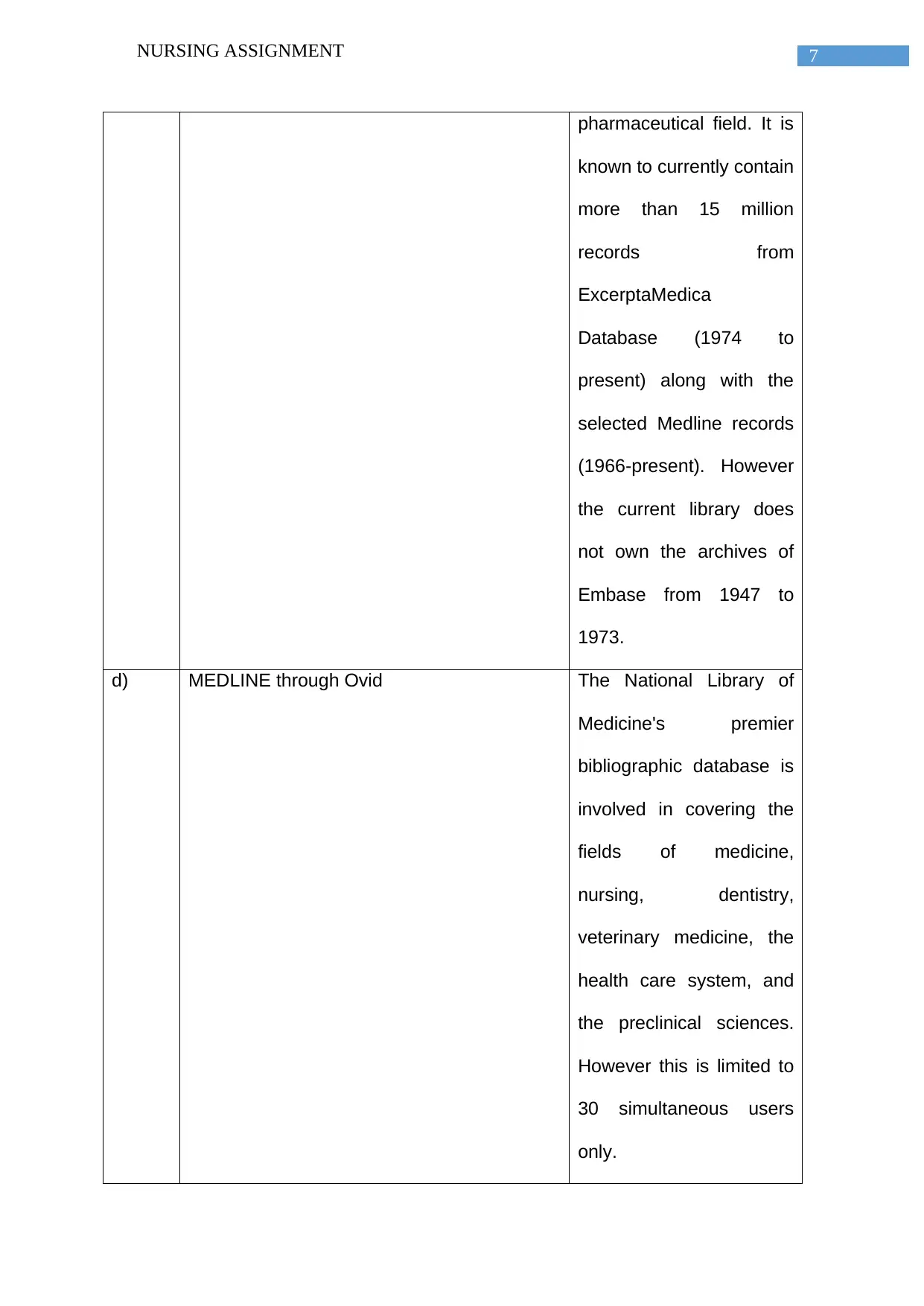
pharmaceutical field. It is
known to currently contain
more than 15 million
records from
ExcerptaMedica
Database (1974 to
present) along with the
selected Medline records
(1966-present). However
the current library does
not own the archives of
Embase from 1947 to
1973.
d) MEDLINE through Ovid The National Library of
Medicine's premier
bibliographic database is
involved in covering the
fields of medicine,
nursing, dentistry,
veterinary medicine, the
health care system, and
the preclinical sciences.
However this is limited to
30 simultaneous users
only.
pharmaceutical field. It is
known to currently contain
more than 15 million
records from
ExcerptaMedica
Database (1974 to
present) along with the
selected Medline records
(1966-present). However
the current library does
not own the archives of
Embase from 1947 to
1973.
d) MEDLINE through Ovid The National Library of
Medicine's premier
bibliographic database is
involved in covering the
fields of medicine,
nursing, dentistry,
veterinary medicine, the
health care system, and
the preclinical sciences.
However this is limited to
30 simultaneous users
only.
8NURSING ASSIGNMENT
Research design
Pilot study design
a) Research question
The current situation that dwells is that there has been an increase in the
amount of complaints regarding the timings of the ward rounds of the doctors.
Therefore in order to conduct a pilot study to investigate this situation the research
questions raised is as follows: Can the ward rounds be effectively organised in order
to reduce complains of the patients regarding the infective timings of the doctors for
ward rounds.
b) Research approach
The research approach that will be implemented for this study is the
qualitative study using a focus group. The ward rounds that are taken by the doctors
or the medical specialists were observed for the conduction of the study. For this four
hospitals were taken into account between the periods of six months. There were
approximately 90 wards which were taken into account.
c) Study design
The study design that was undertaken for the given situation were the
investigation using semi-structured questions. The questions consisted of themes
like how the ward rounds were structured, how these routines were employed and
finally the contributions were made by the doctors and the patient respectively during
Research design
Pilot study design
a) Research question
The current situation that dwells is that there has been an increase in the
amount of complaints regarding the timings of the ward rounds of the doctors.
Therefore in order to conduct a pilot study to investigate this situation the research
questions raised is as follows: Can the ward rounds be effectively organised in order
to reduce complains of the patients regarding the infective timings of the doctors for
ward rounds.
b) Research approach
The research approach that will be implemented for this study is the
qualitative study using a focus group. The ward rounds that are taken by the doctors
or the medical specialists were observed for the conduction of the study. For this four
hospitals were taken into account between the periods of six months. There were
approximately 90 wards which were taken into account.
c) Study design
The study design that was undertaken for the given situation were the
investigation using semi-structured questions. The questions consisted of themes
like how the ward rounds were structured, how these routines were employed and
finally the contributions were made by the doctors and the patient respectively during
⊘ This is a preview!⊘
Do you want full access?
Subscribe today to unlock all pages.
Trusted by 1+ million students worldwide
9NURSING ASSIGNMENT
the condition of the rounds. There were also some follow-up questions in case there
were clarifications required for the understanding of the situation. There were
observational notes prepared on the basis of the ward rounds which were in turn
categorized in accordance to their structures. The semi-structured questions were
provided in the form of a questionnaire. This questionnaire helped the collection of
the data from a wide group of participants. The application of the focus group and
the questionnaire acted as complementary with respect to the study undertaken. A
combination of open ended and closed ended questions were included in the
questionnaire.
d) Setting
The study setting was the hospital wards that is the ninety wards which were
involved in the study from the four different hospitals.
e) Sample
The sample for the study undertaken was approximately 30 doctors who
conducted the rounds. The rounds that were taken by the doctors were of four types
which was also taken into account. These are as follows: the ward rounds only which
were used for teaching and business purpose only. The second is the pre-ward
round meeting that was followed by the ward round, followed by the ward round
follow-up along with a post-ward round meeting. The last one is the pre-ward round
meeting, in addition to the ward round that was followed-up with a post-ward round
meeting. The patients were also included in the study, which consisted of 10 males
and 10 female patients belonging to the concerned wards.
f) Inclusion/exclusion criteria
the condition of the rounds. There were also some follow-up questions in case there
were clarifications required for the understanding of the situation. There were
observational notes prepared on the basis of the ward rounds which were in turn
categorized in accordance to their structures. The semi-structured questions were
provided in the form of a questionnaire. This questionnaire helped the collection of
the data from a wide group of participants. The application of the focus group and
the questionnaire acted as complementary with respect to the study undertaken. A
combination of open ended and closed ended questions were included in the
questionnaire.
d) Setting
The study setting was the hospital wards that is the ninety wards which were
involved in the study from the four different hospitals.
e) Sample
The sample for the study undertaken was approximately 30 doctors who
conducted the rounds. The rounds that were taken by the doctors were of four types
which was also taken into account. These are as follows: the ward rounds only which
were used for teaching and business purpose only. The second is the pre-ward
round meeting that was followed by the ward round, followed by the ward round
follow-up along with a post-ward round meeting. The last one is the pre-ward round
meeting, in addition to the ward round that was followed-up with a post-ward round
meeting. The patients were also included in the study, which consisted of 10 males
and 10 female patients belonging to the concerned wards.
f) Inclusion/exclusion criteria
Paraphrase This Document
Need a fresh take? Get an instant paraphrase of this document with our AI Paraphraser
10NURSING ASSIGNMENT
The inclusion criteria was that the doctors who were asked to participate
should have an experience of rounds for more than 10 months and for the patients,
they should have at least experienced two ward rounds while there stay in the
hospital. Those patients who were not able to speak in English were not included in
the study.
g) Recruitment process
The recruitment process included the recruitment of those participants rather
the doctors who had at least completed 10 weeks of ration on the medical ward
rounds including all the types of the rounds that have been mentioned above. The
patients were also included in the study which consisted of 10 men and 10 women
belonging to the undertaken wards.
h) Informed consent process
An informed consent was obtained from each of the participants after the
objectives of the study were explained to them. Each of the participants were
assured of the confidentiality of the information that is required to be collected. It was
also mentioned that the participants were allowed to participate in the study.
i) Ethics
In terms of the ethical approval, the study was approved by the research
ethics committee of the respective university and IRBS in Singapore.
j) Data collection
The data was collected using the semi-structured questions during a
period of six months which contained a combination of open ended and close
The inclusion criteria was that the doctors who were asked to participate
should have an experience of rounds for more than 10 months and for the patients,
they should have at least experienced two ward rounds while there stay in the
hospital. Those patients who were not able to speak in English were not included in
the study.
g) Recruitment process
The recruitment process included the recruitment of those participants rather
the doctors who had at least completed 10 weeks of ration on the medical ward
rounds including all the types of the rounds that have been mentioned above. The
patients were also included in the study which consisted of 10 men and 10 women
belonging to the undertaken wards.
h) Informed consent process
An informed consent was obtained from each of the participants after the
objectives of the study were explained to them. Each of the participants were
assured of the confidentiality of the information that is required to be collected. It was
also mentioned that the participants were allowed to participate in the study.
i) Ethics
In terms of the ethical approval, the study was approved by the research
ethics committee of the respective university and IRBS in Singapore.
j) Data collection
The data was collected using the semi-structured questions during a
period of six months which contained a combination of open ended and close
11NURSING ASSIGNMENT
ended questions. The respective questionnaires were sent to the doctors in
charge of the respective wards for the collection of the data. The patients were
also included in the study for which semi-structured interviews were conducted
were they were asked to describe any one positive and a negative experience
that is associated with the rounds.
k) Data analysis
For the analysis of the data, the interviews and the answers were analysed
using the qualitative content analysis methodology. The written words were used as
the foundation of the analysis in case of the qualitative content analysis. For the
interview which were audio-taped, the transcript was read and re-read by the authors
so that the understanding can be gained and familiarity can be attained with the
present text. From the obtained text, the units, words and the phrases can be
identified which corresponded to the aim of the study and were finally coded by the
authors individually. For better data analysis, there was categorising of the codes
which were interpreted. In the last step of the analysis, a theme was developed
which was then brought together with the content of the condensed meaning units
along with the codes, the categories in addition to the subthemes on a level that is
interpretative. In order to increase the credibility and the dependability of the study,
the researchers were required to discuss each and every step in order to reach an
agreement.
Sharing of the findings
The investigation uncovered one subject and three subthemes identified with
patients' encounters of ward rounds. The principle subject was treatment of data
from the everyday ward round while sitting tight for private interview. The subthemes
ended questions. The respective questionnaires were sent to the doctors in
charge of the respective wards for the collection of the data. The patients were
also included in the study for which semi-structured interviews were conducted
were they were asked to describe any one positive and a negative experience
that is associated with the rounds.
k) Data analysis
For the analysis of the data, the interviews and the answers were analysed
using the qualitative content analysis methodology. The written words were used as
the foundation of the analysis in case of the qualitative content analysis. For the
interview which were audio-taped, the transcript was read and re-read by the authors
so that the understanding can be gained and familiarity can be attained with the
present text. From the obtained text, the units, words and the phrases can be
identified which corresponded to the aim of the study and were finally coded by the
authors individually. For better data analysis, there was categorising of the codes
which were interpreted. In the last step of the analysis, a theme was developed
which was then brought together with the content of the condensed meaning units
along with the codes, the categories in addition to the subthemes on a level that is
interpretative. In order to increase the credibility and the dependability of the study,
the researchers were required to discuss each and every step in order to reach an
agreement.
Sharing of the findings
The investigation uncovered one subject and three subthemes identified with
patients' encounters of ward rounds. The principle subject was treatment of data
from the everyday ward round while sitting tight for private interview. The subthemes
⊘ This is a preview!⊘
Do you want full access?
Subscribe today to unlock all pages.
Trusted by 1+ million students worldwide

1 out of 21


Related Documents


Your All-in-One AI-Powered Toolkit for Academic Success.
+13062052269
info@desklib.com
Available 24*7 on WhatsApp / Email
![[object Object]](/_next/static/media/star-bottom.7253800d.svg)
Unlock your academic potential
Copyright © 2020–2025 A2Z Services. All Rights Reserved. Developed and managed by ZUCOL.