Comprehensive Guide to Essential Documents for a Clinical Study

Verified

Added on  2021/04/24

|9
|2116
|41
Report
AI Summary
This report provides a detailed overview of the essential documents required for the successful execution and regulatory compliance of a clinical study. It categorizes these documents into three phases: before, during, and after the study. The 'before study' phase includes the investigator's brochure, trial protocol, informed consent form, financial and insurance statements, and agreements between involved parties, among others. The 'during clinical study' phase focuses on updates to the investigator's brochure, revisions to the protocol, monitoring visit reports, source documents, safety notifications, and subject logs. Finally, the 'after completion of the study' phase covers product accountability, subject identification lists, audit certificates, final close-out monitoring sheets, and the clinical study report. The report emphasizes the importance of the trial master file for document management and highlights the necessity of compliance with good clinical practices and regulatory requirements. It also stresses the importance of maintaining all documents for audit purposes and provides a comprehensive guide for researchers, sponsors, and regulatory bodies involved in clinical trials. The document uses references to support its arguments.

Document Page
Essential Document for a Clinical Study
Name:
Department:
University affiliation:
Word count: 1550
tabler-icon-diamond-filled.svg

Paraphrase This Document

Need a fresh take? Get an instant paraphrase of this document with our AI Paraphraser
Document Page
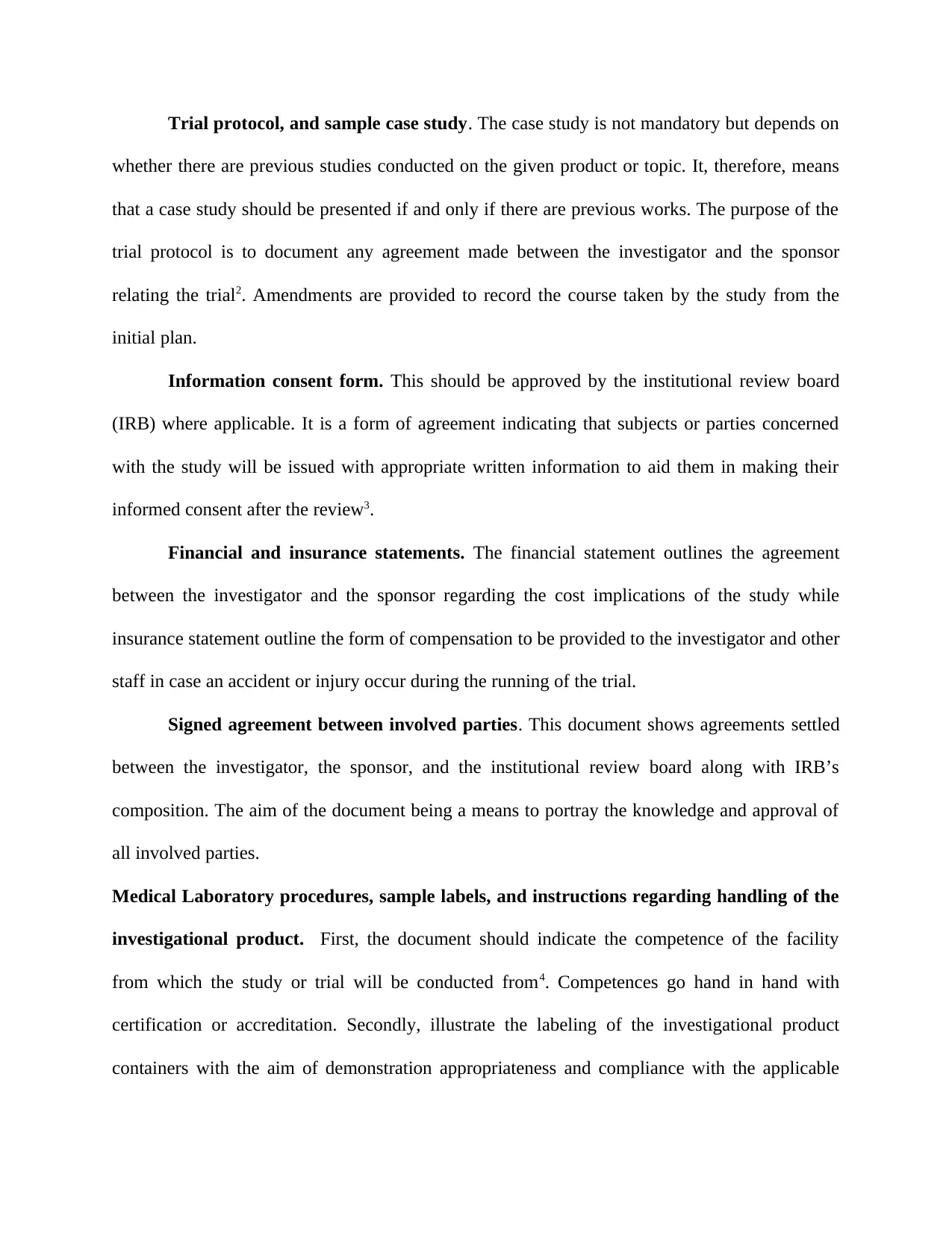
Introduction
Study documents are very crucial for good clinical practices. Like any other scientific
study, a clinical study has a number documents that need to be filled before, during and after
study to help in the success and straightforward review of the research. These documents
facilitate audit and inspection of the study procedures, results, and recommendations by any
person or by the health regulatory authorities. Two parties are involved in the filling of these
documents, the investigator, and the sponsor.
Through these documents, authorities are in a position to validate the study and integrity
of the data collected. With regard to good clinical practices and regulatory requirements,
compliance with these documents is necessary. Compliance will not only permit the conduct and
evaluation of the trial but will also help in a significant way in the successful management of the
clinical study. This paper, therefore, focuses on the necessary documents required before, during
and after a clinical trial/study. Management of these document is possible with a trial master
file1.
Before Study
These documents facilitate the planning of the study. They should, therefore, be filed in
the trial master file before the commencement of the trial. The documents are as discussed
below.
Investigator’s brochure. The purpose of the document is to note or identify any current
scientific information that is relevant to the study or investigational product provided to the
investigator. In other words, the brochure contains pre-clinical and clinical information regarding
the product under investigation2. The information is presented in a simple, concise and objective
form.
Document Page
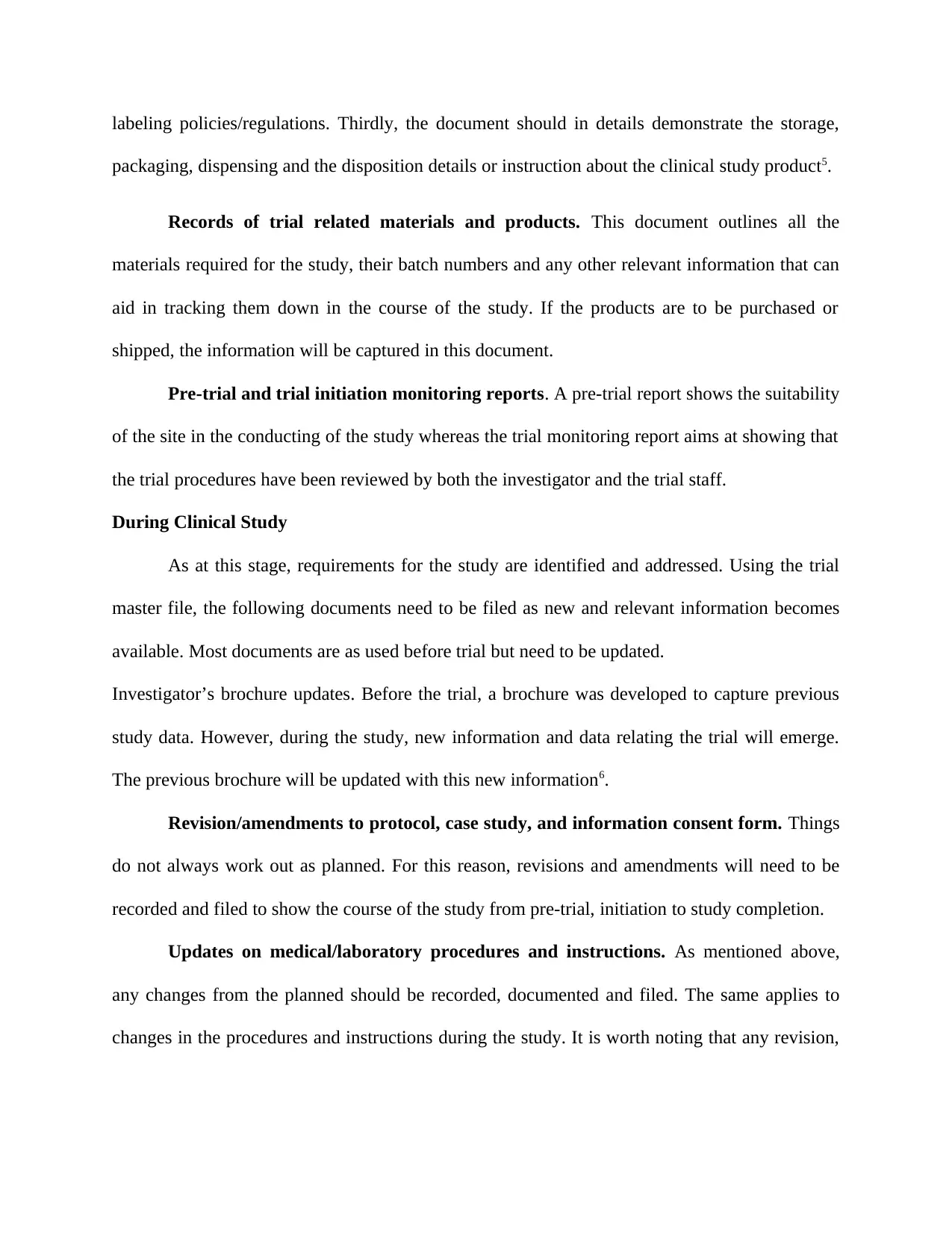
Trial protocol, and sample case study. The case study is not mandatory but depends on
whether there are previous studies conducted on the given product or topic. It, therefore, means
that a case study should be presented if and only if there are previous works. The purpose of the
trial protocol is to document any agreement made between the investigator and the sponsor
relating the trial2. Amendments are provided to record the course taken by the study from the
initial plan.
Information consent form. This should be approved by the institutional review board
(IRB) where applicable. It is a form of agreement indicating that subjects or parties concerned
with the study will be issued with appropriate written information to aid them in making their
informed consent after the review3.
Financial and insurance statements. The financial statement outlines the agreement
between the investigator and the sponsor regarding the cost implications of the study while
insurance statement outline the form of compensation to be provided to the investigator and other
staff in case an accident or injury occur during the running of the trial.
Signed agreement between involved parties. This document shows agreements settled
between the investigator, the sponsor, and the institutional review board along with IRB’s
composition. The aim of the document being a means to portray the knowledge and approval of
all involved parties.
Medical Laboratory procedures, sample labels, and instructions regarding handling of the
investigational product. First, the document should indicate the competence of the facility
from which the study or trial will be conducted from4. Competences go hand in hand with
certification or accreditation. Secondly, illustrate the labeling of the investigational product
containers with the aim of demonstration appropriateness and compliance with the applicable
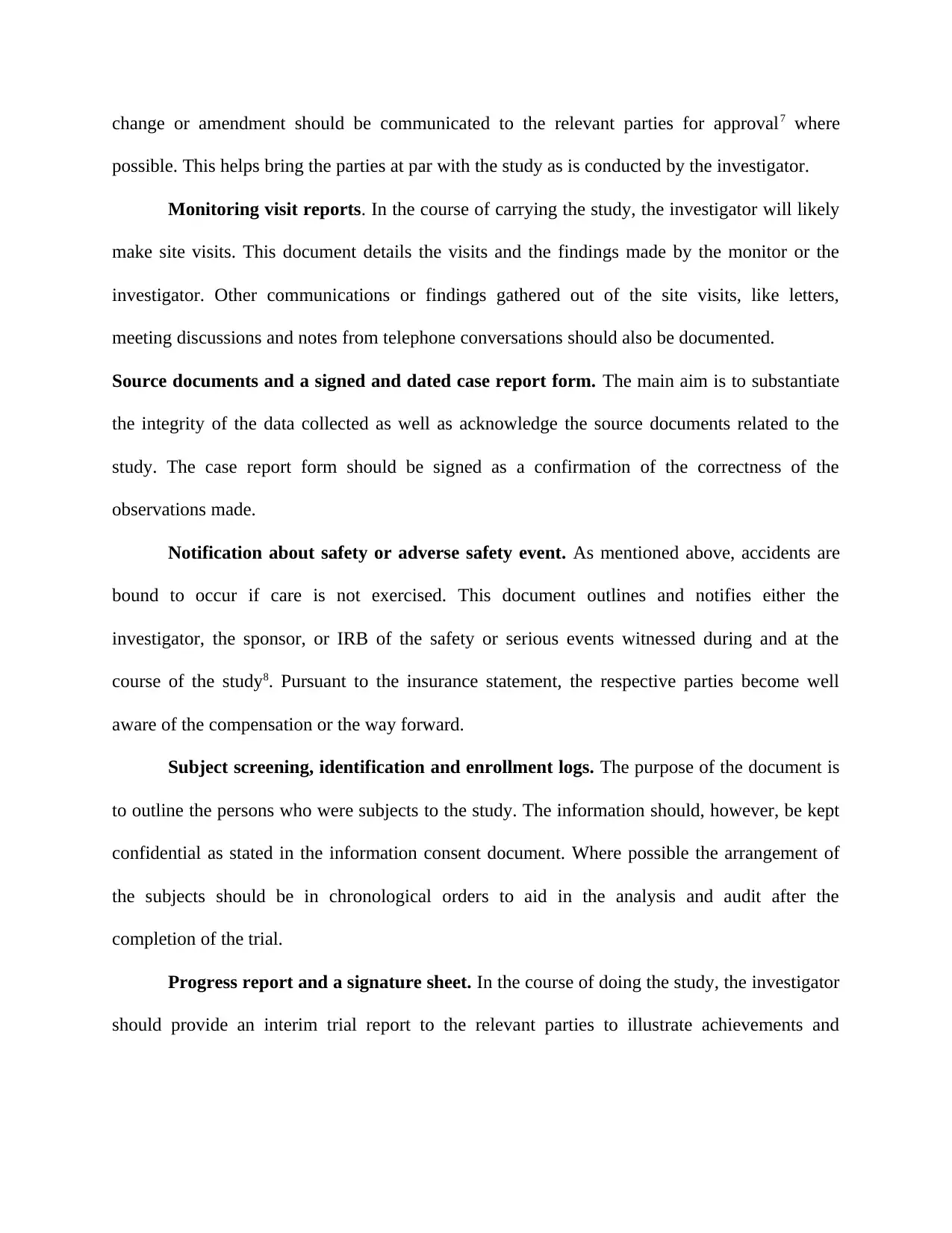
Document Page
labeling policies/regulations. Thirdly, the document should in details demonstrate the storage,
packaging, dispensing and the disposition details or instruction about the clinical study product5.
Records of trial related materials and products. This document outlines all the
materials required for the study, their batch numbers and any other relevant information that can
aid in tracking them down in the course of the study. If the products are to be purchased or
shipped, the information will be captured in this document.
Pre-trial and trial initiation monitoring reports. A pre-trial report shows the suitability
of the site in the conducting of the study whereas the trial monitoring report aims at showing that
the trial procedures have been reviewed by both the investigator and the trial staff.
During Clinical Study
As at this stage, requirements for the study are identified and addressed. Using the trial
master file, the following documents need to be filed as new and relevant information becomes
available. Most documents are as used before trial but need to be updated.
Investigator’s brochure updates. Before the trial, a brochure was developed to capture previous
study data. However, during the study, new information and data relating the trial will emerge.
The previous brochure will be updated with this new information6.
Revision/amendments to protocol, case study, and information consent form. Things
do not always work out as planned. For this reason, revisions and amendments will need to be
recorded and filed to show the course of the study from pre-trial, initiation to study completion.
Updates on medical/laboratory procedures and instructions. As mentioned above,
any changes from the planned should be recorded, documented and filed. The same applies to
changes in the procedures and instructions during the study. It is worth noting that any revision,
tabler-icon-diamond-filled.svg

Paraphrase This Document

Need a fresh take? Get an instant paraphrase of this document with our AI Paraphraser
Document Page
change or amendment should be communicated to the relevant parties for approval7 where
possible. This helps bring the parties at par with the study as is conducted by the investigator.
Monitoring visit reports. In the course of carrying the study, the investigator will likely
make site visits. This document details the visits and the findings made by the monitor or the
investigator. Other communications or findings gathered out of the site visits, like letters,
meeting discussions and notes from telephone conversations should also be documented.
Source documents and a signed and dated case report form. The main aim is to substantiate
the integrity of the data collected as well as acknowledge the source documents related to the
study. The case report form should be signed as a confirmation of the correctness of the
observations made.
Notification about safety or adverse safety event. As mentioned above, accidents are
bound to occur if care is not exercised. This document outlines and notifies either the
investigator, the sponsor, or IRB of the safety or serious events witnessed during and at the
course of the study8. Pursuant to the insurance statement, the respective parties become well
aware of the compensation or the way forward.
Subject screening, identification and enrollment logs. The purpose of the document is
to outline the persons who were subjects to the study. The information should, however, be kept
confidential as stated in the information consent document. Where possible the arrangement of
the subjects should be in chronological orders to aid in the analysis and audit after the
completion of the trial.
Progress report and a signature sheet. In the course of doing the study, the investigator
should provide an interim trial report to the relevant parties to illustrate achievements and
Document Page
challenges faced. Along with this report is a signed signature sheet with initials of all relevant
persons confirming the correctness of entries made in the report.
After Completion of the Study
As at this stage, all the above documents should be filled and filed. This is to help pave
the way to the completion of the study. Below are the documents required at the termination of a
trial.
Product accountability form. When conducting the study or trial, the relevant material
was issued to the investigator. After completion of the trial, the remainders need be returned to
the sponsor. This document, therefore, monitors that investigational product was used in line
with protocol, in right quantities with remainders returned to the sponsor and destroyed where
necessary9.
Complete subject identification list. At the end of the trial, the investigator and his staff
should compile a code list of all the study subjects. This is to allow the easy identification of all
the subjects enrolled in for the study in case there is the need for follow-ups. As mentioned
above, this list should remain confidential according to terms outlined in the information consent
form.
Audit certificate. This document confirms that audit to the study was performed by the relevant
body to ascertain compliance and validity of the study report10.
Final trial close-out monitoring sheet. During the study, several issues and actions emerge.
These issues and events need to be closed out to pave the way for the preparation of the final
report regarding the study. (11) This document outlines the issues and action taken to phase them
out.
Document Page
Clinical study report. Having closed out all actions about the study, obtained relevant
data and filled the necessary study documents, the investigator provides the final study report
clearly illustrating the results together with their interpretation. This report is shared with all the
parties involved12.
Conclusion
Documents are very crucial in a clinical study because they facilitate future referencing.
From the outgoing discussion, the list appears enormous, however, it is allowed to combine one,
or the other document provided the individual elements in these documents remains identifiable.
To easily manage the documents a trial master file is used where documents are filed as they
emerge. Worth remembering is that the final close-out sheet for the trial should only be done
once the investigator, the sponsor, and any other party are certain and satisfied with all the other
documents. Failure to do this will leave some actions not closed out. Finally, all the documents
should be available for audit by the sponsor, IRB or any of the regulatory authorities.
tabler-icon-diamond-filled.svg

Paraphrase This Document

Need a fresh take? Get an instant paraphrase of this document with our AI Paraphraser
Document Page
References
1. Kolman J, Meng P, Scott G. Good clinical practice: standard operating procedures for
clinical researchers. John Wiley & Sons; 2008.
2. Cowan J. Clinical governance and clinical documentation: still a long way to go?.
British Journal of Clinical Governance. 2000 Sep 1;5(3):179-82.
3. Saranto K, Kinnunen UM. Evaluating nursing documentation–research designs and
methods: systematic review. Journal of advanced nursing. 2009 Mar 1;65(3):464-76.
4. Nagle L. M.: Clinical Documentation Standards–Promise or Peril. Nursing Leadership
(CJNL). 2007;20(4).
5. Grimes DA, Hubacher D, Nanda K, Schulz KF, Moher D, Altman DG. The Good
Clinical Practice guideline: a bronze standard for clinical research. The Lancet. 2015
Jul 9;366(9480):172-4.
6. Fischbach FT. Documenting care: communication, the nursing process and
documentation standards. FA Davis Co; 2011.
7. Ammenwerth E, Kutscha U, Kutscha A, Mahler C, Eichstädter R, Haux R. Nursing
process documentation systems in clinical routine—prerequisites and experiences.
International Journal of Medical Informatics. 2001 Dec 1;64(2-3):187-200.
Document Page
8. Saba V. Clinical care classification (CCC) system manual: a guide to nursing
documentation. Springer Publishing Company; 2006 Oct 9.
9. International Organization for Standardization. Information and Documentation:
Records Management: General. International Organization for Standardization; 2011.
10. Smith K. Public sector records management: A practical guide. Routledge; 2016 Apr
15.
11. Roos J, Sennerby L, Albrektsson T. An update on the clinical documentation on
currently used bone anchored endosseous oral implants. Dental update. 2017
Jun;24(5):194-200.
12. Wieseler B, Kerekes MF, Vervoelgyi V, McGauran N, Kaiser T. Impact of document
type on reporting quality of clinical drug trials: a comparison of registry reports,
clinical study reports, and journal publications. BMJ. 2012 Jan 3;344: 8141.
chevron_up_icon
1 out of 9
circle_padding
hide_on_mobile
zoom_out_icon
[object Object]