Analysis: Domestic Abuse Bill, Human Rights Law, and SDGs Compliance

Verified

Added on  2023/04/21

|5
|913
|137
Report
AI Summary
This report provides a comprehensive analysis of a draft bill concerning domestic abuse, evaluating its sufficiency in addressing key concerns such as victim's rights, perpetrator journey, and criminal justice agency response. It examines the bill's provisions in relation to Human Rights Law, the Rule of Law, and Sustainable Development Goals (SDGs), highlighting the role of the justice system in protecting human rights and the importance of adhering to the root causes of abuse. The report further explores how the Rule of Law can be used to promote mitigation and protection within the context of domestic abuse, emphasizing respect for victims' rights and the role of criminal justice agencies in educating society. Recommendations are provided, advocating for stricter laws to protect victims, increased support for criminal investigation agencies to raise public awareness, and the incorporation of voluntary action to educate people within the society. The report also highlights the importance of government campaigns and projects aimed at eliminating domestic violence and promoting respect for human rights and freedom.
Document Page
Systematic Advocacy
Name
Course
Professor
Institution
Date
tabler-icon-diamond-filled.svg

Paraphrase This Document

Need a fresh take? Get an instant paraphrase of this document with our AI Paraphraser
Document Page
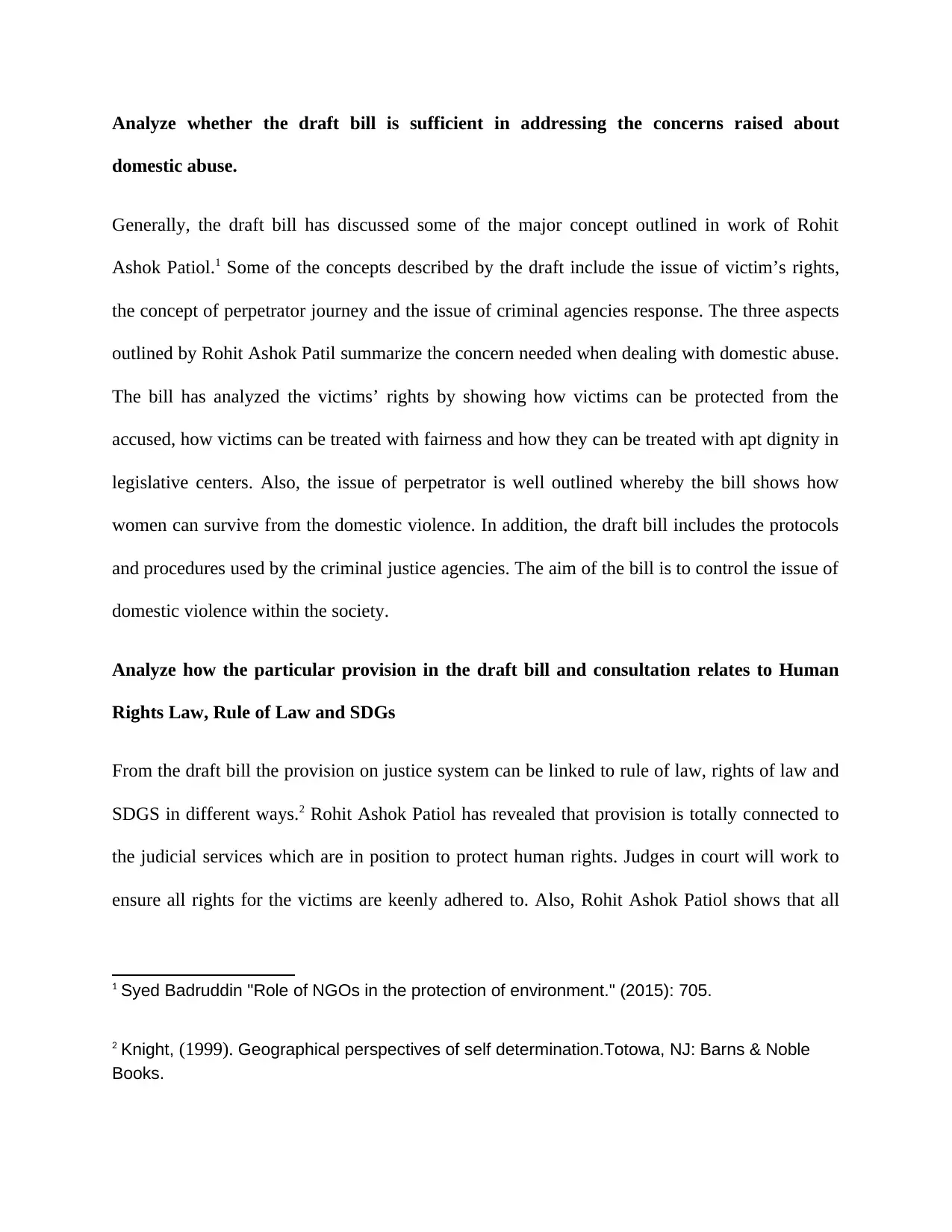
Analyze whether the draft bill is sufficient in addressing the concerns raised about
domestic abuse.
Generally, the draft bill has discussed some of the major concept outlined in work of Rohit
Ashok Patiol.1 Some of the concepts described by the draft include the issue of victim’s rights,
the concept of perpetrator journey and the issue of criminal agencies response. The three aspects
outlined by Rohit Ashok Patil summarize the concern needed when dealing with domestic abuse.
The bill has analyzed the victims’ rights by showing how victims can be protected from the
accused, how victims can be treated with fairness and how they can be treated with apt dignity in
legislative centers. Also, the issue of perpetrator is well outlined whereby the bill shows how
women can survive from the domestic violence. In addition, the draft bill includes the protocols
and procedures used by the criminal justice agencies. The aim of the bill is to control the issue of
domestic violence within the society.
Analyze how the particular provision in the draft bill and consultation relates to Human
Rights Law, Rule of Law and SDGs
From the draft bill the provision on justice system can be linked to rule of law, rights of law and
SDGS in different ways.2 Rohit Ashok Patiol has revealed that provision is totally connected to
the judicial services which are in position to protect human rights. Judges in court will work to
ensure all rights for the victims are keenly adhered to. Also, Rohit Ashok Patiol shows that all
1 Syed Badruddin "Role of NGOs in the protection of environment." (2015): 705.
2 Knight, (1999). Geographical perspectives of self determination.Totowa, NJ: Barns & Noble
Books.
Document Page
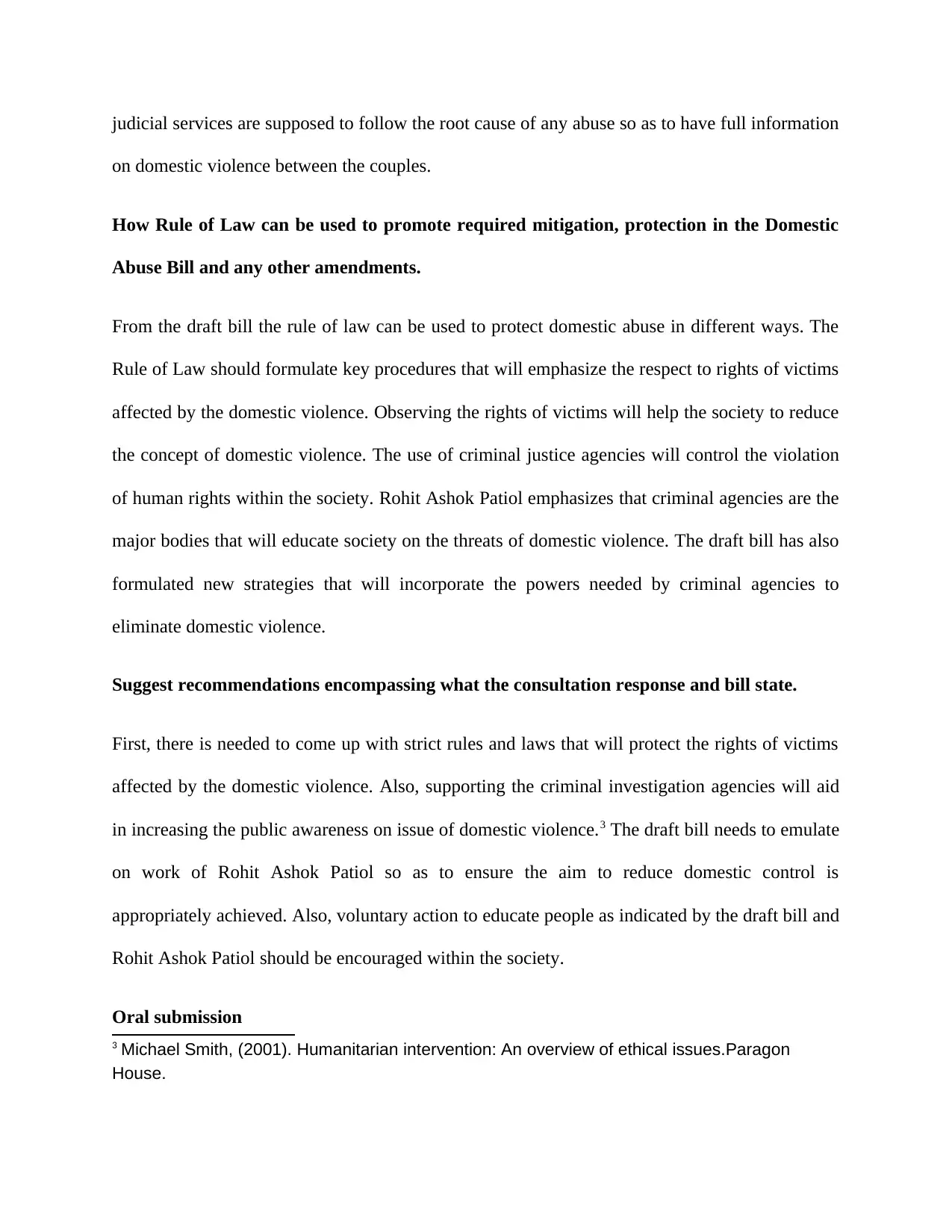
judicial services are supposed to follow the root cause of any abuse so as to have full information
on domestic violence between the couples.
How Rule of Law can be used to promote required mitigation, protection in the Domestic
Abuse Bill and any other amendments.
From the draft bill the rule of law can be used to protect domestic abuse in different ways. The
Rule of Law should formulate key procedures that will emphasize the respect to rights of victims
affected by the domestic violence. Observing the rights of victims will help the society to reduce
the concept of domestic violence. The use of criminal justice agencies will control the violation
of human rights within the society. Rohit Ashok Patiol emphasizes that criminal agencies are the
major bodies that will educate society on the threats of domestic violence. The draft bill has also
formulated new strategies that will incorporate the powers needed by criminal agencies to
eliminate domestic violence.
Suggest recommendations encompassing what the consultation response and bill state.
First, there is needed to come up with strict rules and laws that will protect the rights of victims
affected by the domestic violence. Also, supporting the criminal investigation agencies will aid
in increasing the public awareness on issue of domestic violence.3 The draft bill needs to emulate
on work of Rohit Ashok Patiol so as to ensure the aim to reduce domestic control is
appropriately achieved. Also, voluntary action to educate people as indicated by the draft bill and
Rohit Ashok Patiol should be encouraged within the society.
Oral submission
3 Michael Smith, (2001). Humanitarian intervention: An overview of ethical issues.Paragon
House.
Document Page
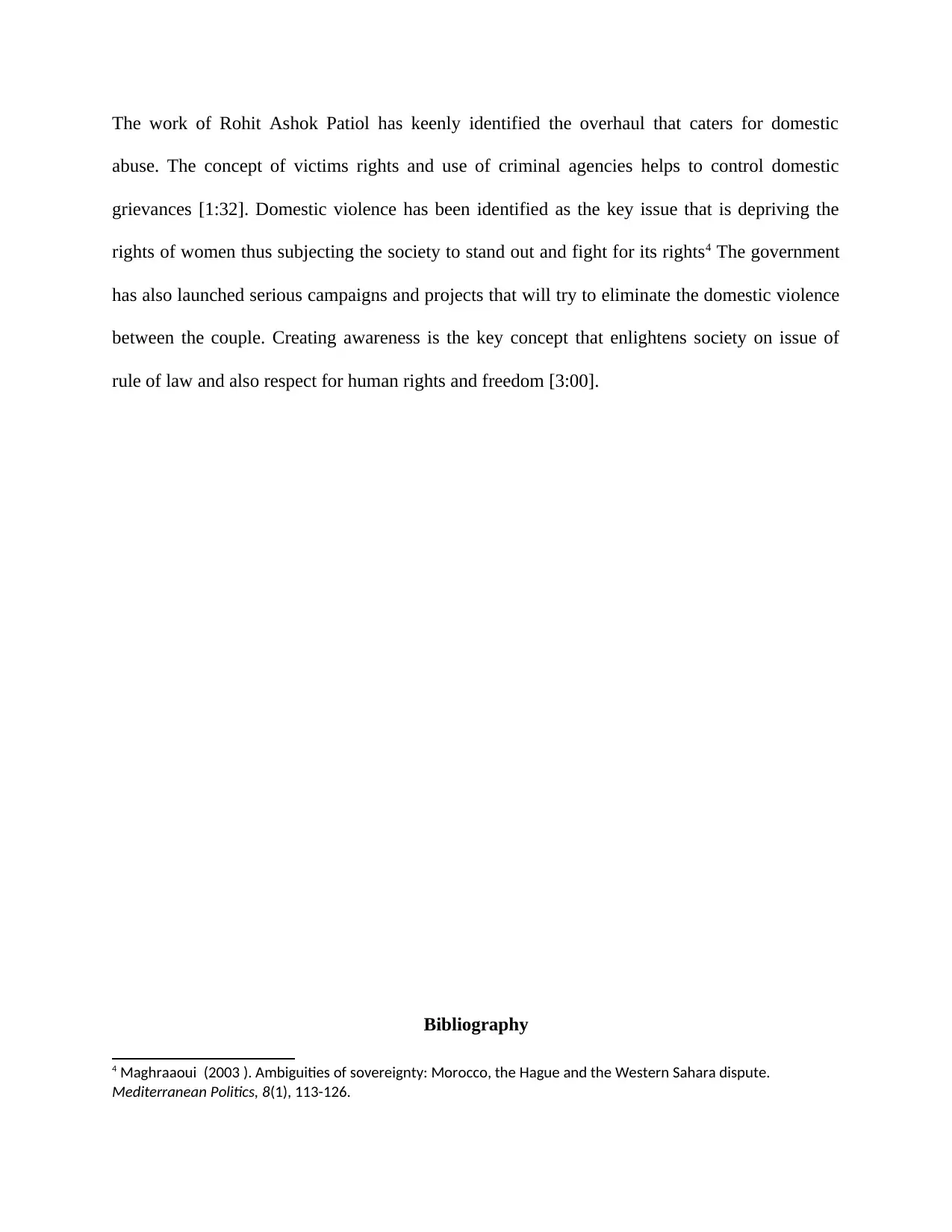
The work of Rohit Ashok Patiol has keenly identified the overhaul that caters for domestic
abuse. The concept of victims rights and use of criminal agencies helps to control domestic
grievances [1:32]. Domestic violence has been identified as the key issue that is depriving the
rights of women thus subjecting the society to stand out and fight for its rights4 The government
has also launched serious campaigns and projects that will try to eliminate the domestic violence
between the couple. Creating awareness is the key concept that enlightens society on issue of
rule of law and also respect for human rights and freedom [3:00].
Bibliography
4 Maghraaoui (2003 ). Ambiguities of sovereignty: Morocco, the Hague and the Western Sahara dispute.
Mediterranean Politics, 8(1), 113-126.
tabler-icon-diamond-filled.svg

Paraphrase This Document

Need a fresh take? Get an instant paraphrase of this document with our AI Paraphraser
Document Page
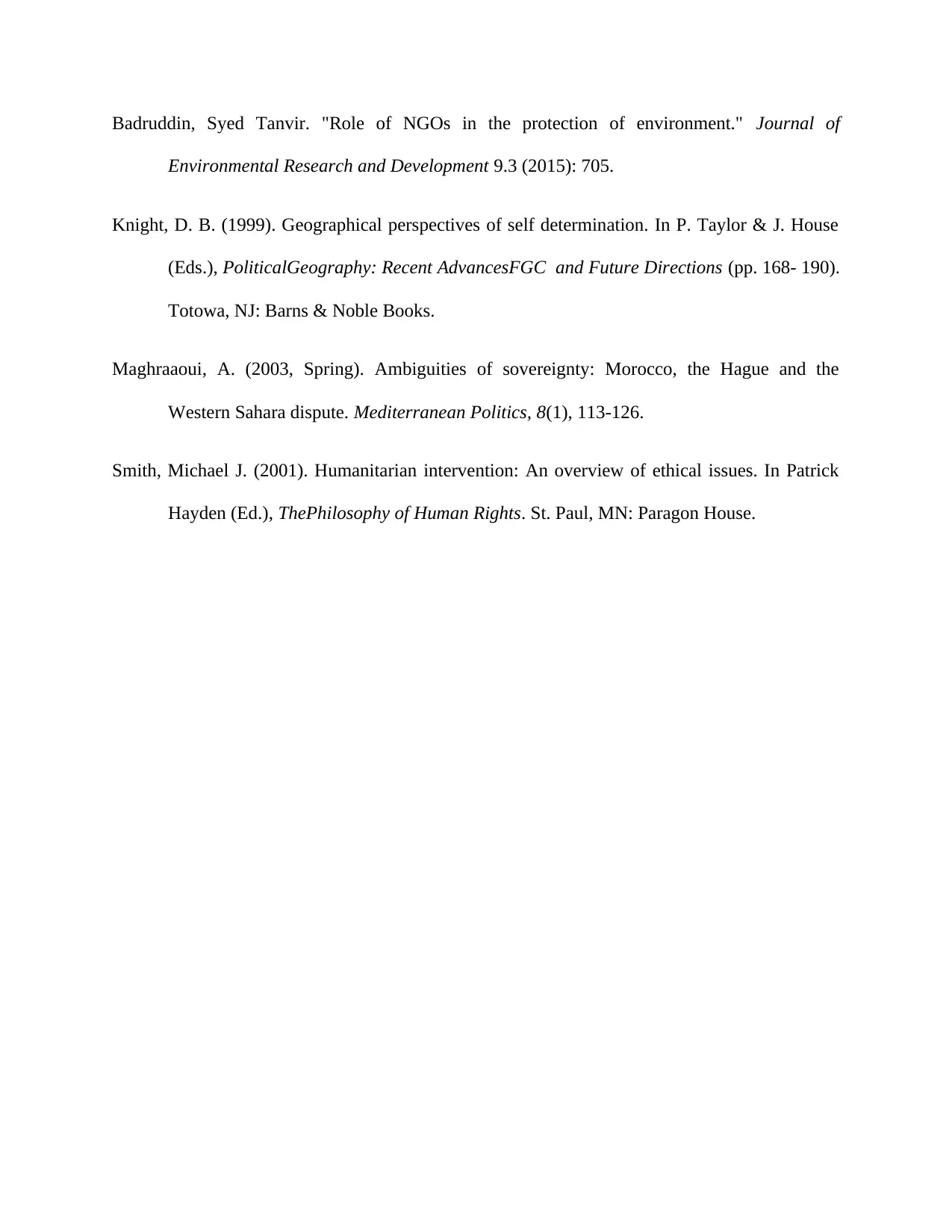
Badruddin, Syed Tanvir. "Role of NGOs in the protection of environment." Journal of
Environmental Research and Development 9.3 (2015): 705.
Knight, D. B. (1999). Geographical perspectives of self determination. In P. Taylor & J. House
(Eds.), PoliticalGeography: Recent AdvancesFGC and Future Directions (pp. 168- 190).
Totowa, NJ: Barns & Noble Books.
Maghraaoui, A. (2003, Spring). Ambiguities of sovereignty: Morocco, the Hague and the
Western Sahara dispute. Mediterranean Politics, 8(1), 113-126.
Smith, Michael J. (2001). Humanitarian intervention: An overview of ethical issues. In Patrick
Hayden (Ed.), ThePhilosophy of Human Rights. St. Paul, MN: Paragon House.
chevron_up_icon
1 out of 5
circle_padding
hide_on_mobile
zoom_out_icon
[object Object]