Domestic Violence's Effects on Children: A Mental Health Review
VerifiedAdded on 2023/06/15
|47
|12719
|236
Literature Review
AI Summary
This literature review critically analyzes the effects of domestic violence on children's mental health, focusing on the psychological, emotional, and behavioral consequences of exposure to violence within the home. It examines internalizing behaviors like depression, anxiety, and PTSD, as well as externalizing behaviors such as aggression and delinquency. The review incorporates findings from five key journals, highlighting the impact of domestic violence on children's developing brains and the potential for long-term structural changes. It further explores legal and policy frameworks in the UK designed to protect child victims, theoretical backgrounds explaining interpersonal violence, and the role of early interventions and trauma-informed treatment. The study also acknowledges limitations such as the limited number of reviewed journals and the exclusion of older studies, while recommending increased public health spending and awareness to mitigate the adverse effects of domestic violence on children.
Running head: MENTAL HEALTH NURSING
EFFECTS OF DOMESTIC VIOLENCE ON THE MENTAL HEALTH OF
CHILDREN
-A Literature Review
Name of the Student
Name of the University
Author Note
EFFECTS OF DOMESTIC VIOLENCE ON THE MENTAL HEALTH OF
CHILDREN
-A Literature Review
Name of the Student
Name of the University
Author Note

Paraphrase This Document
Need a fresh take? Get an instant paraphrase of this document with our AI Paraphraser
1MENTAL HEALTH NURSING
Statement of Findings:
Domestic violence may include physical, emotional, psychological or sexual abuse, as
well as being a victim of a witness to such incidents can scar a child for life
(domesticviolence.com.au 2018). Studies suggest that children have the highest risk of having
adverse effects, especially due to the effect on the developing brain thus, making permanent
structural changes (unicef.org 2018). This can cause internalising behaviours like depression,
Post Traumatic Stress Disorder, anxiety and isolation; or externalising behaviours like
aggression, delinquency and even homicide (Harman 2015; Iratzoqui and McCutcheon 2018;
Bair-Merritt et al., 2015). Exposure to domestic violence can also lead to chronic illnesses,
and reduce life expectancy of affected individuals and increase the propensity of the
perpetuation of such acts (Herman 2015). Furthermore, victims also tend to hide events of
domestic violence, making it harder to identify and also leads to under utilisation of services
(Cook et al. 2017). Studies shows that mechanisms such as emotional regulation can extend
beneficial outcome on the mental well being of the child, and so should be studied more
extensively (Catherine Panter-Brick et al. 2014).
This study critically analyses 5 journals which studied the effect of domestic violence
on children and also supports the above facts. Strategies such as early interventions, complex
treatment for trauma, increase in public healthcare spending, as well as increasing knowledge
about the adverse effects of domestic violence can help to alleviate the effects caused by the
exposure of children to trauma and domestic violence.
Statement of Findings:
Domestic violence may include physical, emotional, psychological or sexual abuse, as
well as being a victim of a witness to such incidents can scar a child for life
(domesticviolence.com.au 2018). Studies suggest that children have the highest risk of having
adverse effects, especially due to the effect on the developing brain thus, making permanent
structural changes (unicef.org 2018). This can cause internalising behaviours like depression,
Post Traumatic Stress Disorder, anxiety and isolation; or externalising behaviours like
aggression, delinquency and even homicide (Harman 2015; Iratzoqui and McCutcheon 2018;
Bair-Merritt et al., 2015). Exposure to domestic violence can also lead to chronic illnesses,
and reduce life expectancy of affected individuals and increase the propensity of the
perpetuation of such acts (Herman 2015). Furthermore, victims also tend to hide events of
domestic violence, making it harder to identify and also leads to under utilisation of services
(Cook et al. 2017). Studies shows that mechanisms such as emotional regulation can extend
beneficial outcome on the mental well being of the child, and so should be studied more
extensively (Catherine Panter-Brick et al. 2014).
This study critically analyses 5 journals which studied the effect of domestic violence
on children and also supports the above facts. Strategies such as early interventions, complex
treatment for trauma, increase in public healthcare spending, as well as increasing knowledge
about the adverse effects of domestic violence can help to alleviate the effects caused by the
exposure of children to trauma and domestic violence.
2MENTAL HEALTH NURSING
Contents
Strengths and Limitations of the study...................................................................................4
Question context.........................................................................................................................5
-What are the effects of domestic violence on children’s mental health...............................5
-Legal background.................................................................................................................8
-Theoretical Background........................................................................................................9
-Policy and Practice Background:........................................................................................10
Methodology:...........................................................................................................................12
-Steps taken to identify key research...................................................................................12
-Terminologies used.............................................................................................................12
-Inclusion and exclusion criteria..........................................................................................12
-Modification of search and rationale..................................................................................13
-Search results......................................................................................................................13
-Steps and tools used to critically analyze key journals.......................................................15
-Ethical considerations.........................................................................................................15
-Potentials for bias................................................................................................................16
Results:.....................................................................................................................................17
-Outlines of key papers........................................................................................................17
Journal 1...........................................................................................................................17
Journal 2...........................................................................................................................17
Journal 3...........................................................................................................................18
Contents
Strengths and Limitations of the study...................................................................................4
Question context.........................................................................................................................5
-What are the effects of domestic violence on children’s mental health...............................5
-Legal background.................................................................................................................8
-Theoretical Background........................................................................................................9
-Policy and Practice Background:........................................................................................10
Methodology:...........................................................................................................................12
-Steps taken to identify key research...................................................................................12
-Terminologies used.............................................................................................................12
-Inclusion and exclusion criteria..........................................................................................12
-Modification of search and rationale..................................................................................13
-Search results......................................................................................................................13
-Steps and tools used to critically analyze key journals.......................................................15
-Ethical considerations.........................................................................................................15
-Potentials for bias................................................................................................................16
Results:.....................................................................................................................................17
-Outlines of key papers........................................................................................................17
Journal 1...........................................................................................................................17
Journal 2...........................................................................................................................17
Journal 3...........................................................................................................................18
⊘ This is a preview!⊘
Do you want full access?
Subscribe today to unlock all pages.

Trusted by 1+ million students worldwide
3MENTAL HEALTH NURSING
Journal 4...........................................................................................................................19
Journal 5...........................................................................................................................20
-Relevance of each key journal............................................................................................20
Journal 1:..........................................................................................................................21
Journal 2:..........................................................................................................................21
Journal 3:..........................................................................................................................22
Journal 4:..........................................................................................................................24
Journal 5...........................................................................................................................24
Discussion................................................................................................................................25
-Implications and relevance of the findings in the context of the research question...........25
-Implications of the findings for further developments in practice, research theory and
policy....................................................................................................................................28
Conclusion................................................................................................................................31
-Limitations of the study......................................................................................................31
-Recommendations...............................................................................................................32
References:...............................................................................................................................33
Journal 4...........................................................................................................................19
Journal 5...........................................................................................................................20
-Relevance of each key journal............................................................................................20
Journal 1:..........................................................................................................................21
Journal 2:..........................................................................................................................21
Journal 3:..........................................................................................................................22
Journal 4:..........................................................................................................................24
Journal 5...........................................................................................................................24
Discussion................................................................................................................................25
-Implications and relevance of the findings in the context of the research question...........25
-Implications of the findings for further developments in practice, research theory and
policy....................................................................................................................................28
Conclusion................................................................................................................................31
-Limitations of the study......................................................................................................31
-Recommendations...............................................................................................................32
References:...............................................................................................................................33
Paraphrase This Document
Need a fresh take? Get an instant paraphrase of this document with our AI Paraphraser
4MENTAL HEALTH NURSING
Strengths and Limitations of the study
The strength of this study lies in the diversity of selected populations in key journals,
from studies conducted in the last 10 years, which provided up to date information. Selection
of different countries enabled the provision of context for comparison with studies done in
the UK, and hence enhances the scope for generalizability. Older studies and literature
reviews were also used to support or contest key points highlighted by the selected journals.
The strength was also attributed to the diversity in the population studied in these journals,
which helps to corroborate and compare results, as well as to identify any variants in the
studies. Each journal has been analysed separately, and their results have been compared
thematically to align their findings under common groups. This helped to identify the
strengths of the studies as well as understand the support provided by other studies to the
highlighted findings.
However, a major constraint was the lack of time to conduct a more thorough
research, and the inability to include more studies in the key journals for an even wider and
robust understanding of the issues as only 5 journals were selected and reviewed. This was a
weakness, because it prevented a larger literature to be analysed and therefore potentially
limit the scope of this study. Additionally, journals published more than 10 years were not
selected for the critical analysis. Therefore, any pertinent aspects highlighted by those studies
which were not addressed in newer studies were omitted from the discussion, and thus could
be a significant source of weakness of the study.
Since this study was conducted in a short span of time, it also limited the scope of
research that analysed each factor to its depths and analyse each contributing factors
thoroughly. Instead, factors highlighted by the selected few journals were discussed, and also
any studies that supports the findings were also discussed briefly, instead of analysing the
Strengths and Limitations of the study
The strength of this study lies in the diversity of selected populations in key journals,
from studies conducted in the last 10 years, which provided up to date information. Selection
of different countries enabled the provision of context for comparison with studies done in
the UK, and hence enhances the scope for generalizability. Older studies and literature
reviews were also used to support or contest key points highlighted by the selected journals.
The strength was also attributed to the diversity in the population studied in these journals,
which helps to corroborate and compare results, as well as to identify any variants in the
studies. Each journal has been analysed separately, and their results have been compared
thematically to align their findings under common groups. This helped to identify the
strengths of the studies as well as understand the support provided by other studies to the
highlighted findings.
However, a major constraint was the lack of time to conduct a more thorough
research, and the inability to include more studies in the key journals for an even wider and
robust understanding of the issues as only 5 journals were selected and reviewed. This was a
weakness, because it prevented a larger literature to be analysed and therefore potentially
limit the scope of this study. Additionally, journals published more than 10 years were not
selected for the critical analysis. Therefore, any pertinent aspects highlighted by those studies
which were not addressed in newer studies were omitted from the discussion, and thus could
be a significant source of weakness of the study.
Since this study was conducted in a short span of time, it also limited the scope of
research that analysed each factor to its depths and analyse each contributing factors
thoroughly. Instead, factors highlighted by the selected few journals were discussed, and also
any studies that supports the findings were also discussed briefly, instead of analysing the
5MENTAL HEALTH NURSING
merits and demerits of each of the supportive findings in a similar structure. This was also a
significant weakness for the study. However, maximum effort has been focussed on
developing a balanced view on the issue of domestic abuse through the analysis of credible
and relevant literature.
Question context
-What are the effects of domestic violence on children’s mental health
According to Domestic Violence Roundtable, children in the age group of 3-17 years
are at the most risk of the adverse effects of domestic violence, and 95% of the incidents are
directed towards the women, as victims to their male partners, with the children often being
the witnesses of these acts (domesticviolenceroundtable.org 2018). Effects of domestic
violence on children includes: poor concentration, hyperactivity, aggression, disobedience,
sleeping disturbances, social withdrawal, and lack of emotion, pessimism, and physical
symptoms (Domesticviolence.com.au 2018; Van der Kolk 2017; Tsavoussis et al. 2014;
Herman 2015; Cook et al. 2017). Children exposed to domestic violence can develop learning
difficulties, have reduced social skills, violent and delinquent behaviour and can also suffer
from anxiety and depression (Cook et al. 2017; Thabet et al. 2015). The vulnerability is
particularly high in case of young children than older ones. Additionally, such children are at
a higher risk of being victims of abuse themselves, also the likelihood of the children
perpetuating the cycle of violence themselves to their next generations is very high apart from
the overall harm to their own wellbeing (unicef.org 2018; Cater & Øverlien, 2014; Milaniak
& Widom, 2015; Costa et al. 2015; Foshee et al. 2016; Iratzoqui et al. 2018; Völkl-Kernstock
et al. 2016)
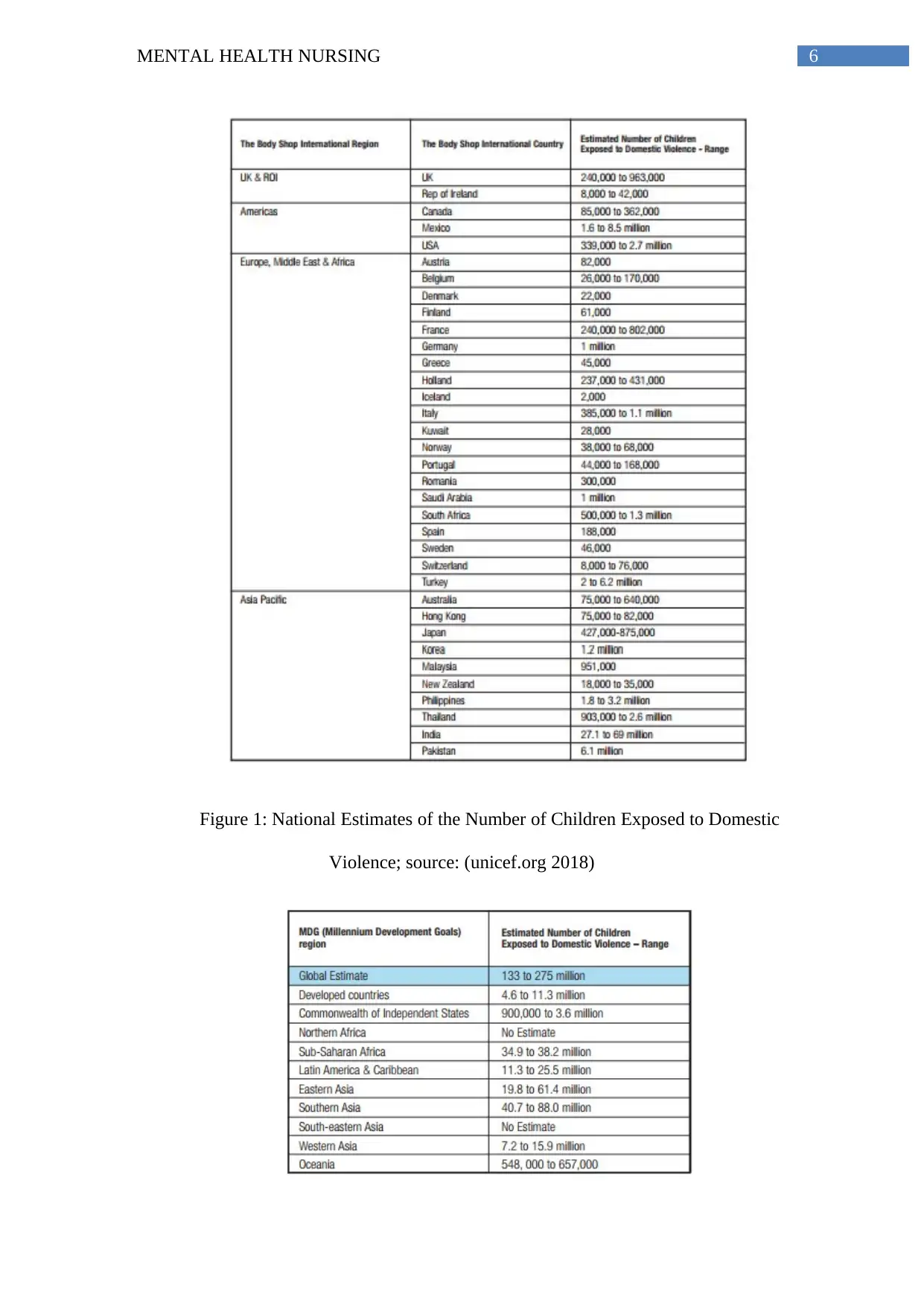
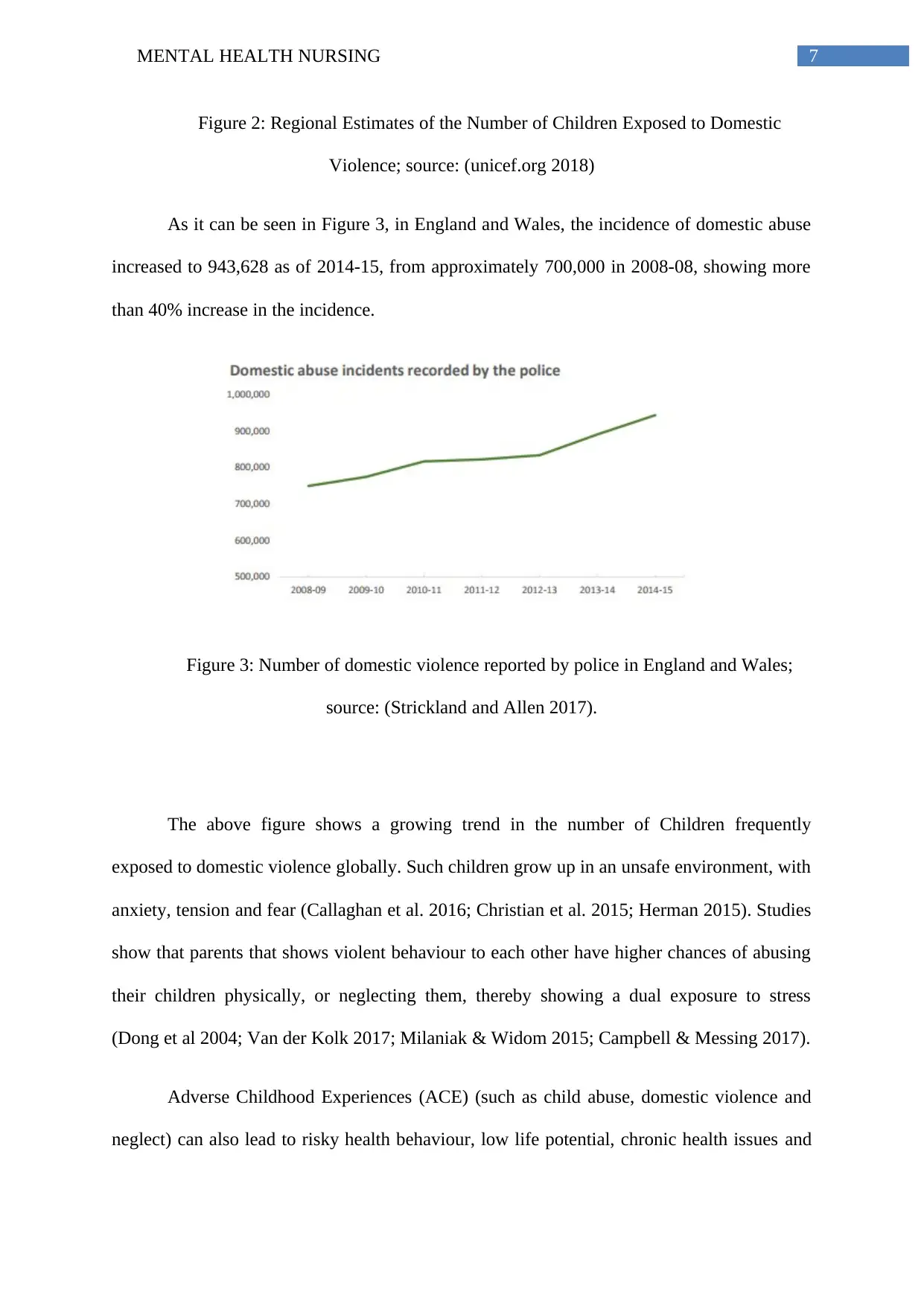
The tables below reports the number of children who are exposed to domestic
violence as of 2006, in countries where such reposts are available.
merits and demerits of each of the supportive findings in a similar structure. This was also a
significant weakness for the study. However, maximum effort has been focussed on
developing a balanced view on the issue of domestic abuse through the analysis of credible
and relevant literature.
Question context
-What are the effects of domestic violence on children’s mental health
According to Domestic Violence Roundtable, children in the age group of 3-17 years
are at the most risk of the adverse effects of domestic violence, and 95% of the incidents are
directed towards the women, as victims to their male partners, with the children often being
the witnesses of these acts (domesticviolenceroundtable.org 2018). Effects of domestic
violence on children includes: poor concentration, hyperactivity, aggression, disobedience,
sleeping disturbances, social withdrawal, and lack of emotion, pessimism, and physical
symptoms (Domesticviolence.com.au 2018; Van der Kolk 2017; Tsavoussis et al. 2014;
Herman 2015; Cook et al. 2017). Children exposed to domestic violence can develop learning
difficulties, have reduced social skills, violent and delinquent behaviour and can also suffer
from anxiety and depression (Cook et al. 2017; Thabet et al. 2015). The vulnerability is
particularly high in case of young children than older ones. Additionally, such children are at
a higher risk of being victims of abuse themselves, also the likelihood of the children
perpetuating the cycle of violence themselves to their next generations is very high apart from
the overall harm to their own wellbeing (unicef.org 2018; Cater & Øverlien, 2014; Milaniak
& Widom, 2015; Costa et al. 2015; Foshee et al. 2016; Iratzoqui et al. 2018; Völkl-Kernstock
et al. 2016)
The tables below reports the number of children who are exposed to domestic
violence as of 2006, in countries where such reposts are available.
⊘ This is a preview!⊘
Do you want full access?
Subscribe today to unlock all pages.
Trusted by 1+ million students worldwide
6MENTAL HEALTH NURSING
Figure 1: National Estimates of the Number of Children Exposed to Domestic
Violence; source: (unicef.org 2018)
Figure 1: National Estimates of the Number of Children Exposed to Domestic
Violence; source: (unicef.org 2018)
Paraphrase This Document
Need a fresh take? Get an instant paraphrase of this document with our AI Paraphraser
7MENTAL HEALTH NURSING
Figure 2: Regional Estimates of the Number of Children Exposed to Domestic
Violence; source: (unicef.org 2018)
As it can be seen in Figure 3, in England and Wales, the incidence of domestic abuse
increased to 943,628 as of 2014-15, from approximately 700,000 in 2008-08, showing more
than 40% increase in the incidence.
Figure 3: Number of domestic violence reported by police in England and Wales;
source: (Strickland and Allen 2017).
The above figure shows a growing trend in the number of Children frequently
exposed to domestic violence globally. Such children grow up in an unsafe environment, with
anxiety, tension and fear (Callaghan et al. 2016; Christian et al. 2015; Herman 2015). Studies
show that parents that shows violent behaviour to each other have higher chances of abusing
their children physically, or neglecting them, thereby showing a dual exposure to stress
(Dong et al 2004; Van der Kolk 2017; Milaniak & Widom 2015; Campbell & Messing 2017).
Adverse Childhood Experiences (ACE) (such as child abuse, domestic violence and
neglect) can also lead to risky health behaviour, low life potential, chronic health issues and
Figure 2: Regional Estimates of the Number of Children Exposed to Domestic
Violence; source: (unicef.org 2018)
As it can be seen in Figure 3, in England and Wales, the incidence of domestic abuse
increased to 943,628 as of 2014-15, from approximately 700,000 in 2008-08, showing more
than 40% increase in the incidence.
Figure 3: Number of domestic violence reported by police in England and Wales;
source: (Strickland and Allen 2017).
The above figure shows a growing trend in the number of Children frequently
exposed to domestic violence globally. Such children grow up in an unsafe environment, with
anxiety, tension and fear (Callaghan et al. 2016; Christian et al. 2015; Herman 2015). Studies
show that parents that shows violent behaviour to each other have higher chances of abusing
their children physically, or neglecting them, thereby showing a dual exposure to stress
(Dong et al 2004; Van der Kolk 2017; Milaniak & Widom 2015; Campbell & Messing 2017).
Adverse Childhood Experiences (ACE) (such as child abuse, domestic violence and
neglect) can also lead to risky health behaviour, low life potential, chronic health issues and
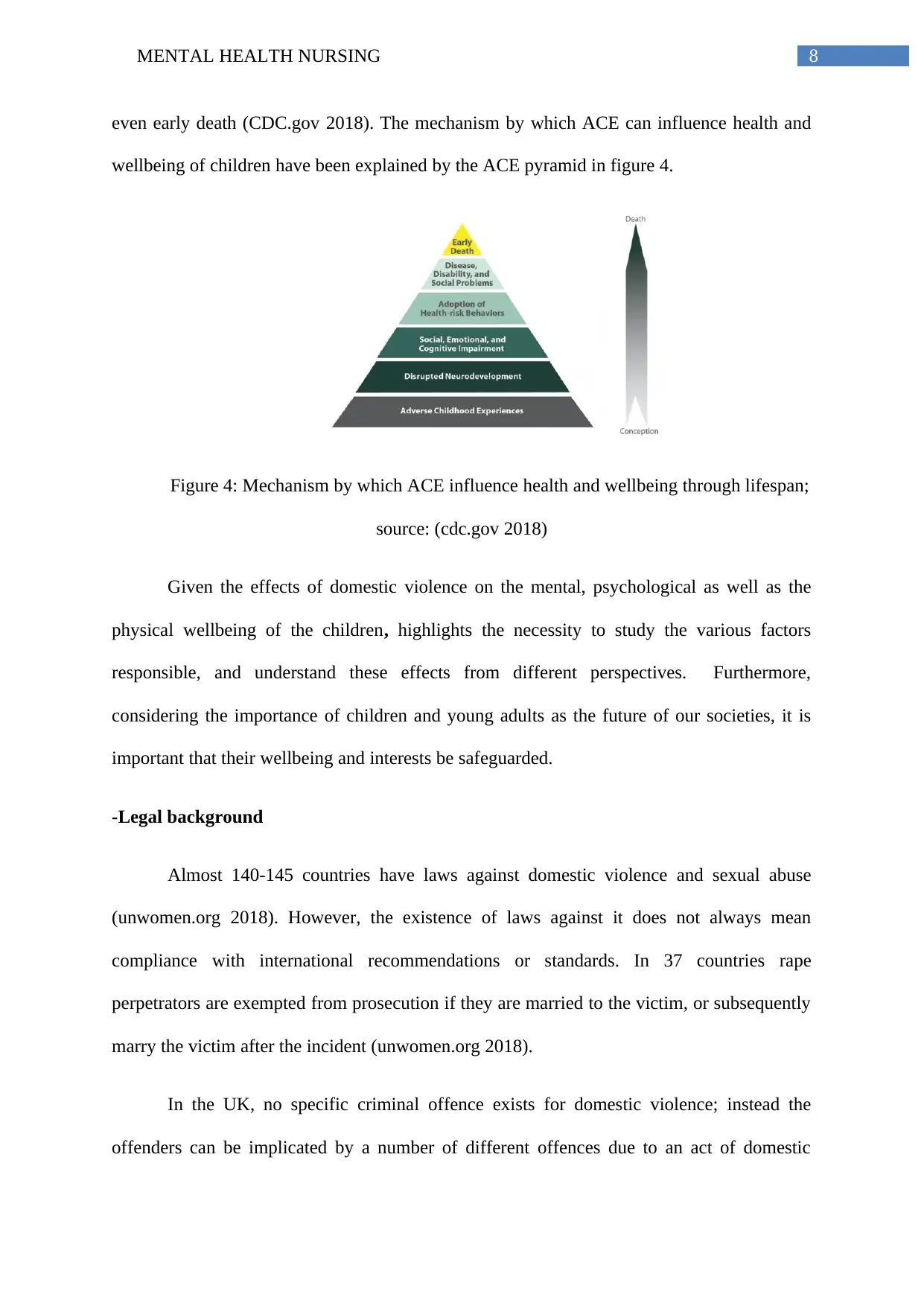
8MENTAL HEALTH NURSING
even early death (CDC.gov 2018). The mechanism by which ACE can influence health and
wellbeing of children have been explained by the ACE pyramid in figure 4.
Figure 4: Mechanism by which ACE influence health and wellbeing through lifespan;
source: (cdc.gov 2018)
Given the effects of domestic violence on the mental, psychological as well as the
physical wellbeing of the children, highlights the necessity to study the various factors
responsible, and understand these effects from different perspectives. Furthermore,
considering the importance of children and young adults as the future of our societies, it is
important that their wellbeing and interests be safeguarded.
-Legal background
Almost 140-145 countries have laws against domestic violence and sexual abuse
(unwomen.org 2018). However, the existence of laws against it does not always mean
compliance with international recommendations or standards. In 37 countries rape
perpetrators are exempted from prosecution if they are married to the victim, or subsequently
marry the victim after the incident (unwomen.org 2018).
In the UK, no specific criminal offence exists for domestic violence; instead the
offenders can be implicated by a number of different offences due to an act of domestic
even early death (CDC.gov 2018). The mechanism by which ACE can influence health and
wellbeing of children have been explained by the ACE pyramid in figure 4.
Figure 4: Mechanism by which ACE influence health and wellbeing through lifespan;
source: (cdc.gov 2018)
Given the effects of domestic violence on the mental, psychological as well as the
physical wellbeing of the children, highlights the necessity to study the various factors
responsible, and understand these effects from different perspectives. Furthermore,
considering the importance of children and young adults as the future of our societies, it is
important that their wellbeing and interests be safeguarded.
-Legal background
Almost 140-145 countries have laws against domestic violence and sexual abuse
(unwomen.org 2018). However, the existence of laws against it does not always mean
compliance with international recommendations or standards. In 37 countries rape
perpetrators are exempted from prosecution if they are married to the victim, or subsequently
marry the victim after the incident (unwomen.org 2018).
In the UK, no specific criminal offence exists for domestic violence; instead the
offenders can be implicated by a number of different offences due to an act of domestic
⊘ This is a preview!⊘
Do you want full access?
Subscribe today to unlock all pages.
Trusted by 1+ million students worldwide
9MENTAL HEALTH NURSING
violence (Strickland and Allen 2017). The criminal offence can range from rape, murder,
manslaughter as well as assault and threatening behaviour. For coercive and controlling
behaviour in an intimate or family relationship, an offender can be penalised under section 76
of Serious Crime Act 2015 (legislation.gov.uk 2018). Civil laws like Family Law Act 1996
and Domestic Violence Crime and Victims Act 2004 safeguards the victims from their abuser
through occupation orders (to exclude the abusers from home) and non-molestation orders
(preventing molestation of the victims). Further protection is also provided by the
Harassment Act 1997 that includes non-harassment and restraining orders (Strickland and
Allen 2017; legislation.gov.uk 2018).
-Theoretical Background
According to the World Health Organization, the interplay between different factors
that can lead to interpersonal violence can be explained through the ‘ecological framework
(who.int 2018). This model has been previously used to explain child abuse, youth violence,
intimate partner violence (IPV), cyber bullying and abuse of elderly (Merrin et al. 2018;
Akhter and Wilson 2016; Dishion 2014; Cross et al. 2015; Melchiorre et al. 2016; Labrum
and Solomon 2015; Sitnick et al. 2017). The model comprises of four nested circles, with the
innermost circle representing individual and biological history that affects the relationship,
the context of the violence forms the second circle, the formal or informal social structures in
which the relationship is embedded (like workplace, neighbourhood, social networks, friends
circle and peer groups) represents the third circle, and social and economic environment is
represented by the outermost circle (who.int 2018). This shows the different levels at which
domestic violence can have adverse effects on individuals.
violence (Strickland and Allen 2017). The criminal offence can range from rape, murder,
manslaughter as well as assault and threatening behaviour. For coercive and controlling
behaviour in an intimate or family relationship, an offender can be penalised under section 76
of Serious Crime Act 2015 (legislation.gov.uk 2018). Civil laws like Family Law Act 1996
and Domestic Violence Crime and Victims Act 2004 safeguards the victims from their abuser
through occupation orders (to exclude the abusers from home) and non-molestation orders
(preventing molestation of the victims). Further protection is also provided by the
Harassment Act 1997 that includes non-harassment and restraining orders (Strickland and
Allen 2017; legislation.gov.uk 2018).
-Theoretical Background
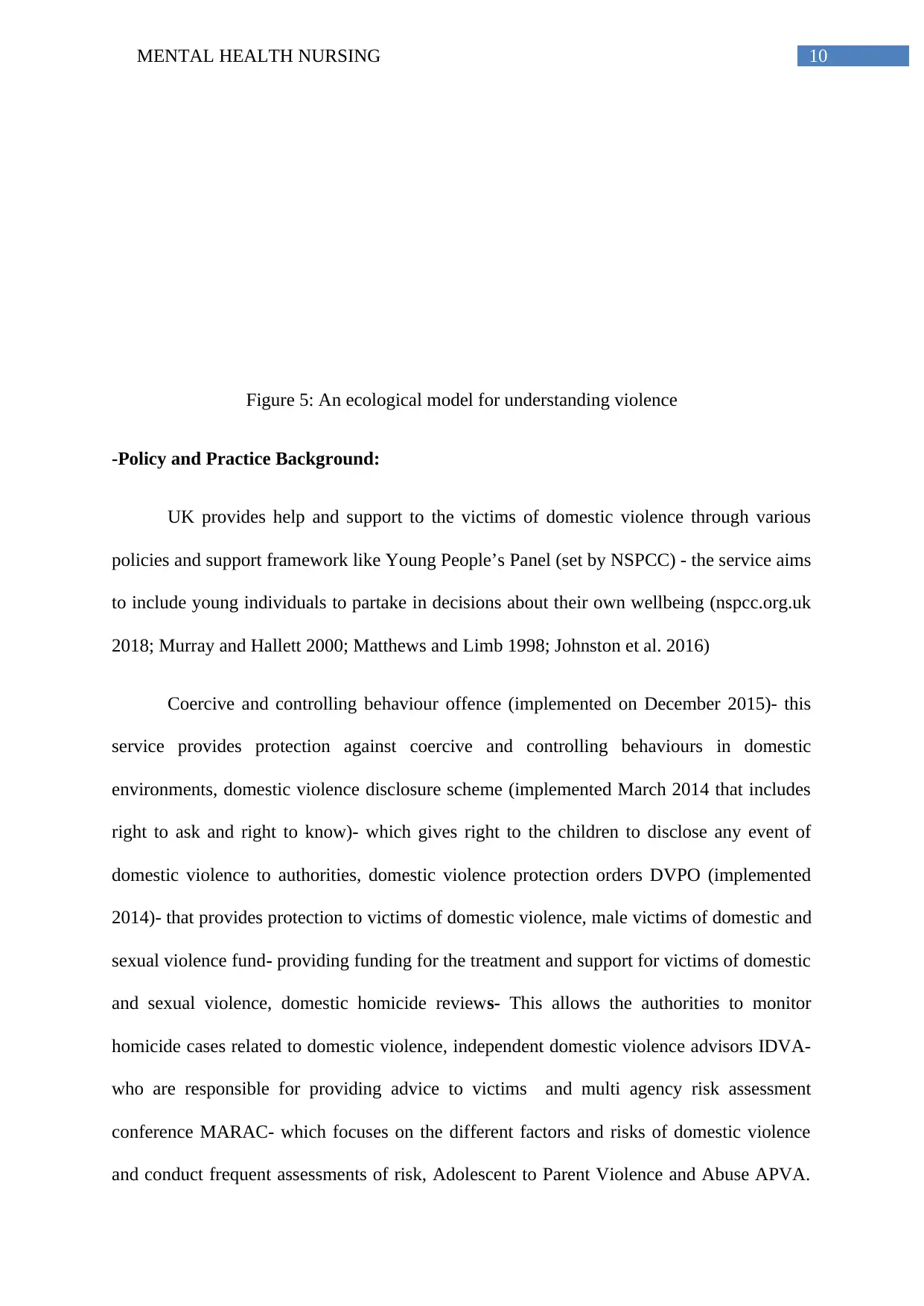
According to the World Health Organization, the interplay between different factors
that can lead to interpersonal violence can be explained through the ‘ecological framework
(who.int 2018). This model has been previously used to explain child abuse, youth violence,
intimate partner violence (IPV), cyber bullying and abuse of elderly (Merrin et al. 2018;
Akhter and Wilson 2016; Dishion 2014; Cross et al. 2015; Melchiorre et al. 2016; Labrum
and Solomon 2015; Sitnick et al. 2017). The model comprises of four nested circles, with the
innermost circle representing individual and biological history that affects the relationship,
the context of the violence forms the second circle, the formal or informal social structures in
which the relationship is embedded (like workplace, neighbourhood, social networks, friends
circle and peer groups) represents the third circle, and social and economic environment is
represented by the outermost circle (who.int 2018). This shows the different levels at which
domestic violence can have adverse effects on individuals.
Paraphrase This Document
Need a fresh take? Get an instant paraphrase of this document with our AI Paraphraser
10MENTAL HEALTH NURSING
Figure 5: An ecological model for understanding violence
-Policy and Practice Background:
UK provides help and support to the victims of domestic violence through various
policies and support framework like Young People’s Panel (set by NSPCC) - the service aims
to include young individuals to partake in decisions about their own wellbeing (nspcc.org.uk
2018; Murray and Hallett 2000; Matthews and Limb 1998; Johnston et al. 2016)
Coercive and controlling behaviour offence (implemented on December 2015)- this
service provides protection against coercive and controlling behaviours in domestic
environments, domestic violence disclosure scheme (implemented March 2014 that includes
right to ask and right to know)- which gives right to the children to disclose any event of
domestic violence to authorities, domestic violence protection orders DVPO (implemented
2014)- that provides protection to victims of domestic violence, male victims of domestic and
sexual violence fund- providing funding for the treatment and support for victims of domestic
and sexual violence, domestic homicide reviews- This allows the authorities to monitor
homicide cases related to domestic violence, independent domestic violence advisors IDVA-
who are responsible for providing advice to victims and multi agency risk assessment
conference MARAC- which focuses on the different factors and risks of domestic violence
and conduct frequent assessments of risk, Adolescent to Parent Violence and Abuse APVA.
SocietyCommunityIndividual
Figure 5: An ecological model for understanding violence
-Policy and Practice Background:
UK provides help and support to the victims of domestic violence through various
policies and support framework like Young People’s Panel (set by NSPCC) - the service aims
to include young individuals to partake in decisions about their own wellbeing (nspcc.org.uk
2018; Murray and Hallett 2000; Matthews and Limb 1998; Johnston et al. 2016)
Coercive and controlling behaviour offence (implemented on December 2015)- this
service provides protection against coercive and controlling behaviours in domestic
environments, domestic violence disclosure scheme (implemented March 2014 that includes
right to ask and right to know)- which gives right to the children to disclose any event of
domestic violence to authorities, domestic violence protection orders DVPO (implemented
2014)- that provides protection to victims of domestic violence, male victims of domestic and
sexual violence fund- providing funding for the treatment and support for victims of domestic
and sexual violence, domestic homicide reviews- This allows the authorities to monitor
homicide cases related to domestic violence, independent domestic violence advisors IDVA-
who are responsible for providing advice to victims and multi agency risk assessment
conference MARAC- which focuses on the different factors and risks of domestic violence
and conduct frequent assessments of risk, Adolescent to Parent Violence and Abuse APVA.
SocietyCommunityIndividual
11MENTAL HEALTH NURSING
Also, the provision of indefinite leave to remain (in UK permanently) for victims of domestic
violence provides them protection from domestic violence when their countries are not able
to do so. Each of these policies has been outlined by the UK Government website (gov.uk
2018).
Also, the provision of indefinite leave to remain (in UK permanently) for victims of domestic
violence provides them protection from domestic violence when their countries are not able
to do so. Each of these policies has been outlined by the UK Government website (gov.uk
2018).
⊘ This is a preview!⊘
Do you want full access?
Subscribe today to unlock all pages.
Trusted by 1+ million students worldwide

1 out of 47


Related Documents


Your All-in-One AI-Powered Toolkit for Academic Success.
+13062052269
info@desklib.com
Available 24*7 on WhatsApp / Email
![[object Object]](/_next/static/media/star-bottom.7253800d.svg)
Unlock your academic potential
Copyright © 2020–2026 A2Z Services. All Rights Reserved. Developed and managed by ZUCOL.