Dow Chemicals: Training and Leadership Development Case Study Analysis
VerifiedAdded on 2020/03/16
|9
|2230
|137
Case Study
AI Summary
This case study analyzes Dow Chemicals' approach to leadership development, focusing on its 'Leadership in Action' program. The analysis begins with a training needs assessment, highlighting the importance of hands-on experience and cultural context in employee development. The study then examines the strengths and weaknesses of Dow's leadership development strategy, which involves sending employees to unfamiliar environments. It further investigates the use of Kirkpatrick's four-level analysis to evaluate the program's effectiveness, assessing employee reactions, skill development, behavioral changes, and business performance outcomes. The case study also explores the impact of the program on employee skills and the challenges of knowledge sharing, while considering the program's advantages and disadvantages. The study emphasizes how the program helped employees develop consulting skills and work with humanitarian groups, while also acknowledging the program's limitations in terms of inclusivity and communication skill development. Finally, the study assesses the program’s effectiveness, highlighting how it can be measured by evaluating the program's impact on the business performance of Dow Chemicals and its employees.

Student’s Last Name 1
Case Study
By (Name)
Course
Professor
University
Date
Case Study
By (Name)
Course
Professor
University
Date
Paraphrase This Document
Need a fresh take? Get an instant paraphrase of this document with our AI Paraphraser

Student’s Last Name 2
Case Study Assignment
Question Three
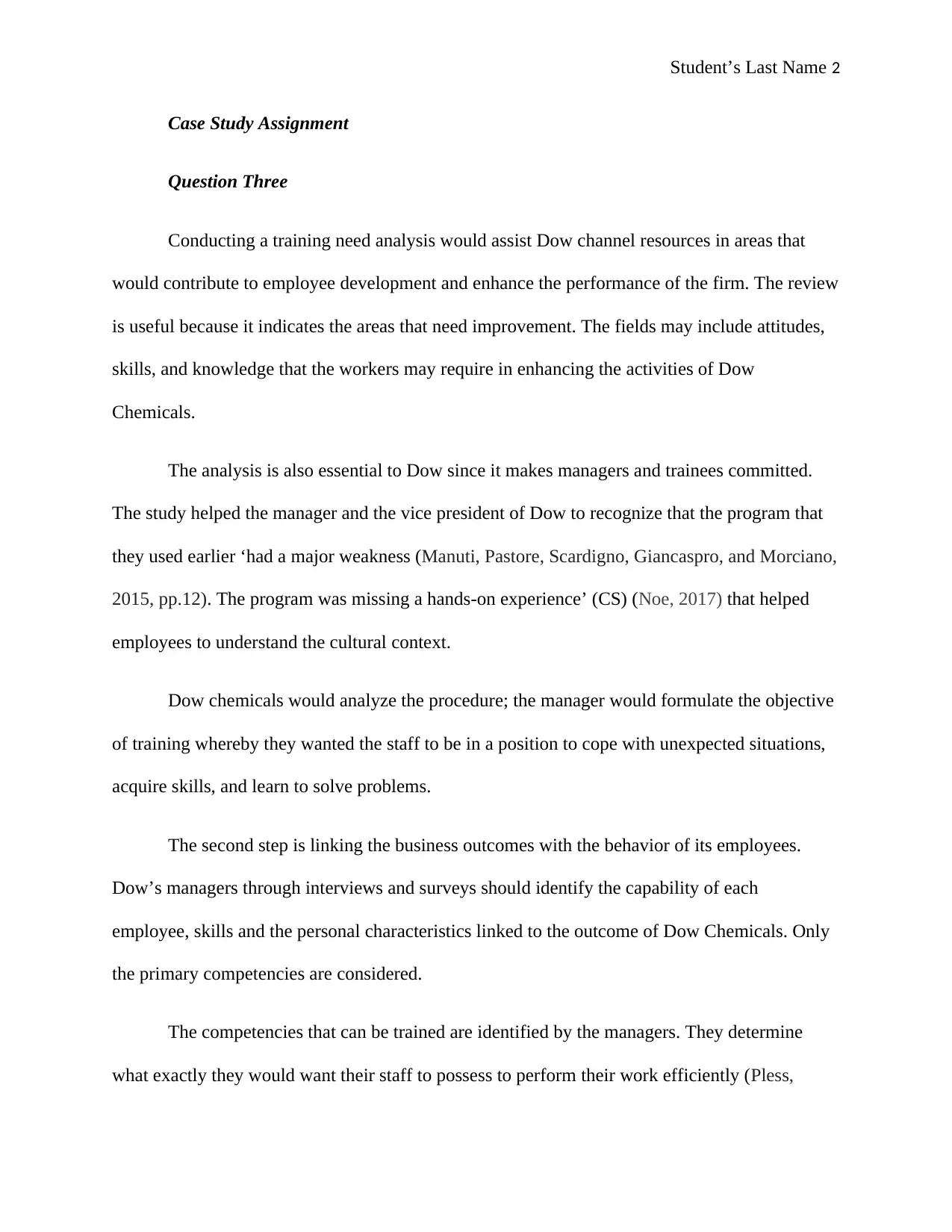
Conducting a training need analysis would assist Dow channel resources in areas that
would contribute to employee development and enhance the performance of the firm. The review
is useful because it indicates the areas that need improvement. The fields may include attitudes,
skills, and knowledge that the workers may require in enhancing the activities of Dow
Chemicals.
The analysis is also essential to Dow since it makes managers and trainees committed.
The study helped the manager and the vice president of Dow to recognize that the program that
they used earlier ‘had a major weakness (Manuti, Pastore, Scardigno, Giancaspro, and Morciano,
2015, pp.12). The program was missing a hands-on experience’ (CS) (Noe, 2017) that helped
employees to understand the cultural context.
Dow chemicals would analyze the procedure; the manager would formulate the objective
of training whereby they wanted the staff to be in a position to cope with unexpected situations,
acquire skills, and learn to solve problems.
The second step is linking the business outcomes with the behavior of its employees.
Dow’s managers through interviews and surveys should identify the capability of each
employee, skills and the personal characteristics linked to the outcome of Dow Chemicals. Only
the primary competencies are considered.
The competencies that can be trained are identified by the managers. They determine
what exactly they would want their staff to possess to perform their work efficiently (Pless,
Case Study Assignment
Question Three
Conducting a training need analysis would assist Dow channel resources in areas that
would contribute to employee development and enhance the performance of the firm. The review
is useful because it indicates the areas that need improvement. The fields may include attitudes,
skills, and knowledge that the workers may require in enhancing the activities of Dow
Chemicals.
The analysis is also essential to Dow since it makes managers and trainees committed.
The study helped the manager and the vice president of Dow to recognize that the program that
they used earlier ‘had a major weakness (Manuti, Pastore, Scardigno, Giancaspro, and Morciano,
2015, pp.12). The program was missing a hands-on experience’ (CS) (Noe, 2017) that helped
employees to understand the cultural context.
Dow chemicals would analyze the procedure; the manager would formulate the objective
of training whereby they wanted the staff to be in a position to cope with unexpected situations,
acquire skills, and learn to solve problems.
The second step is linking the business outcomes with the behavior of its employees.
Dow’s managers through interviews and surveys should identify the capability of each
employee, skills and the personal characteristics linked to the outcome of Dow Chemicals. Only
the primary competencies are considered.
The competencies that can be trained are identified by the managers. They determine
what exactly they would want their staff to possess to perform their work efficiently (Pless,

Student’s Last Name 3
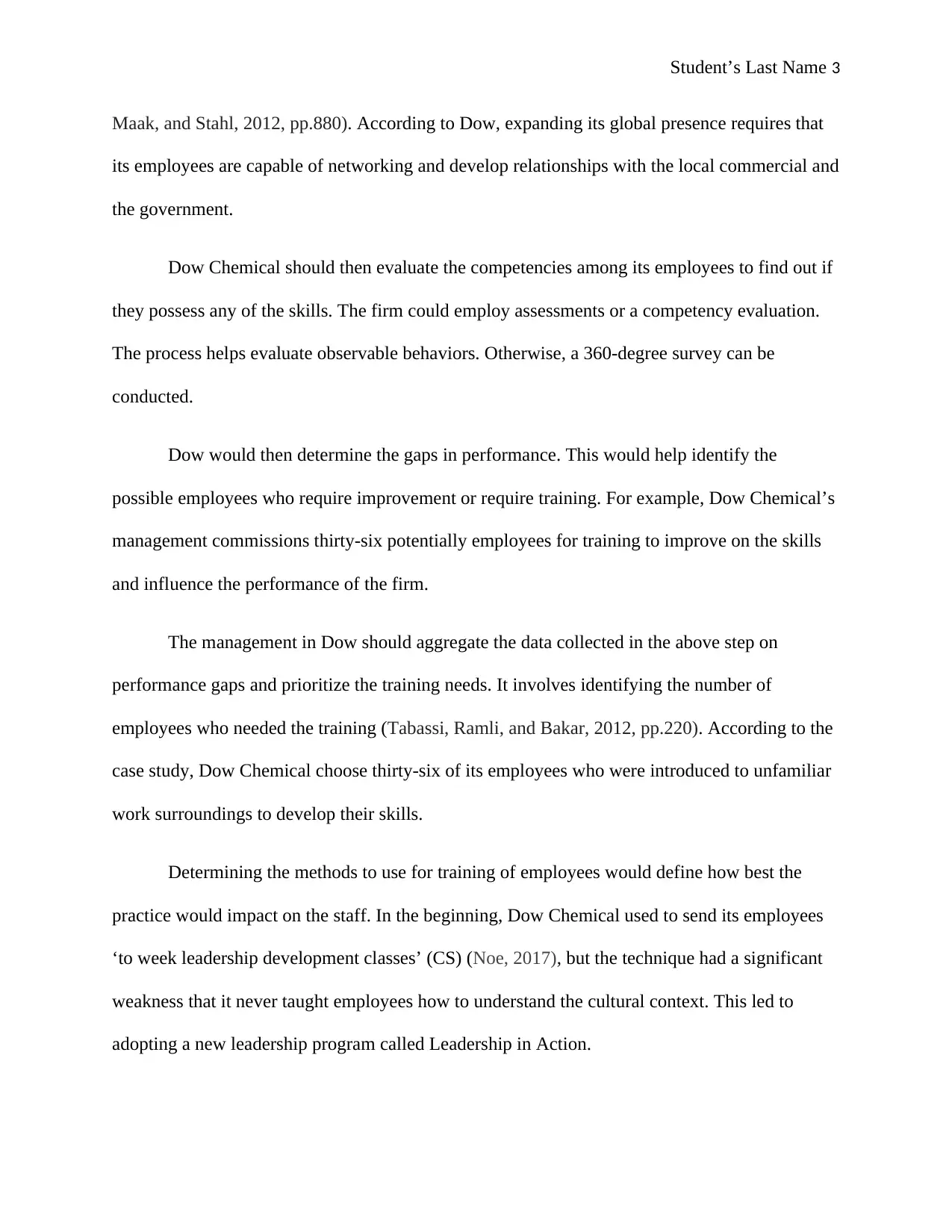
Maak, and Stahl, 2012, pp.880). According to Dow, expanding its global presence requires that
its employees are capable of networking and develop relationships with the local commercial and
the government.
Dow Chemical should then evaluate the competencies among its employees to find out if
they possess any of the skills. The firm could employ assessments or a competency evaluation.
The process helps evaluate observable behaviors. Otherwise, a 360-degree survey can be
conducted.
Dow would then determine the gaps in performance. This would help identify the
possible employees who require improvement or require training. For example, Dow Chemical’s
management commissions thirty-six potentially employees for training to improve on the skills
and influence the performance of the firm.
The management in Dow should aggregate the data collected in the above step on
performance gaps and prioritize the training needs. It involves identifying the number of
employees who needed the training (Tabassi, Ramli, and Bakar, 2012, pp.220). According to the
case study, Dow Chemical choose thirty-six of its employees who were introduced to unfamiliar
work surroundings to develop their skills.
Determining the methods to use for training of employees would define how best the
practice would impact on the staff. In the beginning, Dow Chemical used to send its employees
‘to week leadership development classes’ (CS) (Noe, 2017), but the technique had a significant
weakness that it never taught employees how to understand the cultural context. This led to
adopting a new leadership program called Leadership in Action.
Maak, and Stahl, 2012, pp.880). According to Dow, expanding its global presence requires that
its employees are capable of networking and develop relationships with the local commercial and
the government.
Dow Chemical should then evaluate the competencies among its employees to find out if
they possess any of the skills. The firm could employ assessments or a competency evaluation.
The process helps evaluate observable behaviors. Otherwise, a 360-degree survey can be
conducted.
Dow would then determine the gaps in performance. This would help identify the
possible employees who require improvement or require training. For example, Dow Chemical’s
management commissions thirty-six potentially employees for training to improve on the skills
and influence the performance of the firm.
The management in Dow should aggregate the data collected in the above step on
performance gaps and prioritize the training needs. It involves identifying the number of
employees who needed the training (Tabassi, Ramli, and Bakar, 2012, pp.220). According to the
case study, Dow Chemical choose thirty-six of its employees who were introduced to unfamiliar
work surroundings to develop their skills.
Determining the methods to use for training of employees would define how best the
practice would impact on the staff. In the beginning, Dow Chemical used to send its employees
‘to week leadership development classes’ (CS) (Noe, 2017), but the technique had a significant
weakness that it never taught employees how to understand the cultural context. This led to
adopting a new leadership program called Leadership in Action.
⊘ This is a preview!⊘
Do you want full access?
Subscribe today to unlock all pages.

Trusted by 1+ million students worldwide

Student’s Last Name 4
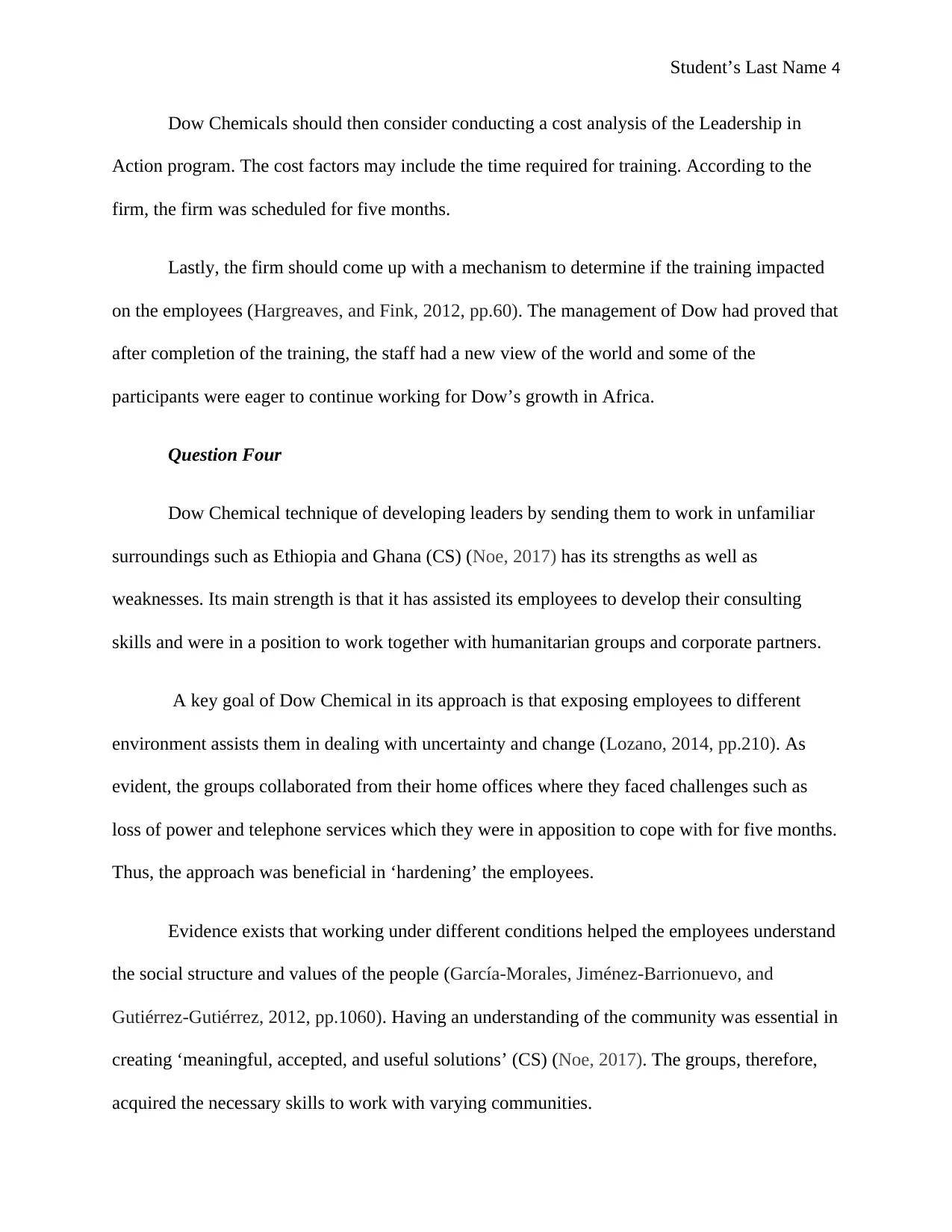
Dow Chemicals should then consider conducting a cost analysis of the Leadership in
Action program. The cost factors may include the time required for training. According to the
firm, the firm was scheduled for five months.
Lastly, the firm should come up with a mechanism to determine if the training impacted
on the employees (Hargreaves, and Fink, 2012, pp.60). The management of Dow had proved that
after completion of the training, the staff had a new view of the world and some of the
participants were eager to continue working for Dow’s growth in Africa.
Question Four
Dow Chemical technique of developing leaders by sending them to work in unfamiliar
surroundings such as Ethiopia and Ghana (CS) (Noe, 2017) has its strengths as well as
weaknesses. Its main strength is that it has assisted its employees to develop their consulting
skills and were in a position to work together with humanitarian groups and corporate partners.
A key goal of Dow Chemical in its approach is that exposing employees to different
environment assists them in dealing with uncertainty and change (Lozano, 2014, pp.210). As
evident, the groups collaborated from their home offices where they faced challenges such as
loss of power and telephone services which they were in apposition to cope with for five months.
Thus, the approach was beneficial in ‘hardening’ the employees.
Evidence exists that working under different conditions helped the employees understand
the social structure and values of the people (García-Morales, Jiménez-Barrionuevo, and
Gutiérrez-Gutiérrez, 2012, pp.1060). Having an understanding of the community was essential in
creating ‘meaningful, accepted, and useful solutions’ (CS) (Noe, 2017). The groups, therefore,
acquired the necessary skills to work with varying communities.
Dow Chemicals should then consider conducting a cost analysis of the Leadership in
Action program. The cost factors may include the time required for training. According to the
firm, the firm was scheduled for five months.
Lastly, the firm should come up with a mechanism to determine if the training impacted
on the employees (Hargreaves, and Fink, 2012, pp.60). The management of Dow had proved that
after completion of the training, the staff had a new view of the world and some of the
participants were eager to continue working for Dow’s growth in Africa.
Question Four
Dow Chemical technique of developing leaders by sending them to work in unfamiliar
surroundings such as Ethiopia and Ghana (CS) (Noe, 2017) has its strengths as well as
weaknesses. Its main strength is that it has assisted its employees to develop their consulting
skills and were in a position to work together with humanitarian groups and corporate partners.
A key goal of Dow Chemical in its approach is that exposing employees to different
environment assists them in dealing with uncertainty and change (Lozano, 2014, pp.210). As
evident, the groups collaborated from their home offices where they faced challenges such as
loss of power and telephone services which they were in apposition to cope with for five months.
Thus, the approach was beneficial in ‘hardening’ the employees.
Evidence exists that working under different conditions helped the employees understand
the social structure and values of the people (García-Morales, Jiménez-Barrionuevo, and
Gutiérrez-Gutiérrez, 2012, pp.1060). Having an understanding of the community was essential in
creating ‘meaningful, accepted, and useful solutions’ (CS) (Noe, 2017). The groups, therefore,
acquired the necessary skills to work with varying communities.
Paraphrase This Document
Need a fresh take? Get an instant paraphrase of this document with our AI Paraphraser

Student’s Last Name 5
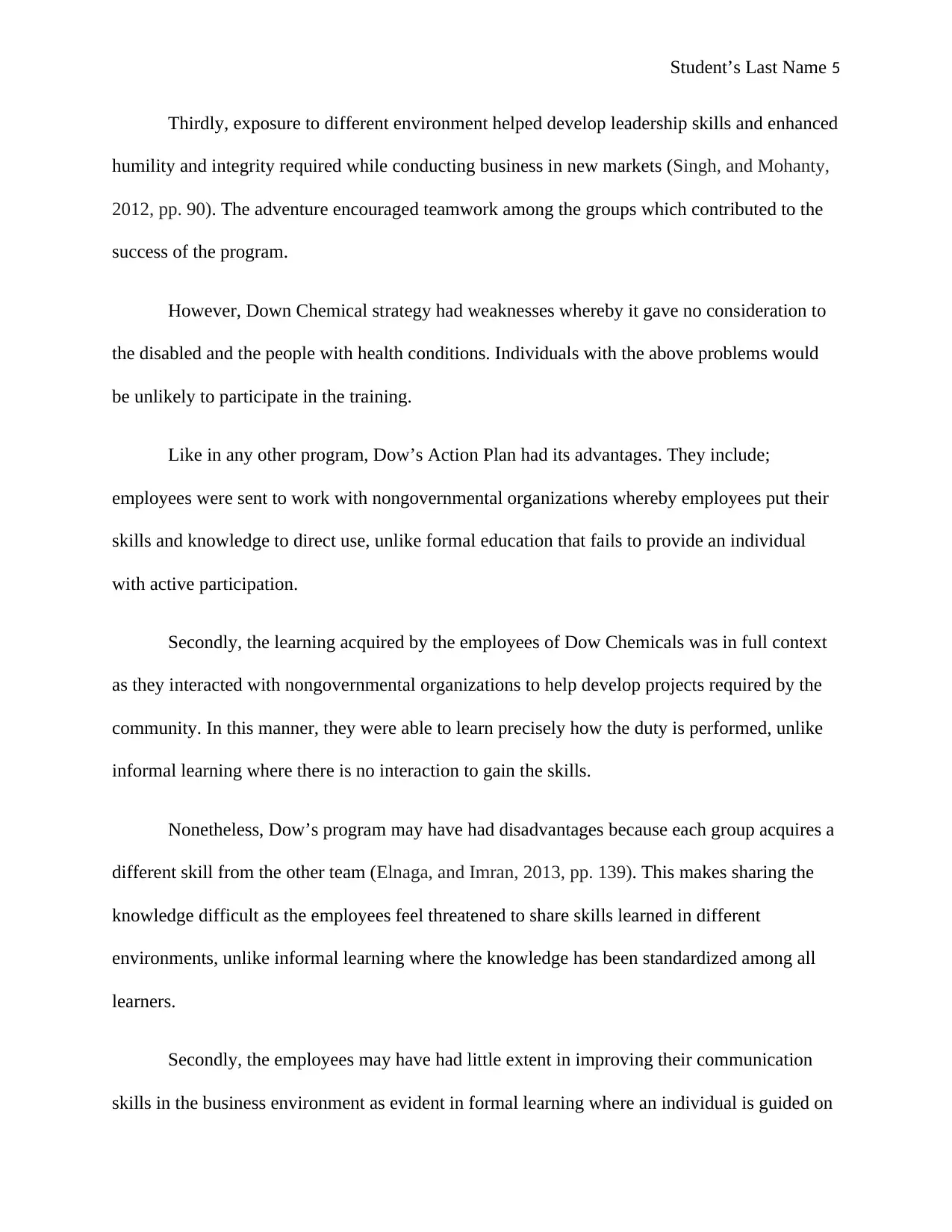
Thirdly, exposure to different environment helped develop leadership skills and enhanced
humility and integrity required while conducting business in new markets (Singh, and Mohanty,
2012, pp. 90). The adventure encouraged teamwork among the groups which contributed to the
success of the program.
However, Down Chemical strategy had weaknesses whereby it gave no consideration to
the disabled and the people with health conditions. Individuals with the above problems would
be unlikely to participate in the training.
Like in any other program, Dow’s Action Plan had its advantages. They include;
employees were sent to work with nongovernmental organizations whereby employees put their
skills and knowledge to direct use, unlike formal education that fails to provide an individual
with active participation.
Secondly, the learning acquired by the employees of Dow Chemicals was in full context
as they interacted with nongovernmental organizations to help develop projects required by the
community. In this manner, they were able to learn precisely how the duty is performed, unlike
informal learning where there is no interaction to gain the skills.
Nonetheless, Dow’s program may have had disadvantages because each group acquires a
different skill from the other team (Elnaga, and Imran, 2013, pp. 139). This makes sharing the
knowledge difficult as the employees feel threatened to share skills learned in different
environments, unlike informal learning where the knowledge has been standardized among all
learners.
Secondly, the employees may have had little extent in improving their communication
skills in the business environment as evident in formal learning where an individual is guided on
Thirdly, exposure to different environment helped develop leadership skills and enhanced
humility and integrity required while conducting business in new markets (Singh, and Mohanty,
2012, pp. 90). The adventure encouraged teamwork among the groups which contributed to the
success of the program.
However, Down Chemical strategy had weaknesses whereby it gave no consideration to
the disabled and the people with health conditions. Individuals with the above problems would
be unlikely to participate in the training.
Like in any other program, Dow’s Action Plan had its advantages. They include;
employees were sent to work with nongovernmental organizations whereby employees put their
skills and knowledge to direct use, unlike formal education that fails to provide an individual
with active participation.
Secondly, the learning acquired by the employees of Dow Chemicals was in full context
as they interacted with nongovernmental organizations to help develop projects required by the
community. In this manner, they were able to learn precisely how the duty is performed, unlike
informal learning where there is no interaction to gain the skills.
Nonetheless, Dow’s program may have had disadvantages because each group acquires a
different skill from the other team (Elnaga, and Imran, 2013, pp. 139). This makes sharing the
knowledge difficult as the employees feel threatened to share skills learned in different
environments, unlike informal learning where the knowledge has been standardized among all
learners.
Secondly, the employees may have had little extent in improving their communication
skills in the business environment as evident in formal learning where an individual is guided on

Student’s Last Name 6
writing and presentation skills. The employees were busy involved in developing their skills in
the new environment but had no one to guide them in developing their communication skills.
Question Five
In determining whether Leadership in Action program had any efficient consequences for
Dow Chemicals, the use of Kirkpatrick’s four-level analysis would be considered. Each of the
four levels indicates a precise level of effectiveness of the Leadership in Action program.
Metrics to be collected include the reaction of the participants, conduct a pre- and post-test after
training, assess the behavior change, and the feedback from the practice.
According to the model, assessing the reactions of the employees of Dow Chemical is the
first level. Here, a survey is conducted to find out the take of the employees regarding the
program (Tahir, Yousafzai, Jan, and Hashim, 2014, pp. 86). It can be in the form of a
questionnaire where questions such as; were the experience of any importance to their work? Are
asked. Verbal reaction from employees can also be used. Reflecting on the responses, if the
employees indicate a positive response, to some level, indicate that the program had an impact
on them. At the end of the program, ‘almost all participants wanted to continue to be involved in
some way working on Dow’s growth in Africa’ (CS) (Noe, 2017).
Conducting a pre- and post-test is the second level of Kirkpatrick’s model. It tries to find
out the degree that the employees of Dow Chemicals have advanced their skills, changed their
attitude, and knowledge as a result of the training. The test is conducted before the employees are
deployed to the different working environment and after the training, to ascertain the learning
that has occurred.
writing and presentation skills. The employees were busy involved in developing their skills in
the new environment but had no one to guide them in developing their communication skills.
Question Five
In determining whether Leadership in Action program had any efficient consequences for
Dow Chemicals, the use of Kirkpatrick’s four-level analysis would be considered. Each of the
four levels indicates a precise level of effectiveness of the Leadership in Action program.
Metrics to be collected include the reaction of the participants, conduct a pre- and post-test after
training, assess the behavior change, and the feedback from the practice.
According to the model, assessing the reactions of the employees of Dow Chemical is the
first level. Here, a survey is conducted to find out the take of the employees regarding the
program (Tahir, Yousafzai, Jan, and Hashim, 2014, pp. 86). It can be in the form of a
questionnaire where questions such as; were the experience of any importance to their work? Are
asked. Verbal reaction from employees can also be used. Reflecting on the responses, if the
employees indicate a positive response, to some level, indicate that the program had an impact
on them. At the end of the program, ‘almost all participants wanted to continue to be involved in
some way working on Dow’s growth in Africa’ (CS) (Noe, 2017).
Conducting a pre- and post-test is the second level of Kirkpatrick’s model. It tries to find
out the degree that the employees of Dow Chemicals have advanced their skills, changed their
attitude, and knowledge as a result of the training. The test is conducted before the employees are
deployed to the different working environment and after the training, to ascertain the learning
that has occurred.
⊘ This is a preview!⊘
Do you want full access?
Subscribe today to unlock all pages.

Trusted by 1+ million students worldwide

Student’s Last Name 7
The third stage involves identifying behavioral change, i.e., how the employees apply the
learned skills and knowledge in their workplace (Pless, and Borecká, 2014, pp. 526). This
assessment tries to answer few questions; are the newly acquired skills and knowledge being
used in the environment of the employee? Despite this level being the most challenging level as
it is not possible to measure the change in behavior, it is the most crucial level of assessing the
effectiveness of a program. Dow’s manager and vice president want the employees “to focus on
understanding social structures and values of the communities” (CS) (Noe, 2017). These are
among the reasons that would lead to behavioral change among the employees. The process is
conducted through close monitoring of the Dow’s employees, through observations, or
conducting interviews with the participants.
The fourth stage involves evaluating training from the results of the business
performance. This could be measured by measuring the rate of return of the Dow’s employees
who were involved in the preparation and those not included in the training (Amitabh, and Sinha,
2012, pp. 212). The data can then be evaluated to find out which among the employees had an
enormous impact on the performance and daily returns of Dow Chemicals.
The third stage involves identifying behavioral change, i.e., how the employees apply the
learned skills and knowledge in their workplace (Pless, and Borecká, 2014, pp. 526). This
assessment tries to answer few questions; are the newly acquired skills and knowledge being
used in the environment of the employee? Despite this level being the most challenging level as
it is not possible to measure the change in behavior, it is the most crucial level of assessing the
effectiveness of a program. Dow’s manager and vice president want the employees “to focus on
understanding social structures and values of the communities” (CS) (Noe, 2017). These are
among the reasons that would lead to behavioral change among the employees. The process is
conducted through close monitoring of the Dow’s employees, through observations, or
conducting interviews with the participants.
The fourth stage involves evaluating training from the results of the business
performance. This could be measured by measuring the rate of return of the Dow’s employees
who were involved in the preparation and those not included in the training (Amitabh, and Sinha,
2012, pp. 212). The data can then be evaluated to find out which among the employees had an
enormous impact on the performance and daily returns of Dow Chemicals.
Paraphrase This Document
Need a fresh take? Get an instant paraphrase of this document with our AI Paraphraser

Student’s Last Name 8
Bibliography
Amitabh, A. and Sinha, S., 2012. The Learning Continuum Formal and Informal Learning
Experiences-Enabling Learning and Creation of New Knowledge in an
Organization. International Journal of Advanced Corporate Learning, 5(2).
Elnaga, A. and Imran, A., 2013. The effect of training on employee performance. European
Journal of Business and Management, 5(4), pp.137-147.
García-Morales, V.J., Jiménez-Barrionuevo, M.M. and Gutiérrez-Gutiérrez, L., 2012.
Transformational leadership influence on organizational performance through organizational
learning and innovation. Journal of business research, 65(7), pp.1040-1050.
Hargreaves, A. and Fink, D., 2012. Sustainable leadership (Vol. 6). John Wiley & Sons.
Lozano, R., 2014. Creativity and organizational learning as means to foster
sustainability. Sustainable development, 22(3), pp.205-216.
Manuti, A., Pastore, S., Scardigno, A.F., Giancaspro, M.L. and Morciano, D., 2015. Formal and
informal learning in the workplace: a research review. International Journal of Training and
Development, 19(1), pp.1-17.
Noe, RA 2017, Employee training & development, 7th edn, Irwin McGraw-Hill, New York, NY.
(Chapter 2).
Pless, N.M. and Borecká, M., 2014. Comparative analysis of International Service Learning
Programs. Journal of Management Development, 33(6), pp.526-550.
Bibliography
Amitabh, A. and Sinha, S., 2012. The Learning Continuum Formal and Informal Learning
Experiences-Enabling Learning and Creation of New Knowledge in an
Organization. International Journal of Advanced Corporate Learning, 5(2).
Elnaga, A. and Imran, A., 2013. The effect of training on employee performance. European
Journal of Business and Management, 5(4), pp.137-147.
García-Morales, V.J., Jiménez-Barrionuevo, M.M. and Gutiérrez-Gutiérrez, L., 2012.
Transformational leadership influence on organizational performance through organizational
learning and innovation. Journal of business research, 65(7), pp.1040-1050.
Hargreaves, A. and Fink, D., 2012. Sustainable leadership (Vol. 6). John Wiley & Sons.
Lozano, R., 2014. Creativity and organizational learning as means to foster
sustainability. Sustainable development, 22(3), pp.205-216.
Manuti, A., Pastore, S., Scardigno, A.F., Giancaspro, M.L. and Morciano, D., 2015. Formal and
informal learning in the workplace: a research review. International Journal of Training and
Development, 19(1), pp.1-17.
Noe, RA 2017, Employee training & development, 7th edn, Irwin McGraw-Hill, New York, NY.
(Chapter 2).
Pless, N.M. and Borecká, M., 2014. Comparative analysis of International Service Learning
Programs. Journal of Management Development, 33(6), pp.526-550.

Student’s Last Name 9
Pless, N.M., Maak, T. and Stahl, G.K., 2012. Promoting corporate social responsibility and
sustainable development through management development: What can be learned from
international service learning programs?. Human Resource Management, 51(6), pp.873-903.
Singh, R. and Mohanty, M., 2012. Impact of training practices on employee productivity: A
comparative study. Interscience Management Review, 2(2), pp.87-92.
Tabassi, A.A., Ramli, M. and Bakar, A.H.A., 2012. Effects of training and motivation practices
on teamwork improvement and task efficiency: The case of construction firms. International
Journal of Project Management, 30(2), pp.213-224.
Tahir, N., Yousafzai, I.K., Jan, S. and Hashim, M., 2014. The Impact of Training and
Development on Employees Performance and Productivity A case study of United Bank Limited
Peshawar City, KPK, Pakistan. International Journal of Academic Research in Business and
Social Sciences, 4(4), p.86.
Pless, N.M., Maak, T. and Stahl, G.K., 2012. Promoting corporate social responsibility and
sustainable development through management development: What can be learned from
international service learning programs?. Human Resource Management, 51(6), pp.873-903.
Singh, R. and Mohanty, M., 2012. Impact of training practices on employee productivity: A
comparative study. Interscience Management Review, 2(2), pp.87-92.
Tabassi, A.A., Ramli, M. and Bakar, A.H.A., 2012. Effects of training and motivation practices
on teamwork improvement and task efficiency: The case of construction firms. International
Journal of Project Management, 30(2), pp.213-224.
Tahir, N., Yousafzai, I.K., Jan, S. and Hashim, M., 2014. The Impact of Training and
Development on Employees Performance and Productivity A case study of United Bank Limited
Peshawar City, KPK, Pakistan. International Journal of Academic Research in Business and
Social Sciences, 4(4), p.86.
⊘ This is a preview!⊘
Do you want full access?
Subscribe today to unlock all pages.

Trusted by 1+ million students worldwide
1 out of 9
Related Documents
Your All-in-One AI-Powered Toolkit for Academic Success.
+13062052269
info@desklib.com
Available 24*7 on WhatsApp / Email
Unlock your academic potential
Copyright © 2020–2025 A2Z Services. All Rights Reserved. Developed and managed by ZUCOL.