KSAU-HS PPHI 512: Down Syndrome Epidemiology Review in Arab World
VerifiedAdded on 2023/06/15
|24
|6342
|214
Report
AI Summary
This report reviews the epidemiology of Down syndrome in the Arab world, highlighting its prevalence, causes, and associated risk factors. It begins with an abstract that summarizes the key findings, followed by a background section that introduces Down syndrome, its types (trisomy 21, mosaicism, and translocation), and its global distribution. The report emphasizes the higher incidence rates in Arab countries compared to global figures, attributing this to factors such as consanguineous marriages, increased maternal age, and limited prenatal detection. It also addresses the social attitudes towards individuals with Down syndrome, noting a lack of awareness and potential for discriminatory behavior. The review aims to provide significant evidence from literature searches conducted through PubMed and other journals, focusing on studies within Saudi Arabia, Gulf countries, and the broader Arab world. The report further discusses the aims of the review, the methods used for article selection, and presents results summarizing individual articles with concise critiques. Ultimately, the review underscores the importance of understanding and addressing Down syndrome in the Arab context to improve the quality of life for affected individuals and their families.

1
DOWN SYNDROME
DOWN SYNDROME

Paraphrase This Document
Need a fresh take? Get an instant paraphrase of this document with our AI Paraphraser
2
Abstract
Down syndrome, also known as ‘trisomy 21’ is a most common genetic problem happens before
birth. One out of every 800 births are affected by this chromosomal anomaly. The abnormal
count of chromosomes in the cell is the genetic reason of down syndrome. Incorrect number of
chromosomes in the cell is generally associated with the errors in chromosome distribution
between the dividing cells during egg formation. Down syndrome affects the development of the
body and brain. One can see a huge variation in mental abilities, behavior and the physical
development of an individual with down syndrome. The range of intellectual disability may also
vary from mild to severe. Symptoms of this disorder are easily recognizable such as the eye
corners started displaying oblique eye fissures, having a flat nasal bridge, short neck and small
head, short and low set ears, broad feet with short toes etc. The physical and mental development
of the people with down syndrome is comparatively slow as compared to others and have distinct
physical appearance and they also face health issues at frequent intervals. The risk of having a
baby with this disorder increase with the maternal age, for instance the risk is 1:1000 at the age
of 30, while at the age of 35 the risk is 1:400. The thinking ability of the people with down
syndrome also declines with age. There is also a risk of developing Alzheimer disease (a brain
disorder), which finally leads to loss of memory (National institute of health). This disorder is
most commonly found in Arab countries like UAE, Egypt, Kuwait and Oman. According to a
research published in CTGA entry, six Arab countries (Dubai, Oman, Qatar, Saudi Arabia,
Kuwait, Israel) have higher incidence of down syndrome than any other international figures
(The centre for Arab genomic studies). The Down syndrome is the most common genetic
disorder found in Arab countries and has a notable scientific attention. Down syndrome
complications in Arab countries include acute leukemia, congenital heart disease and impairment
Abstract
Down syndrome, also known as ‘trisomy 21’ is a most common genetic problem happens before
birth. One out of every 800 births are affected by this chromosomal anomaly. The abnormal
count of chromosomes in the cell is the genetic reason of down syndrome. Incorrect number of
chromosomes in the cell is generally associated with the errors in chromosome distribution
between the dividing cells during egg formation. Down syndrome affects the development of the
body and brain. One can see a huge variation in mental abilities, behavior and the physical
development of an individual with down syndrome. The range of intellectual disability may also
vary from mild to severe. Symptoms of this disorder are easily recognizable such as the eye
corners started displaying oblique eye fissures, having a flat nasal bridge, short neck and small
head, short and low set ears, broad feet with short toes etc. The physical and mental development
of the people with down syndrome is comparatively slow as compared to others and have distinct
physical appearance and they also face health issues at frequent intervals. The risk of having a
baby with this disorder increase with the maternal age, for instance the risk is 1:1000 at the age
of 30, while at the age of 35 the risk is 1:400. The thinking ability of the people with down
syndrome also declines with age. There is also a risk of developing Alzheimer disease (a brain
disorder), which finally leads to loss of memory (National institute of health). This disorder is
most commonly found in Arab countries like UAE, Egypt, Kuwait and Oman. According to a
research published in CTGA entry, six Arab countries (Dubai, Oman, Qatar, Saudi Arabia,
Kuwait, Israel) have higher incidence of down syndrome than any other international figures
(The centre for Arab genomic studies). The Down syndrome is the most common genetic
disorder found in Arab countries and has a notable scientific attention. Down syndrome
complications in Arab countries include acute leukemia, congenital heart disease and impairment

3
of cellular immune responses. This paper mainly discusses about the prevalence and effects of
the down syndrome in Arab countries and their treatment.
of cellular immune responses. This paper mainly discusses about the prevalence and effects of
the down syndrome in Arab countries and their treatment.
⊘ This is a preview!⊘
Do you want full access?
Subscribe today to unlock all pages.

Trusted by 1+ million students worldwide
4
Background
What is Down Syndrome?
Down syndrome is a chromosomal disorder caused due to the abnormal division of cells which
leads to an extra full or partial copy of chromosome 21 (Sherman et al, 2007). ‘Jerome Lejeune’,
a French physician, developed the cause of down syndrome in 1959 (National Down Syndrome
Society). In case of down syndrome, the count of chromosomes is 47 instead of 46 (half
chromosomes comes from the mother and half from the father i.e. 23 from each). So this is due
to having one extra chromosome number 21 in addition to the already existing normal pair. This
type of down syndrome is called trisomy 21 which accounts for 95% of the down syndrome
cases (Spencer, 2014). According to researchers the extra copy of chromosome 21 affects the
normal course of development of an individual, and also there is an increased risk of health
problems associated with this disorder (Dekker, De Deyn, & Rots, 2017).
Mosaicism is the least common form of down syndrome which accounts for only one percent of
cases. This occurs due to a mixture of two type of cells, with some containing the usual count of
46 and some containing 47 chromosomes. People suffering from mosaic down syndrome have
very fewer characteristics as compared to other types of down syndrome). Translocation type of
down syndrome accounts for the remaining 4% cases of the down syndrome. In this type the
additional full or partial copy of chromosome 21 attaches to the another chromosome
(chromosome 14) (Dekker, De Deyn, & Rots, 2017). The hereditary component is present only
in one third cases of translocation down syndrome, that accounts for one percent of the total
cases of down syndrome as a whole. This genetic disorder further affects the physical and mental
wellbeing of the individual by slowing the development growth both physically and mentally.
Background
What is Down Syndrome?
Down syndrome is a chromosomal disorder caused due to the abnormal division of cells which
leads to an extra full or partial copy of chromosome 21 (Sherman et al, 2007). ‘Jerome Lejeune’,
a French physician, developed the cause of down syndrome in 1959 (National Down Syndrome
Society). In case of down syndrome, the count of chromosomes is 47 instead of 46 (half
chromosomes comes from the mother and half from the father i.e. 23 from each). So this is due
to having one extra chromosome number 21 in addition to the already existing normal pair. This
type of down syndrome is called trisomy 21 which accounts for 95% of the down syndrome
cases (Spencer, 2014). According to researchers the extra copy of chromosome 21 affects the
normal course of development of an individual, and also there is an increased risk of health
problems associated with this disorder (Dekker, De Deyn, & Rots, 2017).
Mosaicism is the least common form of down syndrome which accounts for only one percent of
cases. This occurs due to a mixture of two type of cells, with some containing the usual count of
46 and some containing 47 chromosomes. People suffering from mosaic down syndrome have
very fewer characteristics as compared to other types of down syndrome). Translocation type of
down syndrome accounts for the remaining 4% cases of the down syndrome. In this type the
additional full or partial copy of chromosome 21 attaches to the another chromosome
(chromosome 14) (Dekker, De Deyn, & Rots, 2017). The hereditary component is present only
in one third cases of translocation down syndrome, that accounts for one percent of the total
cases of down syndrome as a whole. This genetic disorder further affects the physical and mental
wellbeing of the individual by slowing the development growth both physically and mentally.
Paraphrase This Document
Need a fresh take? Get an instant paraphrase of this document with our AI Paraphraser
5
An individual with down syndrome may also suffer from heart and gastrointestinal disorders.
Early interventions and better knowledge about down syndrome will greatly help in increasing
the quality of life of the children or adult facing this disorder (Centre for Arab Genomic Studies,
2013). Small stature, low muscle tone, an upward slant to the eyes and a single deep crease
across the center of the palm are some of the physical changes that are rightly noticeable in an
individual facing this disorder (Dekker, De Deyn, & Rots, 2017). However, these are not
necessarily the only physical changes that an individual face. Language development is also very
slow amongst the children facing this disorder.
The study of Aburawi, et al, (2015) also finds that children suffering with down syndrome are
significantly shorter and heavier in weight than normal children. Obesity is also a significant
problem among such children. There can be behavioral issues also like attention problem,
stubborn nature, obsessive and compulsive behavior etc. Autism spectrum disorder is also found
in a very small percentage of people facing this disorder which affects communication and social
interaction (Dekker, De Deyn, & Rots, 2017). A gradual decline in thinking ability is also seen
among the people with down syndrome as they age.
Prevalence and cause of Down Syndrome
Down syndrome is considered as the most common congenital anomalies that is affecting 1 in
every 800 births. An individual with down syndrome may have a full extra or partial part of
chromosome 21 present. However, the cause of this extra full or partial chromosome 21 is still
unknown. The prevalence of down syndrome differs from country to country because of the
various social and environmental factors. For, example the incidence of down syndrome may be
lower in the developed countries, in comparison to developing countries. This could be because
An individual with down syndrome may also suffer from heart and gastrointestinal disorders.
Early interventions and better knowledge about down syndrome will greatly help in increasing
the quality of life of the children or adult facing this disorder (Centre for Arab Genomic Studies,
2013). Small stature, low muscle tone, an upward slant to the eyes and a single deep crease
across the center of the palm are some of the physical changes that are rightly noticeable in an
individual facing this disorder (Dekker, De Deyn, & Rots, 2017). However, these are not
necessarily the only physical changes that an individual face. Language development is also very
slow amongst the children facing this disorder.
The study of Aburawi, et al, (2015) also finds that children suffering with down syndrome are
significantly shorter and heavier in weight than normal children. Obesity is also a significant
problem among such children. There can be behavioral issues also like attention problem,
stubborn nature, obsessive and compulsive behavior etc. Autism spectrum disorder is also found
in a very small percentage of people facing this disorder which affects communication and social
interaction (Dekker, De Deyn, & Rots, 2017). A gradual decline in thinking ability is also seen
among the people with down syndrome as they age.
Prevalence and cause of Down Syndrome
Down syndrome is considered as the most common congenital anomalies that is affecting 1 in
every 800 births. An individual with down syndrome may have a full extra or partial part of
chromosome 21 present. However, the cause of this extra full or partial chromosome 21 is still
unknown. The prevalence of down syndrome differs from country to country because of the
various social and environmental factors. For, example the incidence of down syndrome may be
lower in the developed countries, in comparison to developing countries. This could be because
6
the developed countries in the Arab world may have better application and uptake of the
antenatal diagnostic service and also receives the permission to terminate the pregnancy if such
case is discovered. According to the study of Al-Biltagi (2015) “the estimated incidence of down
syndrome is between 1 to 10/1000 live births worldwide” (p. 85).
The only factor linked to an increased chance of having a baby with down syndrome is the
maternal age (National Down Syndrome Society, 2016) and the risk increases with an increase in
maternal age. According to a report the risk is 1:1000 at the age of 30 while at the age of 35 the
risk is 1:400 (Centre for Arab Genomic Studies, 2013). According to a report the incidence of
down syndrome in some Arab countries is slightly higher as compared to the other countries
globally. The incidence of down syndrome in Dubai is 1:319, in Oman it is 1:500, Qatar (1:546),
Saudi Arabia (1:554), Kuwait (1:581), Israel is 1:547 (Al-Biltagi, 2015). There are a number of
factors associated with the higher number of incidence rate in Arab countries such as
consanguineous marriages (marriages among first cousins), increased maternal age and having a
high number of children, lack of prenatal detection which further to terminate pregnancies with
down syndrome fetuses (Hamamy et al, 2011).
Risk Factors For Down Syndrome
People with Down syndrome often take some drugs and supplements to support their brain
activities but according to a research the medicines are not able to make any specific change or
there are no medicines developed till date that helps a person to recover from this disorder. The
burden of this disease is very high in Arab world, because it results in significant morbidity,
mortality and disability among the infants. The rate of children suffering with down syndrome in
many Arab countries is increasing from 1.2-1.7 per 1000 mainly in the industrialized countries.
the developed countries in the Arab world may have better application and uptake of the
antenatal diagnostic service and also receives the permission to terminate the pregnancy if such
case is discovered. According to the study of Al-Biltagi (2015) “the estimated incidence of down
syndrome is between 1 to 10/1000 live births worldwide” (p. 85).
The only factor linked to an increased chance of having a baby with down syndrome is the
maternal age (National Down Syndrome Society, 2016) and the risk increases with an increase in
maternal age. According to a report the risk is 1:1000 at the age of 30 while at the age of 35 the
risk is 1:400 (Centre for Arab Genomic Studies, 2013). According to a report the incidence of
down syndrome in some Arab countries is slightly higher as compared to the other countries
globally. The incidence of down syndrome in Dubai is 1:319, in Oman it is 1:500, Qatar (1:546),
Saudi Arabia (1:554), Kuwait (1:581), Israel is 1:547 (Al-Biltagi, 2015). There are a number of
factors associated with the higher number of incidence rate in Arab countries such as
consanguineous marriages (marriages among first cousins), increased maternal age and having a
high number of children, lack of prenatal detection which further to terminate pregnancies with
down syndrome fetuses (Hamamy et al, 2011).
Risk Factors For Down Syndrome
People with Down syndrome often take some drugs and supplements to support their brain
activities but according to a research the medicines are not able to make any specific change or
there are no medicines developed till date that helps a person to recover from this disorder. The
burden of this disease is very high in Arab world, because it results in significant morbidity,
mortality and disability among the infants. The rate of children suffering with down syndrome in
many Arab countries is increasing from 1.2-1.7 per 1000 mainly in the industrialized countries.
⊘ This is a preview!⊘
Do you want full access?
Subscribe today to unlock all pages.
Trusted by 1+ million students worldwide
7
This mainly due to the high proportion of the child birth. Having large number of children is a
traditional and cultural element in the Arab world and they prefer having many children in
family. This is a significant risk factor, as the mothers keeping giving birth to children till very
old age that affects the health and well-being of the children being born in older age of mother.
There are various social and economic trends associated with a high maternal age in the Arab
world. This is due to the fact that most of the women in the Arab world choose high level of
professional development in the early 20s and the early 30s (Al-Biltagi, 2015). The only reason
associated with it is to provide better financial conditions to the family for a healthy living. So
now the Arab world is also experiencing similar trends as that of the western world throughout
the shift to industrialization, so there is a need to take the same measures or to adopt the same
practices as that of the western world like antenatal screening using ultrasounds, amniocentesis
and chronic villus sampling as well as preserving the oocyte (an egg bank) (Acikbas et al, 2012).
This results in creating a significant burden of the disease. The high prevalence of down
syndrome in Arabs is due to their socio-economic and religious belief that includes the common
practice of consanguineous marriages, multiparty and increased maternal age.
Lack of educational awareness can also affect the prevalence and incidence of down syndrome.
The lack of education also affects the health outcome of the people in Arab world. The people,
who are not educated, do not understand the significance of the antenatal screening tests, which
is significant for detecting the down syndrome in the babies (Korayem, & AlKofide, 2013).
Therefore, lack of knowledge and education of the parents also prevents them from taking
antenatal screening and terminating such pregnancies. The people in Arab world are at the risk of
genetic problem even if they have the family history of genetic disorder or not. Various countries
in Arab world have also made the provisions for the premarital screening and antenatal
This mainly due to the high proportion of the child birth. Having large number of children is a
traditional and cultural element in the Arab world and they prefer having many children in
family. This is a significant risk factor, as the mothers keeping giving birth to children till very
old age that affects the health and well-being of the children being born in older age of mother.
There are various social and economic trends associated with a high maternal age in the Arab
world. This is due to the fact that most of the women in the Arab world choose high level of
professional development in the early 20s and the early 30s (Al-Biltagi, 2015). The only reason
associated with it is to provide better financial conditions to the family for a healthy living. So
now the Arab world is also experiencing similar trends as that of the western world throughout
the shift to industrialization, so there is a need to take the same measures or to adopt the same
practices as that of the western world like antenatal screening using ultrasounds, amniocentesis
and chronic villus sampling as well as preserving the oocyte (an egg bank) (Acikbas et al, 2012).
This results in creating a significant burden of the disease. The high prevalence of down
syndrome in Arabs is due to their socio-economic and religious belief that includes the common
practice of consanguineous marriages, multiparty and increased maternal age.
Lack of educational awareness can also affect the prevalence and incidence of down syndrome.
The lack of education also affects the health outcome of the people in Arab world. The people,
who are not educated, do not understand the significance of the antenatal screening tests, which
is significant for detecting the down syndrome in the babies (Korayem, & AlKofide, 2013).
Therefore, lack of knowledge and education of the parents also prevents them from taking
antenatal screening and terminating such pregnancies. The people in Arab world are at the risk of
genetic problem even if they have the family history of genetic disorder or not. Various countries
in Arab world have also made the provisions for the premarital screening and antenatal
Paraphrase This Document
Need a fresh take? Get an instant paraphrase of this document with our AI Paraphraser
8
screening. However, the poor access of people to such programs and facilities results in
increasing the burden of disease (Al-Gazali, Hamamy, & Al-Arrayad, 2006).
Attitude of People
The children suffering from down syndrome have different physical features, physical structure
and also have language problems. Such children may face many difficulties in social interaction
and may not get appropriate opportunity of social inclusion (Al-Kindi, Al-Juhaishi, & Al-Saffar,
2012). Studies have found that there is a lack of awareness among the people towards the
individuals suffering from down syndrome and this may result in discriminatory behavior
towards them. The burden of the disease on the patients and families’ increases, due to the
problem of stigmatization and social exclusion. Perception of the people towards down
syndrome has been found to be very poor (Al-Kindi, Al-Juhaishi, & Al-Saffar, 2012). People
often hold negative opinion and negative attitude about people suffering from down syndrome.
This can also result in many psychological consequences and can increase the burden of the
disease Al-Biltagi, (2015). However, there is a lack of qualitative and quantitative evidences of
the community attitude and attitude of people in Arab World. Although, it has been found that
parents do have positive attitude towards the social inclusion of their children in schools, yet, in
general, people in Arabian countries lack the awareness towards the intellectual disability
disorders.
Aims of Review
Aim of the review is to provide significant and important evidences found in the literature. The
search for the articles is conducted through PubMed also some of the articles are also added from
the cross reference and other important journals. Down syndrome is a common congenital
screening. However, the poor access of people to such programs and facilities results in
increasing the burden of disease (Al-Gazali, Hamamy, & Al-Arrayad, 2006).
Attitude of People
The children suffering from down syndrome have different physical features, physical structure
and also have language problems. Such children may face many difficulties in social interaction
and may not get appropriate opportunity of social inclusion (Al-Kindi, Al-Juhaishi, & Al-Saffar,
2012). Studies have found that there is a lack of awareness among the people towards the
individuals suffering from down syndrome and this may result in discriminatory behavior
towards them. The burden of the disease on the patients and families’ increases, due to the
problem of stigmatization and social exclusion. Perception of the people towards down
syndrome has been found to be very poor (Al-Kindi, Al-Juhaishi, & Al-Saffar, 2012). People
often hold negative opinion and negative attitude about people suffering from down syndrome.
This can also result in many psychological consequences and can increase the burden of the
disease Al-Biltagi, (2015). However, there is a lack of qualitative and quantitative evidences of
the community attitude and attitude of people in Arab World. Although, it has been found that
parents do have positive attitude towards the social inclusion of their children in schools, yet, in
general, people in Arabian countries lack the awareness towards the intellectual disability
disorders.
Aims of Review
Aim of the review is to provide significant and important evidences found in the literature. The
search for the articles is conducted through PubMed also some of the articles are also added from
the cross reference and other important journals. Down syndrome is a common congenital
9
anomaly in Saudi Arabia. The frequency of such anomalies differ from country to country on the
basis of various factors. Although, there have been decrease in the prevalence of such disease
with the increasing technological advancement and treatment range, yet Down syndrome still
significantly prevails and result in significant childhood mortality. Therefore, it has also been
found that genetic disorder causes significant morbidity, mortality and disability among children
in Middle East. Genetic disorder is the major problem in the Arab world. This review is mainly
focused on discussing the current knowledge and understanding about the genetic disorders, such
as down syndrome and its prevalence in Arab World.
The inclusion criteria that has been applied for the research is that only published studies and
government reports are select for the purpose of this review. This inclusion criterion is applied in
order to maintain the quality of the evidences. PubMed is specifically used to locate the articles,
cross-sectional studies and quantitative studies for preparing this review. The statistically
significant results can be appropriately obtained from the quantitative study. Therefore, the
review has focused on finding and locating the appropriate and current studies that could provide
the current rate of prevalence, incidence and effects of Down Syndrome in Arab World.
Therefore, this review aims towards providing the effective and readable synthesis of the quality
resources and could also help in enhancing the knowledge about the current area of research. The
review also provides the directions for the future research in reference to down syndrome and its
effect on population in Arab World.
Methods
The qualitative method and inductive approach has been used in preparing this review. Keyword
research method have been used for locating the resources in PubMed. Some of the keywords
anomaly in Saudi Arabia. The frequency of such anomalies differ from country to country on the
basis of various factors. Although, there have been decrease in the prevalence of such disease
with the increasing technological advancement and treatment range, yet Down syndrome still
significantly prevails and result in significant childhood mortality. Therefore, it has also been
found that genetic disorder causes significant morbidity, mortality and disability among children
in Middle East. Genetic disorder is the major problem in the Arab world. This review is mainly
focused on discussing the current knowledge and understanding about the genetic disorders, such
as down syndrome and its prevalence in Arab World.
The inclusion criteria that has been applied for the research is that only published studies and
government reports are select for the purpose of this review. This inclusion criterion is applied in
order to maintain the quality of the evidences. PubMed is specifically used to locate the articles,
cross-sectional studies and quantitative studies for preparing this review. The statistically
significant results can be appropriately obtained from the quantitative study. Therefore, the
review has focused on finding and locating the appropriate and current studies that could provide
the current rate of prevalence, incidence and effects of Down Syndrome in Arab World.
Therefore, this review aims towards providing the effective and readable synthesis of the quality
resources and could also help in enhancing the knowledge about the current area of research. The
review also provides the directions for the future research in reference to down syndrome and its
effect on population in Arab World.
Methods
The qualitative method and inductive approach has been used in preparing this review. Keyword
research method have been used for locating the resources in PubMed. Some of the keywords
⊘ This is a preview!⊘
Do you want full access?
Subscribe today to unlock all pages.
Trusted by 1+ million students worldwide
10
that are used for locating the appropriate resources are ‘Down syndrome’, ‘what is down
syndrome’, ‘prevalence of down syndrome’, ‘risks associated with down syndrome’, ‘burden of
down syndrome on population’, ‘incidence of down syndrome in Arab World’, ‘risk factors and
down syndrome’, ‘prevalence of down syndrome in Arab World’ and ‘reasons of down
syndrome prevalence’.
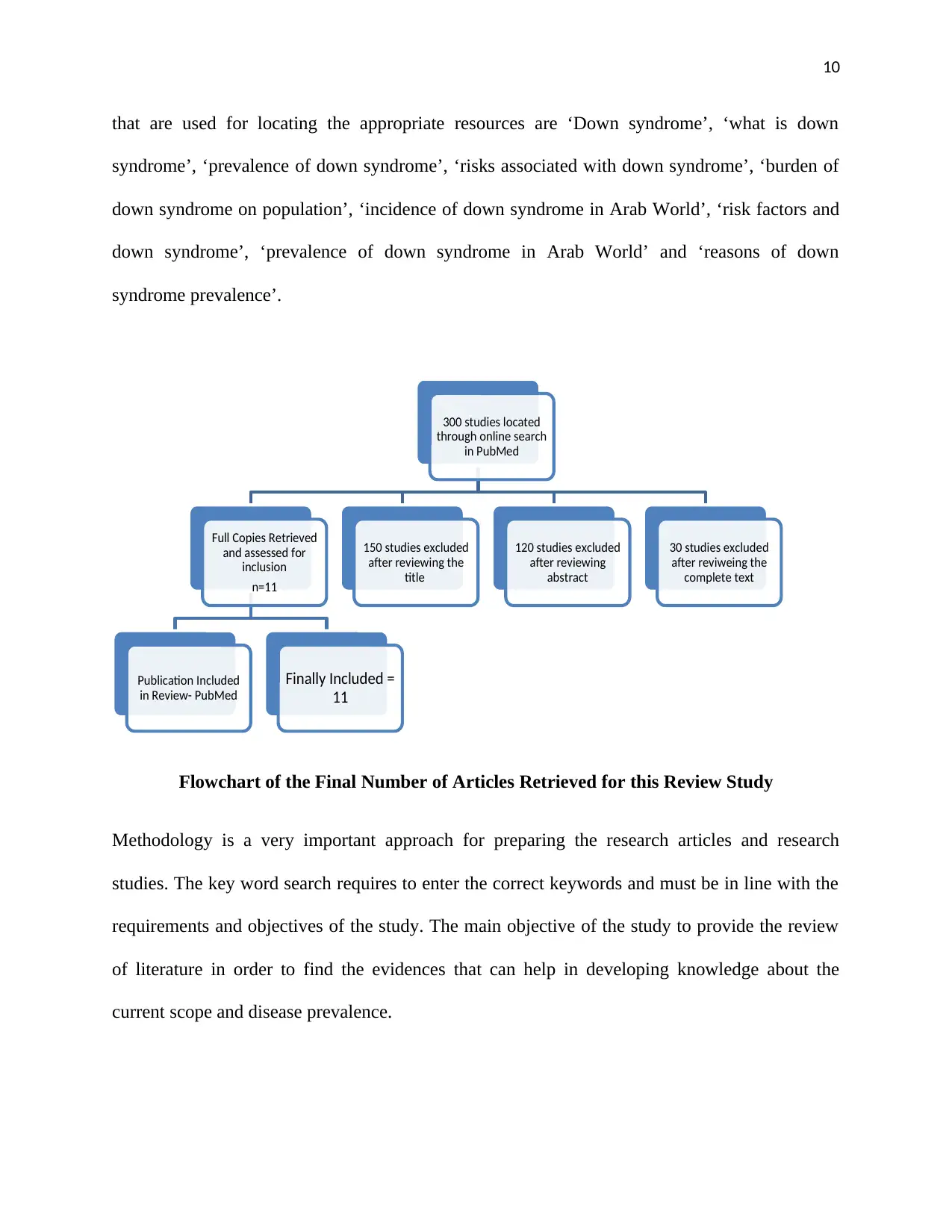
Flowchart of the Final Number of Articles Retrieved for this Review Study
Methodology is a very important approach for preparing the research articles and research
studies. The key word search requires to enter the correct keywords and must be in line with the
requirements and objectives of the study. The main objective of the study to provide the review
of literature in order to find the evidences that can help in developing knowledge about the
current scope and disease prevalence.
300 studies located
through online search
in PubMed
Full Copies Retrieved
and assessed for
inclusion
n=11
Publication Included
in Review- PubMed
Finally Included =
11
150 studies excluded
after reviewing the
title
120 studies excluded
after reviewing
abstract
30 studies excluded
after reviweing the
complete text
that are used for locating the appropriate resources are ‘Down syndrome’, ‘what is down
syndrome’, ‘prevalence of down syndrome’, ‘risks associated with down syndrome’, ‘burden of
down syndrome on population’, ‘incidence of down syndrome in Arab World’, ‘risk factors and
down syndrome’, ‘prevalence of down syndrome in Arab World’ and ‘reasons of down
syndrome prevalence’.
Flowchart of the Final Number of Articles Retrieved for this Review Study
Methodology is a very important approach for preparing the research articles and research
studies. The key word search requires to enter the correct keywords and must be in line with the
requirements and objectives of the study. The main objective of the study to provide the review
of literature in order to find the evidences that can help in developing knowledge about the
current scope and disease prevalence.
300 studies located
through online search
in PubMed
Full Copies Retrieved
and assessed for
inclusion
n=11
Publication Included
in Review- PubMed
Finally Included =
11
150 studies excluded
after reviewing the
title
120 studies excluded
after reviewing
abstract
30 studies excluded
after reviweing the
complete text
Paraphrase This Document
Need a fresh take? Get an instant paraphrase of this document with our AI Paraphraser
11
Results
1. Dekker, A. D., De Deyn, P. P., & Rots, M. G. (2017). Epigenetics and Down
syndrome. In Neuropsychiatric Disorders and Epigenetics (pp. 163-184).
This study is found to be significant because it provides important and current evidences related
to down syndrome. The study also defines the genetic disorder, however, it lacks to provide the
empirical evidences about the epidemiology of the down syndrome. This study can be beneficial
in exploring the epigenetics associated with down syndrome.
2. Aburawi, E. H., Nagelkerke, N., Deeb, A., Abdulla, S., & Abdulrazzaq, Y. M. (2015).
National growth charts for United Arab Emirates children with Down syndrome
from birth to 15 years of age. Journal of epidemiology, 25(1), 20-29. (PubMed)
This is a very important study as it is focused on the Arab country and can help in informing
about prevalence and epidemiology of down syndrome. UAE is a significant part of Arab World
and a developed country. The prevalence of disease in this country provides a strong in sight
about the reasons of disease occurrence and also inform that what challenges children have to
face, who are suffering from down syndrome. This article helped in gaining the epidemiological
information about disease.
3. Sherman, S. L., Allen, E. G., Bean, L. H., & Freeman, S. B. (2007). Epidemiology of
Down syndrome. Developmental Disabilities Research Reviews, 13(3), 221-227.
(PubMed)
This study has been helpful in informing about the incidence and prevalence of down syndrome
around the world. This study provides some strong evidences about the epidemiology of this
genetic disorder and what are the major risk factors associated with it. However, the study lacks
Results
1. Dekker, A. D., De Deyn, P. P., & Rots, M. G. (2017). Epigenetics and Down
syndrome. In Neuropsychiatric Disorders and Epigenetics (pp. 163-184).
This study is found to be significant because it provides important and current evidences related
to down syndrome. The study also defines the genetic disorder, however, it lacks to provide the
empirical evidences about the epidemiology of the down syndrome. This study can be beneficial
in exploring the epigenetics associated with down syndrome.
2. Aburawi, E. H., Nagelkerke, N., Deeb, A., Abdulla, S., & Abdulrazzaq, Y. M. (2015).
National growth charts for United Arab Emirates children with Down syndrome
from birth to 15 years of age. Journal of epidemiology, 25(1), 20-29. (PubMed)
This is a very important study as it is focused on the Arab country and can help in informing
about prevalence and epidemiology of down syndrome. UAE is a significant part of Arab World
and a developed country. The prevalence of disease in this country provides a strong in sight
about the reasons of disease occurrence and also inform that what challenges children have to
face, who are suffering from down syndrome. This article helped in gaining the epidemiological
information about disease.
3. Sherman, S. L., Allen, E. G., Bean, L. H., & Freeman, S. B. (2007). Epidemiology of
Down syndrome. Developmental Disabilities Research Reviews, 13(3), 221-227.
(PubMed)
This study has been helpful in informing about the incidence and prevalence of down syndrome
around the world. This study provides some strong evidences about the epidemiology of this
genetic disorder and what are the major risk factors associated with it. However, the study lacks
12
some significant empirical evidences. Study identifies down syndrome as the most common
genetic disorder globally. One significant limitation of the study is that it provides the evidences
from the sample of children from United States.
4. Spencer, K. (2014). Screening for Down syndrome. Scandinavian Journal of Clinical
and Laboratory Investigation, 74(sup244), 41-47. (PubMed)
This study is significant because it informs about the antenatal screening, which is significant for
identifying the genetic disorder in babies. Screening is considered as the important and
successfully developed as the biochemical marker and algorithms for identifying the risks mainly
associated with trisomy 21 and 18. This study is very significant for increasing the awareness
towards the process of screening that is mainly important in the Arab world, because the
incidence of down syndrome in children is higher in Arab countries.
5. Centre for Arab Genomic Studies. (2013). Down Syndrome in the Arab world.
Retrieved from http://www.cags.org.ae/Down%20Syndrome-English.pdf
This is a document that significantly address the issue of down syndrome in relation to Arab
World. One significant limitation of the study is that it is not a journal article or papers, yet is
associated with Arab Genomics, therefore, provides many significant evidence mainly associated
with Arab countries. It provides the information about prevalence and incidence rate. The only
limitation of the study is that it lacks empirical evidences from literature.
6. Hamamy, H., Antonarakis, S. E., Cavalli-Sforza, L. L., Temtamy, S., Romeo, G.,
Ten Kate, L. P., ... & Bathija, H. (2011). Consanguineous marriages, pearls and
perils: Geneva international consanguinity workshop report. Genetics in
Medicine, 13(9), 841. (PubMed)
some significant empirical evidences. Study identifies down syndrome as the most common
genetic disorder globally. One significant limitation of the study is that it provides the evidences
from the sample of children from United States.
4. Spencer, K. (2014). Screening for Down syndrome. Scandinavian Journal of Clinical
and Laboratory Investigation, 74(sup244), 41-47. (PubMed)
This study is significant because it informs about the antenatal screening, which is significant for
identifying the genetic disorder in babies. Screening is considered as the important and
successfully developed as the biochemical marker and algorithms for identifying the risks mainly
associated with trisomy 21 and 18. This study is very significant for increasing the awareness
towards the process of screening that is mainly important in the Arab world, because the
incidence of down syndrome in children is higher in Arab countries.
5. Centre for Arab Genomic Studies. (2013). Down Syndrome in the Arab world.
Retrieved from http://www.cags.org.ae/Down%20Syndrome-English.pdf
This is a document that significantly address the issue of down syndrome in relation to Arab
World. One significant limitation of the study is that it is not a journal article or papers, yet is
associated with Arab Genomics, therefore, provides many significant evidence mainly associated
with Arab countries. It provides the information about prevalence and incidence rate. The only
limitation of the study is that it lacks empirical evidences from literature.
6. Hamamy, H., Antonarakis, S. E., Cavalli-Sforza, L. L., Temtamy, S., Romeo, G.,
Ten Kate, L. P., ... & Bathija, H. (2011). Consanguineous marriages, pearls and
perils: Geneva international consanguinity workshop report. Genetics in
Medicine, 13(9), 841. (PubMed)
⊘ This is a preview!⊘
Do you want full access?
Subscribe today to unlock all pages.
Trusted by 1+ million students worldwide

1 out of 24


Related Documents


Your All-in-One AI-Powered Toolkit for Academic Success.
+13062052269
info@desklib.com
Available 24*7 on WhatsApp / Email
![[object Object]](/_next/static/media/star-bottom.7253800d.svg)
Unlock your academic potential
Copyright © 2020–2026 A2Z Services. All Rights Reserved. Developed and managed by ZUCOL.