Case Analysis: Drakeford v. Tuomey Healthcare System - Health Law

Verified

Added on  2022/08/24

|7
|1773
|29
Case Study
AI Summary
This case analysis examines the legal dispute between Michael Drakeford and Tuomey Healthcare System, focusing on violations of the Stark Law and the False Claims Act. The analysis delves into the facts of the case, including the non-compete agreements offered to physicians and the alleged financial incentives that influenced referrals. The assignment identifies the key issues, such as whether the agreements violated federal regulations, and outlines the court's ruling, which found Tuomey liable. The case also explores the court's application of the law, discussing the implications of the decisions on healthcare practices and physician contracts. The analysis concludes with the author's opinion on the case and its impact on hospital risk management and patient care. References from various legal and healthcare journals are also included to support the analysis.
Document Page
Running head: HEALTH LAW CASE ANALYSIS
Health Law Case Analysis
Student Name
University Name
Author Note
tabler-icon-diamond-filled.svg

Paraphrase This Document

Need a fresh take? Get an instant paraphrase of this document with our AI Paraphraser
Document Page
1
Case Analysis
Subject:
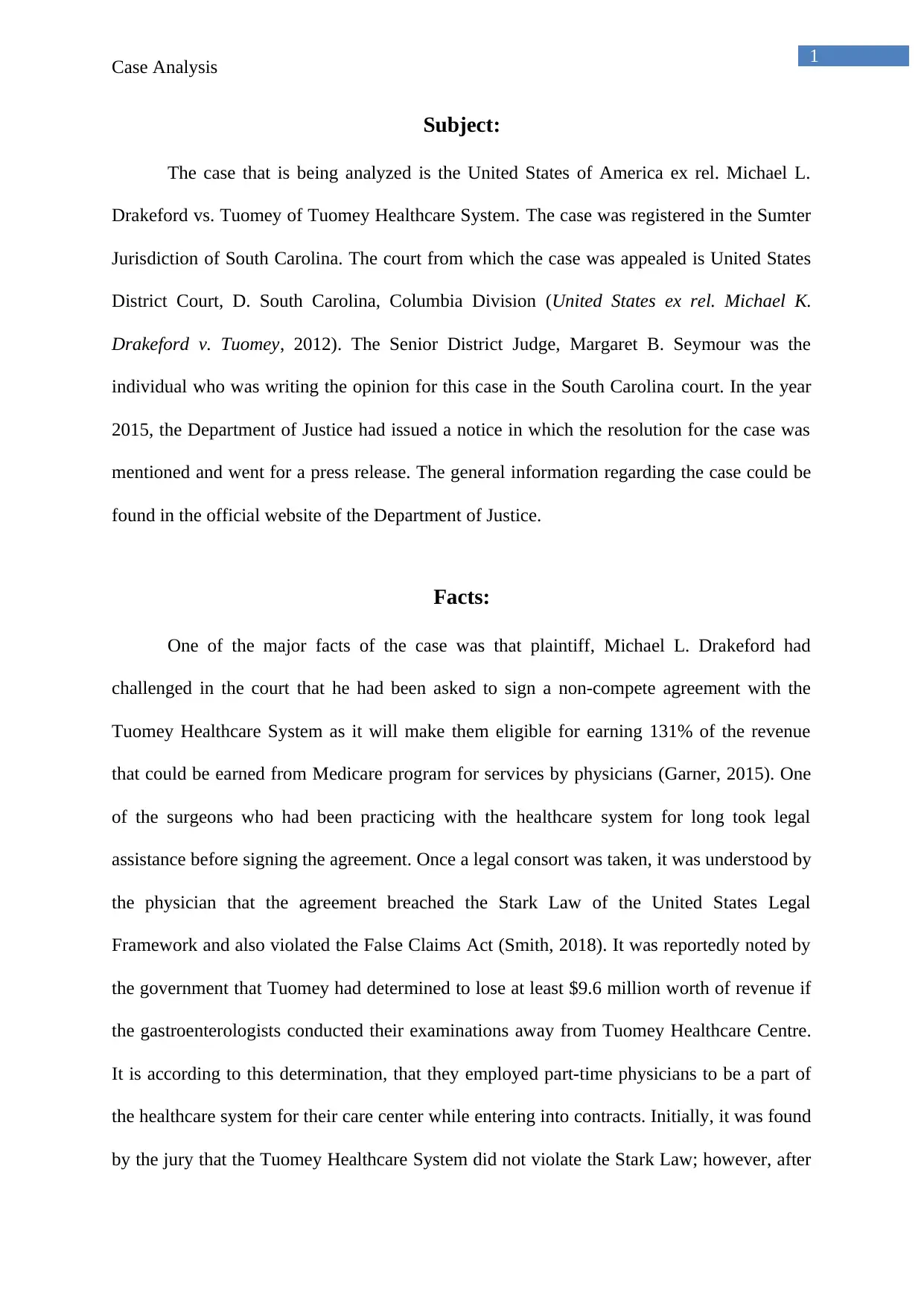
The case that is being analyzed is the United States of America ex rel. Michael L.
Drakeford vs. Tuomey of Tuomey Healthcare System. The case was registered in the Sumter
Jurisdiction of South Carolina. The court from which the case was appealed is United States
District Court, D. South Carolina, Columbia Division (United States ex rel. Michael K.
Drakeford v. Tuomey, 2012). The Senior District Judge, Margaret B. Seymour was the
individual who was writing the opinion for this case in the South Carolina court. In the year
2015, the Department of Justice had issued a notice in which the resolution for the case was
mentioned and went for a press release. The general information regarding the case could be
found in the official website of the Department of Justice.
Facts:
One of the major facts of the case was that plaintiff, Michael L. Drakeford had
challenged in the court that he had been asked to sign a non-compete agreement with the
Tuomey Healthcare System as it will make them eligible for earning 131% of the revenue
that could be earned from Medicare program for services by physicians (Garner, 2015). One
of the surgeons who had been practicing with the healthcare system for long took legal
assistance before signing the agreement. Once a legal consort was taken, it was understood by
the physician that the agreement breached the Stark Law of the United States Legal
Framework and also violated the False Claims Act (Smith, 2018). It was reportedly noted by
the government that Tuomey had determined to lose at least $9.6 million worth of revenue if
the gastroenterologists conducted their examinations away from Tuomey Healthcare Centre.
It is according to this determination, that they employed part-time physicians to be a part of
the healthcare system for their care center while entering into contracts. Initially, it was found
by the jury that the Tuomey Healthcare System did not violate the Stark Law; however, after
Document Page
2
Case Analysis
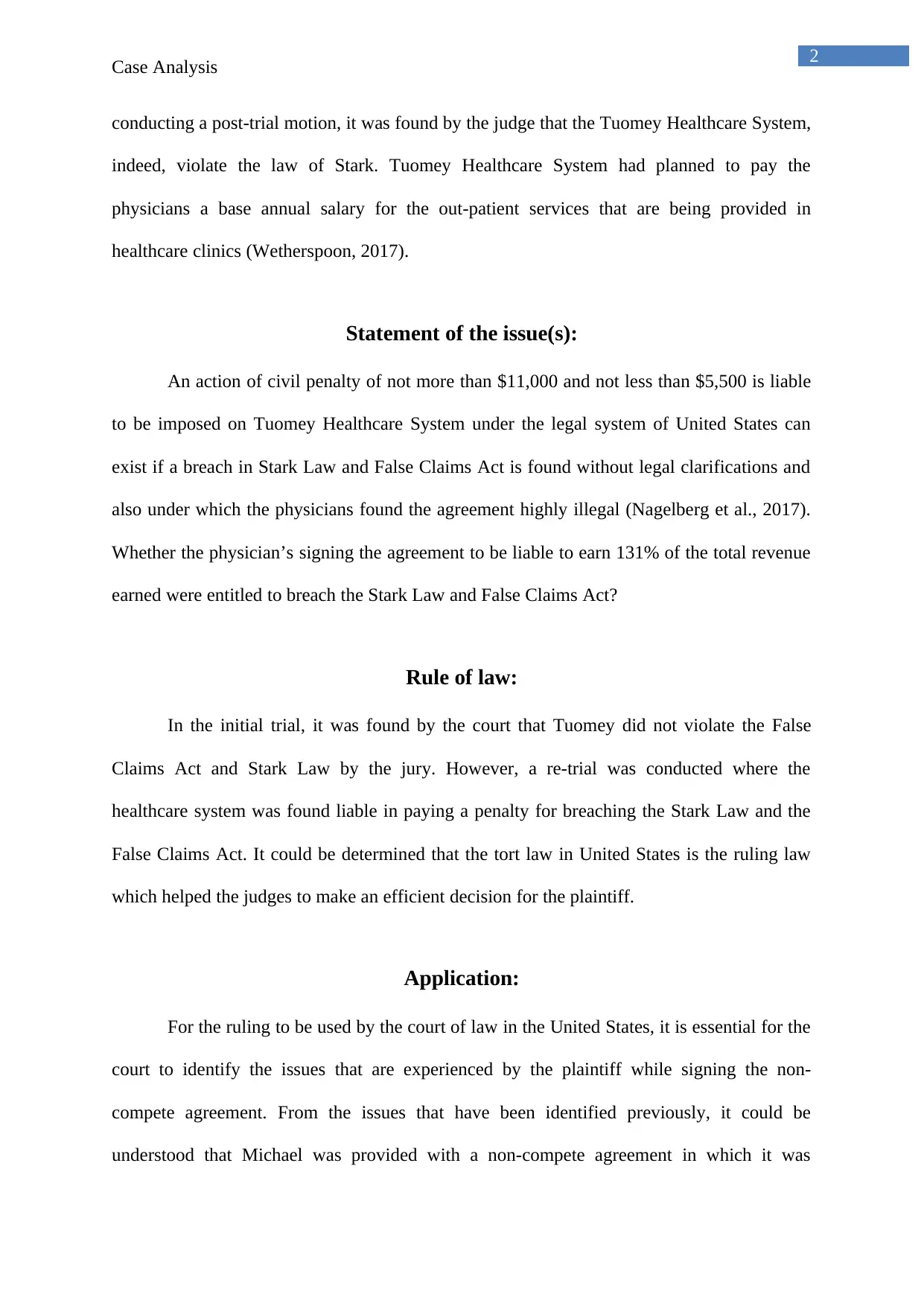
conducting a post-trial motion, it was found by the judge that the Tuomey Healthcare System,
indeed, violate the law of Stark. Tuomey Healthcare System had planned to pay the
physicians a base annual salary for the out-patient services that are being provided in
healthcare clinics (Wetherspoon, 2017).
Statement of the issue(s):
An action of civil penalty of not more than $11,000 and not less than $5,500 is liable
to be imposed on Tuomey Healthcare System under the legal system of United States can
exist if a breach in Stark Law and False Claims Act is found without legal clarifications and
also under which the physicians found the agreement highly illegal (Nagelberg et al., 2017).
Whether the physician’s signing the agreement to be liable to earn 131% of the total revenue
earned were entitled to breach the Stark Law and False Claims Act?
Rule of law:
In the initial trial, it was found by the court that Tuomey did not violate the False
Claims Act and Stark Law by the jury. However, a re-trial was conducted where the
healthcare system was found liable in paying a penalty for breaching the Stark Law and the
False Claims Act. It could be determined that the tort law in United States is the ruling law
which helped the judges to make an efficient decision for the plaintiff.
Application:
For the ruling to be used by the court of law in the United States, it is essential for the
court to identify the issues that are experienced by the plaintiff while signing the non-
compete agreement. From the issues that have been identified previously, it could be
understood that Michael was provided with a non-compete agreement in which it was
Document Page
3
Case Analysis
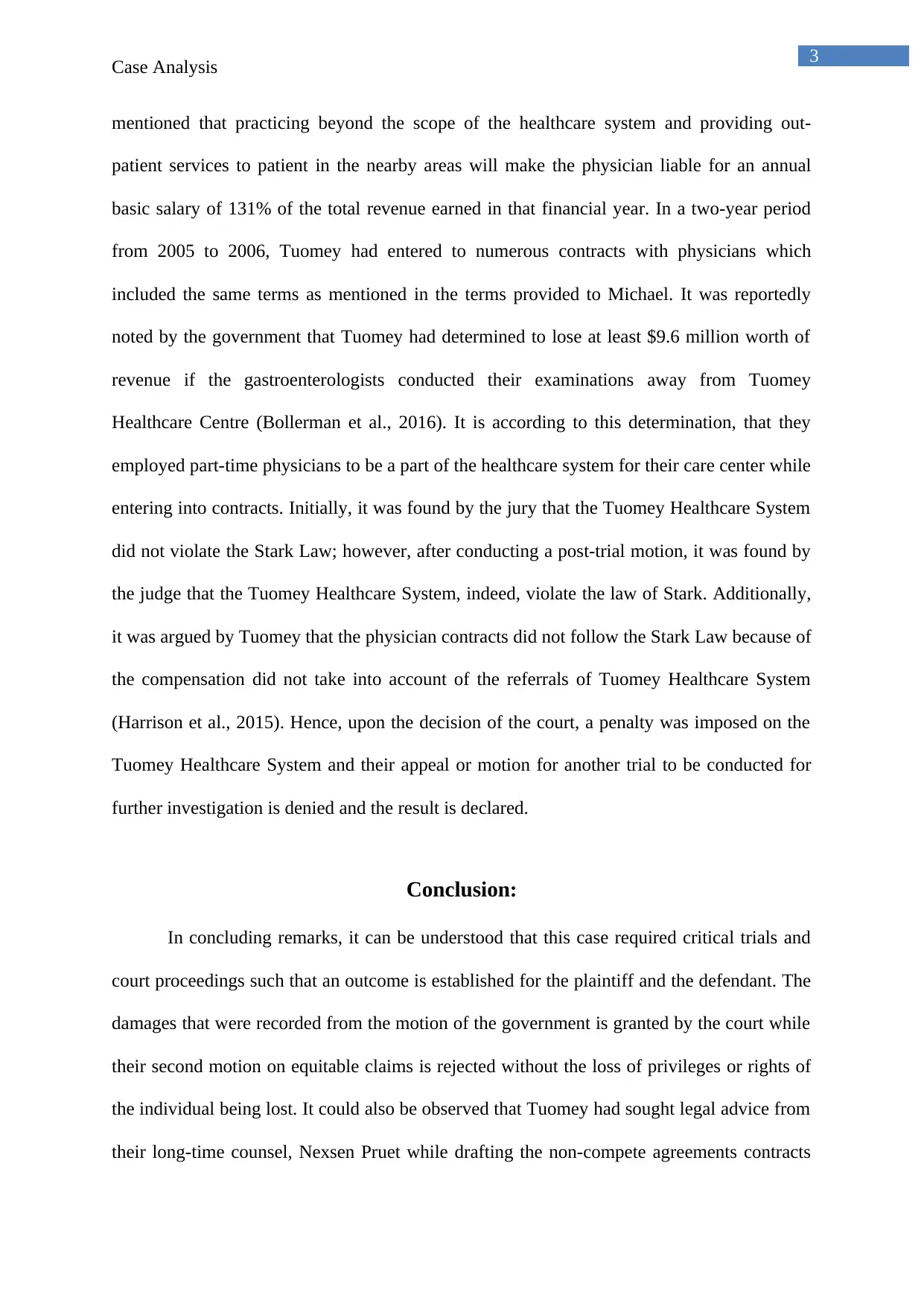
mentioned that practicing beyond the scope of the healthcare system and providing out-
patient services to patient in the nearby areas will make the physician liable for an annual
basic salary of 131% of the total revenue earned in that financial year. In a two-year period
from 2005 to 2006, Tuomey had entered to numerous contracts with physicians which
included the same terms as mentioned in the terms provided to Michael. It was reportedly
noted by the government that Tuomey had determined to lose at least $9.6 million worth of
revenue if the gastroenterologists conducted their examinations away from Tuomey
Healthcare Centre (Bollerman et al., 2016). It is according to this determination, that they
employed part-time physicians to be a part of the healthcare system for their care center while
entering into contracts. Initially, it was found by the jury that the Tuomey Healthcare System
did not violate the Stark Law; however, after conducting a post-trial motion, it was found by
the judge that the Tuomey Healthcare System, indeed, violate the law of Stark. Additionally,
it was argued by Tuomey that the physician contracts did not follow the Stark Law because of
the compensation did not take into account of the referrals of Tuomey Healthcare System
(Harrison et al., 2015). Hence, upon the decision of the court, a penalty was imposed on the
Tuomey Healthcare System and their appeal or motion for another trial to be conducted for
further investigation is denied and the result is declared.
Conclusion:
In concluding remarks, it can be understood that this case required critical trials and
court proceedings such that an outcome is established for the plaintiff and the defendant. The
damages that were recorded from the motion of the government is granted by the court while
their second motion on equitable claims is rejected without the loss of privileges or rights of
the individual being lost. It could also be observed that Tuomey had sought legal advice from
their long-time counsel, Nexsen Pruet while drafting the non-compete agreements contracts
tabler-icon-diamond-filled.svg

Paraphrase This Document

Need a fresh take? Get an instant paraphrase of this document with our AI Paraphraser
Document Page
4
Case Analysis
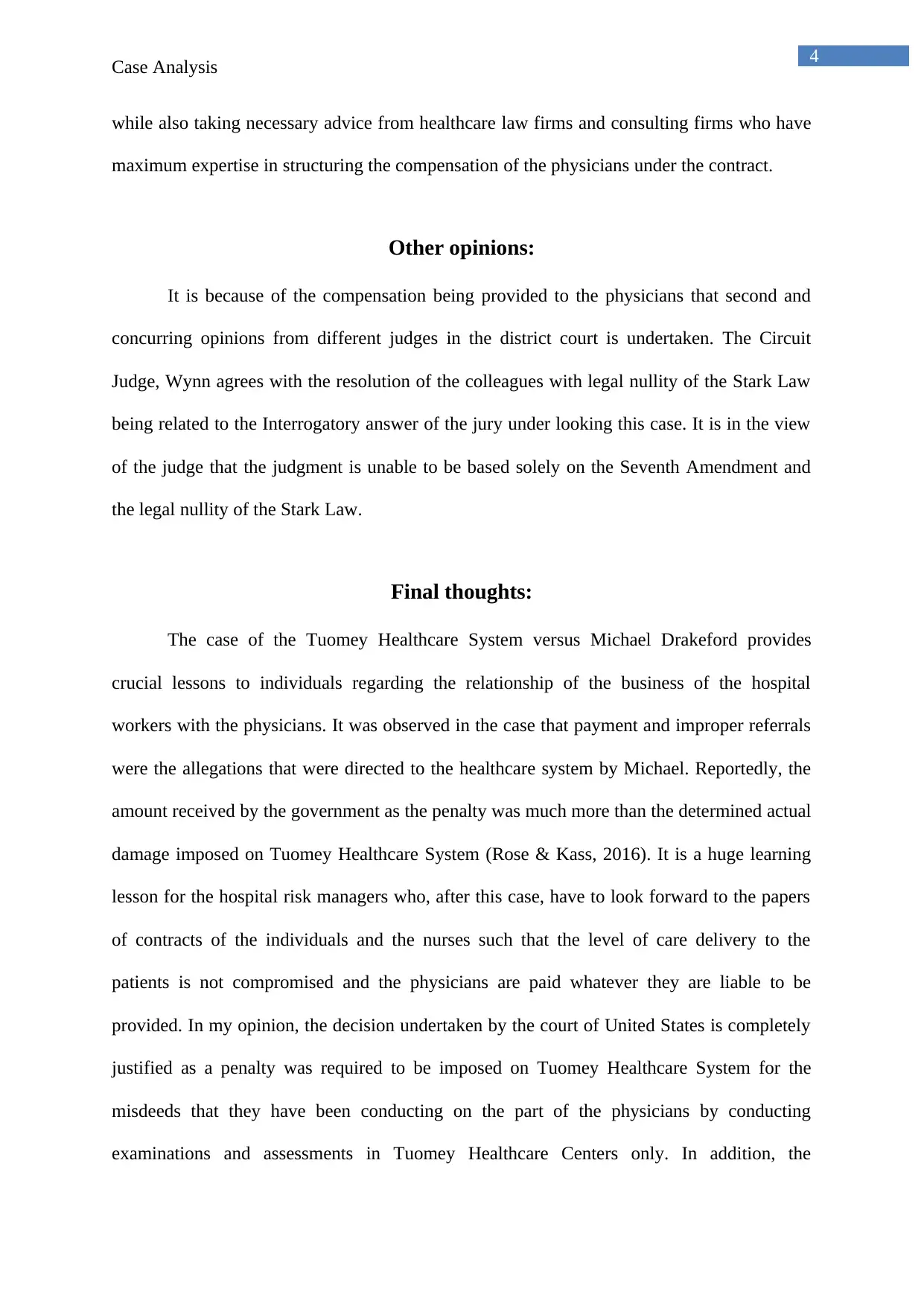
while also taking necessary advice from healthcare law firms and consulting firms who have
maximum expertise in structuring the compensation of the physicians under the contract.
Other opinions:
It is because of the compensation being provided to the physicians that second and
concurring opinions from different judges in the district court is undertaken. The Circuit
Judge, Wynn agrees with the resolution of the colleagues with legal nullity of the Stark Law
being related to the Interrogatory answer of the jury under looking this case. It is in the view
of the judge that the judgment is unable to be based solely on the Seventh Amendment and
the legal nullity of the Stark Law.
Final thoughts:
The case of the Tuomey Healthcare System versus Michael Drakeford provides
crucial lessons to individuals regarding the relationship of the business of the hospital
workers with the physicians. It was observed in the case that payment and improper referrals
were the allegations that were directed to the healthcare system by Michael. Reportedly, the
amount received by the government as the penalty was much more than the determined actual
damage imposed on Tuomey Healthcare System (Rose & Kass, 2016). It is a huge learning
lesson for the hospital risk managers who, after this case, have to look forward to the papers
of contracts of the individuals and the nurses such that the level of care delivery to the
patients is not compromised and the physicians are paid whatever they are liable to be
provided. In my opinion, the decision undertaken by the court of United States is completely
justified as a penalty was required to be imposed on Tuomey Healthcare System for the
misdeeds that they have been conducting on the part of the physicians by conducting
examinations and assessments in Tuomey Healthcare Centers only. In addition, the
Document Page
5
Case Analysis
physicians were also asked to sign the contract containing clauses because of which the
physicians are not allowed to work except for Tuomey Healthcare Center for the next ten
years and two years after the completion of the contract. The number one priority of the
hospital organization is the effective delivery of care by complying with the standards of the
nursing and medical professionals such that a positive health outcome for the patient is likely
to be established. The compliance rate of the physicians with the appropriate delivery of care
to the patients and their relatives is one of the major vision of hospital organizations which
are likely to be met by different healthcare professionals.
Document Page
6
Case Analysis
References
Bollerman, K., Egbert, A., Fazio, M., & Graves, B. (2016). Health Care Fraud. Am. Crim. L.
Rev., 53, 1393.
Garner, C. B. (2015). Medicare–Bridging the Gap Between Ridiculous and Sublime.
California Healthcare News, Online (2015).
Harrison, S., Brogan, E., Egbert, A., Glasser, J., & Godin, C. (2015). Health Care Fraud. Am.
Crim. L. Rev., 52, 1223.
Nagelberg, M., Lee, J., Rioux, D., & Strong, M. (2017). False Statements and False Claims.
Am. Crim. L. Rev., 54, 1273.
Rose, R. V., & Kass, J. S. (2016). Legal Implications of Physician Investment and Ownership
in Health Care Enterprises. CONTINUUM: Lifelong Learning in Neurology, 22(5),
1685-1690.
Smith, T. (2018). health system-owned physician practices are any losses acceptable? It's
time to address physician practice losses and their associated regulatory and financial
risks. Healthcare Financial Management, 72(8), 38-44.
United States ex rel. Michael K. Drakeford v. Tuomey, F.3d 394 (South Carolina 2012).
Wetherspoon, V. K. (2017). Stark Violations Discovered during Due Diligence: To Disclose
or Not. Quinnipiac Health LJ, 20, 105.
chevron_up_icon
1 out of 7
circle_padding
hide_on_mobile
zoom_out_icon
[object Object]