Dream Massage Business Ethics Report: Employee vs Contractor?
VerifiedAdded on 2023/06/10
|9
|1564
|164
Report
AI Summary
This report examines the business ethics of Dream Massage, focusing on the distinction between employees and independent contractors, potential violations of employment discrimination laws, and ethical considerations in maintaining a dress code policy. The report analyzes whether Janice should be classified as an employee or an independent contractor, highlighting the differences in control, benefits, and tax liabilities. It also addresses the company's violation of employment discrimination laws by restricting Janice from wearing a hijab, emphasizing the importance of accommodating religious beliefs. Furthermore, the report discusses ethical considerations when creating a dress code policy, including religious accommodation, disability considerations, and gender neutrality. The report concludes that the company's actions raise significant ethical concerns and legal issues.
BUSINESS ETHICS 0
dream massage
REPORT ON BUSINESS ETHICS
Student’s name
6/16/2018
dream massage
REPORT ON BUSINESS ETHICS
Student’s name
6/16/2018
Paraphrase This Document
Need a fresh take? Get an instant paraphrase of this document with our AI Paraphraser

BUSINESS ETHICS 1
EXECUTIVE SUMMARY
Business Ethics refers to a thin line of difference between right and wrong.
Additionally business ethics means a code of conduct that guides an organisation to do what
is right and to avoid doing what is wrong. A corporate operates in a manner that it tends to
touch several lives and it may have a deep impact over the society in which it operates hence
it becomes moral obligation of an organisation to adopt moral principles and a code of
conduct that never harms anyone knowingly. Following report is based on business ethics and
it highlights the difference between right and wrong business practices.
EXECUTIVE SUMMARY
Business Ethics refers to a thin line of difference between right and wrong.
Additionally business ethics means a code of conduct that guides an organisation to do what
is right and to avoid doing what is wrong. A corporate operates in a manner that it tends to
touch several lives and it may have a deep impact over the society in which it operates hence
it becomes moral obligation of an organisation to adopt moral principles and a code of
conduct that never harms anyone knowingly. Following report is based on business ethics and
it highlights the difference between right and wrong business practices.

BUSINESS ETHICS 2
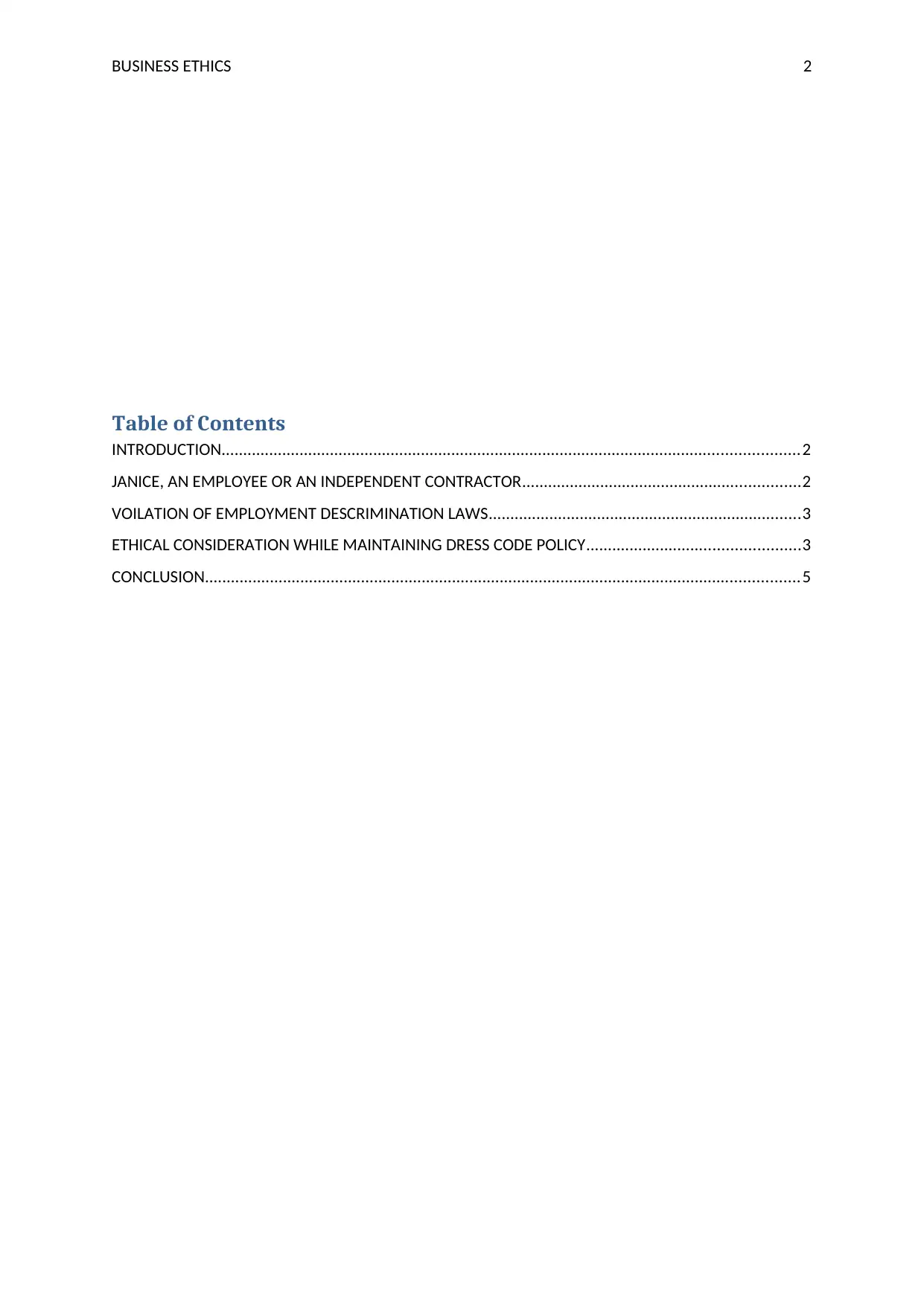
Table of Contents
INTRODUCTION.....................................................................................................................................2
JANICE, AN EMPLOYEE OR AN INDEPENDENT CONTRACTOR................................................................2
VOILATION OF EMPLOYMENT DESCRIMINATION LAWS........................................................................3
ETHICAL CONSIDERATION WHILE MAINTAINING DRESS CODE POLICY.................................................3
CONCLUSION.........................................................................................................................................5
Table of Contents
INTRODUCTION.....................................................................................................................................2
JANICE, AN EMPLOYEE OR AN INDEPENDENT CONTRACTOR................................................................2
VOILATION OF EMPLOYMENT DESCRIMINATION LAWS........................................................................3
ETHICAL CONSIDERATION WHILE MAINTAINING DRESS CODE POLICY.................................................3
CONCLUSION.........................................................................................................................................5
⊘ This is a preview!⊘
Do you want full access?
Subscribe today to unlock all pages.

Trusted by 1+ million students worldwide

BUSINESS ETHICS 3
INTRODUCTION
Business ethics refers to a code of conduct guiding a corporate entity to follow moral
principle, to do things that are right and not to harm anyone knowingly through any of its
actions (Shaw, 2013).
This report is based on a case study of a massage company named Dream Massage,
Dream massage hired Janice as an independent contractor providing her with no employment
benefits or tax withholding but at the same time dream massage requires Janice to work on its
condition, it intends to exercise complete control over how Janice performs her work. Plus on
the very first day at work Janice was asked not to wear hijab, as it was against company’s
policy. All this adds up to various ethical dilemmas and the following report is an attempt to
gain insight into the problem and suggest a proper solution to it.
JANICE, AN EMPLOYEE OR AN INDEPENDENT CONTRACTOR
In order to understand weather Janice shall be considered as an independent employee
or an independent contractor the difference between an employee and an independent
contractor is to be analysed.
An independent contractor is a person who is an expert in the industry, he is the one
who decides his own schedule for the work, the way in which he wants to perform his work,
he takes care of all his tax liabilities by himself plus, he is not entitled to any employment
benefits provided by the company. When a company engages itself with an independent
INTRODUCTION
Business ethics refers to a code of conduct guiding a corporate entity to follow moral
principle, to do things that are right and not to harm anyone knowingly through any of its
actions (Shaw, 2013).
This report is based on a case study of a massage company named Dream Massage,
Dream massage hired Janice as an independent contractor providing her with no employment
benefits or tax withholding but at the same time dream massage requires Janice to work on its
condition, it intends to exercise complete control over how Janice performs her work. Plus on
the very first day at work Janice was asked not to wear hijab, as it was against company’s
policy. All this adds up to various ethical dilemmas and the following report is an attempt to
gain insight into the problem and suggest a proper solution to it.
JANICE, AN EMPLOYEE OR AN INDEPENDENT CONTRACTOR
In order to understand weather Janice shall be considered as an independent employee
or an independent contractor the difference between an employee and an independent
contractor is to be analysed.
An independent contractor is a person who is an expert in the industry, he is the one
who decides his own schedule for the work, the way in which he wants to perform his work,
he takes care of all his tax liabilities by himself plus, he is not entitled to any employment
benefits provided by the company. When a company engages itself with an independent
Paraphrase This Document
Need a fresh take? Get an instant paraphrase of this document with our AI Paraphraser

BUSINESS ETHICS 4
contractor it is a relationship between business and business not business and employee
(Office of child support enforcement, 2015).
Whereas an employee is a person hired by the company, who is required to offer his
services in lieu of the salary offered by the company, working hours of an employee are
decided by the company, he is required to perform his work as instructed by the company,
company takes care of his tax liabilities as well as provides him with several employment
benefits like retirement benefits, health care benefits etc.
From the above discussion it can be analysed that Janice qualifies as an independent
contractor as the company is not providing Janice with any of the employment benefits or tax
savings on its earning.
Further it can also be concluded that the company has no rights to control Janice’s
work schedule, the way she wants to perform her work or the clothes she wants to wear at
work.
VOILATION OF EMPLOYMENT DESCRIMINATION LAWS
Under civil rights act 1964, equal employment opportunity commission was formed to
restrict various discriminatory practices at the work place, title VII of the civil rights act
restricts an employer to exercise any discriminatory practices based on race, gender, colour,
cast or nationality (U.S. equal employment opportunity commission, 2018).
The company has violated employment discrimination laws while forbidding Janice
from wearing hijab. Hijab is an important Muslim belief which Muslim women follow while
being outside in the middle of strangers. According to this belief Muslim women put a scarf
on their heads which covers their head and chest (Al-islam, 2018). Company should have
respected her belief instead of restricting her on the name of dress code. Company’s point of
contractor it is a relationship between business and business not business and employee
(Office of child support enforcement, 2015).
Whereas an employee is a person hired by the company, who is required to offer his
services in lieu of the salary offered by the company, working hours of an employee are
decided by the company, he is required to perform his work as instructed by the company,
company takes care of his tax liabilities as well as provides him with several employment
benefits like retirement benefits, health care benefits etc.
From the above discussion it can be analysed that Janice qualifies as an independent
contractor as the company is not providing Janice with any of the employment benefits or tax
savings on its earning.
Further it can also be concluded that the company has no rights to control Janice’s
work schedule, the way she wants to perform her work or the clothes she wants to wear at
work.
VOILATION OF EMPLOYMENT DESCRIMINATION LAWS
Under civil rights act 1964, equal employment opportunity commission was formed to
restrict various discriminatory practices at the work place, title VII of the civil rights act
restricts an employer to exercise any discriminatory practices based on race, gender, colour,
cast or nationality (U.S. equal employment opportunity commission, 2018).
The company has violated employment discrimination laws while forbidding Janice
from wearing hijab. Hijab is an important Muslim belief which Muslim women follow while
being outside in the middle of strangers. According to this belief Muslim women put a scarf
on their heads which covers their head and chest (Al-islam, 2018). Company should have
respected her belief instead of restricting her on the name of dress code. Company’s point of

BUSINESS ETHICS 5
restricting Janice from practicing hijab is invalid on two grounds. Firstly, Janice is not an
employee of the company but an independent contractor which itself gives her freedom to
choose what to wear. Secondly, law of the country gives Janice or for instance any person
weather an employee or not, enough power to practice his/her religious beliefs and practices.
ETHICAL CONSIDERATION WHILE MAINTAINING DRESS CODE POLICY
Dress code policy of an organisation refers to set of rules which guide employees on how
to dress, what to wear and what not to at the work place (Greedus, 2018). Dress code brings
uniformity to the work place and it also represents the company. While designing a dress
code policy of the company following points should be considered-
Workforce is often inclusive of people from diverse cultures.
Employee suggestions play a vital role.
Dress code must be gender neutral.
Dress code shall never be framed or implemented in a discriminatory manner.
It should always be flexible enough to accommodate an employee’s reasonable needs
(Pollock, 2016).
While maintaining a rigid dress code policy several ethical considerations need to be
made such as:
Religious consideration- Title VI of civil rights code requires an employer to provide its
employees with a religion based discrimination free place of work. Hence an employer must
always frame and implement a dress code policy which is flexible enough to accommodate
religious practices and beliefs until and unless it causes an undue hardship to the
organisation. A small piece of jewellery, a head scarf or anything required by a religious
restricting Janice from practicing hijab is invalid on two grounds. Firstly, Janice is not an
employee of the company but an independent contractor which itself gives her freedom to
choose what to wear. Secondly, law of the country gives Janice or for instance any person
weather an employee or not, enough power to practice his/her religious beliefs and practices.
ETHICAL CONSIDERATION WHILE MAINTAINING DRESS CODE POLICY
Dress code policy of an organisation refers to set of rules which guide employees on how
to dress, what to wear and what not to at the work place (Greedus, 2018). Dress code brings
uniformity to the work place and it also represents the company. While designing a dress
code policy of the company following points should be considered-
Workforce is often inclusive of people from diverse cultures.
Employee suggestions play a vital role.
Dress code must be gender neutral.
Dress code shall never be framed or implemented in a discriminatory manner.
It should always be flexible enough to accommodate an employee’s reasonable needs
(Pollock, 2016).
While maintaining a rigid dress code policy several ethical considerations need to be
made such as:
Religious consideration- Title VI of civil rights code requires an employer to provide its
employees with a religion based discrimination free place of work. Hence an employer must
always frame and implement a dress code policy which is flexible enough to accommodate
religious practices and beliefs until and unless it causes an undue hardship to the
organisation. A small piece of jewellery, a head scarf or anything required by a religious
⊘ This is a preview!⊘
Do you want full access?
Subscribe today to unlock all pages.

Trusted by 1+ million students worldwide

BUSINESS ETHICS 6
belief to be worn shall be permitted at the workplace, even if it contravenes the formal dress
code to a certain limit (The Balance Carers, 2018).
Disability or medical condition consideration- dress code policy shall permit some
relaxation to an employee with some medical condition or a disability in order to feel
comfortable at work. For example, in case an employee is suffering from a foot injury which
does not allow him to wear formal shoes, which otherwise is a part of a formal dress code so
in this case employee should be permitted to wear slippers, snickers or whatever he feels
more comfortable to put on while at the workplace.
Gender identity consideration- dress code policy should always be gender neutral instead
of one which is based on gender stereotypes, for instance a policy that enforces professional
attire at work is more likeable then the one which suggests suits for men and dresses for
women (Casuga, 2017).
CONCLUSION
In the end of report it can be concluded that there is a major difference between an
independent contractor and an employee. A company has no rights to exercise control over an
independent contractor regarding his ways of performing a task or working hours plus the
company is not liable to pay his/ her tax liabilities or to provide him with any of the
employment benefits. In addition to this it can also be concluded that restricting an employee
from practicing his/ her religious beliefs at the work place until and unless they do not cost
any undue hardship to the organisation, amounts to violation of title VI of civil rights code. It
has also been suggested that while framing a dress code policy, religious, disability/ medical
condition and gender identity considerations shall be kept in mind.
belief to be worn shall be permitted at the workplace, even if it contravenes the formal dress
code to a certain limit (The Balance Carers, 2018).
Disability or medical condition consideration- dress code policy shall permit some
relaxation to an employee with some medical condition or a disability in order to feel
comfortable at work. For example, in case an employee is suffering from a foot injury which
does not allow him to wear formal shoes, which otherwise is a part of a formal dress code so
in this case employee should be permitted to wear slippers, snickers or whatever he feels
more comfortable to put on while at the workplace.
Gender identity consideration- dress code policy should always be gender neutral instead
of one which is based on gender stereotypes, for instance a policy that enforces professional
attire at work is more likeable then the one which suggests suits for men and dresses for
women (Casuga, 2017).
CONCLUSION
In the end of report it can be concluded that there is a major difference between an
independent contractor and an employee. A company has no rights to exercise control over an
independent contractor regarding his ways of performing a task or working hours plus the
company is not liable to pay his/ her tax liabilities or to provide him with any of the
employment benefits. In addition to this it can also be concluded that restricting an employee
from practicing his/ her religious beliefs at the work place until and unless they do not cost
any undue hardship to the organisation, amounts to violation of title VI of civil rights code. It
has also been suggested that while framing a dress code policy, religious, disability/ medical
condition and gender identity considerations shall be kept in mind.
Paraphrase This Document
Need a fresh take? Get an instant paraphrase of this document with our AI Paraphraser

BUSINESS ETHICS 7
REFERENCES
Al-islam. (2018). Why hijab. Retrieved from: https://www.al-islam.org/hijab-muslim-
womens-dress-islamic-or-cultural-sayyid-muhammad-rizvi/why-hijab
Casuga, J.B. (2017). Dress code liability? Sex Bias not always clean-cut. Retrieved from:
https://www.bna.com/dress-code-liability-n57982083831/
Greedus, A. (2018). How to establish an office dress code. Retrieved from: https://www.cv-
library.co.uk/recruitment-insight/establish-office-dress-code/
Office of child support enforcement. (2015). What is the difference between an independent
employee and a contractor? Retrieved from:
https://www.acf.hhs.gov/css/resource/the-difference-between-an-independent-
contractor-and-an-employee
Pollock, O. (2016). Dress codes in the work place. Retrieved from: https://www.legal-
island.com/articles/uk/features/hr/2016/nov/dress-codes-in-the-workplace/
Shaw, W.H. (2013). Business Ethics: A textbook with cases, (8th ed). Boston, United States :
Cengage Learning
The balance Careers. (2018). Employment law- dress codes, Tough questions while
implementing your dress code. Retrieved from:
https://www.thebalancecareers.com/tough-questions-about-implementing-your-dress-
code-1917932
REFERENCES
Al-islam. (2018). Why hijab. Retrieved from: https://www.al-islam.org/hijab-muslim-
womens-dress-islamic-or-cultural-sayyid-muhammad-rizvi/why-hijab
Casuga, J.B. (2017). Dress code liability? Sex Bias not always clean-cut. Retrieved from:
https://www.bna.com/dress-code-liability-n57982083831/
Greedus, A. (2018). How to establish an office dress code. Retrieved from: https://www.cv-
library.co.uk/recruitment-insight/establish-office-dress-code/
Office of child support enforcement. (2015). What is the difference between an independent
employee and a contractor? Retrieved from:
https://www.acf.hhs.gov/css/resource/the-difference-between-an-independent-
contractor-and-an-employee
Pollock, O. (2016). Dress codes in the work place. Retrieved from: https://www.legal-
island.com/articles/uk/features/hr/2016/nov/dress-codes-in-the-workplace/
Shaw, W.H. (2013). Business Ethics: A textbook with cases, (8th ed). Boston, United States :
Cengage Learning
The balance Careers. (2018). Employment law- dress codes, Tough questions while
implementing your dress code. Retrieved from:
https://www.thebalancecareers.com/tough-questions-about-implementing-your-dress-
code-1917932

BUSINESS ETHICS 8
U.S. Equal Employment Opportunity Commission. (2018). Title VI of the civil right act,
1964. Retrieved from: https://www.eeoc.gov/laws/statutes/titlevii.cfm
U.S. Equal Employment Opportunity Commission. (2018). Title VI of the civil right act,
1964. Retrieved from: https://www.eeoc.gov/laws/statutes/titlevii.cfm
⊘ This is a preview!⊘
Do you want full access?
Subscribe today to unlock all pages.

Trusted by 1+ million students worldwide
1 out of 9
Related Documents
Your All-in-One AI-Powered Toolkit for Academic Success.
+13062052269
info@desklib.com
Available 24*7 on WhatsApp / Email
Unlock your academic potential
Copyright © 2020–2026 A2Z Services. All Rights Reserved. Developed and managed by ZUCOL.