The Legal Drinking Age in the United States: An Argument for Change
VerifiedAdded on 2023/06/04
|10
|3171
|269
Essay
AI Summary
This essay presents a persuasive argument for raising the legal drinking age in the United States to 25, targeting the US Congress as its audience. The paper begins by establishing the current legal drinking age of 21 and its exceptions, then proceeds to argue that raising the age to 25 will have significant health benefits, reduce alcohol abuse among young people, and decrease alcohol-related deaths. It cites studies showing a correlation between the legal drinking age and traffic accidents, and highlights the negative impact of alcohol on brain development during the early twenties, which is a critical period for brain maturation. The essay also discusses how alcohol abuse can damage relationships and negatively impact academic and career goals. Furthermore, the essay addresses counterarguments, acknowledging the rights of 18-year-olds, and the current drinking age in other countries while emphasizing the benefits of a higher drinking age. It concludes that increasing the drinking age will lead to fewer alcohol poisoning deaths, and overall, promote a healthier lifestyle for young people, justifying the need for the proposed change.

0
English Essay
The legal drinking age in the United States
English Essay
The legal drinking age in the United States

Paraphrase This Document
Need a fresh take? Get an instant paraphrase of this document with our AI Paraphraser
1
The legal drinking age in the United States has been a topic of debate, especially when it
comes to times such as graduation and spring break. In the United States, all fifty states have
set their minimum age of drinking to 21; however, there are certain exception exists such as
under adult supervision, consumption at home, medical necessity and others. Proponents who
support lowering of the legal drinking age of 21 to 18 argue that this has not stopped teen
drinking. This law has pushed underage binge drinker who drink in private and controlled
environments which leads to negative health and life-endangering behavior in teenagers. On
the other hand, studies have shown that the legal drinking age should be increased to reduce
the negative impact of alcohol on teenagers at an early age and for numerous health and
social benefits (DeJong and Blanchette 108-115). This paper will evaluate various arguments
by evaluating different studies to analyze why the legal drinking age in the United States
should increase to 25. The thesis will argue that increasing the legal drinking age will have
many health benefits along with reducing the number of young people who abuse alcohol,
reduce deaths caused due to alcohols and assist teenagers in living an overall healthy life. The
negative issues relating to increasing the legal drinking age will be evaluated in the paper and
how these issues are overcome by the benefits of increasing the legal age will be discussed as
well.
A Minimum Legal Drinking Age (MLDA) of 21 saves a number of lives of younger people
and protects their health; therefore, raising the age limit to 25 will save more lives and
improve the health of younger people. In the United States, MLDA was changed by Ronal
Reagan from 18 to 21 in 1984, and by 1988 all the other states complied by this limit, and
they also changed their MLDA to 21. Before 1984, the MLDA in the United States varies as
per different states as some states had 18, 19 or 20 as legal age for drinking. After increasing
the legal age of drinking just by three years, the studies have shown that it resulted in a 16
percent decrease in the number of crashes in which young people were involved (CDC).
The legal drinking age in the United States has been a topic of debate, especially when it
comes to times such as graduation and spring break. In the United States, all fifty states have
set their minimum age of drinking to 21; however, there are certain exception exists such as
under adult supervision, consumption at home, medical necessity and others. Proponents who
support lowering of the legal drinking age of 21 to 18 argue that this has not stopped teen
drinking. This law has pushed underage binge drinker who drink in private and controlled
environments which leads to negative health and life-endangering behavior in teenagers. On
the other hand, studies have shown that the legal drinking age should be increased to reduce
the negative impact of alcohol on teenagers at an early age and for numerous health and
social benefits (DeJong and Blanchette 108-115). This paper will evaluate various arguments
by evaluating different studies to analyze why the legal drinking age in the United States
should increase to 25. The thesis will argue that increasing the legal drinking age will have
many health benefits along with reducing the number of young people who abuse alcohol,
reduce deaths caused due to alcohols and assist teenagers in living an overall healthy life. The
negative issues relating to increasing the legal drinking age will be evaluated in the paper and
how these issues are overcome by the benefits of increasing the legal age will be discussed as
well.
A Minimum Legal Drinking Age (MLDA) of 21 saves a number of lives of younger people
and protects their health; therefore, raising the age limit to 25 will save more lives and
improve the health of younger people. In the United States, MLDA was changed by Ronal
Reagan from 18 to 21 in 1984, and by 1988 all the other states complied by this limit, and
they also changed their MLDA to 21. Before 1984, the MLDA in the United States varies as
per different states as some states had 18, 19 or 20 as legal age for drinking. After increasing
the legal age of drinking just by three years, the studies have shown that it resulted in a 16
percent decrease in the number of crashes in which young people were involved (CDC).
2
Moreover, over 57 studies conducted by the University of Minnesota showed that increasing
the legal age of drinking has saved the lives of many young people. (Lang) Since studies have
shown that just by increasing the legal age of drinking lives of young people can be saved,
liberal California has applied this rule on smoking as well. In order to reduce harm of
smoking on youth, the anti-smoking lobby in liberal California has implemented a rule based
on which it is illegal for people under 21 to buy cigarettes in the state. By applying this
principle, raising the MLDA to 25 will result in saving more lives. The study conducted by
the National Institute on Alcohol Abuse and Alcoholism has provided that 86.4 percent of
people ages 18 or older has admitted that they have drunk alcohol. In 2015, 623,000
adolescents’ ages 12-17 and 15.1 million adults ages 18 and older reported Alcohol Use
Disorder (AUD) in which they abuse alcohol (NIH). This number can be reduced if the
United States Congress decides to increase the MLDA to 25 to restrict the legal access of
alcohol to young people.
At the age of 21, people’s brain is still evolving, and use of alcohol can adversely affect the
growth of the brain due to which young people are more likely to become addicted to alcohol.
Studies conducted in the field of neuroscience have shown that a human brain is fully formed
after puberty which means before the age of 21. However, the brain did not stop to evolve,
and it continues evolving till the mid or late 20s. According to neuroscientist Jay Giedd,
people’s brain evolve in their mid and even late 20s due to which they manage risks and
make better decision when they are in their 30s (Lang). Additionally, the use of alcohol
during early 20s has a negative impact on the development of the brain due to which the risk
of addiction increases. The human brain at the age of 21 is not competent to understand the
difference between right and wrong. During this period, many people started their first jobs,
and they are more likely to spend the money in bars while drinking and wasting their lives
rather than saving money for their future. At the age of 21, it is not expected from people that
Moreover, over 57 studies conducted by the University of Minnesota showed that increasing
the legal age of drinking has saved the lives of many young people. (Lang) Since studies have
shown that just by increasing the legal age of drinking lives of young people can be saved,
liberal California has applied this rule on smoking as well. In order to reduce harm of
smoking on youth, the anti-smoking lobby in liberal California has implemented a rule based
on which it is illegal for people under 21 to buy cigarettes in the state. By applying this
principle, raising the MLDA to 25 will result in saving more lives. The study conducted by
the National Institute on Alcohol Abuse and Alcoholism has provided that 86.4 percent of
people ages 18 or older has admitted that they have drunk alcohol. In 2015, 623,000
adolescents’ ages 12-17 and 15.1 million adults ages 18 and older reported Alcohol Use
Disorder (AUD) in which they abuse alcohol (NIH). This number can be reduced if the
United States Congress decides to increase the MLDA to 25 to restrict the legal access of
alcohol to young people.
At the age of 21, people’s brain is still evolving, and use of alcohol can adversely affect the
growth of the brain due to which young people are more likely to become addicted to alcohol.
Studies conducted in the field of neuroscience have shown that a human brain is fully formed
after puberty which means before the age of 21. However, the brain did not stop to evolve,
and it continues evolving till the mid or late 20s. According to neuroscientist Jay Giedd,
people’s brain evolve in their mid and even late 20s due to which they manage risks and
make better decision when they are in their 30s (Lang). Additionally, the use of alcohol
during early 20s has a negative impact on the development of the brain due to which the risk
of addiction increases. The human brain at the age of 21 is not competent to understand the
difference between right and wrong. During this period, many people started their first jobs,
and they are more likely to spend the money in bars while drinking and wasting their lives
rather than saving money for their future. At the age of 21, it is not expected from people that
⊘ This is a preview!⊘
Do you want full access?
Subscribe today to unlock all pages.

Trusted by 1+ million students worldwide
3
they are unable to understand that their actions will have a negative impact in their lives due
to which it is easy for them to waste their money and time if they become addicted to alcohol
(Bonnie and Scott 158-161). During this stage, the brain is more vulnerable towards negative
impact of alcohol abuse since it is at the evolving stage which makes it easy for young people
to get addicted to the effect of alcohol (Silveri 189-200). They are more likely to use alcohol
as a way to run away from their problems which makes them more addicted, and it destroys
their future. Therefore, changing the MLDA to 25 will reduce the negative impact of alcohol
on the brain of young people since their brain will be evolved to understand that it is not good
for them. They will be able to make rational decisions, and it will reduce the risk of alcohol
addiction at the stage of 21.
The minimum legal drinking age should be raised because alcohol abuse destroys many
families in the United States and it adversely affects the ability of young people to build
strong relationships. Alcoholism or alcohol abuse is a serious problem that destroys a
marriage or relationships of people. People who are addicted to alcohol suffer issues such as
ignoring children, impair health issue, no family budget, no time for partners or family and
others (Plunk et al. 463-469). In case of people in their early 20s, they are less likely to
understand the negative impact of alcohol on their brain due to which they easily become
addicted to alcohol. It adversely affects their relationship with their parents and partners, and
it also affects their learning abilities. During the age of 21, many people start their higher
education or learn new courses to build a strong career. However, during this period they also
get access to alcohol which diverts them from their goals. They are more likely to abuse
alcohol with their friends rather than learning new skills to build their career (Yoruk and
Yoruk 477-479). Studies have shown that people who start using alcohol at early stages of
their lives are more likely to get divorced in their life. The alcohol abuse has a direct like with
the higher divorce rate in the United States. Thus, by increasing the minimum age for
they are unable to understand that their actions will have a negative impact in their lives due
to which it is easy for them to waste their money and time if they become addicted to alcohol
(Bonnie and Scott 158-161). During this stage, the brain is more vulnerable towards negative
impact of alcohol abuse since it is at the evolving stage which makes it easy for young people
to get addicted to the effect of alcohol (Silveri 189-200). They are more likely to use alcohol
as a way to run away from their problems which makes them more addicted, and it destroys
their future. Therefore, changing the MLDA to 25 will reduce the negative impact of alcohol
on the brain of young people since their brain will be evolved to understand that it is not good
for them. They will be able to make rational decisions, and it will reduce the risk of alcohol
addiction at the stage of 21.
The minimum legal drinking age should be raised because alcohol abuse destroys many
families in the United States and it adversely affects the ability of young people to build
strong relationships. Alcoholism or alcohol abuse is a serious problem that destroys a
marriage or relationships of people. People who are addicted to alcohol suffer issues such as
ignoring children, impair health issue, no family budget, no time for partners or family and
others (Plunk et al. 463-469). In case of people in their early 20s, they are less likely to
understand the negative impact of alcohol on their brain due to which they easily become
addicted to alcohol. It adversely affects their relationship with their parents and partners, and
it also affects their learning abilities. During the age of 21, many people start their higher
education or learn new courses to build a strong career. However, during this period they also
get access to alcohol which diverts them from their goals. They are more likely to abuse
alcohol with their friends rather than learning new skills to build their career (Yoruk and
Yoruk 477-479). Studies have shown that people who start using alcohol at early stages of
their lives are more likely to get divorced in their life. The alcohol abuse has a direct like with
the higher divorce rate in the United States. Thus, by increasing the minimum age for
Paraphrase This Document
Need a fresh take? Get an instant paraphrase of this document with our AI Paraphraser
4
drinking, the United State Congress can prohibit young people from getting access to alcohol
at an early stage. It would reduce the rate of alcohol abuse in young people and assist them in
focusing on building their academic career. They will able to focus on their career and
relationship which would benefit them in the future. It would also reduce the divorce rate in
the United States and ensure that people did not destroy their relationship by abusing alcohol.
Increasing the drinking age in the United States will reduce the percentage of total traffic
fatalities involving young people which are a major issue in the country. A meta-study
highlighted in 100 of 102 analyzes (98 percent) that decreasing the legal age and the number
of traffic accidents is correlated (ProCon). It means that raising the age of drinking resulted in
reducing the number of traffic accidents. This study also highlighted that since the legal age
of drinking has risen to 21, the traffic accidents have decreased by a third. According to a
study conducted by the National Highway Traffic Safety Administration (NHTSA), it is
estimated that more than 31,417 lives have been saved from 1975 to 2016 (NHTSA). These
lives are saved because the number of young intoxicated drivers was less because the legal
drinking age was raised by the United States Congress. There were more than 323,121,000
car crashes in the United States in 2016 which is a substantially high number (Revolvy).
Alcohol is a major reason due to which these accidents occurred. Thus, if the legal drinking
age in the United States has increased, then the number of traffic crashes will reduce as well.
The number of young people who are driving recklessly while drinking will be reduced
which will eventually decrease the number of traffic crashes which will save many lives.
Many people argue that since 18 is the age of adulthood in the United States after which
people get the right to make their own choices, then they should also have the right to make a
decision whether they wanted to consume alcohol or not. In the United States, turning 18
means a person is competent enough to make serious decisions about his life and others.
After turning 18, the person gets the right to vote in the country, sign legal contracts, serve on
drinking, the United State Congress can prohibit young people from getting access to alcohol
at an early stage. It would reduce the rate of alcohol abuse in young people and assist them in
focusing on building their academic career. They will able to focus on their career and
relationship which would benefit them in the future. It would also reduce the divorce rate in
the United States and ensure that people did not destroy their relationship by abusing alcohol.
Increasing the drinking age in the United States will reduce the percentage of total traffic
fatalities involving young people which are a major issue in the country. A meta-study
highlighted in 100 of 102 analyzes (98 percent) that decreasing the legal age and the number
of traffic accidents is correlated (ProCon). It means that raising the age of drinking resulted in
reducing the number of traffic accidents. This study also highlighted that since the legal age
of drinking has risen to 21, the traffic accidents have decreased by a third. According to a
study conducted by the National Highway Traffic Safety Administration (NHTSA), it is
estimated that more than 31,417 lives have been saved from 1975 to 2016 (NHTSA). These
lives are saved because the number of young intoxicated drivers was less because the legal
drinking age was raised by the United States Congress. There were more than 323,121,000
car crashes in the United States in 2016 which is a substantially high number (Revolvy).
Alcohol is a major reason due to which these accidents occurred. Thus, if the legal drinking
age in the United States has increased, then the number of traffic crashes will reduce as well.
The number of young people who are driving recklessly while drinking will be reduced
which will eventually decrease the number of traffic crashes which will save many lives.
Many people argue that since 18 is the age of adulthood in the United States after which
people get the right to make their own choices, then they should also have the right to make a
decision whether they wanted to consume alcohol or not. In the United States, turning 18
means a person is competent enough to make serious decisions about his life and others.
After turning 18, the person gets the right to vote in the country, sign legal contracts, serve on
5
juries, smoke cigarettes, join the military, prosecuted as adults, and vote in the elections. All
these decisions are significant since the affects a person’s life. Voting and choosing the leader
of the country is also a significant responsibility which is imposed on the person in the United
States when he/she turns 18. It is argued that since all these rights and responsibilities are
imposed on a person when he turns 18, why shouldn’t he/she receive the right to consume
alcohol (Tan et al. 1042-1046). The United States also has one of the highest minimum legal
drinking ages than compared to other countries in the world. For instance, in countries such
as Japan, India, Iceland, and South Korea, the minimum legal drinking age is 18. In some
countries such as Germany and Belgium, the legal drinking age is 16. Many experts argue
that allowing 18 to 20-year-old people to drink will reduce the number of people who
unsafely drive their vehicles (Patrick and Schulenberg 193). Due to imposition of minimum
drinking age limit, many young people are likely to illegally buy drink from unsupervised
places which increase. By reducing the legal age or keeping it the same, it is more likely that
18 to 20-year-olds are drinking in regulated environment. Many people also argued that the
number of traffic accidents reduced two years before the Uniform Drinking Age Act was
implemented in the United States after which the legal age limit was set to 21 (DeJong and
Blanchette 108-115). It is also argued that reducing the legal drinking age will reduce the
cases of young people who illegally purchase alcohol from unsafe places. It will put a stop on
the illegal market of alcohol in the United States from which young people purchase alcohol
for consumption.
However, the studies have clearly identified that there are many health benefits of increasing
the minimum legal drinking age and it also protects many lives due to reducing in illegal
alcohol consumption, less traffic accidents, fewer divorces, and others. Although 18 years is
considered as the age of adulthood in the United States after which a person receives the right
to make its own decisions, however, their brain is still evolving which makes them more
juries, smoke cigarettes, join the military, prosecuted as adults, and vote in the elections. All
these decisions are significant since the affects a person’s life. Voting and choosing the leader
of the country is also a significant responsibility which is imposed on the person in the United
States when he/she turns 18. It is argued that since all these rights and responsibilities are
imposed on a person when he turns 18, why shouldn’t he/she receive the right to consume
alcohol (Tan et al. 1042-1046). The United States also has one of the highest minimum legal
drinking ages than compared to other countries in the world. For instance, in countries such
as Japan, India, Iceland, and South Korea, the minimum legal drinking age is 18. In some
countries such as Germany and Belgium, the legal drinking age is 16. Many experts argue
that allowing 18 to 20-year-old people to drink will reduce the number of people who
unsafely drive their vehicles (Patrick and Schulenberg 193). Due to imposition of minimum
drinking age limit, many young people are likely to illegally buy drink from unsupervised
places which increase. By reducing the legal age or keeping it the same, it is more likely that
18 to 20-year-olds are drinking in regulated environment. Many people also argued that the
number of traffic accidents reduced two years before the Uniform Drinking Age Act was
implemented in the United States after which the legal age limit was set to 21 (DeJong and
Blanchette 108-115). It is also argued that reducing the legal drinking age will reduce the
cases of young people who illegally purchase alcohol from unsafe places. It will put a stop on
the illegal market of alcohol in the United States from which young people purchase alcohol
for consumption.
However, the studies have clearly identified that there are many health benefits of increasing
the minimum legal drinking age and it also protects many lives due to reducing in illegal
alcohol consumption, less traffic accidents, fewer divorces, and others. Although 18 years is
considered as the age of adulthood in the United States after which a person receives the right
to make its own decisions, however, their brain is still evolving which makes them more
⊘ This is a preview!⊘
Do you want full access?
Subscribe today to unlock all pages.
Trusted by 1+ million students worldwide
6
vulnerable to alcohol addiction. They are more likely to become addicted to alcohol at this
stage which adversely affects their whole life. If people did not start drinking alcohol at a
young age, it would reduce the number of alcohol poisoning deaths in the United States since
young people are more likely to abuse alcohol (Grucza et al. 377-394). The consumption of
alcohol also negatively affects their relationship with their parents, partners, and others. By
raising the legal age limit of drinking, people are more likely to build strong and meaning
relationship with their loved ones. Studies have created highlighted the direct link between
traffic accidents and the minimum legal drinking age. Traffic accidents are a major issue in
the United States due to which a large number of innocent people die every day. By imposing
restriction on alcohol consumption of young people, the number of traffic accidents will
reduce. Due to a 16 percent decline in traffic fatalities in the United States after rising the
legal age of drinking to 21, more than 800 lives are saved each year (Birch). The government
will be able to increase this number of raising the MLDA to 21. Furthermore, the issue of
illegal alcohol market can be addressed by the government by implementing strict policies
which are targeted towards capturing those individuals who indulge in these activities
(DeJong and Blanchette 108-115). The illegal alcohol market should be stopped by imposing
strict regulations rather than reducing the minimum legal age of drinking which would
adversely affect the health of a large number of young people.
Based on the above observations, it can be concluded that increasing the minimum legal
drinking age in the United States will have numerous benefits based on which a large number
of lives can be saved. Firstly, there are various health benefits of raising the legal age because
alcohol has a negative impact on people health and this effect increased in case of young
people. Since the brain of people at their early 20s is still evolving, they are more likely to
become addicted to alcohol. They are also more likely to abuse alcohol in the early stages of
their lives and give them legal access to alcohol increases this risk. It also reduces the number
vulnerable to alcohol addiction. They are more likely to become addicted to alcohol at this
stage which adversely affects their whole life. If people did not start drinking alcohol at a
young age, it would reduce the number of alcohol poisoning deaths in the United States since
young people are more likely to abuse alcohol (Grucza et al. 377-394). The consumption of
alcohol also negatively affects their relationship with their parents, partners, and others. By
raising the legal age limit of drinking, people are more likely to build strong and meaning
relationship with their loved ones. Studies have created highlighted the direct link between
traffic accidents and the minimum legal drinking age. Traffic accidents are a major issue in
the United States due to which a large number of innocent people die every day. By imposing
restriction on alcohol consumption of young people, the number of traffic accidents will
reduce. Due to a 16 percent decline in traffic fatalities in the United States after rising the
legal age of drinking to 21, more than 800 lives are saved each year (Birch). The government
will be able to increase this number of raising the MLDA to 21. Furthermore, the issue of
illegal alcohol market can be addressed by the government by implementing strict policies
which are targeted towards capturing those individuals who indulge in these activities
(DeJong and Blanchette 108-115). The illegal alcohol market should be stopped by imposing
strict regulations rather than reducing the minimum legal age of drinking which would
adversely affect the health of a large number of young people.
Based on the above observations, it can be concluded that increasing the minimum legal
drinking age in the United States will have numerous benefits based on which a large number
of lives can be saved. Firstly, there are various health benefits of raising the legal age because
alcohol has a negative impact on people health and this effect increased in case of young
people. Since the brain of people at their early 20s is still evolving, they are more likely to
become addicted to alcohol. They are also more likely to abuse alcohol in the early stages of
their lives and give them legal access to alcohol increases this risk. It also reduces the number
Paraphrase This Document
Need a fresh take? Get an instant paraphrase of this document with our AI Paraphraser
7
of drunk drivers in the United States which will reduce the number of traffic accidents in the
country in which a large number of innocent people die. Although the adulthood in the
United States is considered as 18 years when the person gets the rights to make significant
decisions in life, however, studies have shown that the brain of human are not competent at
that time and it is vulnerable towards bad things such as alcohol. People who are not addicted
to alcohol are more likely to build strong relationships and success in their lives because
alcohol consumption did not interfere with their academic career. Therefore, the benefits of
raising the MLDA to from 21 to 25 in the United States clearly overcome its disadvantages
based on which the United States Congress should increase the minimum legal drinking age
to 25.
of drunk drivers in the United States which will reduce the number of traffic accidents in the
country in which a large number of innocent people die. Although the adulthood in the
United States is considered as 18 years when the person gets the rights to make significant
decisions in life, however, studies have shown that the brain of human are not competent at
that time and it is vulnerable towards bad things such as alcohol. People who are not addicted
to alcohol are more likely to build strong relationships and success in their lives because
alcohol consumption did not interfere with their academic career. Therefore, the benefits of
raising the MLDA to from 21 to 25 in the United States clearly overcome its disadvantages
based on which the United States Congress should increase the minimum legal drinking age
to 25.
8
Works Cited
Birch, Jenna. "The Legal Drinking Age In The U.S. Wasn’t Always 21". Teen Vogue, 2016,
https://www.teenvogue.com/story/minimum-drinking-age-legal-21-america-history.
Accessed 17 Oct 2018.
Bonnie, Richard J., and Elizabeth S. Scott. "The teenage brain: Adolescent brain research and
the law." Current directions in psychological science 22.2 (2013): 158-161.
CDC. “Age 21 Minimum Legal Drinking Age.” Centers for Disease Control and Prevention,
2018, https://www.cdc.gov/alcohol/fact-sheets/minimum-legal-drinking-age.htm.
Accessed 17 Oct 2018.
DeJong, William, and Jason Blanchette. "Case closed: research evidence on the positive
public health impact of the age 21 minimum legal drinking age in the United
States." Journal of Studies on Alcohol and Drugs, Supplement s17 (2014): 108-115.
Grucza, Richard A., et al. "The legacy of minimum legal drinking age law changes: long‐
term effects on suicide and homicide deaths among women." Alcoholism: Clinical
and Experimental Research 36.2 (2012): 377-384.
Lang, Kylie. “It’s time to raise the legal drinking age to 25.” Daily Telegraph, 2016,
https://www.dailytelegraph.com.au/rendezview/its-time-to-raise-the-legal-drinking-
age-to-25/news-story/77727b74d8b40c2749f2df680dabbd77. Accessed 17 Oct 2018.
NHTSA. “Drunk Driving.” NHTSA, 2018, https://www.nhtsa.gov/risky-driving/drunk-
driving. Accessed 17 Oct 2018.
NIH. “Alcohol Facts and Statistics.” National Institute on Alcohol Abuse and Alcoholism,
2018,
Works Cited
Birch, Jenna. "The Legal Drinking Age In The U.S. Wasn’t Always 21". Teen Vogue, 2016,
https://www.teenvogue.com/story/minimum-drinking-age-legal-21-america-history.
Accessed 17 Oct 2018.
Bonnie, Richard J., and Elizabeth S. Scott. "The teenage brain: Adolescent brain research and
the law." Current directions in psychological science 22.2 (2013): 158-161.
CDC. “Age 21 Minimum Legal Drinking Age.” Centers for Disease Control and Prevention,
2018, https://www.cdc.gov/alcohol/fact-sheets/minimum-legal-drinking-age.htm.
Accessed 17 Oct 2018.
DeJong, William, and Jason Blanchette. "Case closed: research evidence on the positive
public health impact of the age 21 minimum legal drinking age in the United
States." Journal of Studies on Alcohol and Drugs, Supplement s17 (2014): 108-115.
Grucza, Richard A., et al. "The legacy of minimum legal drinking age law changes: long‐
term effects on suicide and homicide deaths among women." Alcoholism: Clinical
and Experimental Research 36.2 (2012): 377-384.
Lang, Kylie. “It’s time to raise the legal drinking age to 25.” Daily Telegraph, 2016,
https://www.dailytelegraph.com.au/rendezview/its-time-to-raise-the-legal-drinking-
age-to-25/news-story/77727b74d8b40c2749f2df680dabbd77. Accessed 17 Oct 2018.
NHTSA. “Drunk Driving.” NHTSA, 2018, https://www.nhtsa.gov/risky-driving/drunk-
driving. Accessed 17 Oct 2018.
NIH. “Alcohol Facts and Statistics.” National Institute on Alcohol Abuse and Alcoholism,
2018,
⊘ This is a preview!⊘
Do you want full access?
Subscribe today to unlock all pages.
Trusted by 1+ million students worldwide
9
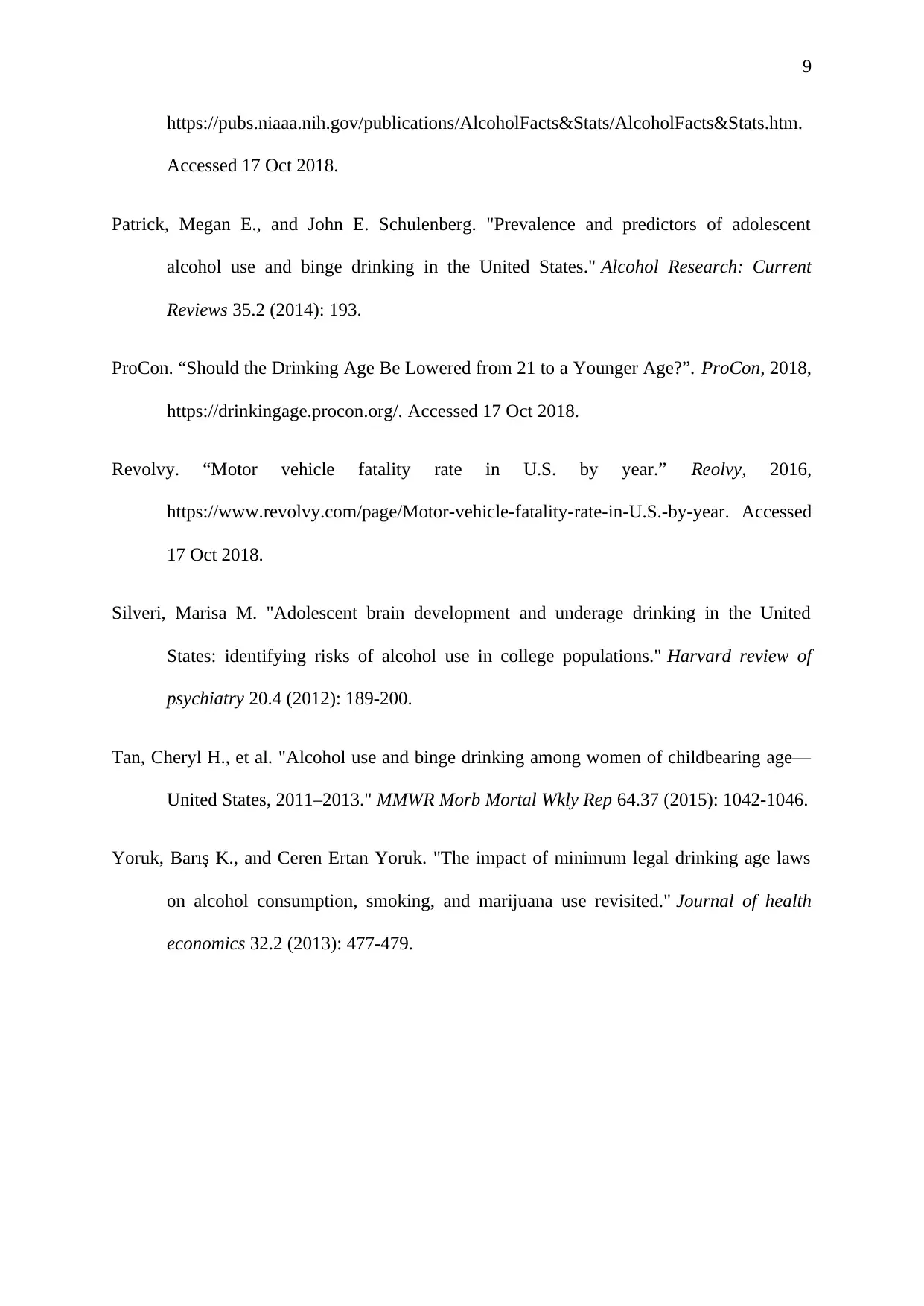
https://pubs.niaaa.nih.gov/publications/AlcoholFacts&Stats/AlcoholFacts&Stats.htm.
Accessed 17 Oct 2018.
Patrick, Megan E., and John E. Schulenberg. "Prevalence and predictors of adolescent
alcohol use and binge drinking in the United States." Alcohol Research: Current
Reviews 35.2 (2014): 193.
ProCon. “Should the Drinking Age Be Lowered from 21 to a Younger Age?”. ProCon, 2018,
https://drinkingage.procon.org/. Accessed 17 Oct 2018.
Revolvy. “Motor vehicle fatality rate in U.S. by year.” Reolvy, 2016,
https://www.revolvy.com/page/Motor-vehicle-fatality-rate-in-U.S.-by-year. Accessed
17 Oct 2018.
Silveri, Marisa M. "Adolescent brain development and underage drinking in the United
States: identifying risks of alcohol use in college populations." Harvard review of
psychiatry 20.4 (2012): 189-200.
Tan, Cheryl H., et al. "Alcohol use and binge drinking among women of childbearing age—
United States, 2011–2013." MMWR Morb Mortal Wkly Rep 64.37 (2015): 1042-1046.
Yoruk, Barış K., and Ceren Ertan Yoruk. "The impact of minimum legal drinking age laws
on alcohol consumption, smoking, and marijuana use revisited." Journal of health
economics 32.2 (2013): 477-479.
https://pubs.niaaa.nih.gov/publications/AlcoholFacts&Stats/AlcoholFacts&Stats.htm.
Accessed 17 Oct 2018.
Patrick, Megan E., and John E. Schulenberg. "Prevalence and predictors of adolescent
alcohol use and binge drinking in the United States." Alcohol Research: Current
Reviews 35.2 (2014): 193.
ProCon. “Should the Drinking Age Be Lowered from 21 to a Younger Age?”. ProCon, 2018,
https://drinkingage.procon.org/. Accessed 17 Oct 2018.
Revolvy. “Motor vehicle fatality rate in U.S. by year.” Reolvy, 2016,
https://www.revolvy.com/page/Motor-vehicle-fatality-rate-in-U.S.-by-year. Accessed
17 Oct 2018.
Silveri, Marisa M. "Adolescent brain development and underage drinking in the United
States: identifying risks of alcohol use in college populations." Harvard review of
psychiatry 20.4 (2012): 189-200.
Tan, Cheryl H., et al. "Alcohol use and binge drinking among women of childbearing age—
United States, 2011–2013." MMWR Morb Mortal Wkly Rep 64.37 (2015): 1042-1046.
Yoruk, Barış K., and Ceren Ertan Yoruk. "The impact of minimum legal drinking age laws
on alcohol consumption, smoking, and marijuana use revisited." Journal of health
economics 32.2 (2013): 477-479.

1 out of 10


Related Documents


Your All-in-One AI-Powered Toolkit for Academic Success.
+13062052269
info@desklib.com
Available 24*7 on WhatsApp / Email
![[object Object]](/_next/static/media/star-bottom.7253800d.svg)
Unlock your academic potential
Copyright © 2020–2026 A2Z Services. All Rights Reserved. Developed and managed by ZUCOL.