Investigating Drought's Impact on the Australian Agricultural Industry
VerifiedAdded on 2023/03/30
|21
|3914
|119
Project
AI Summary
This research proposal investigates the significant impact of drought on the Australian agricultural sector. It begins with an introduction to Australia's climate variations and the historical context of droughts. The problem statement highlights the negative effects of extreme weather conditions on agriculture and the economic consequences for farmers. The research aims to understand the current drought situation, examine 21st-century droughts, evaluate drought's impact, and explore government responses. The literature review covers drought concepts, climate change's influence, observed trends, and specific 21st-century events like the Millennium drought. The methodology outlines the research philosophy, approach, design, strategy, data collection and analysis techniques, ethical considerations, study organization, and project budget. The proposal anticipates that drought negatively affects agricultural production, leading to financial losses for farmers and sector-wide economic impacts. The research uses historical data, literature reviews, and case studies to support its findings and conclusions.
Running head: RESEARCH PROPOSAL
How Drought Affected the Australian Agricultural Industry
Name of the Student:
Name of the University:
Author’s Note:
How Drought Affected the Australian Agricultural Industry
Name of the Student:
Name of the University:
Author’s Note:

Paraphrase This Document
Need a fresh take? Get an instant paraphrase of this document with our AI Paraphraser
1RESEARCH PROPOSAL
Table of Contents
1.0 Introduction...........................................................................................................................2
2.0 Problem statement................................................................................................................2
3.0 Aim and objectives and research questions..........................................................................2
4.0 Justification and potential output of the research.................................................................3
5.0 Literature review...................................................................................................................4
5.1 Concept of drought................................................................................................................4
5.2 Impact of climate change on drought....................................................................................5
5.3 Observed trends on drought in Australia...............................................................................5
5.4 21st century droughts in Australia..........................................................................................6
5.5 Australia’s current drought situation.....................................................................................6
5.6 Impact of drought on Australian agricultural sector..............................................................8
6. Methodology..............................................................................................................................10
6.1 Research philosophy............................................................................................................10
6.2 Research approach...............................................................................................................10
6.3 Research design...................................................................................................................10
6.4 Research strategy.................................................................................................................11
6.5 Data collection process........................................................................................................11
6.6 Data analysis technique.......................................................................................................11
Table of Contents
1.0 Introduction...........................................................................................................................2
2.0 Problem statement................................................................................................................2
3.0 Aim and objectives and research questions..........................................................................2
4.0 Justification and potential output of the research.................................................................3
5.0 Literature review...................................................................................................................4
5.1 Concept of drought................................................................................................................4
5.2 Impact of climate change on drought....................................................................................5
5.3 Observed trends on drought in Australia...............................................................................5
5.4 21st century droughts in Australia..........................................................................................6
5.5 Australia’s current drought situation.....................................................................................6
5.6 Impact of drought on Australian agricultural sector..............................................................8
6. Methodology..............................................................................................................................10
6.1 Research philosophy............................................................................................................10
6.2 Research approach...............................................................................................................10
6.3 Research design...................................................................................................................10
6.4 Research strategy.................................................................................................................11
6.5 Data collection process........................................................................................................11
6.6 Data analysis technique.......................................................................................................11
2RESEARCH PROPOSAL
6.7 Ethical considerations..........................................................................................................12
6.8 Organization of the study.....................................................................................................12
6.9 Budget, project activities and Gantt chart............................................................................13
References......................................................................................................................................16
6.7 Ethical considerations..........................................................................................................12
6.8 Organization of the study.....................................................................................................12
6.9 Budget, project activities and Gantt chart............................................................................13
References......................................................................................................................................16
⊘ This is a preview!⊘
Do you want full access?
Subscribe today to unlock all pages.

Trusted by 1+ million students worldwide
3RESEARCH PROPOSAL
1.0 Introduction
The climate and weather of Australia varies throughout the different territories and states and
generally four different seasons are seen encountered. Australia’s season’s and weather condition
are opposite at times to that of the northern hemisphere. In Australia, December to February is
experienced as summer, March to May is said to be autumn, June to August is said to be winter
and September to November is said to be spring. During the time of federation, Australia
suffered major drought. Australia have encountered years when the country have received below
average rainfall thereby, hampering the agricultural sector of the country significantly (Palmer et
al., 2015).
2.0 Problem statement
Drought is one of the common issues that Australia has been encountering since the 19th
century. This is majorly due to the climatic condition that prevails throughout Australia. Due to
the geographical location of Australia, the country has faced extreme weather conditions that
have negatively affected the agricultural sector. The farmers have encountered several issues
while growing crops due to lack of suitable weather weather conditions and adequate water.
Additionally, as the crops grown are less, the agricultural sector has limited crops to export and
sell due to which the economic aspects of the farmers are compromised significantly (Deo, Kisi
& Singh, 2017).
3.0 Aim and objectives and research questions
The aim of the research is to investigate how drought has affected the Australian agricultural
society.
1.0 Introduction
The climate and weather of Australia varies throughout the different territories and states and
generally four different seasons are seen encountered. Australia’s season’s and weather condition
are opposite at times to that of the northern hemisphere. In Australia, December to February is
experienced as summer, March to May is said to be autumn, June to August is said to be winter
and September to November is said to be spring. During the time of federation, Australia
suffered major drought. Australia have encountered years when the country have received below
average rainfall thereby, hampering the agricultural sector of the country significantly (Palmer et
al., 2015).
2.0 Problem statement
Drought is one of the common issues that Australia has been encountering since the 19th
century. This is majorly due to the climatic condition that prevails throughout Australia. Due to
the geographical location of Australia, the country has faced extreme weather conditions that
have negatively affected the agricultural sector. The farmers have encountered several issues
while growing crops due to lack of suitable weather weather conditions and adequate water.
Additionally, as the crops grown are less, the agricultural sector has limited crops to export and
sell due to which the economic aspects of the farmers are compromised significantly (Deo, Kisi
& Singh, 2017).
3.0 Aim and objectives and research questions
The aim of the research is to investigate how drought has affected the Australian agricultural
society.
Paraphrase This Document
Need a fresh take? Get an instant paraphrase of this document with our AI Paraphraser
4RESEARCH PROPOSAL
The objectives of the research are:
To develop an understanding about the Australia’s current drought situation
To investigate the 21st century droughts in Australia
To critically evaluate the impact of drought on the Australian agricultural sector
To shed light on the steps undertaken by the government for coping up with the impact of
drought on the Australian agricultural sector
The questions of the research are:
What understanding do you have about Australia’s current drought situation?
What are the 20th century droughts in Australia?
What is the impact of drought on the Australian agricultural sector?
What are the steps undertaken by the government for coping up with the impact of
drought on the Australian agricultural sector?
4.0 Justification and potential output of the research
Undertaking the research is rationalized because this will help in developing an in-sight and
deeper understanding of the impact of drought on the Australian’s agricultural sector. This will
provide an opportunity to shed light on the droughts that Australia have encountered in the 20th
century and how it has affected the Australian agricultural sector. While reviewing the 20th
century droughts in Australia, the adequate knowledge about the current drought situation in
Australia can also be gathered thereby, figuring out the impact on the agricultural sector. In
doing so, the research is also significant because this will allow in figuring out the steps or
interventions undertaken by the Australian government in combating with the impact of the issue
on the agricultural sector (Low et al., 2015).
The objectives of the research are:
To develop an understanding about the Australia’s current drought situation
To investigate the 21st century droughts in Australia
To critically evaluate the impact of drought on the Australian agricultural sector
To shed light on the steps undertaken by the government for coping up with the impact of
drought on the Australian agricultural sector
The questions of the research are:
What understanding do you have about Australia’s current drought situation?
What are the 20th century droughts in Australia?
What is the impact of drought on the Australian agricultural sector?
What are the steps undertaken by the government for coping up with the impact of
drought on the Australian agricultural sector?
4.0 Justification and potential output of the research
Undertaking the research is rationalized because this will help in developing an in-sight and
deeper understanding of the impact of drought on the Australian’s agricultural sector. This will
provide an opportunity to shed light on the droughts that Australia have encountered in the 20th
century and how it has affected the Australian agricultural sector. While reviewing the 20th
century droughts in Australia, the adequate knowledge about the current drought situation in
Australia can also be gathered thereby, figuring out the impact on the agricultural sector. In
doing so, the research is also significant because this will allow in figuring out the steps or
interventions undertaken by the Australian government in combating with the impact of the issue
on the agricultural sector (Low et al., 2015).
5RESEARCH PROPOSAL
The potential output of the research is expected to be that drought has affected negatively the
agricultural sector of Australia. The most obvious impact of drought on the Australian
agricultural sector is reduced volume of agricultural production, specifically crops that falls
sharply due to lack of adequate and suitable environment for farming. As a result, the farmers
lose money, as the crops get destroyed due to drought. Additionally, farmers have to spend huge
amount of money on irrigation and drilling wells in order to get adequate water supply thereby,
costing them huge. As a result, the economy of the farmers and the sector is affected negatively,
as they are unable to cover up their expenses suitably (Head, 2014).
5.0 Literature review
5.1 Concept of drought
Drought is a common climatic adversity that is noticed across countries when the dry
period is abnormally prolonged. According to Lobell et al. (2015), drought is defined as the
abnormally prolonged dry period that results in water scarcity that is unable to meet the normal
expectation of water. However, as argued by Deo and Sahin (2015), the concept of drought
highlights monitoring the extent and severity of rainfall deficiency. Therefore, if the rainfall of a
place is less than the area’s total rainfall over a period is less than the average for that period, the
place is said to be experiencing drought. Similar is the case of Australia, the geographical
location of the country have made it vulnerable to severe climatic conditions and drought is one
of them.
5.2 Impact of climate change on drought
Global warming has contributed largely towards climatic change due to which the
weather of countries across the world has experienced significant changes. According to Palmer
The potential output of the research is expected to be that drought has affected negatively the
agricultural sector of Australia. The most obvious impact of drought on the Australian
agricultural sector is reduced volume of agricultural production, specifically crops that falls
sharply due to lack of adequate and suitable environment for farming. As a result, the farmers
lose money, as the crops get destroyed due to drought. Additionally, farmers have to spend huge
amount of money on irrigation and drilling wells in order to get adequate water supply thereby,
costing them huge. As a result, the economy of the farmers and the sector is affected negatively,
as they are unable to cover up their expenses suitably (Head, 2014).
5.0 Literature review
5.1 Concept of drought
Drought is a common climatic adversity that is noticed across countries when the dry
period is abnormally prolonged. According to Lobell et al. (2015), drought is defined as the
abnormally prolonged dry period that results in water scarcity that is unable to meet the normal
expectation of water. However, as argued by Deo and Sahin (2015), the concept of drought
highlights monitoring the extent and severity of rainfall deficiency. Therefore, if the rainfall of a
place is less than the area’s total rainfall over a period is less than the average for that period, the
place is said to be experiencing drought. Similar is the case of Australia, the geographical
location of the country have made it vulnerable to severe climatic conditions and drought is one
of them.
5.2 Impact of climate change on drought
Global warming has contributed largely towards climatic change due to which the
weather of countries across the world has experienced significant changes. According to Palmer
⊘ This is a preview!⊘
Do you want full access?
Subscribe today to unlock all pages.
Trusted by 1+ million students worldwide
6RESEARCH PROPOSAL
et al. (2015), warming of the climate has resulted towards a southward shift in weather fronts
from the Southern Ocean that is mainly responsible for bringing rain to Australia during winter
and spring. As these weather fronts have shifted southwards, rainfall in Australia has declined
significantly thereby, making the prone to drought. Australia has also experienced significant
weather conditions in terms of warming in the past 5 decades. As a result, Australia is
experiencing increased intensity and frequency of hot days and heat waves thereby, increasing
the probability of drought severity. Therefore, it can be inferred that severe and vigorous climatic
changes is making drought conditions in southwest and southeast Australia worse. Additionally,
over the past 3 decades, consistent decrease of cool season and rainfall has also been noticed in
Australia (Spinoni et al., 2014).
5.3 Observed trends on drought in Australia
Australia have experienced severe and several major droughts during the 20th and 21st
centuries. Some of the most severe droughts that Australia have experienced are the Federation
Drought from 1895 to 1903, the World War II drought from 1939 to 1945 and the Millennium
drought from 1996 to 2010. Therefore, the major droughts are without precedent in the last four
centuries. Over the past three decades, rainfall in the cool season in Australia has declined
drastically when compared to the natural variability (Teenberth et al. 2014). For instance, the
Southeastern Australia has experienced 15% decline in the late autumn whereas the early winter
rainfall have decreased by 25% compared to the average rainfall since 1970. Such huge
reductions in rainfall in Australia have resulted in large reductions in stream flows of up to 60%
throughout Australia. For example, the average annual stream flow in Perth’s dam has declined
by nearly 80% since 1970 (Deo et al., 2017).
et al. (2015), warming of the climate has resulted towards a southward shift in weather fronts
from the Southern Ocean that is mainly responsible for bringing rain to Australia during winter
and spring. As these weather fronts have shifted southwards, rainfall in Australia has declined
significantly thereby, making the prone to drought. Australia has also experienced significant
weather conditions in terms of warming in the past 5 decades. As a result, Australia is
experiencing increased intensity and frequency of hot days and heat waves thereby, increasing
the probability of drought severity. Therefore, it can be inferred that severe and vigorous climatic
changes is making drought conditions in southwest and southeast Australia worse. Additionally,
over the past 3 decades, consistent decrease of cool season and rainfall has also been noticed in
Australia (Spinoni et al., 2014).
5.3 Observed trends on drought in Australia
Australia have experienced severe and several major droughts during the 20th and 21st
centuries. Some of the most severe droughts that Australia have experienced are the Federation
Drought from 1895 to 1903, the World War II drought from 1939 to 1945 and the Millennium
drought from 1996 to 2010. Therefore, the major droughts are without precedent in the last four
centuries. Over the past three decades, rainfall in the cool season in Australia has declined
drastically when compared to the natural variability (Teenberth et al. 2014). For instance, the
Southeastern Australia has experienced 15% decline in the late autumn whereas the early winter
rainfall have decreased by 25% compared to the average rainfall since 1970. Such huge
reductions in rainfall in Australia have resulted in large reductions in stream flows of up to 60%
throughout Australia. For example, the average annual stream flow in Perth’s dam has declined
by nearly 80% since 1970 (Deo et al., 2017).
Paraphrase This Document
Need a fresh take? Get an instant paraphrase of this document with our AI Paraphraser
7RESEARCH PROPOSAL
5.4 21st century droughts in Australia
Australia encountered several droughts in the 21st century that affected the agricultural
sector adversely.
Millennium drought in south-eastern Australia
From 1996 to 2010, southeastern Australia experienced prolonged dry conditions because
the average rainfall of the area was well below the average rainfall during the months of April to
October. The so called “millennium drought” existed from 2001 to 2009 that came to an end
with the arrival of La Nina conditions during 2010 to 2011 thereby, resulting in heavy summer
rainfall (Vance et al., 2015).
2001 to 2009: Majority of the eastern Australia experienced dry weather during 2001. If reports
are to be believed 2002 was one of the driest and warmest years on the records that spread
remarkably dry conditions specifically in the eastern half of the country and was considered as
the fourth driest year since 1990 in Australia. In 2003, the El Nino weather pattern broke out that
resulted in occasional yet strong rainfall in 2003 to 2004. Finally, the emergence of La Nina
pattern in 2010 and 2011 brought a sigh of relief resulting in record-breaking rainfall that
increased surface water storage, soil moisture content and climatic conditions (Cai et al., 2014).
5.5 Australia’s current drought situation
Record breaking heat has been noticed in Australia in 2016 and 2017 that resulted in
intense heat waves, bush fires and heat waves. However, the unbearable summer was followed
by record breaking winter fuelling up the already existing drought conditions.
5.4 21st century droughts in Australia
Australia encountered several droughts in the 21st century that affected the agricultural
sector adversely.
Millennium drought in south-eastern Australia
From 1996 to 2010, southeastern Australia experienced prolonged dry conditions because
the average rainfall of the area was well below the average rainfall during the months of April to
October. The so called “millennium drought” existed from 2001 to 2009 that came to an end
with the arrival of La Nina conditions during 2010 to 2011 thereby, resulting in heavy summer
rainfall (Vance et al., 2015).
2001 to 2009: Majority of the eastern Australia experienced dry weather during 2001. If reports
are to be believed 2002 was one of the driest and warmest years on the records that spread
remarkably dry conditions specifically in the eastern half of the country and was considered as
the fourth driest year since 1990 in Australia. In 2003, the El Nino weather pattern broke out that
resulted in occasional yet strong rainfall in 2003 to 2004. Finally, the emergence of La Nina
pattern in 2010 and 2011 brought a sigh of relief resulting in record-breaking rainfall that
increased surface water storage, soil moisture content and climatic conditions (Cai et al., 2014).
5.5 Australia’s current drought situation
Record breaking heat has been noticed in Australia in 2016 and 2017 that resulted in
intense heat waves, bush fires and heat waves. However, the unbearable summer was followed
by record breaking winter fuelling up the already existing drought conditions.
8RESEARCH PROPOSAL
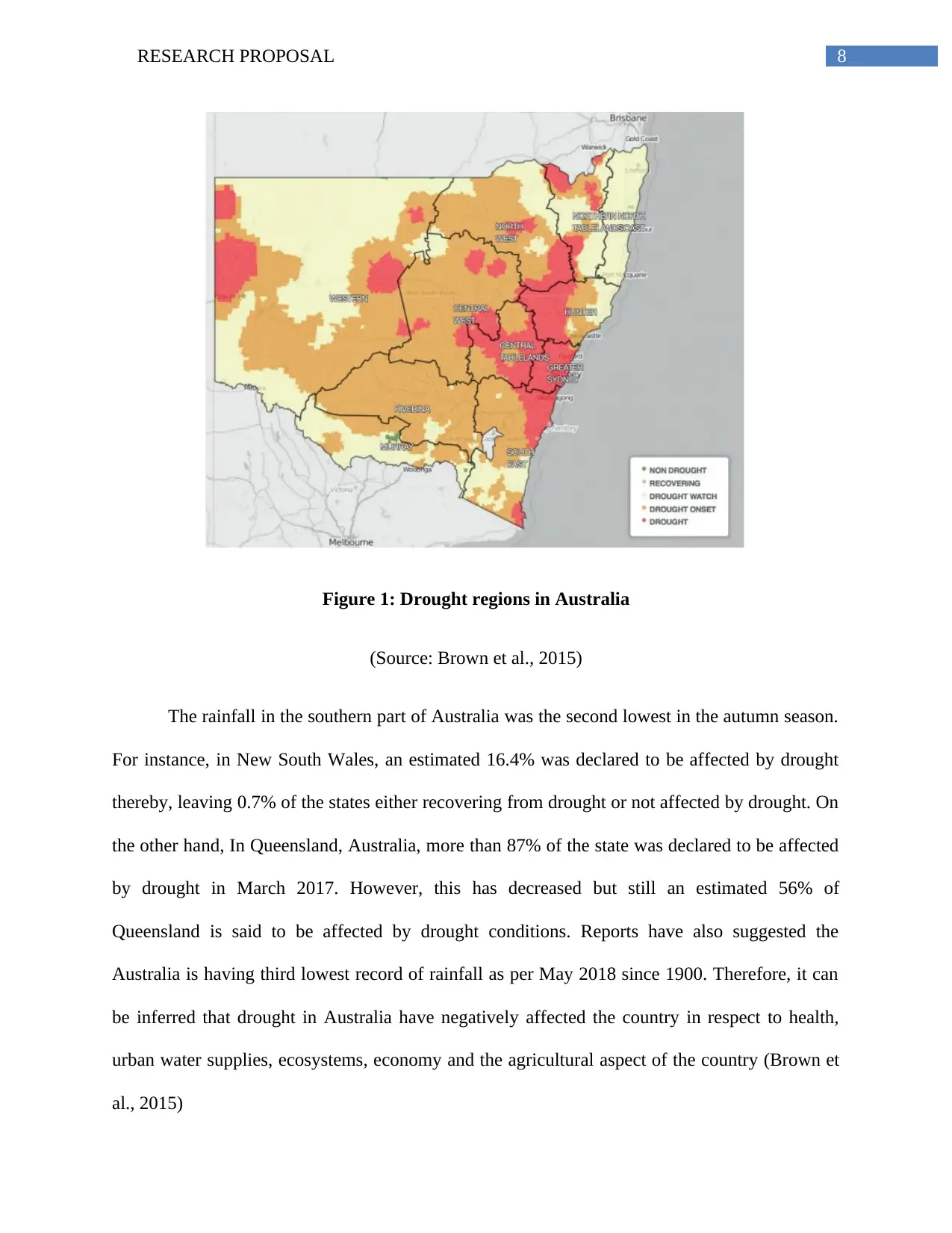
Figure 1: Drought regions in Australia
(Source: Brown et al., 2015)
The rainfall in the southern part of Australia was the second lowest in the autumn season.
For instance, in New South Wales, an estimated 16.4% was declared to be affected by drought
thereby, leaving 0.7% of the states either recovering from drought or not affected by drought. On
the other hand, In Queensland, Australia, more than 87% of the state was declared to be affected
by drought in March 2017. However, this has decreased but still an estimated 56% of
Queensland is said to be affected by drought conditions. Reports have also suggested the
Australia is having third lowest record of rainfall as per May 2018 since 1900. Therefore, it can
be inferred that drought in Australia have negatively affected the country in respect to health,
urban water supplies, ecosystems, economy and the agricultural aspect of the country (Brown et
al., 2015)
Figure 1: Drought regions in Australia
(Source: Brown et al., 2015)
The rainfall in the southern part of Australia was the second lowest in the autumn season.
For instance, in New South Wales, an estimated 16.4% was declared to be affected by drought
thereby, leaving 0.7% of the states either recovering from drought or not affected by drought. On
the other hand, In Queensland, Australia, more than 87% of the state was declared to be affected
by drought in March 2017. However, this has decreased but still an estimated 56% of
Queensland is said to be affected by drought conditions. Reports have also suggested the
Australia is having third lowest record of rainfall as per May 2018 since 1900. Therefore, it can
be inferred that drought in Australia have negatively affected the country in respect to health,
urban water supplies, ecosystems, economy and the agricultural aspect of the country (Brown et
al., 2015)
⊘ This is a preview!⊘
Do you want full access?
Subscribe today to unlock all pages.
Trusted by 1+ million students worldwide
9RESEARCH PROPOSAL
5.6 Impact of drought on Australian agricultural sector
Considering the information presented in the above sections, it can be said that drought
have adversely affected the agricultural sector of the country. According to Kirby et al. (2014),
severe drought conditions have wiped billions from Australian farm production. The drought that
affected the eastern part of Australia affected the growth of winter crops negatively and
significantly reduced the 2018-2019 winter crop growth. As a result, declination in the live
animal export also affected the agricultural sector. As a result, it can be said that Australia can
take more than 5 years for the value of all that is farmed in Australia.
Drought throughout Australia has the agricultural sector drastically because the growth of
crops was reduced and farmers were unable to combat and supply according to the demand of the
country and the population. As mentioned by O’loingsigh et al. (2015), dairy producers were hit
extremely hard by the drought of 2004. In 2004, the extreme weather conditions were a soft year
for this sector and due to drought the revenue of the dairy industry decreased by 5.6%. On the
other hand, agricultural production was also negatively affected due to drought in Australia. The
use of water by the agricultural industry reduced by 37% from 2000 to 2001 as well as from
2004 to 2005 due to drought affecting majority of Australia (Post et al. 2014). If reports are to be
believed, more than 10,000 people were directly affected due to drought. The agricultural sector
of New South Wales was most affected where the production of the agricultural sector was
reduced by 100% in Menindee. Additionally, the agricultural sector of Queensland was also
drastically affected by drought and crop production in Biloela was reduced by 100% as well. The
impact of drought in Queensland has been so severe that Bourke in Australia had sufficient water
for growing one cotton crop in the past five years (Saft et al., 2015).
5.6 Impact of drought on Australian agricultural sector
Considering the information presented in the above sections, it can be said that drought
have adversely affected the agricultural sector of the country. According to Kirby et al. (2014),
severe drought conditions have wiped billions from Australian farm production. The drought that
affected the eastern part of Australia affected the growth of winter crops negatively and
significantly reduced the 2018-2019 winter crop growth. As a result, declination in the live
animal export also affected the agricultural sector. As a result, it can be said that Australia can
take more than 5 years for the value of all that is farmed in Australia.
Drought throughout Australia has the agricultural sector drastically because the growth of
crops was reduced and farmers were unable to combat and supply according to the demand of the
country and the population. As mentioned by O’loingsigh et al. (2015), dairy producers were hit
extremely hard by the drought of 2004. In 2004, the extreme weather conditions were a soft year
for this sector and due to drought the revenue of the dairy industry decreased by 5.6%. On the
other hand, agricultural production was also negatively affected due to drought in Australia. The
use of water by the agricultural industry reduced by 37% from 2000 to 2001 as well as from
2004 to 2005 due to drought affecting majority of Australia (Post et al. 2014). If reports are to be
believed, more than 10,000 people were directly affected due to drought. The agricultural sector
of New South Wales was most affected where the production of the agricultural sector was
reduced by 100% in Menindee. Additionally, the agricultural sector of Queensland was also
drastically affected by drought and crop production in Biloela was reduced by 100% as well. The
impact of drought in Queensland has been so severe that Bourke in Australia had sufficient water
for growing one cotton crop in the past five years (Saft et al., 2015).
Paraphrase This Document
Need a fresh take? Get an instant paraphrase of this document with our AI Paraphraser
10RESEARCH PROPOSAL
Due to severe drought conditions, the production of crops lowered significantly because
the crops were not getting suitable weather conditions to grow. Extreme heat and reduced rainfall
made the weather highly unfavorable for crops to grow thereby, affecting the export rate of the
Australian agricultural sector. As a result of drought, the rural exports of Australian agricultural
sector reduced by an estimated 13% from 2002 to 2003. This is said to be the largest and major
decline in the agricultural rural export in the Australian history (Kirkegaard et al., 2016).
Therefore, it can be summarized that drought has always been a severe issue for Australia
and recently global warming is contributing towards the extreme weather conditions more that is
imposing negative impact on the Australian environment and the agricultural sector. Reduced
crop growth, production and export followed by reduced income for the farmers, decreased
animal rearing are noticed thereby, affecting the overall agricultural sector of Australia.
Due to severe drought conditions, the production of crops lowered significantly because
the crops were not getting suitable weather conditions to grow. Extreme heat and reduced rainfall
made the weather highly unfavorable for crops to grow thereby, affecting the export rate of the
Australian agricultural sector. As a result of drought, the rural exports of Australian agricultural
sector reduced by an estimated 13% from 2002 to 2003. This is said to be the largest and major
decline in the agricultural rural export in the Australian history (Kirkegaard et al., 2016).
Therefore, it can be summarized that drought has always been a severe issue for Australia
and recently global warming is contributing towards the extreme weather conditions more that is
imposing negative impact on the Australian environment and the agricultural sector. Reduced
crop growth, production and export followed by reduced income for the farmers, decreased
animal rearing are noticed thereby, affecting the overall agricultural sector of Australia.
11RESEARCH PROPOSAL
6. Methodology
6.1 Research philosophy
For undertaking the research, interpretivism philosophy will be used. Using this
philosophy will provide an opportunity to consider the views and opinions of different authors
and sources and interpret it accordingly for understanding how drought have affected the
agricultural industry of Australia. This will also facilitate comparing and contrasting information
about the Australian agricultural industry before and after drought have been encountered
thereby, gathering better understanding about the Australian agricultural industry (Kumar, 2019).
6.2 Research approach
For undertaking the research, deductive approach will be used. Using deductive approach
will provide an opportunity to refer to various previously existing pieces of literatures and
information available in different secondary sources thereby, making observations accordingly.
In this case, deductive approach will be suitable because this will allow studying the agricultural
sector of Australia and making suitable observations regarding the impact of drought in the
sector (Mackey & Gass, 2015).
6.3 Research design
For this research, descriptive research design will be used. Using descriptive design is
most suitable because this allowed identifying the issues within the research followed by
analyzing the potential issues that led to the emergence of the issues. In this case, descriptive
design will help in finding issues that resulted in drought in Australia and the reasons that led to
the issues that caused drought thereby, affecting the Australian agricultural industry (Taylor,
Bogdan & DeVault, 2015).
6. Methodology
6.1 Research philosophy
For undertaking the research, interpretivism philosophy will be used. Using this
philosophy will provide an opportunity to consider the views and opinions of different authors
and sources and interpret it accordingly for understanding how drought have affected the
agricultural industry of Australia. This will also facilitate comparing and contrasting information
about the Australian agricultural industry before and after drought have been encountered
thereby, gathering better understanding about the Australian agricultural industry (Kumar, 2019).
6.2 Research approach
For undertaking the research, deductive approach will be used. Using deductive approach
will provide an opportunity to refer to various previously existing pieces of literatures and
information available in different secondary sources thereby, making observations accordingly.
In this case, deductive approach will be suitable because this will allow studying the agricultural
sector of Australia and making suitable observations regarding the impact of drought in the
sector (Mackey & Gass, 2015).
6.3 Research design
For this research, descriptive research design will be used. Using descriptive design is
most suitable because this allowed identifying the issues within the research followed by
analyzing the potential issues that led to the emergence of the issues. In this case, descriptive
design will help in finding issues that resulted in drought in Australia and the reasons that led to
the issues that caused drought thereby, affecting the Australian agricultural industry (Taylor,
Bogdan & DeVault, 2015).
⊘ This is a preview!⊘
Do you want full access?
Subscribe today to unlock all pages.
Trusted by 1+ million students worldwide

1 out of 21


Related Documents


Your All-in-One AI-Powered Toolkit for Academic Success.
+13062052269
info@desklib.com
Available 24*7 on WhatsApp / Email
![[object Object]](/_next/static/media/star-bottom.7253800d.svg)
Unlock your academic potential
Copyright © 2020–2026 A2Z Services. All Rights Reserved. Developed and managed by ZUCOL.