SLE706 Assignment: Reasons for Drug Discovery Failure and Solutions
VerifiedAdded on 2022/10/06
|12
|2826
|500
Report
AI Summary
This report delves into the complexities of drug discovery and development, exploring the reasons behind the high failure rates observed in the pharmaceutical industry. It highlights the intricate processes involved, from identifying lead compounds to bringing a new drug to market, and the associated costs and challenges. The report examines factors contributing to failure, such as inadequate study design, poor dosage selection, and insufficient understanding of drug interactions within the body. Furthermore, it discusses the impact of patent expirations and the rise of generic competition. The report then proposes innovative solutions to increase success rates, including improvements in clinical trial design, the use of modeling and simulation, and a focus on incremental innovation. The report emphasizes the importance of comprehensive data analysis and the need for effective strategies to mitigate risks, ultimately aiming to improve the efficiency and success of drug development processes. The document is contributed by a student to be published on the website Desklib. Desklib is a platform which provides all the necessary AI based study tools for students.
MEDICAL ASSIGNMENT SOLUTION 1
Medical Assignment Solution
Student’s Name
Institutional Affiliation
Date
City
Medical Assignment Solution
Student’s Name
Institutional Affiliation
Date
City

Paraphrase This Document
Need a fresh take? Get an instant paraphrase of this document with our AI Paraphraser
MEDICAL ASSIGNMENT SOLUTION 2
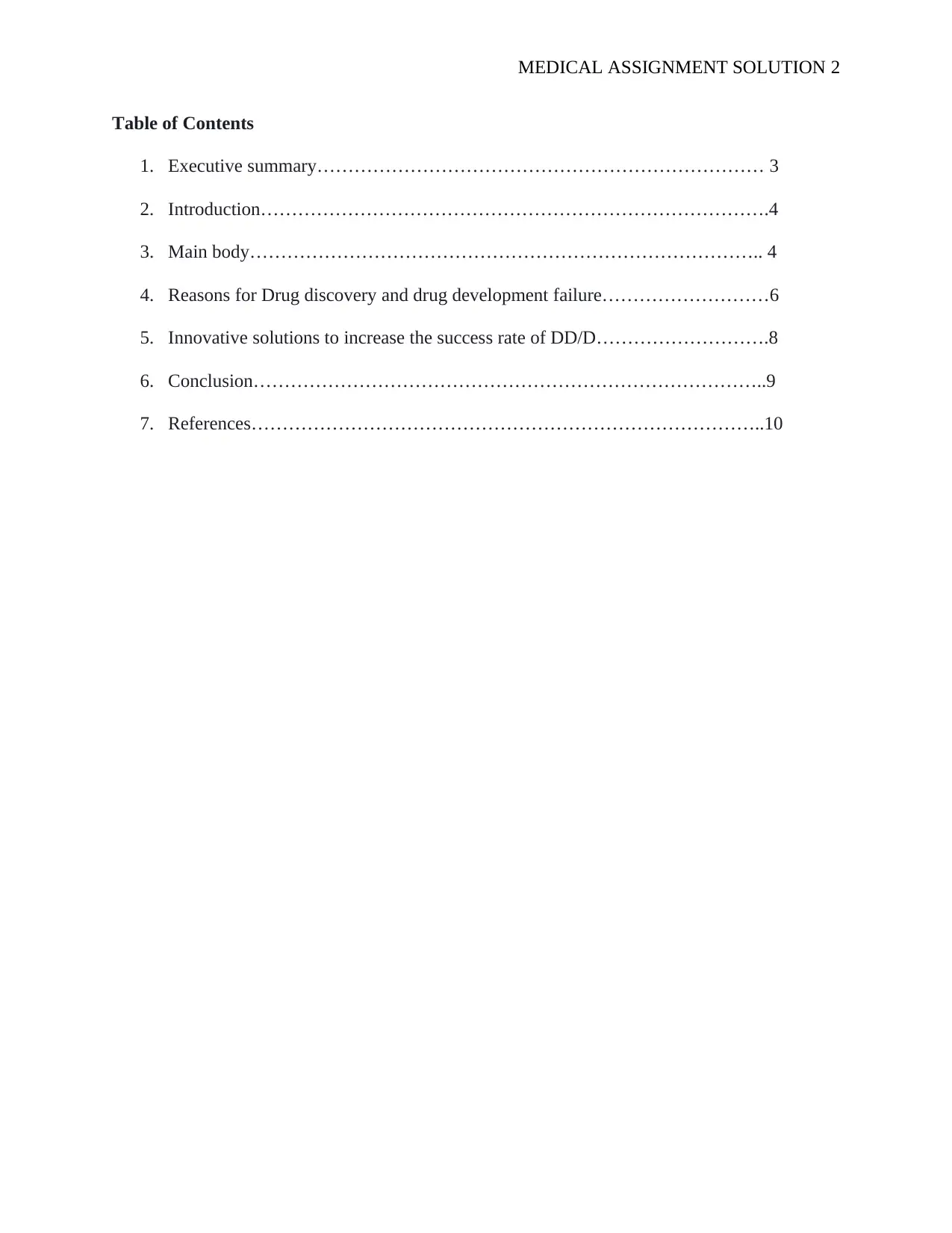
Table of Contents
1. Executive summary……………………………………………………………… 3
2. Introduction……………………………………………………………………….4
3. Main body……………………………………………………………………….. 4
4. Reasons for Drug discovery and drug development failure………………………6
5. Innovative solutions to increase the success rate of DD/D……………………….8
6. Conclusion………………………………………………………………………..9
7. References………………………………………………………………………..10
Table of Contents
1. Executive summary……………………………………………………………… 3
2. Introduction……………………………………………………………………….4
3. Main body……………………………………………………………………….. 4
4. Reasons for Drug discovery and drug development failure………………………6
5. Innovative solutions to increase the success rate of DD/D……………………….8
6. Conclusion………………………………………………………………………..9
7. References………………………………………………………………………..10
MEDICAL ASSIGNMENT SOLUTION 3
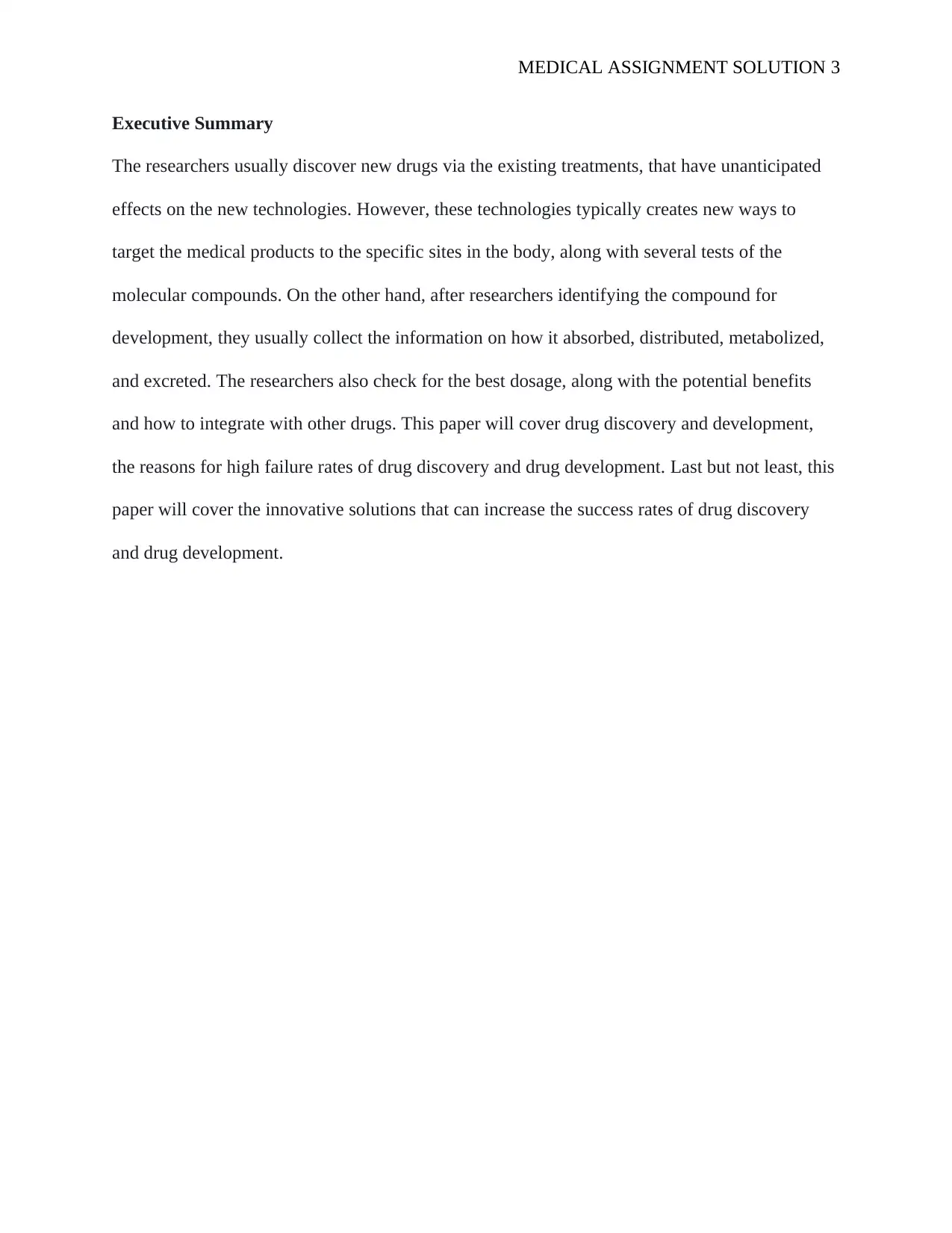
Executive Summary
The researchers usually discover new drugs via the existing treatments, that have unanticipated
effects on the new technologies. However, these technologies typically creates new ways to
target the medical products to the specific sites in the body, along with several tests of the
molecular compounds. On the other hand, after researchers identifying the compound for
development, they usually collect the information on how it absorbed, distributed, metabolized,
and excreted. The researchers also check for the best dosage, along with the potential benefits
and how to integrate with other drugs. This paper will cover drug discovery and development,
the reasons for high failure rates of drug discovery and drug development. Last but not least, this
paper will cover the innovative solutions that can increase the success rates of drug discovery
and drug development.
Executive Summary
The researchers usually discover new drugs via the existing treatments, that have unanticipated
effects on the new technologies. However, these technologies typically creates new ways to
target the medical products to the specific sites in the body, along with several tests of the
molecular compounds. On the other hand, after researchers identifying the compound for
development, they usually collect the information on how it absorbed, distributed, metabolized,
and excreted. The researchers also check for the best dosage, along with the potential benefits
and how to integrate with other drugs. This paper will cover drug discovery and development,
the reasons for high failure rates of drug discovery and drug development. Last but not least, this
paper will cover the innovative solutions that can increase the success rates of drug discovery
and drug development.
⊘ This is a preview!⊘
Do you want full access?
Subscribe today to unlock all pages.

Trusted by 1+ million students worldwide
MEDICAL ASSIGNMENT SOLUTION 4
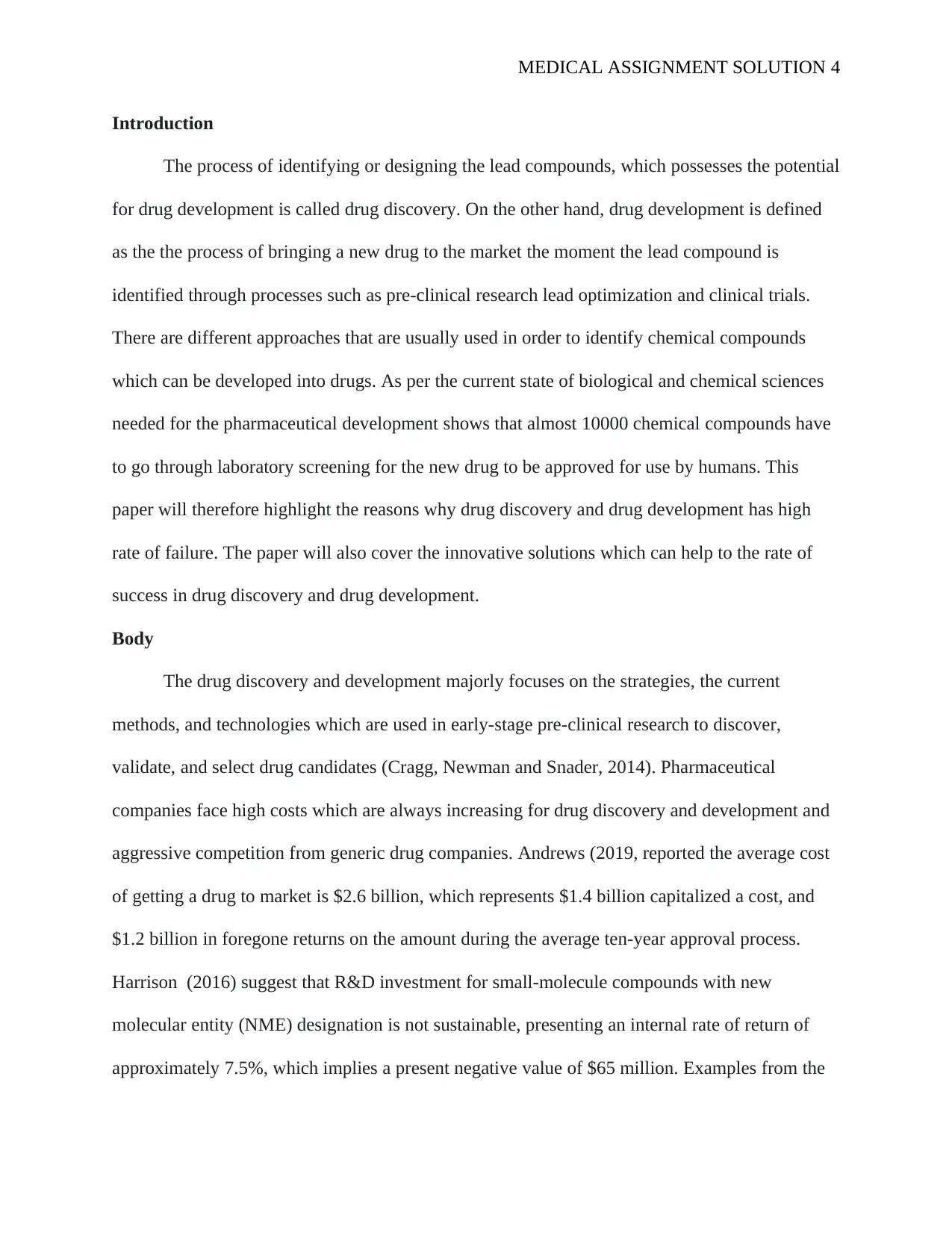
Introduction
The process of identifying or designing the lead compounds, which possesses the potential
for drug development is called drug discovery. On the other hand, drug development is defined
as the the process of bringing a new drug to the market the moment the lead compound is
identified through processes such as pre-clinical research lead optimization and clinical trials.
There are different approaches that are usually used in order to identify chemical compounds
which can be developed into drugs. As per the current state of biological and chemical sciences
needed for the pharmaceutical development shows that almost 10000 chemical compounds have
to go through laboratory screening for the new drug to be approved for use by humans. This
paper will therefore highlight the reasons why drug discovery and drug development has high
rate of failure. The paper will also cover the innovative solutions which can help to the rate of
success in drug discovery and drug development.
Body
The drug discovery and development majorly focuses on the strategies, the current
methods, and technologies which are used in early-stage pre-clinical research to discover,
validate, and select drug candidates (Cragg, Newman and Snader, 2014). Pharmaceutical
companies face high costs which are always increasing for drug discovery and development and
aggressive competition from generic drug companies. Andrews (2019, reported the average cost
of getting a drug to market is $2.6 billion, which represents $1.4 billion capitalized a cost, and
$1.2 billion in foregone returns on the amount during the average ten-year approval process.
Harrison (2016) suggest that R&D investment for small-molecule compounds with new
molecular entity (NME) designation is not sustainable, presenting an internal rate of return of
approximately 7.5%, which implies a present negative value of $65 million. Examples from the
Introduction
The process of identifying or designing the lead compounds, which possesses the potential
for drug development is called drug discovery. On the other hand, drug development is defined
as the the process of bringing a new drug to the market the moment the lead compound is
identified through processes such as pre-clinical research lead optimization and clinical trials.
There are different approaches that are usually used in order to identify chemical compounds
which can be developed into drugs. As per the current state of biological and chemical sciences
needed for the pharmaceutical development shows that almost 10000 chemical compounds have
to go through laboratory screening for the new drug to be approved for use by humans. This
paper will therefore highlight the reasons why drug discovery and drug development has high
rate of failure. The paper will also cover the innovative solutions which can help to the rate of
success in drug discovery and drug development.
Body
The drug discovery and development majorly focuses on the strategies, the current
methods, and technologies which are used in early-stage pre-clinical research to discover,
validate, and select drug candidates (Cragg, Newman and Snader, 2014). Pharmaceutical
companies face high costs which are always increasing for drug discovery and development and
aggressive competition from generic drug companies. Andrews (2019, reported the average cost
of getting a drug to market is $2.6 billion, which represents $1.4 billion capitalized a cost, and
$1.2 billion in foregone returns on the amount during the average ten-year approval process.
Harrison (2016) suggest that R&D investment for small-molecule compounds with new
molecular entity (NME) designation is not sustainable, presenting an internal rate of return of
approximately 7.5%, which implies a present negative value of $65 million. Examples from the
Paraphrase This Document
Need a fresh take? Get an instant paraphrase of this document with our AI Paraphraser
MEDICAL ASSIGNMENT SOLUTION 5
literature consistently report that just 25-30% of this $1.4 billion is spent on incremental
innovations, or post-approval research and development (R&D) (Adir et al, 2019).
Inducing the most significant investment brands drug patent expiry threatens
pharmaceutical companies with the end of market dominance and blockbuster revenues as
generic manufacturers flood the market with less expensive alternatives. The Drug Price
Competition and Patent Term Restoration Act of 1984 (aka Waxman-Hatch Act) established
general introduction upon patent expiration, but it represented a tradeoff: it extended drug patents
to reward innovation and fast-tracked post-expiration general introduction to effect cost savings.
A classic example is the 2001 patent expiration for Eli Lilly’s Prozac, which drew at least a
dozen generics to market (Brown and Wright, 2016).
Once generating $3 billion in annual revenue, Eli Lilly lost half of its customers within
two weeks and after 16 months had lost 73.8%. In general, Atadja and Perez (2017) suggest
100% median usage frequency of branded drugs pre-patent expiry and 79% median usage
frequency post-patent expiry irrespective of related revenue, which correlates higher generic
utilization with higher revenues. Thus, it is unsurprising that pharmaceutical companies are
motivated to protect their revenues by overcoming patent expirations through incremental
innovation of existing drugs (Sarkar and Sarkar, 2019).
From 2012 to 2018, it has been estimated that $290 billion in sales is at risk for patent
expiration (Formoso et al., 2016), which has been described a pharmaceutical “patent cliff.” The
figures present the outcome: between 2000 and 2013, overall healthcare expenditures inflated by
5-6% annually, while CMS reported pharmaceutical expenditure growth at 9% from 2000-2009,
but only 1.5% from 2010 to 2013. Pharmaceutical expenditure is projected to inflate 6.9%
annually from 2014 to 2024 (Mishra, 2016). It should be noted that the CMS data on drug
literature consistently report that just 25-30% of this $1.4 billion is spent on incremental
innovations, or post-approval research and development (R&D) (Adir et al, 2019).
Inducing the most significant investment brands drug patent expiry threatens
pharmaceutical companies with the end of market dominance and blockbuster revenues as
generic manufacturers flood the market with less expensive alternatives. The Drug Price
Competition and Patent Term Restoration Act of 1984 (aka Waxman-Hatch Act) established
general introduction upon patent expiration, but it represented a tradeoff: it extended drug patents
to reward innovation and fast-tracked post-expiration general introduction to effect cost savings.
A classic example is the 2001 patent expiration for Eli Lilly’s Prozac, which drew at least a
dozen generics to market (Brown and Wright, 2016).
Once generating $3 billion in annual revenue, Eli Lilly lost half of its customers within
two weeks and after 16 months had lost 73.8%. In general, Atadja and Perez (2017) suggest
100% median usage frequency of branded drugs pre-patent expiry and 79% median usage
frequency post-patent expiry irrespective of related revenue, which correlates higher generic
utilization with higher revenues. Thus, it is unsurprising that pharmaceutical companies are
motivated to protect their revenues by overcoming patent expirations through incremental
innovation of existing drugs (Sarkar and Sarkar, 2019).
From 2012 to 2018, it has been estimated that $290 billion in sales is at risk for patent
expiration (Formoso et al., 2016), which has been described a pharmaceutical “patent cliff.” The
figures present the outcome: between 2000 and 2013, overall healthcare expenditures inflated by
5-6% annually, while CMS reported pharmaceutical expenditure growth at 9% from 2000-2009,
but only 1.5% from 2010 to 2013. Pharmaceutical expenditure is projected to inflate 6.9%
annually from 2014 to 2024 (Mishra, 2016). It should be noted that the CMS data on drug
MEDICAL ASSIGNMENT SOLUTION 6
expenditure does not differentiate between spending on on-patent vs. generic drugs. It also does
not distinguish spending on (A) novel innovations vs. (B) incremental innovations, which the
FDA describes as (A) drugs containing previously unapproved molecules and (B) approved
modifications to existing drugs or new drugs created from an already approved drug,
respectively. Since lower spending growth occurred at the time of the "patent cliff" described
above, there appears to be a correlation between increased spending and approval/use of on-
patent drugs, which were found to cost 300% more than generics even after patent expiration
(Nikalje, 2015).
Reasons for high failure rates in the drug discovery and drug development
There are several reasons why failure rates in drug discovery and development are high.
To start with, the marketable dosage form with the desired drug delivery has to be developed to
commercialize the product. Insufficient understanding of how investigational product interacts
with the body can also increase the failure rate (Lipinski, Lombardo, Dominy and Feeney, 2015).
The interactions usually vary between animals and human beings, healthy and patients. Some of
the other reasons that can increase the failure rates of drug discovery and drug development are
how data are analyzed, the inadequate study design, and non-optimal assessment schedules.
Accordingly, the placebo response also contributes to the drug development failure (Ho, Wang
and Chow, 2015).
The quality of clinical data usually build the key evidence along with conclusive results
of clinical trial. In that case, it is a key to the successful study closure. Dr. Soon-Shiong recently
bought rights from Samyang Biopharmaceuticals to Cynviloq, a similar drug known
as paclitaxel nanoparticle polymeric micelle, an albumin-free formulation of paclitaxel that
achieves identical therapeutic effects (Hauser, Attwood, Rask-Andersen, Schiöth and Gloriam,
expenditure does not differentiate between spending on on-patent vs. generic drugs. It also does
not distinguish spending on (A) novel innovations vs. (B) incremental innovations, which the
FDA describes as (A) drugs containing previously unapproved molecules and (B) approved
modifications to existing drugs or new drugs created from an already approved drug,
respectively. Since lower spending growth occurred at the time of the "patent cliff" described
above, there appears to be a correlation between increased spending and approval/use of on-
patent drugs, which were found to cost 300% more than generics even after patent expiration
(Nikalje, 2015).
Reasons for high failure rates in the drug discovery and drug development
There are several reasons why failure rates in drug discovery and development are high.
To start with, the marketable dosage form with the desired drug delivery has to be developed to
commercialize the product. Insufficient understanding of how investigational product interacts
with the body can also increase the failure rate (Lipinski, Lombardo, Dominy and Feeney, 2015).
The interactions usually vary between animals and human beings, healthy and patients. Some of
the other reasons that can increase the failure rates of drug discovery and drug development are
how data are analyzed, the inadequate study design, and non-optimal assessment schedules.
Accordingly, the placebo response also contributes to the drug development failure (Ho, Wang
and Chow, 2015).
The quality of clinical data usually build the key evidence along with conclusive results
of clinical trial. In that case, it is a key to the successful study closure. Dr. Soon-Shiong recently
bought rights from Samyang Biopharmaceuticals to Cynviloq, a similar drug known
as paclitaxel nanoparticle polymeric micelle, an albumin-free formulation of paclitaxel that
achieves identical therapeutic effects (Hauser, Attwood, Rask-Andersen, Schiöth and Gloriam,
⊘ This is a preview!⊘
Do you want full access?
Subscribe today to unlock all pages.
Trusted by 1+ million students worldwide
MEDICAL ASSIGNMENT SOLUTION 7
2017). Cynviloq does not infringe on Celgene's patent for Abraxane since both rely on
incremental innovation adjacent to known therapy (Rudin and Weissleder, 2016). However,
Cynviloq will likely experience faster approval and relatively low investment to prove
therapeutic equivalence to Abraxane. This is because it delivers the same molecule and
demonstrates an improved safety profile in clinical trials by eliminating risks associated with
using albumin. That is a human blood component, which must address a genetic variation of
recipient albumin type and risk of contamination for immunosuppressed chemotherapy patients
(Rudin and Weissleder, 2016).
Dr. Soon-Shiong exploited two pathways of incremental innovation by presenting a new
dosage form and a new reformulation that made a viable and more effective therapy from an
existing one. Finally, it should be noted that while Dr. Soon-Shiong’s albumin and secondary
nanoparticle drug delivery mechanism have been patented, they have far-reaching applications in
other chemotherapies to improve efficacy and decrease toxicity. Both Abraxane and Cynviloq
provide evidence that incremental innovation is a vital part of drug discovery and present clear
evidence that patent expiry, enhanced revenue, and clinical outcomes function to catalyze
incremental innovation (Intini, Bonifazi, and Migliaccio, 2019).
As a final note, the systematic devaluing of incremental innovation has resulted in a
direct challenge to future pharmaceutical discovery: ignoring the importance of incremental
innovations devalues incremental findings. The result is a scientific community that tolerates
incomplete data and publication bias, which systematically hides the very opportunities that
drive innovation in all forms.
Dr. Soon-Shiong’s discovery was a direct response to honest discussion during a 1992
National Cancer Institute meeting of Taxol’s efficacy and toxicity. Unsurprisingly, a meta-
2017). Cynviloq does not infringe on Celgene's patent for Abraxane since both rely on
incremental innovation adjacent to known therapy (Rudin and Weissleder, 2016). However,
Cynviloq will likely experience faster approval and relatively low investment to prove
therapeutic equivalence to Abraxane. This is because it delivers the same molecule and
demonstrates an improved safety profile in clinical trials by eliminating risks associated with
using albumin. That is a human blood component, which must address a genetic variation of
recipient albumin type and risk of contamination for immunosuppressed chemotherapy patients
(Rudin and Weissleder, 2016).
Dr. Soon-Shiong exploited two pathways of incremental innovation by presenting a new
dosage form and a new reformulation that made a viable and more effective therapy from an
existing one. Finally, it should be noted that while Dr. Soon-Shiong’s albumin and secondary
nanoparticle drug delivery mechanism have been patented, they have far-reaching applications in
other chemotherapies to improve efficacy and decrease toxicity. Both Abraxane and Cynviloq
provide evidence that incremental innovation is a vital part of drug discovery and present clear
evidence that patent expiry, enhanced revenue, and clinical outcomes function to catalyze
incremental innovation (Intini, Bonifazi, and Migliaccio, 2019).
As a final note, the systematic devaluing of incremental innovation has resulted in a
direct challenge to future pharmaceutical discovery: ignoring the importance of incremental
innovations devalues incremental findings. The result is a scientific community that tolerates
incomplete data and publication bias, which systematically hides the very opportunities that
drive innovation in all forms.
Dr. Soon-Shiong’s discovery was a direct response to honest discussion during a 1992
National Cancer Institute meeting of Taxol’s efficacy and toxicity. Unsurprisingly, a meta-
Paraphrase This Document
Need a fresh take? Get an instant paraphrase of this document with our AI Paraphraser
MEDICAL ASSIGNMENT SOLUTION 8
studies on Taxol trials cautiously suggest minimal bias. This legacy has not translated to
downstream studies: a 2009 analysis of a nab-paclitaxel chemotherapy study found differences
between published findings (most toxic effects were minimal, rarely limited therapy, and did not
have a detrimental impact on the overall quality of life.) and FDA findings. Additional papers
present a similar concern, like a 2012 meta-study of 110 phase III clinical trials of novel breast
cancer treatments that revealed 67% of papers presented biased findings on adverse side-
effects.
The role of incremental innovation continues to reveal itself. As Shadlen poignantly
wrote in 2005, personalized medicine' is dependent on incremental innovations in the form of
expansions in the members of each drug class." To that end, anyone who knows anything about
pharmaceuticals would agree that victories short of a cure should never be considered permanent.
It is willful ignorance to suggest that failures experience a different fate (Intini, Bonifazi, and
Migliaccio, 2019).
Thus, patent expiry, enhanced revenue, and clinical outcomes are well negotiated when
incremental innovation is appropriately valued, and the road thereto cleared of obstacles
impeding its ability to present effective therapies from past failures and application to future
successes cannot be overestimated. Additional studies are needed to determine the potential
drivers of incremental innovation in terms of fully disclosed scientific data.
Furthermore, the usage of drug pricing policies that may temper low appraisal and
methodology to determine the meaningful value of development related to revenue (Nair et al.,
2017).
Innovative solutions to increase the success rates in the drug discovery and drug
Development
studies on Taxol trials cautiously suggest minimal bias. This legacy has not translated to
downstream studies: a 2009 analysis of a nab-paclitaxel chemotherapy study found differences
between published findings (most toxic effects were minimal, rarely limited therapy, and did not
have a detrimental impact on the overall quality of life.) and FDA findings. Additional papers
present a similar concern, like a 2012 meta-study of 110 phase III clinical trials of novel breast
cancer treatments that revealed 67% of papers presented biased findings on adverse side-
effects.
The role of incremental innovation continues to reveal itself. As Shadlen poignantly
wrote in 2005, personalized medicine' is dependent on incremental innovations in the form of
expansions in the members of each drug class." To that end, anyone who knows anything about
pharmaceuticals would agree that victories short of a cure should never be considered permanent.
It is willful ignorance to suggest that failures experience a different fate (Intini, Bonifazi, and
Migliaccio, 2019).
Thus, patent expiry, enhanced revenue, and clinical outcomes are well negotiated when
incremental innovation is appropriately valued, and the road thereto cleared of obstacles
impeding its ability to present effective therapies from past failures and application to future
successes cannot be overestimated. Additional studies are needed to determine the potential
drivers of incremental innovation in terms of fully disclosed scientific data.
Furthermore, the usage of drug pricing policies that may temper low appraisal and
methodology to determine the meaningful value of development related to revenue (Nair et al.,
2017).
Innovative solutions to increase the success rates in the drug discovery and drug
Development
MEDICAL ASSIGNMENT SOLUTION 9
The most significant impact on the timescale of drug discovery is to be made in clinical
trials. In that case, changes in the earlier stages usually have little effect (Intini, Bonifazi, and
Migliaccio, 2019). However, increasing the success rate in most phases often increases the time
it takes in discovering the drug. Reducing repeats at any stage is the only way to reduce the costs
together with time to launch. As an illustration, the reduction of repeats in Phase III can help to
reduce the need for many projects, which can then reduce the costs of discovery (Frank and
Hargreaves, 2015).
Reduction of attrition rate by starting a comprehensive evaluation of potential safety
issues that are associated with the primary target. The risk mitigation plan should, therefore, be
built in the early development stages by the use of silico panel. Accordingly, the use of modeling
and simulation to inform the drug development decisions can help to increase the success rate.
This approach is useful especially for tasks which range from the prediction of defensible doses
to the comprehension of the association between the drug concentration and the desirable
pharmacodynamics responses (Intini, Bonifazi, and Migliaccio, 2019).
The other solution of increasing the success rate of drug discovery and development is
selecting the necessary efficacy endpoints. The best endpoints usually give a direct readout of the
clinical benefits since they are always also of interest to the regulatory authorities.
Conclusion
In conclusion, drug discovery and drug development process is lengthy and complicated.
However, some of the reasons why there is a high failure rate are because of poor dosage
selection, the inadequate study design in conjunction with how data is analyzed. On the other
hand, some of the innovative solutions which can help in increasing the success rate drug
discovery and development are ensuring appropriate clinical trial design, the use of modeling and
The most significant impact on the timescale of drug discovery is to be made in clinical
trials. In that case, changes in the earlier stages usually have little effect (Intini, Bonifazi, and
Migliaccio, 2019). However, increasing the success rate in most phases often increases the time
it takes in discovering the drug. Reducing repeats at any stage is the only way to reduce the costs
together with time to launch. As an illustration, the reduction of repeats in Phase III can help to
reduce the need for many projects, which can then reduce the costs of discovery (Frank and
Hargreaves, 2015).
Reduction of attrition rate by starting a comprehensive evaluation of potential safety
issues that are associated with the primary target. The risk mitigation plan should, therefore, be
built in the early development stages by the use of silico panel. Accordingly, the use of modeling
and simulation to inform the drug development decisions can help to increase the success rate.
This approach is useful especially for tasks which range from the prediction of defensible doses
to the comprehension of the association between the drug concentration and the desirable
pharmacodynamics responses (Intini, Bonifazi, and Migliaccio, 2019).
The other solution of increasing the success rate of drug discovery and development is
selecting the necessary efficacy endpoints. The best endpoints usually give a direct readout of the
clinical benefits since they are always also of interest to the regulatory authorities.
Conclusion
In conclusion, drug discovery and drug development process is lengthy and complicated.
However, some of the reasons why there is a high failure rate are because of poor dosage
selection, the inadequate study design in conjunction with how data is analyzed. On the other
hand, some of the innovative solutions which can help in increasing the success rate drug
discovery and development are ensuring appropriate clinical trial design, the use of modeling and
⊘ This is a preview!⊘
Do you want full access?
Subscribe today to unlock all pages.
Trusted by 1+ million students worldwide
MEDICAL ASSIGNMENT SOLUTION 10
simulation. However, the FDA always wants a new drug to be effective and safe enough for
patients’ consumption. That's is the reason why the this process starts with discovery &
development, then pre-clinical research, clinical trials with multiple phases, FDA review &
approval, and post-market monitoring/surveillance.
simulation. However, the FDA always wants a new drug to be effective and safe enough for
patients’ consumption. That's is the reason why the this process starts with discovery &
development, then pre-clinical research, clinical trials with multiple phases, FDA review &
approval, and post-market monitoring/surveillance.
Paraphrase This Document
Need a fresh take? Get an instant paraphrase of this document with our AI Paraphraser
MEDICAL ASSIGNMENT SOLUTION 11
References
Adir, O., Poley, M., Chen, G., Froim, S., Krinsky, N., Shklover, J., Shainsky‐Roitman, J.,
Lammers, T., and Schroeder, A., 2019. Integrating Artificial Intelligence and Nanotechnology
for Precision Cancer Medicine. Advanced Materials.
Andrews, R.J., 2019. Nanotechnology: Managing Molecules for Modern Medicine. In The
Modern Hospital (pp. 133-143). Springer, Cham.
Atadja, P. and Perez, L., 2017. Discovery and Development of Farydak (NVP-LBH589,
Panobinostat) as an Anticancer Drug. Successful Drug Discovery, 2.
Brown, E.D. and Wright, G.D., 2016. Antibacterial drug discovery in the resistance
era. Nature, 529(7586), p.336.
Cragg, G.M., Newman, D.J. and Snader, K.M., 2014. Natural products in drug discovery and
development. Journal of natural products, 60(1), pp.52-60.
Formoso, P., Muzzalupo, R., Tavano, L., De Filpo, G. and Pasquale Nicoletta, F., 2016.
Nanotechnology for the environment and medicine. Mini reviews in medicinal chemistry, 16(8),
pp.668-675.
Frank, R. and Hargreaves, R., 2015. Clinical biomarkers in drug discovery and
development. Nature reviews Drug discovery, 2(7), p.566.
Harrison, R.K., 2016. Phase II and phase III failures: 2013–2015.
Hauser, A.S., Attwood, M.M., Rask-Andersen, M., Schiöth, H.B. and Gloriam, D.E., 2017.
Trends in GPCR drug discovery: new agents, targets and indications. Nature reviews Drug
discovery, 16(12), p.829.
References
Adir, O., Poley, M., Chen, G., Froim, S., Krinsky, N., Shklover, J., Shainsky‐Roitman, J.,
Lammers, T., and Schroeder, A., 2019. Integrating Artificial Intelligence and Nanotechnology
for Precision Cancer Medicine. Advanced Materials.
Andrews, R.J., 2019. Nanotechnology: Managing Molecules for Modern Medicine. In The
Modern Hospital (pp. 133-143). Springer, Cham.
Atadja, P. and Perez, L., 2017. Discovery and Development of Farydak (NVP-LBH589,
Panobinostat) as an Anticancer Drug. Successful Drug Discovery, 2.
Brown, E.D. and Wright, G.D., 2016. Antibacterial drug discovery in the resistance
era. Nature, 529(7586), p.336.
Cragg, G.M., Newman, D.J. and Snader, K.M., 2014. Natural products in drug discovery and
development. Journal of natural products, 60(1), pp.52-60.
Formoso, P., Muzzalupo, R., Tavano, L., De Filpo, G. and Pasquale Nicoletta, F., 2016.
Nanotechnology for the environment and medicine. Mini reviews in medicinal chemistry, 16(8),
pp.668-675.
Frank, R. and Hargreaves, R., 2015. Clinical biomarkers in drug discovery and
development. Nature reviews Drug discovery, 2(7), p.566.
Harrison, R.K., 2016. Phase II and phase III failures: 2013–2015.
Hauser, A.S., Attwood, M.M., Rask-Andersen, M., Schiöth, H.B. and Gloriam, D.E., 2017.
Trends in GPCR drug discovery: new agents, targets and indications. Nature reviews Drug
discovery, 16(12), p.829.
MEDICAL ASSIGNMENT SOLUTION 12
Ho, D., Wang, C.H.K. and Chow, E.K.H., 2015. Nanodiamonds: The intersection of
nanotechnology, drug development, and personalized medicine. Science Advances, 1(7),
p.e1500439.
Intini, A., Bonifazi, D. and Migliaccio, G., 2019. Challenges and New Frontiers in the Paediatric
Drug Discovery and Development. In Drug Discovery and Development-New Advances.
IntechOpen.
Lipinski, C.A., Lombardo, F., Dominy, B.W. and Feeney, P.J., 2015. Experimental and
computational approaches to estimate solubility and permeability in drug discovery and
development settings. Advanced drug delivery reviews, 23(1-3), pp.3-25.
Mishra, S., 2016. Nanotechnology in medicine. Indian heart journal, 68(3), pp.437-439.
Nair, R.R., Padhee, S., Das, T., Green, R., Howell, M., Mohapatra, S.S. and Mohapatra, S., 2017.
Three-and Four-Dimensional Spheroid and FiSS Tumoroid Cultures: Platforms for Drug
Discovery and Development and Translational Research. Critical Reviews™ in Therapeutic
Drug Carrier Systems, 34(3).
Nikalje, A.P., 2015. Nanotechnology and its applications in medicine. Med chem, 5(2), pp.081-
089.
Rudin, M. and Weissleder, R., 2016. Molecular imaging in drug discovery and
development. Nature reviews Drug discovery, 2(2), p.123.
Sarkar, S. and Sarkar, S.C., 2019. Chapter-4 Application of Nanotechnology in Medicine. MED
CAL SCIENCES, 117, p.49.
Ho, D., Wang, C.H.K. and Chow, E.K.H., 2015. Nanodiamonds: The intersection of
nanotechnology, drug development, and personalized medicine. Science Advances, 1(7),
p.e1500439.
Intini, A., Bonifazi, D. and Migliaccio, G., 2019. Challenges and New Frontiers in the Paediatric
Drug Discovery and Development. In Drug Discovery and Development-New Advances.
IntechOpen.
Lipinski, C.A., Lombardo, F., Dominy, B.W. and Feeney, P.J., 2015. Experimental and
computational approaches to estimate solubility and permeability in drug discovery and
development settings. Advanced drug delivery reviews, 23(1-3), pp.3-25.
Mishra, S., 2016. Nanotechnology in medicine. Indian heart journal, 68(3), pp.437-439.
Nair, R.R., Padhee, S., Das, T., Green, R., Howell, M., Mohapatra, S.S. and Mohapatra, S., 2017.
Three-and Four-Dimensional Spheroid and FiSS Tumoroid Cultures: Platforms for Drug
Discovery and Development and Translational Research. Critical Reviews™ in Therapeutic
Drug Carrier Systems, 34(3).
Nikalje, A.P., 2015. Nanotechnology and its applications in medicine. Med chem, 5(2), pp.081-
089.
Rudin, M. and Weissleder, R., 2016. Molecular imaging in drug discovery and
development. Nature reviews Drug discovery, 2(2), p.123.
Sarkar, S. and Sarkar, S.C., 2019. Chapter-4 Application of Nanotechnology in Medicine. MED
CAL SCIENCES, 117, p.49.
⊘ This is a preview!⊘
Do you want full access?
Subscribe today to unlock all pages.
Trusted by 1+ million students worldwide

1 out of 12


Related Documents


Your All-in-One AI-Powered Toolkit for Academic Success.
+13062052269
info@desklib.com
Available 24*7 on WhatsApp / Email
![[object Object]](/_next/static/media/star-bottom.7253800d.svg)
Unlock your academic potential
Copyright © 2020–2026 A2Z Services. All Rights Reserved. Developed and managed by ZUCOL.