Drugs Across Cultures Essay: Social Relationships and Drug Usage
VerifiedAdded on 2023/04/20
|7
|1317
|408
Essay
AI Summary
This essay, likely for an Anthropology course, analyzes the social processes surrounding drug consumption and exchange across cultures. It examines a case study by Dwyer (2011) which explores drug exchanges and social relationships in marketplaces, emphasizing that these exchanges are driven by social and cultural connections. The essay relates Dwyer's research to de Launey's (2001) work on drug use in Nimbin, highlighting the impact of socioeconomic factors. The essay presents arguments supporting the influence of social relationships on drug usage, drawing on research by Linton et al. (2016), Bazzi et al. (2016), and Brauer and De Coster (2015). Finally, the essay explores the implications of these findings for treatment and recovery, referencing studies by Latkin and Knowlton (2015), Stevens et al. (2015), Dingle, Cruwys and Frings (2015), and Frings and Albery (2015), emphasizing the importance of social support and identity in addiction recovery.
Running head: DRUGS ACROSS CULTURES
DRUGS ACROSS CULTURES
Name of the Student
Name of the University
Author note
DRUGS ACROSS CULTURES
Name of the Student
Name of the University
Author note
Paraphrase This Document
Need a fresh take? Get an instant paraphrase of this document with our AI Paraphraser

1DRUGS ACROSS CULTURES
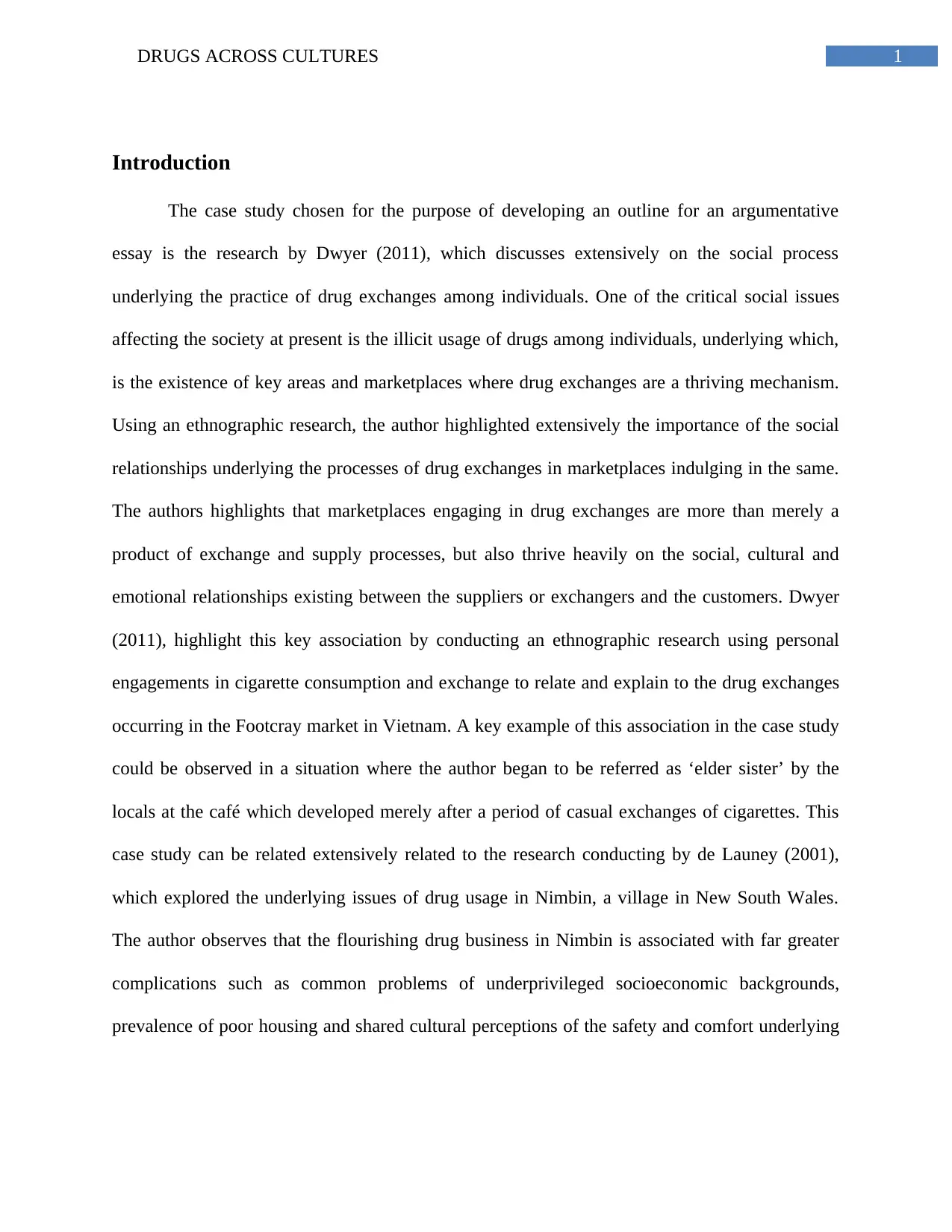
Introduction
The case study chosen for the purpose of developing an outline for an argumentative
essay is the research by Dwyer (2011), which discusses extensively on the social process
underlying the practice of drug exchanges among individuals. One of the critical social issues
affecting the society at present is the illicit usage of drugs among individuals, underlying which,
is the existence of key areas and marketplaces where drug exchanges are a thriving mechanism.
Using an ethnographic research, the author highlighted extensively the importance of the social
relationships underlying the processes of drug exchanges in marketplaces indulging in the same.
The authors highlights that marketplaces engaging in drug exchanges are more than merely a
product of exchange and supply processes, but also thrive heavily on the social, cultural and
emotional relationships existing between the suppliers or exchangers and the customers. Dwyer
(2011), highlight this key association by conducting an ethnographic research using personal
engagements in cigarette consumption and exchange to relate and explain to the drug exchanges
occurring in the Footcray market in Vietnam. A key example of this association in the case study
could be observed in a situation where the author began to be referred as ‘elder sister’ by the
locals at the café which developed merely after a period of casual exchanges of cigarettes. This
case study can be related extensively related to the research conducting by de Launey (2001),
which explored the underlying issues of drug usage in Nimbin, a village in New South Wales.
The author observes that the flourishing drug business in Nimbin is associated with far greater
complications such as common problems of underprivileged socioeconomic backgrounds,
prevalence of poor housing and shared cultural perceptions of the safety and comfort underlying
Introduction
The case study chosen for the purpose of developing an outline for an argumentative
essay is the research by Dwyer (2011), which discusses extensively on the social process
underlying the practice of drug exchanges among individuals. One of the critical social issues
affecting the society at present is the illicit usage of drugs among individuals, underlying which,
is the existence of key areas and marketplaces where drug exchanges are a thriving mechanism.
Using an ethnographic research, the author highlighted extensively the importance of the social
relationships underlying the processes of drug exchanges in marketplaces indulging in the same.
The authors highlights that marketplaces engaging in drug exchanges are more than merely a
product of exchange and supply processes, but also thrive heavily on the social, cultural and
emotional relationships existing between the suppliers or exchangers and the customers. Dwyer
(2011), highlight this key association by conducting an ethnographic research using personal
engagements in cigarette consumption and exchange to relate and explain to the drug exchanges
occurring in the Footcray market in Vietnam. A key example of this association in the case study
could be observed in a situation where the author began to be referred as ‘elder sister’ by the
locals at the café which developed merely after a period of casual exchanges of cigarettes. This
case study can be related extensively related to the research conducting by de Launey (2001),
which explored the underlying issues of drug usage in Nimbin, a village in New South Wales.
The author observes that the flourishing drug business in Nimbin is associated with far greater
complications such as common problems of underprivileged socioeconomic backgrounds,
prevalence of poor housing and shared cultural perceptions of the safety and comfort underlying

2DRUGS ACROSS CULTURES
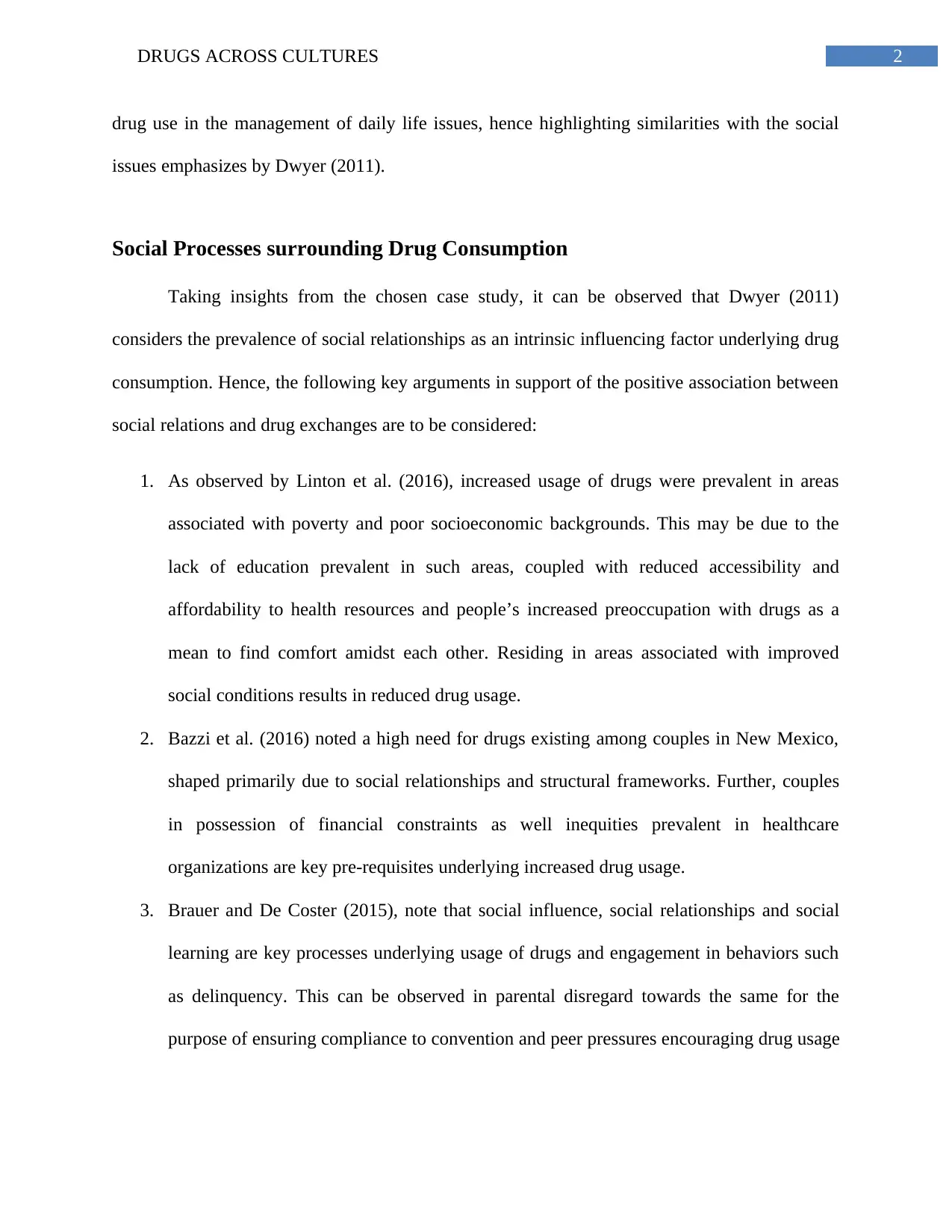
drug use in the management of daily life issues, hence highlighting similarities with the social
issues emphasizes by Dwyer (2011).
Social Processes surrounding Drug Consumption
Taking insights from the chosen case study, it can be observed that Dwyer (2011)
considers the prevalence of social relationships as an intrinsic influencing factor underlying drug
consumption. Hence, the following key arguments in support of the positive association between
social relations and drug exchanges are to be considered:
1. As observed by Linton et al. (2016), increased usage of drugs were prevalent in areas
associated with poverty and poor socioeconomic backgrounds. This may be due to the
lack of education prevalent in such areas, coupled with reduced accessibility and
affordability to health resources and people’s increased preoccupation with drugs as a
mean to find comfort amidst each other. Residing in areas associated with improved
social conditions results in reduced drug usage.
2. Bazzi et al. (2016) noted a high need for drugs existing among couples in New Mexico,
shaped primarily due to social relationships and structural frameworks. Further, couples
in possession of financial constraints as well inequities prevalent in healthcare
organizations are key pre-requisites underlying increased drug usage.
3. Brauer and De Coster (2015), note that social influence, social relationships and social
learning are key processes underlying usage of drugs and engagement in behaviors such
as delinquency. This can be observed in parental disregard towards the same for the
purpose of ensuring compliance to convention and peer pressures encouraging drug usage
drug use in the management of daily life issues, hence highlighting similarities with the social
issues emphasizes by Dwyer (2011).
Social Processes surrounding Drug Consumption
Taking insights from the chosen case study, it can be observed that Dwyer (2011)
considers the prevalence of social relationships as an intrinsic influencing factor underlying drug
consumption. Hence, the following key arguments in support of the positive association between
social relations and drug exchanges are to be considered:
1. As observed by Linton et al. (2016), increased usage of drugs were prevalent in areas
associated with poverty and poor socioeconomic backgrounds. This may be due to the
lack of education prevalent in such areas, coupled with reduced accessibility and
affordability to health resources and people’s increased preoccupation with drugs as a
mean to find comfort amidst each other. Residing in areas associated with improved
social conditions results in reduced drug usage.
2. Bazzi et al. (2016) noted a high need for drugs existing among couples in New Mexico,
shaped primarily due to social relationships and structural frameworks. Further, couples
in possession of financial constraints as well inequities prevalent in healthcare
organizations are key pre-requisites underlying increased drug usage.
3. Brauer and De Coster (2015), note that social influence, social relationships and social
learning are key processes underlying usage of drugs and engagement in behaviors such
as delinquency. This can be observed in parental disregard towards the same for the
purpose of ensuring compliance to convention and peer pressures encouraging drug usage
⊘ This is a preview!⊘
Do you want full access?
Subscribe today to unlock all pages.

Trusted by 1+ million students worldwide

3DRUGS ACROSS CULTURES
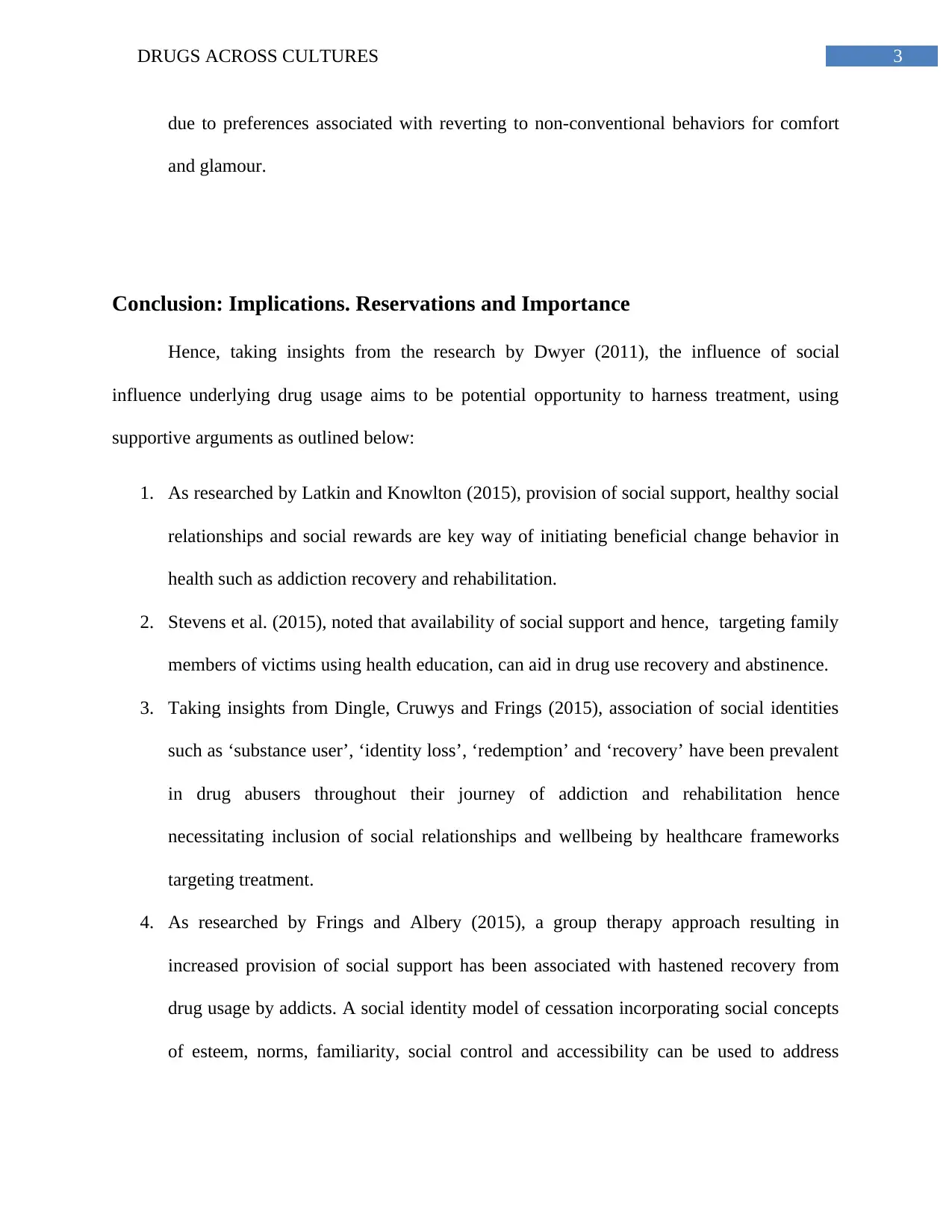
due to preferences associated with reverting to non-conventional behaviors for comfort
and glamour.
Conclusion: Implications. Reservations and Importance
Hence, taking insights from the research by Dwyer (2011), the influence of social
influence underlying drug usage aims to be potential opportunity to harness treatment, using
supportive arguments as outlined below:
1. As researched by Latkin and Knowlton (2015), provision of social support, healthy social
relationships and social rewards are key way of initiating beneficial change behavior in
health such as addiction recovery and rehabilitation.
2. Stevens et al. (2015), noted that availability of social support and hence, targeting family
members of victims using health education, can aid in drug use recovery and abstinence.
3. Taking insights from Dingle, Cruwys and Frings (2015), association of social identities
such as ‘substance user’, ‘identity loss’, ‘redemption’ and ‘recovery’ have been prevalent
in drug abusers throughout their journey of addiction and rehabilitation hence
necessitating inclusion of social relationships and wellbeing by healthcare frameworks
targeting treatment.
4. As researched by Frings and Albery (2015), a group therapy approach resulting in
increased provision of social support has been associated with hastened recovery from
drug usage by addicts. A social identity model of cessation incorporating social concepts
of esteem, norms, familiarity, social control and accessibility can be used to address
due to preferences associated with reverting to non-conventional behaviors for comfort
and glamour.
Conclusion: Implications. Reservations and Importance
Hence, taking insights from the research by Dwyer (2011), the influence of social
influence underlying drug usage aims to be potential opportunity to harness treatment, using
supportive arguments as outlined below:
1. As researched by Latkin and Knowlton (2015), provision of social support, healthy social
relationships and social rewards are key way of initiating beneficial change behavior in
health such as addiction recovery and rehabilitation.
2. Stevens et al. (2015), noted that availability of social support and hence, targeting family
members of victims using health education, can aid in drug use recovery and abstinence.
3. Taking insights from Dingle, Cruwys and Frings (2015), association of social identities
such as ‘substance user’, ‘identity loss’, ‘redemption’ and ‘recovery’ have been prevalent
in drug abusers throughout their journey of addiction and rehabilitation hence
necessitating inclusion of social relationships and wellbeing by healthcare frameworks
targeting treatment.
4. As researched by Frings and Albery (2015), a group therapy approach resulting in
increased provision of social support has been associated with hastened recovery from
drug usage by addicts. A social identity model of cessation incorporating social concepts
of esteem, norms, familiarity, social control and accessibility can be used to address
Paraphrase This Document
Need a fresh take? Get an instant paraphrase of this document with our AI Paraphraser

4DRUGS ACROSS CULTURES
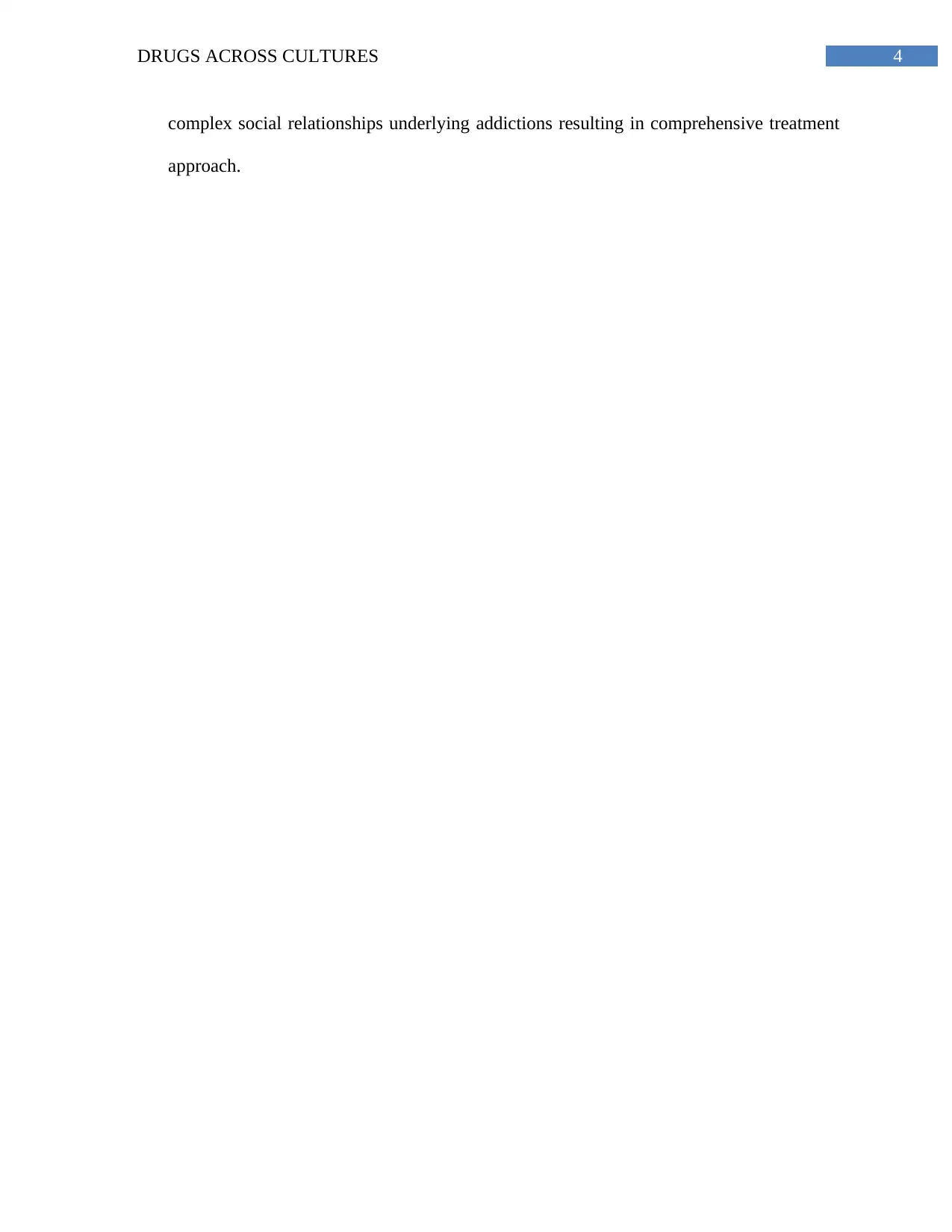
complex social relationships underlying addictions resulting in comprehensive treatment
approach.
complex social relationships underlying addictions resulting in comprehensive treatment
approach.

5DRUGS ACROSS CULTURES
References
Bazzi, A.R., Syvertsen, J.L., Rolón, M.L., Martinez, G., Rangel, G., Vera, A., Amaro, H.,
Ulibarri, M.D., Hernandez, D.O. and Strathdee, S.A., 2016. Social and structural challenges to
drug cessation among couples in northern Mexico: implications for drug treatment in
underserved communities. Journal of substance abuse treatment, 61, pp.26-33.
Brauer, J.R. and De Coster, S., 2015. Social relationships and delinquency: Revisiting parent and
peer influence during adolescence. Youth & Society, 47(3), pp.374-394.
de Launey, C.A., 2001. What drug problem? Cannabis and heroin in an alternative
community. Theses, p.60.
Dingle, G.A., Cruwys, T. and Frings, D., 2015. Social identities as pathways into and out of
addiction. Frontiers in psychology, 6, p.1795.
Dwyer, R., 2011. The social life of smokes. Suzanne Fraser is Associate Professor in the Centre
for Women’s Studies and Gender Research, School of Political and Social Inquiry, Faculty of
Arts, Monash University. She also holds a research appointment with the National Drug
Research Institute at Curtin University., p.19.
Frings, D. and Albery, I.P., 2015. The social identity model of cessation maintenance:
Formulation and initial evidence. Addictive Behaviors, 44, pp.35-42.
Latkin, C.A. and Knowlton, A.R., 2015. Social network assessments and interventions for health
behavior change: a critical review. Behavioral Medicine, 41(3), pp.90-97.
References
Bazzi, A.R., Syvertsen, J.L., Rolón, M.L., Martinez, G., Rangel, G., Vera, A., Amaro, H.,
Ulibarri, M.D., Hernandez, D.O. and Strathdee, S.A., 2016. Social and structural challenges to
drug cessation among couples in northern Mexico: implications for drug treatment in
underserved communities. Journal of substance abuse treatment, 61, pp.26-33.
Brauer, J.R. and De Coster, S., 2015. Social relationships and delinquency: Revisiting parent and
peer influence during adolescence. Youth & Society, 47(3), pp.374-394.
de Launey, C.A., 2001. What drug problem? Cannabis and heroin in an alternative
community. Theses, p.60.
Dingle, G.A., Cruwys, T. and Frings, D., 2015. Social identities as pathways into and out of
addiction. Frontiers in psychology, 6, p.1795.
Dwyer, R., 2011. The social life of smokes. Suzanne Fraser is Associate Professor in the Centre
for Women’s Studies and Gender Research, School of Political and Social Inquiry, Faculty of
Arts, Monash University. She also holds a research appointment with the National Drug
Research Institute at Curtin University., p.19.
Frings, D. and Albery, I.P., 2015. The social identity model of cessation maintenance:
Formulation and initial evidence. Addictive Behaviors, 44, pp.35-42.
Latkin, C.A. and Knowlton, A.R., 2015. Social network assessments and interventions for health
behavior change: a critical review. Behavioral Medicine, 41(3), pp.90-97.
⊘ This is a preview!⊘
Do you want full access?
Subscribe today to unlock all pages.

Trusted by 1+ million students worldwide

6DRUGS ACROSS CULTURES
Linton, S.L., Cooper, H.L., Luo, R., Karnes, C., Renneker, K., Haley, D.F., Hunter-Jones, J.,
Ross, Z., Bonney, L. and Rothenberg, R., 2016. People and places: Relocating to neighborhoods
with better economic and social conditions is associated with less risky drug/alcohol network
characteristics among African American adults in Atlanta, GA. Drug and alcohol
dependence, 160, pp.30-41.
Stevens, E., Jason, L.A., Ram, D. and Light, J., 2015. Investigating social support and network
relationships in substance use disorder recovery. Substance abuse, 36(4), pp.396-399.
Linton, S.L., Cooper, H.L., Luo, R., Karnes, C., Renneker, K., Haley, D.F., Hunter-Jones, J.,
Ross, Z., Bonney, L. and Rothenberg, R., 2016. People and places: Relocating to neighborhoods
with better economic and social conditions is associated with less risky drug/alcohol network
characteristics among African American adults in Atlanta, GA. Drug and alcohol
dependence, 160, pp.30-41.
Stevens, E., Jason, L.A., Ram, D. and Light, J., 2015. Investigating social support and network
relationships in substance use disorder recovery. Substance abuse, 36(4), pp.396-399.
1 out of 7
Your All-in-One AI-Powered Toolkit for Academic Success.
+13062052269
info@desklib.com
Available 24*7 on WhatsApp / Email
Unlock your academic potential
Copyright © 2020–2026 A2Z Services. All Rights Reserved. Developed and managed by ZUCOL.