Analyzing Decision Support Systems Effectiveness and Impact

Verified

Added on  2023/06/14

|13
|1190
|392
Report
AI Summary
This document presents an article review focusing on the effectiveness of Decision Support Systems (DSS) and their impact on organizational performance. The review critically examines Ben Zvi's (2010) article, highlighting its exploration of perceived effectiveness and its influence on client satisfaction. It identifies a gap in the literature concerning the integration of choice process factors like perceived usefulness and satisfaction, noting that existing studies primarily focus on direct impacts of system design. The research methodology, involving simulation with graduate students, is discussed, along with key findings such as the reliance of organizational performance on system usefulness and client satisfaction. The review also evaluates the article's credibility, pointing out limitations related to the simulation's complexity and the reliance on self-reports. The document concludes by suggesting future research directions and referencing several relevant academic sources. Desklib provides access to similar solved assignments and past papers for students.
Document Page
Article Review
Name
Student number
Resident campus
lecturer
tabler-icon-diamond-filled.svg

Paraphrase This Document

Need a fresh take? Get an instant paraphrase of this document with our AI Paraphraser
Document Page
Topic of the article
The article under review is “Measuring
the perceived effectiveness of decision
support systems and their impact on
performance. Decision Support
Systems” by Ben Zvi (2010).
The topic has all the earmarks of being
the fortune of the client i.e. perceived
effectiveness (Chou & Chang 2008)
Document Page
The article
Based upon the article, the reader gains a vast
understanding about the topic of the article.
First, the audience learns that several studies have
been conducted by various scholars to determine
the effectiveness of DSS in different settings.
Bharati & Chaudhury (2004),researched online
choice emotionally supportive networks
Crowston et al. (1999) conducted a study on open
and bias-free source programming improvement
settings.
Reinig (2009) considered community-oriented
advancements
Document Page
A gap in the literature
Although various authors have already conducted
studies on the topic of Decision Support Systems,
there exists a significant gap in literature.
Mainly, this is because these examinations
centered primarily around the direct impacts of
framework outline and use on results and client
execution.
Very few studies have incorporated choice
process factors, such as saw helpfulness,
fulfillment, satisfaction, and saw ease of
utilization
tabler-icon-diamond-filled.svg

Paraphrase This Document

Need a fresh take? Get an instant paraphrase of this document with our AI Paraphraser
Document Page
Cont…
As such, the generally modest figure
of concentrates that put in place
choice process factors in studies for
might be the aftereffect of the
regularly utilized authoritative
setting for such investigations,
where process factors such as states
of mind may seem not so much vital
but rather blander and along these
lines difficult to catch or measure.
Document Page
cont
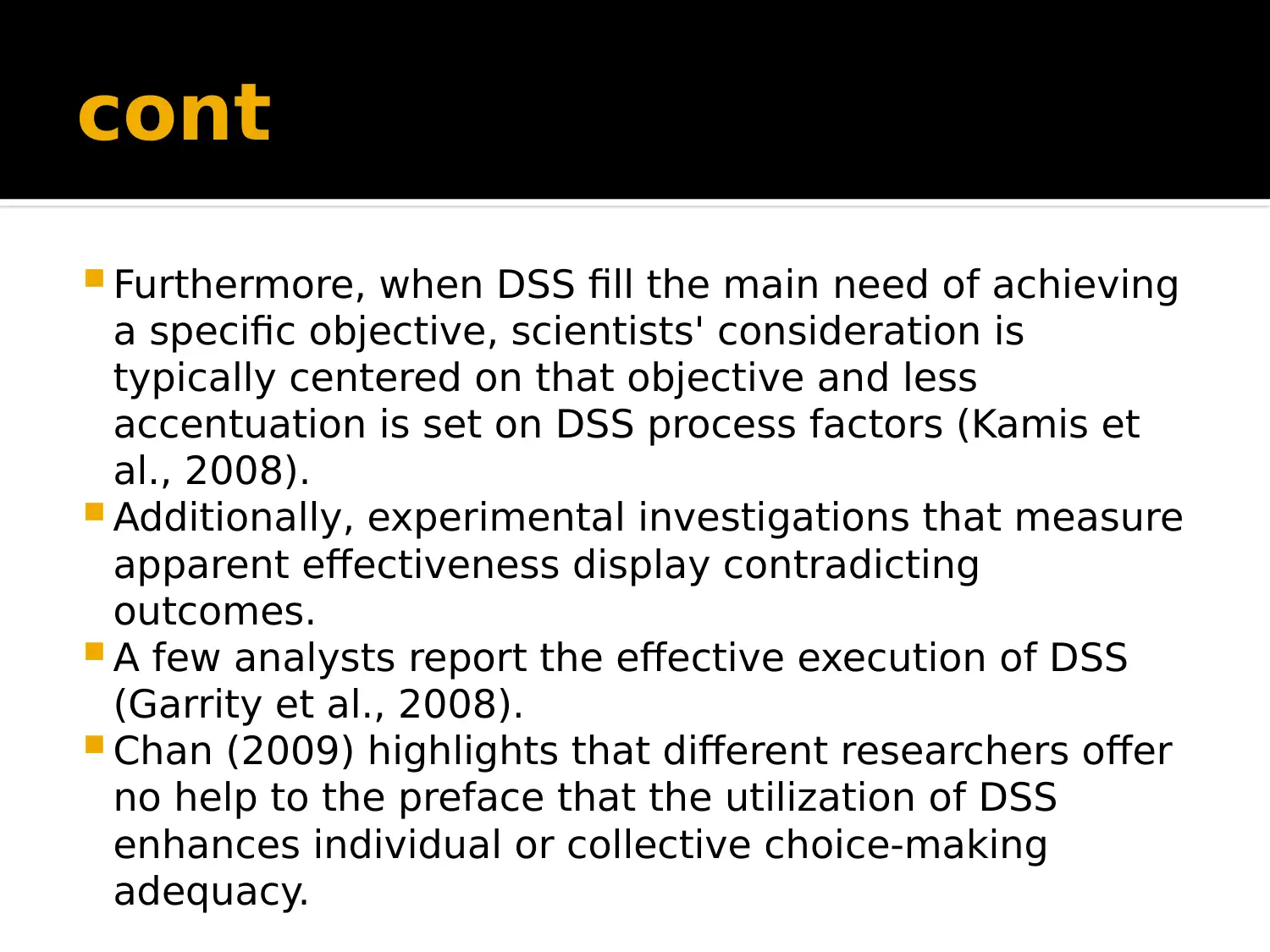
Furthermore, when DSS fill the main need of achieving
a specific objective, scientists' consideration is
typically centered on that objective and less
accentuation is set on DSS process factors (Kamis et
al., 2008).
Additionally, experimental investigations that measure
apparent effectiveness display contradicting
outcomes.
A few analysts report the effective execution of DSS
(Garrity et al., 2008).
Chan (2009) highlights that different researchers offer
no help to the preface that the utilization of DSS
enhances individual or collective choice-making
adequacy.
Document Page
Cont…
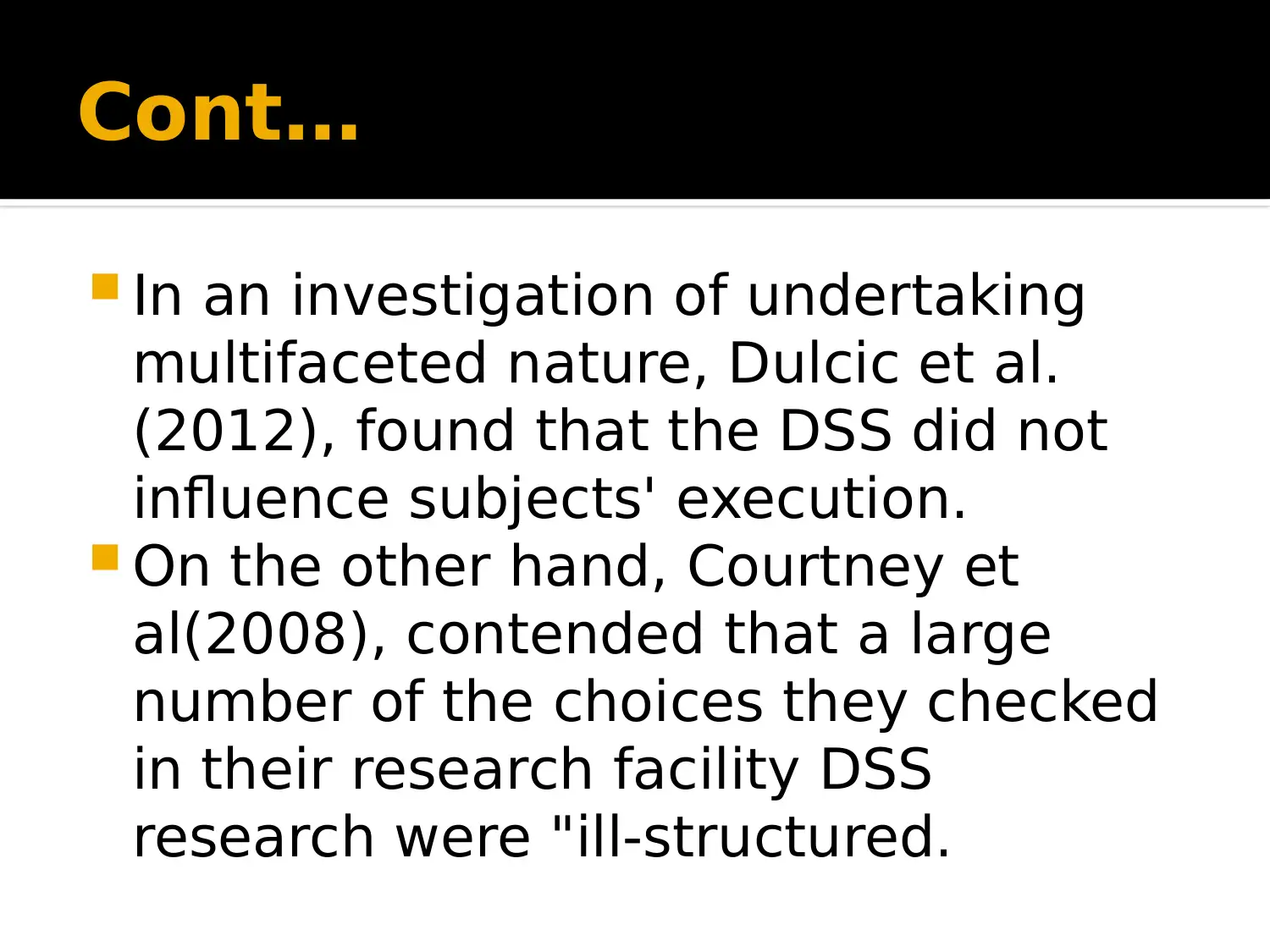
In an investigation of undertaking
multifaceted nature, Dulcic et al.
(2012), found that the DSS did not
influence subjects' execution.
On the other hand, Courtney et
al(2008), contended that a large
number of the choices they checked
in their research facility DSS
research were "ill-structured.
tabler-icon-diamond-filled.svg

Paraphrase This Document

Need a fresh take? Get an instant paraphrase of this document with our AI Paraphraser
Document Page
How was the research conducted?
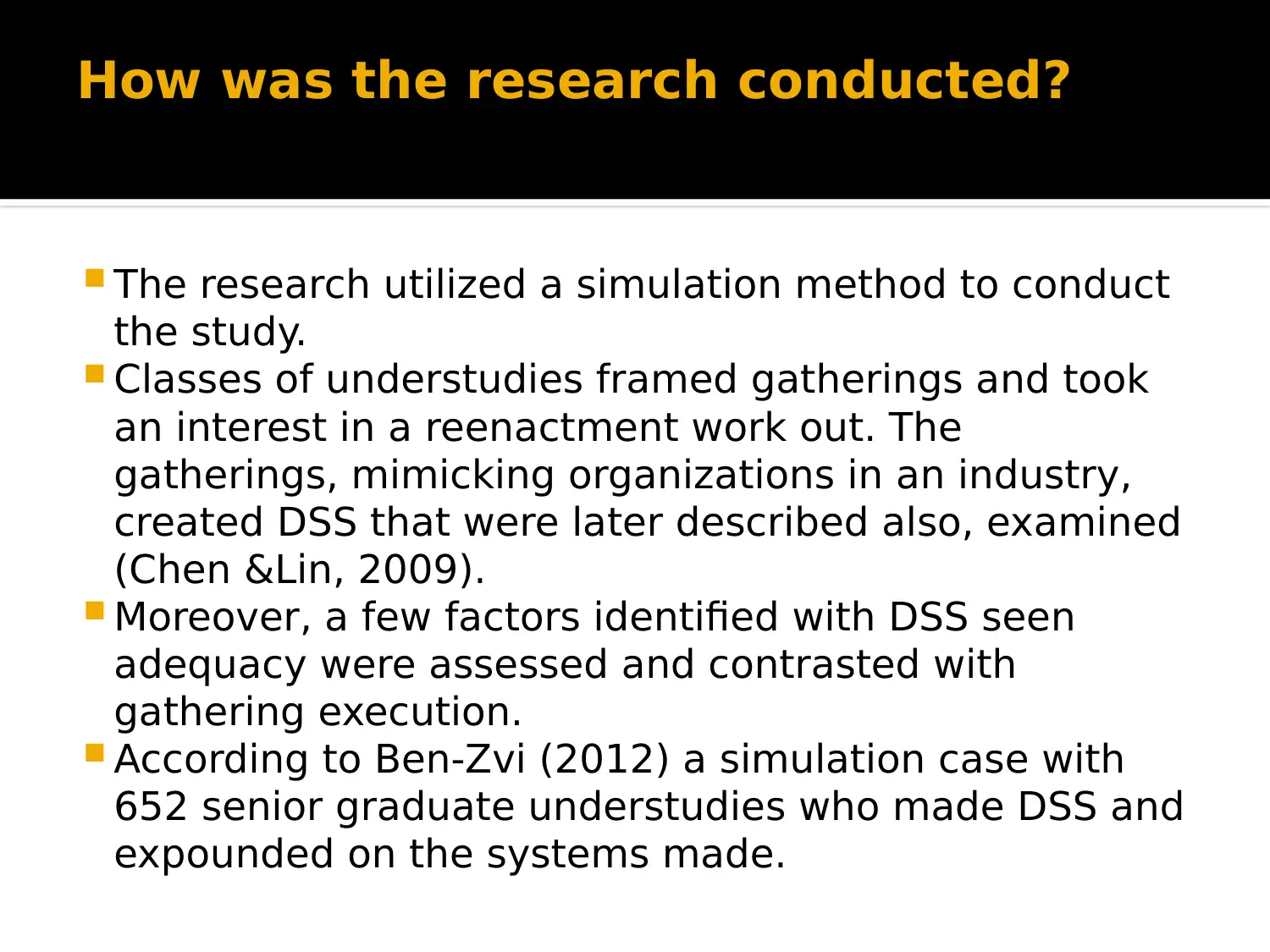
The research utilized a simulation method to conduct
the study.
Classes of understudies framed gatherings and took
an interest in a reenactment work out. The
gatherings, mimicking organizations in an industry,
created DSS that were later described also, examined
(Chen &Lin, 2009).
Moreover, a few factors identified with DSS seen
adequacy were assessed and contrasted with
gathering execution.
According to Ben-Zvi (2012) a simulation case with
652 senior graduate understudies who made DSS and
expounded on the systems made.
Document Page
What where the findings?
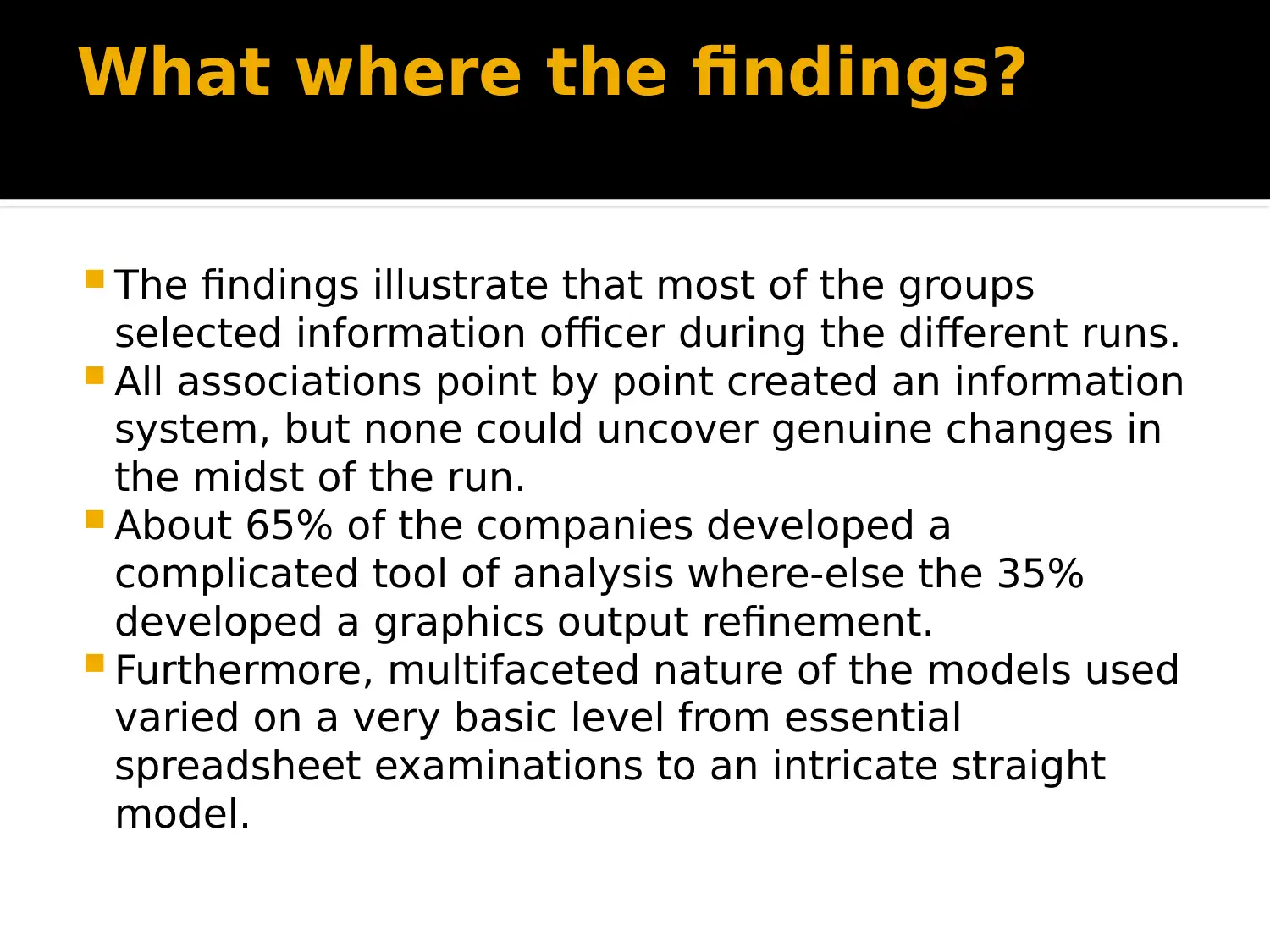
The findings illustrate that most of the groups
selected information officer during the different runs.
All associations point by point created an information
system, but none could uncover genuine changes in
the midst of the run.
About 65% of the companies developed a
complicated tool of analysis where-else the 35%
developed a graphics output refinement.
Furthermore, multifaceted nature of the models used
varied on a very basic level from essential
spreadsheet examinations to an intricate straight
model.
Document Page
Implications of the article
The results demonstrate a solid and huge reliance of
organization performance on the following factors:
framework's handiness,
client fulfillment,
the commitment of the system to the assorted utilitarian
regions as well as to the whole organization achievement,
If the DSS lived up to its desires.
It appears as though the more prominent the
fulfillment from the created framework in meeting its
planned point as developed by the clients, the better
the organization's execution in the reenactment.
tabler-icon-diamond-filled.svg

Paraphrase This Document

Need a fresh take? Get an instant paraphrase of this document with our AI Paraphraser
Document Page
Overall evaluation of the
article
Despite the findings in the article, credibility
and effectiveness issues of the article are
noted.
The simulation is exceptionally mind-boggling
and wide to give issues and practical basic
leadership reproduction.
However, it is uncertain whether or not the
self-reports reveal genuine lead of framework
customers in actuality (Lin & Tu, 2012).
Future examinations can give definite
outcomes utilizing target measures.
Document Page
References
Ben-Zvi, T., 2010 The efficacy of business simulation games in
creating Decision Support Systems: An experimental
investigation. Decision Support Systems, 49(1), pp.61-69.
Ben-Zvi, T., 2012 Measuring the perceived effectiveness of decision
support systems and their impact on performance. Decision Support
Systems, 54(1), pp.248-256.
Bharati, P. and Chaudhury, A., 2004 An empirical investigation of
decision-making satisfaction in web-based decision support
systems. Decision support systems, 37(2), pp.187-197.
Chan, S.H., 2009 The roles of user motivation to perform a task and
decision support system (DSS) effectiveness and efficiency in DSS
use. Computers in Human Behavior, 25(1), pp.217-228.
Chen, L. and Lin, C., 2009 DSS interaction: a simulation
experiment. SIGHCI 2009 Proceedings, p.17.
Chou, S.Y. and Chang, Y.H., 2008 A decision support system for
supplier selection based on a strategy-aligned fuzzy SMART
approach. Expert systems with applications, 34(4), pp.2241-2253.
chevron_up_icon
1 out of 13
circle_padding
hide_on_mobile
zoom_out_icon
[object Object]