Cloud Computing Solution for DTGOV: Architecture and Security
VerifiedAdded on 2023/03/17
|29
|8675
|51
Report
AI Summary
This report provides a cloud computing solution for DTGOV, a public company aiming to modernize its IT infrastructure. It recommends dynamic scalability and resource pooling architectures, detailing their benefits and issues. The report explores the risks of a hybrid cloud strategy and emphasizes information security steps, including backup, disaster recovery, and application resilience. It also includes an operations checklist for cloud deployment. The report concludes with a summary of the findings, offering DTGOV a roadmap for adopting cloud computing to enhance its data availability and operational efficiency. The report also discusses the architectures of the databases, including the shared nothing database architecture and the shared disk database architecture. It also discusses the resource pooling architecture.
Running head: CLOUD COMPUTING SOLUTION FOR DTGOV
CLOUD COMPUTING SOLUTION FOR DTGOV
Name of student
Name of university
Author’s note:
CLOUD COMPUTING SOLUTION FOR DTGOV
Name of student
Name of university
Author’s note:

Paraphrase This Document
Need a fresh take? Get an instant paraphrase of this document with our AI Paraphraser
1
CLOUD COMPUTING SOLUTION FOR DTGOV
Table of Contents
Introduction....................................................................................................................2
Discussion......................................................................................................................2
Recommended architectures......................................................................................2
Issues and benefits of recommended cloud architecture..........................................10
Issues of Service load balancing architecture:.....................................................10
Benefits of Service load balancing architecture:..................................................10
Issues of dynamic scaling architecture:................................................................11
Benefits of the dynamic scaling architecture:......................................................11
Issues of resource pooling architecture:...............................................................12
Benefits of the resource pooling architecture:.....................................................13
Risks of hybrid cloud strategy..................................................................................13
Information security steps and the controls.............................................................15
Recommends that are to be included.......................................................................18
Backup and disaster recovery...............................................................................18
Application resilience...........................................................................................19
Operations checklist.................................................................................................20
Conclusion....................................................................................................................21
References....................................................................................................................23
CLOUD COMPUTING SOLUTION FOR DTGOV
Table of Contents
Introduction....................................................................................................................2
Discussion......................................................................................................................2
Recommended architectures......................................................................................2
Issues and benefits of recommended cloud architecture..........................................10
Issues of Service load balancing architecture:.....................................................10
Benefits of Service load balancing architecture:..................................................10
Issues of dynamic scaling architecture:................................................................11
Benefits of the dynamic scaling architecture:......................................................11
Issues of resource pooling architecture:...............................................................12
Benefits of the resource pooling architecture:.....................................................13
Risks of hybrid cloud strategy..................................................................................13
Information security steps and the controls.............................................................15
Recommends that are to be included.......................................................................18
Backup and disaster recovery...............................................................................18
Application resilience...........................................................................................19
Operations checklist.................................................................................................20
Conclusion....................................................................................................................21
References....................................................................................................................23
2
CLOUD COMPUTING SOLUTION FOR DTGOV
Introduction
This report aims to provide the appropriate cloud computing solution for the DTGOV
organisation for allowing the fast computing capabilities in the organisation. The
recommended cloud architectures for the organisation that could be deployed by the
organisation. The benefits and the issues of the recommended cloud architecture are provided
in this report. The major risks of the hybrid cloud strategy has been briefly described in this
report along with the critical analysis of these issues on the organisation. The information
security controls and the steps that are required to be taken for securing the computing of the
organisation are clearly stated in this report. The recommends that are required to be included
in the policies and the protocols of the organisation are clearly stated along with the clear
discussion of the information security. The operations checklist has been provided for the
cloud deployment. Lastly this report concludes with an appropriate conclusion for the report
that provides the summary of the report.
Discussion
In the present times, the companies are increasingly becoming global organisations.
These organisations commonly do not restrict themselves in the conducting of business in
any single location. This is the similar situation with the DTGOV organisation who wants to
expand their business and increase the availability of the data for the employees and the
customers of the organisation.
Recommended architectures
Some of the architecture that would help the organisation to fulfil the business
strategies are:
CLOUD COMPUTING SOLUTION FOR DTGOV
Introduction
This report aims to provide the appropriate cloud computing solution for the DTGOV
organisation for allowing the fast computing capabilities in the organisation. The
recommended cloud architectures for the organisation that could be deployed by the
organisation. The benefits and the issues of the recommended cloud architecture are provided
in this report. The major risks of the hybrid cloud strategy has been briefly described in this
report along with the critical analysis of these issues on the organisation. The information
security controls and the steps that are required to be taken for securing the computing of the
organisation are clearly stated in this report. The recommends that are required to be included
in the policies and the protocols of the organisation are clearly stated along with the clear
discussion of the information security. The operations checklist has been provided for the
cloud deployment. Lastly this report concludes with an appropriate conclusion for the report
that provides the summary of the report.
Discussion
In the present times, the companies are increasingly becoming global organisations.
These organisations commonly do not restrict themselves in the conducting of business in
any single location. This is the similar situation with the DTGOV organisation who wants to
expand their business and increase the availability of the data for the employees and the
customers of the organisation.
Recommended architectures
Some of the architecture that would help the organisation to fulfil the business
strategies are:
⊘ This is a preview!⊘
Do you want full access?
Subscribe today to unlock all pages.

Trusted by 1+ million students worldwide
3
CLOUD COMPUTING SOLUTION FOR DTGOV
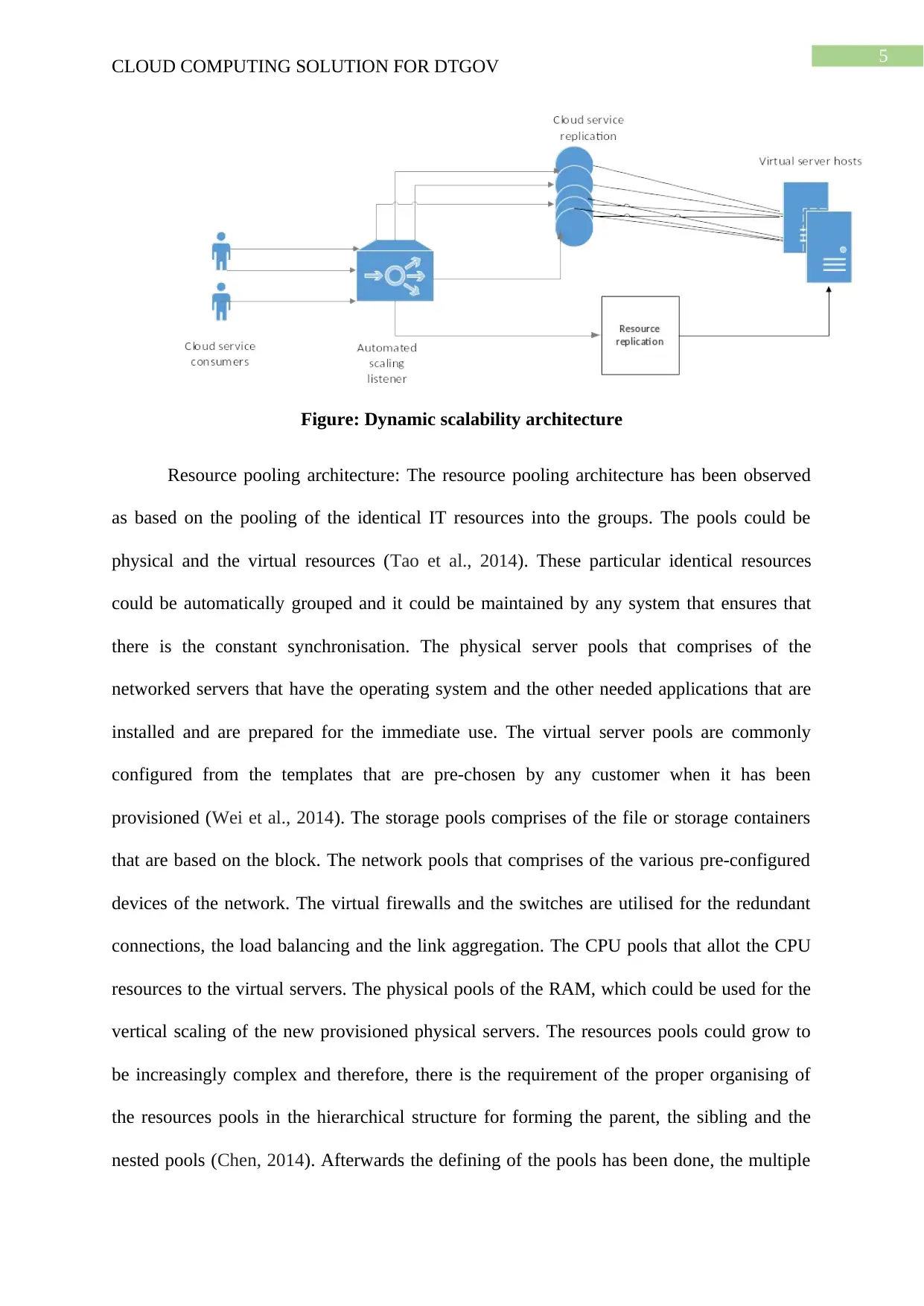
Dynamic scalability architecture: This architecture is the architectural model that is
based on the system of any predefined scaling conditions that triggers the dynamic allocation
of all the IT resources from the resource pools (Rittinghouse & Ransome, 2016). The
dynamic allocation allows the variable utilisation as it has been dictated by the demand
fluctuations of the usage as the unnecessary IT resources could be effectively reclaimed
deprived of any requiring manual interaction. The listener of the automated scaling has been
configured with the workload thresholds that perform the dictation when the new IT
resources are required to be added to all the workload processing (Hashem et al., 2015). The
mechanism could be offered with the logic that determines the number of the extra IT
resources could be dynamically provided on the basis of the terms of any provided
provisioning contract of any cloud consumer. Some of the dynamic scaling that could be
utilised by the organisation are the dynamic horizontal scaling, the dynamic vertical scaling,
and the dynamic relocation. In the dynamic horizontal scaling, the instances of the IT
resources are scaled in and out in for handling the workloads that are significantly
fluctuating. The automatic scaling listener performs the effective monitoring of the requests
and the replication of the signals resources for the initiation of the IT resource duplication
according the permissions and the requirements. In the dynamic vertical scaling, the instances
of the IT resources could be scaled down and up when any major requirement of the adjusting
has been faced for the processing capacity of any single IT resource (Botta et al., 2016). As
an example, the virtual server that has been overloaded could have the memory dynamically
extended or it might have the addition of the processing core. In the dynamic relocation, the
relocation of the IT resources is done to any host with the increased capacity. This dynamic
scalability architecture could be applied to the significant range of the IT resources that
includes the virtual servers as well as the cloud storage devices. Besides this core automated
scaling listener as well as the mechanisms of the resource replication, some of the
CLOUD COMPUTING SOLUTION FOR DTGOV
Dynamic scalability architecture: This architecture is the architectural model that is
based on the system of any predefined scaling conditions that triggers the dynamic allocation
of all the IT resources from the resource pools (Rittinghouse & Ransome, 2016). The
dynamic allocation allows the variable utilisation as it has been dictated by the demand
fluctuations of the usage as the unnecessary IT resources could be effectively reclaimed
deprived of any requiring manual interaction. The listener of the automated scaling has been
configured with the workload thresholds that perform the dictation when the new IT
resources are required to be added to all the workload processing (Hashem et al., 2015). The
mechanism could be offered with the logic that determines the number of the extra IT
resources could be dynamically provided on the basis of the terms of any provided
provisioning contract of any cloud consumer. Some of the dynamic scaling that could be
utilised by the organisation are the dynamic horizontal scaling, the dynamic vertical scaling,
and the dynamic relocation. In the dynamic horizontal scaling, the instances of the IT
resources are scaled in and out in for handling the workloads that are significantly
fluctuating. The automatic scaling listener performs the effective monitoring of the requests
and the replication of the signals resources for the initiation of the IT resource duplication
according the permissions and the requirements. In the dynamic vertical scaling, the instances
of the IT resources could be scaled down and up when any major requirement of the adjusting
has been faced for the processing capacity of any single IT resource (Botta et al., 2016). As
an example, the virtual server that has been overloaded could have the memory dynamically
extended or it might have the addition of the processing core. In the dynamic relocation, the
relocation of the IT resources is done to any host with the increased capacity. This dynamic
scalability architecture could be applied to the significant range of the IT resources that
includes the virtual servers as well as the cloud storage devices. Besides this core automated
scaling listener as well as the mechanisms of the resource replication, some of the
Paraphrase This Document
Need a fresh take? Get an instant paraphrase of this document with our AI Paraphraser
4
CLOUD COMPUTING SOLUTION FOR DTGOV
mechanisms that could also be utilised in the form of the cloud architecture are the cloud
usage monitor, the hypervisor and the pay-per-use monitor (Whaiduzzaman et al., 2014).
With the help of this architecture, the database in the cloud storage could be elastically and
dynamically scalable. This allows the firm to provide the complete data availability for the
customers and the employees of the organisation. The database architecture that could be
significantly used by the organisation are the share nothing database architecture and the
shared disk database architecture. Within the shared nothing database architecture, the
partitioning of the data could be done and then maintained into the partitioned servers. It
could be observed that the performance could be significantly decreased with addition of any
extra servers (Chen et al., 2015). These particular aspects are the present problems that are
being faced by organisations while the shared nothing database is being deployed in the
cloud. In the architecture of the shared disk database, there is no requirement of the
partitioning of the data. It utilises the group of the low cost servers with the sole collection of
the data. Deprived of the partitioning, the complete data could be placed in total servers and it
has been defined as the master-master configuration. If any of the node fails, the other nodes
could provide the required service to the organisation. Therefore, it majorly supports the
dynamic and the elastic scalability, the high availability and the reduced maintenance (Ali,
Khan & Vasilakos, 2015). This architectural model is significantly based on the system of the
predefined conditions of the scaling that performs the triggering of the dynamic allocation of
all the IT resources from the resource pools. This dynamic allocation allows the variable
utilisation as it has been dictated by the usage demand fluctuations as the unnecessary IT
resources could be efficiently reclaimed deprived of any requirement of the manual
interaction.
CLOUD COMPUTING SOLUTION FOR DTGOV
mechanisms that could also be utilised in the form of the cloud architecture are the cloud
usage monitor, the hypervisor and the pay-per-use monitor (Whaiduzzaman et al., 2014).
With the help of this architecture, the database in the cloud storage could be elastically and
dynamically scalable. This allows the firm to provide the complete data availability for the
customers and the employees of the organisation. The database architecture that could be
significantly used by the organisation are the share nothing database architecture and the
shared disk database architecture. Within the shared nothing database architecture, the
partitioning of the data could be done and then maintained into the partitioned servers. It
could be observed that the performance could be significantly decreased with addition of any
extra servers (Chen et al., 2015). These particular aspects are the present problems that are
being faced by organisations while the shared nothing database is being deployed in the
cloud. In the architecture of the shared disk database, there is no requirement of the
partitioning of the data. It utilises the group of the low cost servers with the sole collection of
the data. Deprived of the partitioning, the complete data could be placed in total servers and it
has been defined as the master-master configuration. If any of the node fails, the other nodes
could provide the required service to the organisation. Therefore, it majorly supports the
dynamic and the elastic scalability, the high availability and the reduced maintenance (Ali,
Khan & Vasilakos, 2015). This architectural model is significantly based on the system of the
predefined conditions of the scaling that performs the triggering of the dynamic allocation of
all the IT resources from the resource pools. This dynamic allocation allows the variable
utilisation as it has been dictated by the usage demand fluctuations as the unnecessary IT
resources could be efficiently reclaimed deprived of any requirement of the manual
interaction.
5
CLOUD COMPUTING SOLUTION FOR DTGOV
Figure: Dynamic scalability architecture
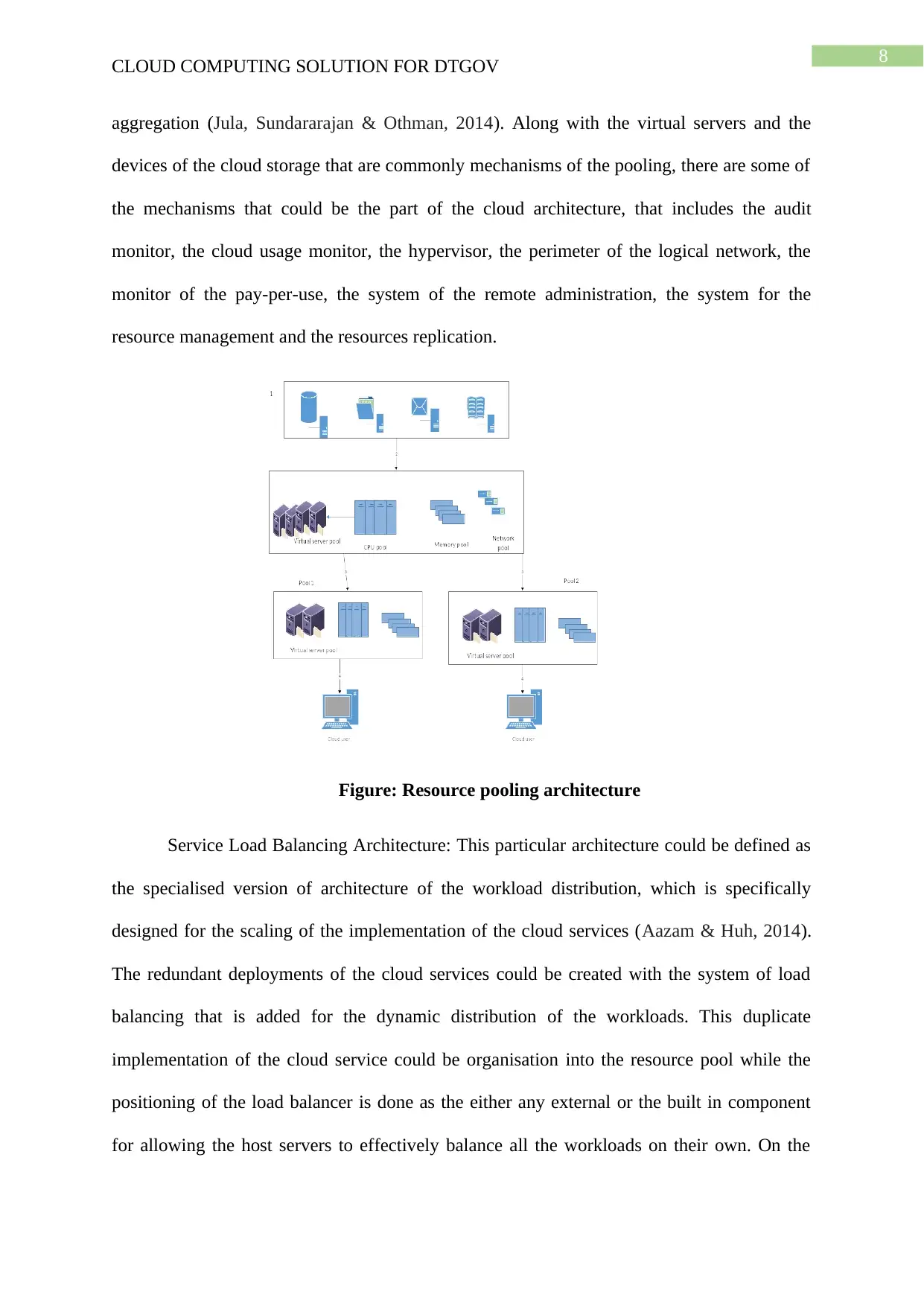
Resource pooling architecture: The resource pooling architecture has been observed
as based on the pooling of the identical IT resources into the groups. The pools could be
physical and the virtual resources (Tao et al., 2014). These particular identical resources
could be automatically grouped and it could be maintained by any system that ensures that
there is the constant synchronisation. The physical server pools that comprises of the
networked servers that have the operating system and the other needed applications that are
installed and are prepared for the immediate use. The virtual server pools are commonly
configured from the templates that are pre-chosen by any customer when it has been
provisioned (Wei et al., 2014). The storage pools comprises of the file or storage containers
that are based on the block. The network pools that comprises of the various pre-configured
devices of the network. The virtual firewalls and the switches are utilised for the redundant
connections, the load balancing and the link aggregation. The CPU pools that allot the CPU
resources to the virtual servers. The physical pools of the RAM, which could be used for the
vertical scaling of the new provisioned physical servers. The resources pools could grow to
be increasingly complex and therefore, there is the requirement of the proper organising of
the resources pools in the hierarchical structure for forming the parent, the sibling and the
nested pools (Chen, 2014). Afterwards the defining of the pools has been done, the multiple
CLOUD COMPUTING SOLUTION FOR DTGOV
Figure: Dynamic scalability architecture
Resource pooling architecture: The resource pooling architecture has been observed
as based on the pooling of the identical IT resources into the groups. The pools could be
physical and the virtual resources (Tao et al., 2014). These particular identical resources
could be automatically grouped and it could be maintained by any system that ensures that
there is the constant synchronisation. The physical server pools that comprises of the
networked servers that have the operating system and the other needed applications that are
installed and are prepared for the immediate use. The virtual server pools are commonly
configured from the templates that are pre-chosen by any customer when it has been
provisioned (Wei et al., 2014). The storage pools comprises of the file or storage containers
that are based on the block. The network pools that comprises of the various pre-configured
devices of the network. The virtual firewalls and the switches are utilised for the redundant
connections, the load balancing and the link aggregation. The CPU pools that allot the CPU
resources to the virtual servers. The physical pools of the RAM, which could be used for the
vertical scaling of the new provisioned physical servers. The resources pools could grow to
be increasingly complex and therefore, there is the requirement of the proper organising of
the resources pools in the hierarchical structure for forming the parent, the sibling and the
nested pools (Chen, 2014). Afterwards the defining of the pools has been done, the multiple
⊘ This is a preview!⊘
Do you want full access?
Subscribe today to unlock all pages.
Trusted by 1+ million students worldwide
6
CLOUD COMPUTING SOLUTION FOR DTGOV
instances of the resources from each of the pool could be utilised for the creation of the in-
memory pool of all the live IT resources that could be pulled and then utilised on the demand
by any system as it is required. The resources pool architecture utilises the several kinds of
the similar kind of the mechanisms as the architecture of the workload distribution functions
and these are the auditing of the pools for the effective monitoring of the usage of the
resources pools, the utilisation of the cloud usage monitor at the run time for the effective
tracking and the synchronising of the IT resources and the underlying management systems,
the hypervisor that manages the access of the virtual server pools and the virtual server for
any other resources pools, the use of the logical network perimeter that could logically
organise and then isolate the resources pools, the utilisation of the Pay-per-use monitor is
done that collects the information of the usage and the billing on the basis of how the IT
resources are being used by the customers of the organisation and the remote administration
is also used that has the major function of the creation of the interface with the back-end
servers for the effective administration of the resource pools, the resource management
system is used that offers the customers with all the required tools and the options of the
permission management that is used for the administration of the resource pools and the
resource replication that helps in the generating of several new instances of the resource for
the resources pools as it has been dictated by the demand (Almorsy, Grundy & Müller, 2016).
The sharing of the identical IT resources for the scalability purposes could be significantly
error prone and it is the problem for maintaining the completely synchronised on any on-
going basis. The provided solution for this kind of issue is the maintenance of the automated
synchronisation system for the effective grouping of the identical IT resources into the pools
and for maintaining the effective synchronicity. The resource pooling architecture could be
utilised for both the horizontally or the vertically scale the systems on the basis of the proper
organising of the pools. The resource pools of the RAM and the CPU could be utilised for the
CLOUD COMPUTING SOLUTION FOR DTGOV
instances of the resources from each of the pool could be utilised for the creation of the in-
memory pool of all the live IT resources that could be pulled and then utilised on the demand
by any system as it is required. The resources pool architecture utilises the several kinds of
the similar kind of the mechanisms as the architecture of the workload distribution functions
and these are the auditing of the pools for the effective monitoring of the usage of the
resources pools, the utilisation of the cloud usage monitor at the run time for the effective
tracking and the synchronising of the IT resources and the underlying management systems,
the hypervisor that manages the access of the virtual server pools and the virtual server for
any other resources pools, the use of the logical network perimeter that could logically
organise and then isolate the resources pools, the utilisation of the Pay-per-use monitor is
done that collects the information of the usage and the billing on the basis of how the IT
resources are being used by the customers of the organisation and the remote administration
is also used that has the major function of the creation of the interface with the back-end
servers for the effective administration of the resource pools, the resource management
system is used that offers the customers with all the required tools and the options of the
permission management that is used for the administration of the resource pools and the
resource replication that helps in the generating of several new instances of the resource for
the resources pools as it has been dictated by the demand (Almorsy, Grundy & Müller, 2016).
The sharing of the identical IT resources for the scalability purposes could be significantly
error prone and it is the problem for maintaining the completely synchronised on any on-
going basis. The provided solution for this kind of issue is the maintenance of the automated
synchronisation system for the effective grouping of the identical IT resources into the pools
and for maintaining the effective synchronicity. The resource pooling architecture could be
utilised for both the horizontally or the vertically scale the systems on the basis of the proper
organising of the pools. The resource pools of the RAM and the CPU could be utilised for the
Paraphrase This Document
Need a fresh take? Get an instant paraphrase of this document with our AI Paraphraser
7
CLOUD COMPUTING SOLUTION FOR DTGOV
vertically scaling of any IT resource like the virtual server if there is any increase in the
workload and there is a major requirement of the CPU as well as the RAM (Sadiku, Musa &
Momoh, 2014). The virtual servers could pull these specific resources from the resource
pools of the CPU and the RAM. In any live environment of the business who are using the
application servers might face significant issue when the workload increases and there is the
requirement of the increase in the hosting by the virtual server along with the increased CPU
cycles and the RAM for effective computation. The request is sent by the virtual server for
the resources from Resource Management System that allocates the increase RAM and the
CPU resources from resource pool of the RAM and CPU for the vertical scaling of the server
(Gai et al., 2016). When there is a drop in the load, the resources could be released and it is
made available to resources pool once more. The resources pools like the virtual or the
physical servers could be extensively utilised for the horizontal scaling of the system by
implementing the extra virtual or the physical servers from any virtual server pool online as
soon as the demand is increased, then the shutdown could be done again when workloads
scales down (Botta et al., 2014). Some of the kinds of the resources pools are the physical
server pools that are composed of the networked servers which has been installed along with
the operating systems as well as the other necessary applications and the programs that are
ready to use immediately. The virtual server pools are commonly configured by the
utilisation of the sole of the various available templates that are chosen by any cloud
consumer while the provisioning is done (Marinescu, 2017). The storage or pools of the cloud
storage device comprises of the file based or even block based structures of storage that
comprises of the empty or the filled devices of the cloud storage. The network pools
commonly comprises of the distinct preconfigured connectivity devices of the network. As an
instance, the pool of the devices on the virtual firewall or the switches on the physical
network could be created for the redundant connectivity, the load balancing or the link
CLOUD COMPUTING SOLUTION FOR DTGOV
vertically scaling of any IT resource like the virtual server if there is any increase in the
workload and there is a major requirement of the CPU as well as the RAM (Sadiku, Musa &
Momoh, 2014). The virtual servers could pull these specific resources from the resource
pools of the CPU and the RAM. In any live environment of the business who are using the
application servers might face significant issue when the workload increases and there is the
requirement of the increase in the hosting by the virtual server along with the increased CPU
cycles and the RAM for effective computation. The request is sent by the virtual server for
the resources from Resource Management System that allocates the increase RAM and the
CPU resources from resource pool of the RAM and CPU for the vertical scaling of the server
(Gai et al., 2016). When there is a drop in the load, the resources could be released and it is
made available to resources pool once more. The resources pools like the virtual or the
physical servers could be extensively utilised for the horizontal scaling of the system by
implementing the extra virtual or the physical servers from any virtual server pool online as
soon as the demand is increased, then the shutdown could be done again when workloads
scales down (Botta et al., 2014). Some of the kinds of the resources pools are the physical
server pools that are composed of the networked servers which has been installed along with
the operating systems as well as the other necessary applications and the programs that are
ready to use immediately. The virtual server pools are commonly configured by the
utilisation of the sole of the various available templates that are chosen by any cloud
consumer while the provisioning is done (Marinescu, 2017). The storage or pools of the cloud
storage device comprises of the file based or even block based structures of storage that
comprises of the empty or the filled devices of the cloud storage. The network pools
commonly comprises of the distinct preconfigured connectivity devices of the network. As an
instance, the pool of the devices on the virtual firewall or the switches on the physical
network could be created for the redundant connectivity, the load balancing or the link
8
CLOUD COMPUTING SOLUTION FOR DTGOV
aggregation (Jula, Sundararajan & Othman, 2014). Along with the virtual servers and the
devices of the cloud storage that are commonly mechanisms of the pooling, there are some of
the mechanisms that could be the part of the cloud architecture, that includes the audit
monitor, the cloud usage monitor, the hypervisor, the perimeter of the logical network, the
monitor of the pay-per-use, the system of the remote administration, the system for the
resource management and the resources replication.
Figure: Resource pooling architecture
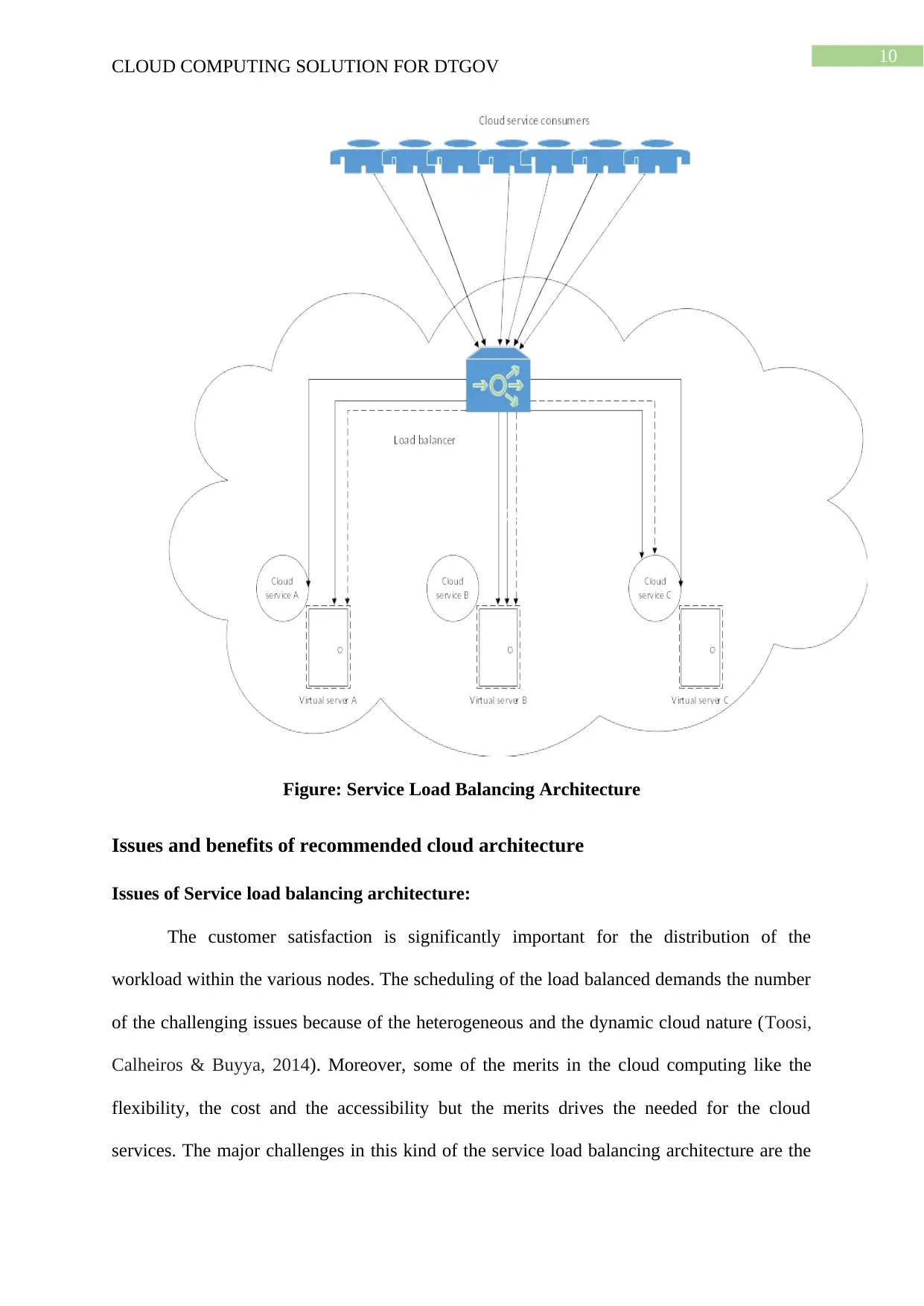
Service Load Balancing Architecture: This particular architecture could be defined as
the specialised version of architecture of the workload distribution, which is specifically
designed for the scaling of the implementation of the cloud services (Aazam & Huh, 2014).
The redundant deployments of the cloud services could be created with the system of load
balancing that is added for the dynamic distribution of the workloads. This duplicate
implementation of the cloud service could be organisation into the resource pool while the
positioning of the load balancer is done as the either any external or the built in component
for allowing the host servers to effectively balance all the workloads on their own. On the
CLOUD COMPUTING SOLUTION FOR DTGOV
aggregation (Jula, Sundararajan & Othman, 2014). Along with the virtual servers and the
devices of the cloud storage that are commonly mechanisms of the pooling, there are some of
the mechanisms that could be the part of the cloud architecture, that includes the audit
monitor, the cloud usage monitor, the hypervisor, the perimeter of the logical network, the
monitor of the pay-per-use, the system of the remote administration, the system for the
resource management and the resources replication.
Figure: Resource pooling architecture
Service Load Balancing Architecture: This particular architecture could be defined as
the specialised version of architecture of the workload distribution, which is specifically
designed for the scaling of the implementation of the cloud services (Aazam & Huh, 2014).
The redundant deployments of the cloud services could be created with the system of load
balancing that is added for the dynamic distribution of the workloads. This duplicate
implementation of the cloud service could be organisation into the resource pool while the
positioning of the load balancer is done as the either any external or the built in component
for allowing the host servers to effectively balance all the workloads on their own. On the
⊘ This is a preview!⊘
Do you want full access?
Subscribe today to unlock all pages.
Trusted by 1+ million students worldwide
9
CLOUD COMPUTING SOLUTION FOR DTGOV
basis of the anticipated workload and the processing capacity of the environment of the host
server, the multiple instances of every implementation of the cloud service could be
effectively generated as the part of the resource pool that could efficiently respond to the
fluctuating request volumes with the increased efficiency (Oliveira, Thomas & Espadanal,
2014). The positioning of the load balancer could be done as either independent of all the
cloud services as well as the host servers or it could be built-in section of the environment of
the server or the application. In former case, the primary server along with the logic of the
load balancing could effectively communicate with the adjacent servers for the effective
balancing of the workload.
CLOUD COMPUTING SOLUTION FOR DTGOV
basis of the anticipated workload and the processing capacity of the environment of the host
server, the multiple instances of every implementation of the cloud service could be
effectively generated as the part of the resource pool that could efficiently respond to the
fluctuating request volumes with the increased efficiency (Oliveira, Thomas & Espadanal,
2014). The positioning of the load balancer could be done as either independent of all the
cloud services as well as the host servers or it could be built-in section of the environment of
the server or the application. In former case, the primary server along with the logic of the
load balancing could effectively communicate with the adjacent servers for the effective
balancing of the workload.
Paraphrase This Document
Need a fresh take? Get an instant paraphrase of this document with our AI Paraphraser
10
CLOUD COMPUTING SOLUTION FOR DTGOV
Figure: Service Load Balancing Architecture
Issues and benefits of recommended cloud architecture
Issues of Service load balancing architecture:
The customer satisfaction is significantly important for the distribution of the
workload within the various nodes. The scheduling of the load balanced demands the number
of the challenging issues because of the heterogeneous and the dynamic cloud nature (Toosi,
Calheiros & Buyya, 2014). Moreover, some of the merits in the cloud computing like the
flexibility, the cost and the accessibility but the merits drives the needed for the cloud
services. The major challenges in this kind of the service load balancing architecture are the
CLOUD COMPUTING SOLUTION FOR DTGOV
Figure: Service Load Balancing Architecture
Issues and benefits of recommended cloud architecture
Issues of Service load balancing architecture:
The customer satisfaction is significantly important for the distribution of the
workload within the various nodes. The scheduling of the load balanced demands the number
of the challenging issues because of the heterogeneous and the dynamic cloud nature (Toosi,
Calheiros & Buyya, 2014). Moreover, some of the merits in the cloud computing like the
flexibility, the cost and the accessibility but the merits drives the needed for the cloud
services. The major challenges in this kind of the service load balancing architecture are the
11
CLOUD COMPUTING SOLUTION FOR DTGOV
security issues, the legal and the compliant issues, the QoS, interoperability issues and the
performance, the load balancing and the issues of the data management. The performance
could be of significant issues for the computing environment for the complete efficiency of
system. In the service load balancing architecture, all the parameters could be improved that
would lead to the complete improvement of the system performance (Li et al., 2015). The
response time has been described in the distributed systems about the amount of time that is
required for the responding to any specific load balancing. In service load balancing
architecture, the dynamic scaling takes increased response time as opposed to the other
architecture (Avram, 2014).
Benefits of Service load balancing architecture:
The highly performing applications of the service load balancing architecture are the
major benefit of the conventional on-premise substitutes and are significantly less expensive
and the implementation process is significantly simple. The company could gain the
increased scalability and with the effective utilisation of the load balancers, the company
could easily match up with the increased traffic from the users and then distribute among the
various servers or the network devices (Fehling et al., 2014). With the implementation of the
service load balancing architecture, the company could gain the ability of effective handling
of the unseen spikes in the traffic in the network. The business continuity could be executed
with the increased flexibility. It is gained because when the workload has been distributed
among the various servers or the network units, with the failure of even one node could
burden the complete network but this burden could be effectively handled by shifting it to
any other active node (Rahimi et al., 2014).
Issues of dynamic scaling architecture:
Some of the issues that are faced by the implementation of the dynamic scaling
architecture could be categorised as the issues of migration from one cloud to another, the
CLOUD COMPUTING SOLUTION FOR DTGOV
security issues, the legal and the compliant issues, the QoS, interoperability issues and the
performance, the load balancing and the issues of the data management. The performance
could be of significant issues for the computing environment for the complete efficiency of
system. In the service load balancing architecture, all the parameters could be improved that
would lead to the complete improvement of the system performance (Li et al., 2015). The
response time has been described in the distributed systems about the amount of time that is
required for the responding to any specific load balancing. In service load balancing
architecture, the dynamic scaling takes increased response time as opposed to the other
architecture (Avram, 2014).
Benefits of Service load balancing architecture:
The highly performing applications of the service load balancing architecture are the
major benefit of the conventional on-premise substitutes and are significantly less expensive
and the implementation process is significantly simple. The company could gain the
increased scalability and with the effective utilisation of the load balancers, the company
could easily match up with the increased traffic from the users and then distribute among the
various servers or the network devices (Fehling et al., 2014). With the implementation of the
service load balancing architecture, the company could gain the ability of effective handling
of the unseen spikes in the traffic in the network. The business continuity could be executed
with the increased flexibility. It is gained because when the workload has been distributed
among the various servers or the network units, with the failure of even one node could
burden the complete network but this burden could be effectively handled by shifting it to
any other active node (Rahimi et al., 2014).
Issues of dynamic scaling architecture:
Some of the issues that are faced by the implementation of the dynamic scaling
architecture could be categorised as the issues of migration from one cloud to another, the
⊘ This is a preview!⊘
Do you want full access?
Subscribe today to unlock all pages.
Trusted by 1+ million students worldwide

1 out of 29


Related Documents


Your All-in-One AI-Powered Toolkit for Academic Success.
+13062052269
info@desklib.com
Available 24*7 on WhatsApp / Email
![[object Object]](/_next/static/media/star-bottom.7253800d.svg)
Unlock your academic potential
Copyright © 2020–2026 A2Z Services. All Rights Reserved. Developed and managed by ZUCOL.