The Impact of Dual Diagnosis on Aboriginal Mental Health: A Report

Verified

Added on  2023/01/06

|6
|930
|98
Report
AI Summary
This report examines the critical issue of dual diagnosis and its impact on the mental health of Aboriginal populations. It explores the personal experiences of Aboriginal individuals facing co-occurring mental health problems and substance use disorders, highlighting the role of alcohol and harmful substances in contributing to depression and other mental illnesses. The report delves into how dual diagnosis, encompassing both mental health issues and substance abuse, complicates treatment and recovery, potentially leading to relapse. It also discusses the prevalence of substance abuse among Aboriginal individuals and its direct effects on the central nervous system, leading to increased depression and anxiety. The conclusion summarizes the detrimental effects of dual diagnosis, emphasizing the urgent need for interventions to address these complex challenges within Aboriginal communities. The report includes references to academic journals and books supporting the findings.

Document Page
Mental Health
1
tabler-icon-diamond-filled.svg

Paraphrase This Document

Need a fresh take? Get an instant paraphrase of this document with our AI Paraphraser
Document Page
Contents
INTRODUCTION...........................................................................................................................3
MAIN BODY..................................................................................................................................3
Personal life experience of aboriginal people (Dual diagnosis)..................................................3
Describe that how alcohol and substance lead to the depression among aboriginal population. 3
How dual diagnosis affect the mental health of aboriginal people..............................................4
CONCLUSION................................................................................................................................5
REFERENCES................................................................................................................................6
2
Document Page
INTRODUCTION
The documentation will discuss about the “Aboriginal" people who are suffering from Dual
Diagnosis problem. It is the most common problem that mainly occurred due to consumption of
harmful substances and alcohol within large amount. Furthermore, it will describe dual diagnosis
condition and how will effect on the mental health condition of “aboriginal” people.
MAIN BODY
Personal life experience of aboriginal people (Dual diagnosis)
The issue of co-existing mental health and other alcohol that has been determined as an
important one by aboriginal people in Australia (Rieb & et.al., 2020). As per evidence, it has
been identified the dual diagnosis, which was common presentation among aboriginal workers
(Colonna & et.al., 2020). In personal experience, it has been identified the collecting the large
data or information about aboriginal population.
According to report of national Drug strategy, large number of aboriginal individual
suffered from dual diagnosis problem who have aged above 40 years (Edwards, 2020 ). The
aboriginal people with dual diagnosis have both mental illness and alcohol problem, disorder. It
is very dangerous for their health condition. Dual diagnosis have developed the complexities to
treatment, recovery and also associated with incidence of relapse.
Describe that how alcohol and substance lead to the depression among aboriginal population.
According to survey, it has found that 47% male and 55% female consume harmful substances,
alcohols (Fong, 2017). It obvious thing to increase mental illness such as depression, psychotic
disorders. In some situation, it also developed the lifetime suicide thoughts and attempts,
significantly more likely among those harmful substances (Raimi & et.al., 2019).
3
Document Page
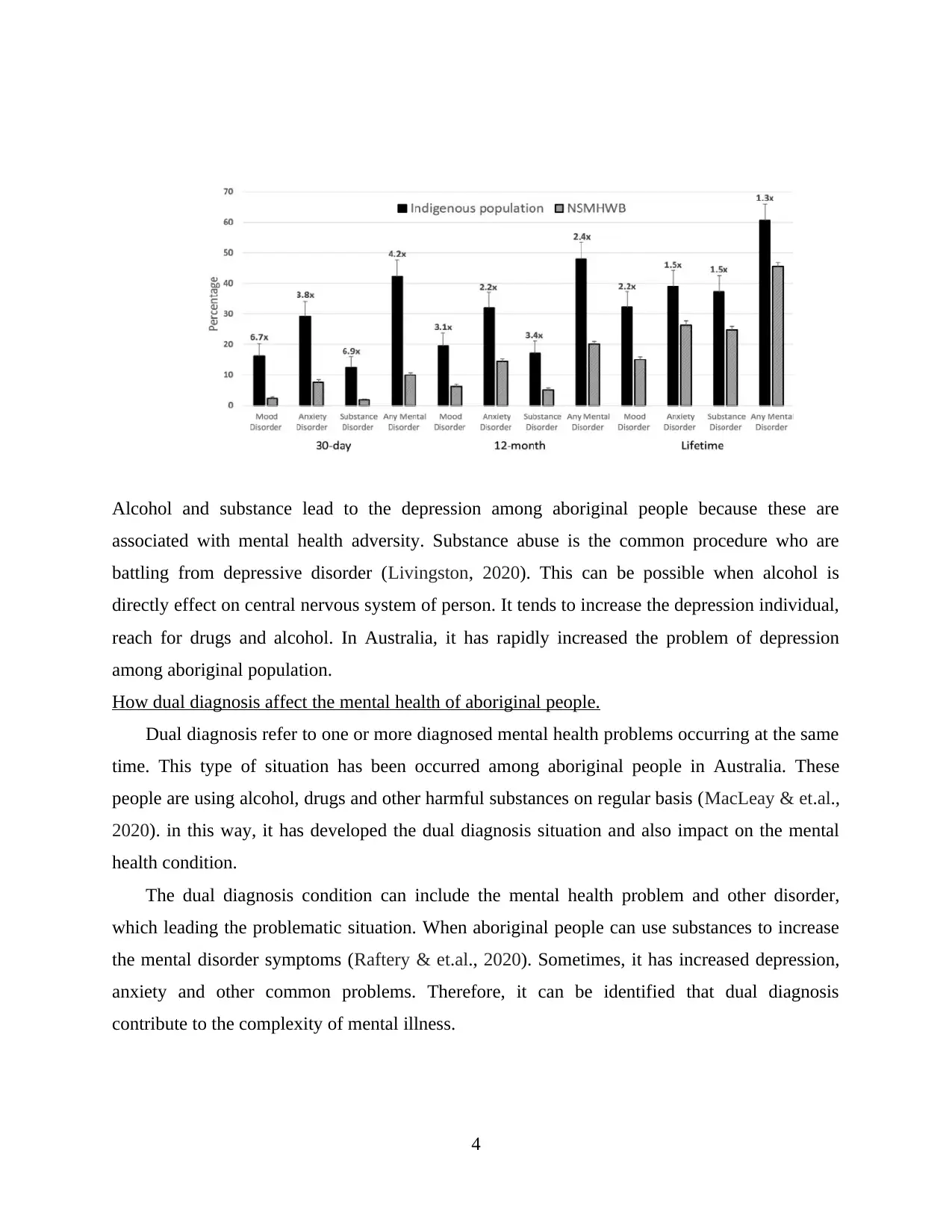
Alcohol and substance lead to the depression among aboriginal people because these are
associated with mental health adversity. Substance abuse is the common procedure who are
battling from depressive disorder (Livingston, 2020). This can be possible when alcohol is
directly effect on central nervous system of person. It tends to increase the depression individual,
reach for drugs and alcohol. In Australia, it has rapidly increased the problem of depression
among aboriginal population.
How dual diagnosis affect the mental health of aboriginal people.
Dual diagnosis refer to one or more diagnosed mental health problems occurring at the same
time. This type of situation has been occurred among aboriginal people in Australia. These
people are using alcohol, drugs and other harmful substances on regular basis (MacLeay & et.al.,
2020). in this way, it has developed the dual diagnosis situation and also impact on the mental
health condition.
The dual diagnosis condition can include the mental health problem and other disorder,
which leading the problematic situation. When aboriginal people can use substances to increase
the mental disorder symptoms (Raftery & et.al., 2020). Sometimes, it has increased depression,
anxiety and other common problems. Therefore, it can be identified that dual diagnosis
contribute to the complexity of mental illness.
4
tabler-icon-diamond-filled.svg

Paraphrase This Document

Need a fresh take? Get an instant paraphrase of this document with our AI Paraphraser
Document Page
CONCLUSION
From above discussion, it has summarised about dual diagnosis condition in which directly
affecting on the mental health condition. in order to increase represent depression, anxiety. As
per analysis, it has identified that dual diagnosis problem occurred when consuming excess
amount of substances, drugs and alcohols. These are directly affecting on the central nervous
system.
5
Document Page
REFERENCES
Book and Journals
Colonna, E. & et.al., (2020). Review of tobacco use among Aboriginal and Torres Strait Islander
peoples. Perth, WA: Australian Indigenous HealthInfoNet.
Edwards, R. E. (2020). Young adult women with problematic alcohol use: The impact of social
capital on recovery (Doctoral dissertation, Queensland University of Technology).
Fong, W. (2017). The Relationship between Ethnicity and Dual Diagnosis to Received
Outpatient Treatment on a National Level (Doctoral dissertation, The Chicago School of
Professional Psychology).
Livingston, W. (2020). Alcohol and drug use: From dual diagnosis to well-being. Mental Health
and Social Work. 331-351.
MacLeay, E. & et.al., (2020). Care planning and nonpharmacological interventions in a
metropolitan inpatient dual diagnosis service: A retrospective exploratory
study. International Journal of Mental Health Nursing.
Raftery, D. & et.al., (2020). Insight in substance use disorder: A systematic review of the
literature. Addictive Behaviors. 106549.
Raimi, M. & et.al., (2019). Public Health Impact of Substance Use on Adolescent: A Snapshot of
Yenagoa in Bayelsa State. Nigeria. American Journal of Biomedical Science & Research.
Rieb, L. M. & et.al., (2020). Withdrawal-associated injury site pain prevalence and correlates
among opioid-using people who inject drugs in Vancouver, Canada. Drug and Alcohol
Dependence. 108242.
6
chevron_up_icon
1 out of 6
circle_padding
hide_on_mobile
zoom_out_icon
[object Object]