Duquesne University Nursing: Teaching Plan on Breast Screening
VerifiedAdded on 2023/06/08
|5
|1293
|316
AI Summary
This teaching plan, designed for women aged 15-45, focuses on raising awareness about breast cancer risks and the importance of early detection through breast screening and self-examination. The plan aims to educate women about routine breast screening, demonstrate self-examination techniques, and address stigmas associated with screening programs. It includes statistical data on breast cancer prevalence, benefits of early diagnosis, and step-by-step instructions for performing self-exams. The plan also incorporates methods to evaluate the effectiveness of the teaching through surveys and knowledge assessments. Desklib offers this and many other solved assignments for students.
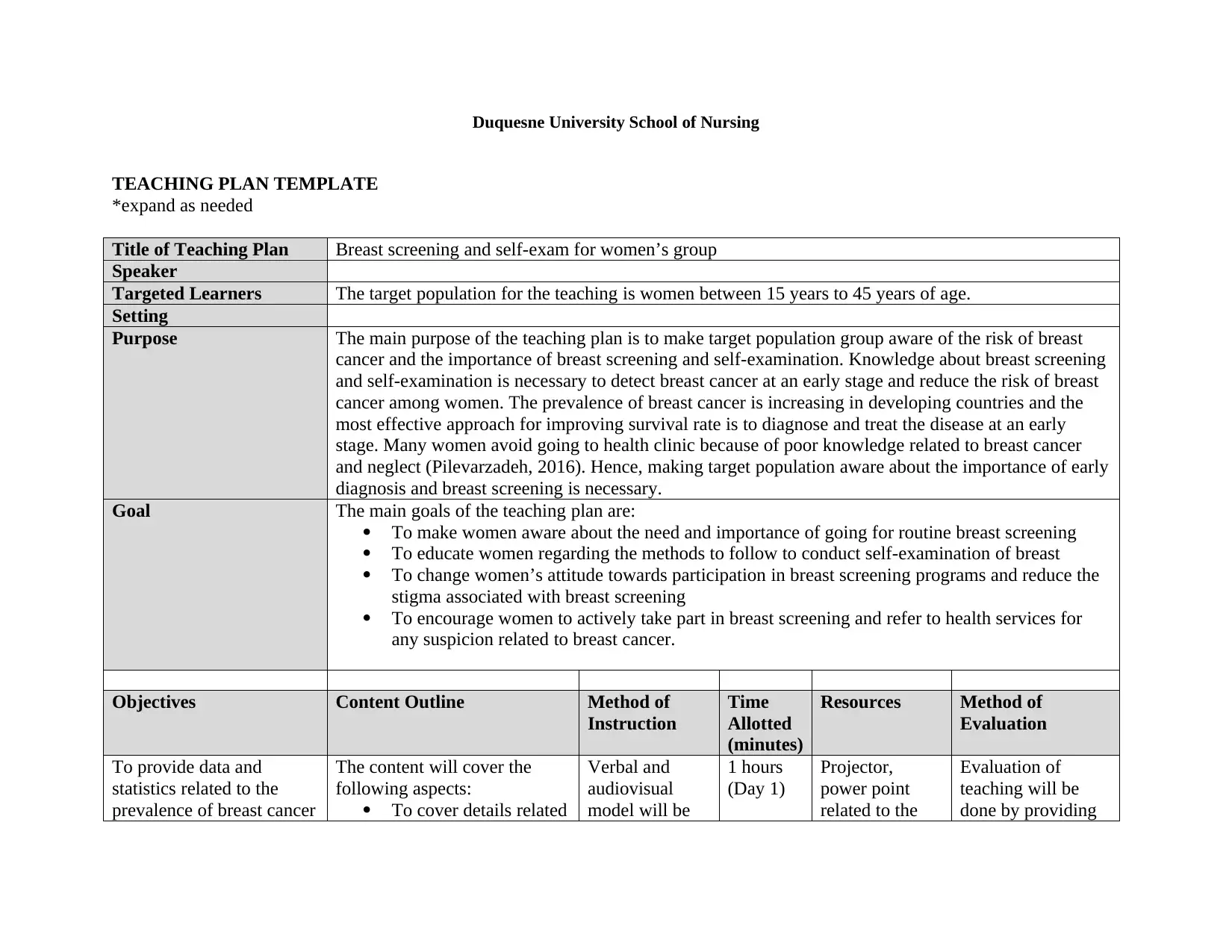
Duquesne University School of Nursing
TEACHING PLAN TEMPLATE
*expand as needed
Title of Teaching Plan Breast screening and self-exam for women’s group
Speaker
Targeted Learners The target population for the teaching is women between 15 years to 45 years of age.
Setting
Purpose The main purpose of the teaching plan is to make target population group aware of the risk of breast
cancer and the importance of breast screening and self-examination. Knowledge about breast screening
and self-examination is necessary to detect breast cancer at an early stage and reduce the risk of breast
cancer among women. The prevalence of breast cancer is increasing in developing countries and the
most effective approach for improving survival rate is to diagnose and treat the disease at an early
stage. Many women avoid going to health clinic because of poor knowledge related to breast cancer
and neglect (Pilevarzadeh, 2016). Hence, making target population aware about the importance of early
diagnosis and breast screening is necessary.
Goal The main goals of the teaching plan are:
To make women aware about the need and importance of going for routine breast screening
To educate women regarding the methods to follow to conduct self-examination of breast
To change women’s attitude towards participation in breast screening programs and reduce the
stigma associated with breast screening
To encourage women to actively take part in breast screening and refer to health services for
any suspicion related to breast cancer.
Objectives Content Outline Method of
Instruction
Time
Allotted
(minutes)
Resources Method of
Evaluation
To provide data and
statistics related to the
prevalence of breast cancer
The content will cover the
following aspects:
To cover details related
Verbal and
audiovisual
model will be
1 hours
(Day 1)
Projector,
power point
related to the
Evaluation of
teaching will be
done by providing
TEACHING PLAN TEMPLATE
*expand as needed
Title of Teaching Plan Breast screening and self-exam for women’s group
Speaker
Targeted Learners The target population for the teaching is women between 15 years to 45 years of age.
Setting
Purpose The main purpose of the teaching plan is to make target population group aware of the risk of breast
cancer and the importance of breast screening and self-examination. Knowledge about breast screening
and self-examination is necessary to detect breast cancer at an early stage and reduce the risk of breast
cancer among women. The prevalence of breast cancer is increasing in developing countries and the
most effective approach for improving survival rate is to diagnose and treat the disease at an early
stage. Many women avoid going to health clinic because of poor knowledge related to breast cancer
and neglect (Pilevarzadeh, 2016). Hence, making target population aware about the importance of early
diagnosis and breast screening is necessary.
Goal The main goals of the teaching plan are:
To make women aware about the need and importance of going for routine breast screening
To educate women regarding the methods to follow to conduct self-examination of breast
To change women’s attitude towards participation in breast screening programs and reduce the
stigma associated with breast screening
To encourage women to actively take part in breast screening and refer to health services for
any suspicion related to breast cancer.
Objectives Content Outline Method of
Instruction
Time
Allotted
(minutes)
Resources Method of
Evaluation
To provide data and
statistics related to the
prevalence of breast cancer
The content will cover the
following aspects:
To cover details related
Verbal and
audiovisual
model will be
1 hours
(Day 1)
Projector,
power point
related to the
Evaluation of
teaching will be
done by providing
Paraphrase This Document
Need a fresh take? Get an instant paraphrase of this document with our AI Paraphraser

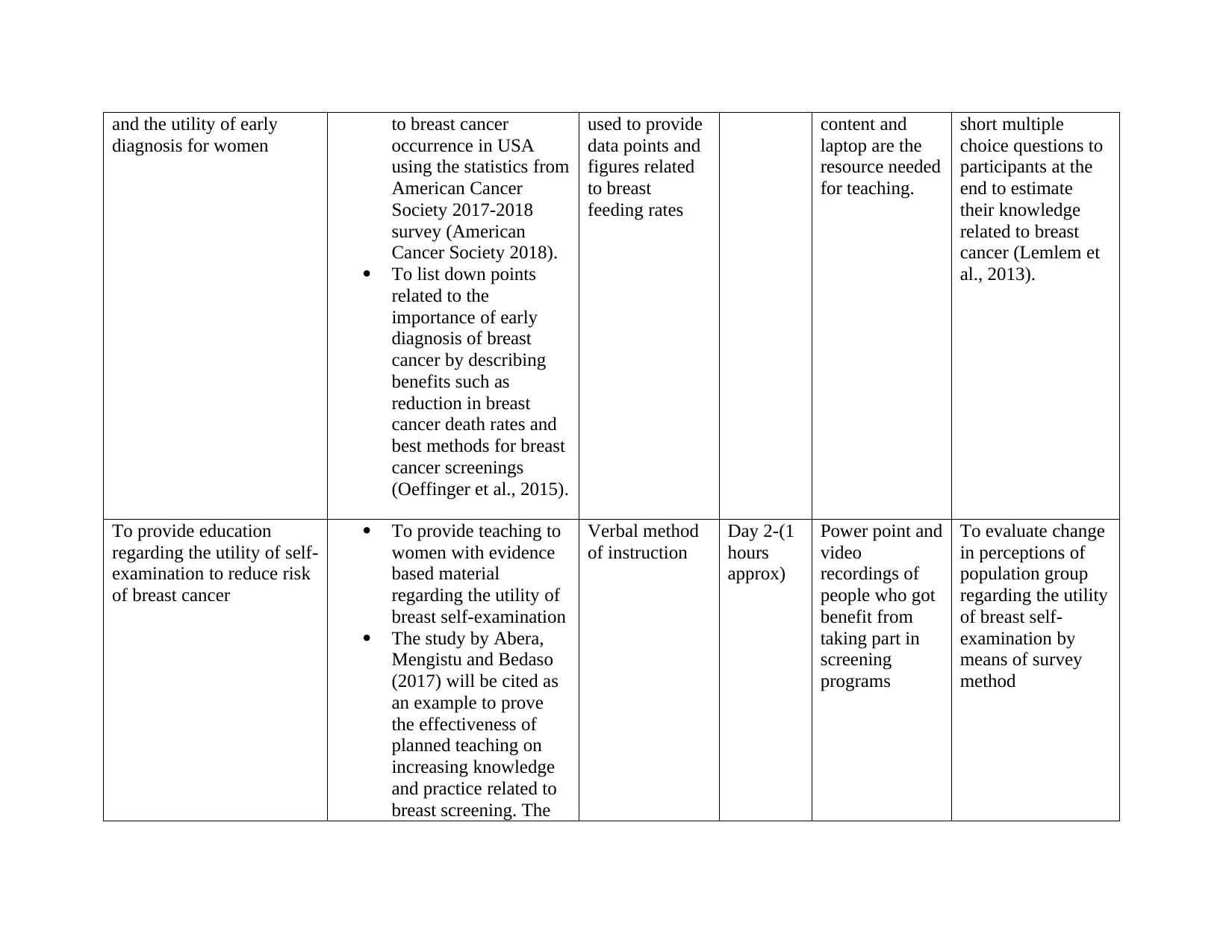
and the utility of early
diagnosis for women
to breast cancer
occurrence in USA
using the statistics from
American Cancer
Society 2017-2018
survey (American
Cancer Society 2018).
To list down points
related to the
importance of early
diagnosis of breast
cancer by describing
benefits such as
reduction in breast
cancer death rates and
best methods for breast
cancer screenings
(Oeffinger et al., 2015).
used to provide
data points and
figures related
to breast
feeding rates
content and
laptop are the
resource needed
for teaching.
short multiple
choice questions to
participants at the
end to estimate
their knowledge
related to breast
cancer (Lemlem et
al., 2013).
To provide education
regarding the utility of self-
examination to reduce risk
of breast cancer
To provide teaching to
women with evidence
based material
regarding the utility of
breast self-examination
The study by Abera,
Mengistu and Bedaso
(2017) will be cited as
an example to prove
the effectiveness of
planned teaching on
increasing knowledge
and practice related to
breast screening. The
Verbal method
of instruction
Day 2-(1
hours
approx)
Power point and
video
recordings of
people who got
benefit from
taking part in
screening
programs
To evaluate change
in perceptions of
population group
regarding the utility
of breast self-
examination by
means of survey
method
diagnosis for women
to breast cancer
occurrence in USA
using the statistics from
American Cancer
Society 2017-2018
survey (American
Cancer Society 2018).
To list down points
related to the
importance of early
diagnosis of breast
cancer by describing
benefits such as
reduction in breast
cancer death rates and
best methods for breast
cancer screenings
(Oeffinger et al., 2015).
used to provide
data points and
figures related
to breast
feeding rates
content and
laptop are the
resource needed
for teaching.
short multiple
choice questions to
participants at the
end to estimate
their knowledge
related to breast
cancer (Lemlem et
al., 2013).
To provide education
regarding the utility of self-
examination to reduce risk
of breast cancer
To provide teaching to
women with evidence
based material
regarding the utility of
breast self-examination
The study by Abera,
Mengistu and Bedaso
(2017) will be cited as
an example to prove
the effectiveness of
planned teaching on
increasing knowledge
and practice related to
breast screening. The
Verbal method
of instruction
Day 2-(1
hours
approx)
Power point and
video
recordings of
people who got
benefit from
taking part in
screening
programs
To evaluate change
in perceptions of
population group
regarding the utility
of breast self-
examination by
means of survey
method

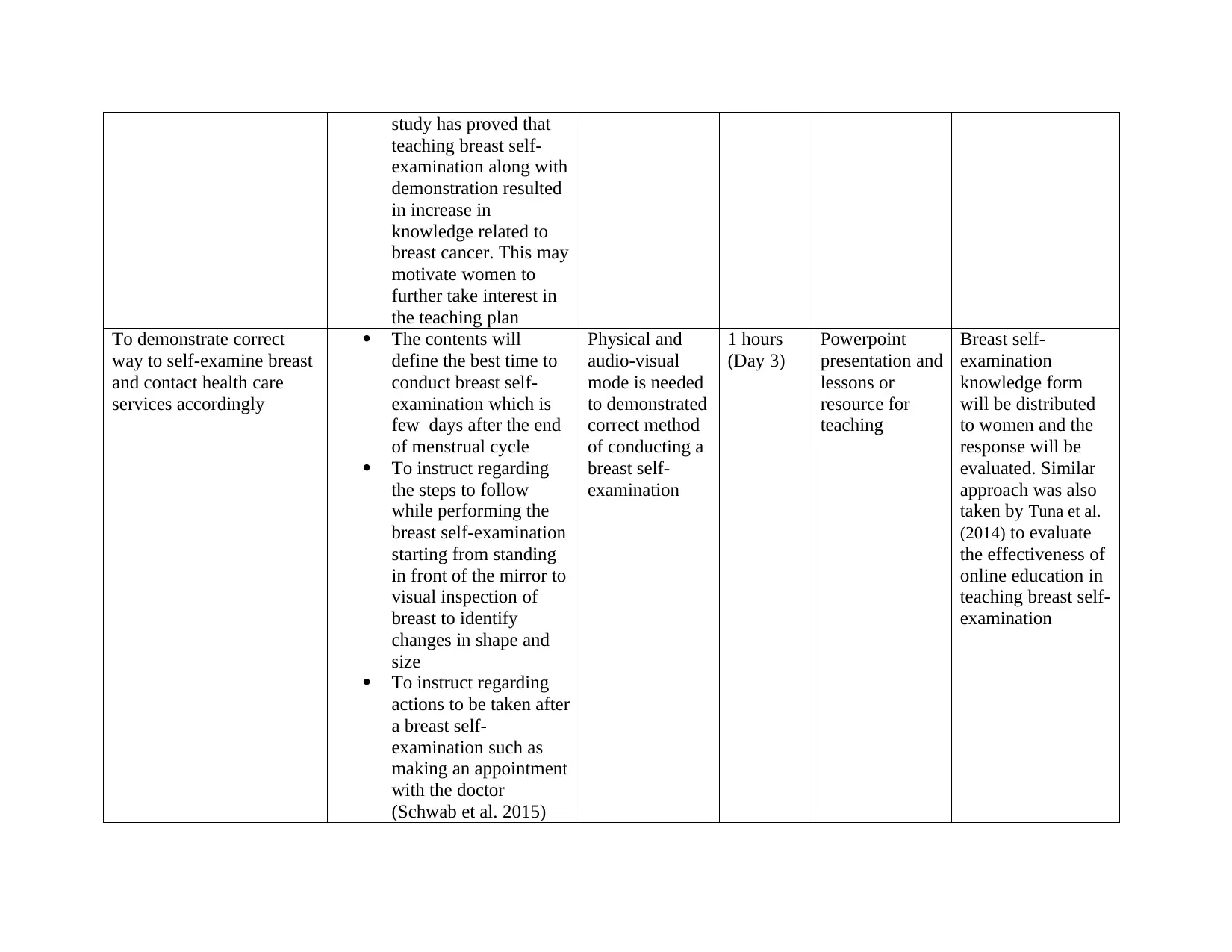
study has proved that
teaching breast self-
examination along with
demonstration resulted
in increase in
knowledge related to
breast cancer. This may
motivate women to
further take interest in
the teaching plan
To demonstrate correct
way to self-examine breast
and contact health care
services accordingly
The contents will
define the best time to
conduct breast self-
examination which is
few days after the end
of menstrual cycle
To instruct regarding
the steps to follow
while performing the
breast self-examination
starting from standing
in front of the mirror to
visual inspection of
breast to identify
changes in shape and
size
To instruct regarding
actions to be taken after
a breast self-
examination such as
making an appointment
with the doctor
(Schwab et al. 2015)
Physical and
audio-visual
mode is needed
to demonstrated
correct method
of conducting a
breast self-
examination
1 hours
(Day 3)
Powerpoint
presentation and
lessons or
resource for
teaching
Breast self-
examination
knowledge form
will be distributed
to women and the
response will be
evaluated. Similar
approach was also
taken by Tuna et al.
(2014) to evaluate
the effectiveness of
online education in
teaching breast self-
examination
teaching breast self-
examination along with
demonstration resulted
in increase in
knowledge related to
breast cancer. This may
motivate women to
further take interest in
the teaching plan
To demonstrate correct
way to self-examine breast
and contact health care
services accordingly
The contents will
define the best time to
conduct breast self-
examination which is
few days after the end
of menstrual cycle
To instruct regarding
the steps to follow
while performing the
breast self-examination
starting from standing
in front of the mirror to
visual inspection of
breast to identify
changes in shape and
size
To instruct regarding
actions to be taken after
a breast self-
examination such as
making an appointment
with the doctor
(Schwab et al. 2015)
Physical and
audio-visual
mode is needed
to demonstrated
correct method
of conducting a
breast self-
examination
1 hours
(Day 3)
Powerpoint
presentation and
lessons or
resource for
teaching
Breast self-
examination
knowledge form
will be distributed
to women and the
response will be
evaluated. Similar
approach was also
taken by Tuna et al.
(2014) to evaluate
the effectiveness of
online education in
teaching breast self-
examination
⊘ This is a preview!⊘
Do you want full access?
Subscribe today to unlock all pages.

Trusted by 1+ million students worldwide

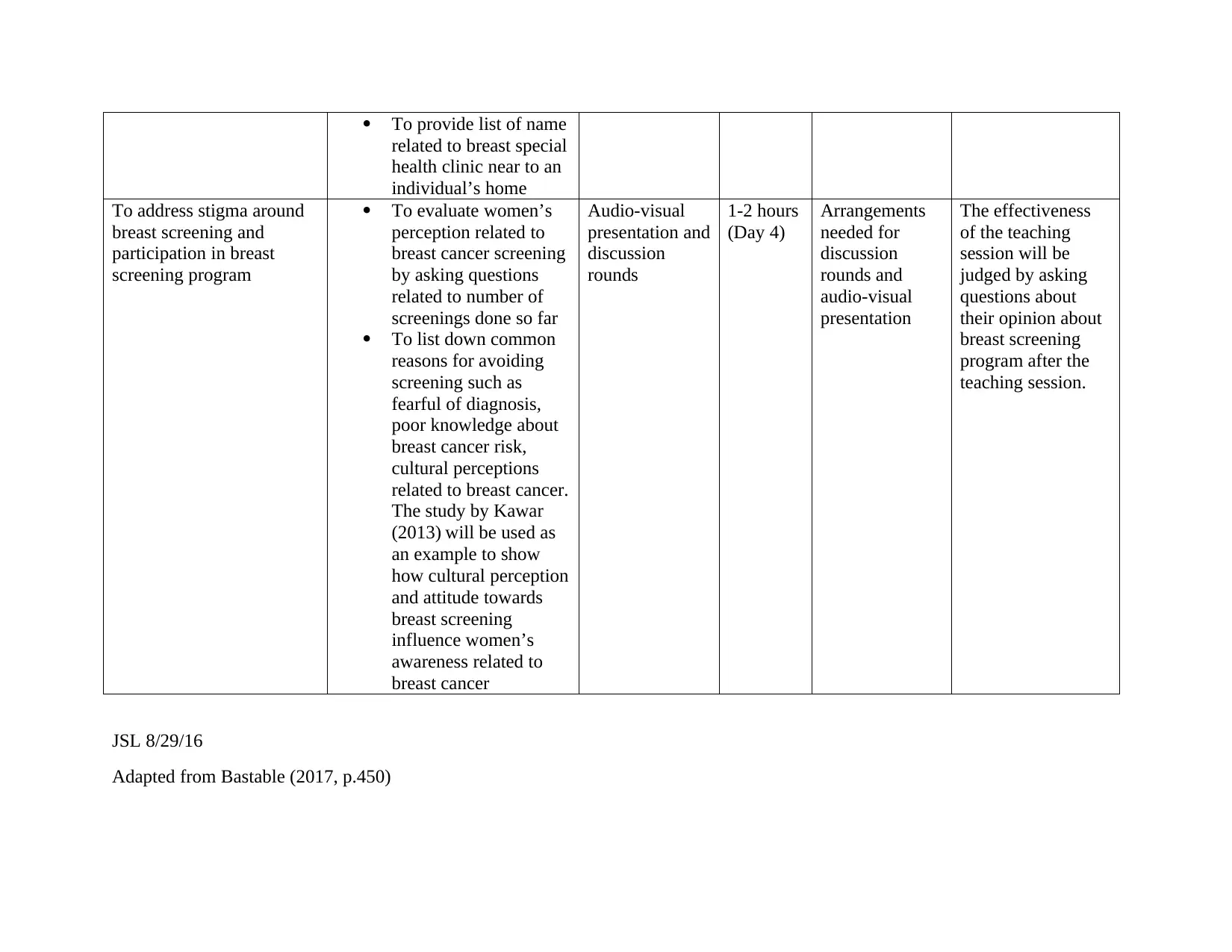
To provide list of name
related to breast special
health clinic near to an
individual’s home
To address stigma around
breast screening and
participation in breast
screening program
To evaluate women’s
perception related to
breast cancer screening
by asking questions
related to number of
screenings done so far
To list down common
reasons for avoiding
screening such as
fearful of diagnosis,
poor knowledge about
breast cancer risk,
cultural perceptions
related to breast cancer.
The study by Kawar
(2013) will be used as
an example to show
how cultural perception
and attitude towards
breast screening
influence women’s
awareness related to
breast cancer
Audio-visual
presentation and
discussion
rounds
1-2 hours
(Day 4)
Arrangements
needed for
discussion
rounds and
audio-visual
presentation
The effectiveness
of the teaching
session will be
judged by asking
questions about
their opinion about
breast screening
program after the
teaching session.
JSL 8/29/16
Adapted from Bastable (2017, p.450)
related to breast special
health clinic near to an
individual’s home
To address stigma around
breast screening and
participation in breast
screening program
To evaluate women’s
perception related to
breast cancer screening
by asking questions
related to number of
screenings done so far
To list down common
reasons for avoiding
screening such as
fearful of diagnosis,
poor knowledge about
breast cancer risk,
cultural perceptions
related to breast cancer.
The study by Kawar
(2013) will be used as
an example to show
how cultural perception
and attitude towards
breast screening
influence women’s
awareness related to
breast cancer
Audio-visual
presentation and
discussion
rounds
1-2 hours
(Day 4)
Arrangements
needed for
discussion
rounds and
audio-visual
presentation
The effectiveness
of the teaching
session will be
judged by asking
questions about
their opinion about
breast screening
program after the
teaching session.
JSL 8/29/16
Adapted from Bastable (2017, p.450)
Paraphrase This Document
Need a fresh take? Get an instant paraphrase of this document with our AI Paraphraser

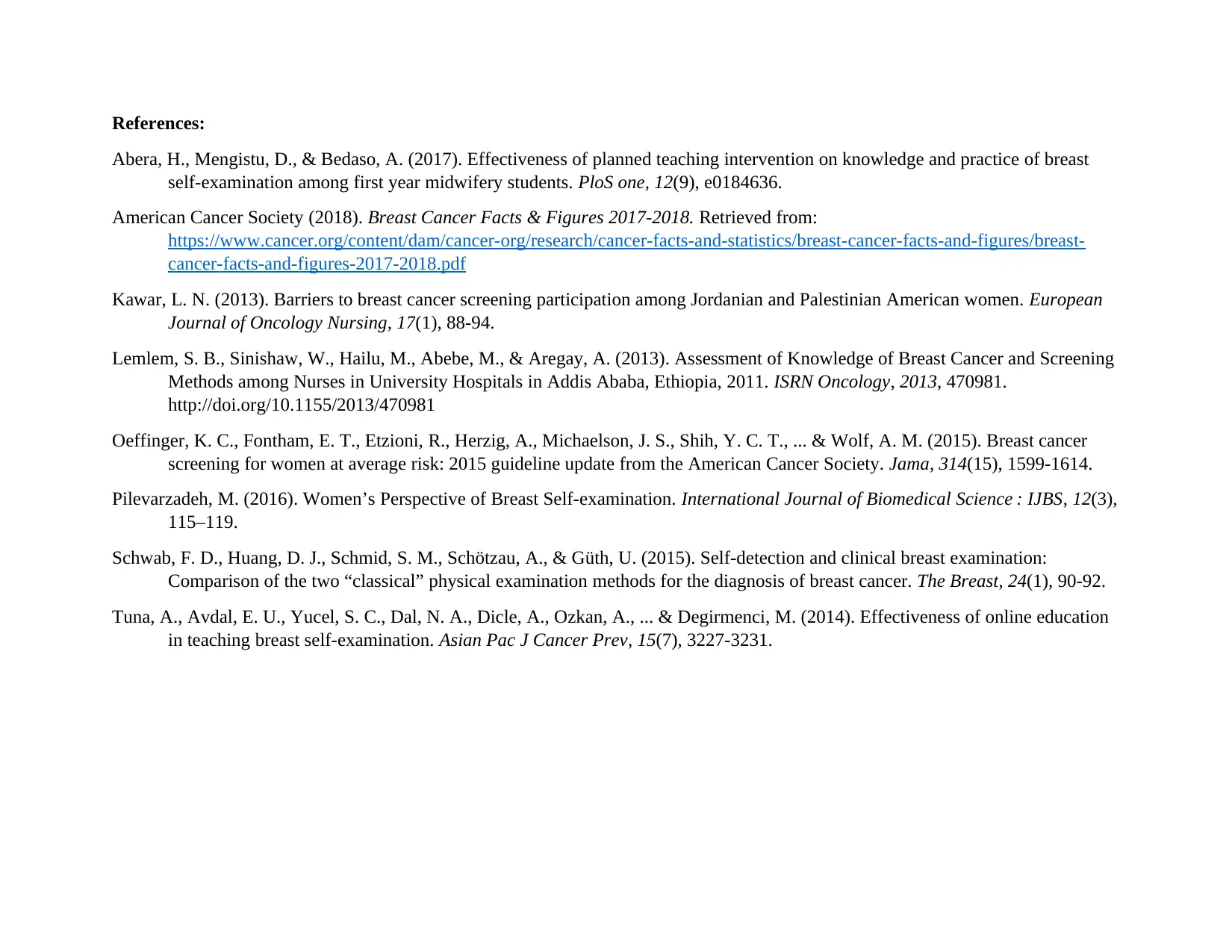
References:
Abera, H., Mengistu, D., & Bedaso, A. (2017). Effectiveness of planned teaching intervention on knowledge and practice of breast
self-examination among first year midwifery students. PloS one, 12(9), e0184636.
American Cancer Society (2018). Breast Cancer Facts & Figures 2017-2018. Retrieved from:
https://www.cancer.org/content/dam/cancer-org/research/cancer-facts-and-statistics/breast-cancer-facts-and-figures/breast-
cancer-facts-and-figures-2017-2018.pdf
Kawar, L. N. (2013). Barriers to breast cancer screening participation among Jordanian and Palestinian American women. European
Journal of Oncology Nursing, 17(1), 88-94.
Lemlem, S. B., Sinishaw, W., Hailu, M., Abebe, M., & Aregay, A. (2013). Assessment of Knowledge of Breast Cancer and Screening
Methods among Nurses in University Hospitals in Addis Ababa, Ethiopia, 2011. ISRN Oncology, 2013, 470981.
http://doi.org/10.1155/2013/470981
Oeffinger, K. C., Fontham, E. T., Etzioni, R., Herzig, A., Michaelson, J. S., Shih, Y. C. T., ... & Wolf, A. M. (2015). Breast cancer
screening for women at average risk: 2015 guideline update from the American Cancer Society. Jama, 314(15), 1599-1614.
Pilevarzadeh, M. (2016). Women’s Perspective of Breast Self-examination. International Journal of Biomedical Science : IJBS, 12(3),
115–119.
Schwab, F. D., Huang, D. J., Schmid, S. M., Schötzau, A., & Güth, U. (2015). Self-detection and clinical breast examination:
Comparison of the two “classical” physical examination methods for the diagnosis of breast cancer. The Breast, 24(1), 90-92.
Tuna, A., Avdal, E. U., Yucel, S. C., Dal, N. A., Dicle, A., Ozkan, A., ... & Degirmenci, M. (2014). Effectiveness of online education
in teaching breast self-examination. Asian Pac J Cancer Prev, 15(7), 3227-3231.
Abera, H., Mengistu, D., & Bedaso, A. (2017). Effectiveness of planned teaching intervention on knowledge and practice of breast
self-examination among first year midwifery students. PloS one, 12(9), e0184636.
American Cancer Society (2018). Breast Cancer Facts & Figures 2017-2018. Retrieved from:
https://www.cancer.org/content/dam/cancer-org/research/cancer-facts-and-statistics/breast-cancer-facts-and-figures/breast-
cancer-facts-and-figures-2017-2018.pdf
Kawar, L. N. (2013). Barriers to breast cancer screening participation among Jordanian and Palestinian American women. European
Journal of Oncology Nursing, 17(1), 88-94.
Lemlem, S. B., Sinishaw, W., Hailu, M., Abebe, M., & Aregay, A. (2013). Assessment of Knowledge of Breast Cancer and Screening
Methods among Nurses in University Hospitals in Addis Ababa, Ethiopia, 2011. ISRN Oncology, 2013, 470981.
http://doi.org/10.1155/2013/470981
Oeffinger, K. C., Fontham, E. T., Etzioni, R., Herzig, A., Michaelson, J. S., Shih, Y. C. T., ... & Wolf, A. M. (2015). Breast cancer
screening for women at average risk: 2015 guideline update from the American Cancer Society. Jama, 314(15), 1599-1614.
Pilevarzadeh, M. (2016). Women’s Perspective of Breast Self-examination. International Journal of Biomedical Science : IJBS, 12(3),
115–119.
Schwab, F. D., Huang, D. J., Schmid, S. M., Schötzau, A., & Güth, U. (2015). Self-detection and clinical breast examination:
Comparison of the two “classical” physical examination methods for the diagnosis of breast cancer. The Breast, 24(1), 90-92.
Tuna, A., Avdal, E. U., Yucel, S. C., Dal, N. A., Dicle, A., Ozkan, A., ... & Degirmenci, M. (2014). Effectiveness of online education
in teaching breast self-examination. Asian Pac J Cancer Prev, 15(7), 3227-3231.
1 out of 5
Related Documents
Your All-in-One AI-Powered Toolkit for Academic Success.
+13062052269
info@desklib.com
Available 24*7 on WhatsApp / Email
Unlock your academic potential
Copyright © 2020–2026 A2Z Services. All Rights Reserved. Developed and managed by ZUCOL.