Companies Act 2006: Duty to Avoid Conflict of Interest for Directors
VerifiedAdded on  2023/01/18
|5
|1071
|31
Report
AI Summary
This report examines the duty of directors to avoid conflicts of interest, as stipulated in Section 175 of the Companies Act 2006. It highlights the fiduciary relationship between directors and the company, emphasizing the importance of maintaining confidentiality, loyalty, and separating personal and professional interests. The report discusses the implications of conflicts, including instances where directors use company information for personal gain or fail to act in the best interests of the company. It references the case of Regal (Hastings) Ltd v Gulliver (1942) HL to illustrate breaches of fiduciary duty. The report concludes that directors play a critical role in business activities and must avoid conflicts to protect the company's rights and the interests of its employees. The Companies Act 2006 aims to protect the rights of all parties involved and ensure fair decision-making.
DUTY TO AVOID CONFLICT OF
INTEREST OF DIRECTORS
Paraphrase This Document
Need a fresh take? Get an instant paraphrase of this document with our AI Paraphraser

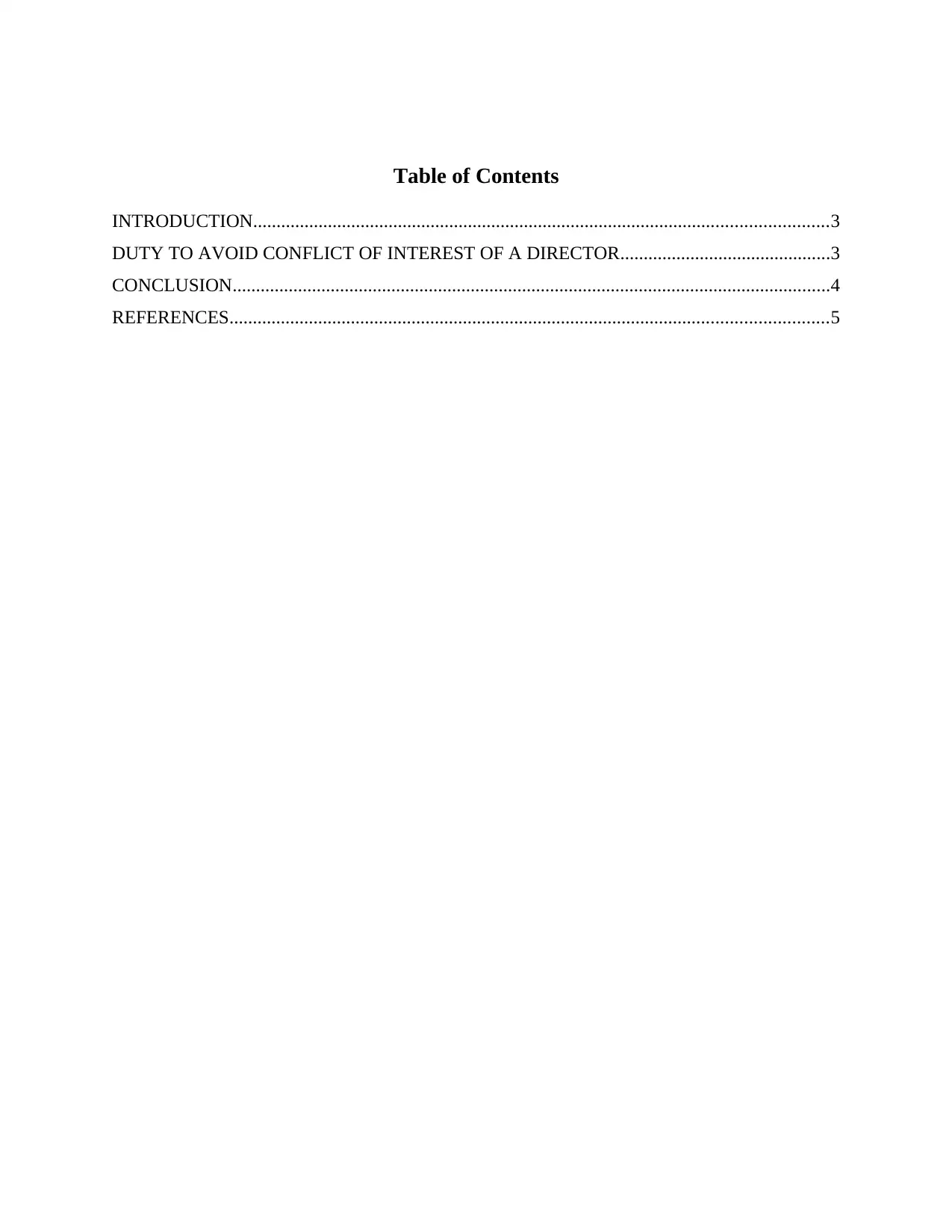
Table of Contents
INTRODUCTION...........................................................................................................................3
DUTY TO AVOID CONFLICT OF INTEREST OF A DIRECTOR.............................................3
CONCLUSION................................................................................................................................4
REFERENCES................................................................................................................................5
INTRODUCTION...........................................................................................................................3
DUTY TO AVOID CONFLICT OF INTEREST OF A DIRECTOR.............................................3
CONCLUSION................................................................................................................................4
REFERENCES................................................................................................................................5

INTRODUCTION
Directors are such person which carry the fiduciary relationship with the company and
they play the role of the agents in which they carry certain obligations. In this aspects the
decision which is made by the directors are the legal obligation which is bound by the employees
to follow it (Menkel-Meadow and et.al., 2018). Thus, in such aspects to undertake the matter
related to deciding the duties of directors, they also carry various aspects to avoid such conflict
which raises in respect of not maintaining the duty at work place.
DUTY TO AVOID CONFLICT OF INTEREST OF A DIRECTOR
In respect of undertaking the duties of the directors, they carry certain norms and
regulation which is bound by directors to follow it. Firstly in respect of maintain the
confidentiality at work place. As they cannot disclose the company information with taking prior
approval from the owners of the company (Richerson and et.al., 2016). Secondly the duty is
relating to maintain loyalty and trust at work place so that they can retain the employees interest
towards the work for longer way. The major duty which they carry is relating to differentiating
the life of personal and profession way and not mix with any of the situation to gain profits.
Under sections 175 of the companies act, 2006, it stated that the conflict arises in
company in relation to directors carrying various aspects such as directors are familiar with the
situation that if they deal in such matter, it results in arising the actual conflict or when the
directors uses the company information for personal profits. The conflict also raises in respect of
taking advise from the advisory person which is specially appointed to guide the company.
In relation to matters which is specified under section 175 (4) of the companies act, 2006
it is related to avoiding the conflict which arises through any such perspective as changing the
article of the association (Chen, Chang and Lo, 2015). As if the directors feel that the policy is
resulting to bringing conflict and it is difficult to avoid such conflict, than in such manner articles
are amended. It is also examined that in relating to undertaking the pre authorization procedure
regarding sharing the resolution in the board meeting. Through this aspects it resulting in getting
the getting more correct decision regarding avoiding the conflicts in better way.
Thus, in such aspects it is necessary to avoid conflict in company which is raised by
directors as the conflict resulting in affecting the rights and goodwill of the company and also
affects the right of the employees working under the company (Sriram, Martin-Ortega and
Herman, 2017). Companies act, 2006 is mainly imposed in respect of undertaking certain norms
Directors are such person which carry the fiduciary relationship with the company and
they play the role of the agents in which they carry certain obligations. In this aspects the
decision which is made by the directors are the legal obligation which is bound by the employees
to follow it (Menkel-Meadow and et.al., 2018). Thus, in such aspects to undertake the matter
related to deciding the duties of directors, they also carry various aspects to avoid such conflict
which raises in respect of not maintaining the duty at work place.
DUTY TO AVOID CONFLICT OF INTEREST OF A DIRECTOR
In respect of undertaking the duties of the directors, they carry certain norms and
regulation which is bound by directors to follow it. Firstly in respect of maintain the
confidentiality at work place. As they cannot disclose the company information with taking prior
approval from the owners of the company (Richerson and et.al., 2016). Secondly the duty is
relating to maintain loyalty and trust at work place so that they can retain the employees interest
towards the work for longer way. The major duty which they carry is relating to differentiating
the life of personal and profession way and not mix with any of the situation to gain profits.
Under sections 175 of the companies act, 2006, it stated that the conflict arises in
company in relation to directors carrying various aspects such as directors are familiar with the
situation that if they deal in such matter, it results in arising the actual conflict or when the
directors uses the company information for personal profits. The conflict also raises in respect of
taking advise from the advisory person which is specially appointed to guide the company.
In relation to matters which is specified under section 175 (4) of the companies act, 2006
it is related to avoiding the conflict which arises through any such perspective as changing the
article of the association (Chen, Chang and Lo, 2015). As if the directors feel that the policy is
resulting to bringing conflict and it is difficult to avoid such conflict, than in such manner articles
are amended. It is also examined that in relating to undertaking the pre authorization procedure
regarding sharing the resolution in the board meeting. Through this aspects it resulting in getting
the getting more correct decision regarding avoiding the conflicts in better way.
Thus, in such aspects it is necessary to avoid conflict in company which is raised by
directors as the conflict resulting in affecting the rights and goodwill of the company and also
affects the right of the employees working under the company (Sriram, Martin-Ortega and
Herman, 2017). Companies act, 2006 is mainly imposed in respect of undertaking certain norms
⊘ This is a preview!⊘
Do you want full access?
Subscribe today to unlock all pages.

Trusted by 1+ million students worldwide

to protect the right of the person and also provide justice to parties in respect of any breach
committed in not getting fair decisions and judgement.
As the situation is reflected under the case study of the Regal (Hastings) Ltd Gulliver
(1942) HL, as in this case study the situation is raised regarding breaching the fiduciary liability
of the directors in respect of performing the duty (R E G A L ( H A S T I N G S ) L T D V
G U L L I V E R : H L 2 0 F E B 1 9 4 2 , 2 0 1 9 ) . The case states that the regal is the owner of the
cinema and due to giving the security to the landlord regarding the establishment of the
company. They made the investment with the helps from four person which are the directors of
the company. As without the information of the shareholders or not taking their consent, they
share the business and earn profits which is to be distributed between the directors. Thus, in such
case shareholders file the suit against the company in respect of not taking prior consent from
them regarding selling the business. This results in causing breach in respect of performing their
rights. Thus, it results in facing conflict through directors in respect of using the business profits
for their personal use.
CONCLUSION
From the above study, the report conclude that directors play the important role in
relation to dealing with the business activities in better way. As they play the role of agents in
which they had to hear to the employees regarding the issue which they are facing and than
imposed the polices and ideas to owner to imposed them to maintain security in company. Thus,
the main reason of undertaking section 175 of the companies Act, 2006 is relating to avoiding
the conflict which arises through the directors movement in respect of not maintaining the
adequate difference in actual and potential interest.
committed in not getting fair decisions and judgement.
As the situation is reflected under the case study of the Regal (Hastings) Ltd Gulliver
(1942) HL, as in this case study the situation is raised regarding breaching the fiduciary liability
of the directors in respect of performing the duty (R E G A L ( H A S T I N G S ) L T D V
G U L L I V E R : H L 2 0 F E B 1 9 4 2 , 2 0 1 9 ) . The case states that the regal is the owner of the
cinema and due to giving the security to the landlord regarding the establishment of the
company. They made the investment with the helps from four person which are the directors of
the company. As without the information of the shareholders or not taking their consent, they
share the business and earn profits which is to be distributed between the directors. Thus, in such
case shareholders file the suit against the company in respect of not taking prior consent from
them regarding selling the business. This results in causing breach in respect of performing their
rights. Thus, it results in facing conflict through directors in respect of using the business profits
for their personal use.
CONCLUSION
From the above study, the report conclude that directors play the important role in
relation to dealing with the business activities in better way. As they play the role of agents in
which they had to hear to the employees regarding the issue which they are facing and than
imposed the polices and ideas to owner to imposed them to maintain security in company. Thus,
the main reason of undertaking section 175 of the companies Act, 2006 is relating to avoiding
the conflict which arises through the directors movement in respect of not maintaining the
adequate difference in actual and potential interest.
Paraphrase This Document
Need a fresh take? Get an instant paraphrase of this document with our AI Paraphraser

REFERENCES
Books and Journals:
Chen, M. H., Chang, Y. Y. and Lo, Y. H., 2015. Creativity cognitive style, conflict, and career
success for creative entrepreneurs. Journal of Business Research. 68(4). pp.906-910.
Menkel-Meadow, C. J. and et.al., 2018. Dispute resolution: beyond the adversarial model.
Aspen Publishers.
Richerson, P. and et.al., 2016. Cultural group selection plays an essential role in explaining
human cooperation: A sketch of the evidence. Behavioral and Brain Sciences. 39.
Sriram, C. L., Martin-Ortega, O. and Herman, J., 2017. War, conflict and human rights: theory
and practice. Routledge.
Online
R E G A L ( H A S T I N G S ) L T D V G U L L I V E R : H L 2 0 F E B 1 9 4 2 . 2019. Online.
Available through: <https://swarb.co.uk/regal-hastings-ltd-v-gulliver-hl-20-feb-1942/>.
Books and Journals:
Chen, M. H., Chang, Y. Y. and Lo, Y. H., 2015. Creativity cognitive style, conflict, and career
success for creative entrepreneurs. Journal of Business Research. 68(4). pp.906-910.
Menkel-Meadow, C. J. and et.al., 2018. Dispute resolution: beyond the adversarial model.
Aspen Publishers.
Richerson, P. and et.al., 2016. Cultural group selection plays an essential role in explaining
human cooperation: A sketch of the evidence. Behavioral and Brain Sciences. 39.
Sriram, C. L., Martin-Ortega, O. and Herman, J., 2017. War, conflict and human rights: theory
and practice. Routledge.
Online
R E G A L ( H A S T I N G S ) L T D V G U L L I V E R : H L 2 0 F E B 1 9 4 2 . 2019. Online.
Available through: <https://swarb.co.uk/regal-hastings-ltd-v-gulliver-hl-20-feb-1942/>.
1 out of 5
Related Documents
Your All-in-One AI-Powered Toolkit for Academic Success.
 +13062052269
info@desklib.com
Available 24*7 on WhatsApp / Email
Unlock your academic potential
Copyright © 2020–2025 A2Z Services. All Rights Reserved. Developed and managed by ZUCOL.