Analyzing the Impacts of Dysfunctional Leadership with Examples
VerifiedAdded on 2023/04/11
|11
|2531
|57
Essay
AI Summary
This essay provides a comprehensive analysis of the impacts of dysfunctional leadership on organizations and employees. It defines dysfunctional leadership as a destructive form of headship that causes harm through negative behaviors and traits. The essay explores various negative impacts, including impairment of organizational function, creation of unrest within teams, lack of commitment from employees, disengagement of workers, abuse of power, avoidance of accountability, and lack of compassion. Practical examples, such as the contrasting leadership styles of US presidents Obama and Bush, and cases within companies like Starbucks and Google, are used to illustrate these points. The essay emphasizes that dysfunctional leadership can lead to decreased profitability, productivity, increased turnover rates, and a decline in overall organizational performance. The study references various journal articles to support its arguments and provides a well-researched perspective on the detrimental effects of dysfunctional leadership.
Running Head: IMPACTS OF DYSFUNCTIONAL LEADERSHIP 1
Impacts of Dysfunctional Leadership
Name:
Institution Affiliation:
Impacts of Dysfunctional Leadership
Name:
Institution Affiliation:

Paraphrase This Document
Need a fresh take? Get an instant paraphrase of this document with our AI Paraphraser
IMPACTS OF DYSFUNCTIONAL LEADERSHIP 2
Introduction
Dysfunctional leadership also refers to the lethal or destructive form of headship in the
sector of survey. Dandira (2012) describes such leaders within an organization to be those people
who, through benefit of their devastating behaviors and their dysfunctional special virtues or
traits, cause serious alongside durable harm on the people, corporations, groups, societies, and
even the countries that they manage. In most cases, Dysfunctional behavior refers to the behavior
that causes harm or projected to lead to damage to the group, workers, or shareholders of a
company. Alemu (2016) defined the dysfunctional form of leadership to be the systematic as
well as repeated traits by the supervisor, manager that abuses the lawful concerns of the
organization by declining or damaging the goals of the organization, its task, resources, together
with job satisfaction of subordinates (Harmon, 2018). Operations of dysfunctional leaders remain
to be the major aspect that is devastating to engagement and satisfaction of job among workers.
It also contributes significantly to the cases of burnout among employees. It is evident from
various surveys that bad leaders cause misery among subordinates and are major health hazards
leading to enormous costs of medical services. Therefore, the major aim of this research paper is
to have a critical discussion of the impact of dysfunctional leadership and provide some practical
examples to support the arguments.
Impact of dysfunctional leadership
Dysfunctional behaviors occur in the great leader due to various influences. A great
leader has most probably faced different situations that have had high risk, high uncertainty, and
extreme instability. A great leader always starts developing at a tender age. By the time they are
aged to go to work, they have gone through a lot in their operations (Leary, Green, Denson,
Henley, & Langford, 2013). Leading operations in an organization remain to be the process that
Introduction
Dysfunctional leadership also refers to the lethal or destructive form of headship in the
sector of survey. Dandira (2012) describes such leaders within an organization to be those people
who, through benefit of their devastating behaviors and their dysfunctional special virtues or
traits, cause serious alongside durable harm on the people, corporations, groups, societies, and
even the countries that they manage. In most cases, Dysfunctional behavior refers to the behavior
that causes harm or projected to lead to damage to the group, workers, or shareholders of a
company. Alemu (2016) defined the dysfunctional form of leadership to be the systematic as
well as repeated traits by the supervisor, manager that abuses the lawful concerns of the
organization by declining or damaging the goals of the organization, its task, resources, together
with job satisfaction of subordinates (Harmon, 2018). Operations of dysfunctional leaders remain
to be the major aspect that is devastating to engagement and satisfaction of job among workers.
It also contributes significantly to the cases of burnout among employees. It is evident from
various surveys that bad leaders cause misery among subordinates and are major health hazards
leading to enormous costs of medical services. Therefore, the major aim of this research paper is
to have a critical discussion of the impact of dysfunctional leadership and provide some practical
examples to support the arguments.
Impact of dysfunctional leadership
Dysfunctional behaviors occur in the great leader due to various influences. A great
leader has most probably faced different situations that have had high risk, high uncertainty, and
extreme instability. A great leader always starts developing at a tender age. By the time they are
aged to go to work, they have gone through a lot in their operations (Leary, Green, Denson,
Henley, & Langford, 2013). Leading operations in an organization remain to be the process that
IMPACTS OF DYSFUNCTIONAL LEADERSHIP 3
concentrates on directing and influencing the operations of the organized group to accomplish
goals through effective communication. Dysfunctional headship is therefore premised on the
inter-individual connection. Consequently, the manager must belong to the group (Connor &
Birchwood, 2012). Besides, dysfunctional leadership is vital to the performance of workers
together with the excellence of corporate. It is clear that this form of leadership has both positive
and negative effects of achieving desired outcomes in an organization. Impacts of dysfunctional
headship can scope from minor disobediences along with frustrations to having disastrous
consequences on the endurance of the organization (Rivas, 2015). Some of the impacts of
dysfunctional leadership on the effectiveness of the organization consist of profitability and
productivity that are adversely affected by the actions and influences of these leaders.
Impairment or abnormality in the function of the system
Dysfunctional leadership is the major cause of cases of impairment or abnormalities in
the appropriate functioning of an organization. In the context of corporations, this type of
leadership leads to the situation where the organization is unable to work within the usual ranks
of yield and produces (Van Fleet & Griffin, 2016). It always leads to suddenly lower excellence
or magnitude of services or products. Additionally, dysfunctional leadership leads to different
dark-side of leadership. Dysfunctional leadership leads to a lot of drama, damage of team, drama,
high passions, and concern that happen among followers. Here, efforts of cooperation are
pointless, as associates of the organization either clash to bear the destructive manager or to
blush the leader out of the management of an organization (Kubis, 2015). Therefore,
dysfunctional leadership leads to lack of proper function of operating systems that normally hurts
organization performances. For example, a practical case is between the two US presidents,
Obama Barrack and Bush George that are polarising presidents of the past five decades, meaning
concentrates on directing and influencing the operations of the organized group to accomplish
goals through effective communication. Dysfunctional headship is therefore premised on the
inter-individual connection. Consequently, the manager must belong to the group (Connor &
Birchwood, 2012). Besides, dysfunctional leadership is vital to the performance of workers
together with the excellence of corporate. It is clear that this form of leadership has both positive
and negative effects of achieving desired outcomes in an organization. Impacts of dysfunctional
headship can scope from minor disobediences along with frustrations to having disastrous
consequences on the endurance of the organization (Rivas, 2015). Some of the impacts of
dysfunctional leadership on the effectiveness of the organization consist of profitability and
productivity that are adversely affected by the actions and influences of these leaders.
Impairment or abnormality in the function of the system
Dysfunctional leadership is the major cause of cases of impairment or abnormalities in
the appropriate functioning of an organization. In the context of corporations, this type of
leadership leads to the situation where the organization is unable to work within the usual ranks
of yield and produces (Van Fleet & Griffin, 2016). It always leads to suddenly lower excellence
or magnitude of services or products. Additionally, dysfunctional leadership leads to different
dark-side of leadership. Dysfunctional leadership leads to a lot of drama, damage of team, drama,
high passions, and concern that happen among followers. Here, efforts of cooperation are
pointless, as associates of the organization either clash to bear the destructive manager or to
blush the leader out of the management of an organization (Kubis, 2015). Therefore,
dysfunctional leadership leads to lack of proper function of operating systems that normally hurts
organization performances. For example, a practical case is between the two US presidents,
Obama Barrack and Bush George that are polarising presidents of the past five decades, meaning
⊘ This is a preview!⊘
Do you want full access?
Subscribe today to unlock all pages.

Trusted by 1+ million students worldwide
IMPACTS OF DYSFUNCTIONAL LEADERSHIP 4
they had huge gap in approval ratings amid republicans together with democrats. It shows that if
the leadership of these two presidents were effective, then nation would not be so divided the
way they left the US.
Creation of unrest in team
Dysfunctional leadership tends to separate whether intentionally or unintentionally,
divide, as well as create unrest within teams in organizations. For instance, an individual
destructive leader is another individual’s hero (Othman, Fang, & Lay, 2013). Various researchers
have indicated that there is a connection between destructive or dysfunctional leadership
tendencies and charismatic tendencies. Therefore, dysfunctional leadership results from the
charm of the leader, its intelligence, admiration by the followers, and the environment that
supports negative actions and traits. All these aspects assist in feeding the power of the negative
leader. Cavelzani & Williams (2013) suggests that dysfunctional leader always uses charismatic
tendencies to manipulate, isolate, as well as ostracize their followers. Such operations are where
teamwork within an organization is impacted by dysfunctional leadership. For example, in most
organizations, when the destructive or negative leader is present, followers tend to move away
from that manager or they will jump on the bandwagon of the destructive leader (Rocco, 2016).
When such a situation does occur, the division happens within the team. In some instances, the
leader intentionally seeks to develop turmoil in the team.
Lack of commitment
Dysfunction due to destructive headship can also result to inefficiency of pledge to the
organization along with management. The leadership form makes a worker that entrust to
operations of a company that has a manager that bullies, intimidates, or hindrances with their
they had huge gap in approval ratings amid republicans together with democrats. It shows that if
the leadership of these two presidents were effective, then nation would not be so divided the
way they left the US.
Creation of unrest in team
Dysfunctional leadership tends to separate whether intentionally or unintentionally,
divide, as well as create unrest within teams in organizations. For instance, an individual
destructive leader is another individual’s hero (Othman, Fang, & Lay, 2013). Various researchers
have indicated that there is a connection between destructive or dysfunctional leadership
tendencies and charismatic tendencies. Therefore, dysfunctional leadership results from the
charm of the leader, its intelligence, admiration by the followers, and the environment that
supports negative actions and traits. All these aspects assist in feeding the power of the negative
leader. Cavelzani & Williams (2013) suggests that dysfunctional leader always uses charismatic
tendencies to manipulate, isolate, as well as ostracize their followers. Such operations are where
teamwork within an organization is impacted by dysfunctional leadership. For example, in most
organizations, when the destructive or negative leader is present, followers tend to move away
from that manager or they will jump on the bandwagon of the destructive leader (Rocco, 2016).
When such a situation does occur, the division happens within the team. In some instances, the
leader intentionally seeks to develop turmoil in the team.
Lack of commitment
Dysfunction due to destructive headship can also result to inefficiency of pledge to the
organization along with management. The leadership form makes a worker that entrust to
operations of a company that has a manager that bullies, intimidates, or hindrances with their
Paraphrase This Document
Need a fresh take? Get an instant paraphrase of this document with our AI Paraphraser
IMPACTS OF DYSFUNCTIONAL LEADERSHIP 5
capabilities to perform the work to have low self-esteem leading to low concentration (Shapira,
2015). In most cases, a worker that is a fatality of a lethal leader would have the lack of faith in
the corporation that would create it more likely to cause trouble in moving on with their
commitments. For instance, reaction to the destructive leader’s behaviors and nonexistence of
obligation, workers would connect in counter creative work trait that they would have hold in or
else. Behaviors of dysfunctional leaders can make workers believe that if the leaders would act
this to an individual worker, it might be achieved to them as well during their operations. Not
merely is there a lack of belief in the dysfunctional manager, although in the corporation that
would enable one of its head to act in such a destructive way. Therefore, when a company can
condone such kind of trait whether straight or indirectly, it prepares the customs of the place of
work that destructive behavior is acceptable (Debortoli & Nunes, 2013). In most instances,
dysfunctional leadership makes it tough for the management to ask workers to put their trust,
faith, and commitment in departments with such leaders. Such moves make companies with
dysfunctional leaders to have higher cases of turnover rate (Miyazaki, 2014). Therefore,
dysfunctional leadership can reduce commitments of workers as it makes workers feel
disrespected, untrusted, unsupported, and disengaged in most actions taken by their leaders. For
instance, this leadership makes employees in companies such as Starbucks that deal with coffee
to no longer feel the commitment to the organization. Lack of such commitments makes the
workers in Starbucks Company to have an easy way for to move on to a different organization.
It affects the engagement of workers
Engagement of workers in different operations of an organization consists of the
harnessing of members of the company to work roles. Engagement process during work
performance is simultaneously cognitive, emotional, physical, and existential. Therefore,
capabilities to perform the work to have low self-esteem leading to low concentration (Shapira,
2015). In most cases, a worker that is a fatality of a lethal leader would have the lack of faith in
the corporation that would create it more likely to cause trouble in moving on with their
commitments. For instance, reaction to the destructive leader’s behaviors and nonexistence of
obligation, workers would connect in counter creative work trait that they would have hold in or
else. Behaviors of dysfunctional leaders can make workers believe that if the leaders would act
this to an individual worker, it might be achieved to them as well during their operations. Not
merely is there a lack of belief in the dysfunctional manager, although in the corporation that
would enable one of its head to act in such a destructive way. Therefore, when a company can
condone such kind of trait whether straight or indirectly, it prepares the customs of the place of
work that destructive behavior is acceptable (Debortoli & Nunes, 2013). In most instances,
dysfunctional leadership makes it tough for the management to ask workers to put their trust,
faith, and commitment in departments with such leaders. Such moves make companies with
dysfunctional leaders to have higher cases of turnover rate (Miyazaki, 2014). Therefore,
dysfunctional leadership can reduce commitments of workers as it makes workers feel
disrespected, untrusted, unsupported, and disengaged in most actions taken by their leaders. For
instance, this leadership makes employees in companies such as Starbucks that deal with coffee
to no longer feel the commitment to the organization. Lack of such commitments makes the
workers in Starbucks Company to have an easy way for to move on to a different organization.
It affects the engagement of workers
Engagement of workers in different operations of an organization consists of the
harnessing of members of the company to work roles. Engagement process during work
performance is simultaneously cognitive, emotional, physical, and existential. Therefore,
IMPACTS OF DYSFUNCTIONAL LEADERSHIP 6
dysfunctional leadership leads to disengagement of workers (Sheard, Kakabadse, & Kakabadse,
2013). It leads to instances of uncoupling of roles of work, characterized withdrawal along with
defensiveness cognitive, emotional, or physical. Dysfunctional leadership impacted workers’
engagement by modifying their engagement that in turn mediates behaviors. Organizations with
dysfunctional leaders it remains tough for the management to predict worker’s outcomes, the
success of an organization, and economic performance. The leadership fails to enhance employee
engagement in their operations within the organization. For instance, links amid leadership and
engagement of workers and performance of corporate make gaps within dysfunctional leadership
to be an urgent concern in most organizations. According to sediments by Miyazaki (2014), this
type of leadership leads to cases of a high rate of attrition that is a leading indicator of troubled
friendship in an organization. It makes workers leave when their needs are not well served
(Harmon, 2018). All these tools ensure that workers are empowered through training, resource
provision, and support to ensure that they are not discouraged by destructive leaders in any way.
For instance, in Google Company that had faced cases in recent times had operated by help of
dysfunctional leadership. This type of leadership made managers to be responsible for
engagement and retention by concentrating on the creation of appropriate tools to boost workers
engagement. For instance, managers in the Google Company are currently aiming at tying
workers to their end year reviews, promotions, and bonuses as a way of encouraging engagement
in operations for a long duration
Abuse of power
Dysfunctional leadership tends to citrate leaders that abuse power in the offices that they
hold. These leaders utilize their individual powers to bully, frighten, and harass members of the
organization by leading to bad sense on organization. Dysfunctional leadership leads to the
dysfunctional leadership leads to disengagement of workers (Sheard, Kakabadse, & Kakabadse,
2013). It leads to instances of uncoupling of roles of work, characterized withdrawal along with
defensiveness cognitive, emotional, or physical. Dysfunctional leadership impacted workers’
engagement by modifying their engagement that in turn mediates behaviors. Organizations with
dysfunctional leaders it remains tough for the management to predict worker’s outcomes, the
success of an organization, and economic performance. The leadership fails to enhance employee
engagement in their operations within the organization. For instance, links amid leadership and
engagement of workers and performance of corporate make gaps within dysfunctional leadership
to be an urgent concern in most organizations. According to sediments by Miyazaki (2014), this
type of leadership leads to cases of a high rate of attrition that is a leading indicator of troubled
friendship in an organization. It makes workers leave when their needs are not well served
(Harmon, 2018). All these tools ensure that workers are empowered through training, resource
provision, and support to ensure that they are not discouraged by destructive leaders in any way.
For instance, in Google Company that had faced cases in recent times had operated by help of
dysfunctional leadership. This type of leadership made managers to be responsible for
engagement and retention by concentrating on the creation of appropriate tools to boost workers
engagement. For instance, managers in the Google Company are currently aiming at tying
workers to their end year reviews, promotions, and bonuses as a way of encouraging engagement
in operations for a long duration
Abuse of power
Dysfunctional leadership tends to citrate leaders that abuse power in the offices that they
hold. These leaders utilize their individual powers to bully, frighten, and harass members of the
organization by leading to bad sense on organization. Dysfunctional leadership leads to the
⊘ This is a preview!⊘
Do you want full access?
Subscribe today to unlock all pages.
Trusted by 1+ million students worldwide
IMPACTS OF DYSFUNCTIONAL LEADERSHIP 7
creation of leaders that lack respect to their followers (Cavelzani & Williams, 2013). They do not
treat followers as the way they would like to be treated. They do not act with integrity or treat
their colleagues with dignity leading to a poor relationship between them with workers. Lack of
respect due to abuse of power by dysfunctional leaders encourages fear that often backfires that
can ultimately put business operators and their operations at risk. Here, most leaders try to
portray what they think each worker wants them to be and in return abuses power invested to
them by the company (Alemu, 2016). Therefore, dysfunctional headship is very risky not just to
people that are impacted with it but also affect operations of organization.
Avoidance of accountability
Dysfunctional leaders are not always ready to call their peers on performance or traits
that might hurt their operations. Leaders always hesitate to hold one another accountable during
the operations. The fail to hold other accountable is because the leaders always fear to jeopardize
a valuable personal relationship (Van Fleet & Griffin, 2016). The avoidance of accountability by
dysfunctional leaders causes the relationship with followers to deteriorate other followers begins
to dislike their peers for not staying up to various prospects and for enabling values of the
followers to follow. Therefore, the idea makes followers to lack the biggest motivation factor
that aims at improving their performance which is peer pressure. In most cases, dysfunctional
leadership affects accountability of operations, as sets that shun accountability support
mediocrity, miss located goals, and fundamental deliverables, and develop resentment amid team
associates that have various principles of presentation. When behaviors of dysfunctional
leadership are overused, it develops the roadblock to trust and openness that affects organization
outcomes (Kubis, 2015). Avoidance of accountability arises because as long as leaders are
creation of leaders that lack respect to their followers (Cavelzani & Williams, 2013). They do not
treat followers as the way they would like to be treated. They do not act with integrity or treat
their colleagues with dignity leading to a poor relationship between them with workers. Lack of
respect due to abuse of power by dysfunctional leaders encourages fear that often backfires that
can ultimately put business operators and their operations at risk. Here, most leaders try to
portray what they think each worker wants them to be and in return abuses power invested to
them by the company (Alemu, 2016). Therefore, dysfunctional headship is very risky not just to
people that are impacted with it but also affect operations of organization.
Avoidance of accountability
Dysfunctional leaders are not always ready to call their peers on performance or traits
that might hurt their operations. Leaders always hesitate to hold one another accountable during
the operations. The fail to hold other accountable is because the leaders always fear to jeopardize
a valuable personal relationship (Van Fleet & Griffin, 2016). The avoidance of accountability by
dysfunctional leaders causes the relationship with followers to deteriorate other followers begins
to dislike their peers for not staying up to various prospects and for enabling values of the
followers to follow. Therefore, the idea makes followers to lack the biggest motivation factor
that aims at improving their performance which is peer pressure. In most cases, dysfunctional
leadership affects accountability of operations, as sets that shun accountability support
mediocrity, miss located goals, and fundamental deliverables, and develop resentment amid team
associates that have various principles of presentation. When behaviors of dysfunctional
leadership are overused, it develops the roadblock to trust and openness that affects organization
outcomes (Kubis, 2015). Avoidance of accountability arises because as long as leaders are
Paraphrase This Document
Need a fresh take? Get an instant paraphrase of this document with our AI Paraphraser
IMPACTS OF DYSFUNCTIONAL LEADERSHIP 8
willing to operate on how they are perceived and develop human relations, they can smooth out
their rough edges.
Lack of compassion
Dysfunctional leadership leads to ineffective leaders that do not understand that great
leadership is about the impact and not authority. Therefore, one of the major impacts of this form
of leadership is the lack of a true sense of compassion. Leaders do not prove to followers that
they are passionate concerning their wellbeing as well as their interests (Harmon, 2018). Besides,
dysfunctional leadership does not produce the best leaders that care as much or even concerning
their followers than they do to their wellbeing. The lack of compassion as brought by this kind of
leadership in most cases makes workers in various organizations to lack interest in operating
within an organization. For instance, in Coca-Cola Company there are cases of high turnover
among workers due to lack of compassion. High rate of turnover has made the management to
engage in processes of doing frequent recruitments that is highly costing the company.
Conclusion
Positive leadership is evident from this study to be an essential factor in improving the
operations of workers and organization at large. Leaders that engage their workers in every
operation help the workers to flourish in every activity that they perform. Besides, it is evident
that leadership such as dysfunctional have more negative impacts of the development of workers
and operations of organizations. It leads to a negative effect on the productivity, creativity, and
financial return of an organization. Therefore, headship is a vital post for operations of any
corporation as they are needed to convey much. From examples given on this context, it is clear
that the negative impacts of dysfunctional leadership outweigh its advantages.
willing to operate on how they are perceived and develop human relations, they can smooth out
their rough edges.
Lack of compassion
Dysfunctional leadership leads to ineffective leaders that do not understand that great
leadership is about the impact and not authority. Therefore, one of the major impacts of this form
of leadership is the lack of a true sense of compassion. Leaders do not prove to followers that
they are passionate concerning their wellbeing as well as their interests (Harmon, 2018). Besides,
dysfunctional leadership does not produce the best leaders that care as much or even concerning
their followers than they do to their wellbeing. The lack of compassion as brought by this kind of
leadership in most cases makes workers in various organizations to lack interest in operating
within an organization. For instance, in Coca-Cola Company there are cases of high turnover
among workers due to lack of compassion. High rate of turnover has made the management to
engage in processes of doing frequent recruitments that is highly costing the company.
Conclusion
Positive leadership is evident from this study to be an essential factor in improving the
operations of workers and organization at large. Leaders that engage their workers in every
operation help the workers to flourish in every activity that they perform. Besides, it is evident
that leadership such as dysfunctional have more negative impacts of the development of workers
and operations of organizations. It leads to a negative effect on the productivity, creativity, and
financial return of an organization. Therefore, headship is a vital post for operations of any
corporation as they are needed to convey much. From examples given on this context, it is clear
that the negative impacts of dysfunctional leadership outweigh its advantages.
IMPACTS OF DYSFUNCTIONAL LEADERSHIP 9
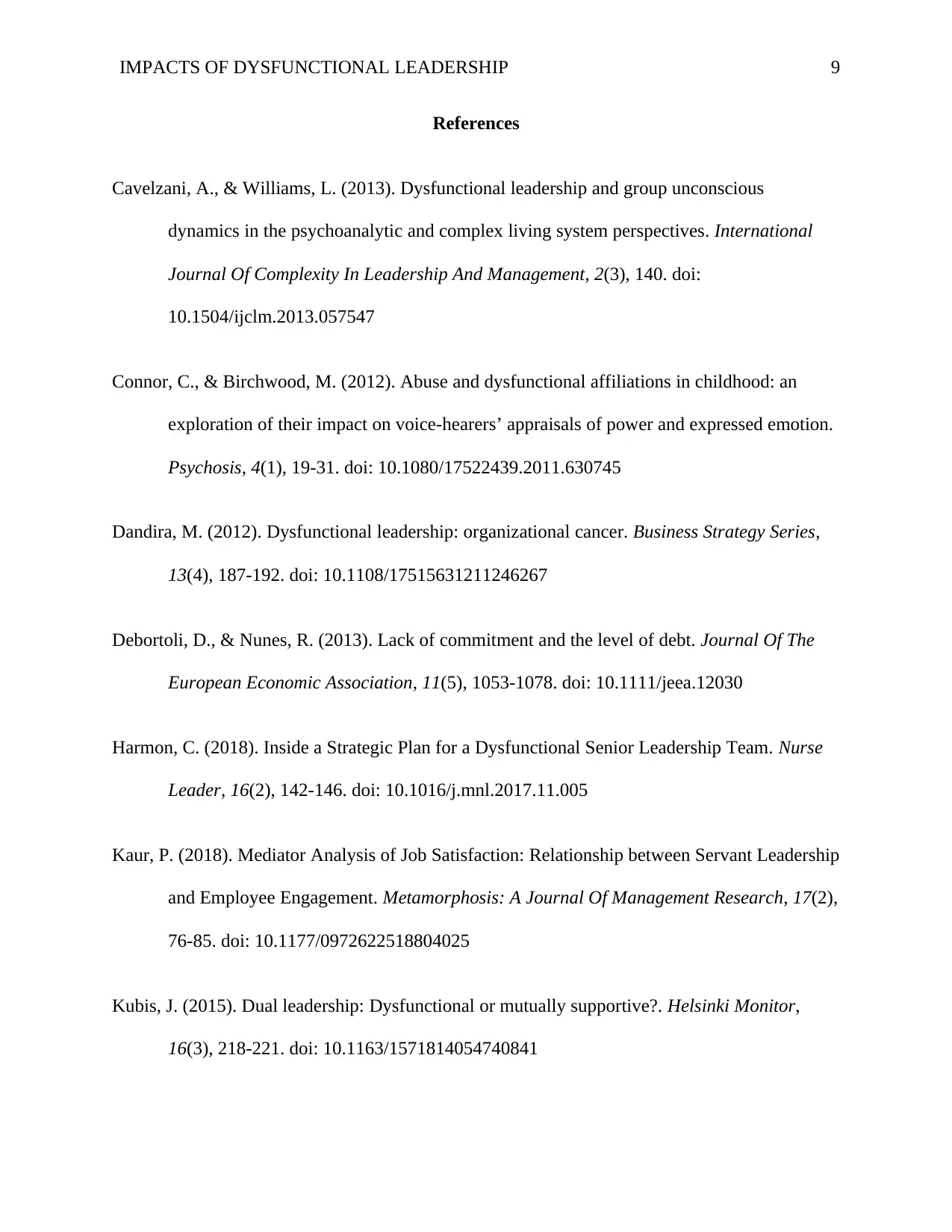
References
Cavelzani, A., & Williams, L. (2013). Dysfunctional leadership and group unconscious
dynamics in the psychoanalytic and complex living system perspectives. International
Journal Of Complexity In Leadership And Management, 2(3), 140. doi:
10.1504/ijclm.2013.057547
Connor, C., & Birchwood, M. (2012). Abuse and dysfunctional affiliations in childhood: an
exploration of their impact on voice-hearers’ appraisals of power and expressed emotion.
Psychosis, 4(1), 19-31. doi: 10.1080/17522439.2011.630745
Dandira, M. (2012). Dysfunctional leadership: organizational cancer. Business Strategy Series,
13(4), 187-192. doi: 10.1108/17515631211246267
Debortoli, D., & Nunes, R. (2013). Lack of commitment and the level of debt. Journal Of The
European Economic Association, 11(5), 1053-1078. doi: 10.1111/jeea.12030
Harmon, C. (2018). Inside a Strategic Plan for a Dysfunctional Senior Leadership Team. Nurse
Leader, 16(2), 142-146. doi: 10.1016/j.mnl.2017.11.005
Kaur, P. (2018). Mediator Analysis of Job Satisfaction: Relationship between Servant Leadership
and Employee Engagement. Metamorphosis: A Journal Of Management Research, 17(2),
76-85. doi: 10.1177/0972622518804025
Kubis, J. (2015). Dual leadership: Dysfunctional or mutually supportive?. Helsinki Monitor,
16(3), 218-221. doi: 10.1163/1571814054740841
References
Cavelzani, A., & Williams, L. (2013). Dysfunctional leadership and group unconscious
dynamics in the psychoanalytic and complex living system perspectives. International
Journal Of Complexity In Leadership And Management, 2(3), 140. doi:
10.1504/ijclm.2013.057547
Connor, C., & Birchwood, M. (2012). Abuse and dysfunctional affiliations in childhood: an
exploration of their impact on voice-hearers’ appraisals of power and expressed emotion.
Psychosis, 4(1), 19-31. doi: 10.1080/17522439.2011.630745
Dandira, M. (2012). Dysfunctional leadership: organizational cancer. Business Strategy Series,
13(4), 187-192. doi: 10.1108/17515631211246267
Debortoli, D., & Nunes, R. (2013). Lack of commitment and the level of debt. Journal Of The
European Economic Association, 11(5), 1053-1078. doi: 10.1111/jeea.12030
Harmon, C. (2018). Inside a Strategic Plan for a Dysfunctional Senior Leadership Team. Nurse
Leader, 16(2), 142-146. doi: 10.1016/j.mnl.2017.11.005
Kaur, P. (2018). Mediator Analysis of Job Satisfaction: Relationship between Servant Leadership
and Employee Engagement. Metamorphosis: A Journal Of Management Research, 17(2),
76-85. doi: 10.1177/0972622518804025
Kubis, J. (2015). Dual leadership: Dysfunctional or mutually supportive?. Helsinki Monitor,
16(3), 218-221. doi: 10.1163/1571814054740841
⊘ This is a preview!⊘
Do you want full access?
Subscribe today to unlock all pages.
Trusted by 1+ million students worldwide
IMPACTS OF DYSFUNCTIONAL LEADERSHIP
10
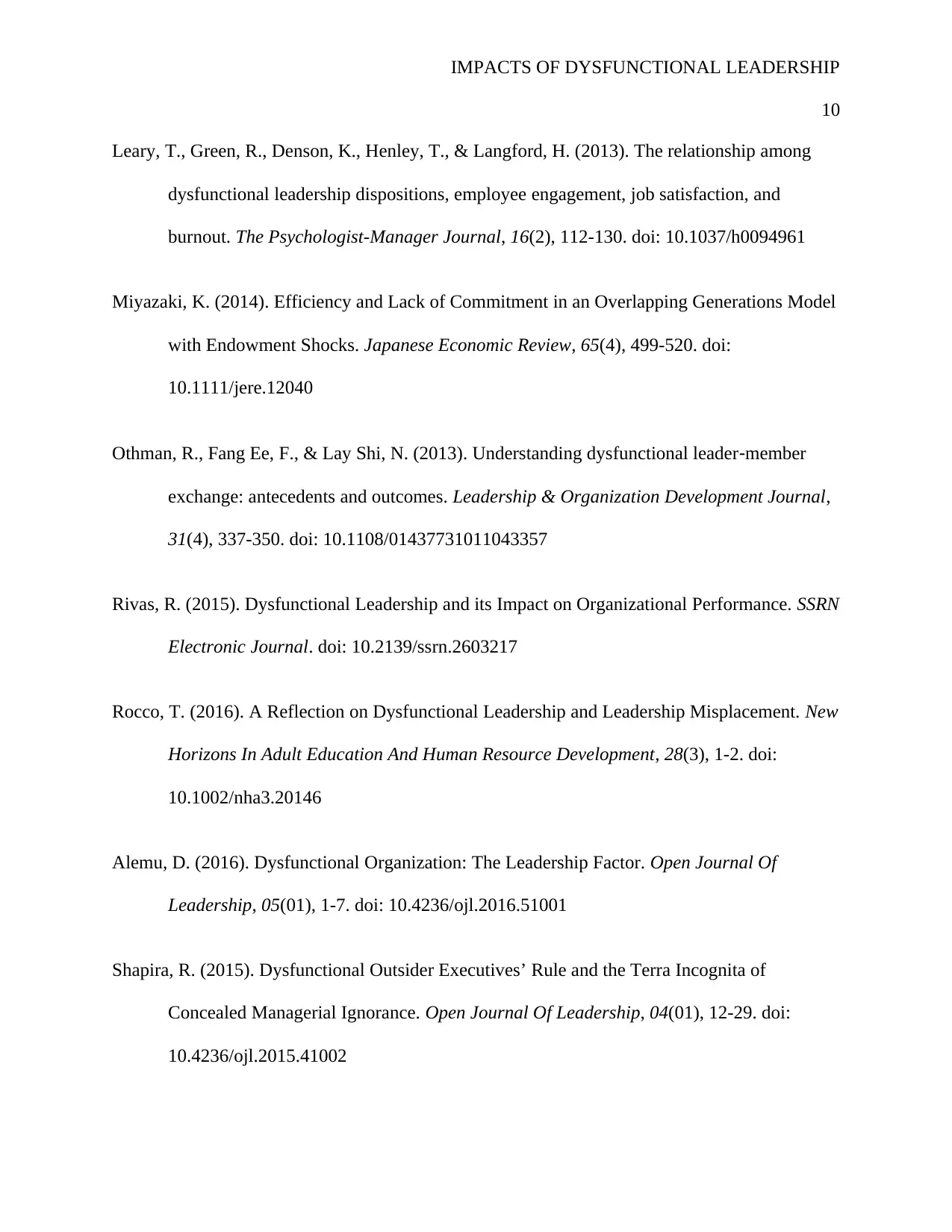
Leary, T., Green, R., Denson, K., Henley, T., & Langford, H. (2013). The relationship among
dysfunctional leadership dispositions, employee engagement, job satisfaction, and
burnout. The Psychologist-Manager Journal, 16(2), 112-130. doi: 10.1037/h0094961
Miyazaki, K. (2014). Efficiency and Lack of Commitment in an Overlapping Generations Model
with Endowment Shocks. Japanese Economic Review, 65(4), 499-520. doi:
10.1111/jere.12040
Othman, R., Fang Ee, F., & Lay Shi, N. (2013). Understanding dysfunctional leader‐member
exchange: antecedents and outcomes. Leadership & Organization Development Journal,
31(4), 337-350. doi: 10.1108/01437731011043357
Rivas, R. (2015). Dysfunctional Leadership and its Impact on Organizational Performance. SSRN
Electronic Journal. doi: 10.2139/ssrn.2603217
Rocco, T. (2016). A Reflection on Dysfunctional Leadership and Leadership Misplacement. New
Horizons In Adult Education And Human Resource Development, 28(3), 1-2. doi:
10.1002/nha3.20146
Alemu, D. (2016). Dysfunctional Organization: The Leadership Factor. Open Journal Of
Leadership, 05(01), 1-7. doi: 10.4236/ojl.2016.51001
Shapira, R. (2015). Dysfunctional Outsider Executives’ Rule and the Terra Incognita of
Concealed Managerial Ignorance. Open Journal Of Leadership, 04(01), 12-29. doi:
10.4236/ojl.2015.41002
10
Leary, T., Green, R., Denson, K., Henley, T., & Langford, H. (2013). The relationship among
dysfunctional leadership dispositions, employee engagement, job satisfaction, and
burnout. The Psychologist-Manager Journal, 16(2), 112-130. doi: 10.1037/h0094961
Miyazaki, K. (2014). Efficiency and Lack of Commitment in an Overlapping Generations Model
with Endowment Shocks. Japanese Economic Review, 65(4), 499-520. doi:
10.1111/jere.12040
Othman, R., Fang Ee, F., & Lay Shi, N. (2013). Understanding dysfunctional leader‐member
exchange: antecedents and outcomes. Leadership & Organization Development Journal,
31(4), 337-350. doi: 10.1108/01437731011043357
Rivas, R. (2015). Dysfunctional Leadership and its Impact on Organizational Performance. SSRN
Electronic Journal. doi: 10.2139/ssrn.2603217
Rocco, T. (2016). A Reflection on Dysfunctional Leadership and Leadership Misplacement. New
Horizons In Adult Education And Human Resource Development, 28(3), 1-2. doi:
10.1002/nha3.20146
Alemu, D. (2016). Dysfunctional Organization: The Leadership Factor. Open Journal Of
Leadership, 05(01), 1-7. doi: 10.4236/ojl.2016.51001
Shapira, R. (2015). Dysfunctional Outsider Executives’ Rule and the Terra Incognita of
Concealed Managerial Ignorance. Open Journal Of Leadership, 04(01), 12-29. doi:
10.4236/ojl.2015.41002
Paraphrase This Document
Need a fresh take? Get an instant paraphrase of this document with our AI Paraphraser
IMPACTS OF DYSFUNCTIONAL LEADERSHIP
11
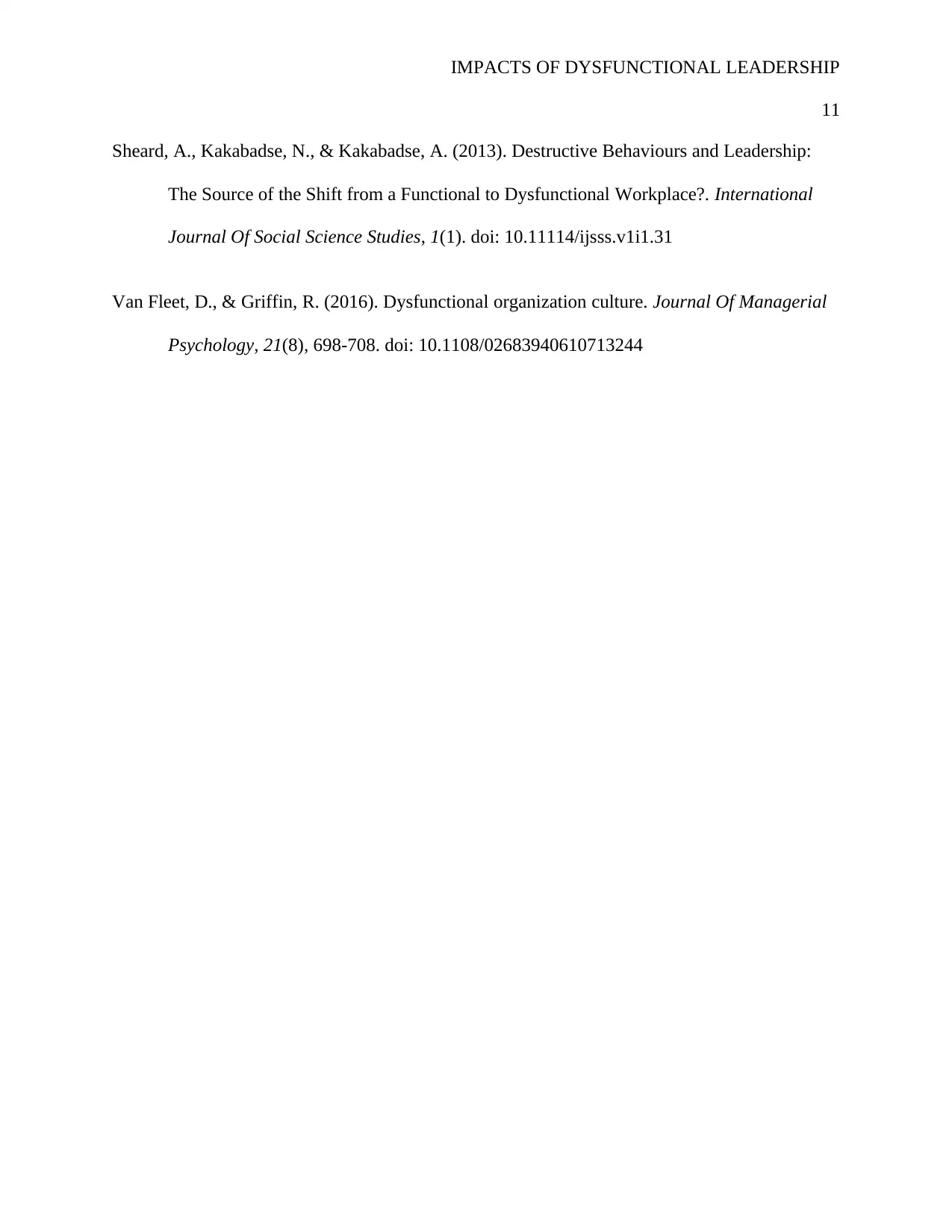
Sheard, A., Kakabadse, N., & Kakabadse, A. (2013). Destructive Behaviours and Leadership:
The Source of the Shift from a Functional to Dysfunctional Workplace?. International
Journal Of Social Science Studies, 1(1). doi: 10.11114/ijsss.v1i1.31
Van Fleet, D., & Griffin, R. (2016). Dysfunctional organization culture. Journal Of Managerial
Psychology, 21(8), 698-708. doi: 10.1108/02683940610713244
11
Sheard, A., Kakabadse, N., & Kakabadse, A. (2013). Destructive Behaviours and Leadership:
The Source of the Shift from a Functional to Dysfunctional Workplace?. International
Journal Of Social Science Studies, 1(1). doi: 10.11114/ijsss.v1i1.31
Van Fleet, D., & Griffin, R. (2016). Dysfunctional organization culture. Journal Of Managerial
Psychology, 21(8), 698-708. doi: 10.1108/02683940610713244

1 out of 11


Related Documents


Your All-in-One AI-Powered Toolkit for Academic Success.
+13062052269
info@desklib.com
Available 24*7 on WhatsApp / Email
![[object Object]](/_next/static/media/star-bottom.7253800d.svg)
Unlock your academic potential
Copyright © 2020–2026 A2Z Services. All Rights Reserved. Developed and managed by ZUCOL.