E. coli Growth Rate: Modeling, Environmental Factors, Control Methods

Verified

Added on  2023/06/09

|6
|1256
|56
Homework Assignment
AI Summary
This assignment presents a bacteria model focusing on the growth analysis of E. coli strains. It identifies the strains with the highest and lowest growth rates and discusses the manageability of highly toxic strains based on their growth patterns. The study uses geometric sequences to model bacterial growth, acknowledging its limitations in representing natural bacterial development. It emphasizes the significance of factors such as temperature and pH levels in influencing E. coli growth rates. Furthermore, it explores methods for controlling E. coli growth, highlighting sterilization as a key technique. The assignment also references research on E. coli, covering growth rates, environmental conditions, and control methods, with a focus on ATP synthesis and carbon sources. The document concludes with a list of references.
Document Page
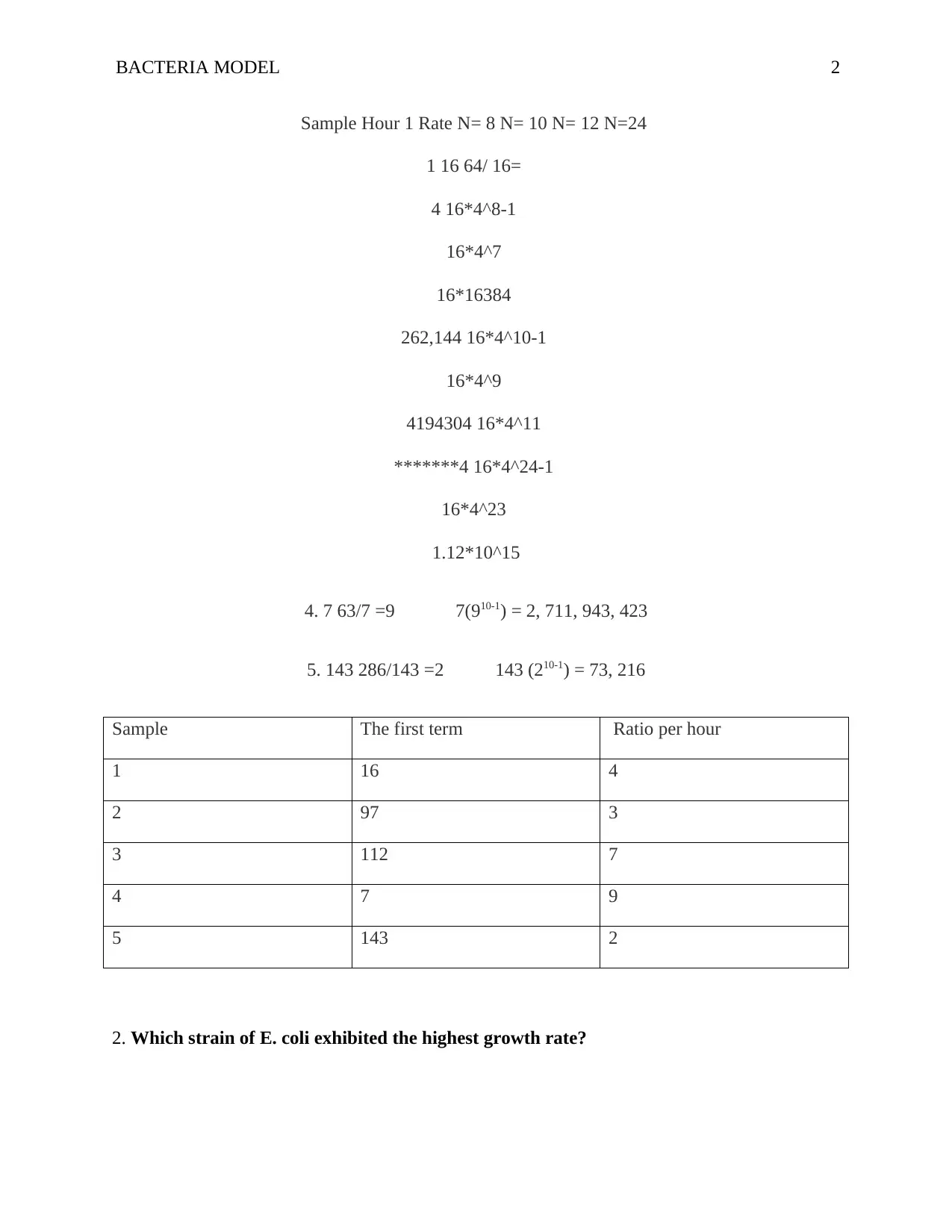
Running head: BACTERIA MODEL 1
Bacteria Model
Students Name
Institutional Affiliation
tabler-icon-diamond-filled.svg

Paraphrase This Document

Need a fresh take? Get an instant paraphrase of this document with our AI Paraphraser
Document Page
BACTERIA MODEL 2
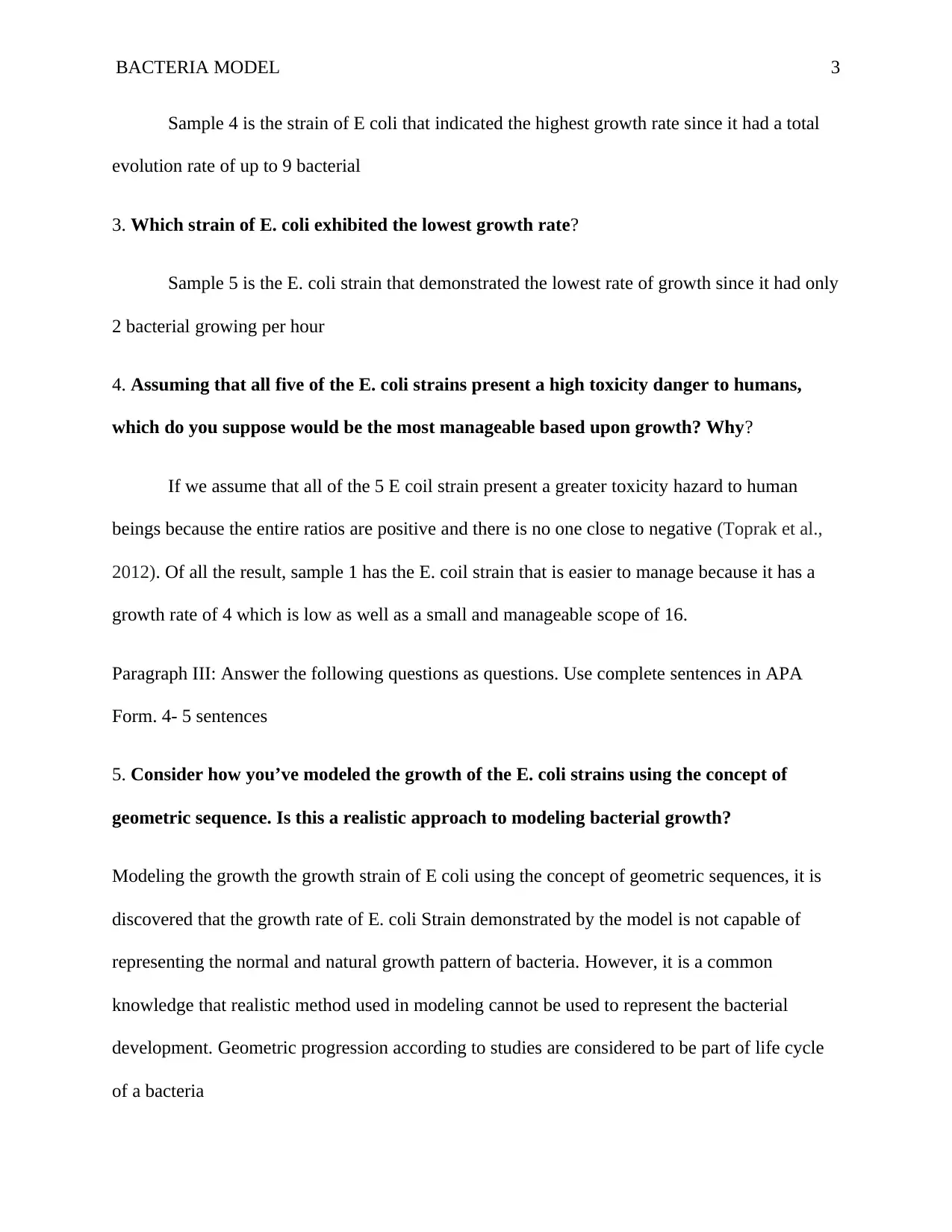
Sample Hour 1 Rate N= 8 N= 10 N= 12 N=24
1 16 64/ 16=
4 16*4^8-1
16*4^7
16*16384
262,144 16*4^10-1
16*4^9
4194304 16*4^11
*******4 16*4^24-1
16*4^23
1.12*10^15
4. 7 63/7 =9 7(910-1) = 2, 711, 943, 423
5. 143 286/143 =2 143 (210-1) = 73, 216
Sample The first term Ratio per hour
1 16 4
2 97 3
3 112 7
4 7 9
5 143 2
2. Which strain of E. coli exhibited the highest growth rate?
Document Page
BACTERIA MODEL 3
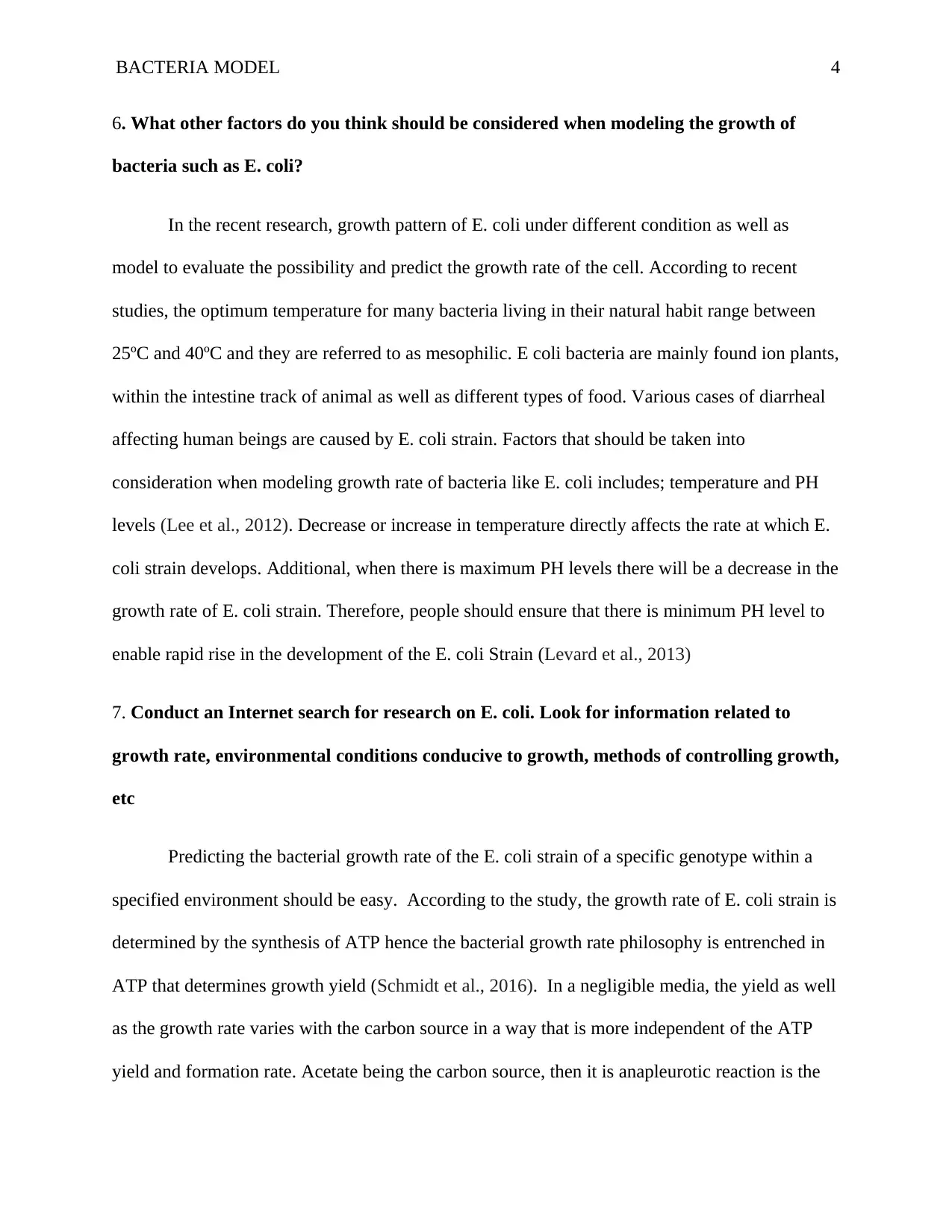
Sample 4 is the strain of E coli that indicated the highest growth rate since it had a total
evolution rate of up to 9 bacterial
3. Which strain of E. coli exhibited the lowest growth rate?
Sample 5 is the E. coli strain that demonstrated the lowest rate of growth since it had only
2 bacterial growing per hour
4. Assuming that all five of the E. coli strains present a high toxicity danger to humans,
which do you suppose would be the most manageable based upon growth? Why?
If we assume that all of the 5 E coil strain present a greater toxicity hazard to human
beings because the entire ratios are positive and there is no one close to negative (Toprak et al.,
2012). Of all the result, sample 1 has the E. coil strain that is easier to manage because it has a
growth rate of 4 which is low as well as a small and manageable scope of 16.
Paragraph III: Answer the following questions as questions. Use complete sentences in APA
Form. 4- 5 sentences
5. Consider how you’ve modeled the growth of the E. coli strains using the concept of
geometric sequence. Is this a realistic approach to modeling bacterial growth?
Modeling the growth the growth strain of E coli using the concept of geometric sequences, it is
discovered that the growth rate of E. coli Strain demonstrated by the model is not capable of
representing the normal and natural growth pattern of bacteria. However, it is a common
knowledge that realistic method used in modeling cannot be used to represent the bacterial
development. Geometric progression according to studies are considered to be part of life cycle
of a bacteria
Document Page
BACTERIA MODEL 4
6. What other factors do you think should be considered when modeling the growth of
bacteria such as E. coli?
In the recent research, growth pattern of E. coli under different condition as well as
model to evaluate the possibility and predict the growth rate of the cell. According to recent
studies, the optimum temperature for many bacteria living in their natural habit range between
25ºC and 40ºC and they are referred to as mesophilic. E coli bacteria are mainly found ion plants,
within the intestine track of animal as well as different types of food. Various cases of diarrheal
affecting human beings are caused by E. coli strain. Factors that should be taken into
consideration when modeling growth rate of bacteria like E. coli includes; temperature and PH
levels (Lee et al., 2012). Decrease or increase in temperature directly affects the rate at which E.
coli strain develops. Additional, when there is maximum PH levels there will be a decrease in the
growth rate of E. coli strain. Therefore, people should ensure that there is minimum PH level to
enable rapid rise in the development of the E. coli Strain (Levard et al., 2013)
7. Conduct an Internet search for research on E. coli. Look for information related to
growth rate, environmental conditions conducive to growth, methods of controlling growth,
etc
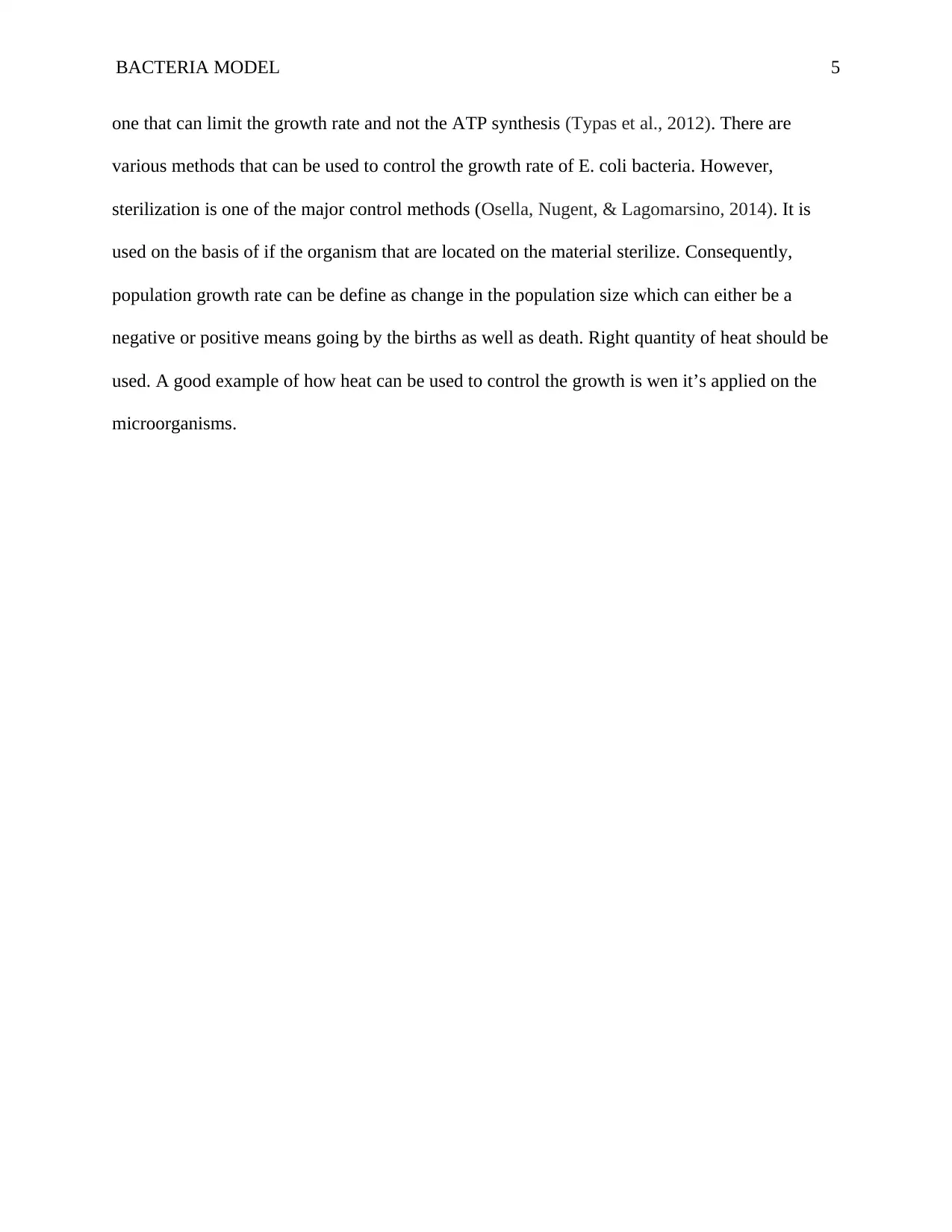
Predicting the bacterial growth rate of the E. coli strain of a specific genotype within a
specified environment should be easy. According to the study, the growth rate of E. coli strain is
determined by the synthesis of ATP hence the bacterial growth rate philosophy is entrenched in
ATP that determines growth yield (Schmidt et al., 2016). In a negligible media, the yield as well
as the growth rate varies with the carbon source in a way that is more independent of the ATP
yield and formation rate. Acetate being the carbon source, then it is anapleurotic reaction is the
tabler-icon-diamond-filled.svg

Paraphrase This Document

Need a fresh take? Get an instant paraphrase of this document with our AI Paraphraser
Document Page
BACTERIA MODEL 5
one that can limit the growth rate and not the ATP synthesis (Typas et al., 2012). There are
various methods that can be used to control the growth rate of E. coli bacteria. However,
sterilization is one of the major control methods (Osella, Nugent, & Lagomarsino, 2014). It is
used on the basis of if the organism that are located on the material sterilize. Consequently,
population growth rate can be define as change in the population size which can either be a
negative or positive means going by the births as well as death. Right quantity of heat should be
used. A good example of how heat can be used to control the growth is wen it’s applied on the
microorganisms.
Document Page
BACTERIA MODEL 6
References
Lee, H., Popodi, E., Tang, H., & Foster, P. L. (2012). Rate and molecular spectrum of
spontaneous mutations in the bacterium Escherichia coli as determined by whole-genome
sequencing. Proceedings of the National Academy of Sciences, 109(41), E2774-E2783.
Levard, C., Mitra, S., Yang, T., Jew, A. D., Badireddy, A. R., Lowry, G. V., & Brown Jr, G. E.
(2013). Effect of chloride on the dissolution rate of silver nanoparticles and toxicity to E.
coli. Environmental science & technology, 47(11), 5738-5745.
Osella, M., Nugent, E., & Lagomarsino, M. C. (2014). Concerted control of Escherichia coli cell
division. Proceedings of the National Academy of Sciences, 201313715.
Schmidt, A., Kochanowski, K., Vedelaar, S., Ahrné, E., Volkmer, B., Callipo, L., ... &
Heinemann, M. (2016). The quantitative and condition-dependent Escherichia coli
proteome. Nature biotechnology, 34(1), 104.
Toprak, E., Veres, A., Michel, J. B., Chait, R., Hartl, D. L., & Kishony, R. (2012). Evolutionary
paths to antibiotic resistance under dynamically sustained drug selection. Nature
genetics, 44(1), 101.
Typas, A., Banzhaf, M., Gross, C. A., & Vollmer, W. (2012). From the regulation of
peptidoglycan synthesis to bacterial growth and morphology. Nature Reviews
Microbiology, 10(2), 123.
chevron_up_icon
1 out of 6
circle_padding
hide_on_mobile
zoom_out_icon
[object Object]