MHE615 E-Marketing: Optimizing Supply, Value & Virtual Chains
VerifiedAdded on 2023/06/11
|16
|4047
|394
Report
AI Summary
This report provides an overview of supply chain, value chain, and virtual value chain concepts in e-marketing. It identifies the core processes within each chain, including strategic planning, demand planning, procurement, manufacturing, and distribution. The report also discusses the stages of development for hotel enterprises to leverage these chains effectively, such as gathering information through the cloud, electronic resource procurement, and online marketing and sales. Furthermore, it highlights the importance of integrating these chains to achieve satisfactory outcomes for both suppliers and customers, emphasizing the use of technology to enhance efficiency and reduce operational costs. The document is available on Desklib, a platform offering a wide array of study resources for students.
RUNNING HEAD: E-Marketing
E-Marketing
Laptop04011
[Pick the date]
E-Marketing
Laptop04011
[Pick the date]

Paraphrase This Document
Need a fresh take? Get an instant paraphrase of this document with our AI Paraphraser
E-Marketing 1
Contents
Introduction.................................................................................................................................................1
Core processes of the supply chain, value chain and virtual value chain....................................................1
Stages in development to attain maximum advantage of view...................................................................7
Examples of business integration models....................................................................................................9
Value to hospitality industry......................................................................................................................10
Conclusion.................................................................................................................................................11
References.................................................................................................................................................11
Contents
Introduction.................................................................................................................................................1
Core processes of the supply chain, value chain and virtual value chain....................................................1
Stages in development to attain maximum advantage of view...................................................................7
Examples of business integration models....................................................................................................9
Value to hospitality industry......................................................................................................................10
Conclusion.................................................................................................................................................11
References.................................................................................................................................................11
E-Marketing 2
Introduction
The purpose of this report is to provide a brief introduction about the three aspects of supply
chain, value chain and virtual value chain as well. The report focuses on identifying the core
processes of supply chain, value chain and virtual value chain. It also explains the stages of
development that the hotel enterprises need to adopt or should adopt in order to take advantage
of the three aspects mentioned. The latter part of the report also explains the system/business
integration models that support the organizations in using this type of value chain. Along with
which, it also explains the value of use of such approaches in the hotel industry.
Further, supply chain refers to the process under which all the parties of the organization are
involved in fulfilling the satisfaction level of the customers. Supply chain is the integration of all
the activities of the company like procurement, logistics, sourcing, conversion etc. to properly
initiate the activities of the company. Value chain refers to the process under which the company
aims to increase the value derived from the products and services in response to its cost. And
virtual value chain refers to the business model that describes the distribution value generated
information services in other parts of the organization (Xu, & Gursoy, 2015). According to
Robert and Zahay (2013), all the three aspects are not different instead they are a form of
growing hierarchy that is only concerned about the satisfactory outcomes for both the suppliers
and the customers. Further, more details about the report are discussed below:
Core processes of the supply chain, value chain and virtual value chain
Supply Chain
Talking about the core process of supply chain, it should be noted that there are some building
blocks of supply chain that helps the management to initiate this facility. These blocks are
strategic planning, demand planning, order fulfillment, supply planning, manufacturing,
procurement etc. (Poirier, 2016).
Introduction
The purpose of this report is to provide a brief introduction about the three aspects of supply
chain, value chain and virtual value chain as well. The report focuses on identifying the core
processes of supply chain, value chain and virtual value chain. It also explains the stages of
development that the hotel enterprises need to adopt or should adopt in order to take advantage
of the three aspects mentioned. The latter part of the report also explains the system/business
integration models that support the organizations in using this type of value chain. Along with
which, it also explains the value of use of such approaches in the hotel industry.
Further, supply chain refers to the process under which all the parties of the organization are
involved in fulfilling the satisfaction level of the customers. Supply chain is the integration of all
the activities of the company like procurement, logistics, sourcing, conversion etc. to properly
initiate the activities of the company. Value chain refers to the process under which the company
aims to increase the value derived from the products and services in response to its cost. And
virtual value chain refers to the business model that describes the distribution value generated
information services in other parts of the organization (Xu, & Gursoy, 2015). According to
Robert and Zahay (2013), all the three aspects are not different instead they are a form of
growing hierarchy that is only concerned about the satisfactory outcomes for both the suppliers
and the customers. Further, more details about the report are discussed below:
Core processes of the supply chain, value chain and virtual value chain
Supply Chain
Talking about the core process of supply chain, it should be noted that there are some building
blocks of supply chain that helps the management to initiate this facility. These blocks are
strategic planning, demand planning, order fulfillment, supply planning, manufacturing,
procurement etc. (Poirier, 2016).
⊘ This is a preview!⊘
Do you want full access?
Subscribe today to unlock all pages.

Trusted by 1+ million students worldwide
E-Marketing 3
Strategic Planning: The initial step is strategic planning which involves strategic supply chain
design and strategic sourcing. The strategic supply chain refers to the design, optimization, and
evaluation of the supply chain model used in planning process. Every part of the model of supply
chain like resources, warehouses, transportation etc. is modeled in such a way so that it executes
the plan effectively (Christopher, 2016).
Strategic Sourcing Process: This process of supply chain helps the business to identify a
minimized set of suppliers with the help of which they can effectively manage strategic
relationship. Vendor analysis and purchasing statistics are used to develop the potential of the
suppliers. The strategic sourcing process develops parameters that drive the procurement
execution in the organization. Under this process of supply the company gains the value of
planning the optimization of resources properly (Gattorna, 2017).
Demand Planning: The process of demand planning involves forecasting, promotion planning,
lifecycle planning, and consensus demand planning.
Supply Planning: the process of supply planning involves the supply network planning, safety
stock planning, supplier collaboration, outsourcing, customer collaboration and lastly,
distribution planning.
Strategic Planning: The initial step is strategic planning which involves strategic supply chain
design and strategic sourcing. The strategic supply chain refers to the design, optimization, and
evaluation of the supply chain model used in planning process. Every part of the model of supply
chain like resources, warehouses, transportation etc. is modeled in such a way so that it executes
the plan effectively (Christopher, 2016).
Strategic Sourcing Process: This process of supply chain helps the business to identify a
minimized set of suppliers with the help of which they can effectively manage strategic
relationship. Vendor analysis and purchasing statistics are used to develop the potential of the
suppliers. The strategic sourcing process develops parameters that drive the procurement
execution in the organization. Under this process of supply the company gains the value of
planning the optimization of resources properly (Gattorna, 2017).
Demand Planning: The process of demand planning involves forecasting, promotion planning,
lifecycle planning, and consensus demand planning.
Supply Planning: the process of supply planning involves the supply network planning, safety
stock planning, supplier collaboration, outsourcing, customer collaboration and lastly,
distribution planning.
Paraphrase This Document
Need a fresh take? Get an instant paraphrase of this document with our AI Paraphraser
E-Marketing 4
Procurement: This process of supply chain involves the process of purchasing order processing,
invoice verification and receipt confirmation. The procurement process provides value to the
organization by purchasing the adequate amount of quantity and verifying it with the invoice as
well.
Manufacturing: Under the process of manufacturing, the management needs to perform the
production planning, manufacturing execution (Ptak, & Schragenheim, 2016).
Warehousing: In the process of warehousing, the company initiates inbound, outbound
processing, warehousing, storage and physical inventory, and cross docking. This aspect is
mainly related to storage and shipment of goods produced by the organization. This process
gives value to the company in such a way that it helps the organization to store the required
product or inventory and deliver it when demand is increased.
Order Fulfillment: Order fulfillment process includes the sale order processing and billing
business process (Verdouw, Wolfert, Beulens, & Rialland, 2016).
Transportation: lastly, transportation is the end process of the supply chain that completes the
whole activity of the company. This process involves transportation planning, freight costing
planning and transportation execution.
Value Chain
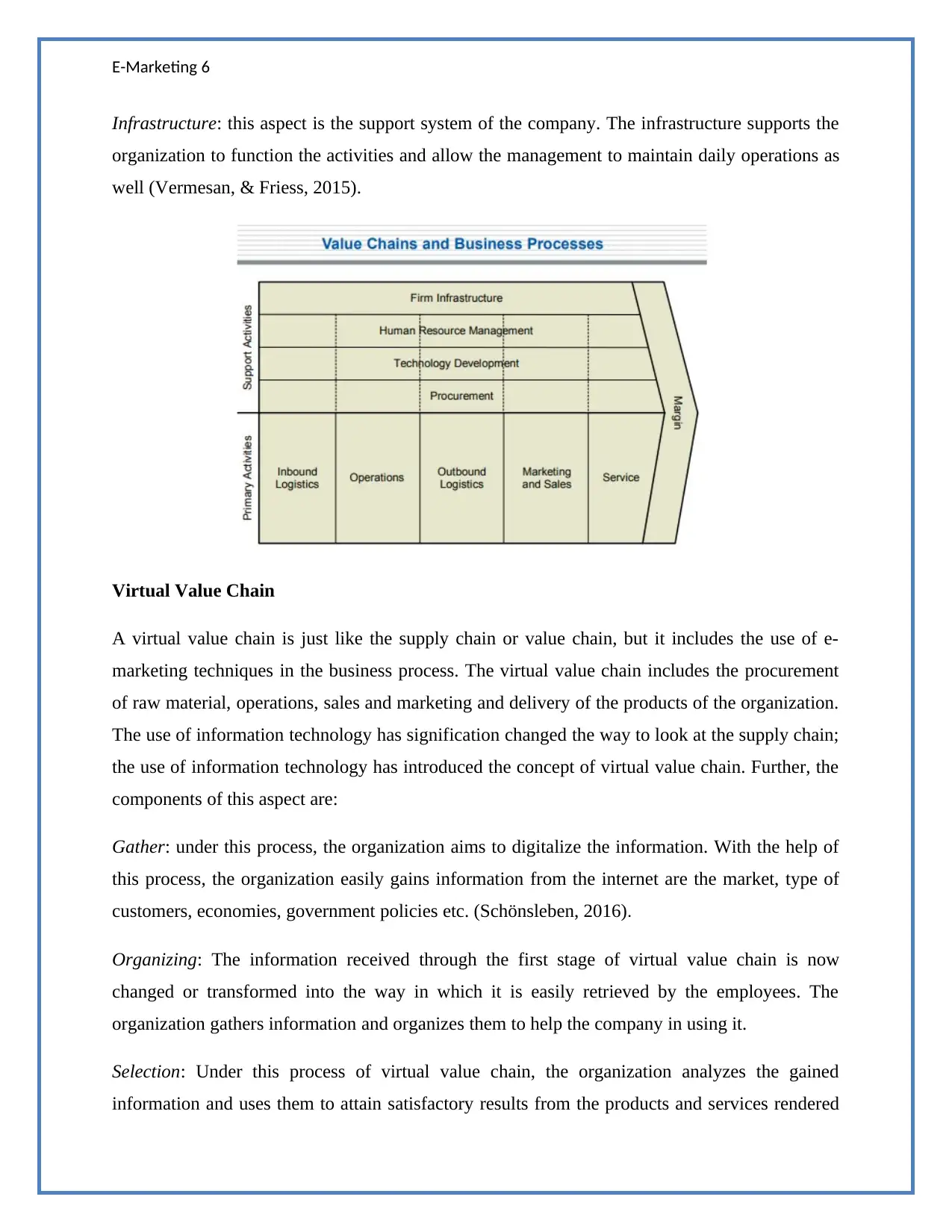
The value chain process focuses on the systems and how the inputs of the company are changed
to derive output for the consumers of products of the organization. The system of value chain is
derived by Porter who said that these activities are common in all business process which are
divided in primary and support activities.
Primary activity: These activities are directly related to the creation of goods, its sale, support
and maintenance of products and services. This activity consists of following aspects:
Inbound operation: This part of value chain involves receiving, storing and distributing the
inputs in the process. The suppliers act as the key factor in this case (Hugos, 2018).
Procurement: This process of supply chain involves the process of purchasing order processing,
invoice verification and receipt confirmation. The procurement process provides value to the
organization by purchasing the adequate amount of quantity and verifying it with the invoice as
well.
Manufacturing: Under the process of manufacturing, the management needs to perform the
production planning, manufacturing execution (Ptak, & Schragenheim, 2016).
Warehousing: In the process of warehousing, the company initiates inbound, outbound
processing, warehousing, storage and physical inventory, and cross docking. This aspect is
mainly related to storage and shipment of goods produced by the organization. This process
gives value to the company in such a way that it helps the organization to store the required
product or inventory and deliver it when demand is increased.
Order Fulfillment: Order fulfillment process includes the sale order processing and billing
business process (Verdouw, Wolfert, Beulens, & Rialland, 2016).
Transportation: lastly, transportation is the end process of the supply chain that completes the
whole activity of the company. This process involves transportation planning, freight costing
planning and transportation execution.
Value Chain
The value chain process focuses on the systems and how the inputs of the company are changed
to derive output for the consumers of products of the organization. The system of value chain is
derived by Porter who said that these activities are common in all business process which are
divided in primary and support activities.
Primary activity: These activities are directly related to the creation of goods, its sale, support
and maintenance of products and services. This activity consists of following aspects:
Inbound operation: This part of value chain involves receiving, storing and distributing the
inputs in the process. The suppliers act as the key factor in this case (Hugos, 2018).
E-Marketing 5
Operations: Under this process, the inputs are changed in outputs of the company that are further
distributed to the customers. This process delivers value in the products formed by the
organization.
Outbound Logistics: The outbound logistics provide the products and services to the customers
in the market. This aspect includes collection, storage and distribution system. This process
delivers value from one person to other (Wisner, Tan, & Leong, 2014).
Marketing and sales: under this process, the employees convince the clients to purchase the
products of the company. Communication is the best way to convince the client to purchase the
products of the organization. This process increases the value of the customers derived from the
product and services (Stadtler, 2015).
Service: This aspect helps in integrating all the above mentioned activities and increasing the
value received to the customer with the use of products and services.
Support activities: These activities act as a helping hand to the primary function activities. Apart
from supporting the operation process, this process supports the marketing and sales activities of
the company as well. Below mentioned form a part of the support activities of the value chain
analysis:
Procurement (purchasing): Under this process the organization purchases or procure the
resources that are actually needed for the creation of products. The management finds the best
vendor at best prices for the organization (Monczka, Handfield, Giunipero, & Patterson, 2015).
Human resource management: Under the process of HRM, the organization recruits, hire,
motivate, give reward, train and retain the employees in the organization. People are the most
important asset of the organization so the management can get good advantage with the use of
good HR practices in the environment. The HRM activities aim to motivate the employees to
integrate all the activities and derive best positive results for the organization.
Technological development: under these activities, the organization manages and process
information and protects the knowledge base of the organization as well. The company aims to
use technology to enhance the activities of the company by minimizing the cost of operation as
well.
Operations: Under this process, the inputs are changed in outputs of the company that are further
distributed to the customers. This process delivers value in the products formed by the
organization.
Outbound Logistics: The outbound logistics provide the products and services to the customers
in the market. This aspect includes collection, storage and distribution system. This process
delivers value from one person to other (Wisner, Tan, & Leong, 2014).
Marketing and sales: under this process, the employees convince the clients to purchase the
products of the company. Communication is the best way to convince the client to purchase the
products of the organization. This process increases the value of the customers derived from the
product and services (Stadtler, 2015).
Service: This aspect helps in integrating all the above mentioned activities and increasing the
value received to the customer with the use of products and services.
Support activities: These activities act as a helping hand to the primary function activities. Apart
from supporting the operation process, this process supports the marketing and sales activities of
the company as well. Below mentioned form a part of the support activities of the value chain
analysis:
Procurement (purchasing): Under this process the organization purchases or procure the
resources that are actually needed for the creation of products. The management finds the best
vendor at best prices for the organization (Monczka, Handfield, Giunipero, & Patterson, 2015).
Human resource management: Under the process of HRM, the organization recruits, hire,
motivate, give reward, train and retain the employees in the organization. People are the most
important asset of the organization so the management can get good advantage with the use of
good HR practices in the environment. The HRM activities aim to motivate the employees to
integrate all the activities and derive best positive results for the organization.
Technological development: under these activities, the organization manages and process
information and protects the knowledge base of the organization as well. The company aims to
use technology to enhance the activities of the company by minimizing the cost of operation as
well.
⊘ This is a preview!⊘
Do you want full access?
Subscribe today to unlock all pages.
Trusted by 1+ million students worldwide
E-Marketing 6
Infrastructure: this aspect is the support system of the company. The infrastructure supports the
organization to function the activities and allow the management to maintain daily operations as
well (Vermesan, & Friess, 2015).
Virtual Value Chain
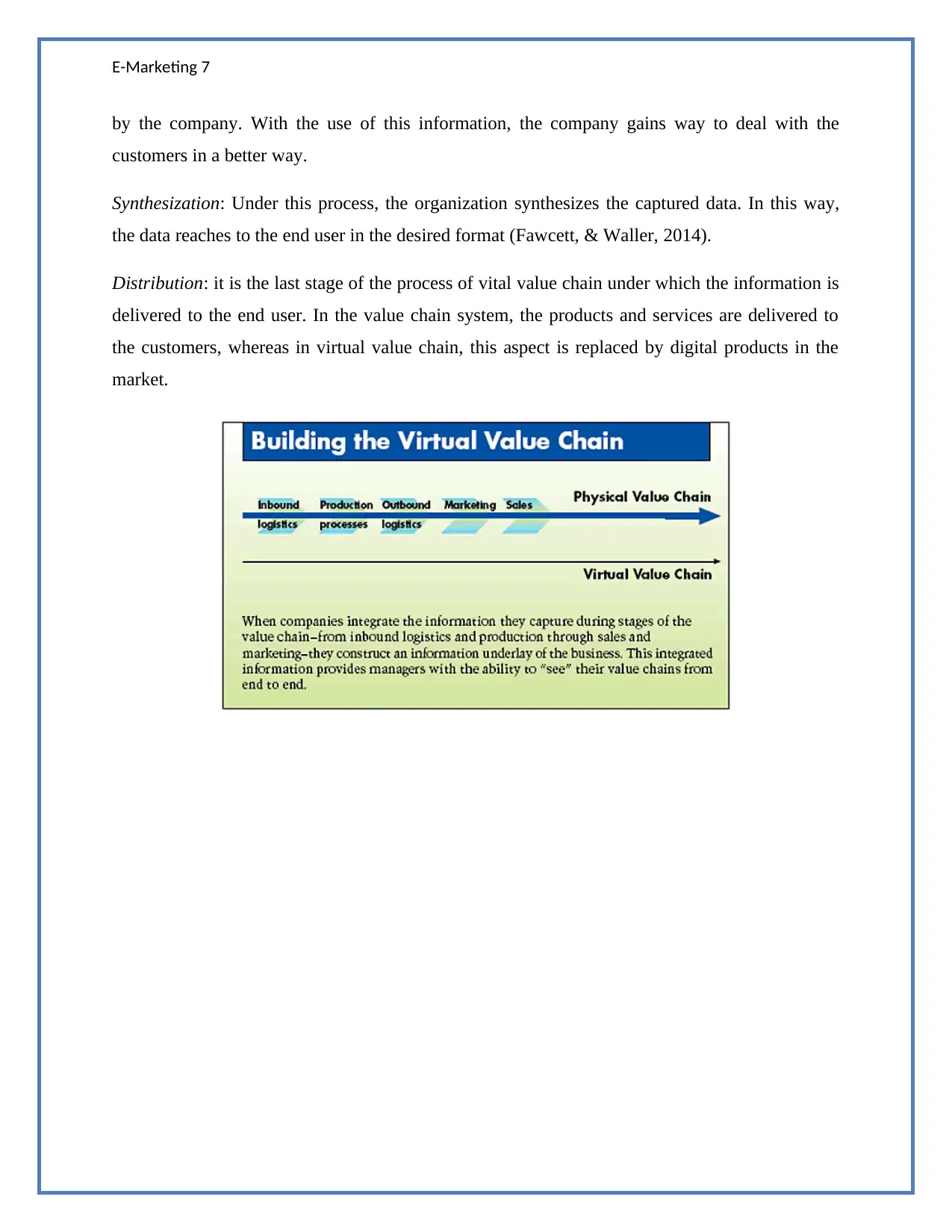
A virtual value chain is just like the supply chain or value chain, but it includes the use of e-
marketing techniques in the business process. The virtual value chain includes the procurement
of raw material, operations, sales and marketing and delivery of the products of the organization.
The use of information technology has signification changed the way to look at the supply chain;
the use of information technology has introduced the concept of virtual value chain. Further, the
components of this aspect are:
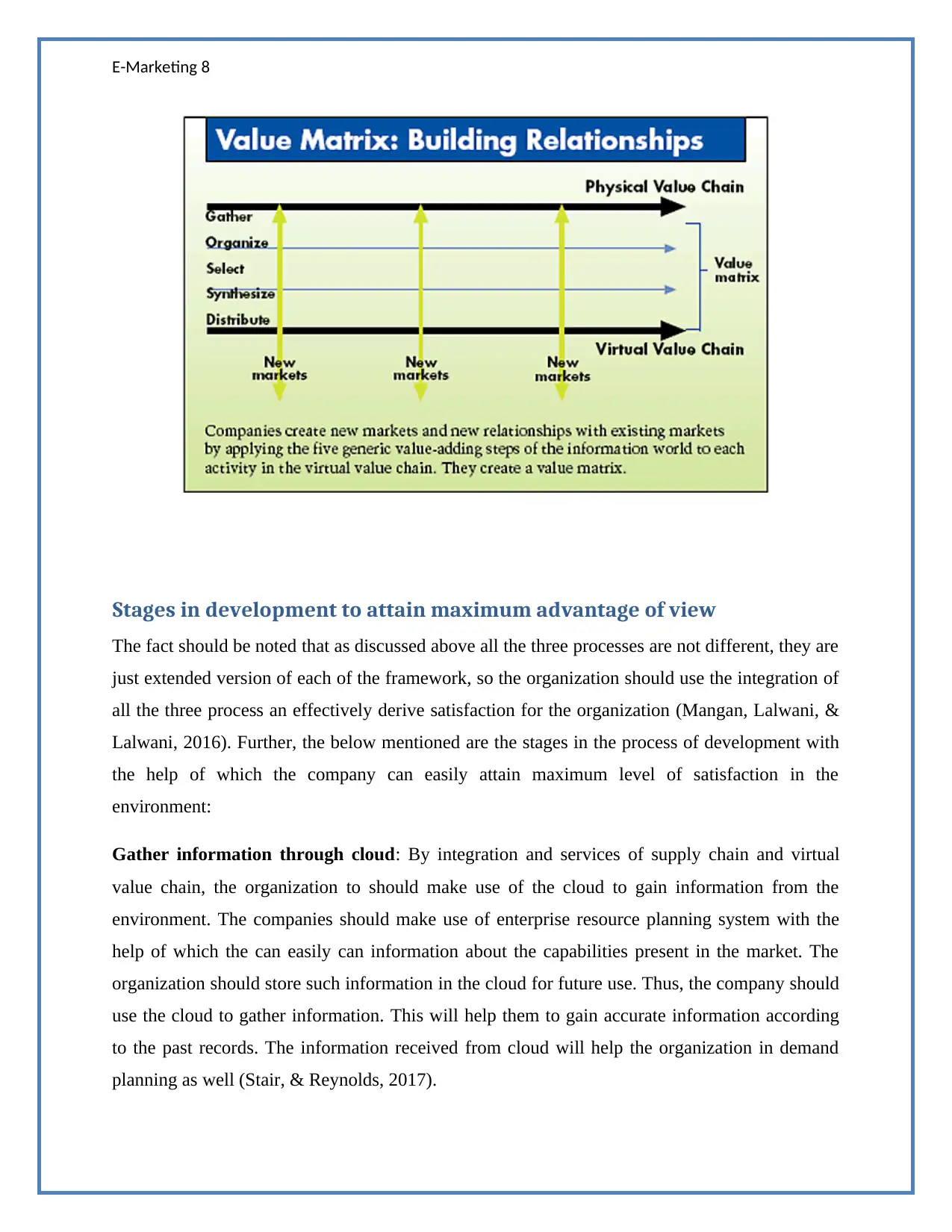
Gather: under this process, the organization aims to digitalize the information. With the help of
this process, the organization easily gains information from the internet are the market, type of
customers, economies, government policies etc. (Schönsleben, 2016).
Organizing: The information received through the first stage of virtual value chain is now
changed or transformed into the way in which it is easily retrieved by the employees. The
organization gathers information and organizes them to help the company in using it.
Selection: Under this process of virtual value chain, the organization analyzes the gained
information and uses them to attain satisfactory results from the products and services rendered
Infrastructure: this aspect is the support system of the company. The infrastructure supports the
organization to function the activities and allow the management to maintain daily operations as
well (Vermesan, & Friess, 2015).
Virtual Value Chain
A virtual value chain is just like the supply chain or value chain, but it includes the use of e-
marketing techniques in the business process. The virtual value chain includes the procurement
of raw material, operations, sales and marketing and delivery of the products of the organization.
The use of information technology has signification changed the way to look at the supply chain;
the use of information technology has introduced the concept of virtual value chain. Further, the
components of this aspect are:
Gather: under this process, the organization aims to digitalize the information. With the help of
this process, the organization easily gains information from the internet are the market, type of
customers, economies, government policies etc. (Schönsleben, 2016).
Organizing: The information received through the first stage of virtual value chain is now
changed or transformed into the way in which it is easily retrieved by the employees. The
organization gathers information and organizes them to help the company in using it.
Selection: Under this process of virtual value chain, the organization analyzes the gained
information and uses them to attain satisfactory results from the products and services rendered
Paraphrase This Document
Need a fresh take? Get an instant paraphrase of this document with our AI Paraphraser
E-Marketing 7
by the company. With the use of this information, the company gains way to deal with the
customers in a better way.
Synthesization: Under this process, the organization synthesizes the captured data. In this way,
the data reaches to the end user in the desired format (Fawcett, & Waller, 2014).
Distribution: it is the last stage of the process of vital value chain under which the information is
delivered to the end user. In the value chain system, the products and services are delivered to
the customers, whereas in virtual value chain, this aspect is replaced by digital products in the
market.
by the company. With the use of this information, the company gains way to deal with the
customers in a better way.
Synthesization: Under this process, the organization synthesizes the captured data. In this way,
the data reaches to the end user in the desired format (Fawcett, & Waller, 2014).
Distribution: it is the last stage of the process of vital value chain under which the information is
delivered to the end user. In the value chain system, the products and services are delivered to
the customers, whereas in virtual value chain, this aspect is replaced by digital products in the
market.
E-Marketing 8
Stages in development to attain maximum advantage of view
The fact should be noted that as discussed above all the three processes are not different, they are
just extended version of each of the framework, so the organization should use the integration of
all the three process an effectively derive satisfaction for the organization (Mangan, Lalwani, &
Lalwani, 2016). Further, the below mentioned are the stages in the process of development with
the help of which the company can easily attain maximum level of satisfaction in the
environment:
Gather information through cloud: By integration and services of supply chain and virtual
value chain, the organization to should make use of the cloud to gain information from the
environment. The companies should make use of enterprise resource planning system with the
help of which the can easily can information about the capabilities present in the market. The
organization should store such information in the cloud for future use. Thus, the company should
use the cloud to gather information. This will help them to gain accurate information according
to the past records. The information received from cloud will help the organization in demand
planning as well (Stair, & Reynolds, 2017).
Stages in development to attain maximum advantage of view
The fact should be noted that as discussed above all the three processes are not different, they are
just extended version of each of the framework, so the organization should use the integration of
all the three process an effectively derive satisfaction for the organization (Mangan, Lalwani, &
Lalwani, 2016). Further, the below mentioned are the stages in the process of development with
the help of which the company can easily attain maximum level of satisfaction in the
environment:
Gather information through cloud: By integration and services of supply chain and virtual
value chain, the organization to should make use of the cloud to gain information from the
environment. The companies should make use of enterprise resource planning system with the
help of which the can easily can information about the capabilities present in the market. The
organization should store such information in the cloud for future use. Thus, the company should
use the cloud to gather information. This will help them to gain accurate information according
to the past records. The information received from cloud will help the organization in demand
planning as well (Stair, & Reynolds, 2017).
⊘ This is a preview!⊘
Do you want full access?
Subscribe today to unlock all pages.
Trusted by 1+ million students worldwide
E-Marketing 9
Procurement of resources: The resources should be noted procured using the electronic
marketing. With the help of this feature the company should analyze the areas where the
resources or the raw material are being sold at cheap prices due to which, they should procure the
resources according. The enterprise resource planning system can be used in the organization to
check the places from where the company can easily get information about the resources and
procure them as well. Further, with the help of this process the organization can reduce the
operational cost and increase the quality production for the organization as well (Hofmann,
2017).
Electronic transmission to warehouse: After procuring the resources, the organization should
connect with the warehouse of the company in order to store the inputs and outputs for the future
use. With the help of this aspect, while initiating the operations for the organization, the
employees can directly intimate other employees present at the warehouse to send the raw
material and the other employees can perform the action just after receiving the message in no
time. This process decreases the time duration of the supply chain management process and
increases the effectiveness of the organization as well. This process will enhance the
communication in the internal process of the organization (Ross, 2016).
Online marketing and sales: Physical marketing and sales in the physical supply chain method
only attracts customers that are physically connected to them. Introduction of the process of
supply chain to electronic marketing gives new targets to the company to achieve. This process
increases the target customers present in the market by the adding the online customers as well.
The company can now with the use of this process attract the customer through social media
marketing and initiate online sales as well. This aspect can develop the company and introduce it
in the international online market as well (Ross, 2016).
Integration of infrastructure: Infrastructure is the best resource with the help of which the
organization can effectively manage the activities of the company. If the infrastructure of the
organization is not efficient then the company faces difficulty in managing all the activities and
providing optimum level of satisfaction to the customers as well. By integrating information
technology in this process, the organization can effectively create a web of all the resources in
the organization with the help of which the organization easily make use of the resource it and
procure it on time (Ebrahim, 2015).
Procurement of resources: The resources should be noted procured using the electronic
marketing. With the help of this feature the company should analyze the areas where the
resources or the raw material are being sold at cheap prices due to which, they should procure the
resources according. The enterprise resource planning system can be used in the organization to
check the places from where the company can easily get information about the resources and
procure them as well. Further, with the help of this process the organization can reduce the
operational cost and increase the quality production for the organization as well (Hofmann,
2017).
Electronic transmission to warehouse: After procuring the resources, the organization should
connect with the warehouse of the company in order to store the inputs and outputs for the future
use. With the help of this aspect, while initiating the operations for the organization, the
employees can directly intimate other employees present at the warehouse to send the raw
material and the other employees can perform the action just after receiving the message in no
time. This process decreases the time duration of the supply chain management process and
increases the effectiveness of the organization as well. This process will enhance the
communication in the internal process of the organization (Ross, 2016).
Online marketing and sales: Physical marketing and sales in the physical supply chain method
only attracts customers that are physically connected to them. Introduction of the process of
supply chain to electronic marketing gives new targets to the company to achieve. This process
increases the target customers present in the market by the adding the online customers as well.
The company can now with the use of this process attract the customer through social media
marketing and initiate online sales as well. This aspect can develop the company and introduce it
in the international online market as well (Ross, 2016).
Integration of infrastructure: Infrastructure is the best resource with the help of which the
organization can effectively manage the activities of the company. If the infrastructure of the
organization is not efficient then the company faces difficulty in managing all the activities and
providing optimum level of satisfaction to the customers as well. By integrating information
technology in this process, the organization can effectively create a web of all the resources in
the organization with the help of which the organization easily make use of the resource it and
procure it on time (Ebrahim, 2015).
Paraphrase This Document
Need a fresh take? Get an instant paraphrase of this document with our AI Paraphraser
E-Marketing 10
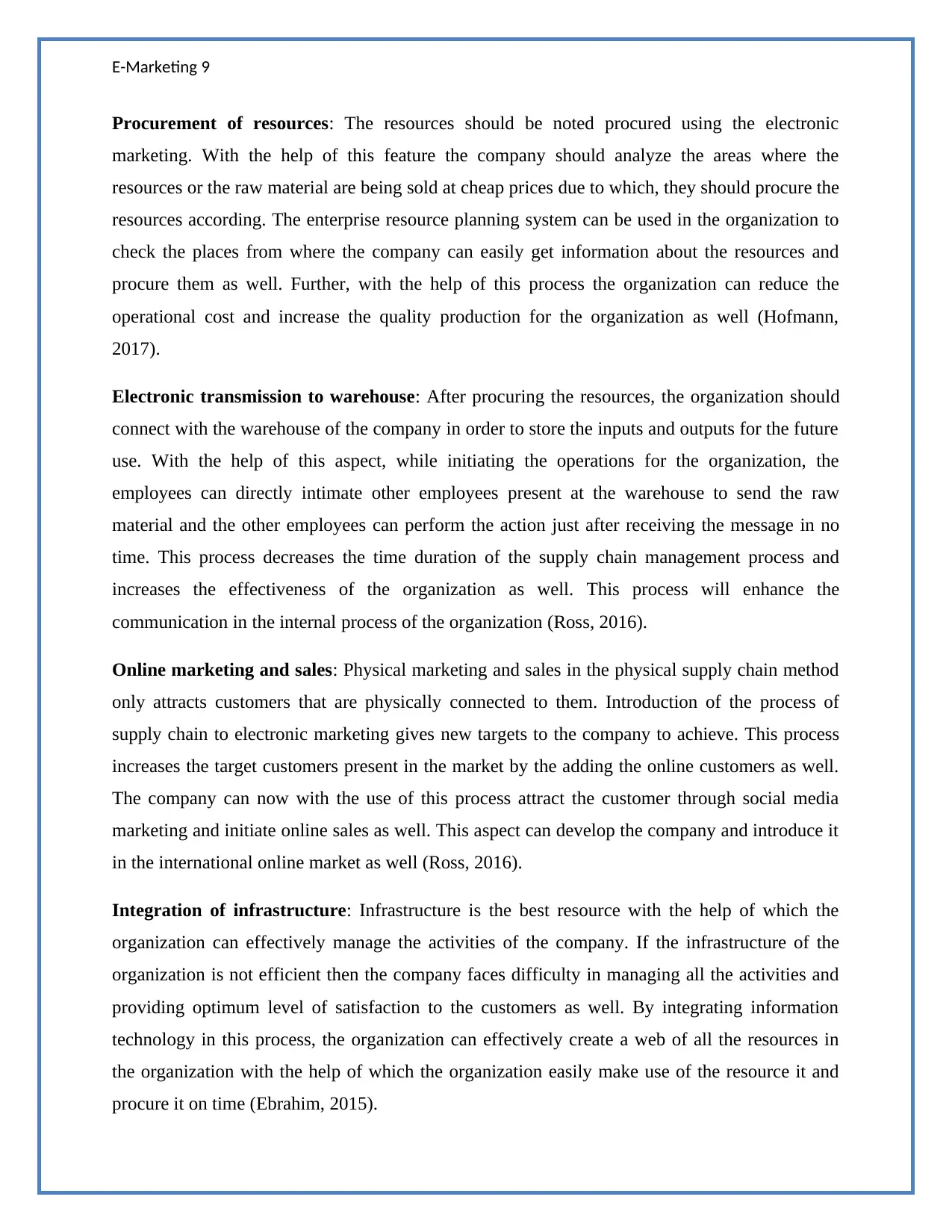
Thus, the above mentioned are the stages in the process of development with the help of which
an organization can effectively make of these strategies and attain satisfaction as well.
Examples of business integration models
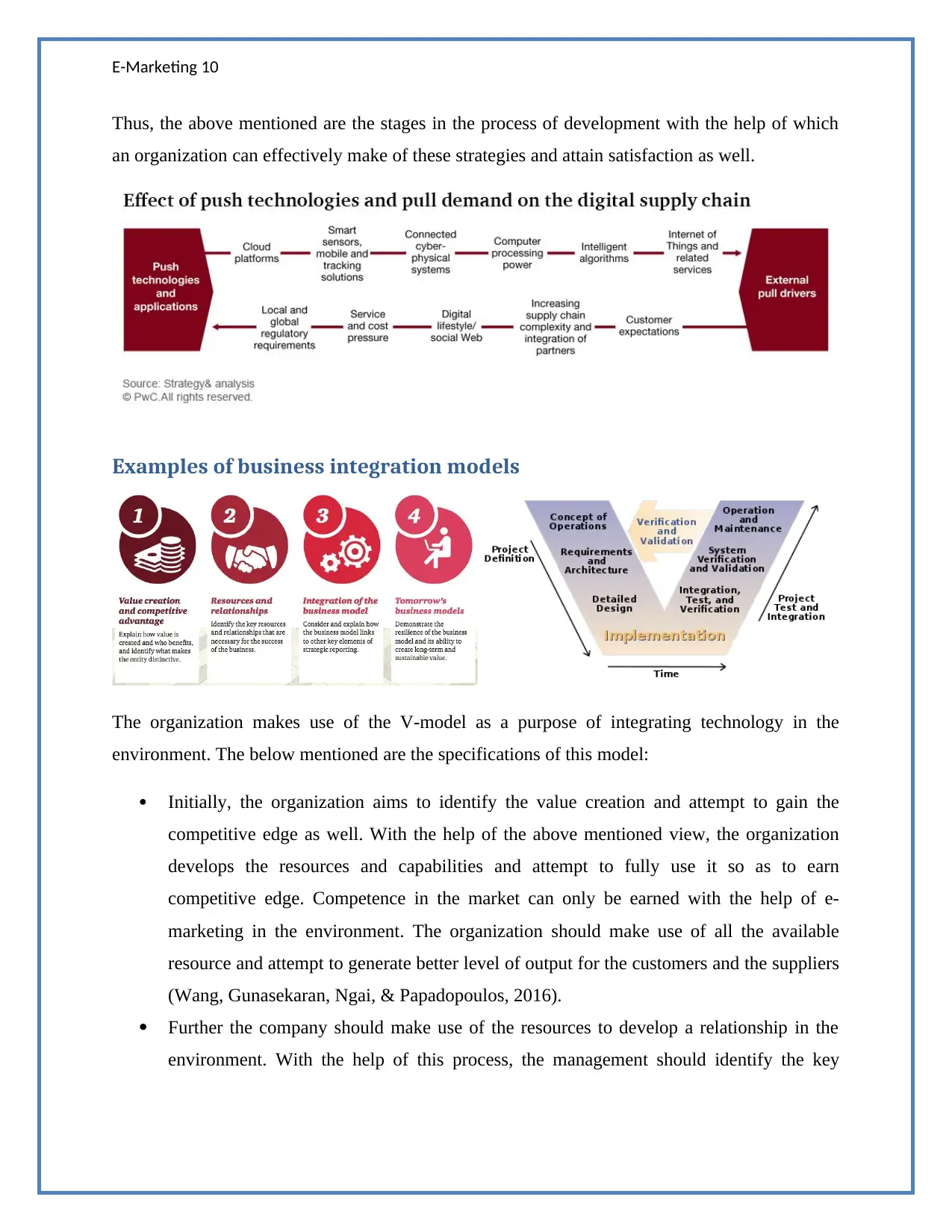
The organization makes use of the V-model as a purpose of integrating technology in the
environment. The below mentioned are the specifications of this model:
Initially, the organization aims to identify the value creation and attempt to gain the
competitive edge as well. With the help of the above mentioned view, the organization
develops the resources and capabilities and attempt to fully use it so as to earn
competitive edge. Competence in the market can only be earned with the help of e-
marketing in the environment. The organization should make use of all the available
resource and attempt to generate better level of output for the customers and the suppliers
(Wang, Gunasekaran, Ngai, & Papadopoulos, 2016).
Further the company should make use of the resources to develop a relationship in the
environment. With the help of this process, the management should identify the key
Thus, the above mentioned are the stages in the process of development with the help of which
an organization can effectively make of these strategies and attain satisfaction as well.
Examples of business integration models
The organization makes use of the V-model as a purpose of integrating technology in the
environment. The below mentioned are the specifications of this model:
Initially, the organization aims to identify the value creation and attempt to gain the
competitive edge as well. With the help of the above mentioned view, the organization
develops the resources and capabilities and attempt to fully use it so as to earn
competitive edge. Competence in the market can only be earned with the help of e-
marketing in the environment. The organization should make use of all the available
resource and attempt to generate better level of output for the customers and the suppliers
(Wang, Gunasekaran, Ngai, & Papadopoulos, 2016).
Further the company should make use of the resources to develop a relationship in the
environment. With the help of this process, the management should identify the key
E-Marketing 11
resources sand aim to use it effectively for the purpose of satisfying the suppliers and the
customers.
Now comes the part of integrating the business mode, under this process, the organization
should initially develop and plan, then integrate the requirement of the resources
accordingly. Afterwards, the organization should use the resources and the infrastructures
to help the management to integrate, test and verify the system. After this process the
organization should implement the system verification and validation. And lastly, the
company should implement the function of operations and maintenance (Ross, 2015).
Value to hospitality industry
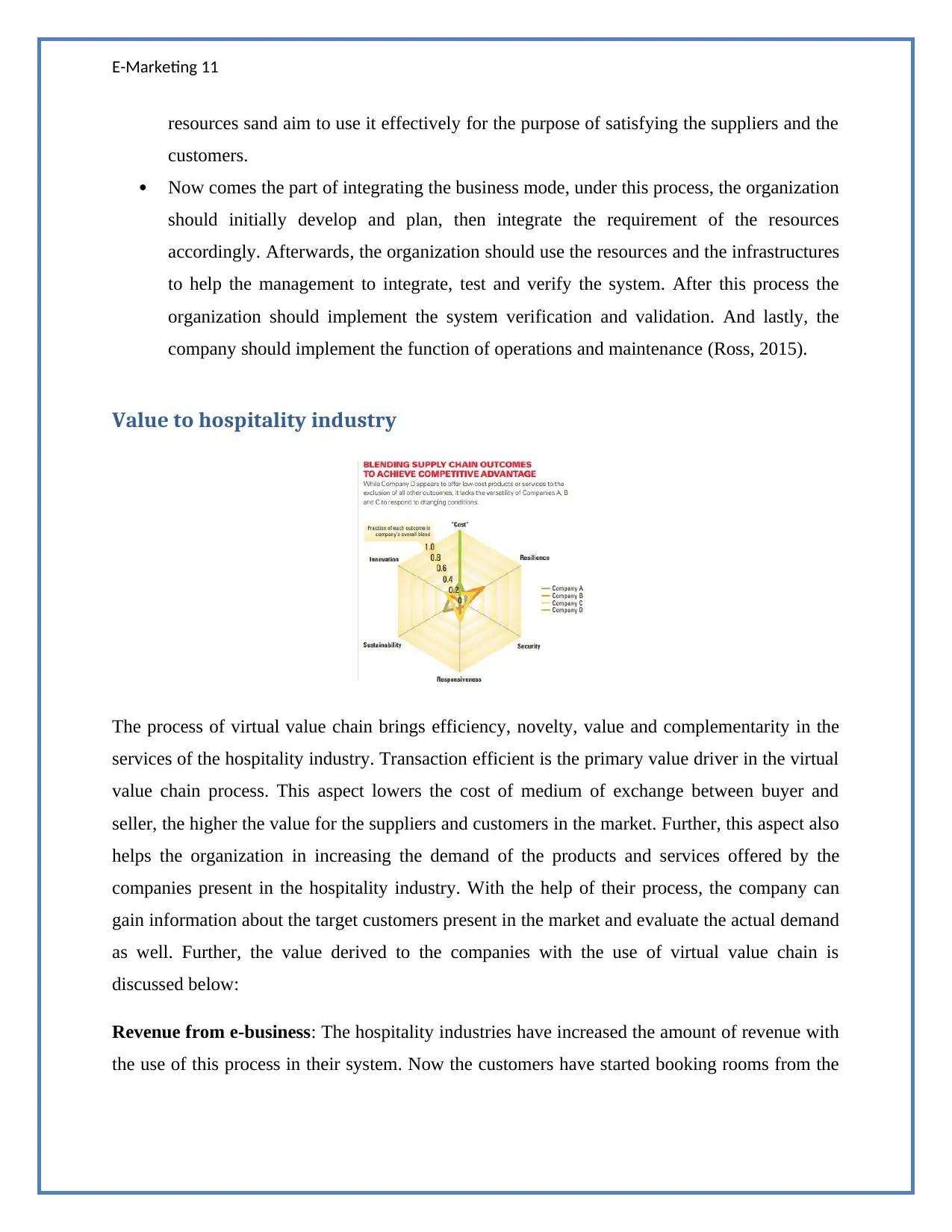
The process of virtual value chain brings efficiency, novelty, value and complementarity in the
services of the hospitality industry. Transaction efficient is the primary value driver in the virtual
value chain process. This aspect lowers the cost of medium of exchange between buyer and
seller, the higher the value for the suppliers and customers in the market. Further, this aspect also
helps the organization in increasing the demand of the products and services offered by the
companies present in the hospitality industry. With the help of their process, the company can
gain information about the target customers present in the market and evaluate the actual demand
as well. Further, the value derived to the companies with the use of virtual value chain is
discussed below:
Revenue from e-business: The hospitality industries have increased the amount of revenue with
the use of this process in their system. Now the customers have started booking rooms from the
resources sand aim to use it effectively for the purpose of satisfying the suppliers and the
customers.
Now comes the part of integrating the business mode, under this process, the organization
should initially develop and plan, then integrate the requirement of the resources
accordingly. Afterwards, the organization should use the resources and the infrastructures
to help the management to integrate, test and verify the system. After this process the
organization should implement the system verification and validation. And lastly, the
company should implement the function of operations and maintenance (Ross, 2015).
Value to hospitality industry
The process of virtual value chain brings efficiency, novelty, value and complementarity in the
services of the hospitality industry. Transaction efficient is the primary value driver in the virtual
value chain process. This aspect lowers the cost of medium of exchange between buyer and
seller, the higher the value for the suppliers and customers in the market. Further, this aspect also
helps the organization in increasing the demand of the products and services offered by the
companies present in the hospitality industry. With the help of their process, the company can
gain information about the target customers present in the market and evaluate the actual demand
as well. Further, the value derived to the companies with the use of virtual value chain is
discussed below:
Revenue from e-business: The hospitality industries have increased the amount of revenue with
the use of this process in their system. Now the customers have started booking rooms from the
⊘ This is a preview!⊘
Do you want full access?
Subscribe today to unlock all pages.
Trusted by 1+ million students worldwide

1 out of 16


Related Documents


Your All-in-One AI-Powered Toolkit for Academic Success.
+13062052269
info@desklib.com
Available 24*7 on WhatsApp / Email
![[object Object]](/_next/static/media/star-bottom.7253800d.svg)
Unlock your academic potential
Copyright © 2020–2026 A2Z Services. All Rights Reserved. Developed and managed by ZUCOL.