E123 - Business and Economy: Analyzing Impacts on Business Firms
VerifiedAdded on 2024/04/25
|14
|2888
|401
Report
AI Summary
This report examines the effects of economic factors such as economic growth, inflation, and unemployment on business operations. It discusses the causes of economic growth, including labor force expansion and technological advancements, as well as the causes of inflation, such as demand-pull and cost-push factors. The report also explores the different types of unemployment and their causes. Furthermore, it analyzes how firms respond to changes in economic growth, the effects of inflation on firms, and strategies for dealing with inflation, such as monetary and supply-side policies. Finally, it assesses the effects of increased unemployment on firms, including weakened customer buying power and increased unemployment insurance taxes. The report uses examples and diagrams to illustrate key concepts and strategies.

Business and Economy
1
1

Paraphrase This Document
Need a fresh take? Get an instant paraphrase of this document with our AI Paraphraser

Table of Contents
Introduction......................................................................................................................................2
1. Understanding the main causes of economic growth, inflation and unemployment...................3
1.1 Discuss two possible causes of the mentioned aspects..........................................................3
a. Economic growth.................................................................................................................3
b. Inflation................................................................................................................................3
c. Unemployment.....................................................................................................................5
2. Understanding the effects that changes in the economy may have on business..........................7
2.1 Analyse using two examples how firms may respond to changes in economic growth........7
2.2 Discuss two effects that inflation may have on firms and assess the strategies they may use
to deal with them.........................................................................................................................7
2.3 Assess two effects of increased unemployment on a firm.....................................................9
Conclusion.....................................................................................................................................11
Reference list.................................................................................................................................12
2
Introduction......................................................................................................................................2
1. Understanding the main causes of economic growth, inflation and unemployment...................3
1.1 Discuss two possible causes of the mentioned aspects..........................................................3
a. Economic growth.................................................................................................................3
b. Inflation................................................................................................................................3
c. Unemployment.....................................................................................................................5
2. Understanding the effects that changes in the economy may have on business..........................7
2.1 Analyse using two examples how firms may respond to changes in economic growth........7
2.2 Discuss two effects that inflation may have on firms and assess the strategies they may use
to deal with them.........................................................................................................................7
2.3 Assess two effects of increased unemployment on a firm.....................................................9
Conclusion.....................................................................................................................................11
Reference list.................................................................................................................................12
2

Introduction
The study focuses on business and economic effects of it on the same. The purpose of running a
company is to earn profits in business. While several internal factors are dependent on the
progress of business of an organisation, there are factors on which the company does not have
any hold. The factors include economic growth, inflation and rate of unemployment. Economic
growth takes place due to several reasons and it impacts the functioning of the company big
time. The mentioned attributes are considered for the study.
Inflation and growth of unemployment adversely affects the functioning of the company.
Companies take measures to deal with economic growth and the same is explained with the help
of examples. Inflation occurs due to several reasons and potential impacts of inflation on an
organisation’s operations are described below. Strategies that can be taken by an organisation to
come out of the same would be discussed. Impacts of unemployment are considered as part of
the study.
3
The study focuses on business and economic effects of it on the same. The purpose of running a
company is to earn profits in business. While several internal factors are dependent on the
progress of business of an organisation, there are factors on which the company does not have
any hold. The factors include economic growth, inflation and rate of unemployment. Economic
growth takes place due to several reasons and it impacts the functioning of the company big
time. The mentioned attributes are considered for the study.
Inflation and growth of unemployment adversely affects the functioning of the company.
Companies take measures to deal with economic growth and the same is explained with the help
of examples. Inflation occurs due to several reasons and potential impacts of inflation on an
organisation’s operations are described below. Strategies that can be taken by an organisation to
come out of the same would be discussed. Impacts of unemployment are considered as part of
the study.
3
⊘ This is a preview!⊘
Do you want full access?
Subscribe today to unlock all pages.

Trusted by 1+ million students worldwide
1. Understanding the main causes of economic growth, inflation and unemployment
1.1 Discuss two possible causes of the mentioned aspects
a. Economic growth
The causes of economic growth are mentioned below.
Growth in the labour force: In the view of Ehrenberg and Smith (2016), when every parameter
stays constant, the enhancement of labour force could lead to more economic growth. More
workers contribute towards efficient working and more productivity. The mentioned aspect, in
turn, yields better economic goods and services. It should be noted that a high influx of cheap
labour contributes to enhanced labour force. Immigration of labour contributes towards the same
and earns economic growth.
Superior technology or other capital goods: To improve the productivity technological
enhancement and increment in capital goods could lead to economic growth. Considerable
savings and investment essential for research and development contributes towards economic
growth. Internet and microcomputers have contributed towards enhancement in the economic
growth. Technological improvement remains a constant and it would help economic growth in
future. Technologies namely artificial intelligence that drives robots and replaces human labour
would influence economic growth (Špaček and Vacík, 2016).
b. Inflation
The causes of inflation are mentioned below.
Demand Pull Inflation
4
1.1 Discuss two possible causes of the mentioned aspects
a. Economic growth
The causes of economic growth are mentioned below.
Growth in the labour force: In the view of Ehrenberg and Smith (2016), when every parameter
stays constant, the enhancement of labour force could lead to more economic growth. More
workers contribute towards efficient working and more productivity. The mentioned aspect, in
turn, yields better economic goods and services. It should be noted that a high influx of cheap
labour contributes to enhanced labour force. Immigration of labour contributes towards the same
and earns economic growth.
Superior technology or other capital goods: To improve the productivity technological
enhancement and increment in capital goods could lead to economic growth. Considerable
savings and investment essential for research and development contributes towards economic
growth. Internet and microcomputers have contributed towards enhancement in the economic
growth. Technological improvement remains a constant and it would help economic growth in
future. Technologies namely artificial intelligence that drives robots and replaces human labour
would influence economic growth (Špaček and Vacík, 2016).
b. Inflation
The causes of inflation are mentioned below.
Demand Pull Inflation
4
Paraphrase This Document
Need a fresh take? Get an instant paraphrase of this document with our AI Paraphraser
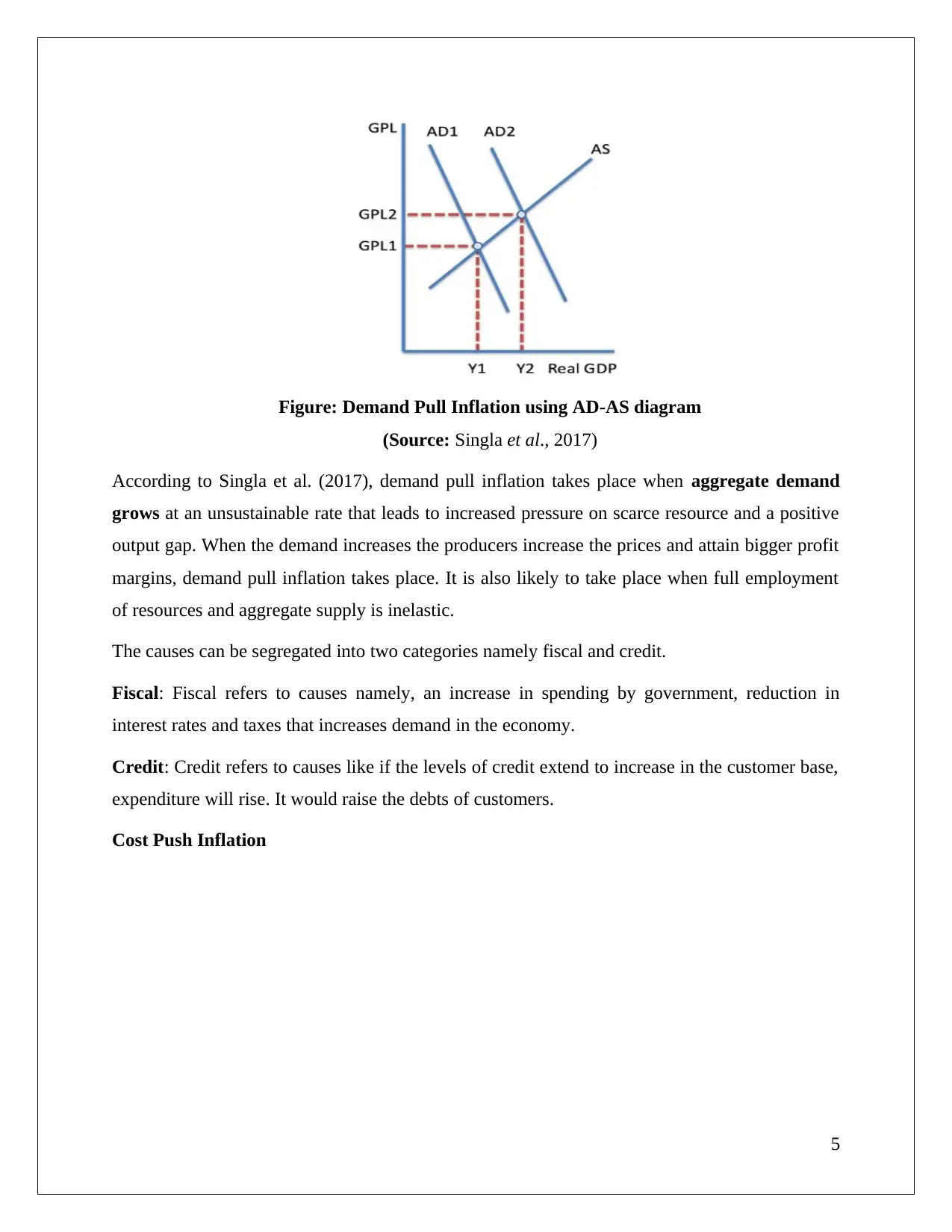
Figure: Demand Pull Inflation using AD-AS diagram
(Source: Singla et al., 2017)
According to Singla et al. (2017), demand pull inflation takes place when aggregate demand
grows at an unsustainable rate that leads to increased pressure on scarce resource and a positive
output gap. When the demand increases the producers increase the prices and attain bigger profit
margins, demand pull inflation takes place. It is also likely to take place when full employment
of resources and aggregate supply is inelastic.
The causes can be segregated into two categories namely fiscal and credit.
Fiscal: Fiscal refers to causes namely, an increase in spending by government, reduction in
interest rates and taxes that increases demand in the economy.
Credit: Credit refers to causes like if the levels of credit extend to increase in the customer base,
expenditure will rise. It would raise the debts of customers.
Cost Push Inflation
5
(Source: Singla et al., 2017)
According to Singla et al. (2017), demand pull inflation takes place when aggregate demand
grows at an unsustainable rate that leads to increased pressure on scarce resource and a positive
output gap. When the demand increases the producers increase the prices and attain bigger profit
margins, demand pull inflation takes place. It is also likely to take place when full employment
of resources and aggregate supply is inelastic.
The causes can be segregated into two categories namely fiscal and credit.
Fiscal: Fiscal refers to causes namely, an increase in spending by government, reduction in
interest rates and taxes that increases demand in the economy.
Credit: Credit refers to causes like if the levels of credit extend to increase in the customer base,
expenditure will rise. It would raise the debts of customers.
Cost Push Inflation
5

Figure: Cost Push Inflation using AD-AS diagram
(Source: Takami, 2015)
Cost push inflation takes place when firms respond to increasing costs by increasing prices so
as to keep their profit margins intact. Costs can increase due to several causes namely increase in
the cost of components like raw materials, increase in the labour costs, inflation expectations,
higher indirect taxes, fall in exchange rate and monopoly employers. Import cost inflation takes
place when the costs of essential imports increase (Takami, 2015).
c. Unemployment
According to Dosi et al. (2016), unemployment refers to the number of people who are not
working but are activity on the lookout for work. Unemployment is of three type namely
structural unemployment, frictional unemployment and cynical unemployment.
Frictional unemployment occurs when employee takes it up voluntarily. They feel that they have
enough money saved and can afford to quit unfulfilling work. It can occur when new workers
look to enter the work force. Students who graduate from the high school tend to look for job
that suits their qualifications and skills. When the students do not find such job profiles they stay
unemployed (Carrère et al., 2015).
Restrepo et al. (2015) opine that structural unemployment takes place when the company makes
progress in technology and workers are bound to quit jobs. Computers and robots accomplish a
significant amount of work and reduce human labour. The mentioned aspect tends to replace
6
(Source: Takami, 2015)
Cost push inflation takes place when firms respond to increasing costs by increasing prices so
as to keep their profit margins intact. Costs can increase due to several causes namely increase in
the cost of components like raw materials, increase in the labour costs, inflation expectations,
higher indirect taxes, fall in exchange rate and monopoly employers. Import cost inflation takes
place when the costs of essential imports increase (Takami, 2015).
c. Unemployment
According to Dosi et al. (2016), unemployment refers to the number of people who are not
working but are activity on the lookout for work. Unemployment is of three type namely
structural unemployment, frictional unemployment and cynical unemployment.
Frictional unemployment occurs when employee takes it up voluntarily. They feel that they have
enough money saved and can afford to quit unfulfilling work. It can occur when new workers
look to enter the work force. Students who graduate from the high school tend to look for job
that suits their qualifications and skills. When the students do not find such job profiles they stay
unemployed (Carrère et al., 2015).
Restrepo et al. (2015) opine that structural unemployment takes place when the company makes
progress in technology and workers are bound to quit jobs. Computers and robots accomplish a
significant amount of work and reduce human labour. The mentioned aspect tends to replace
6
⊘ This is a preview!⊘
Do you want full access?
Subscribe today to unlock all pages.
Trusted by 1+ million students worldwide

workers. Workers require training before they could get a job in their field. Structural
unemployment takes place a company moves it manufacturing centre to a different country. The
new country provides cheap labour and low cost of living hence the people who were previously
working have to leave their job.
7
unemployment takes place a company moves it manufacturing centre to a different country. The
new country provides cheap labour and low cost of living hence the people who were previously
working have to leave their job.
7
Paraphrase This Document
Need a fresh take? Get an instant paraphrase of this document with our AI Paraphraser

2. Understanding the effects that changes in the economy may have on business
2.1 Analyse using two examples how firms may respond to changes in economic growth
The chief executive officer of a company can take steps to prepare his company for a situation of
robust economy.
Hedging the belts: Companies take up commodity derivatives to restrict the prices of raw
materials. The mentioned aspect attains the purpose of ensuring adequate supply of raw
materials. Prices of products namely gas, oil, coal, agricultural products, metals electricity can be
reduced by virtue of commodity derivatives. Different oil companies locked down on high prices
of oil when prices reduced from $ 100 to $ 80 a barrel. The buyers of future contracts gain from
the increased prices of the underlying commodity (Martin and Sunley, 2015).
Swimming the channel: McCombie and Thirlwall (2016) put forward that customers and sales
channel are important assets of a company. Sales can be enhanced in a number of ways.
Companies provide expedited service delivery and warranty along with the produce line.
Companies also try to enter new market as a strategy to enhance the number of channels. They
can also consider strategies namely taking part in alliances, mergers, partnerships and
acquisitions. Franchising the product is a considerable measure. Alliances and partnership turn
out to be less capital intensive method of growing a company. The measure does not involve
investment in inventory and new product facilities.
2.2 Discuss two effects that inflation may have on firms and assess the strategies they may
use to deal with them
Firms prefer the inflation to stay stable and low. When the inflation rises by 3 % or 4 % firms
witness rise in uncertainly and costs (economicshelp.org, 2017). It can have effects in firms
operations.
Change in costs: Ndou and Gumata (2017) opine that if inflation is high the firms require
updating the prices in a frequent manner. For prices in pounds and dollars the effects turn out to
8
2.1 Analyse using two examples how firms may respond to changes in economic growth
The chief executive officer of a company can take steps to prepare his company for a situation of
robust economy.
Hedging the belts: Companies take up commodity derivatives to restrict the prices of raw
materials. The mentioned aspect attains the purpose of ensuring adequate supply of raw
materials. Prices of products namely gas, oil, coal, agricultural products, metals electricity can be
reduced by virtue of commodity derivatives. Different oil companies locked down on high prices
of oil when prices reduced from $ 100 to $ 80 a barrel. The buyers of future contracts gain from
the increased prices of the underlying commodity (Martin and Sunley, 2015).
Swimming the channel: McCombie and Thirlwall (2016) put forward that customers and sales
channel are important assets of a company. Sales can be enhanced in a number of ways.
Companies provide expedited service delivery and warranty along with the produce line.
Companies also try to enter new market as a strategy to enhance the number of channels. They
can also consider strategies namely taking part in alliances, mergers, partnerships and
acquisitions. Franchising the product is a considerable measure. Alliances and partnership turn
out to be less capital intensive method of growing a company. The measure does not involve
investment in inventory and new product facilities.
2.2 Discuss two effects that inflation may have on firms and assess the strategies they may
use to deal with them
Firms prefer the inflation to stay stable and low. When the inflation rises by 3 % or 4 % firms
witness rise in uncertainly and costs (economicshelp.org, 2017). It can have effects in firms
operations.
Change in costs: Ndou and Gumata (2017) opine that if inflation is high the firms require
updating the prices in a frequent manner. For prices in pounds and dollars the effects turn out to
8
be significantly damaging. It becomes difficult for firms to find goods that can be sold for
pounds. It should be noted at this point that price changes need not be calculated manually at
present but are facilitated with the help of bar codes in less time. Unexpected inflation leads to
renegotiating wage deals with the employees. The rise in wage can turn out to be significantly
more for the firm and they may face issues to meet them. If inflation turns out to be higher than
expected then costs of investment change frequently. This forces the firm to invest less owing to
the fact that they grow uncertain over future costs, demands and wages. International
competitiveness takes a hit. If the inflation of UK turns out to be higher than that of other
countries it forces the UK firms to be less competitive than international competitors.
Stagflation: Cost push inflation is a drastic type of inflation. It occurs due to rise in the cost of
raw materials and at the same time decrease in demand. The firms are then met with a two way
disaster. They have to deal with rising cost and at the same time deal with low demands. It
becomes necessary for firms at those points to reduce profit margins and absorb price increments
(Darovskii, 2017).
The firms can use strategies to come out of the effects of inflation. The strategies are mentioned
below.
Monetary policies: Monetary policies increase the cost of borrowing and discourage spending.
The mentioned aspect leads to lower inflation and economic growth. The UK and USA use the
policy to maintain a low inflation. The UK government gives a target to the Bank of England.
The inflation target is 2 % +/-1. The interest rate is used by the bank to achieve its target
(economicshelp.org, 2017). The monetary policy of the UK is set by the Monetary Policy
Committee of England. They predict the future inflation. They measure the various economic
statistics and decide on whether the economy is overheating. When MPC sees the inflation is
going above target they increase the rate of interest. It contributes towards reduction in the
growth of aggregate demand in the economy. Slow growth leads to reduction in inflation. Higher
interest rate makes people spend less. The reasons for the mentioned aspect include more interest
rate leads to increased cost of borrowing and discouraging them to spend and borrow. It leads to
reduced rates of disposable income with mortgages. Higher interest rate leads to increase in the
value of the exchange rate leading to more imports and low exports (Galí, 2015).
9
pounds. It should be noted at this point that price changes need not be calculated manually at
present but are facilitated with the help of bar codes in less time. Unexpected inflation leads to
renegotiating wage deals with the employees. The rise in wage can turn out to be significantly
more for the firm and they may face issues to meet them. If inflation turns out to be higher than
expected then costs of investment change frequently. This forces the firm to invest less owing to
the fact that they grow uncertain over future costs, demands and wages. International
competitiveness takes a hit. If the inflation of UK turns out to be higher than that of other
countries it forces the UK firms to be less competitive than international competitors.
Stagflation: Cost push inflation is a drastic type of inflation. It occurs due to rise in the cost of
raw materials and at the same time decrease in demand. The firms are then met with a two way
disaster. They have to deal with rising cost and at the same time deal with low demands. It
becomes necessary for firms at those points to reduce profit margins and absorb price increments
(Darovskii, 2017).
The firms can use strategies to come out of the effects of inflation. The strategies are mentioned
below.
Monetary policies: Monetary policies increase the cost of borrowing and discourage spending.
The mentioned aspect leads to lower inflation and economic growth. The UK and USA use the
policy to maintain a low inflation. The UK government gives a target to the Bank of England.
The inflation target is 2 % +/-1. The interest rate is used by the bank to achieve its target
(economicshelp.org, 2017). The monetary policy of the UK is set by the Monetary Policy
Committee of England. They predict the future inflation. They measure the various economic
statistics and decide on whether the economy is overheating. When MPC sees the inflation is
going above target they increase the rate of interest. It contributes towards reduction in the
growth of aggregate demand in the economy. Slow growth leads to reduction in inflation. Higher
interest rate makes people spend less. The reasons for the mentioned aspect include more interest
rate leads to increased cost of borrowing and discouraging them to spend and borrow. It leads to
reduced rates of disposable income with mortgages. Higher interest rate leads to increase in the
value of the exchange rate leading to more imports and low exports (Galí, 2015).
9
⊘ This is a preview!⊘
Do you want full access?
Subscribe today to unlock all pages.
Trusted by 1+ million students worldwide
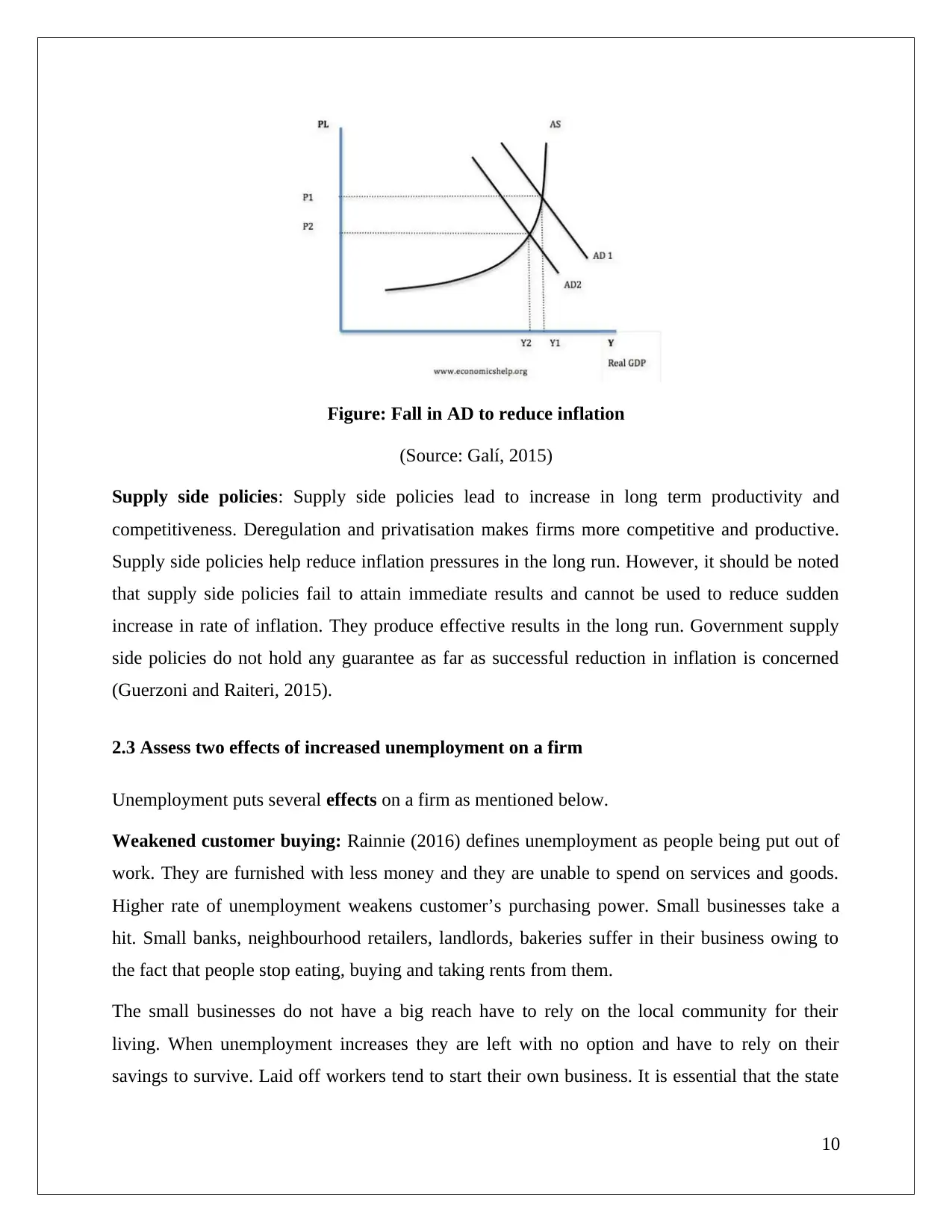
Figure: Fall in AD to reduce inflation
(Source: Galí, 2015)
Supply side policies: Supply side policies lead to increase in long term productivity and
competitiveness. Deregulation and privatisation makes firms more competitive and productive.
Supply side policies help reduce inflation pressures in the long run. However, it should be noted
that supply side policies fail to attain immediate results and cannot be used to reduce sudden
increase in rate of inflation. They produce effective results in the long run. Government supply
side policies do not hold any guarantee as far as successful reduction in inflation is concerned
(Guerzoni and Raiteri, 2015).
2.3 Assess two effects of increased unemployment on a firm
Unemployment puts several effects on a firm as mentioned below.
Weakened customer buying: Rainnie (2016) defines unemployment as people being put out of
work. They are furnished with less money and they are unable to spend on services and goods.
Higher rate of unemployment weakens customer’s purchasing power. Small businesses take a
hit. Small banks, neighbourhood retailers, landlords, bakeries suffer in their business owing to
the fact that people stop eating, buying and taking rents from them.
The small businesses do not have a big reach have to rely on the local community for their
living. When unemployment increases they are left with no option and have to rely on their
savings to survive. Laid off workers tend to start their own business. It is essential that the state
10
(Source: Galí, 2015)
Supply side policies: Supply side policies lead to increase in long term productivity and
competitiveness. Deregulation and privatisation makes firms more competitive and productive.
Supply side policies help reduce inflation pressures in the long run. However, it should be noted
that supply side policies fail to attain immediate results and cannot be used to reduce sudden
increase in rate of inflation. They produce effective results in the long run. Government supply
side policies do not hold any guarantee as far as successful reduction in inflation is concerned
(Guerzoni and Raiteri, 2015).
2.3 Assess two effects of increased unemployment on a firm
Unemployment puts several effects on a firm as mentioned below.
Weakened customer buying: Rainnie (2016) defines unemployment as people being put out of
work. They are furnished with less money and they are unable to spend on services and goods.
Higher rate of unemployment weakens customer’s purchasing power. Small businesses take a
hit. Small banks, neighbourhood retailers, landlords, bakeries suffer in their business owing to
the fact that people stop eating, buying and taking rents from them.
The small businesses do not have a big reach have to rely on the local community for their
living. When unemployment increases they are left with no option and have to rely on their
savings to survive. Laid off workers tend to start their own business. It is essential that the state
10
Paraphrase This Document
Need a fresh take? Get an instant paraphrase of this document with our AI Paraphraser
Department of Labour (DOL) provide them help in the form of entrepreneurial workshops or
provide the people business loans to start their own business.
Rise in Unemployment insurance taxes: In the view of González-Sánchez (2015), an economy
that faces high unemployment leaves states having shortage of money to borrow money from the
federal government. The same is used by the states to cover the UI benefit claims. Small
businesses that disproportionally face financial hardships in times of recession require paying
higher federal unemployment rates.
Handling UI benefit claims turn out to be tedious and confusing for small business leaders. They
lack knowledge as far as methods of being taxed and knowing whether an employee is eligible
for benefits is concerned. The employers should avoid such challenges by acquiring knowledge
about a state’s UI regulations. Employers also need to keep track of the tax payments and
maintain UI charges documents against the employees.
11
provide the people business loans to start their own business.
Rise in Unemployment insurance taxes: In the view of González-Sánchez (2015), an economy
that faces high unemployment leaves states having shortage of money to borrow money from the
federal government. The same is used by the states to cover the UI benefit claims. Small
businesses that disproportionally face financial hardships in times of recession require paying
higher federal unemployment rates.
Handling UI benefit claims turn out to be tedious and confusing for small business leaders. They
lack knowledge as far as methods of being taxed and knowing whether an employee is eligible
for benefits is concerned. The employers should avoid such challenges by acquiring knowledge
about a state’s UI regulations. Employers also need to keep track of the tax payments and
maintain UI charges documents against the employees.
11

Conclusion
From the assignment, it can be reflected that important aspects are described with introduction
and then the study has delved into explanation of the same. It is hopeful that it would become
easy for the readers to grasp the matter. Examples have been considered at essential junctions of
the study. Graphs are used to elucidate matters. It is expected that the readers would get a
comprehensive knowledge about the topics covered in the study. It would benefit an organisation
to deal with inflation, unemployment and economic downturn. Authentic sources have been
considered for the study hence the information used can be relied.
12
From the assignment, it can be reflected that important aspects are described with introduction
and then the study has delved into explanation of the same. It is hopeful that it would become
easy for the readers to grasp the matter. Examples have been considered at essential junctions of
the study. Graphs are used to elucidate matters. It is expected that the readers would get a
comprehensive knowledge about the topics covered in the study. It would benefit an organisation
to deal with inflation, unemployment and economic downturn. Authentic sources have been
considered for the study hence the information used can be relied.
12
⊘ This is a preview!⊘
Do you want full access?
Subscribe today to unlock all pages.
Trusted by 1+ million students worldwide

1 out of 14


Related Documents


Your All-in-One AI-Powered Toolkit for Academic Success.
+13062052269
info@desklib.com
Available 24*7 on WhatsApp / Email
![[object Object]](/_next/static/media/star-bottom.7253800d.svg)
Unlock your academic potential
Copyright © 2020–2025 A2Z Services. All Rights Reserved. Developed and managed by ZUCOL.