SNPG917: Early Detection of Breast Cancer Literature Review Report
VerifiedAdded on 2023/01/10
|24
|4758
|36
Report
AI Summary
This report investigates various interventions for the early detection of breast cancer in women over 40, highlighting the significance of early detection in improving patient outcomes and reducing mortality rates. The report begins by establishing the importance of the topic, given the high incidence of breast cancer and the benefits of early detection. A comprehensive search strategy, utilizing databases like MEDLINE, PubMed, and CINAHL, is detailed, along with the selection criteria for relevant studies. The evidence is synthesized from three key studies focusing on mammographic screening, breast MRI, and bioimpedance spectroscopy. Each intervention is critically reviewed, considering its strengths, limitations, and impact on clinical practice. The report concludes that while mammography and breast MRI show promise, further research is needed, particularly for newer interventions like bioimpedance spectroscopy, to refine and improve early detection strategies. The report emphasizes the need for continued research to enhance the quality of interventions and ultimately improve the survival rates of women with breast cancer.
Running head: EARLY DETECTION OF BREAST CANCER
EARLY DETECTION OF BREAST CANCER
Name of Student:
Name of University:
Author’s Note:
EARLY DETECTION OF BREAST CANCER
Name of Student:
Name of University:
Author’s Note:

Paraphrase This Document
Need a fresh take? Get an instant paraphrase of this document with our AI Paraphraser
1EARLY DETECTION OF BREAST CANCER
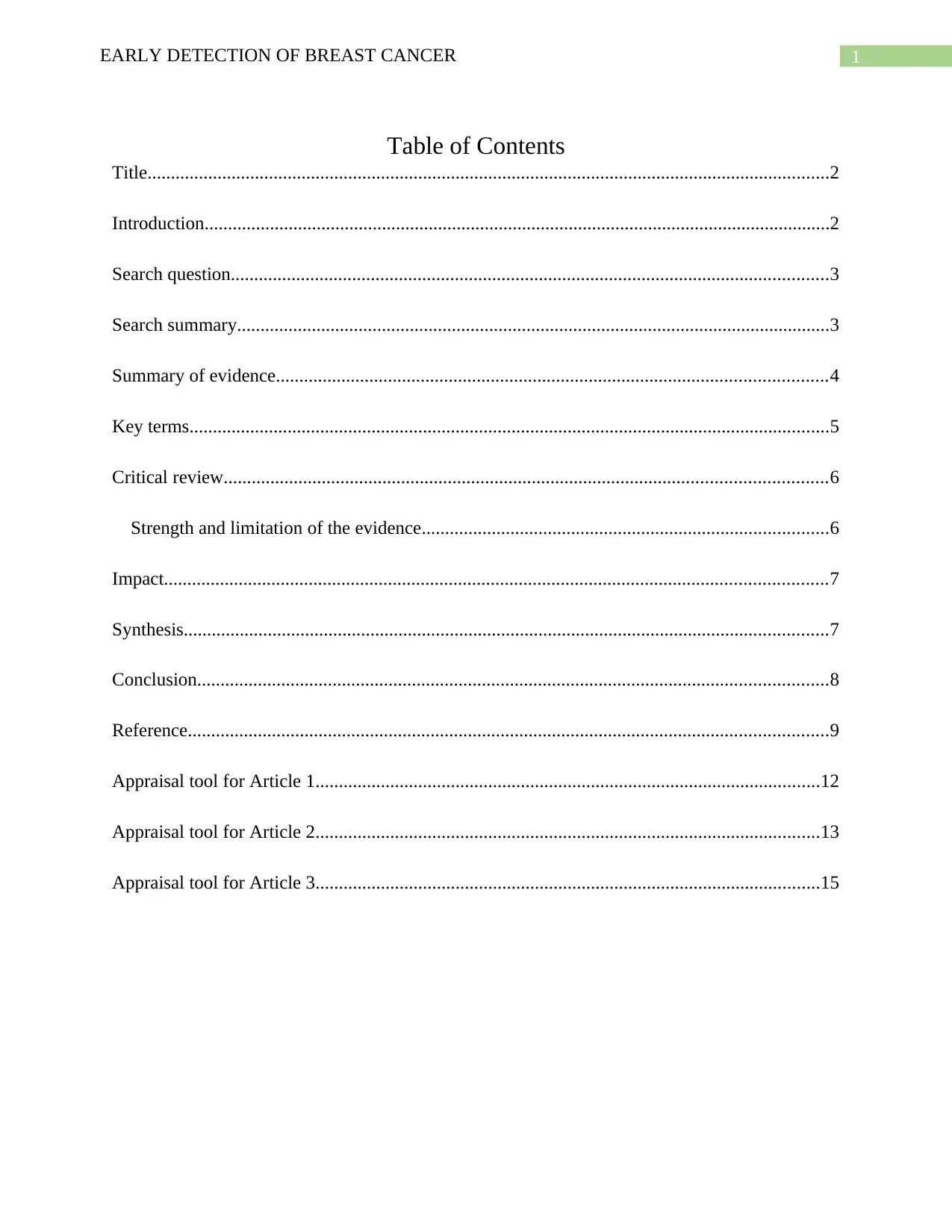
Table of Contents
Title..................................................................................................................................................2
Introduction......................................................................................................................................2
Search question................................................................................................................................3
Search summary...............................................................................................................................3
Summary of evidence......................................................................................................................4
Key terms.........................................................................................................................................5
Critical review.................................................................................................................................6
Strength and limitation of the evidence.......................................................................................6
Impact..............................................................................................................................................7
Synthesis..........................................................................................................................................7
Conclusion.......................................................................................................................................8
Reference.........................................................................................................................................9
Appraisal tool for Article 1............................................................................................................12
Appraisal tool for Article 2............................................................................................................13
Appraisal tool for Article 3............................................................................................................15
Table of Contents
Title..................................................................................................................................................2
Introduction......................................................................................................................................2
Search question................................................................................................................................3
Search summary...............................................................................................................................3
Summary of evidence......................................................................................................................4
Key terms.........................................................................................................................................5
Critical review.................................................................................................................................6
Strength and limitation of the evidence.......................................................................................6
Impact..............................................................................................................................................7
Synthesis..........................................................................................................................................7
Conclusion.......................................................................................................................................8
Reference.........................................................................................................................................9
Appraisal tool for Article 1............................................................................................................12
Appraisal tool for Article 2............................................................................................................13
Appraisal tool for Article 3............................................................................................................15
2EARLY DETECTION OF BREAST CANCER
Title
Various intervention to detect breast cancer in early stage among the women above 40 years old.
Introduction
Background
Breast cancer is one of the reasons for the high rate of mortality among women
worldwide. It is the leading cause of cancer-related death in women above the age of 40 years.
Total estimated death caused by breast cancer is 1.7 million in 2012, which got increased to 6.2
million in 2018. Therefore, overall 15% death in women is because of cancer. Though the
prevalence of breast cancer was higher in developed region, however, the rate is increasing
globally (Lagendijk et al., 2018). The most significant reason for such a high rate is failure in the
detection of cancer at an early stage. To improve the outcome of breast cancer among the women
and their survival, discovery at an early stage is the most critical. According to the
epidemiological analysis of breast cancer, there are various risk which is associated with the
disease in which 10% of the cases are due to genetic factors and 90% of the cases are because of
non-genetic factors. Therefore, the early detection of breast cancer has always been an issue in
the health care sector. The present study is significant as it will help to analyse the various
intervention which is used to detect the breast cancer at early stage among the women who are at
40 years old.
Early stage of breast cancer generally has an adverse effect on the bone density. The
impact of neoadjuvant chemotherapy helps in the increasing the serum level of bone turnover,
however, such therapy would be effective only when the breast cancer is detected at early stage
(Chen, Xu & Yang, 2015). One of the intervention is an examination of women having dense
Title
Various intervention to detect breast cancer in early stage among the women above 40 years old.
Introduction
Background
Breast cancer is one of the reasons for the high rate of mortality among women
worldwide. It is the leading cause of cancer-related death in women above the age of 40 years.
Total estimated death caused by breast cancer is 1.7 million in 2012, which got increased to 6.2
million in 2018. Therefore, overall 15% death in women is because of cancer. Though the
prevalence of breast cancer was higher in developed region, however, the rate is increasing
globally (Lagendijk et al., 2018). The most significant reason for such a high rate is failure in the
detection of cancer at an early stage. To improve the outcome of breast cancer among the women
and their survival, discovery at an early stage is the most critical. According to the
epidemiological analysis of breast cancer, there are various risk which is associated with the
disease in which 10% of the cases are due to genetic factors and 90% of the cases are because of
non-genetic factors. Therefore, the early detection of breast cancer has always been an issue in
the health care sector. The present study is significant as it will help to analyse the various
intervention which is used to detect the breast cancer at early stage among the women who are at
40 years old.
Early stage of breast cancer generally has an adverse effect on the bone density. The
impact of neoadjuvant chemotherapy helps in the increasing the serum level of bone turnover,
however, such therapy would be effective only when the breast cancer is detected at early stage
(Chen, Xu & Yang, 2015). One of the intervention is an examination of women having dense
⊘ This is a preview!⊘
Do you want full access?
Subscribe today to unlock all pages.

Trusted by 1+ million students worldwide
3EARLY DETECTION OF BREAST CANCER
breast cancer as they are at high risk (Kerlikowske et al., 2015). Therefore, it can be said that
breast cancer early detection is the most imperative step to lower the rate of breast cancer-related
death. Hence, such study base on the finding of various intervention that can be used to detect
breast cancer in the early stage in women who are at over 40 years of age can contribute to high
survival rate of women suffering from breast cancer
Search question
What are the interventions that are used to detect breast cancer in early stage among the women
over 40 years old?
Search summary
To search for the literature based on the research question, a broad search strategy has
been used. The articles have been accessed from various database within the University of
Wollongong Library. The following database was searched on 10 June 2019 to recognise the
relevant studies as per the research question: MEDLINE, PubMed, CINAHL, PsycINFO,
SCOPUS, and Academic Search Complete. Such database publishes recent and peer-reviewed
literature and helps to the retrieved huge number of research articles. For conduction of search
from the library, Boolean operators such as “AND” and “OR” has been used. The articles was
searched by using various keywords and search term “intervention “or “strategies” or “best
practice” or “treatment” or “therapy” AND “breast cancer” or “breast carcinoma” or “breast
neoplasm” AND “early stage” AND “women” or “female” AND “40 years”. The studies
searched were restricted to research that got published from 2015 to 2019, full text and of
English language.
breast cancer as they are at high risk (Kerlikowske et al., 2015). Therefore, it can be said that
breast cancer early detection is the most imperative step to lower the rate of breast cancer-related
death. Hence, such study base on the finding of various intervention that can be used to detect
breast cancer in the early stage in women who are at over 40 years of age can contribute to high
survival rate of women suffering from breast cancer
Search question
What are the interventions that are used to detect breast cancer in early stage among the women
over 40 years old?
Search summary
To search for the literature based on the research question, a broad search strategy has
been used. The articles have been accessed from various database within the University of
Wollongong Library. The following database was searched on 10 June 2019 to recognise the
relevant studies as per the research question: MEDLINE, PubMed, CINAHL, PsycINFO,
SCOPUS, and Academic Search Complete. Such database publishes recent and peer-reviewed
literature and helps to the retrieved huge number of research articles. For conduction of search
from the library, Boolean operators such as “AND” and “OR” has been used. The articles was
searched by using various keywords and search term “intervention “or “strategies” or “best
practice” or “treatment” or “therapy” AND “breast cancer” or “breast carcinoma” or “breast
neoplasm” AND “early stage” AND “women” or “female” AND “40 years”. The studies
searched were restricted to research that got published from 2015 to 2019, full text and of
English language.
Paraphrase This Document
Need a fresh take? Get an instant paraphrase of this document with our AI Paraphraser
4EARLY DETECTION OF BREAST CANCER
Further, the only peer-reviewed journal was included in the search strategy. The relevant
studies were identified based on the title, title and MeSH heading. From the extreme search total
of 269 articles was found, which was having the search term. Further, based on the research
question, the articles were excluded and constricted the search based on breast cancer early
detection in over 40 years older women. After eliminating the irrelevant material, a total of 15
was selected, which was reviewed and critically analysed.
Summary of evidence
The studies were examined based on the early detection of breast cancer in women over
40 years old. Three relevant studies are based on interventions to detect breast cancer, which as
discussed as follow:
Moss et al. (2015) conducted research where he has studied the effect of mammographic
screening for early detection of breast cancer in women over 40 years old. The study was
conducted in the United Kingdom. The study was based on a randomized controlled trial which
included women of 39 to 41 years and was given annual screening by mammography. The
control group was administered regular medical care. The analyses of the result were done
statistically in which detection of breast cancer had a rate ratio of 0.88 from the group of a
participant who was screen by mammography. The result of the study has supported early
detection of breast cancer in association with a reduction in the rate of mortality with annual
mammography in women aged 40 to 49 years.
Ribnikar et al. (2015) have conducted a literature review based on breast cancer under the
40 year of age. The author has done a comprehensive analysis in which he has discussed various
intervention which is used to detect cancer at an early stage. Some of the response considered in
Further, the only peer-reviewed journal was included in the search strategy. The relevant
studies were identified based on the title, title and MeSH heading. From the extreme search total
of 269 articles was found, which was having the search term. Further, based on the research
question, the articles were excluded and constricted the search based on breast cancer early
detection in over 40 years older women. After eliminating the irrelevant material, a total of 15
was selected, which was reviewed and critically analysed.
Summary of evidence
The studies were examined based on the early detection of breast cancer in women over
40 years old. Three relevant studies are based on interventions to detect breast cancer, which as
discussed as follow:
Moss et al. (2015) conducted research where he has studied the effect of mammographic
screening for early detection of breast cancer in women over 40 years old. The study was
conducted in the United Kingdom. The study was based on a randomized controlled trial which
included women of 39 to 41 years and was given annual screening by mammography. The
control group was administered regular medical care. The analyses of the result were done
statistically in which detection of breast cancer had a rate ratio of 0.88 from the group of a
participant who was screen by mammography. The result of the study has supported early
detection of breast cancer in association with a reduction in the rate of mortality with annual
mammography in women aged 40 to 49 years.
Ribnikar et al. (2015) have conducted a literature review based on breast cancer under the
40 year of age. The author has done a comprehensive analysis in which he has discussed various
intervention which is used to detect cancer at an early stage. Some of the response considered in
5EARLY DETECTION OF BREAST CANCER
the study are breast MRI and conventional breast imaging techniques. The author has majorly
focused on the breast MRI and stated that it is used for clinical examination of the breast when
mammography does not give relevant result. It provides a better screening of breast cancer
among the population of women over 40 years. However, it is not recommended for the patient
who has implant prostheses.
Shah, Vicini and Arthur (2016) have done research where they have studied about the
bioimpedance spectroscopy for early screening of breast cancer. The authors have done a
systematic review using PRISMA guideline. Total 20 studies were identified, which included
article in the English language. The study has included Australia based research and the database
searched was MEDLINE. The author found that detection of breast cancer by using
bioimpedance spectroscopy gives relevant result. This is the most used technique for early
screening of breast cancer.
Key terms
Breast cancer- It is the type of cancer in which breast organ and its cell have disturbed cell cycle
mechanism resulting in uncontrolled growth. Such uncontrolled growth often leads to the
formation of tumour, which becomes malignant with course of time.
Breast MRI- It is the test which is used to detect breast cancer by applying a magnetic field and
radio waves to capture multiple images of breast tumour. The technique is alternative to the
mammography.
Mammography- It is also the type of breast imaging technique which is used to detect breast
cancer in women. The methods used X-rays to capture the image of breast tumour, thus help to
early detection.
the study are breast MRI and conventional breast imaging techniques. The author has majorly
focused on the breast MRI and stated that it is used for clinical examination of the breast when
mammography does not give relevant result. It provides a better screening of breast cancer
among the population of women over 40 years. However, it is not recommended for the patient
who has implant prostheses.
Shah, Vicini and Arthur (2016) have done research where they have studied about the
bioimpedance spectroscopy for early screening of breast cancer. The authors have done a
systematic review using PRISMA guideline. Total 20 studies were identified, which included
article in the English language. The study has included Australia based research and the database
searched was MEDLINE. The author found that detection of breast cancer by using
bioimpedance spectroscopy gives relevant result. This is the most used technique for early
screening of breast cancer.
Key terms
Breast cancer- It is the type of cancer in which breast organ and its cell have disturbed cell cycle
mechanism resulting in uncontrolled growth. Such uncontrolled growth often leads to the
formation of tumour, which becomes malignant with course of time.
Breast MRI- It is the test which is used to detect breast cancer by applying a magnetic field and
radio waves to capture multiple images of breast tumour. The technique is alternative to the
mammography.
Mammography- It is also the type of breast imaging technique which is used to detect breast
cancer in women. The methods used X-rays to capture the image of breast tumour, thus help to
early detection.
⊘ This is a preview!⊘
Do you want full access?
Subscribe today to unlock all pages.
Trusted by 1+ million students worldwide
6EARLY DETECTION OF BREAST CANCER
Bioimpedance spectroscopy- It is the intervention which is used for both early detections as
well as for reducing the progression of breast cancer. The method determines body composition
and its fluid. It is the emerging method to detect breast cancer by analyzing the cancerous cells.
Critical review
The intervention for early detection of breast cancer is well discussed in the three articles
chosen from the OUW library. The article which has highlighted the use of mammography
intervention and Breast MRI has used overall good methodology quality. Another article which
focused on the Bioimpedance spectroscopy was having poor quality of method for concluding
the result. The report by Moss et al. (2015) has used comparable groups for research where all
the participant were given equal and random allocation of the measure. Therefore the result
concluded is reliable. Paper by Ribnikar et al. (2015) has used poor quality method as there were
no statistical analyses and supporting data to conclude the result. The study by Shah, Vicini and
Arthur (2016) has good methodological quality as the systematic review has wisely extracted the
article based on inclusion and exclusion criteria.
Strength and limitation of the evidence
The major limitation of the study by Ribnikar et al. (2015) was the lack of supporting
research on the result. The author has not conducted any research which proves the authenticity
of the result. Considering the benefit of other intervention explained in the paper, none of the
method (breast MRI) was investigated. However, author has given extant literature based on the
research question.
In contrast to above finding, Moss et al. (2015) highlighted the use of mammography in
early detection of cancer with inclusive investigation. The study is limited with low sample size
Bioimpedance spectroscopy- It is the intervention which is used for both early detections as
well as for reducing the progression of breast cancer. The method determines body composition
and its fluid. It is the emerging method to detect breast cancer by analyzing the cancerous cells.
Critical review
The intervention for early detection of breast cancer is well discussed in the three articles
chosen from the OUW library. The article which has highlighted the use of mammography
intervention and Breast MRI has used overall good methodology quality. Another article which
focused on the Bioimpedance spectroscopy was having poor quality of method for concluding
the result. The report by Moss et al. (2015) has used comparable groups for research where all
the participant were given equal and random allocation of the measure. Therefore the result
concluded is reliable. Paper by Ribnikar et al. (2015) has used poor quality method as there were
no statistical analyses and supporting data to conclude the result. The study by Shah, Vicini and
Arthur (2016) has good methodological quality as the systematic review has wisely extracted the
article based on inclusion and exclusion criteria.
Strength and limitation of the evidence
The major limitation of the study by Ribnikar et al. (2015) was the lack of supporting
research on the result. The author has not conducted any research which proves the authenticity
of the result. Considering the benefit of other intervention explained in the paper, none of the
method (breast MRI) was investigated. However, author has given extant literature based on the
research question.
In contrast to above finding, Moss et al. (2015) highlighted the use of mammography in
early detection of cancer with inclusive investigation. The study is limited with low sample size
Paraphrase This Document
Need a fresh take? Get an instant paraphrase of this document with our AI Paraphraser
7EARLY DETECTION OF BREAST CANCER
where there is the chance of biasness of data. Shah, Vicini and Arthur (2016) reported the new
and emerging intervention Bioimpedance spectroscopy; however, there was no such supporting
literature present in the study based on the finding. Therefore, the finding of the study was
questionable.
Impact
The evidence obtained from the review of literature gives relevant data regarding
different type of intervention that is used for early detection of cancer in elderly age women.
Concerning the finding, mammography, breast MRI and Bioimpedance spectroscopy can be used
for detection of breast cancer. There is other evidence which supports the breast MRI and
Mammography interventions. Impact of such interference in practice will give relevant result for
breast cancer and will help to control high mortality rate due to cancer among women. However,
more research is required in such intervention as no data has been found to prove the authenticity
of it. There is evidence that such intervention sometimes fails to detect cancer at an early stage.
There is a gap in research, which require more extensive research to improve the quality of
intervention.
Synthesis
Breast cancer in women over 40 year is the most lethal disease which has caused high
death rate in them. Breast cancer can be curable if it is detected and treated at early stage. From
the study of Jason et al. (2015), the surveillance reported that women who get detected with
breast cancer at early stage have high survival rate. He confirmed the result by analysing the
mastectomy intervention in women. The finding of the study regarding mammography is
supported by Ahn et al. (2018), where he has stated that screening mammography is linked with
where there is the chance of biasness of data. Shah, Vicini and Arthur (2016) reported the new
and emerging intervention Bioimpedance spectroscopy; however, there was no such supporting
literature present in the study based on the finding. Therefore, the finding of the study was
questionable.
Impact
The evidence obtained from the review of literature gives relevant data regarding
different type of intervention that is used for early detection of cancer in elderly age women.
Concerning the finding, mammography, breast MRI and Bioimpedance spectroscopy can be used
for detection of breast cancer. There is other evidence which supports the breast MRI and
Mammography interventions. Impact of such interference in practice will give relevant result for
breast cancer and will help to control high mortality rate due to cancer among women. However,
more research is required in such intervention as no data has been found to prove the authenticity
of it. There is evidence that such intervention sometimes fails to detect cancer at an early stage.
There is a gap in research, which require more extensive research to improve the quality of
intervention.
Synthesis
Breast cancer in women over 40 year is the most lethal disease which has caused high
death rate in them. Breast cancer can be curable if it is detected and treated at early stage. From
the study of Jason et al. (2015), the surveillance reported that women who get detected with
breast cancer at early stage have high survival rate. He confirmed the result by analysing the
mastectomy intervention in women. The finding of the study regarding mammography is
supported by Ahn et al. (2018), where he has stated that screening mammography is linked with
8EARLY DETECTION OF BREAST CANCER
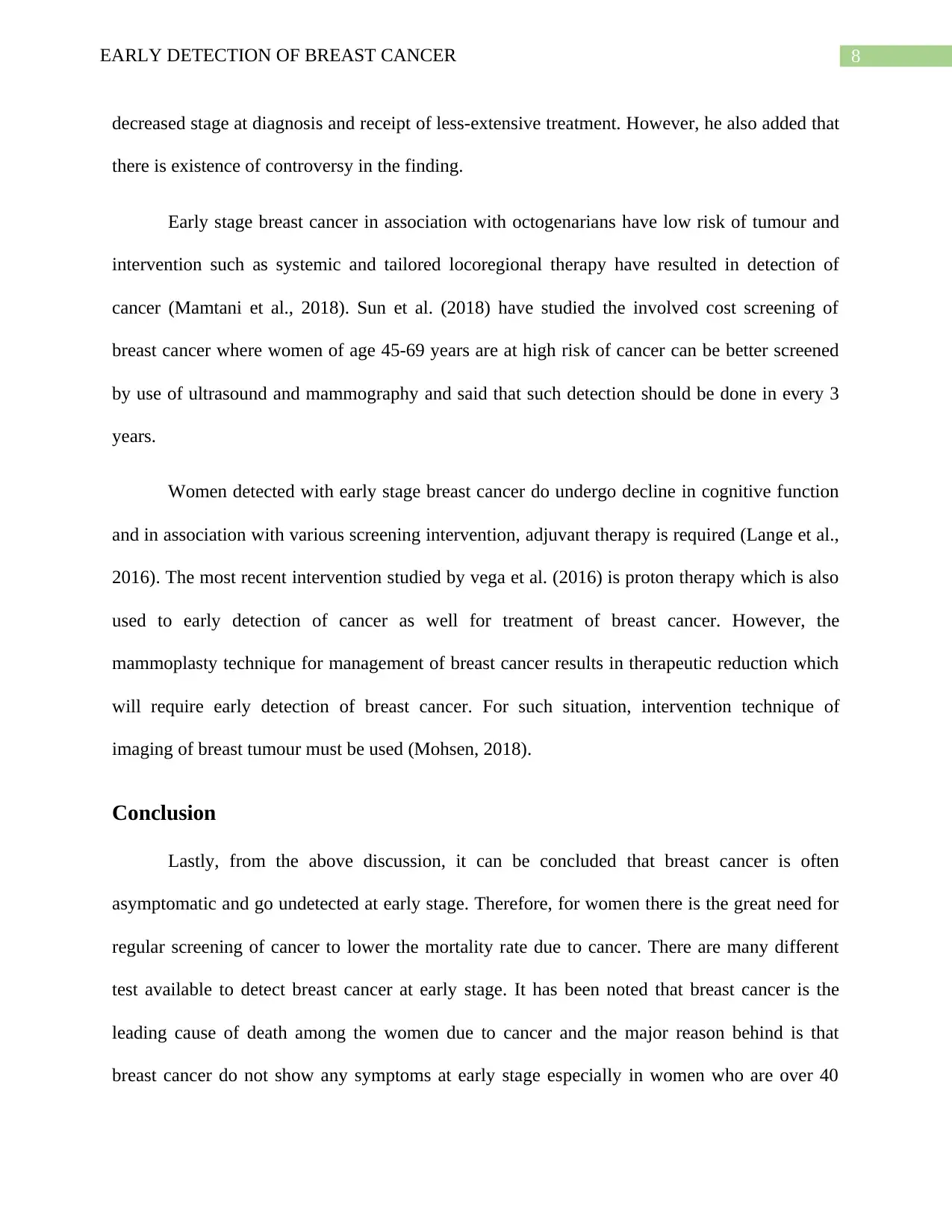
decreased stage at diagnosis and receipt of less-extensive treatment. However, he also added that
there is existence of controversy in the finding.
Early stage breast cancer in association with octogenarians have low risk of tumour and
intervention such as systemic and tailored locoregional therapy have resulted in detection of
cancer (Mamtani et al., 2018). Sun et al. (2018) have studied the involved cost screening of
breast cancer where women of age 45-69 years are at high risk of cancer can be better screened
by use of ultrasound and mammography and said that such detection should be done in every 3
years.
Women detected with early stage breast cancer do undergo decline in cognitive function
and in association with various screening intervention, adjuvant therapy is required (Lange et al.,
2016). The most recent intervention studied by vega et al. (2016) is proton therapy which is also
used to early detection of cancer as well for treatment of breast cancer. However, the
mammoplasty technique for management of breast cancer results in therapeutic reduction which
will require early detection of breast cancer. For such situation, intervention technique of
imaging of breast tumour must be used (Mohsen, 2018).
Conclusion
Lastly, from the above discussion, it can be concluded that breast cancer is often
asymptomatic and go undetected at early stage. Therefore, for women there is the great need for
regular screening of cancer to lower the mortality rate due to cancer. There are many different
test available to detect breast cancer at early stage. It has been noted that breast cancer is the
leading cause of death among the women due to cancer and the major reason behind is that
breast cancer do not show any symptoms at early stage especially in women who are over 40
decreased stage at diagnosis and receipt of less-extensive treatment. However, he also added that
there is existence of controversy in the finding.
Early stage breast cancer in association with octogenarians have low risk of tumour and
intervention such as systemic and tailored locoregional therapy have resulted in detection of
cancer (Mamtani et al., 2018). Sun et al. (2018) have studied the involved cost screening of
breast cancer where women of age 45-69 years are at high risk of cancer can be better screened
by use of ultrasound and mammography and said that such detection should be done in every 3
years.
Women detected with early stage breast cancer do undergo decline in cognitive function
and in association with various screening intervention, adjuvant therapy is required (Lange et al.,
2016). The most recent intervention studied by vega et al. (2016) is proton therapy which is also
used to early detection of cancer as well for treatment of breast cancer. However, the
mammoplasty technique for management of breast cancer results in therapeutic reduction which
will require early detection of breast cancer. For such situation, intervention technique of
imaging of breast tumour must be used (Mohsen, 2018).
Conclusion
Lastly, from the above discussion, it can be concluded that breast cancer is often
asymptomatic and go undetected at early stage. Therefore, for women there is the great need for
regular screening of cancer to lower the mortality rate due to cancer. There are many different
test available to detect breast cancer at early stage. It has been noted that breast cancer is the
leading cause of death among the women due to cancer and the major reason behind is that
breast cancer do not show any symptoms at early stage especially in women who are over 40
⊘ This is a preview!⊘
Do you want full access?
Subscribe today to unlock all pages.
Trusted by 1+ million students worldwide

9EARLY DETECTION OF BREAST CANCER
years. Detection in later stage generally have low survival rate and this has raised the importance
of early screening of breast cancer. Therefore, the study has provided great detail about such
intervention of early detection of cancer.
years. Detection in later stage generally have low survival rate and this has raised the importance
of early screening of breast cancer. Therefore, the study has provided great detail about such
intervention of early detection of cancer.
Paraphrase This Document
Need a fresh take? Get an instant paraphrase of this document with our AI Paraphraser
10EARLY DETECTION OF BREAST CANCER
Reference
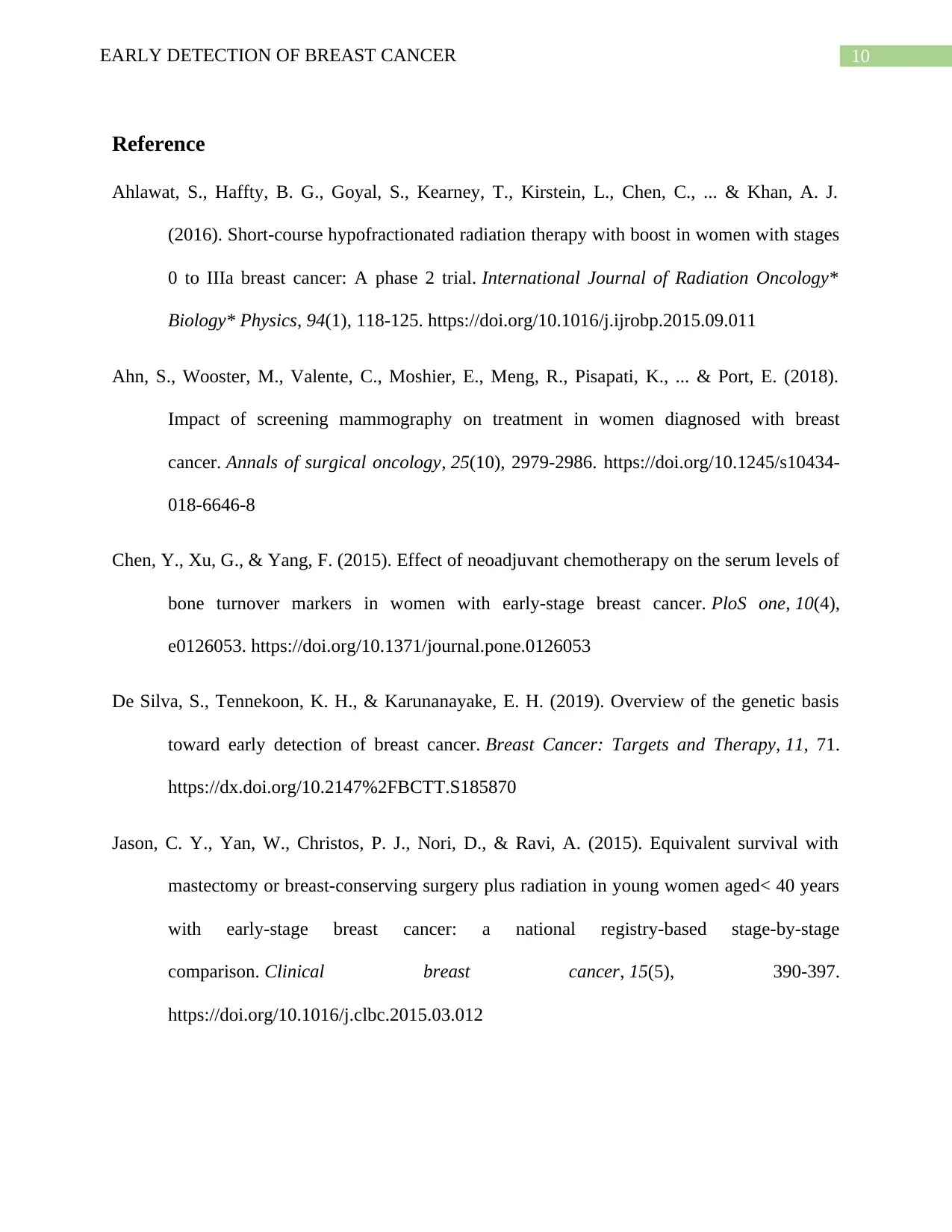
Ahlawat, S., Haffty, B. G., Goyal, S., Kearney, T., Kirstein, L., Chen, C., ... & Khan, A. J.
(2016). Short-course hypofractionated radiation therapy with boost in women with stages
0 to IIIa breast cancer: A phase 2 trial. International Journal of Radiation Oncology*
Biology* Physics, 94(1), 118-125. https://doi.org/10.1016/j.ijrobp.2015.09.011
Ahn, S., Wooster, M., Valente, C., Moshier, E., Meng, R., Pisapati, K., ... & Port, E. (2018).
Impact of screening mammography on treatment in women diagnosed with breast
cancer. Annals of surgical oncology, 25(10), 2979-2986. https://doi.org/10.1245/s10434-
018-6646-8
Chen, Y., Xu, G., & Yang, F. (2015). Effect of neoadjuvant chemotherapy on the serum levels of
bone turnover markers in women with early-stage breast cancer. PloS one, 10(4),
e0126053. https://doi.org/10.1371/journal.pone.0126053
De Silva, S., Tennekoon, K. H., & Karunanayake, E. H. (2019). Overview of the genetic basis
toward early detection of breast cancer. Breast Cancer: Targets and Therapy, 11, 71.
https://dx.doi.org/10.2147%2FBCTT.S185870
Jason, C. Y., Yan, W., Christos, P. J., Nori, D., & Ravi, A. (2015). Equivalent survival with
mastectomy or breast-conserving surgery plus radiation in young women aged< 40 years
with early-stage breast cancer: a national registry-based stage-by-stage
comparison. Clinical breast cancer, 15(5), 390-397.
https://doi.org/10.1016/j.clbc.2015.03.012
Reference
Ahlawat, S., Haffty, B. G., Goyal, S., Kearney, T., Kirstein, L., Chen, C., ... & Khan, A. J.
(2016). Short-course hypofractionated radiation therapy with boost in women with stages
0 to IIIa breast cancer: A phase 2 trial. International Journal of Radiation Oncology*
Biology* Physics, 94(1), 118-125. https://doi.org/10.1016/j.ijrobp.2015.09.011
Ahn, S., Wooster, M., Valente, C., Moshier, E., Meng, R., Pisapati, K., ... & Port, E. (2018).
Impact of screening mammography on treatment in women diagnosed with breast
cancer. Annals of surgical oncology, 25(10), 2979-2986. https://doi.org/10.1245/s10434-
018-6646-8
Chen, Y., Xu, G., & Yang, F. (2015). Effect of neoadjuvant chemotherapy on the serum levels of
bone turnover markers in women with early-stage breast cancer. PloS one, 10(4),
e0126053. https://doi.org/10.1371/journal.pone.0126053
De Silva, S., Tennekoon, K. H., & Karunanayake, E. H. (2019). Overview of the genetic basis
toward early detection of breast cancer. Breast Cancer: Targets and Therapy, 11, 71.
https://dx.doi.org/10.2147%2FBCTT.S185870
Jason, C. Y., Yan, W., Christos, P. J., Nori, D., & Ravi, A. (2015). Equivalent survival with
mastectomy or breast-conserving surgery plus radiation in young women aged< 40 years
with early-stage breast cancer: a national registry-based stage-by-stage
comparison. Clinical breast cancer, 15(5), 390-397.
https://doi.org/10.1016/j.clbc.2015.03.012
11EARLY DETECTION OF BREAST CANCER
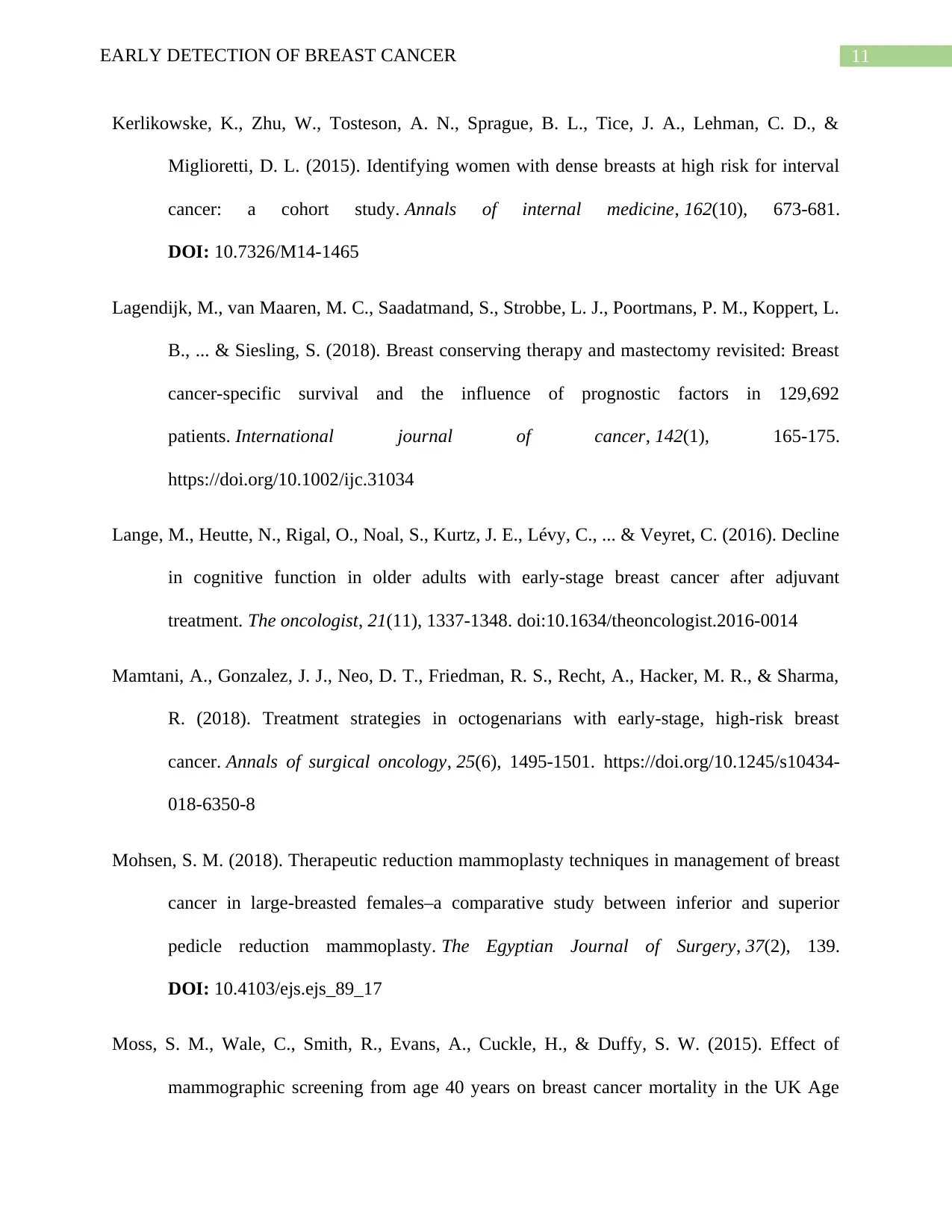
Kerlikowske, K., Zhu, W., Tosteson, A. N., Sprague, B. L., Tice, J. A., Lehman, C. D., &
Miglioretti, D. L. (2015). Identifying women with dense breasts at high risk for interval
cancer: a cohort study. Annals of internal medicine, 162(10), 673-681.
DOI: 10.7326/M14-1465
Lagendijk, M., van Maaren, M. C., Saadatmand, S., Strobbe, L. J., Poortmans, P. M., Koppert, L.
B., ... & Siesling, S. (2018). Breast conserving therapy and mastectomy revisited: Breast
cancer‐specific survival and the influence of prognostic factors in 129,692
patients. International journal of cancer, 142(1), 165-175.
https://doi.org/10.1002/ijc.31034
Lange, M., Heutte, N., Rigal, O., Noal, S., Kurtz, J. E., Lévy, C., ... & Veyret, C. (2016). Decline
in cognitive function in older adults with early-stage breast cancer after adjuvant
treatment. The oncologist, 21(11), 1337-1348. doi:10.1634/theoncologist.2016-0014
Mamtani, A., Gonzalez, J. J., Neo, D. T., Friedman, R. S., Recht, A., Hacker, M. R., & Sharma,
R. (2018). Treatment strategies in octogenarians with early-stage, high-risk breast
cancer. Annals of surgical oncology, 25(6), 1495-1501. https://doi.org/10.1245/s10434-
018-6350-8
Mohsen, S. M. (2018). Therapeutic reduction mammoplasty techniques in management of breast
cancer in large-breasted females–a comparative study between inferior and superior
pedicle reduction mammoplasty. The Egyptian Journal of Surgery, 37(2), 139.
DOI: 10.4103/ejs.ejs_89_17
Moss, S. M., Wale, C., Smith, R., Evans, A., Cuckle, H., & Duffy, S. W. (2015). Effect of
mammographic screening from age 40 years on breast cancer mortality in the UK Age
Kerlikowske, K., Zhu, W., Tosteson, A. N., Sprague, B. L., Tice, J. A., Lehman, C. D., &
Miglioretti, D. L. (2015). Identifying women with dense breasts at high risk for interval
cancer: a cohort study. Annals of internal medicine, 162(10), 673-681.
DOI: 10.7326/M14-1465
Lagendijk, M., van Maaren, M. C., Saadatmand, S., Strobbe, L. J., Poortmans, P. M., Koppert, L.
B., ... & Siesling, S. (2018). Breast conserving therapy and mastectomy revisited: Breast
cancer‐specific survival and the influence of prognostic factors in 129,692
patients. International journal of cancer, 142(1), 165-175.
https://doi.org/10.1002/ijc.31034
Lange, M., Heutte, N., Rigal, O., Noal, S., Kurtz, J. E., Lévy, C., ... & Veyret, C. (2016). Decline
in cognitive function in older adults with early-stage breast cancer after adjuvant
treatment. The oncologist, 21(11), 1337-1348. doi:10.1634/theoncologist.2016-0014
Mamtani, A., Gonzalez, J. J., Neo, D. T., Friedman, R. S., Recht, A., Hacker, M. R., & Sharma,
R. (2018). Treatment strategies in octogenarians with early-stage, high-risk breast
cancer. Annals of surgical oncology, 25(6), 1495-1501. https://doi.org/10.1245/s10434-
018-6350-8
Mohsen, S. M. (2018). Therapeutic reduction mammoplasty techniques in management of breast
cancer in large-breasted females–a comparative study between inferior and superior
pedicle reduction mammoplasty. The Egyptian Journal of Surgery, 37(2), 139.
DOI: 10.4103/ejs.ejs_89_17
Moss, S. M., Wale, C., Smith, R., Evans, A., Cuckle, H., & Duffy, S. W. (2015). Effect of
mammographic screening from age 40 years on breast cancer mortality in the UK Age
⊘ This is a preview!⊘
Do you want full access?
Subscribe today to unlock all pages.
Trusted by 1+ million students worldwide

1 out of 24


Related Documents


Your All-in-One AI-Powered Toolkit for Academic Success.
+13062052269
info@desklib.com
Available 24*7 on WhatsApp / Email
![[object Object]](/_next/static/media/star-bottom.7253800d.svg)
Unlock your academic potential
Copyright © 2020–2026 A2Z Services. All Rights Reserved. Developed and managed by ZUCOL.