Designing a Play Space for Early Childhood Education (3-5 years)

Verified

Added on  2022/12/26

|7
|2074
|25
Project
AI Summary
This project presents a comprehensive plan for an outdoor play space designed for children aged 3 to 5 years in an early childhood education setting. The plan emphasizes "learning through play" and incorporates a block centre utilizing natural resources like clay and wood to foster creativity, problem-solving, and fine motor skills. The project details the play space setup, including the use of natural materials for block construction and decorative elements. It addresses safety concerns, such as sun protection and hygiene, and outlines strategies for educator involvement, including scaffolding and promoting children's agency and independence. The plan aligns with the Early Years Learning Framework (EYLF) of Australia, highlighting how the play space supports various learning outcomes, including problem-solving, communication, and exploration. Furthermore, the project connects the play space to the National Quality Standards, emphasizing staffing arrangements and the importance of educator-child ratios and ethical practices. The conclusion stresses the significance of early childhood education and the practical implementation of the plan, referencing relevant research and literature to support the strategies and outcomes.
Document Page
Introduction
The importance of early learning is one of the main targets of Sustainable
Development Goal which ensures that by the year 2030, all children have access to quality
early childhood development, pre-primary education that will lead to primary education. Pre-
primary education is an essential tool to improve learning, education outcomes as well as the
efficiencies of the education system. However, incorporating pre-primary education planning
in the formal education is quite challenging. The main key element is the strategy of
“learning through play” which is required in the early childhood education planning. The
main goal of this paper is to share some practical ideas of child-centred pedagogy that will
expand the efforts of pre-primary education, in order to ensure the quality of these programs.
It will consider a specific age group and the strategies to provide education through learning
to this age group. Also, the strategies to involve children in this educational planning along
with their safety concern will be clearly described in this paper.
Description of the plan
The plan is made for the children from 3 to 5 years and the outdoor activities have
been selected to support their interests and abilities. An outdoor game planning strategy will
be developed in this paper as it has numerous benefits for the children of this age group.
Playing actively outdoor can be helpful in increasing the flexibility and the fine motor skills
of children which is associated with the development of wide variety of physical skills. In
many literatures, the authors indicated that physical activity can address many growing health
issues among the children (Black et al., 2017). Also, an outdoor plays enables learning from
environment. Researches also indicated that for the pre-schoolers, constructive outdoor play
is not only effective but also attractive. Probably, just because the children can control the
game, the outdoor games are one of the favourite games to all the kinder children. Needless
tabler-icon-diamond-filled.svg

Paraphrase This Document

Need a fresh take? Get an instant paraphrase of this document with our AI Paraphraser
Document Page
to say that different theory of early childhood development clearly specifies outdoor play as
an essential component of academic learning. Considering all the benefits of outdoor play, it
has been chosen in this game planning program for the pre-school children (Burchinal, 2018).
The Play Space
A block centre will be created as a play space in a corner of the garden area and in
order to set up the play space, some natural resources will be used. As it will be a bloc centre,
the main focus will be to include some blocks and decorative objects to make it more
attractive. In this regard, clay and pieces of woods will be used to build blocks.
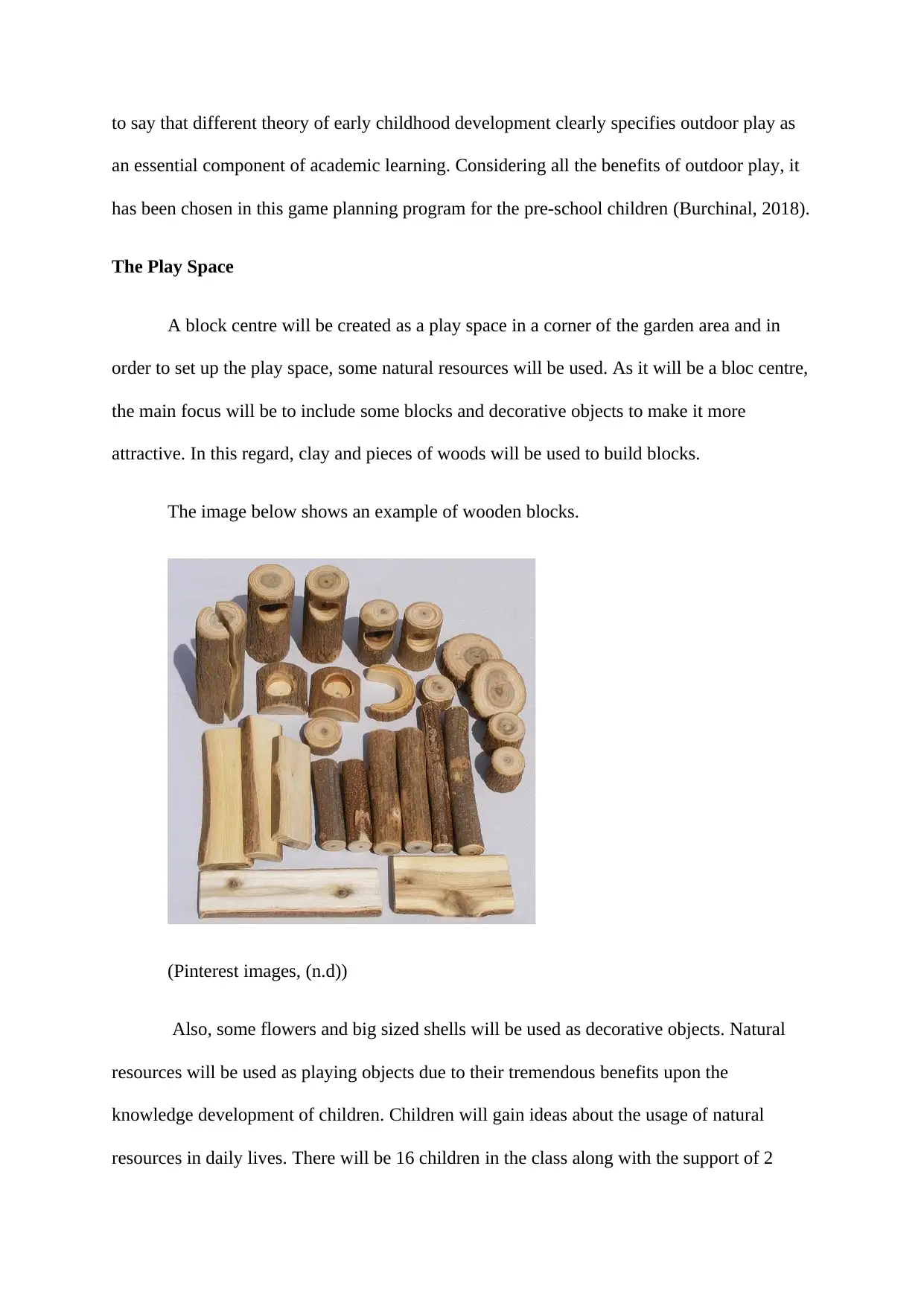
The image below shows an example of wooden blocks.
(Pinterest images, (n.d))
Also, some flowers and big sized shells will be used as decorative objects. Natural
resources will be used as playing objects due to their tremendous benefits upon the
knowledge development of children. Children will gain ideas about the usage of natural
resources in daily lives. There will be 16 children in the class along with the support of 2
Document Page
educators. This experience will enrich the learning of children in many ways. While building
and positioning the blocks their creative skills will be developed (Milner et al., 2019). Also,
with this experiment, their problem solving as well as engineering skill will also be
developed. While placing the objects properly their fine motor skills will be improved. The
experience will also enrich knowledge of working with children and provide opportunities to
improve the functions more. However, safety of the children is the most important factor and
in this purpose preventive measures will be taken. While playing outside, children may
become sunburnt and moderate sunscreen suitable for this age group should be applied to
their skin (Duarte, Picoto, da Costa Pereira & Correia, 2018). Also, they can swallow small
shells and therefore choosing the playing materials is an essential task. Gloves and hand
washes will be used to protect the hygiene procedure (Boggs et al., 2019). They might have
cuts and injuries while playing and use of antiseptic is necessary. The educators will be
assisting the children to play safety in the block centre outside. Educators will thoroughly
check if all the children are actively participating and they will encourage the children who
are not participating by motivating, praising their efforts, having discussion, and introducing
new strategies to play with the materials. Many importance of uninterrupted playing is there.
It can foster creativity and imagination, increase observing power, concentration, exploring
new problem solving techniques (Erwin, 2017). This play space promotes children’s agency
and independence. It also enables them to make choices and decisions. Scaffold learning
refers to the variety of educational techniques that can be applied while teaching children. For
example, if a child is feeling shy then the educator will crouch down to make an eye contact.
The theorist Jerome Bruner first introduced this technique in the teaching methods. The
educators will encourage the children to create their own play spaces to enhance their
learning (Davis, Torr & Degotardi, 2015). The image below shows an example of wooden
blocks.
Document Page
Link to the EYLF
Early Years Learning Framework (EYLF) of Australia specifies different learning
outcomes for the children. Blocks and moreover, natural resources are budget friendly. The
block plays are effective in developing various skills and it links to the EYLF outcomes. An
outdoor play allows kids to explore their environment and also to develop muscle strength,
coordination as well as self-confidence (Cranley, Johnson, Robinson & O’Connor, 2018).
Apart from these, outdoor play encourages some constructive plays that can enhance the
brain development of the children. They can develop problem solving skills and also
experimentation skills which refer to the EYLF outcome 4.2. While playing, children will
interact with the educators and other children that will enhance their communication power
and it relates to the EYLF outcome 5.1 and 5.4. Children will try to investigate and explore
new things that make them more confident. Also, children can get the idea of basic and
fundamental information while playing outdoor games (Grieshaber & Graham, 2017).
Implementation of the standards in practice as an early childhood educator
According to National quality guide that supports children’s agency, there are quality
standards for children’s education. The Quality Area 4 is essential in this regard that supports
staffing arrangements. According to the standard 4.1 of this quality area, there should be
proper staffing. This standard mainly focuses on the staffing arrangements that can enhance
the learning and development of the children which ensures their safety as well as wellbeing.
The element 4.1.1 demonstrates the importance of educator to child ratio that should be
maintained all through while educating children (Melhuish et al., 2016). Again, standard 4.2
of quality area 4 also describes that the educators and all other staffing members should be
respectful as well as ethical while working with children. In order to prevent any conflict as
tabler-icon-diamond-filled.svg

Paraphrase This Document

Need a fresh take? Get an instant paraphrase of this document with our AI Paraphraser
Document Page
well as misunderstanding, educators must build constructive relationships. Also, the element
4.2.1 sets professional standards, guides and relationships for the educators to follow. It helps
them in learning and maintaining the standards in their practice (Ramani & Eason, 2015). The
elements demonstrate the code of conducts that should be incorporated in everyday practice
of care. The standards and elements are helpful to promote children’s agency. Implementing
adequate staffing can be effective in this regard. In the workplace, as an early childhood
educator, I will also implement these standards in my working practice in order to promote
agency of children as these are quite effective to ensure the parents about the safety of
wellbeing of the children and at the same time, it also builds their trust upon the practice of
the agency. The quality area, standards and elements will be essential factors to improve the
learning experiences of the children as well. I will work maintaining the professional and
ethical standards as an early childhood educator in future.
Conclusion
Early childhood education is important for the overall growth of children and this plan
clearly discusses how children from 3 to 5 ages can learn through playing. Also, the EYLF
standards and elements have been linked with the plan and future implementation has also
been discussed.
Document Page
References
Black, M. M., Walker, S. P., Fernald, L. C., Andersen, C. T., DiGirolamo, A. M., Lu, C., ... &
Devercelli, A. E. (2017). Early childhood development coming of age: science
through the life course. The Lancet, 389(10064), 77-90.
Boggs, D., Milner, K. M., Chandna, J., Black, M., Cavallera, V., Dua, T., ... & Hughes, R.
(2019). Rating early child development outcome measurement tools for routine health
programme use. Archives of disease in childhood, 104(Suppl 1), S22-S33.
Burchinal, M. (2018). Measuring early care and education quality. Child Development
Perspectives, 12(1), 3-9.
Cranley, L., Johnson, G., Robinson, C., & O’Connor, D. (2018). Belonging, being and
becoming active citizens. Asia Pacific Journal of Advanced Business and Social
Studies, 4(1).
Davis, B., Torr, J., & Degotardi, S. (2015). Infants and toddlers: how visible are they in the
Early Years Learning Framework?. International Journal of Child Care and
Education Policy, 9(1), 12.
Duarte, A. F., Picoto, A., da Costa Pereira, A., & Correia, O. (2018). Sun protection in
children: a behavioural study. European Journal of Dermatology, 28(3), 338-342.
Erwin, E. J. (2017). Transparency in Early Childhood Education: What the West Can Learn
from Australia’s Focus on Well-Being. Global Education Review, 4(3).
Grieshaber, S., & Graham, L. J. (2017). Equity and educators enacting the Australian early
years learning framework. Critical Studies in Education, 58(1), 89-103.
Document Page
Melhuish, E., Howard, S. J., Siraj, I., Neilsen-Hewett, C., Kingston, D., de Rosnay, M., ... &
Luu, B. (2016). Fostering Effective Early Learning (FEEL) through a professional
development programme for early childhood educators to improve professional
practice and child outcomes in the year before formal schooling: study protocol for a
cluster randomised controlled trial. Trials, 17(1), 602.
Milner, K. M., Bhopal, S., Black, M., Dua, T., Gladstone, M., Hamadani, J., ... & Radner, J.
(2019). Counting outcomes, coverage and quality for early child development
programmes. Archives of disease in childhood, 104(Suppl 1), S13-S21.
Ramani, G. B., & Eason, S. H. (2015). It all adds up: Learning early math through play and
games. Phi Delta Kappan, 96(8), 27-32.
chevron_up_icon
1 out of 7
circle_padding
hide_on_mobile
zoom_out_icon
[object Object]