Exploring Perspectives on Early Childhood Emotional Development

Verified

Added on  2022/10/12

|7
|1667
|19
Essay
AI Summary
This essay provides an in-depth exploration of emotional development in early childhood, examining various perspectives that shape our understanding of how children experience and regulate emotions. The essay begins with an introduction to emotional development, defining it as the psychological and integrative characteristics of growth in infancy and childhood. It then delves into three primary perspectives: the functionalist approach, which emphasizes the adaptive function of emotions in relation to the environment; the dynamic perspective, which views emotions as integrated responses within complex systems; and the systems approach, which focuses on how emotions emerge from interacting elements like motivations and cognitive appraisals. The essay discusses how each perspective contributes to a deeper understanding of emotional development, including the role of emotions in self-awareness, social behavior, and cognitive development. The author reflects on how the functionalist perspective enhanced their understanding of emotional development in children, particularly the role of emotions in self-awareness and the influence of social and physical environments. The essay concludes by summarizing the key points and emphasizing the significance of understanding emotional development for children's overall well-being and social interactions. The essay references key literature and theorists in the field, providing a well-rounded overview of the subject. Students can find similar assignments and study materials on Desklib.
Document Page
Running head: EARLY CHILDHOOD AND DEVELOPMENT 1
Early Childhood and Development
Name
Institution
tabler-icon-diamond-filled.svg

Paraphrase This Document

Need a fresh take? Get an instant paraphrase of this document with our AI Paraphraser
Document Page
EARLY CHILDHOOD AND DEVELOPMENT 2
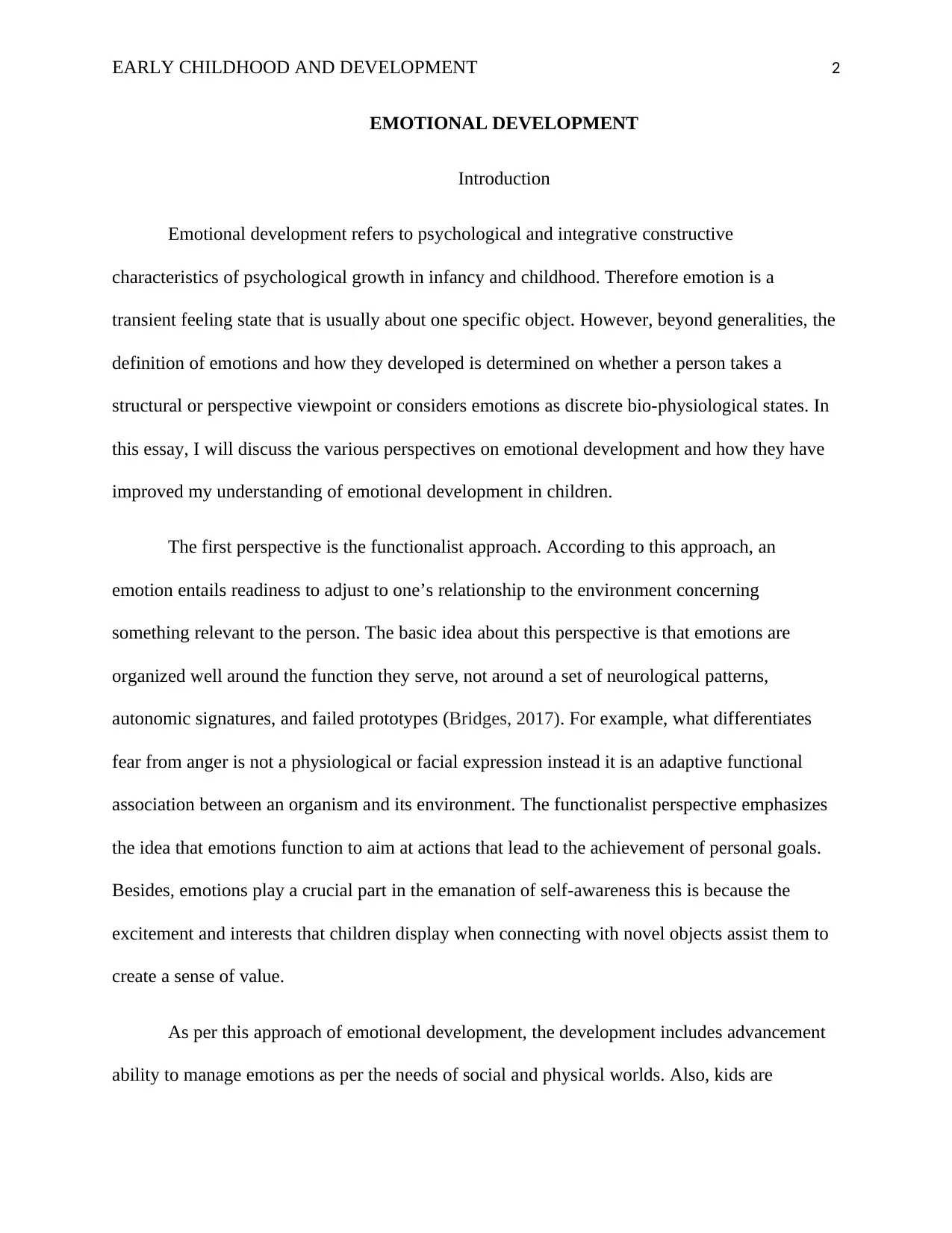
EMOTIONAL DEVELOPMENT
Introduction
Emotional development refers to psychological and integrative constructive
characteristics of psychological growth in infancy and childhood. Therefore emotion is a
transient feeling state that is usually about one specific object. However, beyond generalities, the
definition of emotions and how they developed is determined on whether a person takes a
structural or perspective viewpoint or considers emotions as discrete bio-physiological states. In
this essay, I will discuss the various perspectives on emotional development and how they have
improved my understanding of emotional development in children.
The first perspective is the functionalist approach. According to this approach, an
emotion entails readiness to adjust to one’s relationship to the environment concerning
something relevant to the person. The basic idea about this perspective is that emotions are
organized well around the function they serve, not around a set of neurological patterns,
autonomic signatures, and failed prototypes (Bridges, 2017). For example, what differentiates
fear from anger is not a physiological or facial expression instead it is an adaptive functional
association between an organism and its environment. The functionalist perspective emphasizes
the idea that emotions function to aim at actions that lead to the achievement of personal goals.
Besides, emotions play a crucial part in the emanation of self-awareness this is because the
excitement and interests that children display when connecting with novel objects assist them to
create a sense of value.
As per this approach of emotional development, the development includes advancement
ability to manage emotions as per the needs of social and physical worlds. Also, kids are
Document Page
EARLY CHILDHOOD AND DEVELOPMENT 3
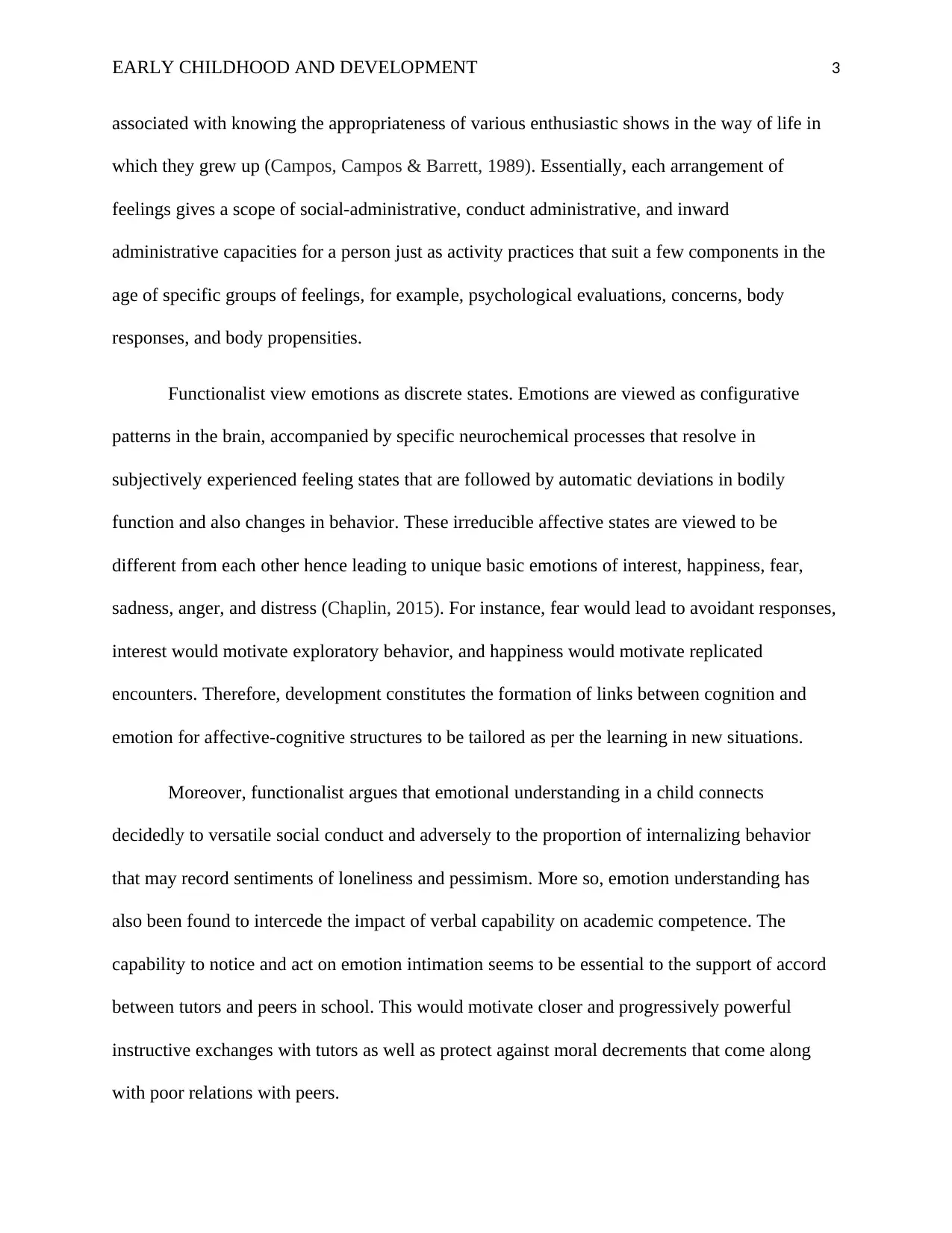
associated with knowing the appropriateness of various enthusiastic shows in the way of life in
which they grew up (Campos, Campos & Barrett, 1989). Essentially, each arrangement of
feelings gives a scope of social-administrative, conduct administrative, and inward
administrative capacities for a person just as activity practices that suit a few components in the
age of specific groups of feelings, for example, psychological evaluations, concerns, body
responses, and body propensities.
Functionalist view emotions as discrete states. Emotions are viewed as configurative
patterns in the brain, accompanied by specific neurochemical processes that resolve in
subjectively experienced feeling states that are followed by automatic deviations in bodily
function and also changes in behavior. These irreducible affective states are viewed to be
different from each other hence leading to unique basic emotions of interest, happiness, fear,
sadness, anger, and distress (Chaplin, 2015). For instance, fear would lead to avoidant responses,
interest would motivate exploratory behavior, and happiness would motivate replicated
encounters. Therefore, development constitutes the formation of links between cognition and
emotion for affective-cognitive structures to be tailored as per the learning in new situations.
Moreover, functionalist argues that emotional understanding in a child connects
decidedly to versatile social conduct and adversely to the proportion of internalizing behavior
that may record sentiments of loneliness and pessimism. More so, emotion understanding has
also been found to intercede the impact of verbal capability on academic competence. The
capability to notice and act on emotion intimation seems to be essential to the support of accord
between tutors and peers in school. This would motivate closer and progressively powerful
instructive exchanges with tutors as well as protect against moral decrements that come along
with poor relations with peers.
Document Page
EARLY CHILDHOOD AND DEVELOPMENT 4
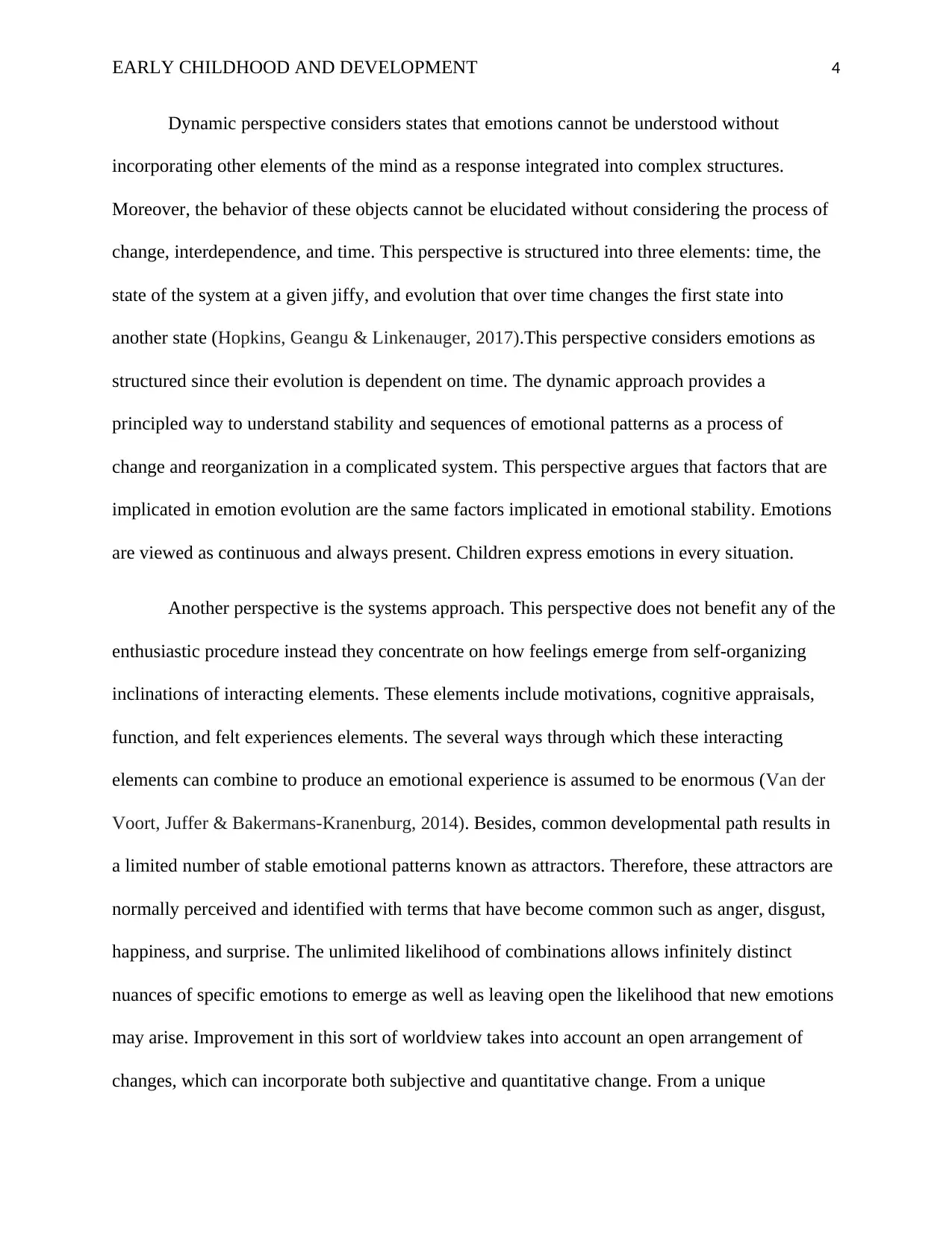
Dynamic perspective considers states that emotions cannot be understood without
incorporating other elements of the mind as a response integrated into complex structures.
Moreover, the behavior of these objects cannot be elucidated without considering the process of
change, interdependence, and time. This perspective is structured into three elements: time, the
state of the system at a given jiffy, and evolution that over time changes the first state into
another state (Hopkins, Geangu & Linkenauger, 2017).This perspective considers emotions as
structured since their evolution is dependent on time. The dynamic approach provides a
principled way to understand stability and sequences of emotional patterns as a process of
change and reorganization in a complicated system. This perspective argues that factors that are
implicated in emotion evolution are the same factors implicated in emotional stability. Emotions
are viewed as continuous and always present. Children express emotions in every situation.
Another perspective is the systems approach. This perspective does not benefit any of the
enthusiastic procedure instead they concentrate on how feelings emerge from self-organizing
inclinations of interacting elements. These elements include motivations, cognitive appraisals,
function, and felt experiences elements. The several ways through which these interacting
elements can combine to produce an emotional experience is assumed to be enormous (Van der
Voort, Juffer & Bakermans-Kranenburg, 2014). Besides, common developmental path results in
a limited number of stable emotional patterns known as attractors. Therefore, these attractors are
normally perceived and identified with terms that have become common such as anger, disgust,
happiness, and surprise. The unlimited likelihood of combinations allows infinitely distinct
nuances of specific emotions to emerge as well as leaving open the likelihood that new emotions
may arise. Improvement in this sort of worldview takes into account an open arrangement of
changes, which can incorporate both subjective and quantitative change. From a unique
tabler-icon-diamond-filled.svg

Paraphrase This Document

Need a fresh take? Get an instant paraphrase of this document with our AI Paraphraser
Document Page
EARLY CHILDHOOD AND DEVELOPMENT 5
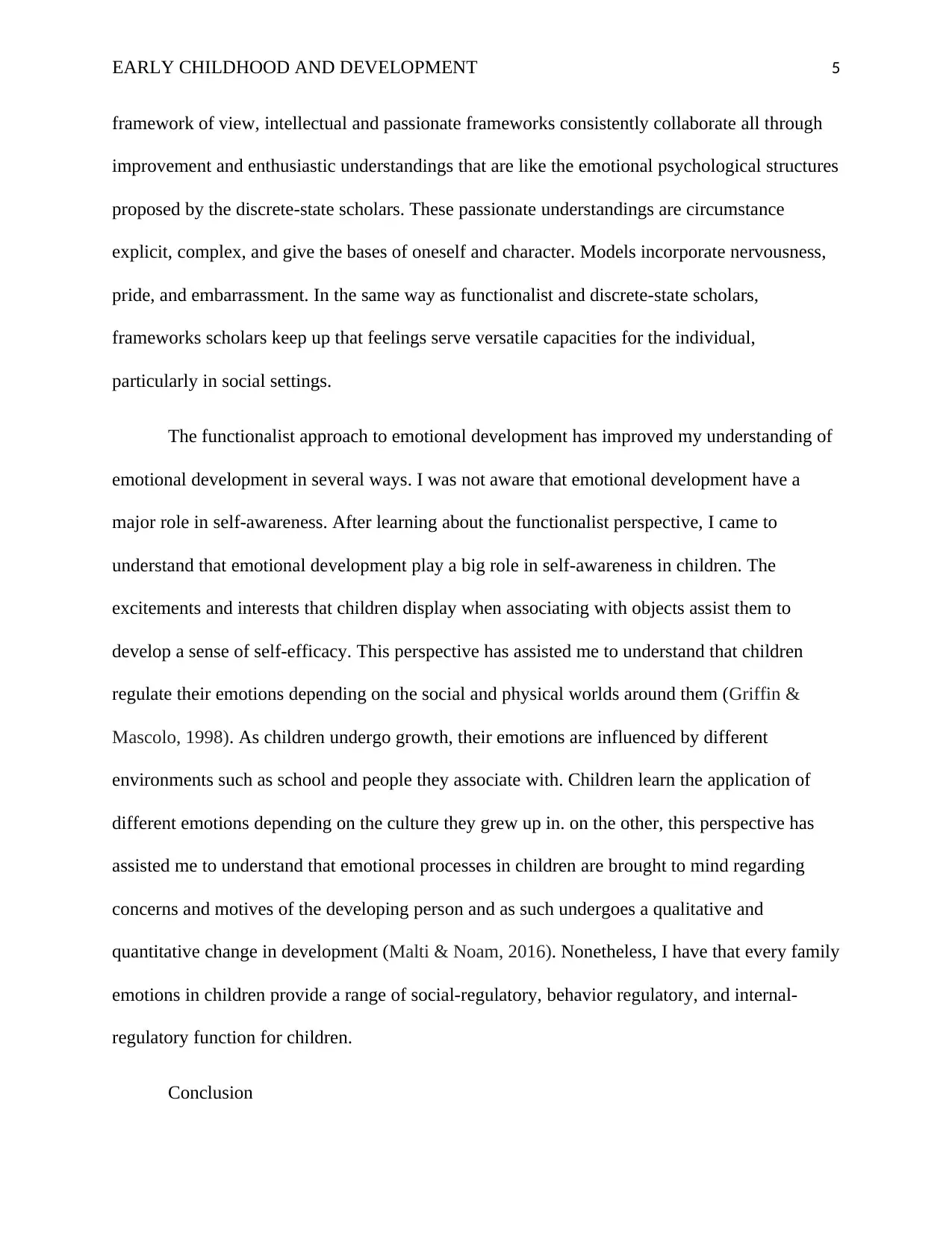
framework of view, intellectual and passionate frameworks consistently collaborate all through
improvement and enthusiastic understandings that are like the emotional psychological structures
proposed by the discrete-state scholars. These passionate understandings are circumstance
explicit, complex, and give the bases of oneself and character. Models incorporate nervousness,
pride, and embarrassment. In the same way as functionalist and discrete-state scholars,
frameworks scholars keep up that feelings serve versatile capacities for the individual,
particularly in social settings.
The functionalist approach to emotional development has improved my understanding of
emotional development in several ways. I was not aware that emotional development have a
major role in self-awareness. After learning about the functionalist perspective, I came to
understand that emotional development play a big role in self-awareness in children. The
excitements and interests that children display when associating with objects assist them to
develop a sense of self-efficacy. This perspective has assisted me to understand that children
regulate their emotions depending on the social and physical worlds around them (Griffin &
Mascolo, 1998). As children undergo growth, their emotions are influenced by different
environments such as school and people they associate with. Children learn the application of
different emotions depending on the culture they grew up in. on the other, this perspective has
assisted me to understand that emotional processes in children are brought to mind regarding
concerns and motives of the developing person and as such undergoes a qualitative and
quantitative change in development (Malti & Noam, 2016). Nonetheless, I have that every family
emotions in children provide a range of social-regulatory, behavior regulatory, and internal-
regulatory function for children.
Conclusion
Document Page
EARLY CHILDHOOD AND DEVELOPMENT 6
Emotional development is the emergence of understanding, expression, and managing of
emotions. Emotion development is an expression of transition from complete dependence to
autonomy, there have been different views from theorists and researchers on emotional
development. One of the views as per the functionalist approach is that emotions are organized
well around the function they serve, not around a set of neurological patterns, autonomic
signatures, and fail prototypes. Functionalists also argue that emotional understanding in a child
connects decidedly to versatile social conduct and adversely to the proportion of internalizing
behavior that may record sentiments of anxiety, loneliness, and depression. Another perspective
is the systems approach. This perspective does not benefit any of the enthusiastic procedure
instead they concentrate on how feelings emerge from self-organizing inclinations of interacting
elements. These elements include motivations, cognitive appraisals, function, and felt
experiences elements.
Document Page
EARLY CHILDHOOD AND DEVELOPMENT 7
References
Bridges, K. M. B. (2017). The social and emotional development of the pre-school child.
Routledge.
Campos, J. J., Campos, R. G., & Barrett, K. C. (1989). Emergent themes in the study of
emotional development and emotion regulation. Developmental psychology, 25(3), 394.
Chaplin, T. M. (2015). Gender and emotion expression: A developmental contextual
perspective. Emotion Review, 7(1), 14-21.
Griffin, S., & Mascolo, M. F. (1998). On the nature, development, and functions of emotions.
In what develops in emotional development? (pp. 3-27). Springer, Boston, MA.
Hopkins, B., Geangu, E., & Linkenauger, S. (Eds.). (2017). The Cambridge encyclopedia of
child development. Cambridge University Press.
Malti, T., & Noam, G. G. (2016). Social-emotional development: From theory to
practice. European Journal of Developmental Psychology, 13(6), 652-665.
Van der Voort, A., Juffer, F., & J. Bakermans-Kranenburg, M. (2014). Sensitive parenting is the
foundation for secure attachment relationships and positive social-emotional development
of children. Journal of Children's Services, 9(2), 165-176.
chevron_up_icon
1 out of 7
circle_padding
hide_on_mobile
zoom_out_icon
[object Object]