Emotional Intelligence in Early Childhood: A Reflective Plan

Verified

Added on  2023/04/20

|4
|833
|56
Report
AI Summary
This report presents an emotional intelligence plan designed for early childhood professionals working with infants and toddlers. It highlights key aspects of emotional intelligence, including stimulation, fellowship, and mindfulness, and emphasizes their importance in fostering a child's cognitive and emotional development. The plan addresses EQ gaps and proposes strategies for improvement, such as patient communication and fostering independence. It underscores the significance of family support and a balanced lifestyle for children. The report references interdisciplinary research on emotional competence and the importance of relationships in infant-toddler curriculum. This document is available on Desklib, a platform offering a variety of study resources.

Document Page
Psychology
tabler-icon-diamond-filled.svg

Paraphrase This Document

Need a fresh take? Get an instant paraphrase of this document with our AI Paraphraser
Document Page
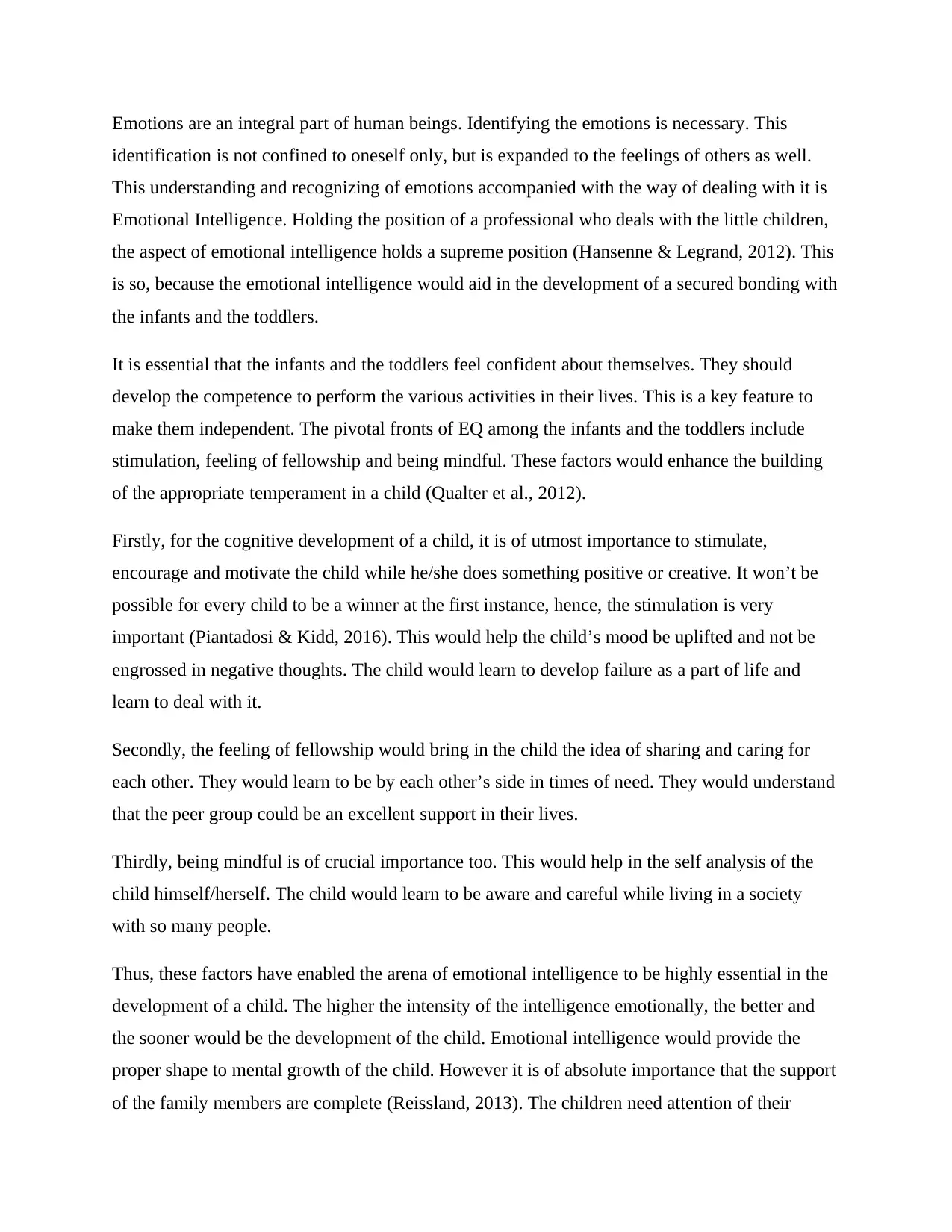
Emotions are an integral part of human beings. Identifying the emotions is necessary. This
identification is not confined to oneself only, but is expanded to the feelings of others as well.
This understanding and recognizing of emotions accompanied with the way of dealing with it is
Emotional Intelligence. Holding the position of a professional who deals with the little children,
the aspect of emotional intelligence holds a supreme position (Hansenne & Legrand, 2012). This
is so, because the emotional intelligence would aid in the development of a secured bonding with
the infants and the toddlers.
It is essential that the infants and the toddlers feel confident about themselves. They should
develop the competence to perform the various activities in their lives. This is a key feature to
make them independent. The pivotal fronts of EQ among the infants and the toddlers include
stimulation, feeling of fellowship and being mindful. These factors would enhance the building
of the appropriate temperament in a child (Qualter et al., 2012).
Firstly, for the cognitive development of a child, it is of utmost importance to stimulate,
encourage and motivate the child while he/she does something positive or creative. It won’t be
possible for every child to be a winner at the first instance, hence, the stimulation is very
important (Piantadosi & Kidd, 2016). This would help the child’s mood be uplifted and not be
engrossed in negative thoughts. The child would learn to develop failure as a part of life and
learn to deal with it.
Secondly, the feeling of fellowship would bring in the child the idea of sharing and caring for
each other. They would learn to be by each other’s side in times of need. They would understand
that the peer group could be an excellent support in their lives.
Thirdly, being mindful is of crucial importance too. This would help in the self analysis of the
child himself/herself. The child would learn to be aware and careful while living in a society
with so many people.
Thus, these factors have enabled the arena of emotional intelligence to be highly essential in the
development of a child. The higher the intensity of the intelligence emotionally, the better and
the sooner would be the development of the child. Emotional intelligence would provide the
proper shape to mental growth of the child. However it is of absolute importance that the support
of the family members are complete (Reissland, 2013). The children need attention of their
Document Page
parents and it should be provided in abundance. They should be given free space to express
themselves. Their lifestyle should be a disciplined one but not very stringent. There must be
room for creativity, daily tasks, education and play.
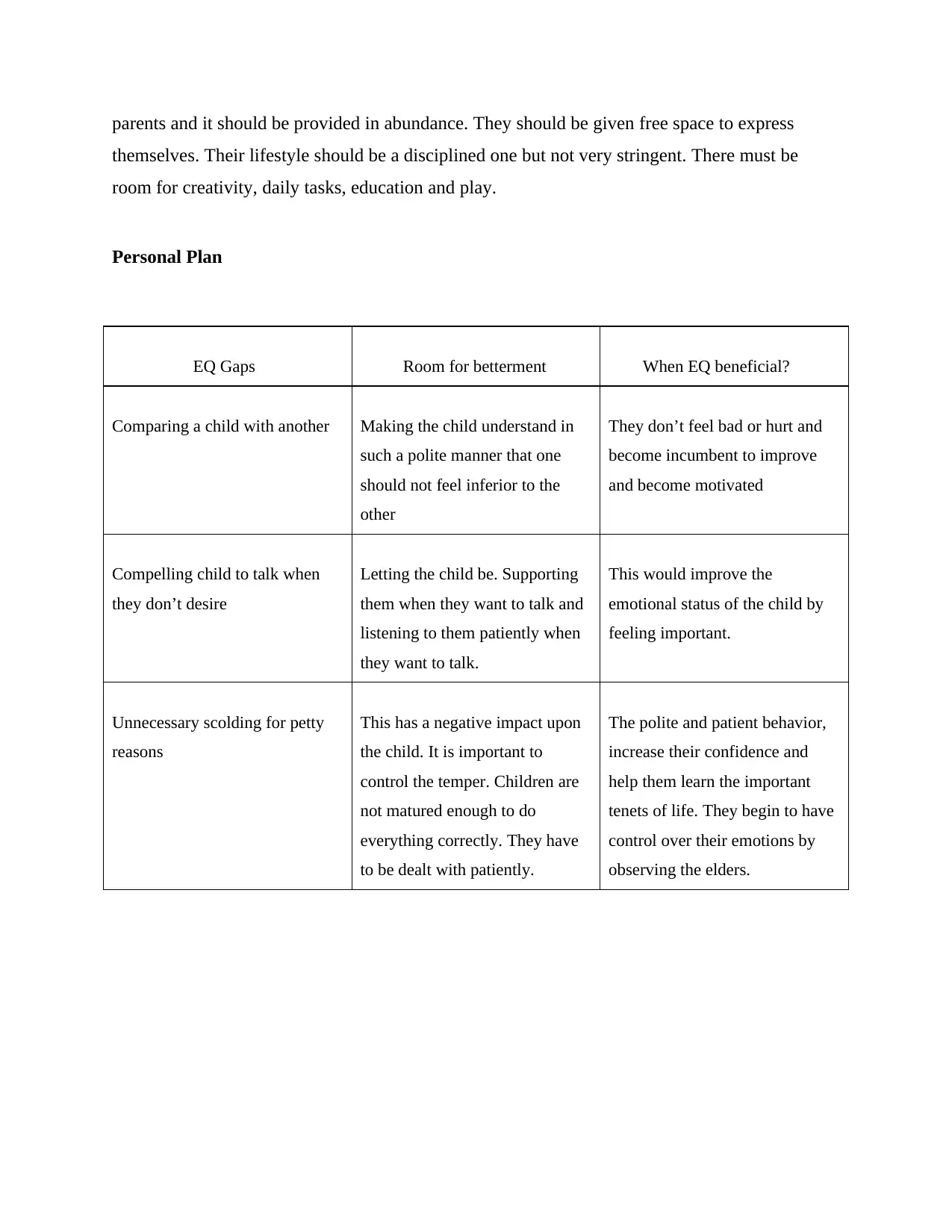
Personal Plan
EQ Gaps Room for betterment When EQ beneficial?
Comparing a child with another Making the child understand in
such a polite manner that one
should not feel inferior to the
other
They don’t feel bad or hurt and
become incumbent to improve
and become motivated
Compelling child to talk when
they don’t desire
Letting the child be. Supporting
them when they want to talk and
listening to them patiently when
they want to talk.
This would improve the
emotional status of the child by
feeling important.
Unnecessary scolding for petty
reasons
This has a negative impact upon
the child. It is important to
control the temper. Children are
not matured enough to do
everything correctly. They have
to be dealt with patiently.
The polite and patient behavior,
increase their confidence and
help them learn the important
tenets of life. They begin to have
control over their emotions by
observing the elders.
Document Page
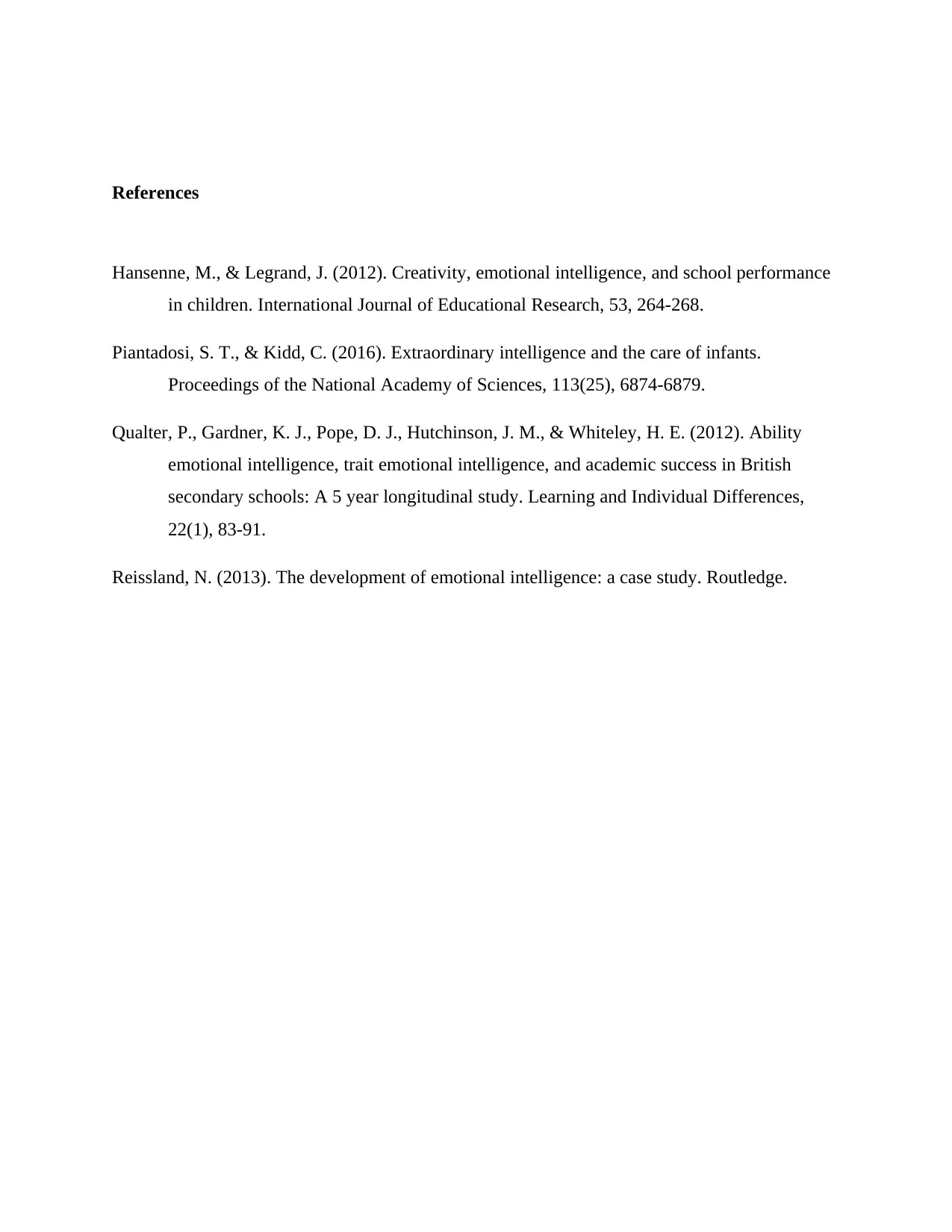
References
Hansenne, M., & Legrand, J. (2012). Creativity, emotional intelligence, and school performance
in children. International Journal of Educational Research, 53, 264-268.
Piantadosi, S. T., & Kidd, C. (2016). Extraordinary intelligence and the care of infants.
Proceedings of the National Academy of Sciences, 113(25), 6874-6879.
Qualter, P., Gardner, K. J., Pope, D. J., Hutchinson, J. M., & Whiteley, H. E. (2012). Ability
emotional intelligence, trait emotional intelligence, and academic success in British
secondary schools: A 5 year longitudinal study. Learning and Individual Differences,
22(1), 83-91.
Reissland, N. (2013). The development of emotional intelligence: a case study. Routledge.
chevron_up_icon
1 out of 4
circle_padding
hide_on_mobile
zoom_out_icon
[object Object]