University Project: Sustainability in Early Childhood Setting Report
VerifiedAdded on 2022/08/27
|13
|3438
|18
Report
AI Summary
This report examines the importance of sustainability within early childhood settings, emphasizing the need for resource management and environmental consciousness. It explores the concept of sustainability, its significance in the context of early childhood education, and the benefits of implementing sustainable practices. The report presents a business case for a grey water treatment system, detailing its cost-benefit analysis, implementation process, and potential environmental and health benefits. It covers various aspects, including water conservation, energy efficiency, and the use of recycled materials. The report also addresses the risks associated with grey water reuse and provides a comprehensive plan for setting up a grey water treatment plant, including different treatment technologies and their applications. Overall, the report aims to provide practical strategies and insights for creating sustainable and environmentally responsible early childhood environments.
Running head: EARLY CHILDHOOD
EARLY CHILDHOOD
Name of the Student
Name of the University
Author Note
EARLY CHILDHOOD
Name of the Student
Name of the University
Author Note

Paraphrase This Document
Need a fresh take? Get an instant paraphrase of this document with our AI Paraphraser
1EARLY CHILDHOOD
Introduction
Sustainability mainly focusses in meeting the needs of the present without
compromising the needs of the existing time without compromising the ability of the future
generation to meet their needs (Ritchie 2013).
This paper will describe why sustainability is important in the concerned early child
care setting, especially focussing on some resources that are needed for the early childhood
setting and how they are sustainable for the setting, including the cost benefit analysis of the
resources used in the settings. While, there are resources that can be managed in an early
childhood settings, saving is of freshwater is an important part of sustainable living in an
early childhood setting. Hence, a whole plan of the setting for grey water treatment for using
them in toilet flushing has been used in this assignment.
Discussion
Sustainability is important for improving the quality of the environment, for clean air,
preservation of the natural resources. Practising sustainability empowers children for
constructing knowledge and explore the values and develop an appreciation of the
environment and its relationship with the world. It helps in the construction of an
environmentally responsible adulthood (Ritchie 2013). Furthermore, early childhood places
are settings are placed where sustainability are often not maintained in terms of energy, water
used in the toilets. Sometimes the equipment used in the rooms are not energy sustainable. In
such cases many changes can be made to make an energy sustainable environment.
Introduction
Sustainability mainly focusses in meeting the needs of the present without
compromising the needs of the existing time without compromising the ability of the future
generation to meet their needs (Ritchie 2013).
This paper will describe why sustainability is important in the concerned early child
care setting, especially focussing on some resources that are needed for the early childhood
setting and how they are sustainable for the setting, including the cost benefit analysis of the
resources used in the settings. While, there are resources that can be managed in an early
childhood settings, saving is of freshwater is an important part of sustainable living in an
early childhood setting. Hence, a whole plan of the setting for grey water treatment for using
them in toilet flushing has been used in this assignment.
Discussion
Sustainability is important for improving the quality of the environment, for clean air,
preservation of the natural resources. Practising sustainability empowers children for
constructing knowledge and explore the values and develop an appreciation of the
environment and its relationship with the world. It helps in the construction of an
environmentally responsible adulthood (Ritchie 2013). Furthermore, early childhood places
are settings are placed where sustainability are often not maintained in terms of energy, water
used in the toilets. Sometimes the equipment used in the rooms are not energy sustainable. In
such cases many changes can be made to make an energy sustainable environment.
2EARLY CHILDHOOD
Business report
Project name: Grey water treatment for toilet flushing
Project sponsor: X early child hood setting
Date of project approval:
Last Revision date:
Contribution to the business strategy:
There are several ways by which the educator of the early childhood setting can actually
facilitate the conservation of the natural resources, like saving energy by turning of the lights
or use of the energy saving light bulbs, recycle the plastic bottles, caps and the tyres to make
innovative substances or using them in play based activities (Davis and Elliott 2014). It is
necessary to develop a structured and managed approach to the resource efficiency that will
identify the opportunities to save money, improve the profile of the issue in the organisation
and set the schedules for the change of the continual improvement (Davis and Elliott 2014).
While there are various resources, one of the natural resources that are often exploited in an
early childhood setting is “water”. Children often do not have awareness about the use of
water and keep the taps on. Children might keep the water running while washing the paint
brushes.
Benefits:
To save energy
To conserve water
To reduce the overall public demand of freshwater
To reduce the amount of waste water entering the sewers or on-site treatment systems.
Time scales:
Analysis says that it can be done approximately 2-3 weeks to implement.
Business report
Project name: Grey water treatment for toilet flushing
Project sponsor: X early child hood setting
Date of project approval:
Last Revision date:
Contribution to the business strategy:
There are several ways by which the educator of the early childhood setting can actually
facilitate the conservation of the natural resources, like saving energy by turning of the lights
or use of the energy saving light bulbs, recycle the plastic bottles, caps and the tyres to make
innovative substances or using them in play based activities (Davis and Elliott 2014). It is
necessary to develop a structured and managed approach to the resource efficiency that will
identify the opportunities to save money, improve the profile of the issue in the organisation
and set the schedules for the change of the continual improvement (Davis and Elliott 2014).
While there are various resources, one of the natural resources that are often exploited in an
early childhood setting is “water”. Children often do not have awareness about the use of
water and keep the taps on. Children might keep the water running while washing the paint
brushes.
Benefits:
To save energy
To conserve water
To reduce the overall public demand of freshwater
To reduce the amount of waste water entering the sewers or on-site treatment systems.
Time scales:
Analysis says that it can be done approximately 2-3 weeks to implement.
⊘ This is a preview!⊘
Do you want full access?
Subscribe today to unlock all pages.

Trusted by 1+ million students worldwide
3EARLY CHILDHOOD
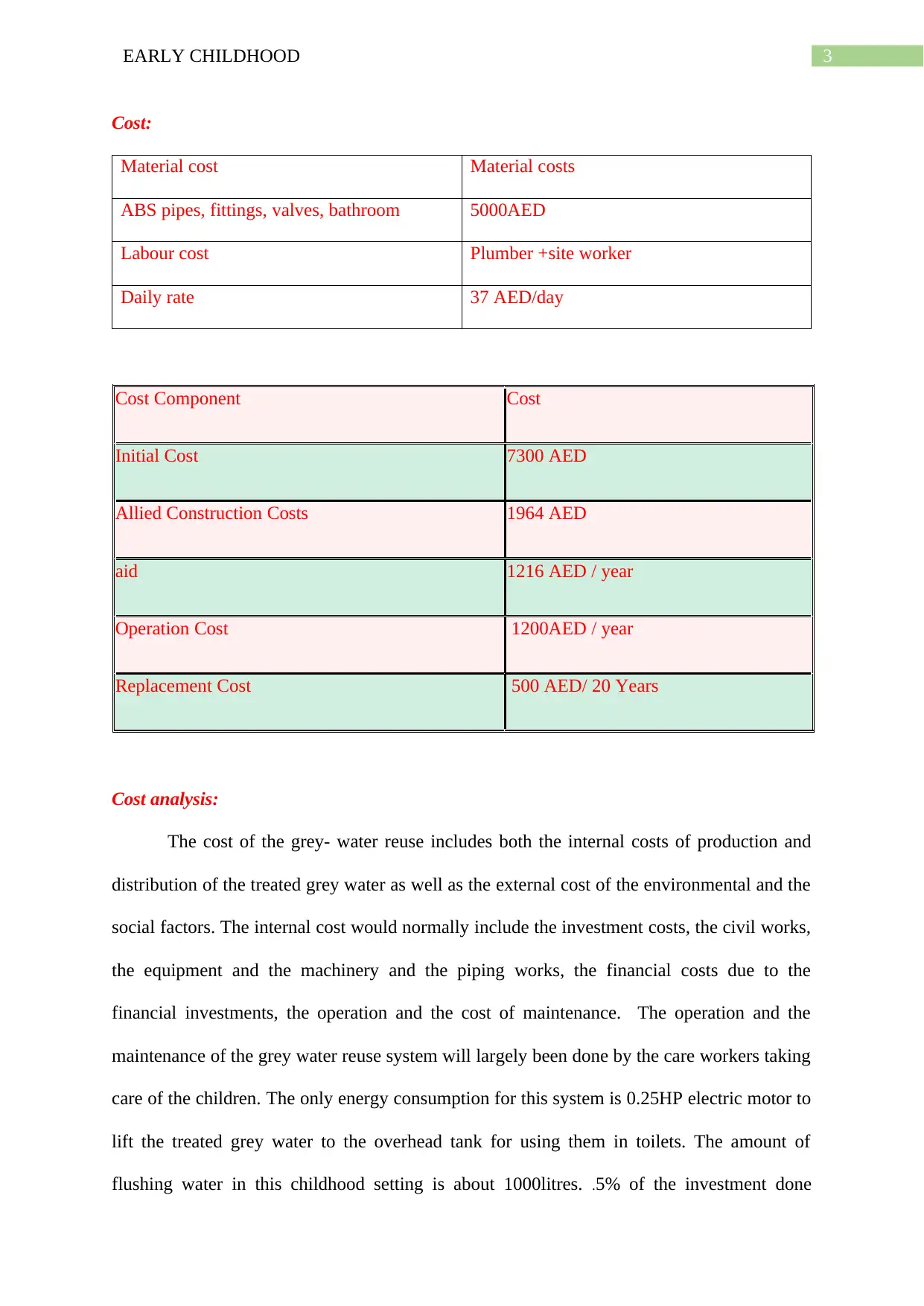
Cost:
Material cost Material costs
ABS pipes, fittings, valves, bathroom 5000AED
Labour cost Plumber +site worker
Daily rate 37 AED/day
Cost Component Cost
Initial Cost 7300 AED
Allied Construction Costs 1964 AED
aid 1216 AED / year
Operation Cost 1200AED / year
Replacement Cost 500 AED/ 20 Years
Cost analysis:
The cost of the grey- water reuse includes both the internal costs of production and
distribution of the treated grey water as well as the external cost of the environmental and the
social factors. The internal cost would normally include the investment costs, the civil works,
the equipment and the machinery and the piping works, the financial costs due to the
financial investments, the operation and the cost of maintenance. The operation and the
maintenance of the grey water reuse system will largely been done by the care workers taking
care of the children. The only energy consumption for this system is 0.25HP electric motor to
lift the treated grey water to the overhead tank for using them in toilets. The amount of
flushing water in this childhood setting is about 1000litres. .5% of the investment done
Cost:
Material cost Material costs
ABS pipes, fittings, valves, bathroom 5000AED
Labour cost Plumber +site worker
Daily rate 37 AED/day
Cost Component Cost
Initial Cost 7300 AED
Allied Construction Costs 1964 AED
aid 1216 AED / year
Operation Cost 1200AED / year
Replacement Cost 500 AED/ 20 Years
Cost analysis:
The cost of the grey- water reuse includes both the internal costs of production and
distribution of the treated grey water as well as the external cost of the environmental and the
social factors. The internal cost would normally include the investment costs, the civil works,
the equipment and the machinery and the piping works, the financial costs due to the
financial investments, the operation and the cost of maintenance. The operation and the
maintenance of the grey water reuse system will largely been done by the care workers taking
care of the children. The only energy consumption for this system is 0.25HP electric motor to
lift the treated grey water to the overhead tank for using them in toilets. The amount of
flushing water in this childhood setting is about 1000litres. .5% of the investment done
Paraphrase This Document
Need a fresh take? Get an instant paraphrase of this document with our AI Paraphraser
4EARLY CHILDHOOD
initially can be regarded as conservation of the civil works, while 3% can be regarded as
maintenance of the electromechanical tools like 0.25 HP electric pump. It also included the
Chlorination cost (Olanrewaju and Ilemobade 2015).
The internal benefits would include the cost of the treated grey water and it can be
evaluated by measuring the savings in the tank water. Another external benefit is the water
infrastructure. This should be evaluated based on the cost infrastructure for getting same
quality of freshwater (Godfrey et al. 2017). The environmental benefits would include the
environmental benefits like reduction in the exploitation of the groundwater. The pollutants
will be reused like phosphorus, nitrogen and potassium. Again, it will help in the storage of
water sources. This increases the quantity of water that is available in the natural resources
that is equivalent to the rainwater collection and reuse of the grey water. The health benefits
includes, a guaranteed supply in times when there is a shortage of water. Direct expenditure
can be reduced due to reduced rate of hospitalizations. The productive warden days lost are
reduced (Godfrey et al. 2017). The external cost for the set up would include, that of the land.
The environmental would include the reduction of the odour, on the basis of the cosy of the
odour abatement (Olanrewaju and Ilemobade 2015). We cannot totally nullify the heath costs
associated to the health risks related to the use of the grey-water.
The aim of the cost benefit analysis is not to include all the benefits but for capturing
all the tangible and the measurable ones. Cost saving is mainly related to the reduced amount
of fresh water consumption in the toilet purpose.
Risks:
The grey water from the laundries or the bathroom is full of different organisms and if comes
in contact with the body might cause gastroenteritis and skin or respiratory infections.
initially can be regarded as conservation of the civil works, while 3% can be regarded as
maintenance of the electromechanical tools like 0.25 HP electric pump. It also included the
Chlorination cost (Olanrewaju and Ilemobade 2015).
The internal benefits would include the cost of the treated grey water and it can be
evaluated by measuring the savings in the tank water. Another external benefit is the water
infrastructure. This should be evaluated based on the cost infrastructure for getting same
quality of freshwater (Godfrey et al. 2017). The environmental benefits would include the
environmental benefits like reduction in the exploitation of the groundwater. The pollutants
will be reused like phosphorus, nitrogen and potassium. Again, it will help in the storage of
water sources. This increases the quantity of water that is available in the natural resources
that is equivalent to the rainwater collection and reuse of the grey water. The health benefits
includes, a guaranteed supply in times when there is a shortage of water. Direct expenditure
can be reduced due to reduced rate of hospitalizations. The productive warden days lost are
reduced (Godfrey et al. 2017). The external cost for the set up would include, that of the land.
The environmental would include the reduction of the odour, on the basis of the cosy of the
odour abatement (Olanrewaju and Ilemobade 2015). We cannot totally nullify the heath costs
associated to the health risks related to the use of the grey-water.
The aim of the cost benefit analysis is not to include all the benefits but for capturing
all the tangible and the measurable ones. Cost saving is mainly related to the reduced amount
of fresh water consumption in the toilet purpose.
Risks:
The grey water from the laundries or the bathroom is full of different organisms and if comes
in contact with the body might cause gastroenteritis and skin or respiratory infections.
5EARLY CHILDHOOD
The complete process of setting up of a grey water treatment plant in an early child hood
setting
Setting up of a treatment process for the reuse of grey water for the toilet flushing can need a
systematic process, which has been stated below:-
Initially it is necessary to gain the commitment from the head of the organization as
any changes would require support from the topmost level. Secondly, it is necessary to
review the amount of fresh water wasted every day for toilet flushing in the early childhood
setting. It is necessary to inquire about the total consumption of water and activities that
require water.
After assessing the needs, it is necessary to assign responsibilities and set up the
priorities and to think about the identification of the main causes of wastage of water. It is
necessary to chalk out a detailed plan outlining the objectives, responsibilities. The action
needs to be taken. A resource efficiency program would require measurement, monitoring
and reporting, segregation, signage and composition and analysis (Godfrey, Labhasetwar and
Wate 2017).
As an initiative to conserve water grey waters can be used in toilets of the schools or a
rain water tank can be installed. “Grey waters” can be defined as the low polluted
wastewaters from the bathtub showers or the hand washing basins, including the ones from
the kitchen and the toilet flushing system (Oteng-Peprah, Acheampong and deVries 2018).
Grey water is referred to as wastewater that does not contain of contribution from the toilet
water. It is considered to be high volume, low strength of waste water having high potential
for the reuse and application of water. Reuse has been an old practice and needs specific
attention. There are many researchers who have studied in order to assess the use of the grey
water with regards to the fittings, the life style patterns and the settlement type.
The complete process of setting up of a grey water treatment plant in an early child hood
setting
Setting up of a treatment process for the reuse of grey water for the toilet flushing can need a
systematic process, which has been stated below:-
Initially it is necessary to gain the commitment from the head of the organization as
any changes would require support from the topmost level. Secondly, it is necessary to
review the amount of fresh water wasted every day for toilet flushing in the early childhood
setting. It is necessary to inquire about the total consumption of water and activities that
require water.
After assessing the needs, it is necessary to assign responsibilities and set up the
priorities and to think about the identification of the main causes of wastage of water. It is
necessary to chalk out a detailed plan outlining the objectives, responsibilities. The action
needs to be taken. A resource efficiency program would require measurement, monitoring
and reporting, segregation, signage and composition and analysis (Godfrey, Labhasetwar and
Wate 2017).
As an initiative to conserve water grey waters can be used in toilets of the schools or a
rain water tank can be installed. “Grey waters” can be defined as the low polluted
wastewaters from the bathtub showers or the hand washing basins, including the ones from
the kitchen and the toilet flushing system (Oteng-Peprah, Acheampong and deVries 2018).
Grey water is referred to as wastewater that does not contain of contribution from the toilet
water. It is considered to be high volume, low strength of waste water having high potential
for the reuse and application of water. Reuse has been an old practice and needs specific
attention. There are many researchers who have studied in order to assess the use of the grey
water with regards to the fittings, the life style patterns and the settlement type.
⊘ This is a preview!⊘
Do you want full access?
Subscribe today to unlock all pages.
Trusted by 1+ million students worldwide
6EARLY CHILDHOOD
The generalization of living life in western way in the city areas in most of the
developing nations experience shortage of water. It is resulting in an increased stress on the
supply of water. Hence, management of the demands is now a popular approach having a
long teen research objectives known as the close loop recycling. Hence, rainwater harvesting
and utilization of grey water is quite a popular trend for the non-potable urban uses like toilet
flushing (Boyjoo, Pareek and Ang 2013). The demand for this water is dependent upon the
acceptance of the grey water. The demand potential is dependent on whether there are any
alternative water sources present. The grey-water projects reduces the demand of the
sensitive water bodies and lowers the cost of the development of the new supplies of water. It
reduces the cost of the waste water treatment and the cost of the disposal and lessens the
discharge of the pollutants on the environment (Boyjoo, Pareek and Ang 2013).
While large scale projects are being recently developed .Many schools and the
households are recycling the grey water to use for purposes like toilet flushing. The
installation of the grey water treatment plan in a small scale has been explained below.
1. Direct reuse system- In this system, it is possible to reuse the grey water without any
treatment provided that the water is not stored for long before use. For this very simple
devices can be used. A hose pipe with a small hand pump can be used to make the siphon.
This allows the bath water to be sent hose to the garden (El Hamouri et al. 2017). The
untreated grey water should not be kept for longer than one day, but two tale spoons of
chlorine bleach needs to be added. The technologies required for the grey water treatment
includes the coarse sand and the soil filtration and the membrane filtration that is mostly
followed by a disinfection step.
2. The grey waters from the showers and the Kitchen of the early childhood setting will be
treated by an adapted low cost approach and the advanced technologies (Mohammed et
al. 2017). The grey water that will be used in the early childhood settings contains low
The generalization of living life in western way in the city areas in most of the
developing nations experience shortage of water. It is resulting in an increased stress on the
supply of water. Hence, management of the demands is now a popular approach having a
long teen research objectives known as the close loop recycling. Hence, rainwater harvesting
and utilization of grey water is quite a popular trend for the non-potable urban uses like toilet
flushing (Boyjoo, Pareek and Ang 2013). The demand for this water is dependent upon the
acceptance of the grey water. The demand potential is dependent on whether there are any
alternative water sources present. The grey-water projects reduces the demand of the
sensitive water bodies and lowers the cost of the development of the new supplies of water. It
reduces the cost of the waste water treatment and the cost of the disposal and lessens the
discharge of the pollutants on the environment (Boyjoo, Pareek and Ang 2013).
While large scale projects are being recently developed .Many schools and the
households are recycling the grey water to use for purposes like toilet flushing. The
installation of the grey water treatment plan in a small scale has been explained below.
1. Direct reuse system- In this system, it is possible to reuse the grey water without any
treatment provided that the water is not stored for long before use. For this very simple
devices can be used. A hose pipe with a small hand pump can be used to make the siphon.
This allows the bath water to be sent hose to the garden (El Hamouri et al. 2017). The
untreated grey water should not be kept for longer than one day, but two tale spoons of
chlorine bleach needs to be added. The technologies required for the grey water treatment
includes the coarse sand and the soil filtration and the membrane filtration that is mostly
followed by a disinfection step.
2. The grey waters from the showers and the Kitchen of the early childhood setting will be
treated by an adapted low cost approach and the advanced technologies (Mohammed et
al. 2017). The grey water that will be used in the early childhood settings contains low
Paraphrase This Document
Need a fresh take? Get an instant paraphrase of this document with our AI Paraphraser
7EARLY CHILDHOOD
levels of pathogens and hence the use and reuse of the grey waters are gaining attention
(Alsulaili et al. 2017). The low cost unit of the early childcare setting would consist of a
gravel-horizontal flow built wetland planted with Phragmites followed by a vertical flow
multilayer sand filter.
3.
The grey water should be disinfected and needs to be stored in a reservoir of polyethylene,
coloured in black. This reservoir should be connected to the school building to feed the toilets
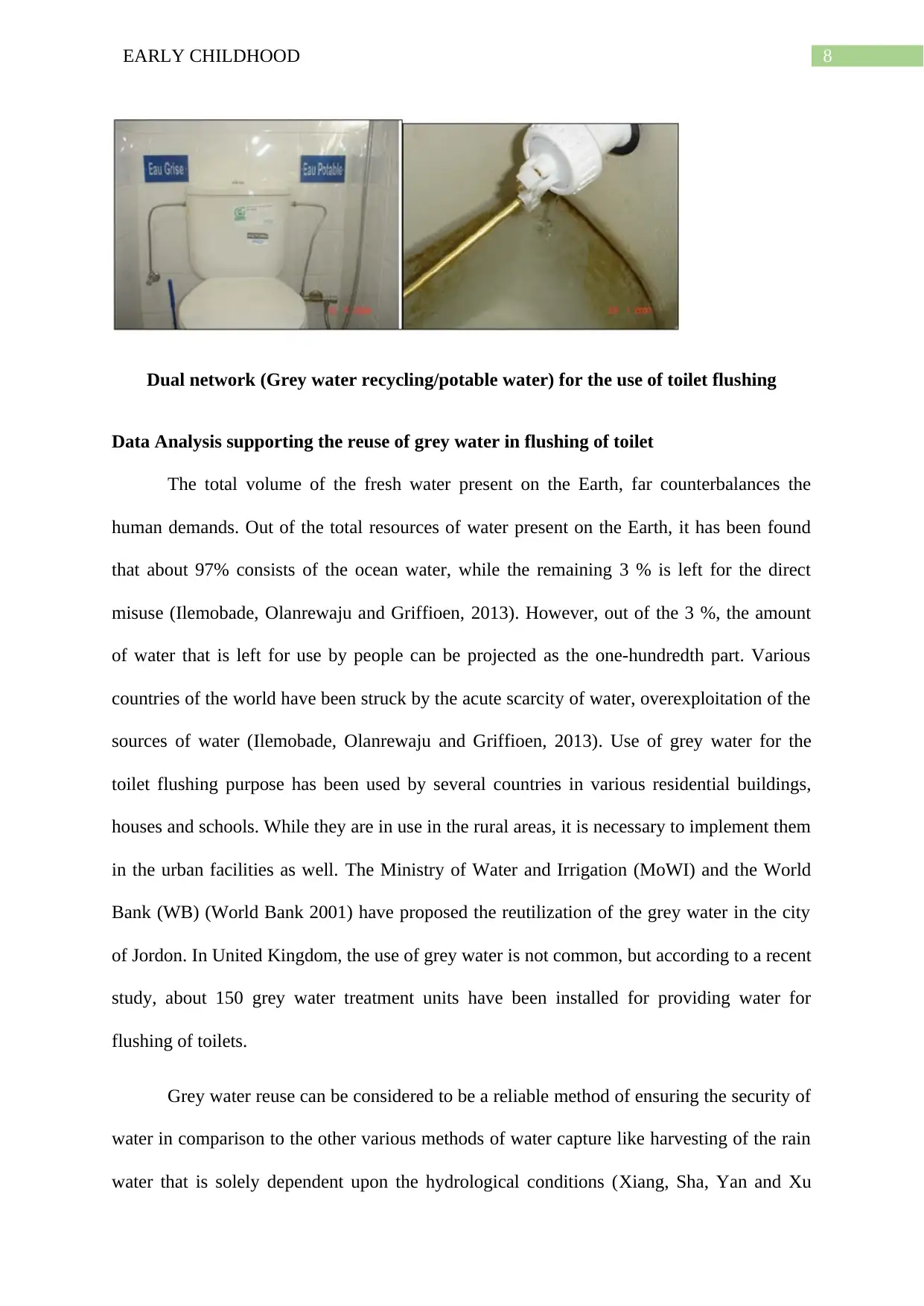
present in the early childcare system (El Hamouri et al. 2017). A pipe of dual network needs
to be adopted along with the valve of the drinking water supply that would stay permanently
closed except when the grey water is unavailable. It will also help the grey water from
flowing back in to the network of the drinking water, and gap of 4 metre needs to be left
between the pipe of potable water and the highest level of water in the reservoirs for flushing.
The grey water can also be sanitized by an UVTspa Teflon system and GW will be forced to
go upward in a Teflon pipe that is placed in an aluminium box (El Hamouri et al. 2017).
It has been recommended in a paper, that the MBR technology can be used that
combines with the activated sludge method, for the elimination of the pollutants, that are
biodegradable and the membrane filtration for separating solid and the liquid (Santasmasas,
Rovira, Clarens and Valderrama 2013). Again, SBR is another technique that is an activated
sludge unit where biomass develops inside the small floating cubes made of foam (Wu 2019).
An aqua cycle can be used that includes three tanks, two for the treating the water and the
third one for the storage of the waste that is UV disinfected (Fountoulakis et al. 2016).
levels of pathogens and hence the use and reuse of the grey waters are gaining attention
(Alsulaili et al. 2017). The low cost unit of the early childcare setting would consist of a
gravel-horizontal flow built wetland planted with Phragmites followed by a vertical flow
multilayer sand filter.
3.
The grey water should be disinfected and needs to be stored in a reservoir of polyethylene,
coloured in black. This reservoir should be connected to the school building to feed the toilets
present in the early childcare system (El Hamouri et al. 2017). A pipe of dual network needs
to be adopted along with the valve of the drinking water supply that would stay permanently
closed except when the grey water is unavailable. It will also help the grey water from
flowing back in to the network of the drinking water, and gap of 4 metre needs to be left
between the pipe of potable water and the highest level of water in the reservoirs for flushing.
The grey water can also be sanitized by an UVTspa Teflon system and GW will be forced to
go upward in a Teflon pipe that is placed in an aluminium box (El Hamouri et al. 2017).
It has been recommended in a paper, that the MBR technology can be used that
combines with the activated sludge method, for the elimination of the pollutants, that are
biodegradable and the membrane filtration for separating solid and the liquid (Santasmasas,
Rovira, Clarens and Valderrama 2013). Again, SBR is another technique that is an activated
sludge unit where biomass develops inside the small floating cubes made of foam (Wu 2019).
An aqua cycle can be used that includes three tanks, two for the treating the water and the
third one for the storage of the waste that is UV disinfected (Fountoulakis et al. 2016).
8EARLY CHILDHOOD
Dual network (Grey water recycling/potable water) for the use of toilet flushing
Data Analysis supporting the reuse of grey water in flushing of toilet
The total volume of the fresh water present on the Earth, far counterbalances the
human demands. Out of the total resources of water present on the Earth, it has been found
that about 97% consists of the ocean water, while the remaining 3 % is left for the direct
misuse (Ilemobade, Olanrewaju and Griffioen, 2013). However, out of the 3 %, the amount
of water that is left for use by people can be projected as the one-hundredth part. Various
countries of the world have been struck by the acute scarcity of water, overexploitation of the
sources of water (Ilemobade, Olanrewaju and Griffioen, 2013). Use of grey water for the
toilet flushing purpose has been used by several countries in various residential buildings,
houses and schools. While they are in use in the rural areas, it is necessary to implement them
in the urban facilities as well. The Ministry of Water and Irrigation (MoWI) and the World
Bank (WB) (World Bank 2001) have proposed the reutilization of the grey water in the city
of Jordon. In United Kingdom, the use of grey water is not common, but according to a recent
study, about 150 grey water treatment units have been installed for providing water for
flushing of toilets.
Grey water reuse can be considered to be a reliable method of ensuring the security of
water in comparison to the other various methods of water capture like harvesting of the rain
water that is solely dependent upon the hydrological conditions (Xiang, Sha, Yan and Xu
Dual network (Grey water recycling/potable water) for the use of toilet flushing
Data Analysis supporting the reuse of grey water in flushing of toilet
The total volume of the fresh water present on the Earth, far counterbalances the
human demands. Out of the total resources of water present on the Earth, it has been found
that about 97% consists of the ocean water, while the remaining 3 % is left for the direct
misuse (Ilemobade, Olanrewaju and Griffioen, 2013). However, out of the 3 %, the amount
of water that is left for use by people can be projected as the one-hundredth part. Various
countries of the world have been struck by the acute scarcity of water, overexploitation of the
sources of water (Ilemobade, Olanrewaju and Griffioen, 2013). Use of grey water for the
toilet flushing purpose has been used by several countries in various residential buildings,
houses and schools. While they are in use in the rural areas, it is necessary to implement them
in the urban facilities as well. The Ministry of Water and Irrigation (MoWI) and the World
Bank (WB) (World Bank 2001) have proposed the reutilization of the grey water in the city
of Jordon. In United Kingdom, the use of grey water is not common, but according to a recent
study, about 150 grey water treatment units have been installed for providing water for
flushing of toilets.
Grey water reuse can be considered to be a reliable method of ensuring the security of
water in comparison to the other various methods of water capture like harvesting of the rain
water that is solely dependent upon the hydrological conditions (Xiang, Sha, Yan and Xu
⊘ This is a preview!⊘
Do you want full access?
Subscribe today to unlock all pages.
Trusted by 1+ million students worldwide
9EARLY CHILDHOOD
2014). The amount of the grey water in a domestic dwelling can differ largely from as less as
15 L per person in a day for the poverty stricken places. Some of the factors that are
responsible for the huge differences are due to the geographical location, condition of the
climate, lifestyle, and the type of infrastructures, habits and cultures among the others (Wu
2019). Grey water can account for almost 75% of the volume of the fresh water produced by
the households or school which can be increased up to 90 % if the dry toilets are used.
Recommendations
Recommendations after setting up of a grey water treatment plan includes
management of the system, analysing the cost, monitoring whether the care givers are using
the properly for flushing out toilets.
It is necessary to discuss with the higher authorities about the feasibility of the
approach and funding should be allocated after constructing a grey water treatment set up
It is necessary to educate children about the use of water and why they should
preserve water. Children during the water play activity or toileting or during washing should
be monitored, that they do not keep the taps open. The water treatment pipes and reservoirs
should be checked and should be kept away from the potable water taps.
Conclusions
In conclusion, it can be stated that the use of grey water is associated with choice of
the reuse, as most of the users would not like to use it that involved personal contact.
However, there are several ways by which water is wasted in an early childhood setting.
There are several other resources, that needs to be managed in an early child hood settings,
however, this paper has taken up only e management of water, as overexploitation of water
takes place in the early childhood settings. Hence, this paper has provided with a business
2014). The amount of the grey water in a domestic dwelling can differ largely from as less as
15 L per person in a day for the poverty stricken places. Some of the factors that are
responsible for the huge differences are due to the geographical location, condition of the
climate, lifestyle, and the type of infrastructures, habits and cultures among the others (Wu
2019). Grey water can account for almost 75% of the volume of the fresh water produced by
the households or school which can be increased up to 90 % if the dry toilets are used.
Recommendations
Recommendations after setting up of a grey water treatment plan includes
management of the system, analysing the cost, monitoring whether the care givers are using
the properly for flushing out toilets.
It is necessary to discuss with the higher authorities about the feasibility of the
approach and funding should be allocated after constructing a grey water treatment set up
It is necessary to educate children about the use of water and why they should
preserve water. Children during the water play activity or toileting or during washing should
be monitored, that they do not keep the taps open. The water treatment pipes and reservoirs
should be checked and should be kept away from the potable water taps.
Conclusions
In conclusion, it can be stated that the use of grey water is associated with choice of
the reuse, as most of the users would not like to use it that involved personal contact.
However, there are several ways by which water is wasted in an early childhood setting.
There are several other resources, that needs to be managed in an early child hood settings,
however, this paper has taken up only e management of water, as overexploitation of water
takes place in the early childhood settings. Hence, this paper has provided with a business
Paraphrase This Document
Need a fresh take? Get an instant paraphrase of this document with our AI Paraphraser
10EARLY CHILDHOOD
plan for the grey water treatment for using them to flush toilets. A comprehensive plan has
been provided long with a cost benefit and analysis. This approach can really act to be cost
effective and the sustainable for the environment. It cannot be denied that the treatment of the
grey water and reuse if incorporated compulsory can cause a substantial drop in the over
reliance of the fresh water resources for the various non-potable uses.
plan for the grey water treatment for using them to flush toilets. A comprehensive plan has
been provided long with a cost benefit and analysis. This approach can really act to be cost
effective and the sustainable for the environment. It cannot be denied that the treatment of the
grey water and reuse if incorporated compulsory can cause a substantial drop in the over
reliance of the fresh water resources for the various non-potable uses.
11EARLY CHILDHOOD
References
Alsulaili, A.D., Hamoda, M.F., Al-Jarallah, R. and Alrukaibi, D., 2017. Treatment and
potential reuse of greywater from schools: a pilot study. Water Science and Technology,
75(9), pp.2119-2129.
Boyjoo, Y., Pareek, V.K. and Ang, M., 2013. A review of greywater characteristics and
treatment processes. Water Science and Technology, 67(7), pp.1403-1424.
Davis, J. and Elliott, S. eds., 2014. Research in early childhood education for sustainability:
International perspectives and provocations. Routledge.
El Hamouri, B., Bey, I., Ait Douch, A., Ghazi, N. and Regelsberger, M., 2018. Greywater
treatment and recycling for toilet flushing: comparison of low and high tech treatment
approaches. Water Practice and Technology, 3(2).
Fountoulakis, M.S., Markakis, N., Petousi, I. and Manios, T., 2016. Single house on-site grey
water treatment using a submerged membrane bioreactor for toilet flushing. Science of the
total environment, 551, pp.706-711.
Godfrey, S., Labhasetwar, P. and Wate, S., 2017. Greywater reuse in residential schools in
Madhya Pradesh, India—A case study of cost–benefit analysis. Resources, Conservation and
Recycling, 53(5), pp.287-293.
Ilemobade, A.A., Olanrewaju, O.O. and Griffioen, M.L., 2013. Greywater reuse for toilet
flushing at a university academic and residential building. Water sa, 39(3), pp.351-360.
Mohammed, N.G.N., Almajed, M., Albeladi, S. and Mohammed, F., Greywater Management
in Bahraini Schools, Jaw School—Case Study.
References
Alsulaili, A.D., Hamoda, M.F., Al-Jarallah, R. and Alrukaibi, D., 2017. Treatment and
potential reuse of greywater from schools: a pilot study. Water Science and Technology,
75(9), pp.2119-2129.
Boyjoo, Y., Pareek, V.K. and Ang, M., 2013. A review of greywater characteristics and
treatment processes. Water Science and Technology, 67(7), pp.1403-1424.
Davis, J. and Elliott, S. eds., 2014. Research in early childhood education for sustainability:
International perspectives and provocations. Routledge.
El Hamouri, B., Bey, I., Ait Douch, A., Ghazi, N. and Regelsberger, M., 2018. Greywater
treatment and recycling for toilet flushing: comparison of low and high tech treatment
approaches. Water Practice and Technology, 3(2).
Fountoulakis, M.S., Markakis, N., Petousi, I. and Manios, T., 2016. Single house on-site grey
water treatment using a submerged membrane bioreactor for toilet flushing. Science of the
total environment, 551, pp.706-711.
Godfrey, S., Labhasetwar, P. and Wate, S., 2017. Greywater reuse in residential schools in
Madhya Pradesh, India—A case study of cost–benefit analysis. Resources, Conservation and
Recycling, 53(5), pp.287-293.
Ilemobade, A.A., Olanrewaju, O.O. and Griffioen, M.L., 2013. Greywater reuse for toilet
flushing at a university academic and residential building. Water sa, 39(3), pp.351-360.
Mohammed, N.G.N., Almajed, M., Albeladi, S. and Mohammed, F., Greywater Management
in Bahraini Schools, Jaw School—Case Study.
⊘ This is a preview!⊘
Do you want full access?
Subscribe today to unlock all pages.
Trusted by 1+ million students worldwide

1 out of 13


Your All-in-One AI-Powered Toolkit for Academic Success.
+13062052269
info@desklib.com
Available 24*7 on WhatsApp / Email
![[object Object]](/_next/static/media/star-bottom.7253800d.svg)
Unlock your academic potential
Copyright © 2020–2026 A2Z Services. All Rights Reserved. Developed and managed by ZUCOL.