An Extended Literature Review on Early Literacy Strategies
VerifiedAdded on 2023/01/13
|17
|6558
|20
Report
AI Summary
This report presents an extended literature review examining the strategies employed by early years educators to foster children's early literacy skills. The introduction highlights the significance of early literacy, encompassing phonics, vocabulary, and language, for long-term child development and academic success. The research objectives include investigating the importance of early literacy, identifying influencing factors, and evaluating current strategies' effectiveness. The methodology section outlines the use of secondary research methods, specifically qualitative approaches with an interpretivism paradigm, employing descriptive research design and thematic analysis. The literature review explores the theoretical framework, research design, data collection, and ethical considerations, including informed consent and confidentiality. The report aims to bridge knowledge gaps, providing valuable insights for educators, institutions, and parents regarding effective strategies and factors impacting early literacy development, ultimately contributing to improved educational outcomes for young children. The report also discusses limitations, like the potential for outdated or misleading information in secondary research, and emphasizes the importance of ethical considerations throughout the research process.
An extended literature review
exploring the strategies early
years educators apply to
develop childrens early
literacy
exploring the strategies early
years educators apply to
develop childrens early
literacy

Paraphrase This Document
Need a fresh take? Get an instant paraphrase of this document with our AI Paraphraser
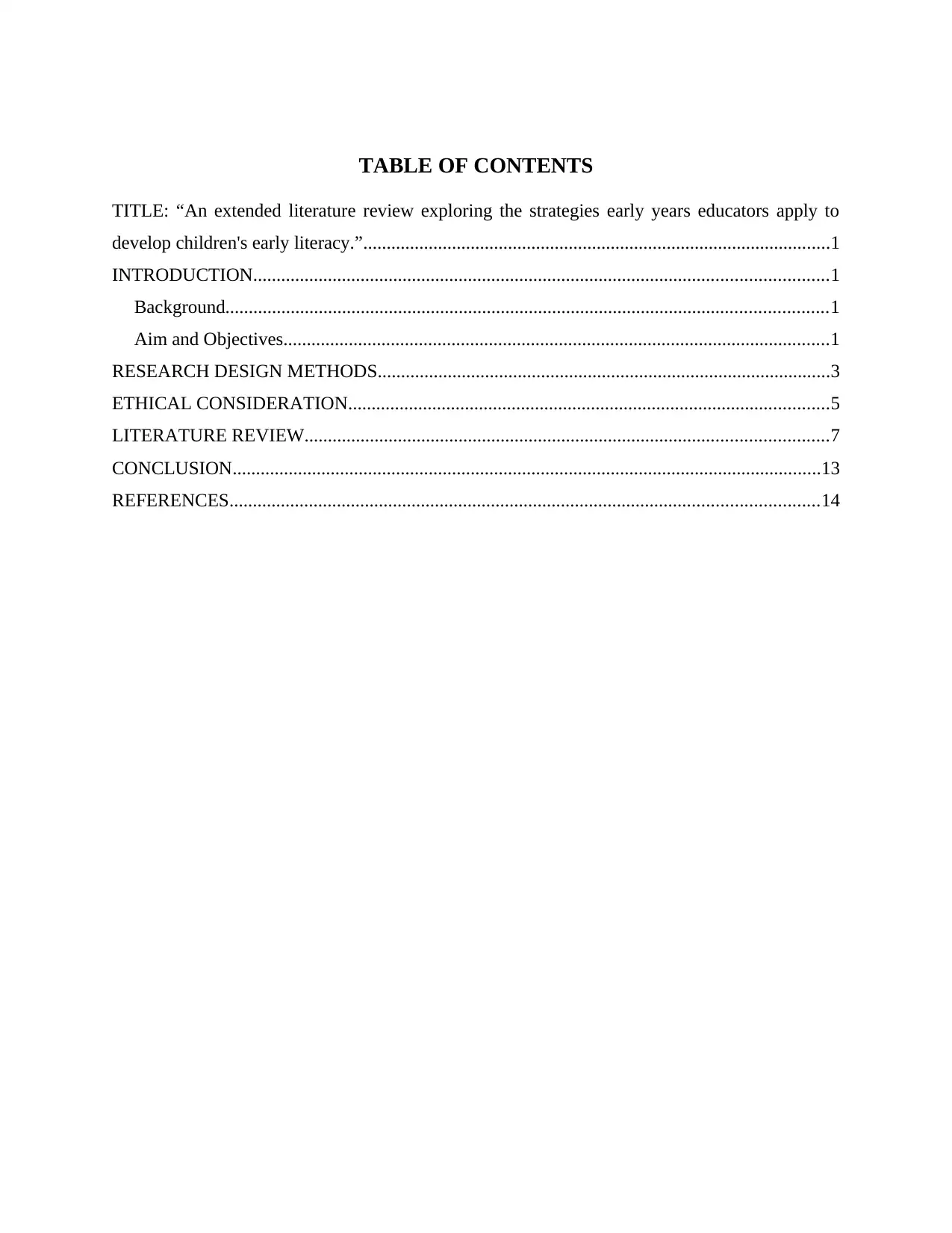
TABLE OF CONTENTS
TITLE: “An extended literature review exploring the strategies early years educators apply to
develop children's early literacy.”....................................................................................................1
INTRODUCTION...........................................................................................................................1
Background.................................................................................................................................1
Aim and Objectives.....................................................................................................................1
RESEARCH DESIGN METHODS.................................................................................................3
ETHICAL CONSIDERATION.......................................................................................................5
LITERATURE REVIEW................................................................................................................7
CONCLUSION..............................................................................................................................13
REFERENCES..............................................................................................................................14
TITLE: “An extended literature review exploring the strategies early years educators apply to
develop children's early literacy.”....................................................................................................1
INTRODUCTION...........................................................................................................................1
Background.................................................................................................................................1
Aim and Objectives.....................................................................................................................1
RESEARCH DESIGN METHODS.................................................................................................3
ETHICAL CONSIDERATION.......................................................................................................5
LITERATURE REVIEW................................................................................................................7
CONCLUSION..............................................................................................................................13
REFERENCES..............................................................................................................................14
TITLE: “An extended literature review exploring the strategies early years educators apply to
develop children's early literacy.”
A. ) INTRODUCTION
Background
Developing early year literacy skills is considered to be very important because it helps in
making learning and reading easier for the children. Early year children who in turn have
advantage to perform better in the school. Early literacy skills which mainly includes phonics,
numeracy, vocabulary and language (Heilmann, Moyle and Rueden, 2018). This in turn
eventually leads to long term growth and development of the children at a very early stage. This
study helps in demonstrating why development of children's early literacy is considered crucial
by early year educators. Furthermore, it will also review key factors which influence the
development of early literacy skills among children at early stage. This study will highlight on
critically exploring on various strategies at a very early years where educators apply to develop
children's early literacy.
Aim and Objectives
Aim
“An extended literature review exploring the strategies early years educators apply to
develop children's early literacy.”
Research Objectives
To examine why development of children's early literacy is considered crucial by early
year educators.
To determine the factors which influence the development of early literacy skills among
children at early stage.
To critically examine strategies which in turn has been used currently by early year's
educators in order to develop children's early literacy.
To evaluate how effective are strategies which in turn are used currently by the early year
educators in order to develop children's early literacy.
B.) Rationale
The researcher of the study has opted for exploring the strategies early years educators
apply to develop children's early literacy because it is of its own academic interest. The
researcher of the study has selected for the particular research topic because it is considered to be
develop children's early literacy.”
A. ) INTRODUCTION
Background
Developing early year literacy skills is considered to be very important because it helps in
making learning and reading easier for the children. Early year children who in turn have
advantage to perform better in the school. Early literacy skills which mainly includes phonics,
numeracy, vocabulary and language (Heilmann, Moyle and Rueden, 2018). This in turn
eventually leads to long term growth and development of the children at a very early stage. This
study helps in demonstrating why development of children's early literacy is considered crucial
by early year educators. Furthermore, it will also review key factors which influence the
development of early literacy skills among children at early stage. This study will highlight on
critically exploring on various strategies at a very early years where educators apply to develop
children's early literacy.
Aim and Objectives
Aim
“An extended literature review exploring the strategies early years educators apply to
develop children's early literacy.”
Research Objectives
To examine why development of children's early literacy is considered crucial by early
year educators.
To determine the factors which influence the development of early literacy skills among
children at early stage.
To critically examine strategies which in turn has been used currently by early year's
educators in order to develop children's early literacy.
To evaluate how effective are strategies which in turn are used currently by the early year
educators in order to develop children's early literacy.
B.) Rationale
The researcher of the study has opted for exploring the strategies early years educators
apply to develop children's early literacy because it is of its own academic interest. The
researcher of the study has selected for the particular research topic because it is considered to be
⊘ This is a preview!⊘
Do you want full access?
Subscribe today to unlock all pages.

Trusted by 1+ million students worldwide
one of the major current issue. Low income, lack of knowledge, negative interactions, high
degree of paperwork, abuse, etc. are considered to be the key issues which in turn has been faced
during early literacy of the children (Early Literacy: Policy and Practice in the Preschool Years,
2020). This issue must be resolved because children's early literacy is considered to be important
because it helps in developing cognitive skills and pre- reading skills which in turn are necessary
for better performance of the children within school. The researcher of the study will resolve the
issue by effectively exploring each themes of the research study which in turn results in gaining
wider perspective on the subject matter of the study.
C.) Specific terminologies
Research methodology: It is considered to be an effective technique which in turn helps
in analysing information related to particular research topic.
Literature review: This is considered to be proper evaluation of the particular data on the
specific subject matter by resolving research problem.
Early literacy: It helps in developing basic literacy skills in children which in turn makes
it easier for them to read and write.
Strategies: This is considered to be an action plan in order to achieve long term goals and
objective.
D.) Research significance
The key significance of the study is to critically examine and explore strategies which in
turn has been used currently by early year's educators in order to develop children's early
literacy. This study is considered to be very beneficial for the researcher because it helps the
researcher to bridge the gaps on the current knowledge associated with why development of
children's early literacy is considered important by early year educators. This research report is
considered to be very beneficial for the teachers, school institution, parents, etc. because it helps
in effectively evaluating the factors which tends to influence the development of early literacy
skills among children at early stage.
E. Research questions
Why development of children's early literacy is considered crucial by early year
educators?
What are the key factors which influence the development of early literacy skills among
children at early stage?
degree of paperwork, abuse, etc. are considered to be the key issues which in turn has been faced
during early literacy of the children (Early Literacy: Policy and Practice in the Preschool Years,
2020). This issue must be resolved because children's early literacy is considered to be important
because it helps in developing cognitive skills and pre- reading skills which in turn are necessary
for better performance of the children within school. The researcher of the study will resolve the
issue by effectively exploring each themes of the research study which in turn results in gaining
wider perspective on the subject matter of the study.
C.) Specific terminologies
Research methodology: It is considered to be an effective technique which in turn helps
in analysing information related to particular research topic.
Literature review: This is considered to be proper evaluation of the particular data on the
specific subject matter by resolving research problem.
Early literacy: It helps in developing basic literacy skills in children which in turn makes
it easier for them to read and write.
Strategies: This is considered to be an action plan in order to achieve long term goals and
objective.
D.) Research significance
The key significance of the study is to critically examine and explore strategies which in
turn has been used currently by early year's educators in order to develop children's early
literacy. This study is considered to be very beneficial for the researcher because it helps the
researcher to bridge the gaps on the current knowledge associated with why development of
children's early literacy is considered important by early year educators. This research report is
considered to be very beneficial for the teachers, school institution, parents, etc. because it helps
in effectively evaluating the factors which tends to influence the development of early literacy
skills among children at early stage.
E. Research questions
Why development of children's early literacy is considered crucial by early year
educators?
What are the key factors which influence the development of early literacy skills among
children at early stage?
Paraphrase This Document
Need a fresh take? Get an instant paraphrase of this document with our AI Paraphraser
What are the strategies which in turn has been used currently by early year's educators in
order to develop children's early literacy?
How effective are strategies which in turn are used currently by the early year educators
in order to develop children's early literacy?
F.) Theoretical framework
Bottom up theoretical approach has been applied in the dissertation. “Stages of Reading
Comprehension” theory has been applied in order to effectively read comprehension skills of the
individual. The three stages associated with the level of reading comprehension is linked with
literal, inferential and evaluation meaning. This study focuses on developing a better
understanding on the development strategies which in turn has been used currently by early
year's educators in order to develop children's early literacy.
RESEARCH DESIGN METHODS
Research methodology is considered to be an effective technique which in turn helps in
analysing information related to particular research topic. It is an appropriate framework which
helps researcher in critically evaluating the overall reliability and validity of the specific research
paper.
A.) Secondary research method
Research methods: It is considered to be one of the systematic procedure to effectively
gain various measures of the study (Pietilä and et.al., 2020). This is further classified into
quantitative and qualitative study. Qualitative method is considered to be very useful in gathering
set of non- numerical data. On the contrary, quantitative research method tends to mainly
emphasize on numerical analysis of the information which has been done using computational
techniques.
The researcher of the study has opted for qualitative research methods because it helps in
gaining more descriptive understanding on exploring the strategies early years educators apply to
develop children's early literacy.
B.) Research paradigm
Research paradigm: It is referred to as the general perspective where it tends to focus on
finding an appropriate way to breakdown the several ranges of complexities while carrying out
the research study (Glesne, 2016). Ontology is considered to be as an effective system that
order to develop children's early literacy?
How effective are strategies which in turn are used currently by the early year educators
in order to develop children's early literacy?
F.) Theoretical framework
Bottom up theoretical approach has been applied in the dissertation. “Stages of Reading
Comprehension” theory has been applied in order to effectively read comprehension skills of the
individual. The three stages associated with the level of reading comprehension is linked with
literal, inferential and evaluation meaning. This study focuses on developing a better
understanding on the development strategies which in turn has been used currently by early
year's educators in order to develop children's early literacy.
RESEARCH DESIGN METHODS
Research methodology is considered to be an effective technique which in turn helps in
analysing information related to particular research topic. It is an appropriate framework which
helps researcher in critically evaluating the overall reliability and validity of the specific research
paper.
A.) Secondary research method
Research methods: It is considered to be one of the systematic procedure to effectively
gain various measures of the study (Pietilä and et.al., 2020). This is further classified into
quantitative and qualitative study. Qualitative method is considered to be very useful in gathering
set of non- numerical data. On the contrary, quantitative research method tends to mainly
emphasize on numerical analysis of the information which has been done using computational
techniques.
The researcher of the study has opted for qualitative research methods because it helps in
gaining more descriptive understanding on exploring the strategies early years educators apply to
develop children's early literacy.
B.) Research paradigm
Research paradigm: It is referred to as the general perspective where it tends to focus on
finding an appropriate way to breakdown the several ranges of complexities while carrying out
the research study (Glesne, 2016). Ontology is considered to be as an effective system that
reflects on interpretation of an individual which tends to constitute a fact. Epistemology is
considered to be as the philosophical field which in turn helps in revolving the study of
knowledge. Ontological position helps in effectively maintaining relationship with reality of the
research study. Epistemology position is considered to be as the nature of knowledge. This
helps in learning and knowing about the specific reality associated with the research topic.
Research paradigm is further classified into positivism and interpretivism method. Positivism
paradigm is based on exploring the social reality in order to gain better understanding of the
behaviour of the human through proper reasoning and observation. Interpretive research
paradigm is useful in inheriting the human interest into the research study.
The researcher of the study has opted for interpretivism approach where researcher will
find claims for gaining wider understanding on the particular area of the research study.
B.) Secondary approaches and strategies
Research approach: This is considered to be as the appropriate procedure which tends to
focus on setting broad assumptions in order to resolve various research problems of the study
(Lune and Berg, 2016). This can be further classified into inductive and deductive approach.
Inductive approach aids to focus on generation of new ideas in order to attain conclusive results.
Deductive research approach focuses on developing hypothesis which tends to focus on
understanding the specific research topic.
The researcher of the study has opted for inductive research approach where it aids at
generating new theories on the factors which influence the development of early literacy skills
among children at early stage.
Research design: It is an appropriate plan which in turn helps in answering several
research questions. This method is closely associated with finding relevant answers to the
research questions (Litosseliti, 2018). This can be further classified into exploratory and
descriptive design. Exploratory method is very useful in clearly establishing the priorities in
order to further improve the proper research design. Descriptive design is very useful in
describing the key characteristics of the particular phenomenon that has been studied.
The researcher of the study has opted for descriptive design because it helps in gaining
wider and in-depth understanding on the research subject matter.
considered to be as the philosophical field which in turn helps in revolving the study of
knowledge. Ontological position helps in effectively maintaining relationship with reality of the
research study. Epistemology position is considered to be as the nature of knowledge. This
helps in learning and knowing about the specific reality associated with the research topic.
Research paradigm is further classified into positivism and interpretivism method. Positivism
paradigm is based on exploring the social reality in order to gain better understanding of the
behaviour of the human through proper reasoning and observation. Interpretive research
paradigm is useful in inheriting the human interest into the research study.
The researcher of the study has opted for interpretivism approach where researcher will
find claims for gaining wider understanding on the particular area of the research study.
B.) Secondary approaches and strategies
Research approach: This is considered to be as the appropriate procedure which tends to
focus on setting broad assumptions in order to resolve various research problems of the study
(Lune and Berg, 2016). This can be further classified into inductive and deductive approach.
Inductive approach aids to focus on generation of new ideas in order to attain conclusive results.
Deductive research approach focuses on developing hypothesis which tends to focus on
understanding the specific research topic.
The researcher of the study has opted for inductive research approach where it aids at
generating new theories on the factors which influence the development of early literacy skills
among children at early stage.
Research design: It is an appropriate plan which in turn helps in answering several
research questions. This method is closely associated with finding relevant answers to the
research questions (Litosseliti, 2018). This can be further classified into exploratory and
descriptive design. Exploratory method is very useful in clearly establishing the priorities in
order to further improve the proper research design. Descriptive design is very useful in
describing the key characteristics of the particular phenomenon that has been studied.
The researcher of the study has opted for descriptive design because it helps in gaining
wider and in-depth understanding on the research subject matter.
⊘ This is a preview!⊘
Do you want full access?
Subscribe today to unlock all pages.
Trusted by 1+ million students worldwide
Data collection: This is one of the most appropriate procedure which is useful in
collecting data on various set of variables. This in turn is considered to be very useful in enabling
individual to appropriately answer several research questions. This can be further classified into
primary and secondary source of data. Primary source is useful because it helps in collecting data
from original sources such as polls, experiments, questionnaire, interviews, etc. Secondary
source is crucial because it helps in exploring already collected information through journals,
manuals, newspapers, books, blogs, magazines, etc.
The researcher of the study has opted for secondary source of data collection which helps
in exploring various extracts and scholarly paper of the researcher and authors in order to gain
valid data associated with the exploration of the strategies applied to develop children's early
literacy.
Data analysis: It is one of the effective technique which is useful in illustrating,
condensing, recapping and evaluating the set data (Hennink, Hutter and Bailey, 2020). This can
be further classified into SPSS tool and thematic analysis. SPSS analysis is very useful in
predicting complex statistical information. On the other hand, thematic analysis helps in
understanding the patterns of the research study which helps in finding best answers to the
research problem.
The researcher of the study has opted for thematic analysis which helps in identifying
common themes to the specific research topic.
D.) Limitation of secondary research
The major limitation while carrying out secondary research is that the information
available is not guaranteed. This in turn results in misleading information. Eventually, this in
turn affects the reliability and quality of the research study (Quinlan and et.al., 2019).
Information which has been provided in secondary research might be outdated and also might
contain misappropriate information which in turn is not considered to be relevant for the research
study. This is considered to be one of the major limitation while carrying out secondary research.
Another major limitation faced by the researcher while carrying out the study is associated with
the time constraints.
collecting data on various set of variables. This in turn is considered to be very useful in enabling
individual to appropriately answer several research questions. This can be further classified into
primary and secondary source of data. Primary source is useful because it helps in collecting data
from original sources such as polls, experiments, questionnaire, interviews, etc. Secondary
source is crucial because it helps in exploring already collected information through journals,
manuals, newspapers, books, blogs, magazines, etc.
The researcher of the study has opted for secondary source of data collection which helps
in exploring various extracts and scholarly paper of the researcher and authors in order to gain
valid data associated with the exploration of the strategies applied to develop children's early
literacy.
Data analysis: It is one of the effective technique which is useful in illustrating,
condensing, recapping and evaluating the set data (Hennink, Hutter and Bailey, 2020). This can
be further classified into SPSS tool and thematic analysis. SPSS analysis is very useful in
predicting complex statistical information. On the other hand, thematic analysis helps in
understanding the patterns of the research study which helps in finding best answers to the
research problem.
The researcher of the study has opted for thematic analysis which helps in identifying
common themes to the specific research topic.
D.) Limitation of secondary research
The major limitation while carrying out secondary research is that the information
available is not guaranteed. This in turn results in misleading information. Eventually, this in
turn affects the reliability and quality of the research study (Quinlan and et.al., 2019).
Information which has been provided in secondary research might be outdated and also might
contain misappropriate information which in turn is not considered to be relevant for the research
study. This is considered to be one of the major limitation while carrying out secondary research.
Another major limitation faced by the researcher while carrying out the study is associated with
the time constraints.
Paraphrase This Document
Need a fresh take? Get an instant paraphrase of this document with our AI Paraphraser
ETHICAL CONSIDERATION
A.) Importance of ethics.
Ethics in the research is considered to be important because it helps in supporting the
values such as fairness and respect which in turn are required to carry out collaborative work.
Ethics in research is crucial because it tends to comply with the social and moral values while
effectively carrying out the specific research study. Ethics in the research is considered to be
important because it helps in making sure that, no unsafe and unreasonable demand has been
made by the researcher (Artal and Rubenfeld, 2017). Research ethics helps in making sure that, it
helps in setting common standards to effectively carry out the research. Ethics in research is
considered to be very useful in promoting the aims of the research which in turn is very useful in
avoiding error. Research ethics helps the participants to be accountable to the public which in
turn results in attaining aims and objectives of the particular area of the study. The major ethical
issues associated with the particular research study is that, it is mainly associated with
maintaining the confidentiality of the participants in the research study. The major ethical issue
faced by the researcher while carrying out the secondary research is associated with not
maintaining proper relationship with the individuals in the team members (Wong and et.al.,
2019). This in turn leads to lower attainment of the aims and objectives of the particular research
study. The researcher of the study will take informed consent from the participants and no
obligation has been given to the researcher at start and end of carrying out the particular study.
The research must be carried with honesty and integrity in order to complete the task within
prescribed time frame. The researcher tends to focus on developing an appropriate relationship
which in turn helps in bridging the gaps and effectively carrying out the specific research study.
The freedom to withdraw from further carrying out the research is given to the respondents.
There is a sense of flexibility to appropriately carrying several operations of the business. The
researcher of the study states that, competency, volunteers, disclosure and comprehension are
considered to be the key core elements in order to carry out secondary research in an ethical and
desirable manner.
b.) Ethical research practice
Ethical consideration is considered to be one of the most crucial part of the research.
Dissertation of the research study is doomed which in turn largely affects the reliability and
authenticity of the research. The researcher of the study has focused on avoiding discriminatory,
A.) Importance of ethics.
Ethics in the research is considered to be important because it helps in supporting the
values such as fairness and respect which in turn are required to carry out collaborative work.
Ethics in research is crucial because it tends to comply with the social and moral values while
effectively carrying out the specific research study. Ethics in the research is considered to be
important because it helps in making sure that, no unsafe and unreasonable demand has been
made by the researcher (Artal and Rubenfeld, 2017). Research ethics helps in making sure that, it
helps in setting common standards to effectively carry out the research. Ethics in research is
considered to be very useful in promoting the aims of the research which in turn is very useful in
avoiding error. Research ethics helps the participants to be accountable to the public which in
turn results in attaining aims and objectives of the particular area of the study. The major ethical
issues associated with the particular research study is that, it is mainly associated with
maintaining the confidentiality of the participants in the research study. The major ethical issue
faced by the researcher while carrying out the secondary research is associated with not
maintaining proper relationship with the individuals in the team members (Wong and et.al.,
2019). This in turn leads to lower attainment of the aims and objectives of the particular research
study. The researcher of the study will take informed consent from the participants and no
obligation has been given to the researcher at start and end of carrying out the particular study.
The research must be carried with honesty and integrity in order to complete the task within
prescribed time frame. The researcher tends to focus on developing an appropriate relationship
which in turn helps in bridging the gaps and effectively carrying out the specific research study.
The freedom to withdraw from further carrying out the research is given to the respondents.
There is a sense of flexibility to appropriately carrying several operations of the business. The
researcher of the study states that, competency, volunteers, disclosure and comprehension are
considered to be the key core elements in order to carry out secondary research in an ethical and
desirable manner.
b.) Ethical research practice
Ethical consideration is considered to be one of the most crucial part of the research.
Dissertation of the research study is doomed which in turn largely affects the reliability and
authenticity of the research. The researcher of the study has focused on avoiding discriminatory,
unacceptable language and offensive language at the time of carrying out the research study
(Pietilä and et.al., 2020). Maintaining anonymity and privacy for the respondents is considered to
be of the paramount importance which helps in gaining wider knowledge on the subject matter of
the study. The researcher of the study has opted for using proper Harvard referencing system
which in turn helps in gaining wider perspective on the particular subject matter. The researcher
of the study will focus on maintaining high degree of objectivity in order to analyse the set
information. This helps in attaining higher operational performance in order to carry out research
project. The research has been carried out with adherence to the Data protection act, UK. This
helps in protecting the data which in turn is very useful in protecting the personal information in
a legal transparent and lawful manner (Gray, 2019). Ethical consideration is considered to be one
of the legal framework which in turn helps in carrying out the study in an effective and
appropriate manner.
C.) Ethical issues and procedures
The key ethical issue faced by the researcher while carrying out the secondary research is
mainly linked with maintaining adequate level of confidentiality of the participants in the
research. The researcher of the study will have to declare affiliations in any form linked with
source of funding. The key ethical issue faced by the researcher while carrying out the
secondary research is mainly linked with use of misleading information which in turn largely
hampers the performance of the research. The communication one with the other participants of
the researcher is mainly linked with that, all the information must be transferred with utmost
transparency and honesty (Lune and Berg, 2016). This in turn hampers the performance and
productivity of the particular research. Participants while carrying out the research study must
not be harmed who in turn largely affects the operations of the business. The researcher of the
study has assessed the relevancy of the study which in turn helps in attaining higher operational
goals and productivity of the business. One of the key ethical issue while carrying out the
research study is mainly linked with the informed consent from several group of people who tend
to have diminished autonomy (Glesne, 2016). This in turn might result in ineffective attainment
of the goals of the specific research study.
(Pietilä and et.al., 2020). Maintaining anonymity and privacy for the respondents is considered to
be of the paramount importance which helps in gaining wider knowledge on the subject matter of
the study. The researcher of the study has opted for using proper Harvard referencing system
which in turn helps in gaining wider perspective on the particular subject matter. The researcher
of the study will focus on maintaining high degree of objectivity in order to analyse the set
information. This helps in attaining higher operational performance in order to carry out research
project. The research has been carried out with adherence to the Data protection act, UK. This
helps in protecting the data which in turn is very useful in protecting the personal information in
a legal transparent and lawful manner (Gray, 2019). Ethical consideration is considered to be one
of the legal framework which in turn helps in carrying out the study in an effective and
appropriate manner.
C.) Ethical issues and procedures
The key ethical issue faced by the researcher while carrying out the secondary research is
mainly linked with maintaining adequate level of confidentiality of the participants in the
research. The researcher of the study will have to declare affiliations in any form linked with
source of funding. The key ethical issue faced by the researcher while carrying out the
secondary research is mainly linked with use of misleading information which in turn largely
hampers the performance of the research. The communication one with the other participants of
the researcher is mainly linked with that, all the information must be transferred with utmost
transparency and honesty (Lune and Berg, 2016). This in turn hampers the performance and
productivity of the particular research. Participants while carrying out the research study must
not be harmed who in turn largely affects the operations of the business. The researcher of the
study has assessed the relevancy of the study which in turn helps in attaining higher operational
goals and productivity of the business. One of the key ethical issue while carrying out the
research study is mainly linked with the informed consent from several group of people who tend
to have diminished autonomy (Glesne, 2016). This in turn might result in ineffective attainment
of the goals of the specific research study.
⊘ This is a preview!⊘
Do you want full access?
Subscribe today to unlock all pages.
Trusted by 1+ million students worldwide
LITERATURE REVIEW
Theme 1: Examining why development of children's early literacy is considered crucial by
early year educators.
According to Su and et.al., (2017) the early years if human development is establish the
basic architecture and function of brain. Therefore, the early period of development further affect
the next stage of human development. That is why, early year educators are quite concern with
the children's early literacy. At this stage, children's learning is more explicit and visible, or else,
preschoolers are experimental , learning by doing rather than figuring things out by thinking
about them. Moreover, this also makes shared activities with educators and peers opportunities
for cognitive growth. So, author also stated that when educator practice in such a way by having
a knowledge of cognitive progress of children at early age then they will definitely enlist the
child's existing knowledge and skills in the new learning opportunities. For instance, when
educator point out how number can be used to describe diverse set of element they used four
blocks, four children because it helps children to generalize an abstract concept.
In the study of Freud (2018) author claimed that it is quite important for the educator to
keep focusing on the early literacy because at this stage, children easily adopt the things which
they see and that is why, it is crucial for them to let them understand. In this stage, language and
literacy development are mainly focused because primary grade educators tend to be strong in
certain aspect of effective language and literacy instruction i.e. word reading skills. While on the
other side, Oliver (2012) argued that teacher must consider other key areas i.e. vocabulary,
reading comprehension, conceptual and content knowledge so that it will help to increase their
early reading skills. Research also shows that in high quality classroom language environment
educator different range of abstract words and complex sentences. Or, if teachers provide
directions, reviewing information, or asking questions they want that sophisticated talk
permeates. Hence, in this type of environment, children also participate in every discussion and
learn new things that they will definitely remember for long term.
On the other side, Levin (2011) provide clear justification of why development of
children's early literacy is consider important for early year educator such that it is important
time in children's lives because it is that time where they first learn how to interact with others
(peers, teacher or parents) and also begin to develop interest. This will live with them forever
throughout their lives. Hence, children's early year are the foundation of their future development
Theme 1: Examining why development of children's early literacy is considered crucial by
early year educators.
According to Su and et.al., (2017) the early years if human development is establish the
basic architecture and function of brain. Therefore, the early period of development further affect
the next stage of human development. That is why, early year educators are quite concern with
the children's early literacy. At this stage, children's learning is more explicit and visible, or else,
preschoolers are experimental , learning by doing rather than figuring things out by thinking
about them. Moreover, this also makes shared activities with educators and peers opportunities
for cognitive growth. So, author also stated that when educator practice in such a way by having
a knowledge of cognitive progress of children at early age then they will definitely enlist the
child's existing knowledge and skills in the new learning opportunities. For instance, when
educator point out how number can be used to describe diverse set of element they used four
blocks, four children because it helps children to generalize an abstract concept.
In the study of Freud (2018) author claimed that it is quite important for the educator to
keep focusing on the early literacy because at this stage, children easily adopt the things which
they see and that is why, it is crucial for them to let them understand. In this stage, language and
literacy development are mainly focused because primary grade educators tend to be strong in
certain aspect of effective language and literacy instruction i.e. word reading skills. While on the
other side, Oliver (2012) argued that teacher must consider other key areas i.e. vocabulary,
reading comprehension, conceptual and content knowledge so that it will help to increase their
early reading skills. Research also shows that in high quality classroom language environment
educator different range of abstract words and complex sentences. Or, if teachers provide
directions, reviewing information, or asking questions they want that sophisticated talk
permeates. Hence, in this type of environment, children also participate in every discussion and
learn new things that they will definitely remember for long term.
On the other side, Levin (2011) provide clear justification of why development of
children's early literacy is consider important for early year educator such that it is important
time in children's lives because it is that time where they first learn how to interact with others
(peers, teacher or parents) and also begin to develop interest. This will live with them forever
throughout their lives. Hence, children's early year are the foundation of their future development
Paraphrase This Document
Need a fresh take? Get an instant paraphrase of this document with our AI Paraphraser
and this also provide a strong base for lifelong learning that further includes cognitive and social
development . Thus, it is consider as an essential building block of a child's future success.
While, Anil and Anand (2017) claim that babies begin to learn about the world around them for
the very early age and this also includes prenatal and postnatal period. Most childhood education
specialist also claim that young children learn best when they are not pushed too hard, they have
an opportunity to keep interacting with others and it is quite essential that all of them treat
kindly. Therefore, it helps them to grow well with social and physical development.
In the study of Britto and et.al., (2017) author stated that children's early literacy creates
direct impact upon brain and they actually learn what they see and feel. Thus, when children
receive assistance in their early years they will definitely attain more success at school. As it is
clear that children start learning from their birth and after that early childhood educators have
important responsibility of helping children so that they may learn key social and emotional
coping skills. At the small stage and first time separation from parents, group participation and
cooperation are some important traits that helps the children to learn. In this time, only teacher or
early year educator assist young minds to develop a sense of interdependence and curiosity
which in turn assist them to increases their learning. Moreover, at the early stage, relationship
bonds, learning experience and emotional interaction all the things affect childhood
development and this in turn assist children to increase their learning which will stay with them
throughout their lives. That is why, the educator are quite concern with the early literacy of
children.
Therefore, Pace and et.al., (2017) stated that in the early stage of children, the grasping
power of children are too strong and that is why, it is quite essential for the educators to focused
all the things that will assist children to enhance their learning. That is why, while investigating
the teacher's perception on the social and emotional development of all pre- school children, and
starting with an exploration of their own personal beliefs is consider important. Even many
studies shows that teacher or early year educator's beliefs affect the way they perceive and also
interpret different situations within a school environment. That is why, all the future outcome of
children's performance is directly link with the early stage development. Thus, it is one of the
most important aspect and a reason to understand that early literacy is one of the crucial by
educators.
development . Thus, it is consider as an essential building block of a child's future success.
While, Anil and Anand (2017) claim that babies begin to learn about the world around them for
the very early age and this also includes prenatal and postnatal period. Most childhood education
specialist also claim that young children learn best when they are not pushed too hard, they have
an opportunity to keep interacting with others and it is quite essential that all of them treat
kindly. Therefore, it helps them to grow well with social and physical development.
In the study of Britto and et.al., (2017) author stated that children's early literacy creates
direct impact upon brain and they actually learn what they see and feel. Thus, when children
receive assistance in their early years they will definitely attain more success at school. As it is
clear that children start learning from their birth and after that early childhood educators have
important responsibility of helping children so that they may learn key social and emotional
coping skills. At the small stage and first time separation from parents, group participation and
cooperation are some important traits that helps the children to learn. In this time, only teacher or
early year educator assist young minds to develop a sense of interdependence and curiosity
which in turn assist them to increases their learning. Moreover, at the early stage, relationship
bonds, learning experience and emotional interaction all the things affect childhood
development and this in turn assist children to increase their learning which will stay with them
throughout their lives. That is why, the educator are quite concern with the early literacy of
children.
Therefore, Pace and et.al., (2017) stated that in the early stage of children, the grasping
power of children are too strong and that is why, it is quite essential for the educators to focused
all the things that will assist children to enhance their learning. That is why, while investigating
the teacher's perception on the social and emotional development of all pre- school children, and
starting with an exploration of their own personal beliefs is consider important. Even many
studies shows that teacher or early year educator's beliefs affect the way they perceive and also
interpret different situations within a school environment. That is why, all the future outcome of
children's performance is directly link with the early stage development. Thus, it is one of the
most important aspect and a reason to understand that early literacy is one of the crucial by
educators.
Overall, it is clearly reflected that study start early in life is highly correlated with the
future school development. Even the professionals of early years also have a long recognized the
importance of language and literacy in preparing the children so that they will be succeed in their
schools. Hence, early literacy plays a key role in enabling the kind of early learning experience
that reduce grade retention and also enhance the productivity in children's adult life. That is why,
through early literacy, all the domain of a child's development are interrelated and this is a reason
why the teachers have more concern with children's early literacy.
Theme 2: Factors which influence the development of early literacy skills among children
at early stage.
Ansari and et.al., (2019) stated that there are many factor which affect the development
of early literacy skills and one of the most important is environment. Such that if children who
are spoken to and read to are more likely to want to speak and read. In this time, social
environment may creates hindrance to the language development and this affect the overall
learning of a children. Moreover, it is also analysed that in early life, children easily learn the
things and also adopt many skills which in turn helps their physical and social development. That
is why, parents and teachers keep focused on all the factors which creates negative impact upon
their growth. In the views of Lanning and Mallek, (2017) the major factor which influences the
development of early literacy skills among children at early age is the modern culture which is
majorly prevalent in the world. This is pertaining to the fact that because of adoption to the
modern culture the competition among the students has increased. Thus, to face this the student
try to adapt to the literacy skill at an early age. This is the most crucial factor in influencing the
student to learn because if they see the other student of same age group excelling in the learning
then this will motivate other students also to begin learning at the early age only. This is majorly
because of the fact that this will help the student in excel in the field of learning since early age.
In contrast to this Yu, Lin and Liao, (2017) argues that background of the student also
influences the learning capability of the student. This is pertaining to the fact that if the
background of the student is good then they will automatically have the eagerness to learn since
the beginning of their life. On the other hand, if the person is not having a good educational
background then they will not have interest in learning and literacy skills. The underlying reason
behind this fact is that here the children does not have intertest in developing literacy skills
future school development. Even the professionals of early years also have a long recognized the
importance of language and literacy in preparing the children so that they will be succeed in their
schools. Hence, early literacy plays a key role in enabling the kind of early learning experience
that reduce grade retention and also enhance the productivity in children's adult life. That is why,
through early literacy, all the domain of a child's development are interrelated and this is a reason
why the teachers have more concern with children's early literacy.
Theme 2: Factors which influence the development of early literacy skills among children
at early stage.
Ansari and et.al., (2019) stated that there are many factor which affect the development
of early literacy skills and one of the most important is environment. Such that if children who
are spoken to and read to are more likely to want to speak and read. In this time, social
environment may creates hindrance to the language development and this affect the overall
learning of a children. Moreover, it is also analysed that in early life, children easily learn the
things and also adopt many skills which in turn helps their physical and social development. That
is why, parents and teachers keep focused on all the factors which creates negative impact upon
their growth. In the views of Lanning and Mallek, (2017) the major factor which influences the
development of early literacy skills among children at early age is the modern culture which is
majorly prevalent in the world. This is pertaining to the fact that because of adoption to the
modern culture the competition among the students has increased. Thus, to face this the student
try to adapt to the literacy skill at an early age. This is the most crucial factor in influencing the
student to learn because if they see the other student of same age group excelling in the learning
then this will motivate other students also to begin learning at the early age only. This is majorly
because of the fact that this will help the student in excel in the field of learning since early age.
In contrast to this Yu, Lin and Liao, (2017) argues that background of the student also
influences the learning capability of the student. This is pertaining to the fact that if the
background of the student is good then they will automatically have the eagerness to learn since
the beginning of their life. On the other hand, if the person is not having a good educational
background then they will not have interest in learning and literacy skills. The underlying reason
behind this fact is that here the children does not have intertest in developing literacy skills
⊘ This is a preview!⊘
Do you want full access?
Subscribe today to unlock all pages.
Trusted by 1+ million students worldwide

1 out of 17


Related Documents


Your All-in-One AI-Powered Toolkit for Academic Success.
+13062052269
info@desklib.com
Available 24*7 on WhatsApp / Email
![[object Object]](/_next/static/media/star-bottom.7253800d.svg)
Unlock your academic potential
Copyright © 2020–2026 A2Z Services. All Rights Reserved. Developed and managed by ZUCOL.