Earning Management: Accrual vs. Real Techniques, Risks, and Tesco Case
VerifiedAdded on 2020/02/05
|13
|4207
|67
Report
AI Summary
This report provides a detailed analysis of earning management techniques, focusing on accrual-based and real-earning management (REM). It explores the meaning, importance, advantages, and disadvantages of each technique, illustrating them with examples such as accrued income, prepaid expenses, and amortization of advertisement costs. The report assesses the risks faced by investors and lenders due to earning management practices and concludes with an examination of the reasons behind Tesco's profit overstatement in 2014, highlighting the implications of these practices on financial reporting and stakeholder trust. Desklib offers this and other solved assignments for students.

ACCOUNTING

Paraphrase This Document
Need a fresh take? Get an instant paraphrase of this document with our AI Paraphraser
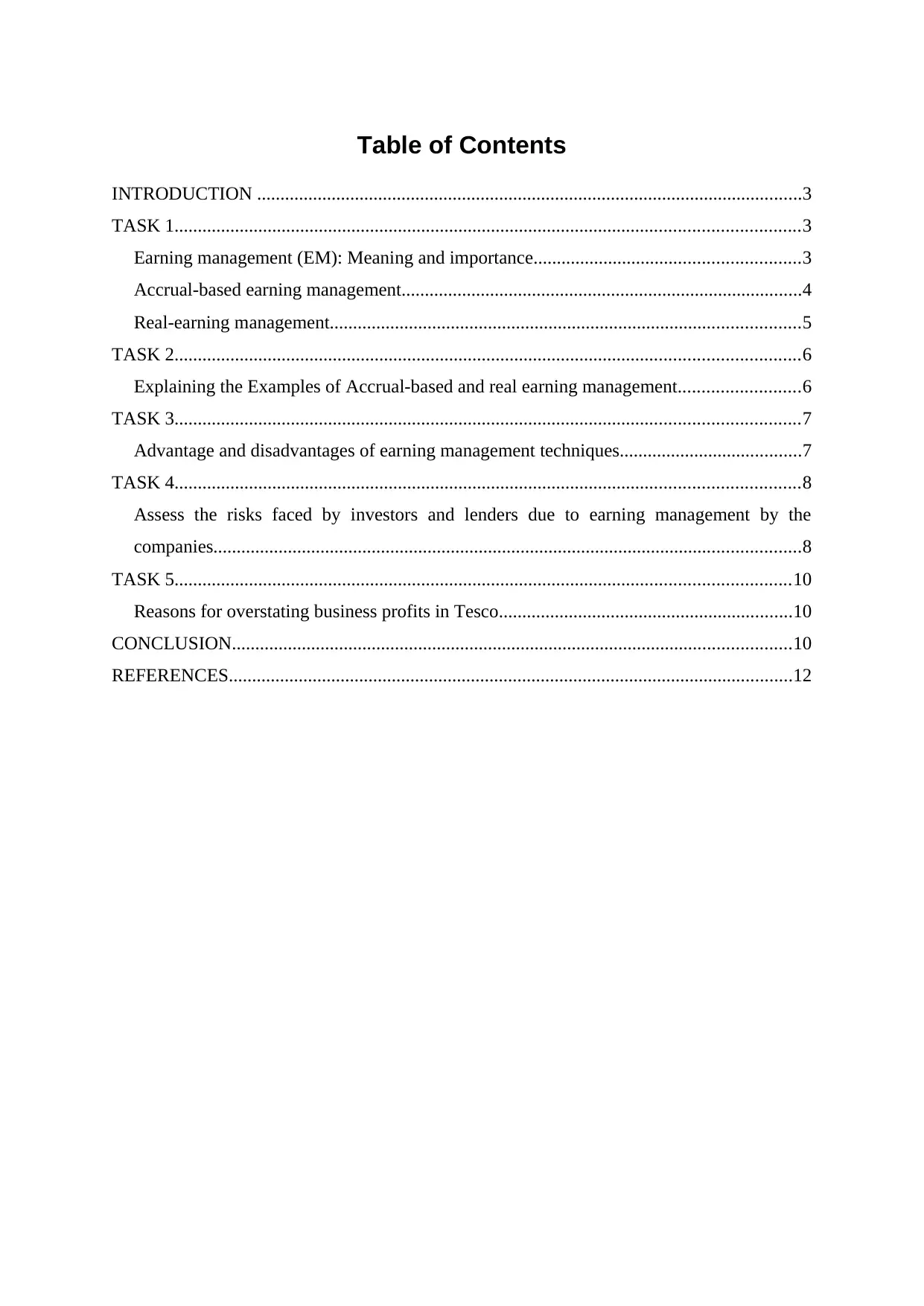
Table of Contents
INTRODUCTION .....................................................................................................................3
TASK 1......................................................................................................................................3
Earning management (EM): Meaning and importance.........................................................3
Accrual-based earning management......................................................................................4
Real-earning management.....................................................................................................5
TASK 2......................................................................................................................................6
Explaining the Examples of Accrual-based and real earning management..........................6
TASK 3......................................................................................................................................7
Advantage and disadvantages of earning management techniques.......................................7
TASK 4......................................................................................................................................8
Assess the risks faced by investors and lenders due to earning management by the
companies..............................................................................................................................8
TASK 5....................................................................................................................................10
Reasons for overstating business profits in Tesco...............................................................10
CONCLUSION........................................................................................................................10
REFERENCES.........................................................................................................................12
INTRODUCTION .....................................................................................................................3
TASK 1......................................................................................................................................3
Earning management (EM): Meaning and importance.........................................................3
Accrual-based earning management......................................................................................4
Real-earning management.....................................................................................................5
TASK 2......................................................................................................................................6
Explaining the Examples of Accrual-based and real earning management..........................6
TASK 3......................................................................................................................................7
Advantage and disadvantages of earning management techniques.......................................7
TASK 4......................................................................................................................................8
Assess the risks faced by investors and lenders due to earning management by the
companies..............................................................................................................................8
TASK 5....................................................................................................................................10
Reasons for overstating business profits in Tesco...............................................................10
CONCLUSION........................................................................................................................10
REFERENCES.........................................................................................................................12
INTRODUCTION
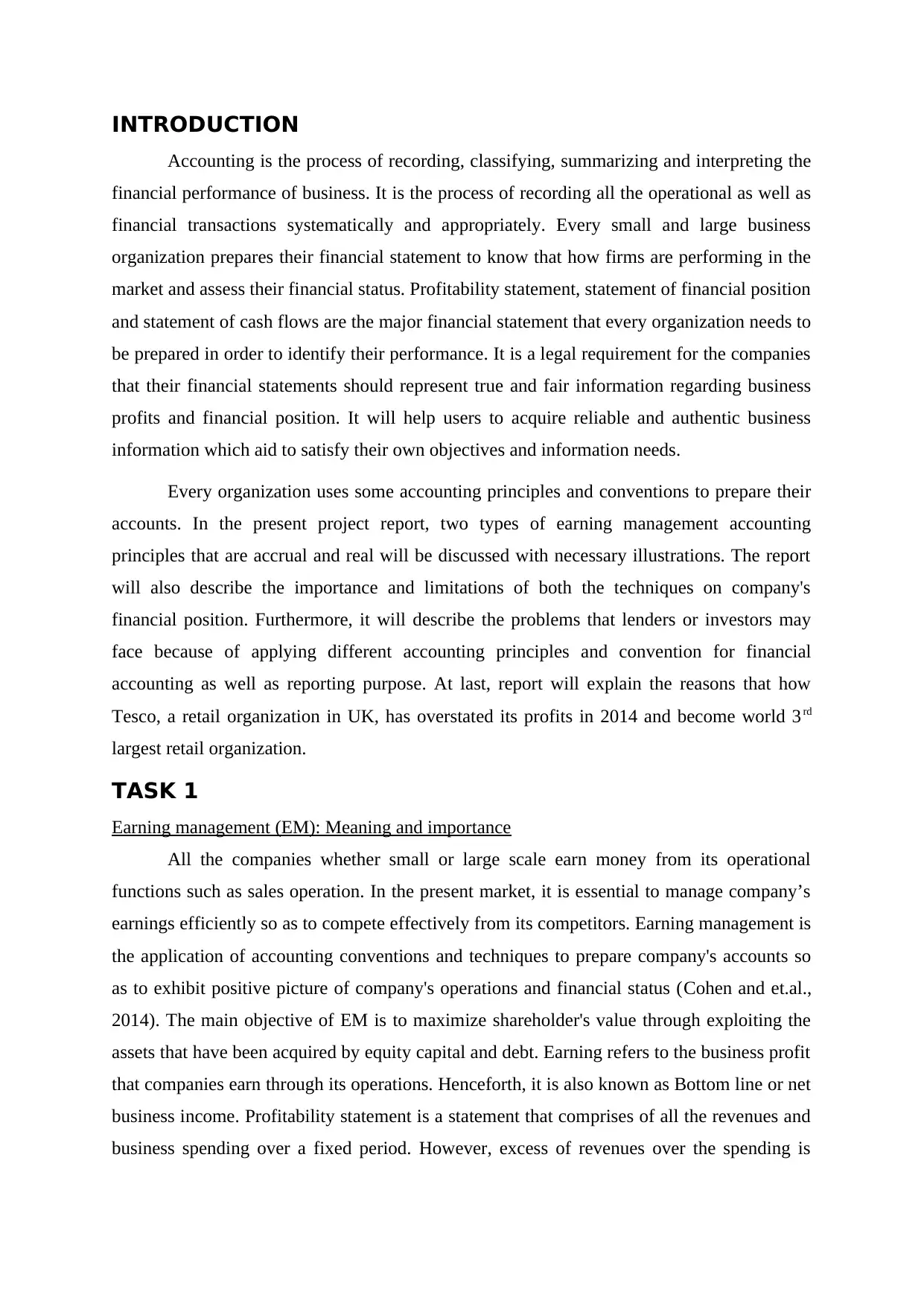
Accounting is the process of recording, classifying, summarizing and interpreting the
financial performance of business. It is the process of recording all the operational as well as
financial transactions systematically and appropriately. Every small and large business
organization prepares their financial statement to know that how firms are performing in the
market and assess their financial status. Profitability statement, statement of financial position
and statement of cash flows are the major financial statement that every organization needs to
be prepared in order to identify their performance. It is a legal requirement for the companies
that their financial statements should represent true and fair information regarding business
profits and financial position. It will help users to acquire reliable and authentic business
information which aid to satisfy their own objectives and information needs.
Every organization uses some accounting principles and conventions to prepare their
accounts. In the present project report, two types of earning management accounting
principles that are accrual and real will be discussed with necessary illustrations. The report
will also describe the importance and limitations of both the techniques on company's
financial position. Furthermore, it will describe the problems that lenders or investors may
face because of applying different accounting principles and convention for financial
accounting as well as reporting purpose. At last, report will explain the reasons that how
Tesco, a retail organization in UK, has overstated its profits in 2014 and become world 3rd
largest retail organization.
TASK 1
Earning management (EM): Meaning and importance
All the companies whether small or large scale earn money from its operational
functions such as sales operation. In the present market, it is essential to manage company’s
earnings efficiently so as to compete effectively from its competitors. Earning management is
the application of accounting conventions and techniques to prepare company's accounts so
as to exhibit positive picture of company's operations and financial status (Cohen and et.al.,
2014). The main objective of EM is to maximize shareholder's value through exploiting the
assets that have been acquired by equity capital and debt. Earning refers to the business profit
that companies earn through its operations. Henceforth, it is also known as Bottom line or net
business income. Profitability statement is a statement that comprises of all the revenues and
business spending over a fixed period. However, excess of revenues over the spending is
Accounting is the process of recording, classifying, summarizing and interpreting the
financial performance of business. It is the process of recording all the operational as well as
financial transactions systematically and appropriately. Every small and large business
organization prepares their financial statement to know that how firms are performing in the
market and assess their financial status. Profitability statement, statement of financial position
and statement of cash flows are the major financial statement that every organization needs to
be prepared in order to identify their performance. It is a legal requirement for the companies
that their financial statements should represent true and fair information regarding business
profits and financial position. It will help users to acquire reliable and authentic business
information which aid to satisfy their own objectives and information needs.
Every organization uses some accounting principles and conventions to prepare their
accounts. In the present project report, two types of earning management accounting
principles that are accrual and real will be discussed with necessary illustrations. The report
will also describe the importance and limitations of both the techniques on company's
financial position. Furthermore, it will describe the problems that lenders or investors may
face because of applying different accounting principles and convention for financial
accounting as well as reporting purpose. At last, report will explain the reasons that how
Tesco, a retail organization in UK, has overstated its profits in 2014 and become world 3rd
largest retail organization.
TASK 1
Earning management (EM): Meaning and importance
All the companies whether small or large scale earn money from its operational
functions such as sales operation. In the present market, it is essential to manage company’s
earnings efficiently so as to compete effectively from its competitors. Earning management is
the application of accounting conventions and techniques to prepare company's accounts so
as to exhibit positive picture of company's operations and financial status (Cohen and et.al.,
2014). The main objective of EM is to maximize shareholder's value through exploiting the
assets that have been acquired by equity capital and debt. Earning refers to the business profit
that companies earn through its operations. Henceforth, it is also known as Bottom line or net
business income. Profitability statement is a statement that comprises of all the revenues and
business spending over a fixed period. However, excess of revenues over the spending is
⊘ This is a preview!⊘
Do you want full access?
Subscribe today to unlock all pages.

Trusted by 1+ million students worldwide
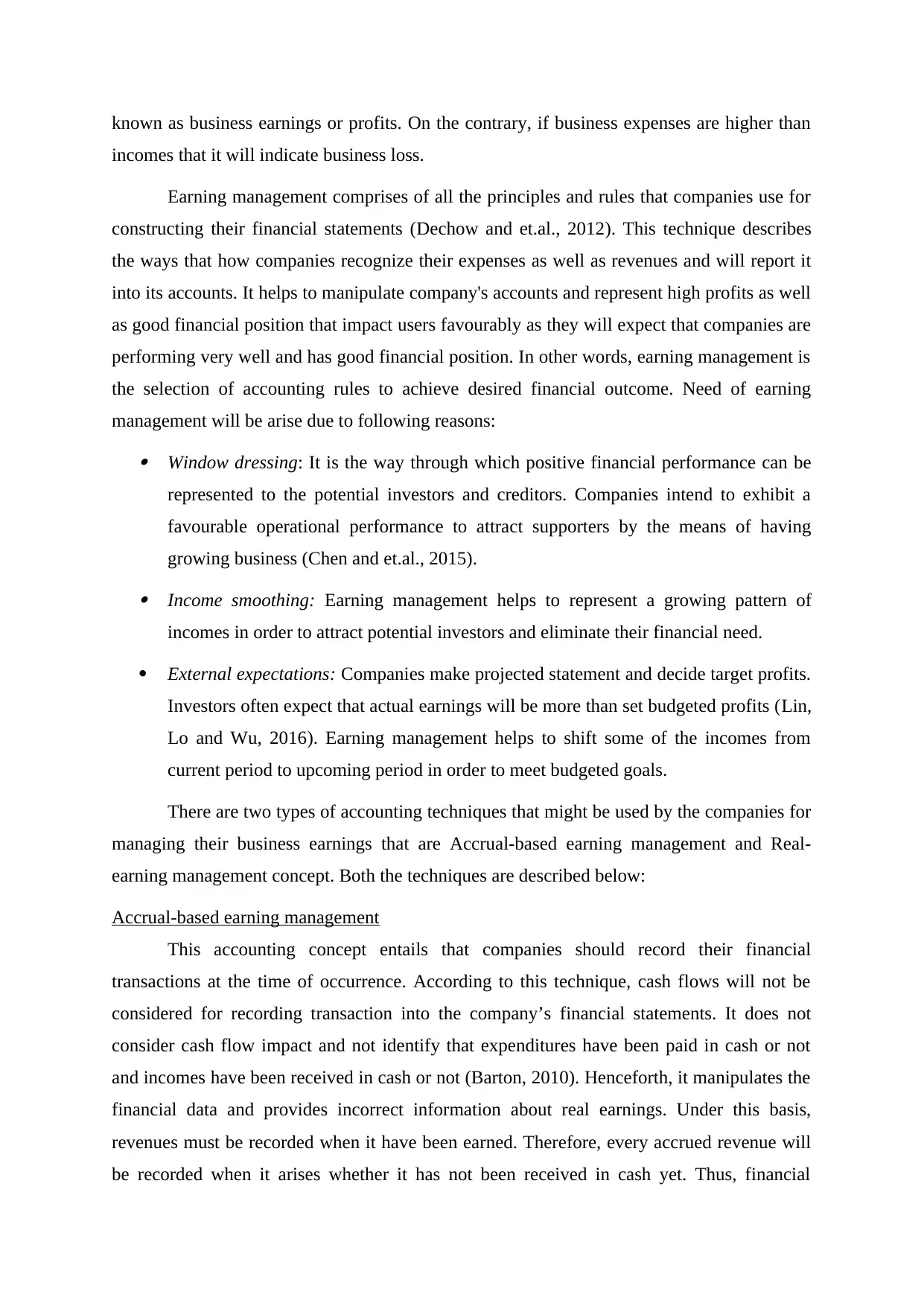
known as business earnings or profits. On the contrary, if business expenses are higher than
incomes that it will indicate business loss.
Earning management comprises of all the principles and rules that companies use for
constructing their financial statements (Dechow and et.al., 2012). This technique describes
the ways that how companies recognize their expenses as well as revenues and will report it
into its accounts. It helps to manipulate company's accounts and represent high profits as well
as good financial position that impact users favourably as they will expect that companies are
performing very well and has good financial position. In other words, earning management is
the selection of accounting rules to achieve desired financial outcome. Need of earning
management will be arise due to following reasons: Window dressing: It is the way through which positive financial performance can be
represented to the potential investors and creditors. Companies intend to exhibit a
favourable operational performance to attract supporters by the means of having
growing business (Chen and et.al., 2015). Income smoothing: Earning management helps to represent a growing pattern of
incomes in order to attract potential investors and eliminate their financial need.
External expectations: Companies make projected statement and decide target profits.
Investors often expect that actual earnings will be more than set budgeted profits (Lin,
Lo and Wu, 2016). Earning management helps to shift some of the incomes from
current period to upcoming period in order to meet budgeted goals.
There are two types of accounting techniques that might be used by the companies for
managing their business earnings that are Accrual-based earning management and Real-
earning management concept. Both the techniques are described below:
Accrual-based earning management
This accounting concept entails that companies should record their financial
transactions at the time of occurrence. According to this technique, cash flows will not be
considered for recording transaction into the company’s financial statements. It does not
consider cash flow impact and not identify that expenditures have been paid in cash or not
and incomes have been received in cash or not (Barton, 2010). Henceforth, it manipulates the
financial data and provides incorrect information about real earnings. Under this basis,
revenues must be recorded when it have been earned. Therefore, every accrued revenue will
be recorded when it arises whether it has not been received in cash yet. Thus, financial
incomes that it will indicate business loss.
Earning management comprises of all the principles and rules that companies use for
constructing their financial statements (Dechow and et.al., 2012). This technique describes
the ways that how companies recognize their expenses as well as revenues and will report it
into its accounts. It helps to manipulate company's accounts and represent high profits as well
as good financial position that impact users favourably as they will expect that companies are
performing very well and has good financial position. In other words, earning management is
the selection of accounting rules to achieve desired financial outcome. Need of earning
management will be arise due to following reasons: Window dressing: It is the way through which positive financial performance can be
represented to the potential investors and creditors. Companies intend to exhibit a
favourable operational performance to attract supporters by the means of having
growing business (Chen and et.al., 2015). Income smoothing: Earning management helps to represent a growing pattern of
incomes in order to attract potential investors and eliminate their financial need.
External expectations: Companies make projected statement and decide target profits.
Investors often expect that actual earnings will be more than set budgeted profits (Lin,
Lo and Wu, 2016). Earning management helps to shift some of the incomes from
current period to upcoming period in order to meet budgeted goals.
There are two types of accounting techniques that might be used by the companies for
managing their business earnings that are Accrual-based earning management and Real-
earning management concept. Both the techniques are described below:
Accrual-based earning management
This accounting concept entails that companies should record their financial
transactions at the time of occurrence. According to this technique, cash flows will not be
considered for recording transaction into the company’s financial statements. It does not
consider cash flow impact and not identify that expenditures have been paid in cash or not
and incomes have been received in cash or not (Barton, 2010). Henceforth, it manipulates the
financial data and provides incorrect information about real earnings. Under this basis,
revenues must be recorded when it have been earned. Therefore, every accrued revenue will
be recorded when it arises whether it has not been received in cash yet. Thus, financial
Paraphrase This Document
Need a fresh take? Get an instant paraphrase of this document with our AI Paraphraser
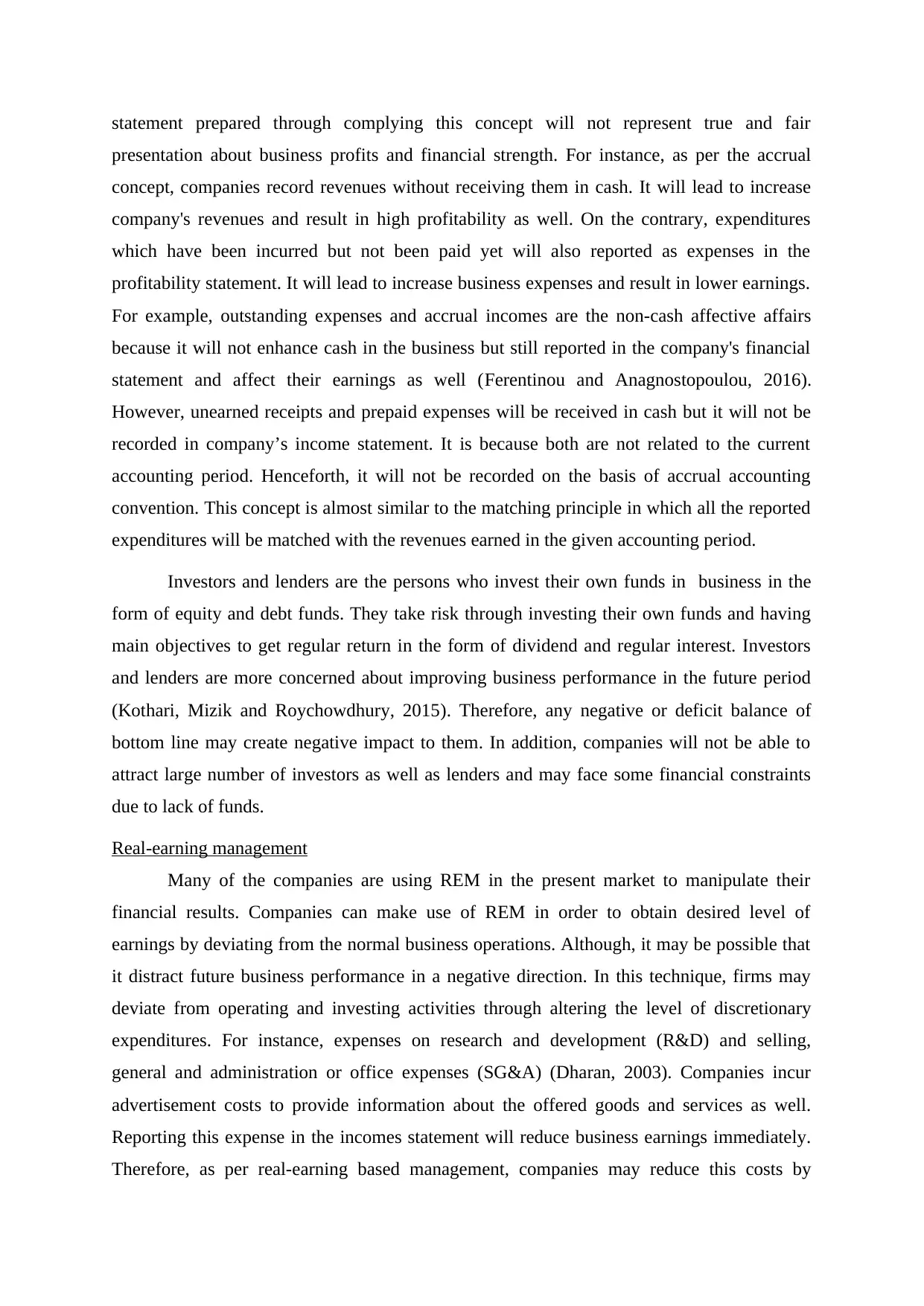
statement prepared through complying this concept will not represent true and fair
presentation about business profits and financial strength. For instance, as per the accrual
concept, companies record revenues without receiving them in cash. It will lead to increase
company's revenues and result in high profitability as well. On the contrary, expenditures
which have been incurred but not been paid yet will also reported as expenses in the
profitability statement. It will lead to increase business expenses and result in lower earnings.
For example, outstanding expenses and accrual incomes are the non-cash affective affairs
because it will not enhance cash in the business but still reported in the company's financial
statement and affect their earnings as well (Ferentinou and Anagnostopoulou, 2016).
However, unearned receipts and prepaid expenses will be received in cash but it will not be
recorded in company’s income statement. It is because both are not related to the current
accounting period. Henceforth, it will not be recorded on the basis of accrual accounting
convention. This concept is almost similar to the matching principle in which all the reported
expenditures will be matched with the revenues earned in the given accounting period.
Investors and lenders are the persons who invest their own funds in business in the
form of equity and debt funds. They take risk through investing their own funds and having
main objectives to get regular return in the form of dividend and regular interest. Investors
and lenders are more concerned about improving business performance in the future period
(Kothari, Mizik and Roychowdhury, 2015). Therefore, any negative or deficit balance of
bottom line may create negative impact to them. In addition, companies will not be able to
attract large number of investors as well as lenders and may face some financial constraints
due to lack of funds.
Real-earning management
Many of the companies are using REM in the present market to manipulate their
financial results. Companies can make use of REM in order to obtain desired level of
earnings by deviating from the normal business operations. Although, it may be possible that
it distract future business performance in a negative direction. In this technique, firms may
deviate from operating and investing activities through altering the level of discretionary
expenditures. For instance, expenses on research and development (R&D) and selling,
general and administration or office expenses (SG&A) (Dharan, 2003). Companies incur
advertisement costs to provide information about the offered goods and services as well.
Reporting this expense in the incomes statement will reduce business earnings immediately.
Therefore, as per real-earning based management, companies may reduce this costs by
presentation about business profits and financial strength. For instance, as per the accrual
concept, companies record revenues without receiving them in cash. It will lead to increase
company's revenues and result in high profitability as well. On the contrary, expenditures
which have been incurred but not been paid yet will also reported as expenses in the
profitability statement. It will lead to increase business expenses and result in lower earnings.
For example, outstanding expenses and accrual incomes are the non-cash affective affairs
because it will not enhance cash in the business but still reported in the company's financial
statement and affect their earnings as well (Ferentinou and Anagnostopoulou, 2016).
However, unearned receipts and prepaid expenses will be received in cash but it will not be
recorded in company’s income statement. It is because both are not related to the current
accounting period. Henceforth, it will not be recorded on the basis of accrual accounting
convention. This concept is almost similar to the matching principle in which all the reported
expenditures will be matched with the revenues earned in the given accounting period.
Investors and lenders are the persons who invest their own funds in business in the
form of equity and debt funds. They take risk through investing their own funds and having
main objectives to get regular return in the form of dividend and regular interest. Investors
and lenders are more concerned about improving business performance in the future period
(Kothari, Mizik and Roychowdhury, 2015). Therefore, any negative or deficit balance of
bottom line may create negative impact to them. In addition, companies will not be able to
attract large number of investors as well as lenders and may face some financial constraints
due to lack of funds.
Real-earning management
Many of the companies are using REM in the present market to manipulate their
financial results. Companies can make use of REM in order to obtain desired level of
earnings by deviating from the normal business operations. Although, it may be possible that
it distract future business performance in a negative direction. In this technique, firms may
deviate from operating and investing activities through altering the level of discretionary
expenditures. For instance, expenses on research and development (R&D) and selling,
general and administration or office expenses (SG&A) (Dharan, 2003). Companies incur
advertisement costs to provide information about the offered goods and services as well.
Reporting this expense in the incomes statement will reduce business earnings immediately.
Therefore, as per real-earning based management, companies may reduce this costs by

capitalizing it. Further, it can be deviated through overproduction because it helps to price
reduction and boosting sales revenues. Moreover, overproduction provide assistance to
reduce per unit costs and spread all the fixed costs to large production (Gunny, 2005).
Furthermore, selling the assets when it can be sale at gain helps to enhance total revenues and
earnings as well.
TASK 2
Explaining the Examples of Accrual-based and real earning management
Accrual-based earning management
Under the accrual based accounting concept, incomes and expenditures will be
reported at the time when they incurred without recognising their cash receipts and payments.
Therefore, its examples are illustrated below:
Accrued income: Total interest for whole year is £24000 out of this interest of 2
months is still accrued by the company, calculated here as under:
Accrued interest = £24000*2/12 = £4000
In this case, interest for full year is £24000 and accrued interest for two months is
amounted to £4000. It means that out of £24000 company received only £20000 and amount
worth £4000 will be termed as accrued interest. When, company adopts accrual concept, than
it will record full year interest of £24000 in the profitability statement as incomes resulted in
increasing business profits. It is because accrued interest is the income of current period
which have not been incurred in cash henceforth, it will be reported in the same year.
Prepaid expenses: This are the expenses which have been paid in prior and related to
the upcoming period.
Total rent paid = £12000
Prepaid rent for 1 month = £1000
As per Accrual concept, only the amount of £11000 will be recorded as expenditures
in the profitability statement. It is because prepaid expenses are not related to the current
accounting period therefore, it will not be shown whether it has been paid in cash or not. It
will lead to lower expenses and attain high profits.
Real-earning management
Advertisement costs for the year = £36000
reduction and boosting sales revenues. Moreover, overproduction provide assistance to
reduce per unit costs and spread all the fixed costs to large production (Gunny, 2005).
Furthermore, selling the assets when it can be sale at gain helps to enhance total revenues and
earnings as well.
TASK 2
Explaining the Examples of Accrual-based and real earning management
Accrual-based earning management
Under the accrual based accounting concept, incomes and expenditures will be
reported at the time when they incurred without recognising their cash receipts and payments.
Therefore, its examples are illustrated below:
Accrued income: Total interest for whole year is £24000 out of this interest of 2
months is still accrued by the company, calculated here as under:
Accrued interest = £24000*2/12 = £4000
In this case, interest for full year is £24000 and accrued interest for two months is
amounted to £4000. It means that out of £24000 company received only £20000 and amount
worth £4000 will be termed as accrued interest. When, company adopts accrual concept, than
it will record full year interest of £24000 in the profitability statement as incomes resulted in
increasing business profits. It is because accrued interest is the income of current period
which have not been incurred in cash henceforth, it will be reported in the same year.
Prepaid expenses: This are the expenses which have been paid in prior and related to
the upcoming period.
Total rent paid = £12000
Prepaid rent for 1 month = £1000
As per Accrual concept, only the amount of £11000 will be recorded as expenditures
in the profitability statement. It is because prepaid expenses are not related to the current
accounting period therefore, it will not be shown whether it has been paid in cash or not. It
will lead to lower expenses and attain high profits.
Real-earning management
Advertisement costs for the year = £36000
⊘ This is a preview!⊘
Do you want full access?
Subscribe today to unlock all pages.
Trusted by 1+ million students worldwide
In REM, if company amortize this cost into 3 years, than in each year, profitability
statements records for only £3000 as expenses results in manipulating profitability and the
balance of £33000 will be reported as fictitious assets in the balance sheet.
Preliminary expenses = £150000
Preliminary expenses comprises all the expenses that have been incurred before
establishing the company such as registration charges. In REM, companies can write off this
expenses within 5 years. Therefore, each year expenditures worth £30000 will be reported
results in lower expenses and high earnings.
TASK 3
Advantage and disadvantages of earning management techniques
Advantage of Accrual based earning management:Managers who are wishing to alter
the REM with the accrual based earning management can take advantage of the following:
It helps managers to manipulate earnings through recording all the business revenues
and expenditures of the relevant accounting period through combining all the
outstanding expenses and accrued incomes (Ball, 2013). However, prepaid expenses
and unearned revenues will be eliminated although, it has been received in cash.
It helps to represent a growth pattern of companies operations and attract large
number of potential investors and lenders to the organization.
Manipulation of profits helps to exhibit favourable business performance so that all
the stakeholders such as existed shareholders, lenders, employees and creditors will
be highly satisfied (Ronen and Yaari, 2008). It improving in manager's
communication of private business information to the external stakeholders.
Disadvantage of Accrual based earning management: Apart from the advantages, it
has several limitations also, described below:
Financial statement does not provide reliable and authentic information to the
managers and represent unfair and untrue financial position (He, 2016).
Managers uses companies financial statements to examine and evaluate financial
performance, Henceforth, incorrect information or misstatement may lead to harmful
decisions.
statements records for only £3000 as expenses results in manipulating profitability and the
balance of £33000 will be reported as fictitious assets in the balance sheet.
Preliminary expenses = £150000
Preliminary expenses comprises all the expenses that have been incurred before
establishing the company such as registration charges. In REM, companies can write off this
expenses within 5 years. Therefore, each year expenditures worth £30000 will be reported
results in lower expenses and high earnings.
TASK 3
Advantage and disadvantages of earning management techniques
Advantage of Accrual based earning management:Managers who are wishing to alter
the REM with the accrual based earning management can take advantage of the following:
It helps managers to manipulate earnings through recording all the business revenues
and expenditures of the relevant accounting period through combining all the
outstanding expenses and accrued incomes (Ball, 2013). However, prepaid expenses
and unearned revenues will be eliminated although, it has been received in cash.
It helps to represent a growth pattern of companies operations and attract large
number of potential investors and lenders to the organization.
Manipulation of profits helps to exhibit favourable business performance so that all
the stakeholders such as existed shareholders, lenders, employees and creditors will
be highly satisfied (Ronen and Yaari, 2008). It improving in manager's
communication of private business information to the external stakeholders.
Disadvantage of Accrual based earning management: Apart from the advantages, it
has several limitations also, described below:
Financial statement does not provide reliable and authentic information to the
managers and represent unfair and untrue financial position (He, 2016).
Managers uses companies financial statements to examine and evaluate financial
performance, Henceforth, incorrect information or misstatement may lead to harmful
decisions.
Paraphrase This Document
Need a fresh take? Get an instant paraphrase of this document with our AI Paraphraser
Under this, if company will show all the advertisement costs in the accounting year in
which they are incurred than it will urgently decline profitability to a great extent.
Thus, misallocation of resources are its costs.
Managers can not determine real profits as artificial profits are represented by accrual-
based earning management.
Advantage of Real earning management : This are described here as under:
Managers can amortise some of their current year expenses over some years such as
advertisement costs. Thus, it will helps to not to increase total expenses and maintain
profitability as well (Gao, 2013). Amortization of costs provide assistance to represent true picture of business
performance. It is because advertisement costs are the expenses that helps not only in
the current year but also in forthcoming years. Henceforth, this method provide
assistance to exhibit real business performance.
Disadvantage of Real earning management:
Its drawback is in the present age of competition, use of REM can reduce companies
competitive strengths.
Increasing the earnings through uses of REM will increase tax liabilities and results in
higher tax payments and lower net profits (Wilson, 2015). Thus, it can be said that
higher tax rates will constraints the use of REM in the businesses.
TASK 4
Assess the risks faced by investors and lenders due to earning management by the companies
As said earlier, earning management techniques are the application of different
accounting conventions, rules and principles that helps to manipulate companies bottom line.
Thus, incorrect business earnings management techniques will mislead business stakeholders
about the companies performance and may lead to harmful decisions. Therefore, investors
and lenders will face many difficulties and risks through decisions that were taken on the
basis of company's financial statement described below:
Investors are the shareholders who invest funds through buying ownership in the
companies and invest their own money in the form of equity capital. They take ownership in
the business through investing their own funds and take risk. Their main objectives is to
receive high return in the form of dividend and capital appreciation in the stock prices. Before
which they are incurred than it will urgently decline profitability to a great extent.
Thus, misallocation of resources are its costs.
Managers can not determine real profits as artificial profits are represented by accrual-
based earning management.
Advantage of Real earning management : This are described here as under:
Managers can amortise some of their current year expenses over some years such as
advertisement costs. Thus, it will helps to not to increase total expenses and maintain
profitability as well (Gao, 2013). Amortization of costs provide assistance to represent true picture of business
performance. It is because advertisement costs are the expenses that helps not only in
the current year but also in forthcoming years. Henceforth, this method provide
assistance to exhibit real business performance.
Disadvantage of Real earning management:
Its drawback is in the present age of competition, use of REM can reduce companies
competitive strengths.
Increasing the earnings through uses of REM will increase tax liabilities and results in
higher tax payments and lower net profits (Wilson, 2015). Thus, it can be said that
higher tax rates will constraints the use of REM in the businesses.
TASK 4
Assess the risks faced by investors and lenders due to earning management by the companies
As said earlier, earning management techniques are the application of different
accounting conventions, rules and principles that helps to manipulate companies bottom line.
Thus, incorrect business earnings management techniques will mislead business stakeholders
about the companies performance and may lead to harmful decisions. Therefore, investors
and lenders will face many difficulties and risks through decisions that were taken on the
basis of company's financial statement described below:
Investors are the shareholders who invest funds through buying ownership in the
companies and invest their own money in the form of equity capital. They take ownership in
the business through investing their own funds and take risk. Their main objectives is to
receive high return in the form of dividend and capital appreciation in the stock prices. Before
investing in the organization, investors analyse risk and reward relationship through acquiring
information from the company's published financial statements. They make use of
profitability statement to know business profits whereas statement of financial position
(SOFP) helps to identify company's capital structure and solvency position (Wu, Shen and
Lu, 2015). They evaluate business profits and compare its trend with the another firms to
determine most viable or growing company in which investment can be made.
Therefore, any misleading or misrepresentation of company's accounts will provide
incorrect information about the business profits and results in harmful decisions.
Furthermore, companies who adopts AEM and REM as earning management techniques.
their profitability will be significantly different from each other. Therefore, in this case,
comparative analysis can not be done. It is because financial statements that are prepared
through using different accounting principles will record same accounting transaction with
different amount. Companies who use accrual concepts, will not reports about all the incomes
that have received in cash in current year but related to upcoming years (Moghaddam and
et..al., 2015). On the other hand, incomes and expenses which are not received and paid in
cash but still relevant to this year will be reported in the profitability statement and results in
misleading the investors.
Along with this, lenders will be also very much affected by companies earning
management techniques. They are the persons who provide funds to the organisation at some
interest charges. Their main aim is to get regular return in the form of interest charges. They
analyse company's profits to determine how much business is able to repay the loan on time
with timely interest payments. Furthermore, they analyse business interest bearing capacity to
identify that how much business is able to meet their borrowing costs out of its available
profits (Joosten, 2012). Thus, in that case, if business use accrual based earning management
than profits will be artificial which may lead to take incorrect lending decisions. Moreover, it
may be possible that profitability reported as per accrual based earning management and real
earning management are different. Thus, comparative analysis can not be carried out
effectively. Along with this, accrual-based technique may lower business profits and indicate
lower interest bearing capacity (The pros and cons of earnings management, 2009).
Therefore, lenders will not lend money to this type of organizations. However, in real, it
might be possible that real profits are higher than reported actual possible. Thus, companies
may face financial difficulties and can not compete effectively.
information from the company's published financial statements. They make use of
profitability statement to know business profits whereas statement of financial position
(SOFP) helps to identify company's capital structure and solvency position (Wu, Shen and
Lu, 2015). They evaluate business profits and compare its trend with the another firms to
determine most viable or growing company in which investment can be made.
Therefore, any misleading or misrepresentation of company's accounts will provide
incorrect information about the business profits and results in harmful decisions.
Furthermore, companies who adopts AEM and REM as earning management techniques.
their profitability will be significantly different from each other. Therefore, in this case,
comparative analysis can not be done. It is because financial statements that are prepared
through using different accounting principles will record same accounting transaction with
different amount. Companies who use accrual concepts, will not reports about all the incomes
that have received in cash in current year but related to upcoming years (Moghaddam and
et..al., 2015). On the other hand, incomes and expenses which are not received and paid in
cash but still relevant to this year will be reported in the profitability statement and results in
misleading the investors.
Along with this, lenders will be also very much affected by companies earning
management techniques. They are the persons who provide funds to the organisation at some
interest charges. Their main aim is to get regular return in the form of interest charges. They
analyse company's profits to determine how much business is able to repay the loan on time
with timely interest payments. Furthermore, they analyse business interest bearing capacity to
identify that how much business is able to meet their borrowing costs out of its available
profits (Joosten, 2012). Thus, in that case, if business use accrual based earning management
than profits will be artificial which may lead to take incorrect lending decisions. Moreover, it
may be possible that profitability reported as per accrual based earning management and real
earning management are different. Thus, comparative analysis can not be carried out
effectively. Along with this, accrual-based technique may lower business profits and indicate
lower interest bearing capacity (The pros and cons of earnings management, 2009).
Therefore, lenders will not lend money to this type of organizations. However, in real, it
might be possible that real profits are higher than reported actual possible. Thus, companies
may face financial difficulties and can not compete effectively.
⊘ This is a preview!⊘
Do you want full access?
Subscribe today to unlock all pages.
Trusted by 1+ million students worldwide

TASK 5
Reasons for overstating business profits in Tesco
Tesco Plc is a British multinational and merchandise retail firm that is headquartered
at Cheshnut, Hertfordshire, England in United Kingdom. The mission of company is to be the
champion for customers by providing better services to them.
In the scenario, it has been given that in the year 2014, Tesco overstated its profits by
a large amount that is £263 million. As a result, Tesco suspended its eight executives
including former commercial director kevin Grace and UK managing director Chris Bush.
However, due to overstated of its bottom line, Tesco became world third largest grocery
retailer organization in the world. It had number of stores in about 12 countries over the
world.
Reasons of overstated profits in Tesco by £263 million
Uses of real based earning management concept was the reason behind this overstated
profits. It is because as per this technique, Tesco amortised its some of the expenditures of the
year 2014 over the next few years. For instance, its advertisement costs that was incurred to
aware the consumer about Tesco's products is very large and if Tesco records all of this
expenses in the same accounting period than it will highly reduce business profits. However,
through uses of REM, Tesco write off some proportion of this costs in 2014 results in lower
profits and high business earnings. Furthermore, through considering administrative and
research and development expenses as capital expenses, Tesco gain advantageous of declined
revenues and high profits (Commerford and et.al., 2016). Moreover, balance costs that not
have been amortized till 2014, will be reported as assets in the financial position statements.
It will lead to enhance financial status and represent growth in profits and financial strength
as well. However, if Tesco has been used accrual concept, than all of the expenses has to be
shown as expenses in the same period. It will ultimately declined profits and indicate lower
performance.
CONCLUSION
On the basis of above report, it can be concluded that REM is increasingly use in the
business in current market situation. It helps to represent real business profits and helps to
take effective decisions by the investors and lenders. Furthermore, the report concluded that
REM has limited uses because of high earnings will impose high tax obligations and results
in lower net profits available for the investors. Along with this, report derived that AEM and
Reasons for overstating business profits in Tesco
Tesco Plc is a British multinational and merchandise retail firm that is headquartered
at Cheshnut, Hertfordshire, England in United Kingdom. The mission of company is to be the
champion for customers by providing better services to them.
In the scenario, it has been given that in the year 2014, Tesco overstated its profits by
a large amount that is £263 million. As a result, Tesco suspended its eight executives
including former commercial director kevin Grace and UK managing director Chris Bush.
However, due to overstated of its bottom line, Tesco became world third largest grocery
retailer organization in the world. It had number of stores in about 12 countries over the
world.
Reasons of overstated profits in Tesco by £263 million
Uses of real based earning management concept was the reason behind this overstated
profits. It is because as per this technique, Tesco amortised its some of the expenditures of the
year 2014 over the next few years. For instance, its advertisement costs that was incurred to
aware the consumer about Tesco's products is very large and if Tesco records all of this
expenses in the same accounting period than it will highly reduce business profits. However,
through uses of REM, Tesco write off some proportion of this costs in 2014 results in lower
profits and high business earnings. Furthermore, through considering administrative and
research and development expenses as capital expenses, Tesco gain advantageous of declined
revenues and high profits (Commerford and et.al., 2016). Moreover, balance costs that not
have been amortized till 2014, will be reported as assets in the financial position statements.
It will lead to enhance financial status and represent growth in profits and financial strength
as well. However, if Tesco has been used accrual concept, than all of the expenses has to be
shown as expenses in the same period. It will ultimately declined profits and indicate lower
performance.
CONCLUSION
On the basis of above report, it can be concluded that REM is increasingly use in the
business in current market situation. It helps to represent real business profits and helps to
take effective decisions by the investors and lenders. Furthermore, the report concluded that
REM has limited uses because of high earnings will impose high tax obligations and results
in lower net profits available for the investors. Along with this, report derived that AEM and
Paraphrase This Document
Need a fresh take? Get an instant paraphrase of this document with our AI Paraphraser
REM both the techniques impact investors and lenders in a great extent because incorrect
reporting structure and timing of reporting the transactions are different in this. So, they can
not compare different companies statements and may lead to harmful lending and investing
decisions. Last part of the report concluded that uses of real-earning management techniques
is the reason for overstated profits by Tesco in the year 2014. In this, Tesco amortized its
expenditures that incurred in a large amount over next few years. This in turn, profitability
statements exhibited large profits availability in Tesco and indicate well performance. Thus,
report concluded that both the AEM and REM techniques are widely used by the businesses
to manipulate their profits and create a good image in the mind of investors, lenders and other
users to enjoy high growth and success.
reporting structure and timing of reporting the transactions are different in this. So, they can
not compare different companies statements and may lead to harmful lending and investing
decisions. Last part of the report concluded that uses of real-earning management techniques
is the reason for overstated profits by Tesco in the year 2014. In this, Tesco amortized its
expenditures that incurred in a large amount over next few years. This in turn, profitability
statements exhibited large profits availability in Tesco and indicate well performance. Thus,
report concluded that both the AEM and REM techniques are widely used by the businesses
to manipulate their profits and create a good image in the mind of investors, lenders and other
users to enjoy high growth and success.
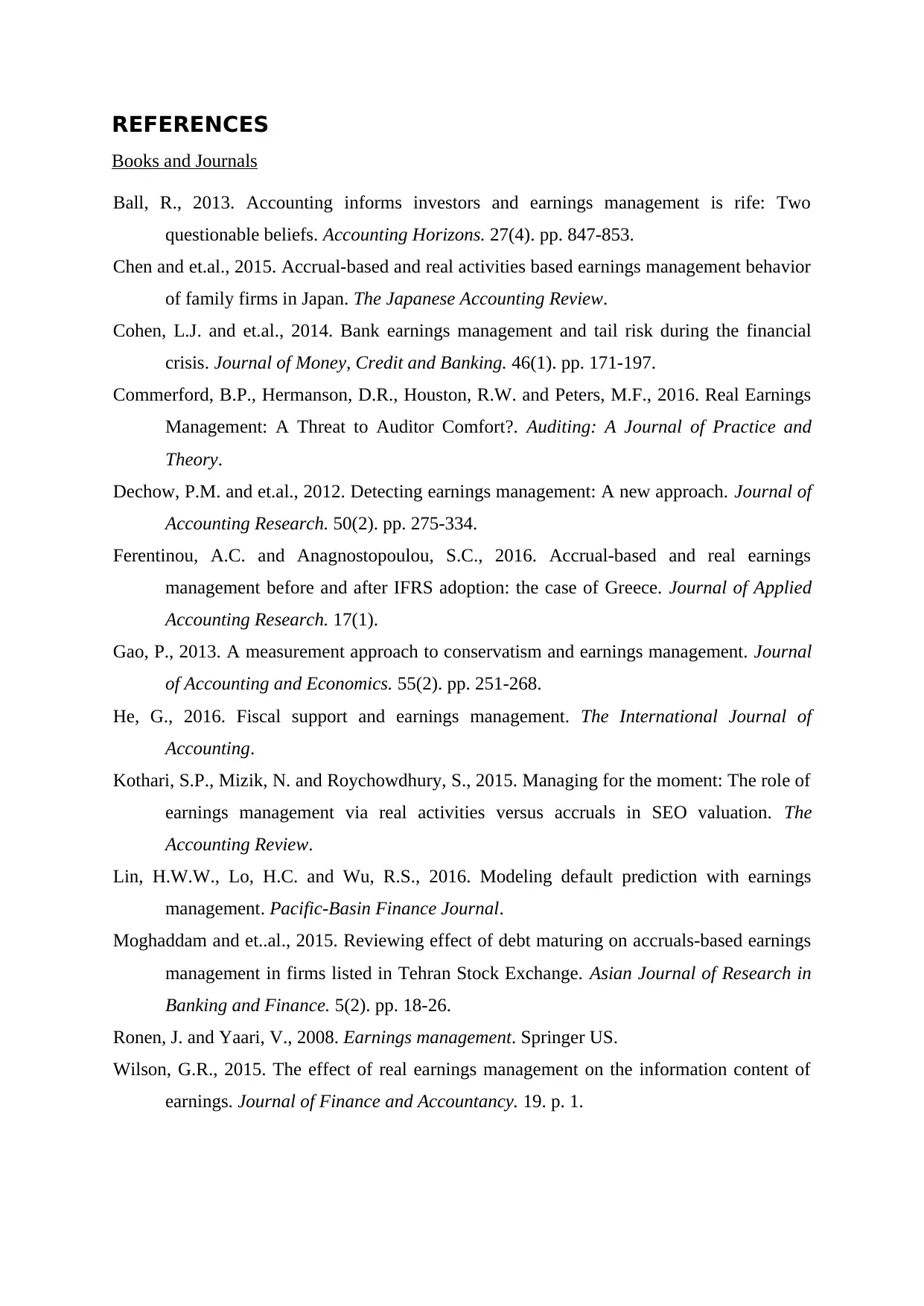
REFERENCES
Books and Journals
Ball, R., 2013. Accounting informs investors and earnings management is rife: Two
questionable beliefs. Accounting Horizons. 27(4). pp. 847-853.
Chen and et.al., 2015. Accrual-based and real activities based earnings management behavior
of family firms in Japan. The Japanese Accounting Review.
Cohen, L.J. and et.al., 2014. Bank earnings management and tail risk during the financial
crisis. Journal of Money, Credit and Banking. 46(1). pp. 171-197.
Commerford, B.P., Hermanson, D.R., Houston, R.W. and Peters, M.F., 2016. Real Earnings
Management: A Threat to Auditor Comfort?. Auditing: A Journal of Practice and
Theory.
Dechow, P.M. and et.al., 2012. Detecting earnings management: A new approach. Journal of
Accounting Research. 50(2). pp. 275-334.
Ferentinou, A.C. and Anagnostopoulou, S.C., 2016. Accrual-based and real earnings
management before and after IFRS adoption: the case of Greece. Journal of Applied
Accounting Research. 17(1).
Gao, P., 2013. A measurement approach to conservatism and earnings management. Journal
of Accounting and Economics. 55(2). pp. 251-268.
He, G., 2016. Fiscal support and earnings management. The International Journal of
Accounting.
Kothari, S.P., Mizik, N. and Roychowdhury, S., 2015. Managing for the moment: The role of
earnings management via real activities versus accruals in SEO valuation. The
Accounting Review.
Lin, H.W.W., Lo, H.C. and Wu, R.S., 2016. Modeling default prediction with earnings
management. Pacific-Basin Finance Journal.
Moghaddam and et..al., 2015. Reviewing effect of debt maturing on accruals-based earnings
management in firms listed in Tehran Stock Exchange. Asian Journal of Research in
Banking and Finance. 5(2). pp. 18-26.
Ronen, J. and Yaari, V., 2008. Earnings management. Springer US.
Wilson, G.R., 2015. The effect of real earnings management on the information content of
earnings. Journal of Finance and Accountancy. 19. p. 1.
Books and Journals
Ball, R., 2013. Accounting informs investors and earnings management is rife: Two
questionable beliefs. Accounting Horizons. 27(4). pp. 847-853.
Chen and et.al., 2015. Accrual-based and real activities based earnings management behavior
of family firms in Japan. The Japanese Accounting Review.
Cohen, L.J. and et.al., 2014. Bank earnings management and tail risk during the financial
crisis. Journal of Money, Credit and Banking. 46(1). pp. 171-197.
Commerford, B.P., Hermanson, D.R., Houston, R.W. and Peters, M.F., 2016. Real Earnings
Management: A Threat to Auditor Comfort?. Auditing: A Journal of Practice and
Theory.
Dechow, P.M. and et.al., 2012. Detecting earnings management: A new approach. Journal of
Accounting Research. 50(2). pp. 275-334.
Ferentinou, A.C. and Anagnostopoulou, S.C., 2016. Accrual-based and real earnings
management before and after IFRS adoption: the case of Greece. Journal of Applied
Accounting Research. 17(1).
Gao, P., 2013. A measurement approach to conservatism and earnings management. Journal
of Accounting and Economics. 55(2). pp. 251-268.
He, G., 2016. Fiscal support and earnings management. The International Journal of
Accounting.
Kothari, S.P., Mizik, N. and Roychowdhury, S., 2015. Managing for the moment: The role of
earnings management via real activities versus accruals in SEO valuation. The
Accounting Review.
Lin, H.W.W., Lo, H.C. and Wu, R.S., 2016. Modeling default prediction with earnings
management. Pacific-Basin Finance Journal.
Moghaddam and et..al., 2015. Reviewing effect of debt maturing on accruals-based earnings
management in firms listed in Tehran Stock Exchange. Asian Journal of Research in
Banking and Finance. 5(2). pp. 18-26.
Ronen, J. and Yaari, V., 2008. Earnings management. Springer US.
Wilson, G.R., 2015. The effect of real earnings management on the information content of
earnings. Journal of Finance and Accountancy. 19. p. 1.
⊘ This is a preview!⊘
Do you want full access?
Subscribe today to unlock all pages.
Trusted by 1+ million students worldwide

1 out of 13


Related Documents


Your All-in-One AI-Powered Toolkit for Academic Success.
+13062052269
info@desklib.com
Available 24*7 on WhatsApp / Email
![[object Object]](/_next/static/media/star-bottom.7253800d.svg)
Unlock your academic potential
Copyright © 2020–2026 A2Z Services. All Rights Reserved. Developed and managed by ZUCOL.