Earnings Management: Motives, Methods, and the Role of IFRS Standards
VerifiedAdded on 2023/06/17
|8
|2302
|161
Essay
AI Summary
This essay delves into the concept of earnings management, exploring the motives behind its practice and the various methods employed by firms to manipulate their reported earnings. It differentiates between accrual and real earnings management, highlighting the techniques used in each. The report discusses aggressive, conservative, and fraudulent accounting methods, examining how International Accounting/Reporting Standards (IAS/IFRS) and Generally Accepted Accounting Principles (GAAP) limit the use of these techniques. Examples of companies like 3Com, Sensorimotor, Tyco, and WR Grace & Co. are provided to illustrate real-world instances of earnings manipulation and the specific devices used. The essay concludes by emphasizing the importance of ethical earnings management practices and the potential consequences of misrepresentation in financial statements, advising that it is good when there is no private purpose.
Earnings Management

Paraphrase This Document
Need a fresh take? Get an instant paraphrase of this document with our AI Paraphraser
Table of Contents
INTRODUCTION ..........................................................................................................................3
TASK 1 ...........................................................................................................................................3
Concept of Managing earnings:..............................................................................................3
TASK 2............................................................................................................................................4
A detailed discussion on the motives of the organisation behind managing the earnings and
what are methods used for same.............................................................................................4
TASK 3............................................................................................................................................5
Discussion of the techniques used by firms to manage earnings and the extent to which
International Accounting/Reporting Standards have limited the use of these method. Use
examples of firms that have engaged in earnings management and the earnings management
devices used by these firms....................................................................................................5
CONCLUSION ...............................................................................................................................7
REFERENCES................................................................................................................................8
INTRODUCTION ..........................................................................................................................3
TASK 1 ...........................................................................................................................................3
Concept of Managing earnings:..............................................................................................3
TASK 2............................................................................................................................................4
A detailed discussion on the motives of the organisation behind managing the earnings and
what are methods used for same.............................................................................................4
TASK 3............................................................................................................................................5
Discussion of the techniques used by firms to manage earnings and the extent to which
International Accounting/Reporting Standards have limited the use of these method. Use
examples of firms that have engaged in earnings management and the earnings management
devices used by these firms....................................................................................................5
CONCLUSION ...............................................................................................................................7
REFERENCES................................................................................................................................8
INTRODUCTION
Earnings management refers to the practices that are followed by a company to deliberately
influence the earnings that are to be reported in the financial statements. It is mainly used by the
organisation to flatten out the earnings variations and show the profits at a consistent rate (Fan,
Jiang, Zhang, and Zhou, 2019). This is done in legitimate ways but this may create doubts in the
minds of investors as they want to invest in such firms who are actually growing and are stable.
This report discusses the main concept of earnings management and what are the techniques that
are taken up by a company to practice this.
TASK 1
Concept of Managing earnings:
Earnings management is concept in accounting which uses accounting a technique to show the
financial statements in an overly positive way. This way they create financial statements with
inflated or smooth earnings (Huang, and Sun, 2017). It is considered a bad concept as the profits
reported in the statements is either fake or measured based on unsure future judgements. It can
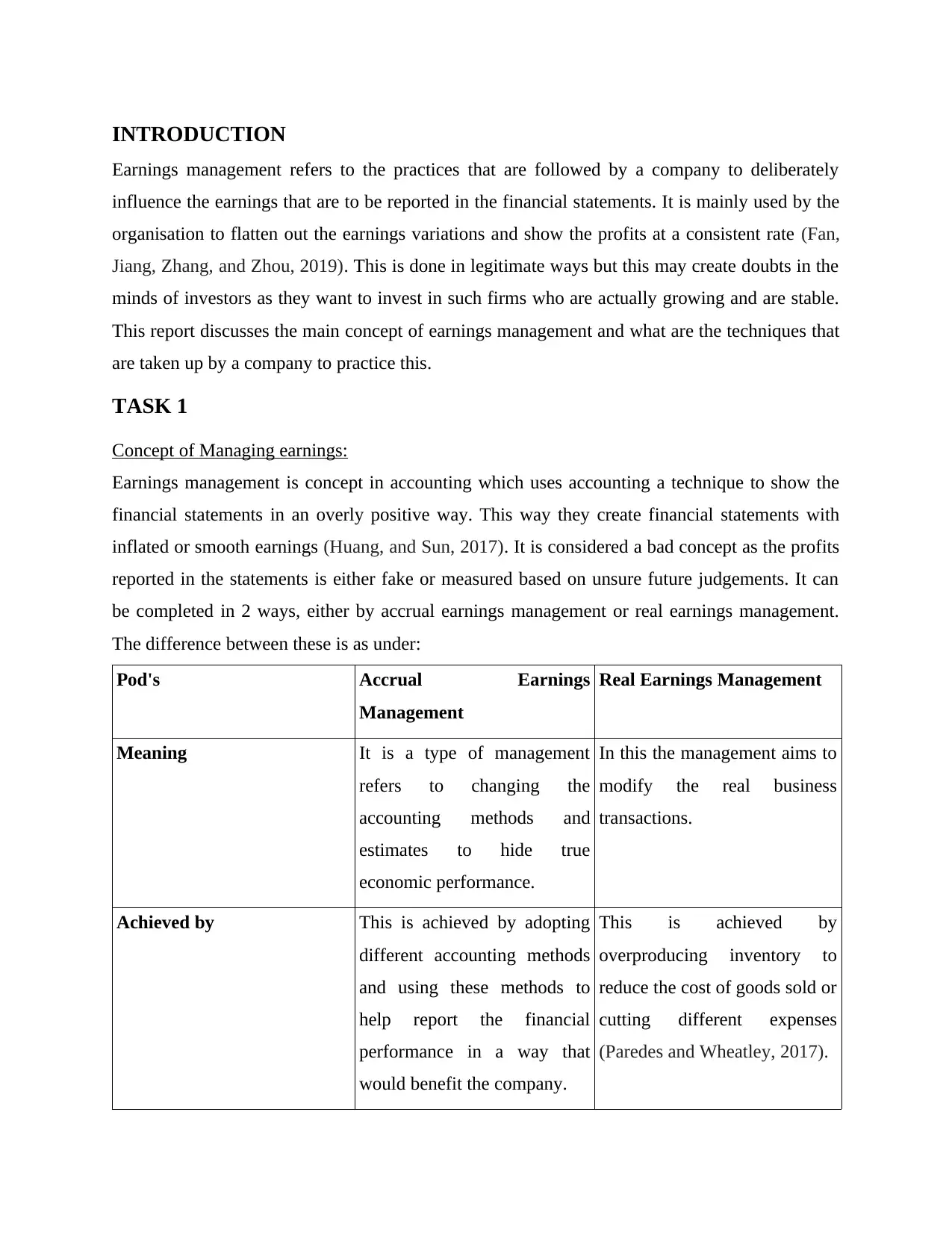
be completed in 2 ways, either by accrual earnings management or real earnings management.
The difference between these is as under:
Pod's Accrual Earnings
Management
Real Earnings Management
Meaning It is a type of management
refers to changing the
accounting methods and
estimates to hide true
economic performance.
In this the management aims to
modify the real business
transactions.
Achieved by This is achieved by adopting
different accounting methods
and using these methods to
help report the financial
performance in a way that
would benefit the company.
This is achieved by
overproducing inventory to
reduce the cost of goods sold or
cutting different expenses
(Paredes and Wheatley, 2017).
Earnings management refers to the practices that are followed by a company to deliberately
influence the earnings that are to be reported in the financial statements. It is mainly used by the
organisation to flatten out the earnings variations and show the profits at a consistent rate (Fan,
Jiang, Zhang, and Zhou, 2019). This is done in legitimate ways but this may create doubts in the
minds of investors as they want to invest in such firms who are actually growing and are stable.
This report discusses the main concept of earnings management and what are the techniques that
are taken up by a company to practice this.
TASK 1
Concept of Managing earnings:
Earnings management is concept in accounting which uses accounting a technique to show the
financial statements in an overly positive way. This way they create financial statements with
inflated or smooth earnings (Huang, and Sun, 2017). It is considered a bad concept as the profits
reported in the statements is either fake or measured based on unsure future judgements. It can
be completed in 2 ways, either by accrual earnings management or real earnings management.
The difference between these is as under:
Pod's Accrual Earnings
Management
Real Earnings Management
Meaning It is a type of management
refers to changing the
accounting methods and
estimates to hide true
economic performance.
In this the management aims to
modify the real business
transactions.
Achieved by This is achieved by adopting
different accounting methods
and using these methods to
help report the financial
performance in a way that
would benefit the company.
This is achieved by
overproducing inventory to
reduce the cost of goods sold or
cutting different expenses
(Paredes and Wheatley, 2017).
⊘ This is a preview!⊘
Do you want full access?
Subscribe today to unlock all pages.

Trusted by 1+ million students worldwide
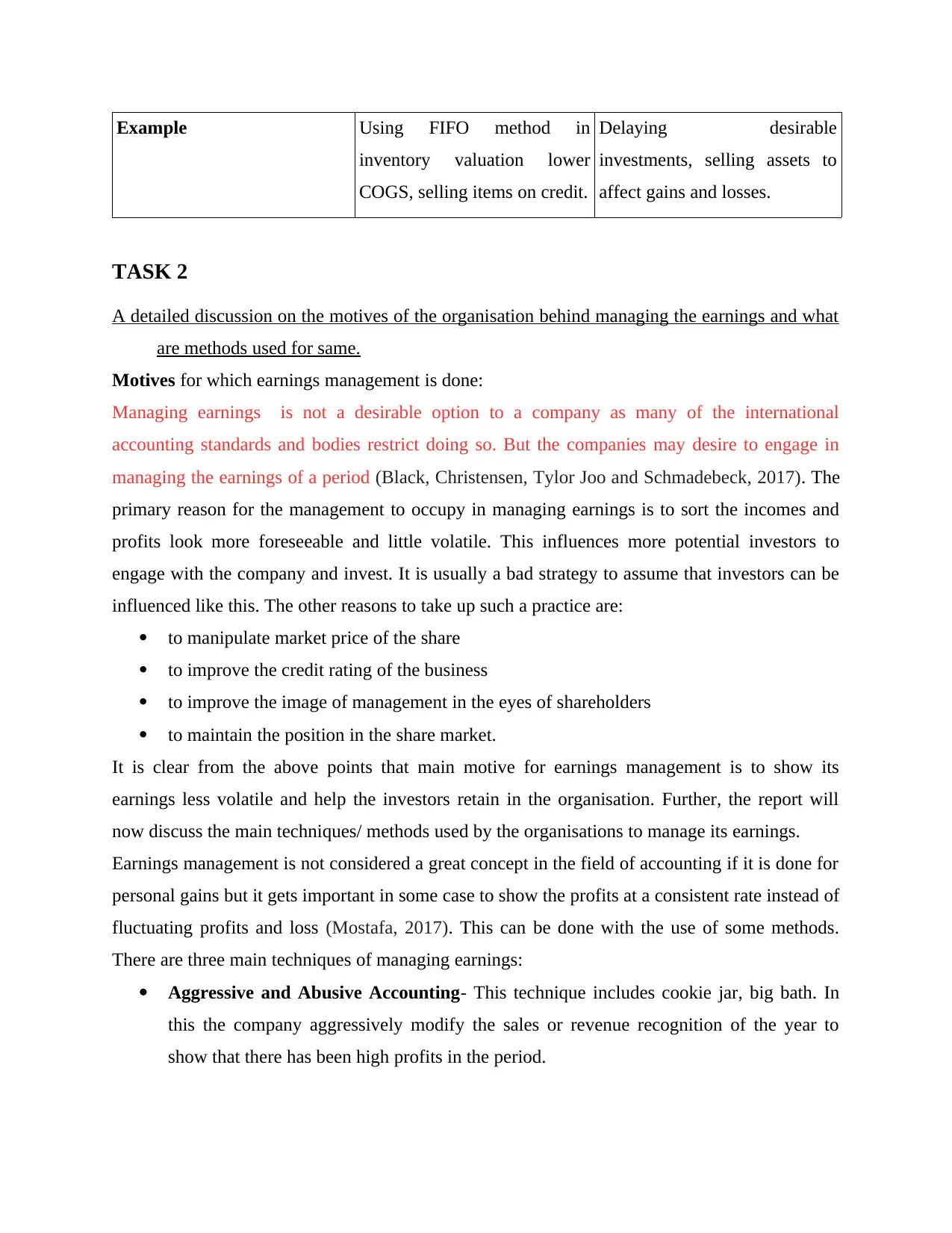
Example Using FIFO method in
inventory valuation lower
COGS, selling items on credit.
Delaying desirable
investments, selling assets to
affect gains and losses.
TASK 2
A detailed discussion on the motives of the organisation behind managing the earnings and what
are methods used for same.
Motives for which earnings management is done:
Managing earnings is not a desirable option to a company as many of the international
accounting standards and bodies restrict doing so. But the companies may desire to engage in
managing the earnings of a period (Black, Christensen, Tylor Joo and Schmadebeck, 2017). The
primary reason for the management to occupy in managing earnings is to sort the incomes and
profits look more foreseeable and little volatile. This influences more potential investors to
engage with the company and invest. It is usually a bad strategy to assume that investors can be
influenced like this. The other reasons to take up such a practice are:
to manipulate market price of the share
to improve the credit rating of the business
to improve the image of management in the eyes of shareholders
to maintain the position in the share market.
It is clear from the above points that main motive for earnings management is to show its
earnings less volatile and help the investors retain in the organisation. Further, the report will
now discuss the main techniques/ methods used by the organisations to manage its earnings.
Earnings management is not considered a great concept in the field of accounting if it is done for
personal gains but it gets important in some case to show the profits at a consistent rate instead of
fluctuating profits and loss (Mostafa, 2017). This can be done with the use of some methods.
There are three main techniques of managing earnings:
Aggressive and Abusive Accounting- This technique includes cookie jar, big bath. In
this the company aggressively modify the sales or revenue recognition of the year to
show that there has been high profits in the period.
inventory valuation lower
COGS, selling items on credit.
Delaying desirable
investments, selling assets to
affect gains and losses.
TASK 2
A detailed discussion on the motives of the organisation behind managing the earnings and what
are methods used for same.
Motives for which earnings management is done:
Managing earnings is not a desirable option to a company as many of the international
accounting standards and bodies restrict doing so. But the companies may desire to engage in
managing the earnings of a period (Black, Christensen, Tylor Joo and Schmadebeck, 2017). The
primary reason for the management to occupy in managing earnings is to sort the incomes and
profits look more foreseeable and little volatile. This influences more potential investors to
engage with the company and invest. It is usually a bad strategy to assume that investors can be
influenced like this. The other reasons to take up such a practice are:
to manipulate market price of the share
to improve the credit rating of the business
to improve the image of management in the eyes of shareholders
to maintain the position in the share market.
It is clear from the above points that main motive for earnings management is to show its
earnings less volatile and help the investors retain in the organisation. Further, the report will
now discuss the main techniques/ methods used by the organisations to manage its earnings.
Earnings management is not considered a great concept in the field of accounting if it is done for
personal gains but it gets important in some case to show the profits at a consistent rate instead of
fluctuating profits and loss (Mostafa, 2017). This can be done with the use of some methods.
There are three main techniques of managing earnings:
Aggressive and Abusive Accounting- This technique includes cookie jar, big bath. In
this the company aggressively modify the sales or revenue recognition of the year to
show that there has been high profits in the period.
Paraphrase This Document
Need a fresh take? Get an instant paraphrase of this document with our AI Paraphraser
Conservative Accounting- This technique bring up to the writing off the costs and
financial loss in the same time period if the company has successful high profits and to
hedge tax liabilities.
Fraudulent Accounting- Accounting becomes fraudulent when the company does not
show profits, or losses to delude stakeholders or high profits to earn bids (Velayutham,
2018).
TASK 3
Discussion of the techniques used by firms to manage earnings and the extent to which
International Accounting/Reporting Standards have limited the use of these method. Use
examples of firms that have engaged in earnings management and the earnings
management devices used by these firms.
It is mainly used by the organisation to flatten out the earnings variations and show the profits at
a consistent rate. The international accounting standards and bodies limit the use of earnings
management to some extent that the companies need to comply with. For this report, Generally
Accepted Accounting principles (GAAP) will be taken into account (Zhang, Uchida, and Dong,
2020). US GAAP includes the pattern, rules and routines essential to mention the acknowledged
accounting activity at a specific time. These render a standard to measure and make financial
reports. These are set rules which are required to be taken as they are and no amendments are
allowed in this. Federal Accounting Standards Advisory Board (FASAB) is responsible for
GAAP. These will be discussed with the particular type of earnings management.
Types of earnings management:
The big bath technique: Non-recurring costs and unusual expenses helps the managers
to make one technique of aggressive accounting practices. Financial analysts overlook
these charges as these are not actually parts of the current operations of firms. These
charges include, writing down assets, establishing reserves. These events are actually
inflated which helps the firms manage future expenses into these accounts (Thenmozhi,
Saravanan and Sasidharan, 2019). GAAP permits the organisation to record a calculated
cost against profits for the cost of utilizing the modification. This charge is then reported
as a non recurring charge against income.
financial loss in the same time period if the company has successful high profits and to
hedge tax liabilities.
Fraudulent Accounting- Accounting becomes fraudulent when the company does not
show profits, or losses to delude stakeholders or high profits to earn bids (Velayutham,
2018).
TASK 3
Discussion of the techniques used by firms to manage earnings and the extent to which
International Accounting/Reporting Standards have limited the use of these method. Use
examples of firms that have engaged in earnings management and the earnings
management devices used by these firms.
It is mainly used by the organisation to flatten out the earnings variations and show the profits at
a consistent rate. The international accounting standards and bodies limit the use of earnings
management to some extent that the companies need to comply with. For this report, Generally
Accepted Accounting principles (GAAP) will be taken into account (Zhang, Uchida, and Dong,
2020). US GAAP includes the pattern, rules and routines essential to mention the acknowledged
accounting activity at a specific time. These render a standard to measure and make financial
reports. These are set rules which are required to be taken as they are and no amendments are
allowed in this. Federal Accounting Standards Advisory Board (FASAB) is responsible for
GAAP. These will be discussed with the particular type of earnings management.
Types of earnings management:
The big bath technique: Non-recurring costs and unusual expenses helps the managers
to make one technique of aggressive accounting practices. Financial analysts overlook
these charges as these are not actually parts of the current operations of firms. These
charges include, writing down assets, establishing reserves. These events are actually
inflated which helps the firms manage future expenses into these accounts (Thenmozhi,
Saravanan and Sasidharan, 2019). GAAP permits the organisation to record a calculated
cost against profits for the cost of utilizing the modification. This charge is then reported
as a non recurring charge against income.
Cookie jar reserves: In this technique the company chooses to show a part of costs in
one accounting time interval and save the balance for other accounting period. Company
is able to do these because in this technique the expenses are based on estimates. GAAP
insists that the company selects a single estimate in this method and follows the same
throughout the accounting period.
Capitalization practices: capitalization means to represent the development costs of
different assets. This technique helps managers to manipulate accounts as these are often
intangible and are based on judgement. GAAP allows this capitalization up to some
extent and mandates to show on what basis the calculations are done.
Operating activities: Managers modify the timings of the events and record those which
are most advantageous to the management. For example, recording or sales in the end of
year which would have been occurred in the next year, this helps businesses show higher
quarter sales. This is only done for a short period of time (Strakova, 2021). GAAP does
not actually guides in this activities.
Revenue Identification: businesses take aggressive actions to increase revenues and
sales in a time interval by supplying bonuses to the salespersons. Businesses take
aggressive accounting actions like selling bonds and securities.
Immaterial misapplication of accounting principles: The organization willingly state
wrongly the earnings that fall below materiality threshold. If it continues, the balance
sheet of the business may become significantly misstated. GAAP does not allow
principles to be followed as it is a rule based accounting.
Reserve one-time costs: The organization voluntarily acknowledge the one time charge
in the kind of contingency reserve for potential expense or loss. The analysts do not count
these reserves as these does not form operating income, this gives the company a chance
to recognize additional earnings. GAAP only allows certain charges to be recognized
here.
“Flushing” the investment portfolio: Company invests in other businesses. GAAP
assumes that investments made less than 20% are passive investments and offer
opportunities for earnings management by timing the sales of these securities which are
gaining vales and which are losing values. This helps the business modify its short term
gains and losses.
one accounting time interval and save the balance for other accounting period. Company
is able to do these because in this technique the expenses are based on estimates. GAAP
insists that the company selects a single estimate in this method and follows the same
throughout the accounting period.
Capitalization practices: capitalization means to represent the development costs of
different assets. This technique helps managers to manipulate accounts as these are often
intangible and are based on judgement. GAAP allows this capitalization up to some
extent and mandates to show on what basis the calculations are done.
Operating activities: Managers modify the timings of the events and record those which
are most advantageous to the management. For example, recording or sales in the end of
year which would have been occurred in the next year, this helps businesses show higher
quarter sales. This is only done for a short period of time (Strakova, 2021). GAAP does
not actually guides in this activities.
Revenue Identification: businesses take aggressive actions to increase revenues and
sales in a time interval by supplying bonuses to the salespersons. Businesses take
aggressive accounting actions like selling bonds and securities.
Immaterial misapplication of accounting principles: The organization willingly state
wrongly the earnings that fall below materiality threshold. If it continues, the balance
sheet of the business may become significantly misstated. GAAP does not allow
principles to be followed as it is a rule based accounting.
Reserve one-time costs: The organization voluntarily acknowledge the one time charge
in the kind of contingency reserve for potential expense or loss. The analysts do not count
these reserves as these does not form operating income, this gives the company a chance
to recognize additional earnings. GAAP only allows certain charges to be recognized
here.
“Flushing” the investment portfolio: Company invests in other businesses. GAAP
assumes that investments made less than 20% are passive investments and offer
opportunities for earnings management by timing the sales of these securities which are
gaining vales and which are losing values. This helps the business modify its short term
gains and losses.
⊘ This is a preview!⊘
Do you want full access?
Subscribe today to unlock all pages.
Trusted by 1+ million students worldwide
Throw out a problem Child: in this technique the business tries to find what is actually
creating problem for the company to earn profits. These can be done via selling the
subsidiary, creating an SPE for financing assets, spinning off the subsidiary. GAAP
requires previous year financial data to justify the decision (Veganzones, Séverin and
Chlibi, 2021).
Early Retirement of Debt:
For academic purposes, it is hard to extract real life examples of companies practising the
earnings management but here are some examples of cases of earnings manipulation:
3 Com had asserted hidden financial losings at U.S. Ai when they united the
organisations. They used Immaterial misapplication here.
Between 1994 and 1995, Sensorimotor acknowledged other period revenue in their
financial statements, showing increased earnings to fit analysts' expectations. The
Chairman and CFO had paid penalties of 50,000 and 40,000 dollars, individually. They
used Operating activities technique here.
Ty-co was constrained to reiterate financial year 1999 and the first quarter of 2000 due to
specific amalgamation and other non-recurring charges, boosting 1999 earnings and
reducing earnings for the first quarter of 2000. It seem that Ty-co set aside cookie jar
reserves which reduced liabilities in 2000, thus, increasing earnings.
WR Gace & Co. was legalised by the securities and exchange board for manipulation of
its profits through cookie jar reserves utilized to glossy profits in one of its unit.
CONCLUSION
From the above mentioned report it has been concluded that managing earnings can be a good at
the same time a bad thing for the organisation, advise is that it is good when there is no private
purpose. It is atrocious for the institution if the establishment is exploiting these methods to blow
up its profit, as it can't be taken up in the long term, as it affects the company. The report
highlights the main techniques that can be taken up by the organisation to manage its earnings.
The report has also highlighted what does GAAP says about these techniques and how it limits
the usage of those techniques. Real life examples are hard to be extracted on the same topic as
companies does not show it in the reports but examples are mentioned in relation to cases that
have been filed for misrepresentation in the financial statements.
creating problem for the company to earn profits. These can be done via selling the
subsidiary, creating an SPE for financing assets, spinning off the subsidiary. GAAP
requires previous year financial data to justify the decision (Veganzones, Séverin and
Chlibi, 2021).
Early Retirement of Debt:
For academic purposes, it is hard to extract real life examples of companies practising the
earnings management but here are some examples of cases of earnings manipulation:
3 Com had asserted hidden financial losings at U.S. Ai when they united the
organisations. They used Immaterial misapplication here.
Between 1994 and 1995, Sensorimotor acknowledged other period revenue in their
financial statements, showing increased earnings to fit analysts' expectations. The
Chairman and CFO had paid penalties of 50,000 and 40,000 dollars, individually. They
used Operating activities technique here.
Ty-co was constrained to reiterate financial year 1999 and the first quarter of 2000 due to
specific amalgamation and other non-recurring charges, boosting 1999 earnings and
reducing earnings for the first quarter of 2000. It seem that Ty-co set aside cookie jar
reserves which reduced liabilities in 2000, thus, increasing earnings.
WR Gace & Co. was legalised by the securities and exchange board for manipulation of
its profits through cookie jar reserves utilized to glossy profits in one of its unit.
CONCLUSION
From the above mentioned report it has been concluded that managing earnings can be a good at
the same time a bad thing for the organisation, advise is that it is good when there is no private
purpose. It is atrocious for the institution if the establishment is exploiting these methods to blow
up its profit, as it can't be taken up in the long term, as it affects the company. The report
highlights the main techniques that can be taken up by the organisation to manage its earnings.
The report has also highlighted what does GAAP says about these techniques and how it limits
the usage of those techniques. Real life examples are hard to be extracted on the same topic as
companies does not show it in the reports but examples are mentioned in relation to cases that
have been filed for misrepresentation in the financial statements.
Paraphrase This Document
Need a fresh take? Get an instant paraphrase of this document with our AI Paraphraser
REFERENCES
Books and Journals
Black, E.L., Christensen, T.E., Taylor Joo, T. and Schmardebeck, R., 2017. The relation between
earnings management and non‐GAAP reporting. Contemporary Accounting
Research. 34(2). pp.750-782.
Fan, Y., Jiang, Y., Zhang, X. and Zhou, Y., 2019. Women on boards and bank earnings
management: From zero to hero. Journal of Banking & Finance. 107. p.105607.
Huang, X.S. and Sun, L., 2017. Managerial ability and real earnings management. Advances in
accounting. 39. pp.91-104.
Mostafa, W., 2017. The impact of earnings management on the value relevance of earnings:
Empirical evidence from Egypt. Managerial Auditing Journal.
Paredes, A.A.P. and Wheatley, C., 2017. The influence of culture on real earnings
management. International Journal of Emerging Markets.
Strakova, L., 2021. Motives and techniques of earnings management used in a global
environment. In SHS Web of Conferences (Vol. 92). EDP Sciences.
Thenmozhi, M., Saravanan, P. and Sasidharan, A., 2019. Impact of excess cash on earnings
management and firm value: Evidence from China. Corporate Ownership &
Control. 17(1). pp.245-254.
Veganzones, D., Séverin, E. and Chlibi, S., 2021. Influence of earnings management on
forecasting corporate failure. International Journal of Forecasting.
Velayutham, E., 2018. Sustainability disclosure and earnings management. Research Handbook
of Finance and Sustainability.
Zhang, Y., Uchida, K. and Dong, L., 2020. External financing and earnings management:
Evidence from international data. Research in International Business and Finance. 54.
p.101275.
Books and Journals
Black, E.L., Christensen, T.E., Taylor Joo, T. and Schmardebeck, R., 2017. The relation between
earnings management and non‐GAAP reporting. Contemporary Accounting
Research. 34(2). pp.750-782.
Fan, Y., Jiang, Y., Zhang, X. and Zhou, Y., 2019. Women on boards and bank earnings
management: From zero to hero. Journal of Banking & Finance. 107. p.105607.
Huang, X.S. and Sun, L., 2017. Managerial ability and real earnings management. Advances in
accounting. 39. pp.91-104.
Mostafa, W., 2017. The impact of earnings management on the value relevance of earnings:
Empirical evidence from Egypt. Managerial Auditing Journal.
Paredes, A.A.P. and Wheatley, C., 2017. The influence of culture on real earnings
management. International Journal of Emerging Markets.
Strakova, L., 2021. Motives and techniques of earnings management used in a global
environment. In SHS Web of Conferences (Vol. 92). EDP Sciences.
Thenmozhi, M., Saravanan, P. and Sasidharan, A., 2019. Impact of excess cash on earnings
management and firm value: Evidence from China. Corporate Ownership &
Control. 17(1). pp.245-254.
Veganzones, D., Séverin, E. and Chlibi, S., 2021. Influence of earnings management on
forecasting corporate failure. International Journal of Forecasting.
Velayutham, E., 2018. Sustainability disclosure and earnings management. Research Handbook
of Finance and Sustainability.
Zhang, Y., Uchida, K. and Dong, L., 2020. External financing and earnings management:
Evidence from international data. Research in International Business and Finance. 54.
p.101275.

1 out of 8


Related Documents


Your All-in-One AI-Powered Toolkit for Academic Success.
+13062052269
info@desklib.com
Available 24*7 on WhatsApp / Email
![[object Object]](/_next/static/media/star-bottom.7253800d.svg)
Unlock your academic potential
Copyright © 2020–2026 A2Z Services. All Rights Reserved. Developed and managed by ZUCOL.