Earthquake Disaster Management Plan for Rio Olympics 2016
VerifiedAdded on 2023/06/04
|8
|2286
|250
Report
AI Summary
This report outlines a disaster management plan for a hypothetical earthquake scenario in Rio de Janeiro during the 2016 Olympic Games. It analyzes the potential impact of an earthquake 50km outside the city, considering the large influx of tourists and athletes. The plan identifies key stakeholders such as the national government, military, police, the International Olympic Committee, emergency response teams, NGOs, and medical facilities, detailing their roles in evacuation, rescue operations, and humanitarian aid. Special considerations address the needs of tourists unfamiliar with the city and managing traffic congestion. The report acknowledges challenges like communication, traffic control, and providing medical services. It includes a plan for managing the psychological impact of the disaster through support centers and counseling. The likely outcomes of the plan include reduced injuries and deaths, effective evacuation, humanitarian assistance, and psychological support. Strategies for evaluating the plan's effectiveness involve tracking rescue numbers, assessing psychological well-being, and evaluating access to resources. The report concludes by emphasizing the importance of proactive disaster preparedness and community resilience.
Running Head: DISASTER MANAGEMENT PLAN 1
DISASTER MANAGEMENT PLAN
Name
Institution Affiliation
DISASTER MANAGEMENT PLAN
Name
Institution Affiliation
Paraphrase This Document
Need a fresh take? Get an instant paraphrase of this document with our AI Paraphraser

DISASTER MANAGEMENT PLAN PAGE8
Introduction
The aim of this report is designing an appropriate disaster management plan for
Rio De Janeiro. The city has a very huge population of over 6 million people. There
are also many visitors and athletes in the city since its hosting the summer Olympics.
The report describes in detail the events of the disaster and also identifies key
stakeholders in the disaster management plan. Factors such as wildlife welfare and
special groups welfare are discussed since they may affect the disaster management
plan. In addition to this, a plan for managing the psychological stressors of the
disaster event. A strategy for evaluating the effectiveness of the disaster management
that is used to manage the disaster event. Some of the strategies that will be used
include calculating the number of people evacuated on time, evaluating the number of
people injured and how the response has been able to help people deal with the
emergency psychologically.
Critical analysis of the disaster event
The city of Rio de Janeiro has a population of more than 6.5 million. During the
Olympic season, the city is expected to receive more than 700 athletes across many
countries around the globe (Filion,2016). There are more than a million visitors who
arrived in the city due to the ongoing Olympic games. This means that a lot of caution
has to be taken when designing the emergency response plan. More than 6 million
people and also wildlife is at risk of being affected by the disaster. The emergency
strategy has to make sure that minimum injuries and casualties are resulting from the
disaster. The emergency response team also has to consider the sensitivity and
urgency of the situation ahead. To avoid chaos and commotion that may lead to more
deaths and injuries, the team will ensure that information is disbursed in an orderly
manner and that citizens are assisted in evacuating the areas that are more likely to be
affected by the earthquake. Information should be disbursed in such a manner that it is
useful in helping the residents to evacuate and stay in safe areas.(Beach, 2010). An
earthquake that is 10km deep and 50km away is very strong. The earthquake is likely
to reach Rio De Janeiro city within less than 24 hours. Therefore, residents have to be
Introduction
The aim of this report is designing an appropriate disaster management plan for
Rio De Janeiro. The city has a very huge population of over 6 million people. There
are also many visitors and athletes in the city since its hosting the summer Olympics.
The report describes in detail the events of the disaster and also identifies key
stakeholders in the disaster management plan. Factors such as wildlife welfare and
special groups welfare are discussed since they may affect the disaster management
plan. In addition to this, a plan for managing the psychological stressors of the
disaster event. A strategy for evaluating the effectiveness of the disaster management
that is used to manage the disaster event. Some of the strategies that will be used
include calculating the number of people evacuated on time, evaluating the number of
people injured and how the response has been able to help people deal with the
emergency psychologically.
Critical analysis of the disaster event
The city of Rio de Janeiro has a population of more than 6.5 million. During the
Olympic season, the city is expected to receive more than 700 athletes across many
countries around the globe (Filion,2016). There are more than a million visitors who
arrived in the city due to the ongoing Olympic games. This means that a lot of caution
has to be taken when designing the emergency response plan. More than 6 million
people and also wildlife is at risk of being affected by the disaster. The emergency
strategy has to make sure that minimum injuries and casualties are resulting from the
disaster. The emergency response team also has to consider the sensitivity and
urgency of the situation ahead. To avoid chaos and commotion that may lead to more
deaths and injuries, the team will ensure that information is disbursed in an orderly
manner and that citizens are assisted in evacuating the areas that are more likely to be
affected by the earthquake. Information should be disbursed in such a manner that it is
useful in helping the residents to evacuate and stay in safe areas.(Beach, 2010). An
earthquake that is 10km deep and 50km away is very strong. The earthquake is likely
to reach Rio De Janeiro city within less than 24 hours. Therefore, residents have to be

DISASTER MANAGEMENT PLAN PAGE8
evacuated to low-risk areas using all means available to manage loss resulting from
the disaster.
Stakeholders and their roles
It is critical to identify all stakeholders that will be involved in the disaster
management plan. Each of the stakeholders will be able to understand their roles in
the rescue and the disaster management plan and hence ensure that the process is
carried out smoothly.
The National government
The national government will play a crucial role in the management of the
earthquake disaster which has hit Rio De Janeiro. The major role of the national
government will be providing of finances which will be very crucial in implementing
this plan. The government will also provide a means of evacuating residents to areas
that are less likely to be affected by the earthquake. Technological resources and
human resources will also come from the government. The government will also be in
charge of construction and repair of public amenities which will be affected by the
earthquake(Santiago-Fandiño, Satō, Maki & Iuchi, 2018) . The government will
provide choppers and high capacity vehicles to help in evacuating people.
Military and police
The military and police will be crucial in managing the disaster. This is because
the population at risk of being affected by this disaster is so large, hence increasing
the need for people to coordinate the evacuation process. The Emergency response
team does not have enough employees to coordinate the entire process and hence the
military and police will play a big role in providing technical assistance which is
crucial in this exercise.
International Olympic committee
The IOC is tasked with the responsibility of managing the Olympic games. It
works in close coordination with the National Olympic committees of various
countries that participate in the Olympic games. The IOC role will be to communicate
to all athletes participating in the games and come up with an evacuation plan to
evacuated to low-risk areas using all means available to manage loss resulting from
the disaster.
Stakeholders and their roles
It is critical to identify all stakeholders that will be involved in the disaster
management plan. Each of the stakeholders will be able to understand their roles in
the rescue and the disaster management plan and hence ensure that the process is
carried out smoothly.
The National government
The national government will play a crucial role in the management of the
earthquake disaster which has hit Rio De Janeiro. The major role of the national
government will be providing of finances which will be very crucial in implementing
this plan. The government will also provide a means of evacuating residents to areas
that are less likely to be affected by the earthquake. Technological resources and
human resources will also come from the government. The government will also be in
charge of construction and repair of public amenities which will be affected by the
earthquake(Santiago-Fandiño, Satō, Maki & Iuchi, 2018) . The government will
provide choppers and high capacity vehicles to help in evacuating people.
Military and police
The military and police will be crucial in managing the disaster. This is because
the population at risk of being affected by this disaster is so large, hence increasing
the need for people to coordinate the evacuation process. The Emergency response
team does not have enough employees to coordinate the entire process and hence the
military and police will play a big role in providing technical assistance which is
crucial in this exercise.
International Olympic committee
The IOC is tasked with the responsibility of managing the Olympic games. It
works in close coordination with the National Olympic committees of various
countries that participate in the Olympic games. The IOC role will be to communicate
to all athletes participating in the games and come up with an evacuation plan to
⊘ This is a preview!⊘
Do you want full access?
Subscribe today to unlock all pages.

Trusted by 1+ million students worldwide

DISASTER MANAGEMENT PLAN PAGE8
ensure that they are safe (Casavant& Philpott,2016). The committee will also ensure
safety for the fans in the stadium and make proper plans to ensure that none of the
athletes or the fans are affected by the disaster.
The emergency rescue team and Non-Governmental Organizations
The emergency response team has the role of ensuring that they carry out rescue
operations for people who may get injured when the earthquake occurs. During an
earthquake, there is likely to be the destruction of buildings and people may find
themselves in the rumbles. The team will need the assistance of various humanitarian
associations such as the Red Cross. The organizations will play a huge role in helping
to manage the humanitarian crisis that may come as a result of the disaster. It will
help in distribution of aid to victims of the earthquake.(Ainuddin & Routray, 2012).
These organizations will be offering humanitarian assistance such as food and shelter.
Hospitals and other medical facilities
The people who get injured after the earthquake will need urgent medical
attention. Therefore, the hospitals will provide ambulances to help offer the victims
urgent medical attention that they need (Shaw & Neef, 2013). Hospitals need to be
ready to receive many victims and to work for extra hours to offer emergency medical
services for victims.
Logistics
To respond appropriately to the disaster that Rio city is facing. It is important that
there is proper flow of information as well as proper coordination of movement of
people. People are encouraged to use public means of transport and avoid using
private means. This will greatly help in reducing congestion in the city while carrying
out the rescue operations (Sylves,2015). People are encouraged to seek refuge in safe
areas which are far from buildings and stay away from the seaside. Food and other
resources will also be required to cater to people who shelter in camps.
Special Considerations
The earthquake is set to occur at a period when there is a huge population of
visitors in the city. During this season, many tourists are staying in hotels and
ensure that they are safe (Casavant& Philpott,2016). The committee will also ensure
safety for the fans in the stadium and make proper plans to ensure that none of the
athletes or the fans are affected by the disaster.
The emergency rescue team and Non-Governmental Organizations
The emergency response team has the role of ensuring that they carry out rescue
operations for people who may get injured when the earthquake occurs. During an
earthquake, there is likely to be the destruction of buildings and people may find
themselves in the rumbles. The team will need the assistance of various humanitarian
associations such as the Red Cross. The organizations will play a huge role in helping
to manage the humanitarian crisis that may come as a result of the disaster. It will
help in distribution of aid to victims of the earthquake.(Ainuddin & Routray, 2012).
These organizations will be offering humanitarian assistance such as food and shelter.
Hospitals and other medical facilities
The people who get injured after the earthquake will need urgent medical
attention. Therefore, the hospitals will provide ambulances to help offer the victims
urgent medical attention that they need (Shaw & Neef, 2013). Hospitals need to be
ready to receive many victims and to work for extra hours to offer emergency medical
services for victims.
Logistics
To respond appropriately to the disaster that Rio city is facing. It is important that
there is proper flow of information as well as proper coordination of movement of
people. People are encouraged to use public means of transport and avoid using
private means. This will greatly help in reducing congestion in the city while carrying
out the rescue operations (Sylves,2015). People are encouraged to seek refuge in safe
areas which are far from buildings and stay away from the seaside. Food and other
resources will also be required to cater to people who shelter in camps.
Special Considerations
The earthquake is set to occur at a period when there is a huge population of
visitors in the city. During this season, many tourists are staying in hotels and
Paraphrase This Document
Need a fresh take? Get an instant paraphrase of this document with our AI Paraphraser

DISASTER MANAGEMENT PLAN PAGE8
apartments and are not conversant with the city. These people needed to be advised
accordingly and helped to avoid being caught in the middle of the crisis. The city is
also hugely populated and traffic at this time is very congested, and hence measures
need to be put in place to manage traffic flow (Wrobel, 2009)
Challenges
The emergency response plan is faced with many challenges. One of these
challenges is communication. The team may face a challenge of communicating to all
many residents within a short time. Given the gravity of the matter, it is important that
the emergency team communicates to both the athletes and the residents within a
short time so that they can evacuate to safety.
The other challenge that the team will face is that of ensuring the smooth flow of
traffic. There is a very high likelihood of tension and panic among residents. Most of
them will be trying to run to safety, and this will likely result in gridlock in traffic as
everyone tries to get out of the city to safe areas (Syngellakis, 2017).
There will also be a challenge in providing medical and emergency services to the
residents. People will require urgent medical attention, and this may strain the medical
facilities that are available as well as medical staff available (Hanfling, & Institute of
Medicine (U.S.) 2012).
It will also be difficult to ensure the safety of fans and athletes during the
Olympic games. Getting the fans out of the stadium will be difficult be difficult. The
games will also have to be interrupted to ensure the safety of everyone who is
involved.
Plan for managing psychological stressor
The earthquake disaster is likely to have a huge psychological impact on both the
residents and the athletes participating in the games. The stress may come out of the
distress due to people losing their loved ones and loss of property (Wrobel,2009). The
emergency team is planning to create support centers in all refugee centers across the
city. These centers will offer canceling services to all the people affected by the
tragedy. Canceling camps will also be set in all health centers and hospitals to help the
people in dealing with the psychological effects of the earthquake (Payant, 2010)
apartments and are not conversant with the city. These people needed to be advised
accordingly and helped to avoid being caught in the middle of the crisis. The city is
also hugely populated and traffic at this time is very congested, and hence measures
need to be put in place to manage traffic flow (Wrobel, 2009)
Challenges
The emergency response plan is faced with many challenges. One of these
challenges is communication. The team may face a challenge of communicating to all
many residents within a short time. Given the gravity of the matter, it is important that
the emergency team communicates to both the athletes and the residents within a
short time so that they can evacuate to safety.
The other challenge that the team will face is that of ensuring the smooth flow of
traffic. There is a very high likelihood of tension and panic among residents. Most of
them will be trying to run to safety, and this will likely result in gridlock in traffic as
everyone tries to get out of the city to safe areas (Syngellakis, 2017).
There will also be a challenge in providing medical and emergency services to the
residents. People will require urgent medical attention, and this may strain the medical
facilities that are available as well as medical staff available (Hanfling, & Institute of
Medicine (U.S.) 2012).
It will also be difficult to ensure the safety of fans and athletes during the
Olympic games. Getting the fans out of the stadium will be difficult be difficult. The
games will also have to be interrupted to ensure the safety of everyone who is
involved.
Plan for managing psychological stressor
The earthquake disaster is likely to have a huge psychological impact on both the
residents and the athletes participating in the games. The stress may come out of the
distress due to people losing their loved ones and loss of property (Wrobel,2009). The
emergency team is planning to create support centers in all refugee centers across the
city. These centers will offer canceling services to all the people affected by the
tragedy. Canceling camps will also be set in all health centers and hospitals to help the
people in dealing with the psychological effects of the earthquake (Payant, 2010)

DISASTER MANAGEMENT PLAN PAGE8
Likely Outcomes
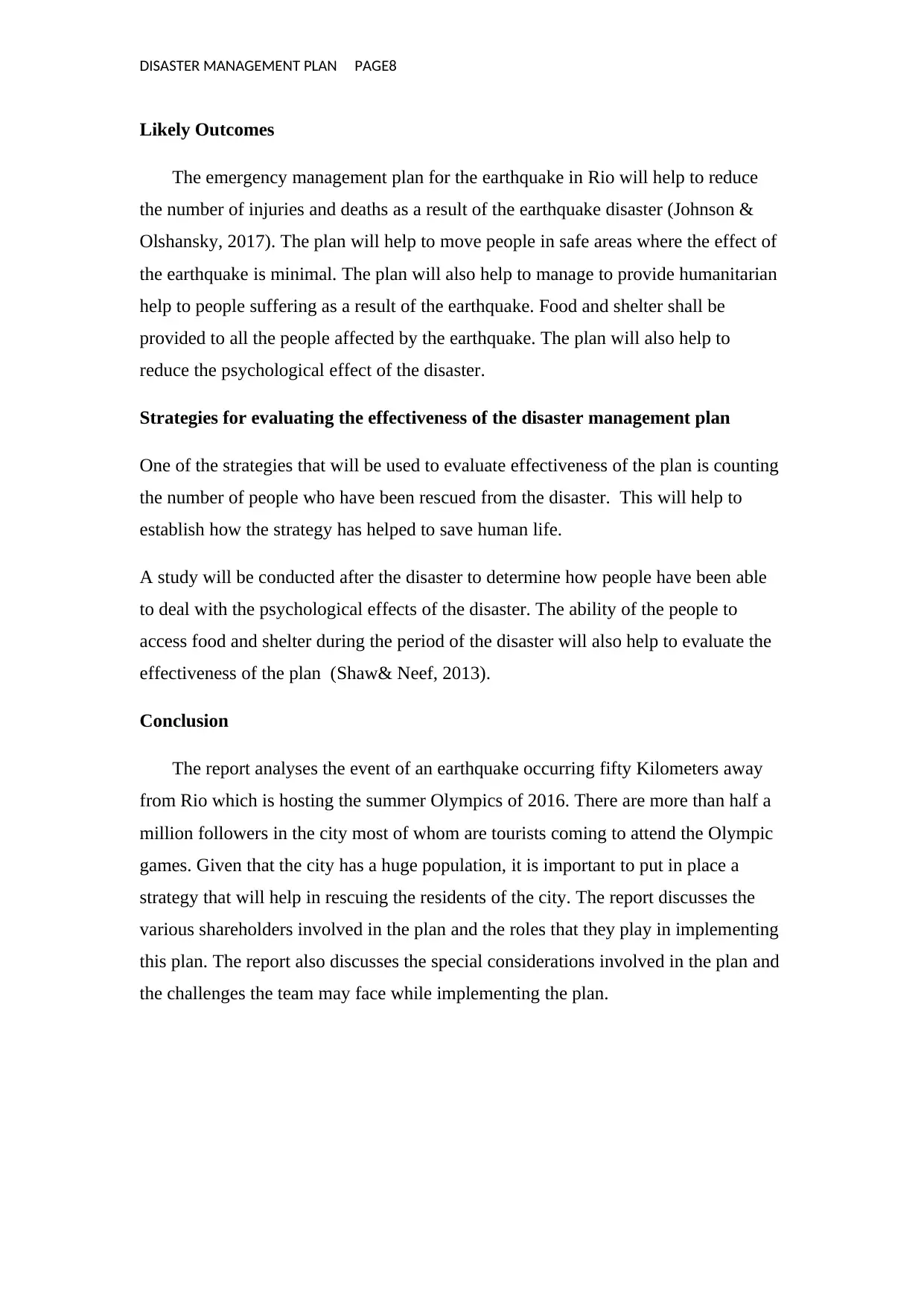
The emergency management plan for the earthquake in Rio will help to reduce
the number of injuries and deaths as a result of the earthquake disaster (Johnson &
Olshansky, 2017). The plan will help to move people in safe areas where the effect of
the earthquake is minimal. The plan will also help to manage to provide humanitarian
help to people suffering as a result of the earthquake. Food and shelter shall be
provided to all the people affected by the earthquake. The plan will also help to
reduce the psychological effect of the disaster.
Strategies for evaluating the effectiveness of the disaster management plan
One of the strategies that will be used to evaluate effectiveness of the plan is counting
the number of people who have been rescued from the disaster. This will help to
establish how the strategy has helped to save human life.
A study will be conducted after the disaster to determine how people have been able
to deal with the psychological effects of the disaster. The ability of the people to
access food and shelter during the period of the disaster will also help to evaluate the
effectiveness of the plan (Shaw& Neef, 2013).
Conclusion
The report analyses the event of an earthquake occurring fifty Kilometers away
from Rio which is hosting the summer Olympics of 2016. There are more than half a
million followers in the city most of whom are tourists coming to attend the Olympic
games. Given that the city has a huge population, it is important to put in place a
strategy that will help in rescuing the residents of the city. The report discusses the
various shareholders involved in the plan and the roles that they play in implementing
this plan. The report also discusses the special considerations involved in the plan and
the challenges the team may face while implementing the plan.
Likely Outcomes
The emergency management plan for the earthquake in Rio will help to reduce
the number of injuries and deaths as a result of the earthquake disaster (Johnson &
Olshansky, 2017). The plan will help to move people in safe areas where the effect of
the earthquake is minimal. The plan will also help to manage to provide humanitarian
help to people suffering as a result of the earthquake. Food and shelter shall be
provided to all the people affected by the earthquake. The plan will also help to
reduce the psychological effect of the disaster.
Strategies for evaluating the effectiveness of the disaster management plan
One of the strategies that will be used to evaluate effectiveness of the plan is counting
the number of people who have been rescued from the disaster. This will help to
establish how the strategy has helped to save human life.
A study will be conducted after the disaster to determine how people have been able
to deal with the psychological effects of the disaster. The ability of the people to
access food and shelter during the period of the disaster will also help to evaluate the
effectiveness of the plan (Shaw& Neef, 2013).
Conclusion
The report analyses the event of an earthquake occurring fifty Kilometers away
from Rio which is hosting the summer Olympics of 2016. There are more than half a
million followers in the city most of whom are tourists coming to attend the Olympic
games. Given that the city has a huge population, it is important to put in place a
strategy that will help in rescuing the residents of the city. The report discusses the
various shareholders involved in the plan and the roles that they play in implementing
this plan. The report also discusses the special considerations involved in the plan and
the challenges the team may face while implementing the plan.
⊘ This is a preview!⊘
Do you want full access?
Subscribe today to unlock all pages.

Trusted by 1+ million students worldwide

DISASTER MANAGEMENT PLAN PAGE8
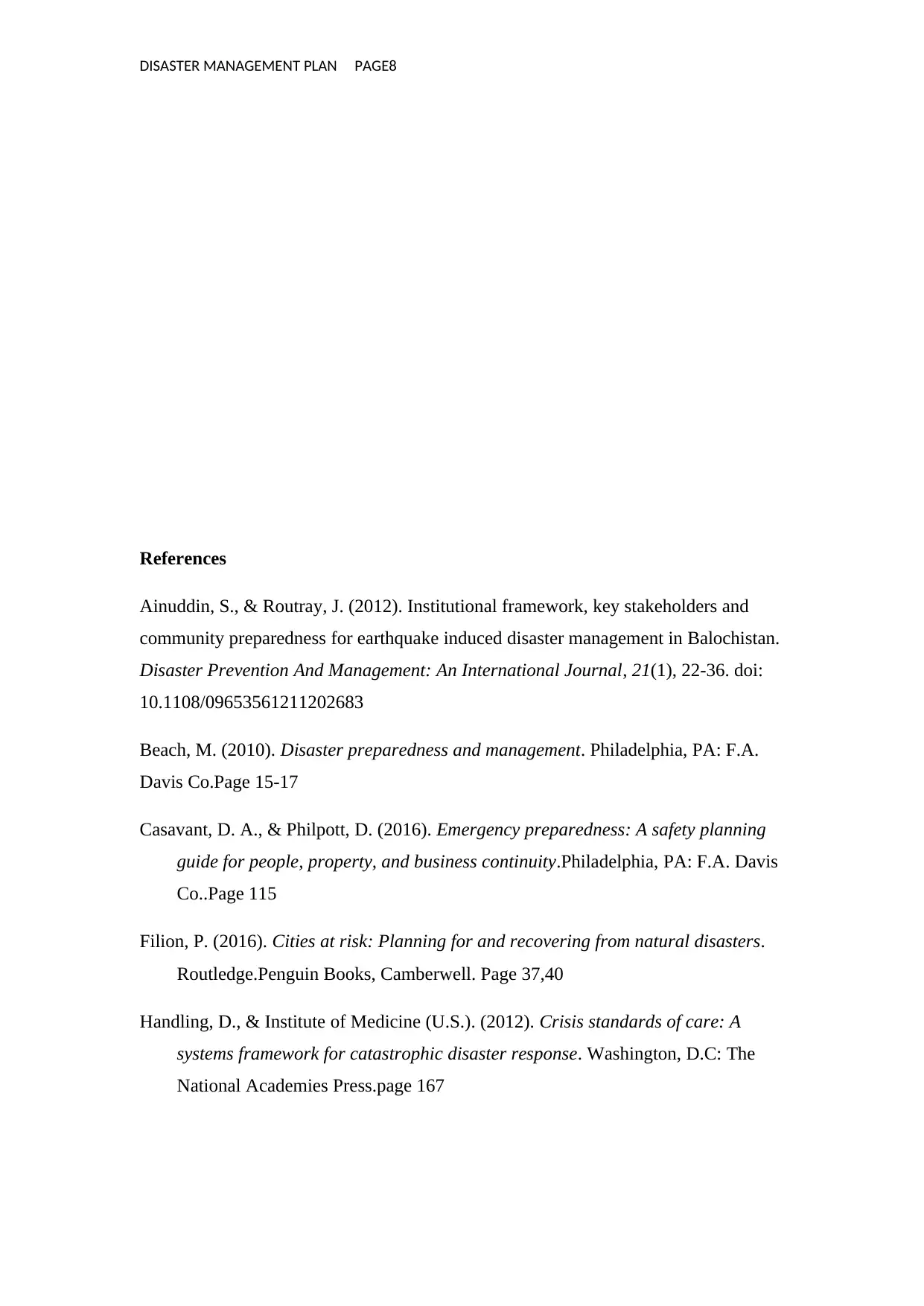
References
Ainuddin, S., & Routray, J. (2012). Institutional framework, key stakeholders and
community preparedness for earthquake induced disaster management in Balochistan.
Disaster Prevention And Management: An International Journal, 21(1), 22-36. doi:
10.1108/09653561211202683
Beach, M. (2010). Disaster preparedness and management. Philadelphia, PA: F.A.
Davis Co.Page 15-17
Casavant, D. A., & Philpott, D. (2016). Emergency preparedness: A safety planning
guide for people, property, and business continuity.Philadelphia, PA: F.A. Davis
Co..Page 115
Filion, P. (2016). Cities at risk: Planning for and recovering from natural disasters.
Routledge.Penguin Books, Camberwell. Page 37,40
Handling, D., & Institute of Medicine (U.S.). (2012). Crisis standards of care: A
systems framework for catastrophic disaster response. Washington, D.C: The
National Academies Press.page 167
References
Ainuddin, S., & Routray, J. (2012). Institutional framework, key stakeholders and
community preparedness for earthquake induced disaster management in Balochistan.
Disaster Prevention And Management: An International Journal, 21(1), 22-36. doi:
10.1108/09653561211202683
Beach, M. (2010). Disaster preparedness and management. Philadelphia, PA: F.A.
Davis Co.Page 15-17
Casavant, D. A., & Philpott, D. (2016). Emergency preparedness: A safety planning
guide for people, property, and business continuity.Philadelphia, PA: F.A. Davis
Co..Page 115
Filion, P. (2016). Cities at risk: Planning for and recovering from natural disasters.
Routledge.Penguin Books, Camberwell. Page 37,40
Handling, D., & Institute of Medicine (U.S.). (2012). Crisis standards of care: A
systems framework for catastrophic disaster response. Washington, D.C: The
National Academies Press.page 167
Paraphrase This Document
Need a fresh take? Get an instant paraphrase of this document with our AI Paraphraser

DISASTER MANAGEMENT PLAN PAGE8
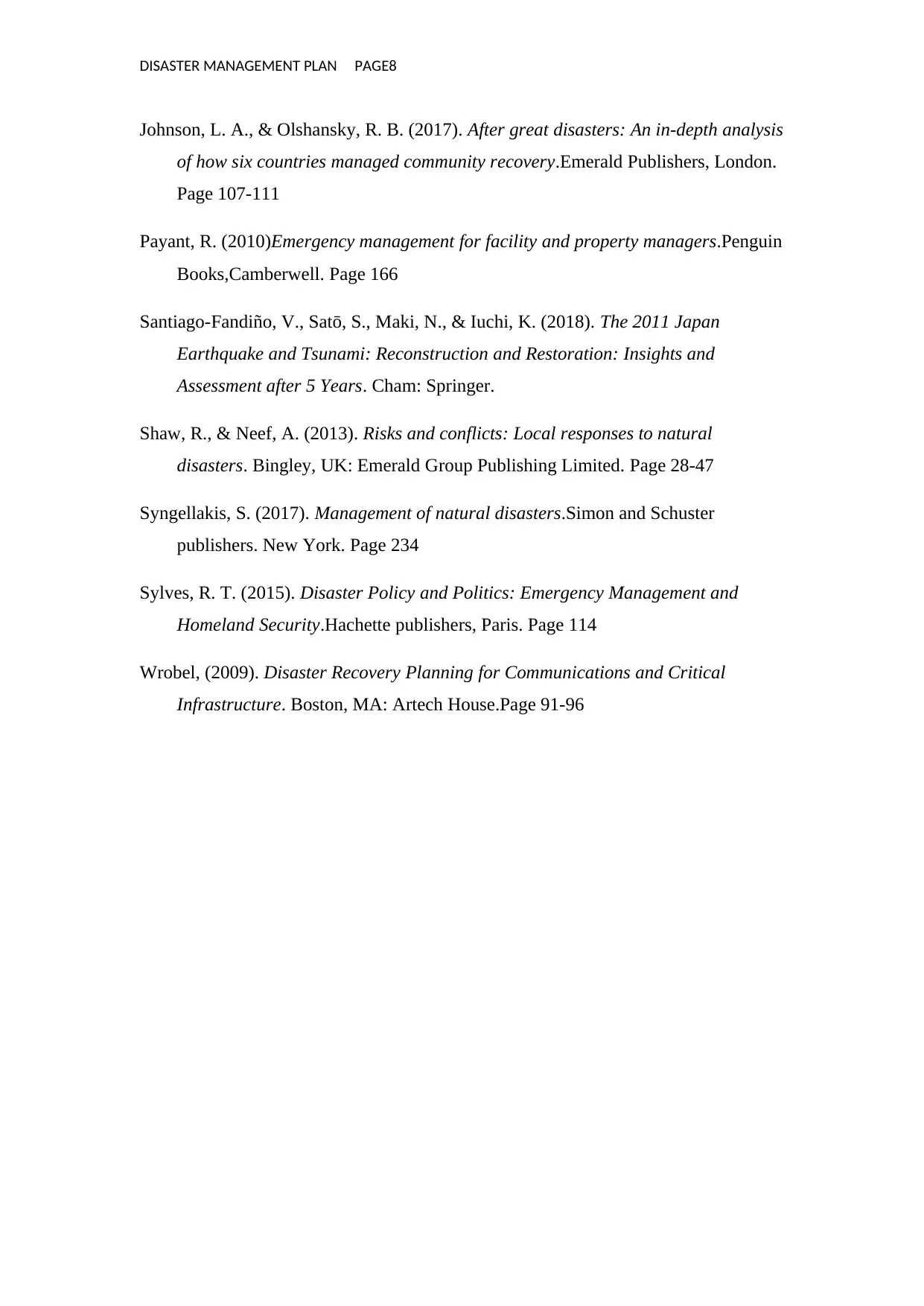
Johnson, L. A., & Olshansky, R. B. (2017). After great disasters: An in-depth analysis
of how six countries managed community recovery.Emerald Publishers, London.
Page 107-111
Payant, R. (2010)Emergency management for facility and property managers.Penguin
Books,Camberwell. Page 166
Santiago-Fandiño, V., Satō, S., Maki, N., & Iuchi, K. (2018). The 2011 Japan
Earthquake and Tsunami: Reconstruction and Restoration: Insights and
Assessment after 5 Years. Cham: Springer.
Shaw, R., & Neef, A. (2013). Risks and conflicts: Local responses to natural
disasters. Bingley, UK: Emerald Group Publishing Limited. Page 28-47
Syngellakis, S. (2017). Management of natural disasters.Simon and Schuster
publishers. New York. Page 234
Sylves, R. T. (2015). Disaster Policy and Politics: Emergency Management and
Homeland Security.Hachette publishers, Paris. Page 114
Wrobel, (2009). Disaster Recovery Planning for Communications and Critical
Infrastructure. Boston, MA: Artech House.Page 91-96
Johnson, L. A., & Olshansky, R. B. (2017). After great disasters: An in-depth analysis
of how six countries managed community recovery.Emerald Publishers, London.
Page 107-111
Payant, R. (2010)Emergency management for facility and property managers.Penguin
Books,Camberwell. Page 166
Santiago-Fandiño, V., Satō, S., Maki, N., & Iuchi, K. (2018). The 2011 Japan
Earthquake and Tsunami: Reconstruction and Restoration: Insights and
Assessment after 5 Years. Cham: Springer.
Shaw, R., & Neef, A. (2013). Risks and conflicts: Local responses to natural
disasters. Bingley, UK: Emerald Group Publishing Limited. Page 28-47
Syngellakis, S. (2017). Management of natural disasters.Simon and Schuster
publishers. New York. Page 234
Sylves, R. T. (2015). Disaster Policy and Politics: Emergency Management and
Homeland Security.Hachette publishers, Paris. Page 114
Wrobel, (2009). Disaster Recovery Planning for Communications and Critical
Infrastructure. Boston, MA: Artech House.Page 91-96
1 out of 8
Related Documents
Your All-in-One AI-Powered Toolkit for Academic Success.
+13062052269
info@desklib.com
Available 24*7 on WhatsApp / Email
Unlock your academic potential
Copyright © 2020–2026 A2Z Services. All Rights Reserved. Developed and managed by ZUCOL.