MGT602 Business Decision Analytics Report: East Hotel Case Study
VerifiedAdded on 2022/08/24
|12
|2563
|16
Report
AI Summary
This report, centered around the MGT602 Business Decision Analytics course, presents an in-depth analysis of decision-making tools and their application in the context of a hotel business, specifically the East Hotel. The report evaluates tools such as marginal analysis, SWOT analysis, decision matrix, and Pareto analysis to enhance the processes of recruitment, training, and retention of high-quality staff. The study emphasizes the effectiveness of marginal analysis, highlighting its ability to compare costs and benefits in decision-making. The report incorporates a case study approach, involving a team member's workplace at East Hotel, and includes a literature review on teams and decision-making. The analysis offers practical recommendations and underscores the importance of data-driven decisions in improving human capital management within the hotel industry. The report also discusses various decision-making scenarios and how different tools can be applied based on specific objectives and desired outcomes.
Running head: BUSINESS DECISION ANALYTICS
1
Business Decision Analytics
Name of Institution:
Name of Student:
Date:
1
Business Decision Analytics
Name of Institution:
Name of Student:
Date:

Paraphrase This Document
Need a fresh take? Get an instant paraphrase of this document with our AI Paraphraser
BUSINESS DECISION ANALYTICS 2
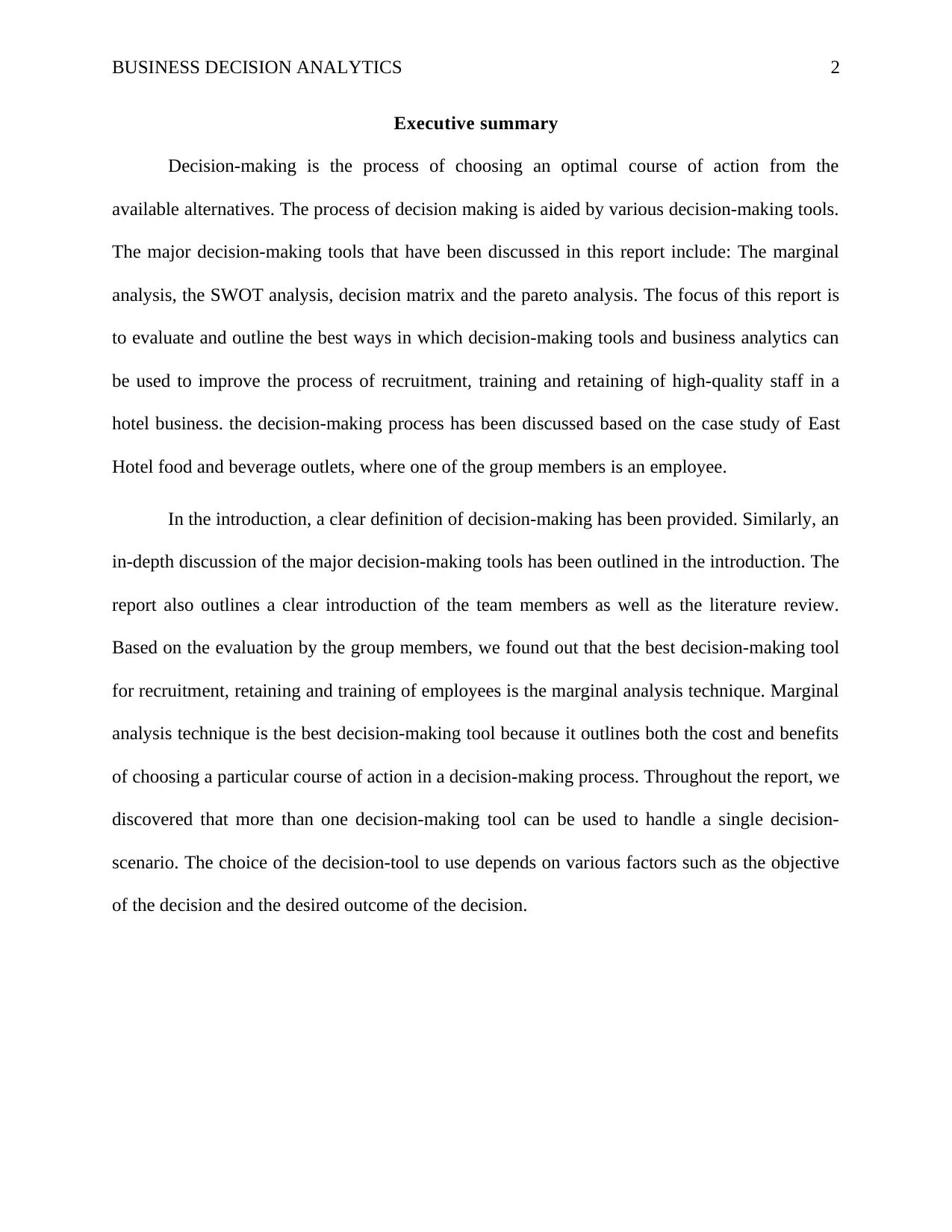
Executive summary
Decision-making is the process of choosing an optimal course of action from the
available alternatives. The process of decision making is aided by various decision-making tools.
The major decision-making tools that have been discussed in this report include: The marginal
analysis, the SWOT analysis, decision matrix and the pareto analysis. The focus of this report is
to evaluate and outline the best ways in which decision-making tools and business analytics can
be used to improve the process of recruitment, training and retaining of high-quality staff in a
hotel business. the decision-making process has been discussed based on the case study of East
Hotel food and beverage outlets, where one of the group members is an employee.
In the introduction, a clear definition of decision-making has been provided. Similarly, an
in-depth discussion of the major decision-making tools has been outlined in the introduction. The
report also outlines a clear introduction of the team members as well as the literature review.
Based on the evaluation by the group members, we found out that the best decision-making tool
for recruitment, retaining and training of employees is the marginal analysis technique. Marginal
analysis technique is the best decision-making tool because it outlines both the cost and benefits
of choosing a particular course of action in a decision-making process. Throughout the report, we
discovered that more than one decision-making tool can be used to handle a single decision-
scenario. The choice of the decision-tool to use depends on various factors such as the objective
of the decision and the desired outcome of the decision.
Executive summary
Decision-making is the process of choosing an optimal course of action from the
available alternatives. The process of decision making is aided by various decision-making tools.
The major decision-making tools that have been discussed in this report include: The marginal
analysis, the SWOT analysis, decision matrix and the pareto analysis. The focus of this report is
to evaluate and outline the best ways in which decision-making tools and business analytics can
be used to improve the process of recruitment, training and retaining of high-quality staff in a
hotel business. the decision-making process has been discussed based on the case study of East
Hotel food and beverage outlets, where one of the group members is an employee.
In the introduction, a clear definition of decision-making has been provided. Similarly, an
in-depth discussion of the major decision-making tools has been outlined in the introduction. The
report also outlines a clear introduction of the team members as well as the literature review.
Based on the evaluation by the group members, we found out that the best decision-making tool
for recruitment, retaining and training of employees is the marginal analysis technique. Marginal
analysis technique is the best decision-making tool because it outlines both the cost and benefits
of choosing a particular course of action in a decision-making process. Throughout the report, we
discovered that more than one decision-making tool can be used to handle a single decision-
scenario. The choice of the decision-tool to use depends on various factors such as the objective
of the decision and the desired outcome of the decision.
BUSINESS DECISION ANALYTICS 3
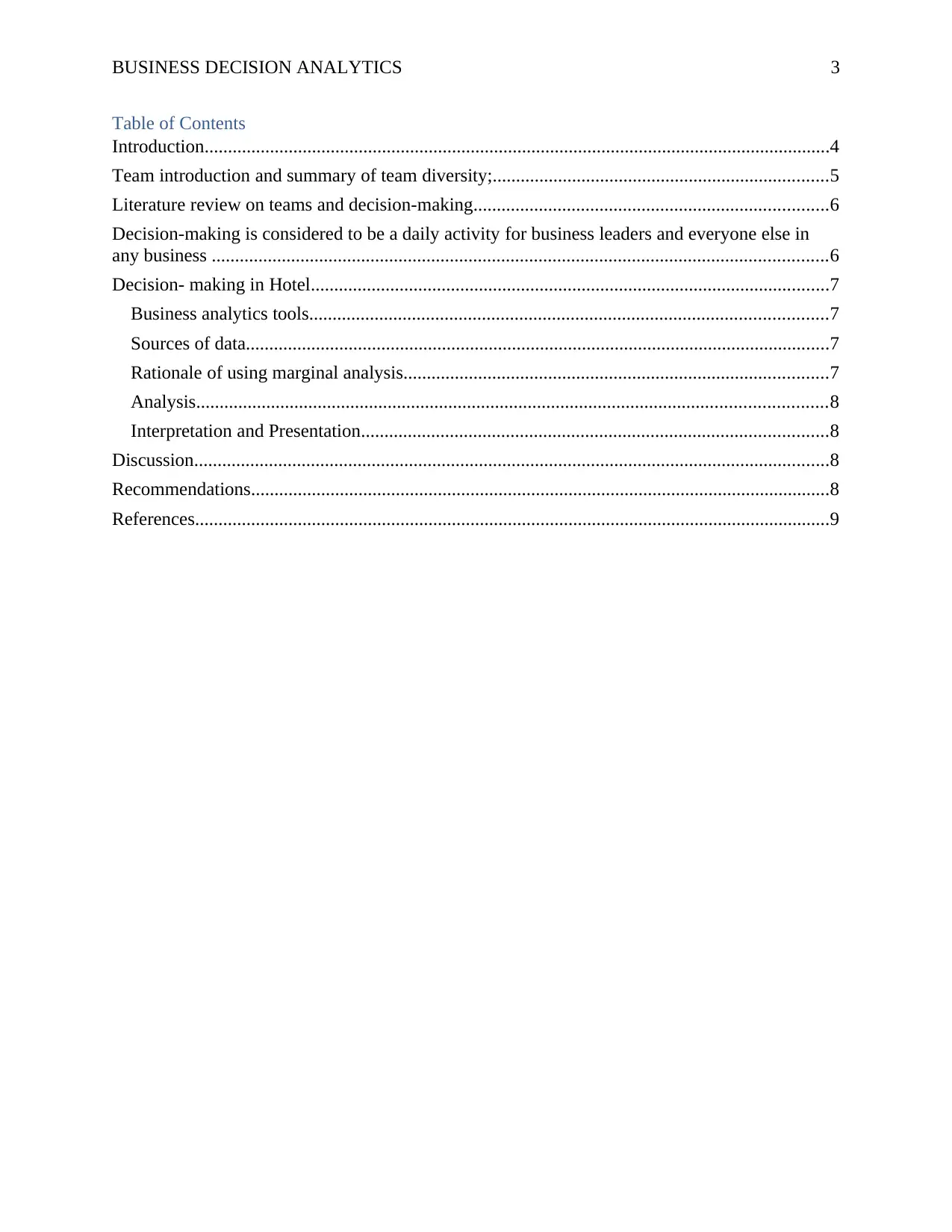
Table of Contents
Introduction......................................................................................................................................4
Team introduction and summary of team diversity;........................................................................5
Literature review on teams and decision-making............................................................................6
Decision-making is considered to be a daily activity for business leaders and everyone else in
any business ....................................................................................................................................6
Decision- making in Hotel...............................................................................................................7
Business analytics tools...............................................................................................................7
Sources of data.............................................................................................................................7
Rationale of using marginal analysis...........................................................................................7
Analysis.......................................................................................................................................8
Interpretation and Presentation....................................................................................................8
Discussion........................................................................................................................................8
Recommendations............................................................................................................................8
References........................................................................................................................................9
Table of Contents
Introduction......................................................................................................................................4
Team introduction and summary of team diversity;........................................................................5
Literature review on teams and decision-making............................................................................6
Decision-making is considered to be a daily activity for business leaders and everyone else in
any business ....................................................................................................................................6
Decision- making in Hotel...............................................................................................................7
Business analytics tools...............................................................................................................7
Sources of data.............................................................................................................................7
Rationale of using marginal analysis...........................................................................................7
Analysis.......................................................................................................................................8
Interpretation and Presentation....................................................................................................8
Discussion........................................................................................................................................8
Recommendations............................................................................................................................8
References........................................................................................................................................9
⊘ This is a preview!⊘
Do you want full access?
Subscribe today to unlock all pages.

Trusted by 1+ million students worldwide
BUSINESS DECISION ANALYTICS 4
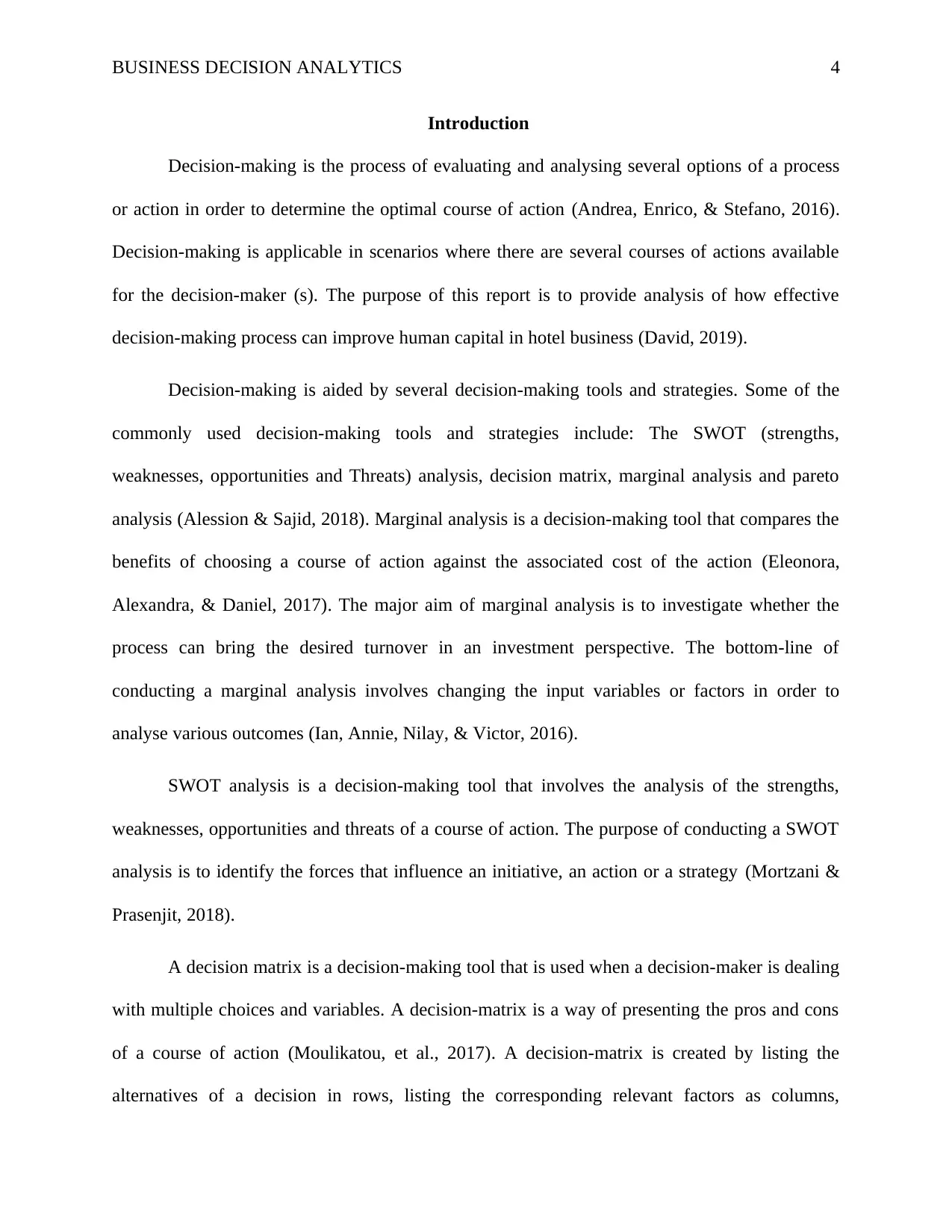
Introduction
Decision-making is the process of evaluating and analysing several options of a process
or action in order to determine the optimal course of action (Andrea, Enrico, & Stefano, 2016).
Decision-making is applicable in scenarios where there are several courses of actions available
for the decision-maker (s). The purpose of this report is to provide analysis of how effective
decision-making process can improve human capital in hotel business (David, 2019).
Decision-making is aided by several decision-making tools and strategies. Some of the
commonly used decision-making tools and strategies include: The SWOT (strengths,
weaknesses, opportunities and Threats) analysis, decision matrix, marginal analysis and pareto
analysis (Alession & Sajid, 2018). Marginal analysis is a decision-making tool that compares the
benefits of choosing a course of action against the associated cost of the action (Eleonora,
Alexandra, & Daniel, 2017). The major aim of marginal analysis is to investigate whether the
process can bring the desired turnover in an investment perspective. The bottom-line of
conducting a marginal analysis involves changing the input variables or factors in order to
analyse various outcomes (Ian, Annie, Nilay, & Victor, 2016).
SWOT analysis is a decision-making tool that involves the analysis of the strengths,
weaknesses, opportunities and threats of a course of action. The purpose of conducting a SWOT
analysis is to identify the forces that influence an initiative, an action or a strategy (Mortzani &
Prasenjit, 2018).
A decision matrix is a decision-making tool that is used when a decision-maker is dealing
with multiple choices and variables. A decision-matrix is a way of presenting the pros and cons
of a course of action (Moulikatou, et al., 2017). A decision-matrix is created by listing the
alternatives of a decision in rows, listing the corresponding relevant factors as columns,
Introduction
Decision-making is the process of evaluating and analysing several options of a process
or action in order to determine the optimal course of action (Andrea, Enrico, & Stefano, 2016).
Decision-making is applicable in scenarios where there are several courses of actions available
for the decision-maker (s). The purpose of this report is to provide analysis of how effective
decision-making process can improve human capital in hotel business (David, 2019).
Decision-making is aided by several decision-making tools and strategies. Some of the
commonly used decision-making tools and strategies include: The SWOT (strengths,
weaknesses, opportunities and Threats) analysis, decision matrix, marginal analysis and pareto
analysis (Alession & Sajid, 2018). Marginal analysis is a decision-making tool that compares the
benefits of choosing a course of action against the associated cost of the action (Eleonora,
Alexandra, & Daniel, 2017). The major aim of marginal analysis is to investigate whether the
process can bring the desired turnover in an investment perspective. The bottom-line of
conducting a marginal analysis involves changing the input variables or factors in order to
analyse various outcomes (Ian, Annie, Nilay, & Victor, 2016).
SWOT analysis is a decision-making tool that involves the analysis of the strengths,
weaknesses, opportunities and threats of a course of action. The purpose of conducting a SWOT
analysis is to identify the forces that influence an initiative, an action or a strategy (Mortzani &
Prasenjit, 2018).
A decision matrix is a decision-making tool that is used when a decision-maker is dealing
with multiple choices and variables. A decision-matrix is a way of presenting the pros and cons
of a course of action (Moulikatou, et al., 2017). A decision-matrix is created by listing the
alternatives of a decision in rows, listing the corresponding relevant factors as columns,
Paraphrase This Document
Need a fresh take? Get an instant paraphrase of this document with our AI Paraphraser
BUSINESS DECISION ANALYTICS 5
establishing a consistent scale of a combination of alternatives and factors, determining the
importance of each factor, multiplying the original rating by the weighted ranking, adding up the
factors under each decision alternative, and choosing the factor with the highest score (Robert, et
al., 2018).
Team introduction and summary of team diversity;
Samuel Bontempo Acioli, from Brazil, is a former semi-professional swimmer that
participate in the Brazilian National team and also had graduated as bachelor associated physical
education. Besides the athlete working life, he also worked as fitness instructor, swimming
teacher and had internships as teacher of physical education in primary and high schools. After
decide to retire from his swimming career, Samuel went to Sydney to improve his English skills
and work at his brother cafe and restaurant. In Sydney he learnt the hospitality industry and have
developed skills and a career in the industry, working as kitchen hand, barista, cafe manager,
events bartender and now bartender at Canberra East Hotel food and beverage department.
The group chose to analyse how effective decision-making process could improve Samuel
workplace challenges in recruit, train and retain highly quality staff. Recruited to work as
bartender in the East Hotel food and beverage outlets he also has shifts as bar supervisor in the
absence of the bar manager. East Hotel is located in Canberra’s inner south, on the merge of
Kingston, Griffith and Manuka precincts. Besides four and half accommodations, East Hotel
provides as well to it gusts a Cafe, Cocktail Bar and an Italian Restaurant as food destination.
The hotel food and beverage department are responsible for managing Joe’s Bar (the cocktail
bar) and Agostinis (the Italian restaurant). This group will review data and information regarding
establishing a consistent scale of a combination of alternatives and factors, determining the
importance of each factor, multiplying the original rating by the weighted ranking, adding up the
factors under each decision alternative, and choosing the factor with the highest score (Robert, et
al., 2018).
Team introduction and summary of team diversity;
Samuel Bontempo Acioli, from Brazil, is a former semi-professional swimmer that
participate in the Brazilian National team and also had graduated as bachelor associated physical
education. Besides the athlete working life, he also worked as fitness instructor, swimming
teacher and had internships as teacher of physical education in primary and high schools. After
decide to retire from his swimming career, Samuel went to Sydney to improve his English skills
and work at his brother cafe and restaurant. In Sydney he learnt the hospitality industry and have
developed skills and a career in the industry, working as kitchen hand, barista, cafe manager,
events bartender and now bartender at Canberra East Hotel food and beverage department.
The group chose to analyse how effective decision-making process could improve Samuel
workplace challenges in recruit, train and retain highly quality staff. Recruited to work as
bartender in the East Hotel food and beverage outlets he also has shifts as bar supervisor in the
absence of the bar manager. East Hotel is located in Canberra’s inner south, on the merge of
Kingston, Griffith and Manuka precincts. Besides four and half accommodations, East Hotel
provides as well to it gusts a Cafe, Cocktail Bar and an Italian Restaurant as food destination.
The hotel food and beverage department are responsible for managing Joe’s Bar (the cocktail
bar) and Agostinis (the Italian restaurant). This group will review data and information regarding
BUSINESS DECISION ANALYTICS 6
Canberra and Australia hospitality and tourism industry to improve the decisions making process
involved in East Hotel food and beverage department staff recruitment and retention.
Literature review on teams and decision-making
Decision-making is considered to be a daily activity for business leaders and everyone else
in any business (Eleonora, Alexandra, & Daniel, 2017). According to (Eleonora, Alexandra, &
Daniel, 2017), business leaders are involved in hundreds of decision-making in daily basis
depending on their roles and areas of specialization. The decision made by the business leaders
are critical in influencing the performance of the businesses. Therefore, those who are involved
in decision-making usually use certain tools and strategies to enable them make the best
decisions for the business. Such tools and strategies also dictate the process of making the
decisions (Adriana, 2017).
Shutterstock (2015) brings the attention to groupthink as a phenomenon that can result in
dysfunctional group decisions where individuals that compose a group don’t contribute with their
own opinion on the decision-making process to avoid other group member rejections or disturb
the group harmony. Groupthink decreases a group capability to generate quality insights and
information useful to improve decisions to be made by a team.
Klug and Bagrow (2016) points out how collaborative teams had increased on size and
importance in the last decades since studies have showed that multi-tasking and specialisation
are prone to mistakes when dealing with cognitive overload and complexity. Although there is
the factor of social loafing in larger groups where an individual applies less effort in a group
Canberra and Australia hospitality and tourism industry to improve the decisions making process
involved in East Hotel food and beverage department staff recruitment and retention.
Literature review on teams and decision-making
Decision-making is considered to be a daily activity for business leaders and everyone else
in any business (Eleonora, Alexandra, & Daniel, 2017). According to (Eleonora, Alexandra, &
Daniel, 2017), business leaders are involved in hundreds of decision-making in daily basis
depending on their roles and areas of specialization. The decision made by the business leaders
are critical in influencing the performance of the businesses. Therefore, those who are involved
in decision-making usually use certain tools and strategies to enable them make the best
decisions for the business. Such tools and strategies also dictate the process of making the
decisions (Adriana, 2017).
Shutterstock (2015) brings the attention to groupthink as a phenomenon that can result in
dysfunctional group decisions where individuals that compose a group don’t contribute with their
own opinion on the decision-making process to avoid other group member rejections or disturb
the group harmony. Groupthink decreases a group capability to generate quality insights and
information useful to improve decisions to be made by a team.
Klug and Bagrow (2016) points out how collaborative teams had increased on size and
importance in the last decades since studies have showed that multi-tasking and specialisation
are prone to mistakes when dealing with cognitive overload and complexity. Although there is
the factor of social loafing in larger groups where an individual applies less effort in a group
⊘ This is a preview!⊘
Do you want full access?
Subscribe today to unlock all pages.
Trusted by 1+ million students worldwide
BUSINESS DECISION ANALYTICS 7
when doing a task as a group, groups can reach successful outcomes with appropriate leadership
and experienced group members.
Decision- making in Hotel
As a group, we decided to analyse the various ways in which effective decision-making process
can be used to improve the human capital in hotel. The analysis is based on the effective
decision-making process in recruitment, training and retaining of high-quality staff.
Business analytics tools
The best decision analytics tool to use in making recruitment decisions is the marginal analysis
technique. In marginal analysis the benefits of choosing an action are compared to the associated
cost of choosing the action. The decision to recruit an employ has the cost of paying their wages
and other benefits. Therefore, before such decisions are made, a proper evaluation must be done
in order to ensure that the business continues making profits (Rosso, Kafarov, Latorre, &
Quijano-Hurtado, 2019).
Sources of data
The major sources of data for evaluating the costs and associated benefits of making a
recruitment decision in hotel are both secondary and primary sources. Some of the possible
sources of data include: The level of qualification of the employee (based on their resume), the
expected wages and benefits (based on the books or accounts), the expected input or production,
the age of the employee, and the role of the employee (Scott, Achilles, Alan, & Donovan, 2016).
when doing a task as a group, groups can reach successful outcomes with appropriate leadership
and experienced group members.
Decision- making in Hotel
As a group, we decided to analyse the various ways in which effective decision-making process
can be used to improve the human capital in hotel. The analysis is based on the effective
decision-making process in recruitment, training and retaining of high-quality staff.
Business analytics tools
The best decision analytics tool to use in making recruitment decisions is the marginal analysis
technique. In marginal analysis the benefits of choosing an action are compared to the associated
cost of choosing the action. The decision to recruit an employ has the cost of paying their wages
and other benefits. Therefore, before such decisions are made, a proper evaluation must be done
in order to ensure that the business continues making profits (Rosso, Kafarov, Latorre, &
Quijano-Hurtado, 2019).
Sources of data
The major sources of data for evaluating the costs and associated benefits of making a
recruitment decision in hotel are both secondary and primary sources. Some of the possible
sources of data include: The level of qualification of the employee (based on their resume), the
expected wages and benefits (based on the books or accounts), the expected input or production,
the age of the employee, and the role of the employee (Scott, Achilles, Alan, & Donovan, 2016).
Paraphrase This Document
Need a fresh take? Get an instant paraphrase of this document with our AI Paraphraser
BUSINESS DECISION ANALYTICS 8
Rationale of using marginal analysis
Marginal analysis looks at the investment aspect of a decision by comparing the costs and
the benefits of making a decision. The aim of looking at the costs and benefits of a decision in
hotel business is to ensure that the hotel meets its operation costs and still make reasonable profit
(Silvia, Karen, Simon, & Sheilla, 2016).
Analysis
An example of analysis can be done based on the following table. The weights of the factors
have been assigned based on the level of effects that they have on the cost of employment as well
as the associated benefits. The weights have been assigned on a scale of range 0 to 10 (0 being
the factor wit the least influence while 10 being the factor with the highest influence on the cost
of employment and the associated benefits).
Factor weight
The level of qualification of the employee 4
the expected wages and benefits 4
the expected input or production 6
the age of the employee 7
the role of the employee 2
Recommendations
We have learnt several lessons from the analysis and evaluation process of using
decision-making tools to improve the human capital in a hotel business. One of the things we
have learnt is that the best way to make an effective decision is to first analyse the scenario and
the expected outcomes. Proper analysis of a decision scenario will lead to an appropriate choice
of decision variables as well as the decision tools. Moreover, the other way of improving the
Rationale of using marginal analysis
Marginal analysis looks at the investment aspect of a decision by comparing the costs and
the benefits of making a decision. The aim of looking at the costs and benefits of a decision in
hotel business is to ensure that the hotel meets its operation costs and still make reasonable profit
(Silvia, Karen, Simon, & Sheilla, 2016).
Analysis
An example of analysis can be done based on the following table. The weights of the factors
have been assigned based on the level of effects that they have on the cost of employment as well
as the associated benefits. The weights have been assigned on a scale of range 0 to 10 (0 being
the factor wit the least influence while 10 being the factor with the highest influence on the cost
of employment and the associated benefits).
Factor weight
The level of qualification of the employee 4
the expected wages and benefits 4
the expected input or production 6
the age of the employee 7
the role of the employee 2
Recommendations
We have learnt several lessons from the analysis and evaluation process of using
decision-making tools to improve the human capital in a hotel business. One of the things we
have learnt is that the best way to make an effective decision is to first analyse the scenario and
the expected outcomes. Proper analysis of a decision scenario will lead to an appropriate choice
of decision variables as well as the decision tools. Moreover, the other way of improving the
BUSINESS DECISION ANALYTICS 9
decision-making process is by keeping proper records and data. For example, in the case study of
improving the human capital in hotel business, it is important to keep proper records of every
employee in order to evaluate over time. The evaluation will inform the decision to train or retain
the given employees.
References
Adriana, B. (2017). Modelling the Employer's and the Employee's Decision-Making Process.
Journal of Telecomuting, 97(2), 56-89.
Alession, I., & Sajid, S. (2018). Are multi-criteria decision-making tools useful? An
experimental comparative study of three methods. European Journal of Operational
Research, 264(2), 462-471.
Andrea, T., Enrico, c., & Stefano, f. (2016). Barriers, drivers and decision-making process for
industrial energy efficiency: A broad study among manufacturing small and medium-
sized enterprises. Journal of Applied Energy, 78(02), 1537-1551.
David, M. (2019). Presidential Management of the Decision-Making Process. Making Foreign
Policy, 45(2), 282.
Eleonora, P., Alexandra, R., & Daniel, B. (2017). Enhancing the online decision-making process
by using augmented reality: A two country comparison of youth markets. Journal of
Retailing and Consumer Services, 38(7), 81-95.
Ian, H., Annie, L., Nilay, D. S., & Victor, M. M. (2016). Shared Decision Making: The Need For
Patient-Clinician Conversation, Not Just Information. Journal of Operational Research,
35(4), 67-88.
Klug, M. B. (2016). Understanding the group dynamics and success of teams. Royal Society of
Open Science. Retrieved from:
http://rsos.royalsocietypublishing.org/content/3/4/160007, 4(3).
Mortzani, & Prasenjit, C. (2018). Intelligent Decision Making Tools in Manufacturing
Technology Selection. Journal of Operational Research, 387(2), 113-126.
Moulikatou, A. L., Beatriz, V., Emilie, F.-B., France, L., Pierre-Hugues, C., Lu, C., . . . Anik, M.
G. (2017). Five shared decision-making tools in 5 months: use of rapid reviews to
decision-making process is by keeping proper records and data. For example, in the case study of
improving the human capital in hotel business, it is important to keep proper records of every
employee in order to evaluate over time. The evaluation will inform the decision to train or retain
the given employees.
References
Adriana, B. (2017). Modelling the Employer's and the Employee's Decision-Making Process.
Journal of Telecomuting, 97(2), 56-89.
Alession, I., & Sajid, S. (2018). Are multi-criteria decision-making tools useful? An
experimental comparative study of three methods. European Journal of Operational
Research, 264(2), 462-471.
Andrea, T., Enrico, c., & Stefano, f. (2016). Barriers, drivers and decision-making process for
industrial energy efficiency: A broad study among manufacturing small and medium-
sized enterprises. Journal of Applied Energy, 78(02), 1537-1551.
David, M. (2019). Presidential Management of the Decision-Making Process. Making Foreign
Policy, 45(2), 282.
Eleonora, P., Alexandra, R., & Daniel, B. (2017). Enhancing the online decision-making process
by using augmented reality: A two country comparison of youth markets. Journal of
Retailing and Consumer Services, 38(7), 81-95.
Ian, H., Annie, L., Nilay, D. S., & Victor, M. M. (2016). Shared Decision Making: The Need For
Patient-Clinician Conversation, Not Just Information. Journal of Operational Research,
35(4), 67-88.
Klug, M. B. (2016). Understanding the group dynamics and success of teams. Royal Society of
Open Science. Retrieved from:
http://rsos.royalsocietypublishing.org/content/3/4/160007, 4(3).
Mortzani, & Prasenjit, C. (2018). Intelligent Decision Making Tools in Manufacturing
Technology Selection. Journal of Operational Research, 387(2), 113-126.
Moulikatou, A. L., Beatriz, V., Emilie, F.-B., France, L., Pierre-Hugues, C., Lu, C., . . . Anik, M.
G. (2017). Five shared decision-making tools in 5 months: use of rapid reviews to
⊘ This is a preview!⊘
Do you want full access?
Subscribe today to unlock all pages.
Trusted by 1+ million students worldwide
BUSINESS DECISION ANALYTICS 10
develop decision boxes for seniors living with dementia and their caregivers. Journal of
Operational Research, 56(2), 123-145.
Robert, J. V., Viola, B. L., Lianne, J., Andrew, W., Durado, B., Richard, C. W., & Robert, S.
(2018). From guideline to practice: New shared decision‐making tools for colorectal
cancer screening from the American Cancer Society. A Cancer Journal for Clinicians,
23(1), 34-67.
Rosso, C., Kafarov, V., Latorre, B., & Quijano-Hurtado. (2019). A novel hybrid approach based
on fuzzy multi-criteria decision-making tools for assessing sustainable alternatives of
power generation in San Andrés Island. Journal of Renewable Sustainable Energy
Systems, 110(4), 159-173.
Scott, G. H., Achilles, A. A., Alan, G. W., & Donovan, Y. C. (2016). A qualitative study
investigating the ethical decision making process: A proposed model. The Leadership
Quarterly, 27(5), 788-801.
Shutterstock. (2015). 6 Strategies for Overcoming the Tendency Toward Groupthink.
https://www.shutterstock.com/blog/6-strategies-for-overcoming-groupthink.
Silvia, P. C., Karen, N., Simon, W., & Sheilla, O. (2016). Managing social media uncertainty to
support the decision making process during Emergencies. Journal of Decision Systems,
25(1), 67-89.
develop decision boxes for seniors living with dementia and their caregivers. Journal of
Operational Research, 56(2), 123-145.
Robert, J. V., Viola, B. L., Lianne, J., Andrew, W., Durado, B., Richard, C. W., & Robert, S.
(2018). From guideline to practice: New shared decision‐making tools for colorectal
cancer screening from the American Cancer Society. A Cancer Journal for Clinicians,
23(1), 34-67.
Rosso, C., Kafarov, V., Latorre, B., & Quijano-Hurtado. (2019). A novel hybrid approach based
on fuzzy multi-criteria decision-making tools for assessing sustainable alternatives of
power generation in San Andrés Island. Journal of Renewable Sustainable Energy
Systems, 110(4), 159-173.
Scott, G. H., Achilles, A. A., Alan, G. W., & Donovan, Y. C. (2016). A qualitative study
investigating the ethical decision making process: A proposed model. The Leadership
Quarterly, 27(5), 788-801.
Shutterstock. (2015). 6 Strategies for Overcoming the Tendency Toward Groupthink.
https://www.shutterstock.com/blog/6-strategies-for-overcoming-groupthink.
Silvia, P. C., Karen, N., Simon, W., & Sheilla, O. (2016). Managing social media uncertainty to
support the decision making process during Emergencies. Journal of Decision Systems,
25(1), 67-89.
Paraphrase This Document
Need a fresh take? Get an instant paraphrase of this document with our AI Paraphraser
BUSINESS DECISION ANALYTICS 11
Appendices
to include team project plan, individual team process feedback and synthesised
evaluation summary agreed by all team members.
Appendices
to include team project plan, individual team process feedback and synthesised
evaluation summary agreed by all team members.

BUSINESS DECISION ANALYTICS 12
⊘ This is a preview!⊘
Do you want full access?
Subscribe today to unlock all pages.
Trusted by 1+ million students worldwide

1 out of 12


Related Documents


![Case Study Report: Business Decision Analysis - [University Name]](/_next/image/?url=https%3A%2F%2Fdesklib.com%2Fmedia%2Fimages%2Fnm%2F0fe1229012094541bae6dce0f9e36c59.jpg&w=256&q=75)


Your All-in-One AI-Powered Toolkit for Academic Success.
+13062052269
info@desklib.com
Available 24*7 on WhatsApp / Email
![[object Object]](/_next/static/media/star-bottom.7253800d.svg)
Unlock your academic potential
Copyright © 2020–2026 A2Z Services. All Rights Reserved. Developed and managed by ZUCOL.