EastJet Audit Project: Planning, Risk, and Materiality
VerifiedAdded on 2019/09/16
|7
|1549
|300
Project
AI Summary
This project provides a comprehensive audit of EastJet, a small airline, focusing on the fiscal year ending December 31, 2016. The project addresses several key aspects of the audit process, including performing a planning analytical review of the financial statements, identifying and explaining audit risks, and designing appropriate audit approaches. It involves calculating planning materiality, evaluating the work of a junior auditor on accounts receivable and property, plant, and equipment, and developing a PPE audit program. The project also discusses the importance of documentation in the audit file and concludes with the drafting of an audit report, considering a material but not pervasive misstatement related to capital leases. The solution covers all required elements, including analysis, risk assessment, procedure design, and reporting, providing a complete response to the assignment brief.
Nadu
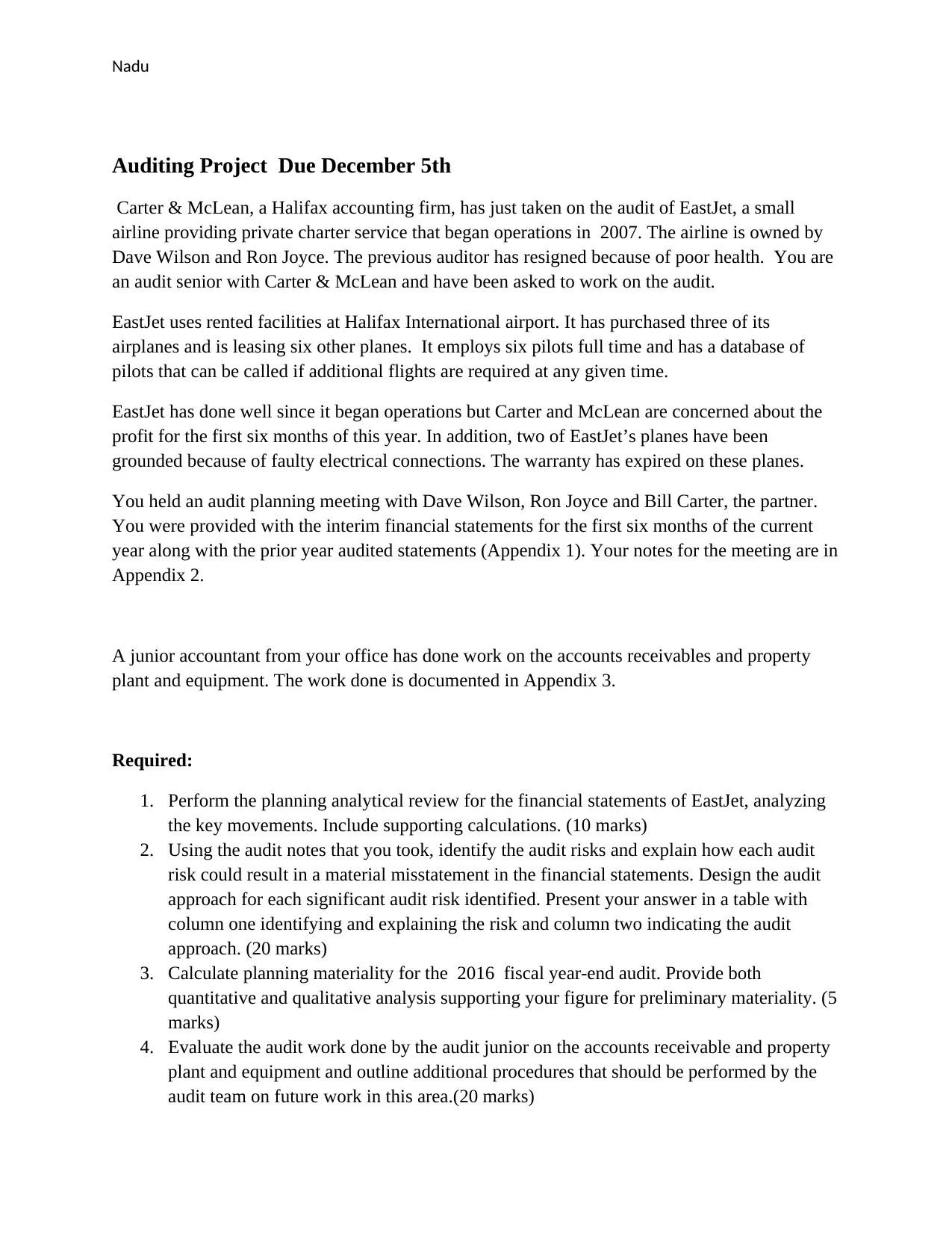
Auditing Project Due December 5th
Carter & McLean, a Halifax accounting firm, has just taken on the audit of EastJet, a small
airline providing private charter service that began operations in 2007. The airline is owned by
Dave Wilson and Ron Joyce. The previous auditor has resigned because of poor health. You are
an audit senior with Carter & McLean and have been asked to work on the audit.
EastJet uses rented facilities at Halifax International airport. It has purchased three of its
airplanes and is leasing six other planes. It employs six pilots full time and has a database of
pilots that can be called if additional flights are required at any given time.
EastJet has done well since it began operations but Carter and McLean are concerned about the
profit for the first six months of this year. In addition, two of EastJet’s planes have been
grounded because of faulty electrical connections. The warranty has expired on these planes.
You held an audit planning meeting with Dave Wilson, Ron Joyce and Bill Carter, the partner.
You were provided with the interim financial statements for the first six months of the current
year along with the prior year audited statements (Appendix 1). Your notes for the meeting are in
Appendix 2.
A junior accountant from your office has done work on the accounts receivables and property
plant and equipment. The work done is documented in Appendix 3.
Required:
1. Perform the planning analytical review for the financial statements of EastJet, analyzing
the key movements. Include supporting calculations. (10 marks)
2. Using the audit notes that you took, identify the audit risks and explain how each audit
risk could result in a material misstatement in the financial statements. Design the audit
approach for each significant audit risk identified. Present your answer in a table with
column one identifying and explaining the risk and column two indicating the audit
approach. (20 marks)
3. Calculate planning materiality for the 2016 fiscal year-end audit. Provide both
quantitative and qualitative analysis supporting your figure for preliminary materiality. (5
marks)
4. Evaluate the audit work done by the audit junior on the accounts receivable and property
plant and equipment and outline additional procedures that should be performed by the
audit team on future work in this area.(20 marks)
Auditing Project Due December 5th
Carter & McLean, a Halifax accounting firm, has just taken on the audit of EastJet, a small
airline providing private charter service that began operations in 2007. The airline is owned by
Dave Wilson and Ron Joyce. The previous auditor has resigned because of poor health. You are
an audit senior with Carter & McLean and have been asked to work on the audit.
EastJet uses rented facilities at Halifax International airport. It has purchased three of its
airplanes and is leasing six other planes. It employs six pilots full time and has a database of
pilots that can be called if additional flights are required at any given time.
EastJet has done well since it began operations but Carter and McLean are concerned about the
profit for the first six months of this year. In addition, two of EastJet’s planes have been
grounded because of faulty electrical connections. The warranty has expired on these planes.
You held an audit planning meeting with Dave Wilson, Ron Joyce and Bill Carter, the partner.
You were provided with the interim financial statements for the first six months of the current
year along with the prior year audited statements (Appendix 1). Your notes for the meeting are in
Appendix 2.
A junior accountant from your office has done work on the accounts receivables and property
plant and equipment. The work done is documented in Appendix 3.
Required:
1. Perform the planning analytical review for the financial statements of EastJet, analyzing
the key movements. Include supporting calculations. (10 marks)
2. Using the audit notes that you took, identify the audit risks and explain how each audit
risk could result in a material misstatement in the financial statements. Design the audit
approach for each significant audit risk identified. Present your answer in a table with
column one identifying and explaining the risk and column two indicating the audit
approach. (20 marks)
3. Calculate planning materiality for the 2016 fiscal year-end audit. Provide both
quantitative and qualitative analysis supporting your figure for preliminary materiality. (5
marks)
4. Evaluate the audit work done by the audit junior on the accounts receivable and property
plant and equipment and outline additional procedures that should be performed by the
audit team on future work in this area.(20 marks)

Paraphrase This Document
Need a fresh take? Get an instant paraphrase of this document with our AI Paraphraser
Nadu
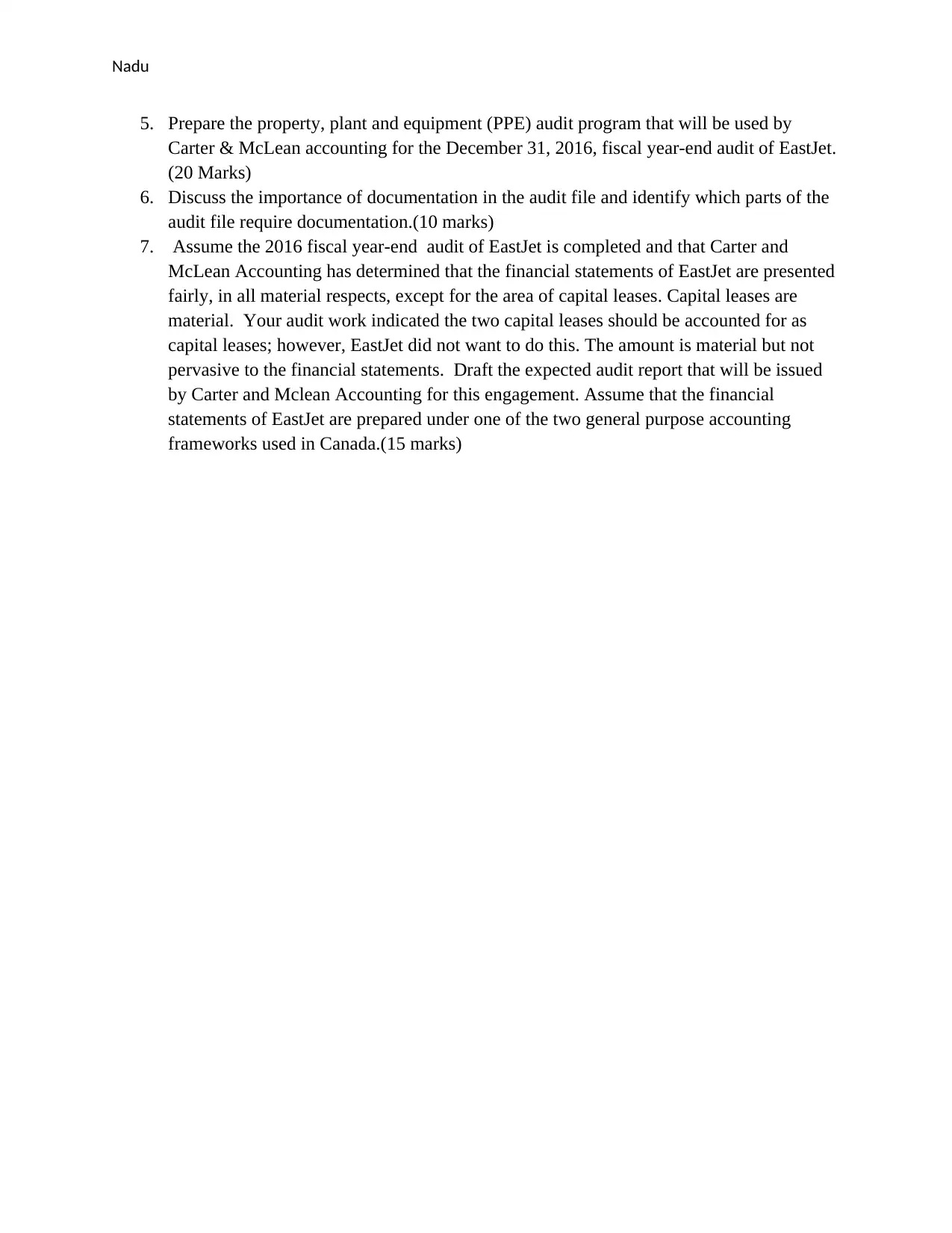
5. Prepare the property, plant and equipment (PPE) audit program that will be used by
Carter & McLean accounting for the December 31, 2016, fiscal year-end audit of EastJet.
(20 Marks)
6. Discuss the importance of documentation in the audit file and identify which parts of the
audit file require documentation.(10 marks)
7. Assume the 2016 fiscal year-end audit of EastJet is completed and that Carter and
McLean Accounting has determined that the financial statements of EastJet are presented
fairly, in all material respects, except for the area of capital leases. Capital leases are
material. Your audit work indicated the two capital leases should be accounted for as
capital leases; however, EastJet did not want to do this. The amount is material but not
pervasive to the financial statements. Draft the expected audit report that will be issued
by Carter and Mclean Accounting for this engagement. Assume that the financial
statements of EastJet are prepared under one of the two general purpose accounting
frameworks used in Canada.(15 marks)
5. Prepare the property, plant and equipment (PPE) audit program that will be used by
Carter & McLean accounting for the December 31, 2016, fiscal year-end audit of EastJet.
(20 Marks)
6. Discuss the importance of documentation in the audit file and identify which parts of the
audit file require documentation.(10 marks)
7. Assume the 2016 fiscal year-end audit of EastJet is completed and that Carter and
McLean Accounting has determined that the financial statements of EastJet are presented
fairly, in all material respects, except for the area of capital leases. Capital leases are
material. Your audit work indicated the two capital leases should be accounted for as
capital leases; however, EastJet did not want to do this. The amount is material but not
pervasive to the financial statements. Draft the expected audit report that will be issued
by Carter and Mclean Accounting for this engagement. Assume that the financial
statements of EastJet are prepared under one of the two general purpose accounting
frameworks used in Canada.(15 marks)
Nadu
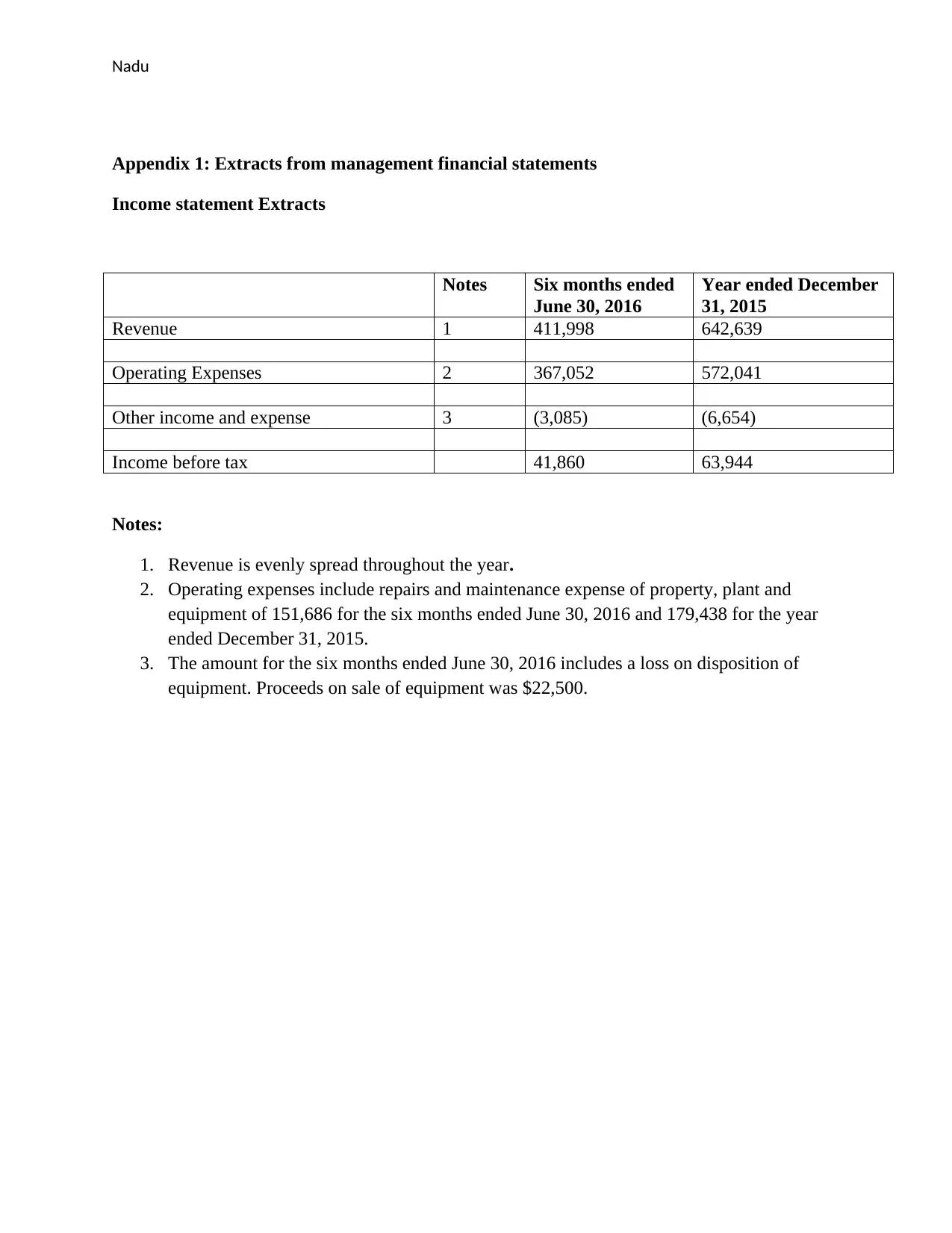
Appendix 1: Extracts from management financial statements
Income statement Extracts
Notes Six months ended
June 30, 2016
Year ended December
31, 2015
Revenue 1 411,998 642,639
Operating Expenses 2 367,052 572,041
Other income and expense 3 (3,085) (6,654)
Income before tax 41,860 63,944
Notes:
1. Revenue is evenly spread throughout the year.
2. Operating expenses include repairs and maintenance expense of property, plant and
equipment of 151,686 for the six months ended June 30, 2016 and 179,438 for the year
ended December 31, 2015.
3. The amount for the six months ended June 30, 2016 includes a loss on disposition of
equipment. Proceeds on sale of equipment was $22,500.
Appendix 1: Extracts from management financial statements
Income statement Extracts
Notes Six months ended
June 30, 2016
Year ended December
31, 2015
Revenue 1 411,998 642,639
Operating Expenses 2 367,052 572,041
Other income and expense 3 (3,085) (6,654)
Income before tax 41,860 63,944
Notes:
1. Revenue is evenly spread throughout the year.
2. Operating expenses include repairs and maintenance expense of property, plant and
equipment of 151,686 for the six months ended June 30, 2016 and 179,438 for the year
ended December 31, 2015.
3. The amount for the six months ended June 30, 2016 includes a loss on disposition of
equipment. Proceeds on sale of equipment was $22,500.
⊘ This is a preview!⊘
Do you want full access?
Subscribe today to unlock all pages.

Trusted by 1+ million students worldwide
Nadu
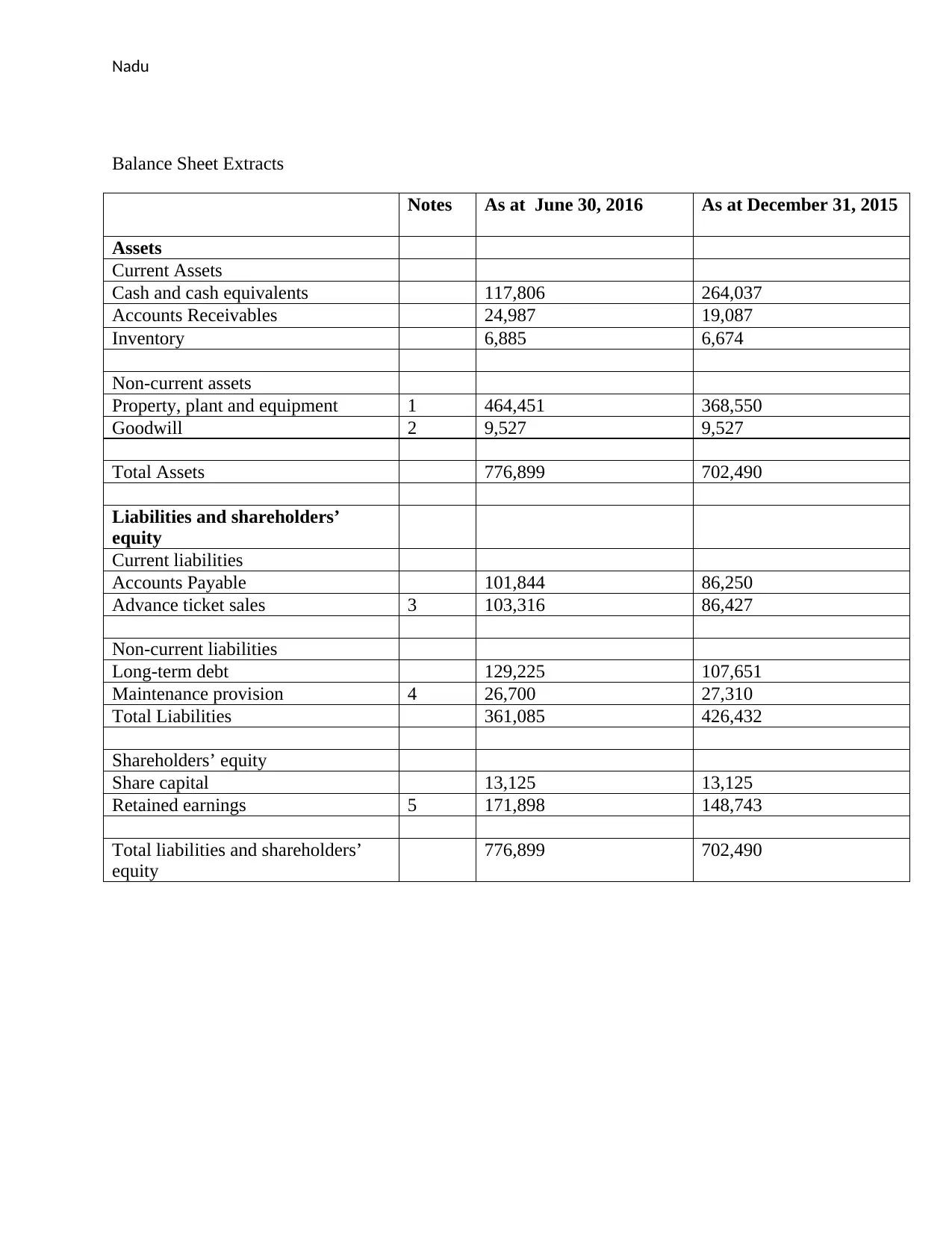
Balance Sheet Extracts
Notes As at June 30, 2016 As at December 31, 2015
Assets
Current Assets
Cash and cash equivalents 117,806 264,037
Accounts Receivables 24,987 19,087
Inventory 6,885 6,674
Non-current assets
Property, plant and equipment 1 464,451 368,550
Goodwill 2 9,527 9,527
Total Assets 776,899 702,490
Liabilities and shareholders’
equity
Current liabilities
Accounts Payable 101,844 86,250
Advance ticket sales 3 103,316 86,427
Non-current liabilities
Long-term debt 129,225 107,651
Maintenance provision 4 26,700 27,310
Total Liabilities 361,085 426,432
Shareholders’ equity
Share capital 13,125 13,125
Retained earnings 5 171,898 148,743
Total liabilities and shareholders’
equity
776,899 702,490
Balance Sheet Extracts
Notes As at June 30, 2016 As at December 31, 2015
Assets
Current Assets
Cash and cash equivalents 117,806 264,037
Accounts Receivables 24,987 19,087
Inventory 6,885 6,674
Non-current assets
Property, plant and equipment 1 464,451 368,550
Goodwill 2 9,527 9,527
Total Assets 776,899 702,490
Liabilities and shareholders’
equity
Current liabilities
Accounts Payable 101,844 86,250
Advance ticket sales 3 103,316 86,427
Non-current liabilities
Long-term debt 129,225 107,651
Maintenance provision 4 26,700 27,310
Total Liabilities 361,085 426,432
Shareholders’ equity
Share capital 13,125 13,125
Retained earnings 5 171,898 148,743
Total liabilities and shareholders’
equity
776,899 702,490
Paraphrase This Document
Need a fresh take? Get an instant paraphrase of this document with our AI Paraphraser
Nadu
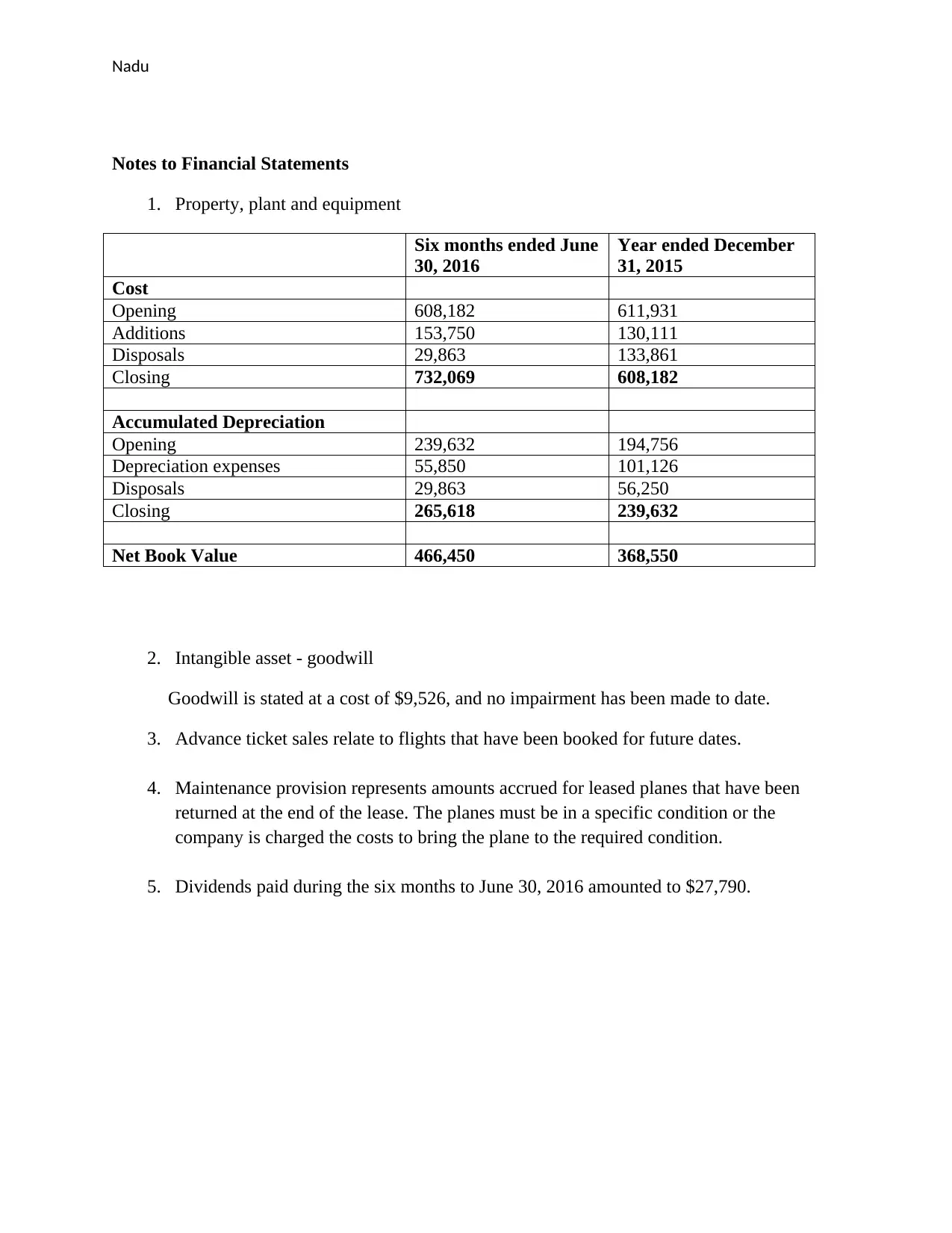
Notes to Financial Statements
1. Property, plant and equipment
Six months ended June
30, 2016
Year ended December
31, 2015
Cost
Opening 608,182 611,931
Additions 153,750 130,111
Disposals 29,863 133,861
Closing 732,069 608,182
Accumulated Depreciation
Opening 239,632 194,756
Depreciation expenses 55,850 101,126
Disposals 29,863 56,250
Closing 265,618 239,632
Net Book Value 466,450 368,550
2. Intangible asset - goodwill
Goodwill is stated at a cost of $9,526, and no impairment has been made to date.
3. Advance ticket sales relate to flights that have been booked for future dates.
4. Maintenance provision represents amounts accrued for leased planes that have been
returned at the end of the lease. The planes must be in a specific condition or the
company is charged the costs to bring the plane to the required condition.
5. Dividends paid during the six months to June 30, 2016 amounted to $27,790.
Notes to Financial Statements
1. Property, plant and equipment
Six months ended June
30, 2016
Year ended December
31, 2015
Cost
Opening 608,182 611,931
Additions 153,750 130,111
Disposals 29,863 133,861
Closing 732,069 608,182
Accumulated Depreciation
Opening 239,632 194,756
Depreciation expenses 55,850 101,126
Disposals 29,863 56,250
Closing 265,618 239,632
Net Book Value 466,450 368,550
2. Intangible asset - goodwill
Goodwill is stated at a cost of $9,526, and no impairment has been made to date.
3. Advance ticket sales relate to flights that have been booked for future dates.
4. Maintenance provision represents amounts accrued for leased planes that have been
returned at the end of the lease. The planes must be in a specific condition or the
company is charged the costs to bring the plane to the required condition.
5. Dividends paid during the six months to June 30, 2016 amounted to $27,790.
Nadu
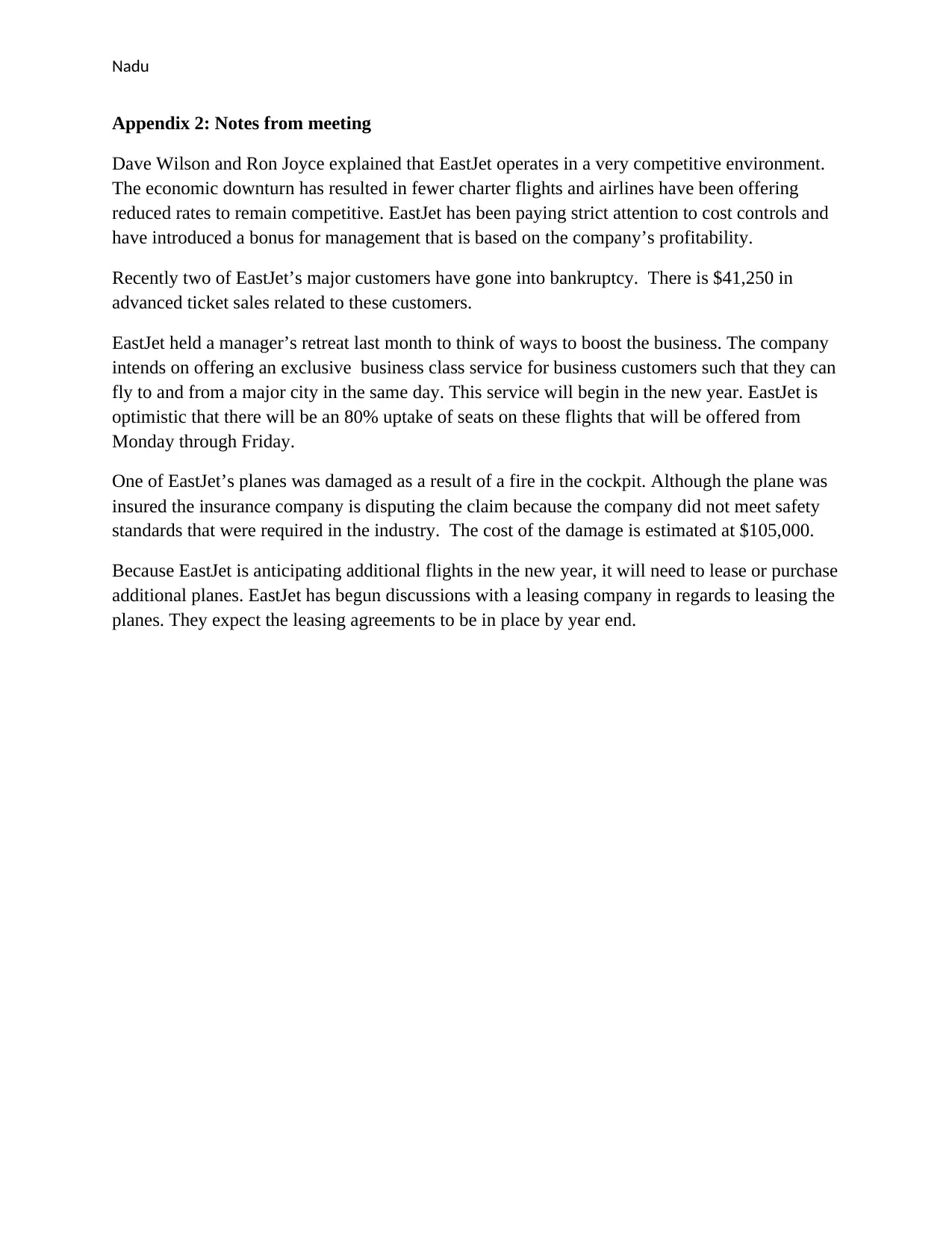
Appendix 2: Notes from meeting
Dave Wilson and Ron Joyce explained that EastJet operates in a very competitive environment.
The economic downturn has resulted in fewer charter flights and airlines have been offering
reduced rates to remain competitive. EastJet has been paying strict attention to cost controls and
have introduced a bonus for management that is based on the company’s profitability.
Recently two of EastJet’s major customers have gone into bankruptcy. There is $41,250 in
advanced ticket sales related to these customers.
EastJet held a manager’s retreat last month to think of ways to boost the business. The company
intends on offering an exclusive business class service for business customers such that they can
fly to and from a major city in the same day. This service will begin in the new year. EastJet is
optimistic that there will be an 80% uptake of seats on these flights that will be offered from
Monday through Friday.
One of EastJet’s planes was damaged as a result of a fire in the cockpit. Although the plane was
insured the insurance company is disputing the claim because the company did not meet safety
standards that were required in the industry. The cost of the damage is estimated at $105,000.
Because EastJet is anticipating additional flights in the new year, it will need to lease or purchase
additional planes. EastJet has begun discussions with a leasing company in regards to leasing the
planes. They expect the leasing agreements to be in place by year end.
Appendix 2: Notes from meeting
Dave Wilson and Ron Joyce explained that EastJet operates in a very competitive environment.
The economic downturn has resulted in fewer charter flights and airlines have been offering
reduced rates to remain competitive. EastJet has been paying strict attention to cost controls and
have introduced a bonus for management that is based on the company’s profitability.
Recently two of EastJet’s major customers have gone into bankruptcy. There is $41,250 in
advanced ticket sales related to these customers.
EastJet held a manager’s retreat last month to think of ways to boost the business. The company
intends on offering an exclusive business class service for business customers such that they can
fly to and from a major city in the same day. This service will begin in the new year. EastJet is
optimistic that there will be an 80% uptake of seats on these flights that will be offered from
Monday through Friday.
One of EastJet’s planes was damaged as a result of a fire in the cockpit. Although the plane was
insured the insurance company is disputing the claim because the company did not meet safety
standards that were required in the industry. The cost of the damage is estimated at $105,000.
Because EastJet is anticipating additional flights in the new year, it will need to lease or purchase
additional planes. EastJet has begun discussions with a leasing company in regards to leasing the
planes. They expect the leasing agreements to be in place by year end.
⊘ This is a preview!⊘
Do you want full access?
Subscribe today to unlock all pages.
Trusted by 1+ million students worldwide
Nadu
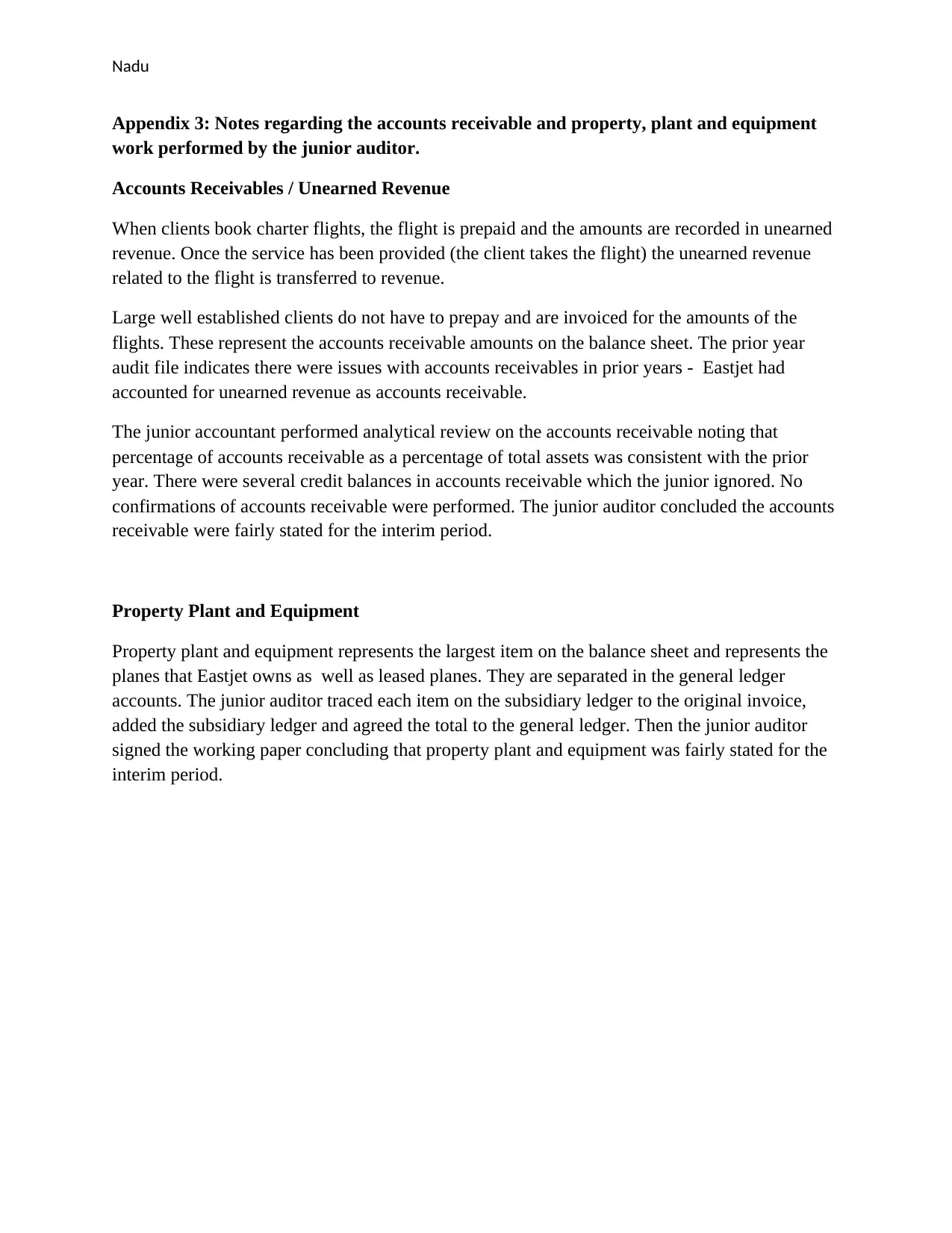
Appendix 3: Notes regarding the accounts receivable and property, plant and equipment
work performed by the junior auditor.
Accounts Receivables / Unearned Revenue
When clients book charter flights, the flight is prepaid and the amounts are recorded in unearned
revenue. Once the service has been provided (the client takes the flight) the unearned revenue
related to the flight is transferred to revenue.
Large well established clients do not have to prepay and are invoiced for the amounts of the
flights. These represent the accounts receivable amounts on the balance sheet. The prior year
audit file indicates there were issues with accounts receivables in prior years - Eastjet had
accounted for unearned revenue as accounts receivable.
The junior accountant performed analytical review on the accounts receivable noting that
percentage of accounts receivable as a percentage of total assets was consistent with the prior
year. There were several credit balances in accounts receivable which the junior ignored. No
confirmations of accounts receivable were performed. The junior auditor concluded the accounts
receivable were fairly stated for the interim period.
Property Plant and Equipment
Property plant and equipment represents the largest item on the balance sheet and represents the
planes that Eastjet owns as well as leased planes. They are separated in the general ledger
accounts. The junior auditor traced each item on the subsidiary ledger to the original invoice,
added the subsidiary ledger and agreed the total to the general ledger. Then the junior auditor
signed the working paper concluding that property plant and equipment was fairly stated for the
interim period.
Appendix 3: Notes regarding the accounts receivable and property, plant and equipment
work performed by the junior auditor.
Accounts Receivables / Unearned Revenue
When clients book charter flights, the flight is prepaid and the amounts are recorded in unearned
revenue. Once the service has been provided (the client takes the flight) the unearned revenue
related to the flight is transferred to revenue.
Large well established clients do not have to prepay and are invoiced for the amounts of the
flights. These represent the accounts receivable amounts on the balance sheet. The prior year
audit file indicates there were issues with accounts receivables in prior years - Eastjet had
accounted for unearned revenue as accounts receivable.
The junior accountant performed analytical review on the accounts receivable noting that
percentage of accounts receivable as a percentage of total assets was consistent with the prior
year. There were several credit balances in accounts receivable which the junior ignored. No
confirmations of accounts receivable were performed. The junior auditor concluded the accounts
receivable were fairly stated for the interim period.
Property Plant and Equipment
Property plant and equipment represents the largest item on the balance sheet and represents the
planes that Eastjet owns as well as leased planes. They are separated in the general ledger
accounts. The junior auditor traced each item on the subsidiary ledger to the original invoice,
added the subsidiary ledger and agreed the total to the general ledger. Then the junior auditor
signed the working paper concluding that property plant and equipment was fairly stated for the
interim period.

1 out of 7


Your All-in-One AI-Powered Toolkit for Academic Success.
+13062052269
info@desklib.com
Available 24*7 on WhatsApp / Email
![[object Object]](/_next/static/media/star-bottom.7253800d.svg)
Unlock your academic potential
Copyright © 2020–2025 A2Z Services. All Rights Reserved. Developed and managed by ZUCOL.