Emergency Response Plan: Ebola Outbreak and Community Health Analysis
VerifiedAdded on 2023/01/03
|10
|2336
|68
Report
AI Summary
This report provides a detailed analysis of an emergency response plan designed to mitigate the impact of an Ebola virus outbreak. The plan emphasizes a top-down approach, breaking down the complex problem into manageable modules. It covers critical aspects such as engagement, consultation, participation, and organization, involving various stakeholders, including government agencies and healthcare professionals. The report highlights the importance of infection control mechanisms, vaccination programs, and community involvement in identifying and supporting affected individuals. It also discusses the use of the KSA model for public health preparedness, emphasizing the need for trained personnel and rapid response strategies. The report concludes by underscoring the significance of emergency response plans in preventing the spread of communicable diseases and protecting community health, with a specific focus on the Ebola virus. The report stresses the importance of a coordinated effort, from identifying risks to empowering organizations to make key decisions during an outbreak.
Running head- COMMUNITY HEALTH AND DISEASE PREVENTION
COMMUNITY HEALTH AND DISEASE PREVENTION
Name of the Student
Name of the University
Author note
COMMUNITY HEALTH AND DISEASE PREVENTION
Name of the Student
Name of the University
Author note

Paraphrase This Document
Need a fresh take? Get an instant paraphrase of this document with our AI Paraphraser
1COMMUNITY HEALTH AND DISEASE PREVENTION
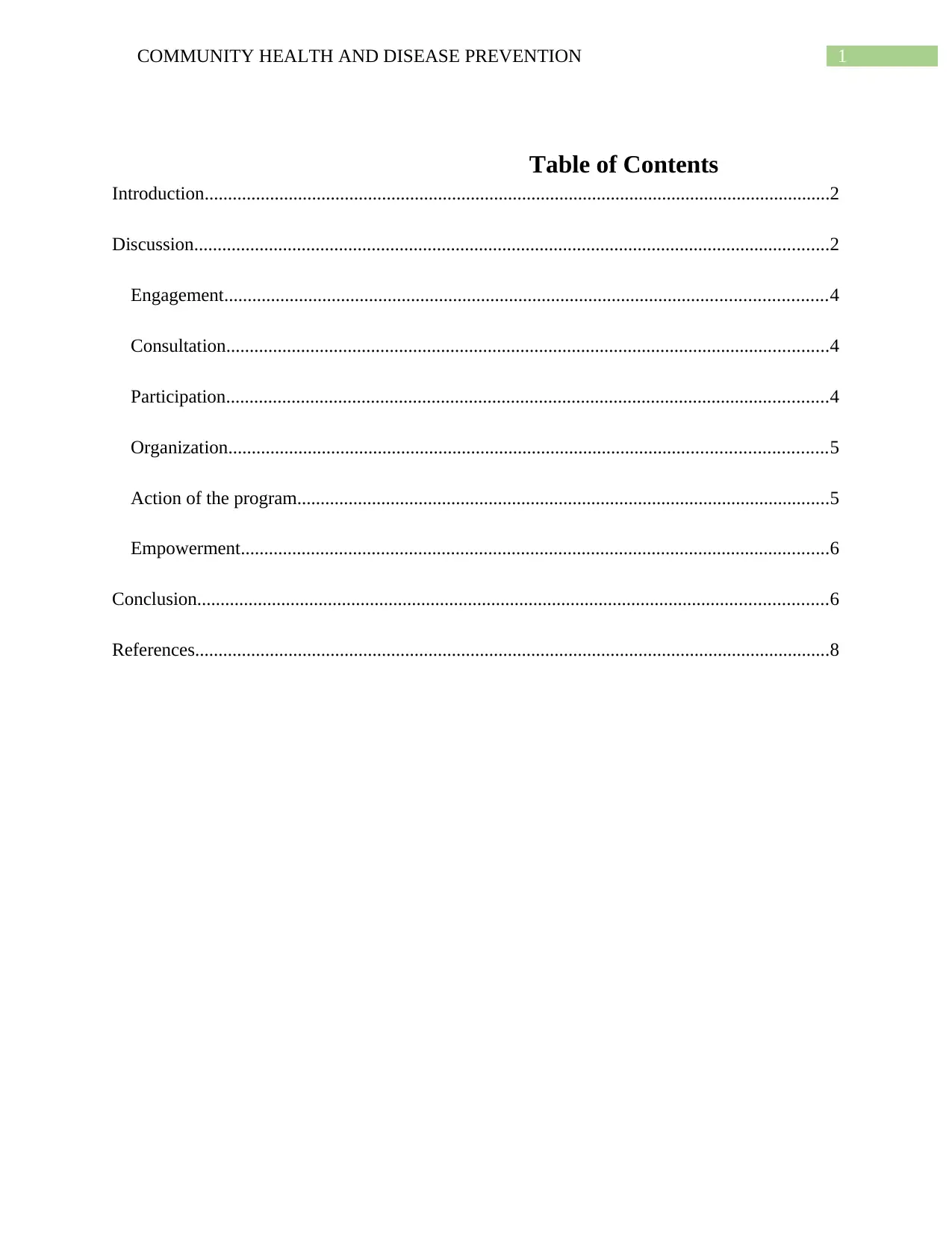
Table of Contents
Introduction......................................................................................................................................2
Discussion........................................................................................................................................2
Engagement.................................................................................................................................4
Consultation.................................................................................................................................4
Participation.................................................................................................................................4
Organization................................................................................................................................5
Action of the program..................................................................................................................5
Empowerment..............................................................................................................................6
Conclusion.......................................................................................................................................6
References........................................................................................................................................8
Table of Contents
Introduction......................................................................................................................................2
Discussion........................................................................................................................................2
Engagement.................................................................................................................................4
Consultation.................................................................................................................................4
Participation.................................................................................................................................4
Organization................................................................................................................................5
Action of the program..................................................................................................................5
Empowerment..............................................................................................................................6
Conclusion.......................................................................................................................................6
References........................................................................................................................................8
2COMMUNITY HEALTH AND DISEASE PREVENTION
Introduction
The emergency plan is a definite plan having all the major things required by a specific
group of people at the time of any emergency conditions. Apart from sending the people with all
the chief benefits of guidance at the time of any crisis conditions, the development of an
emergency plan has numerous other reward. The plan lead to the recognition of certain
hazardous conditions which can hamper the emergency conditions and can eliminate the work of
the emergency plan (Ahmadi-Javid, Seyedi & Syam, 2017) The process may bright on the
shortages like the deficiency of resources including equipment, goods and trained personnel or
the items or products which can be rectified before the occurring of the alternative conditions.
Additionally the emergency plans also promotes safety awareness programs and also shows how
abundant the society is dedicated with the safety of the patients. If a precise emergency plan is
not present, then the unadorned losses like multiple losses and failing of the financial situations
of the organization may occur. This assignment is going to describe about an emergency
response plan against a sudden outbreak of Ebola virus.
Discussion
The aim of an emergency plan is to prevent the emergency conditions as much as
possible. In order to prevent the occurrences of any emergency conditions, a good action plan
has to be developed. The process of the development of any action plan is a cyclic process which
involves the steps of identifying or recognizing the risks, evaluating the risks, responding to the
identified risks, tolerating, treating, transforming, terminating, providing resources to the control
and proper planning, preparing proper plan for the reaction, reporting and monitoring the
Introduction
The emergency plan is a definite plan having all the major things required by a specific
group of people at the time of any emergency conditions. Apart from sending the people with all
the chief benefits of guidance at the time of any crisis conditions, the development of an
emergency plan has numerous other reward. The plan lead to the recognition of certain
hazardous conditions which can hamper the emergency conditions and can eliminate the work of
the emergency plan (Ahmadi-Javid, Seyedi & Syam, 2017) The process may bright on the
shortages like the deficiency of resources including equipment, goods and trained personnel or
the items or products which can be rectified before the occurring of the alternative conditions.
Additionally the emergency plans also promotes safety awareness programs and also shows how
abundant the society is dedicated with the safety of the patients. If a precise emergency plan is
not present, then the unadorned losses like multiple losses and failing of the financial situations
of the organization may occur. This assignment is going to describe about an emergency
response plan against a sudden outbreak of Ebola virus.
Discussion
The aim of an emergency plan is to prevent the emergency conditions as much as
possible. In order to prevent the occurrences of any emergency conditions, a good action plan
has to be developed. The process of the development of any action plan is a cyclic process which
involves the steps of identifying or recognizing the risks, evaluating the risks, responding to the
identified risks, tolerating, treating, transforming, terminating, providing resources to the control
and proper planning, preparing proper plan for the reaction, reporting and monitoring the
⊘ This is a preview!⊘
Do you want full access?
Subscribe today to unlock all pages.

Trusted by 1+ million students worldwide
3COMMUNITY HEALTH AND DISEASE PREVENTION
performances of the risks and lastly reviewing the risk management framework (Carmen,
Defraeye & Van Nieuwenhuyse, 2015).
The approach of top-down can be defined as the approach which differentiates a
complex problem into several small problems. After a particular level has been reached,
decomposition of the modules get closed. However the bottom up approach works in completely
opposite manner (Mollaoğlu & Çelik, 2016). It involves the designing of the most important
parts which are then combined for making the model of higher level. The collaboration of the
sub modules and modules into upper level is done repeatedly till the required algorithm is
obtained. The approach of the bottom up functions with a layer of concept (Anderson et al.,
2018). The most important application of the bottom up approach is testing each fundamental
module before merging it into the bigger one. The testing is completed by using the certain low
level functions.
The KSA s model serves as the model of public health preparedness and response
care competency which serves as an important step for providing preparedness of training to the
workers working in the public health sector. The KSAs, help persons to give the demonstration
of the behaviors that help in assuring an effective and confident performances. This particular
model offers a person the way to operate the competencies of the competency model, describing
the skills and knowledge of the learner as 'remembering'' (Yang & Yang, 2016). It describes the
cognitive skills as 'doing' and the attitudes as 'feeling'. For preparing an emergency response
plan, the workers should at first identify the risks, prepare a team, make the critical information
which can be accessed quickly, updating the alert and the procedures of responses, and lastly
testing the prepared plan before implementing it. For preparing an emergency response plan
against an outbreak of Ebola virus. Ebola virus is the causative agent of hemorrhage fever in
performances of the risks and lastly reviewing the risk management framework (Carmen,
Defraeye & Van Nieuwenhuyse, 2015).
The approach of top-down can be defined as the approach which differentiates a
complex problem into several small problems. After a particular level has been reached,
decomposition of the modules get closed. However the bottom up approach works in completely
opposite manner (Mollaoğlu & Çelik, 2016). It involves the designing of the most important
parts which are then combined for making the model of higher level. The collaboration of the
sub modules and modules into upper level is done repeatedly till the required algorithm is
obtained. The approach of the bottom up functions with a layer of concept (Anderson et al.,
2018). The most important application of the bottom up approach is testing each fundamental
module before merging it into the bigger one. The testing is completed by using the certain low
level functions.
The KSA s model serves as the model of public health preparedness and response
care competency which serves as an important step for providing preparedness of training to the
workers working in the public health sector. The KSAs, help persons to give the demonstration
of the behaviors that help in assuring an effective and confident performances. This particular
model offers a person the way to operate the competencies of the competency model, describing
the skills and knowledge of the learner as 'remembering'' (Yang & Yang, 2016). It describes the
cognitive skills as 'doing' and the attitudes as 'feeling'. For preparing an emergency response
plan, the workers should at first identify the risks, prepare a team, make the critical information
which can be accessed quickly, updating the alert and the procedures of responses, and lastly
testing the prepared plan before implementing it. For preparing an emergency response plan
against an outbreak of Ebola virus. Ebola virus is the causative agent of hemorrhage fever in
Paraphrase This Document
Need a fresh take? Get an instant paraphrase of this document with our AI Paraphraser
4COMMUNITY HEALTH AND DISEASE PREVENTION
humans and other primates. This fever is a communicable disease and thus easily gets spreads
from one person to another. The symptoms and signs of the disease may appear within the range
of two days to three weeks. The symptoms of the early stages are sore throat, high fever, muscle
pain and severe headaches. The steps of the emergency response plan against the spread of the a
Ebola Virus are described below:
Engagement
Each and every person working in the organization have to participate and work together
in the response plan to make it an effective one. It is an expectation for each and every person of
the organization to see and say something relevant to the response plan. Not only the workers of
the organization but also the Stare Government agencies are also involved in the response plan.
Several state agencies and other private healthcare agencies must also get involved. Experts from
different departments are required in different phases of the emergency plan. Irrespective of all
these, a proper source of funding is also required for supplying the organization with finances to
provide the patients with the required necessities (Seidell & Halberstadt, 2015).
Consultation
Experience and efficient persons must be involved for mitigating, preparedness, response
and recovery of the people infected with Ebola virus. Several infection control mechanisms have
to be applied for reducing the rate of the spread of infection. As soon as the disease gets spread,
the infected person are admitted to the hospital, so chances are there for the other people of the
hospital to acquire the infection. Consultations from the doctors are required for reducing the rate
of the spread of infection (Lemoine & Kapnick, 2016).
humans and other primates. This fever is a communicable disease and thus easily gets spreads
from one person to another. The symptoms and signs of the disease may appear within the range
of two days to three weeks. The symptoms of the early stages are sore throat, high fever, muscle
pain and severe headaches. The steps of the emergency response plan against the spread of the a
Ebola Virus are described below:
Engagement
Each and every person working in the organization have to participate and work together
in the response plan to make it an effective one. It is an expectation for each and every person of
the organization to see and say something relevant to the response plan. Not only the workers of
the organization but also the Stare Government agencies are also involved in the response plan.
Several state agencies and other private healthcare agencies must also get involved. Experts from
different departments are required in different phases of the emergency plan. Irrespective of all
these, a proper source of funding is also required for supplying the organization with finances to
provide the patients with the required necessities (Seidell & Halberstadt, 2015).
Consultation
Experience and efficient persons must be involved for mitigating, preparedness, response
and recovery of the people infected with Ebola virus. Several infection control mechanisms have
to be applied for reducing the rate of the spread of infection. As soon as the disease gets spread,
the infected person are admitted to the hospital, so chances are there for the other people of the
hospital to acquire the infection. Consultations from the doctors are required for reducing the rate
of the spread of infection (Lemoine & Kapnick, 2016).
5COMMUNITY HEALTH AND DISEASE PREVENTION
Participation
If all the departments of any organization work properly then only the response plan will
be successful. The authorities of healthcare must diagnose the disease properly, normally ELISA
(enzyme linked immuno sorbent assay ) is done for identifying the disease. The local
communities also play an essential role apart from the healthcare authority. A group called the
community development group only for those people who wants to get involved in the
emergency plan. Not only the local people will help to identify the affected people but also in
detecting the vulnerable people of the society. The susceptible people identified by the local
communities can be kept in a separate place so that they can get treatment at proper time.
Organization
The spread of the infection in the hospital must be reduced and for achieving this, all of
the workers of the hospital must follow the infection control mechanisms. The risk of the spread
of infections from certain animals like bats, apes and monkeys must be reduced (Santibañez et
al., 2015). It is very essential for the nurses to treat the patients by wearing gloves so that the
infection does not get spread. Fir preventing the nosocomial infections proper hygiene must be
maintained. Another important way to prevent the spread of the infection is providing vaccines
(Gostin, & Friedman, 2015). The hospital authority immediately should start providing vaccines
against Ebola virus.
Action of the program
The workers who are involved in the response plan must divided the works among
themselves. The authority of the response plan should be successful in implementing the
emergency response. For curing the infected people as well as to prevent the healthy people from
acquiring the infection the nurses should follow the infection control procedures. Those who
Participation
If all the departments of any organization work properly then only the response plan will
be successful. The authorities of healthcare must diagnose the disease properly, normally ELISA
(enzyme linked immuno sorbent assay ) is done for identifying the disease. The local
communities also play an essential role apart from the healthcare authority. A group called the
community development group only for those people who wants to get involved in the
emergency plan. Not only the local people will help to identify the affected people but also in
detecting the vulnerable people of the society. The susceptible people identified by the local
communities can be kept in a separate place so that they can get treatment at proper time.
Organization
The spread of the infection in the hospital must be reduced and for achieving this, all of
the workers of the hospital must follow the infection control mechanisms. The risk of the spread
of infections from certain animals like bats, apes and monkeys must be reduced (Santibañez et
al., 2015). It is very essential for the nurses to treat the patients by wearing gloves so that the
infection does not get spread. Fir preventing the nosocomial infections proper hygiene must be
maintained. Another important way to prevent the spread of the infection is providing vaccines
(Gostin, & Friedman, 2015). The hospital authority immediately should start providing vaccines
against Ebola virus.
Action of the program
The workers who are involved in the response plan must divided the works among
themselves. The authority of the response plan should be successful in implementing the
emergency response. For curing the infected people as well as to prevent the healthy people from
acquiring the infection the nurses should follow the infection control procedures. Those who
⊘ This is a preview!⊘
Do you want full access?
Subscribe today to unlock all pages.
Trusted by 1+ million students worldwide
6COMMUNITY HEALTH AND DISEASE PREVENTION
work in the hospital for maintaining the hygiene, should perform their work properly. The nurses
must also provide the family members of the patients the information about the several ways to
maintain the hygiene (Lee et al., 2015). The patients who are already affected with the disease
should be kept in separate rooms. Not only providing the patients with the infection control
mechanisms but also the hospital authority must provide the patients with the required
medicines to get cured from the disease (Abramowitz et al., 2017)
Empowerment
The whole power of controlling the whole response plan lies with the organization or the
hospital. The organization will take the decision that whether any new members are required or
not for the purpose of implementation of the response plan. It is the duty of the workers of the
organization only to enquire that the organization need any more financial help or not. If any
such help are required than it will inform about this smatter to the financial body for investing
more money (Fast & Mabee, 2015).
The procedure used in the implementation of the response plan against the sudden
breakout of Ebola virus is a top-down approach. The organizational authority in this case has to
divide the whole healthcare program into several small modules. All of tyhe modules that are
separated work together to provide the emergency plan to the affected people. All of the
separated modules must work together to make the emergency plan an effective one.
Conclusion
The emergency response plan are made and implemented for improving the health
conditions of common people. The care plan are required more during the time of sudden
outbreak of any communicable diseases rather than suffering from natural calamities. This
work in the hospital for maintaining the hygiene, should perform their work properly. The nurses
must also provide the family members of the patients the information about the several ways to
maintain the hygiene (Lee et al., 2015). The patients who are already affected with the disease
should be kept in separate rooms. Not only providing the patients with the infection control
mechanisms but also the hospital authority must provide the patients with the required
medicines to get cured from the disease (Abramowitz et al., 2017)
Empowerment
The whole power of controlling the whole response plan lies with the organization or the
hospital. The organization will take the decision that whether any new members are required or
not for the purpose of implementation of the response plan. It is the duty of the workers of the
organization only to enquire that the organization need any more financial help or not. If any
such help are required than it will inform about this smatter to the financial body for investing
more money (Fast & Mabee, 2015).
The procedure used in the implementation of the response plan against the sudden
breakout of Ebola virus is a top-down approach. The organizational authority in this case has to
divide the whole healthcare program into several small modules. All of tyhe modules that are
separated work together to provide the emergency plan to the affected people. All of the
separated modules must work together to make the emergency plan an effective one.
Conclusion
The emergency response plan are made and implemented for improving the health
conditions of common people. The care plan are required more during the time of sudden
outbreak of any communicable diseases rather than suffering from natural calamities. This
Paraphrase This Document
Need a fresh take? Get an instant paraphrase of this document with our AI Paraphraser
7COMMUNITY HEALTH AND DISEASE PREVENTION
assignment gave us a detailed account about how a healthcare organization or authority
implement an emergency plan for reducing the spread of Ebola virus. The infection caused by
any microorganism can take form of an epidemic even if not controlled at an early stage. all
hospital should follow the infection control mechanisms for preventing the healthy people from
getting infected. Not only the infection caused by the Ebola virus but also the other
communicable diseases also need an emergency plan for reducing the spread of infections.
assignment gave us a detailed account about how a healthcare organization or authority
implement an emergency plan for reducing the spread of Ebola virus. The infection caused by
any microorganism can take form of an epidemic even if not controlled at an early stage. all
hospital should follow the infection control mechanisms for preventing the healthy people from
getting infected. Not only the infection caused by the Ebola virus but also the other
communicable diseases also need an emergency plan for reducing the spread of infections.
8COMMUNITY HEALTH AND DISEASE PREVENTION
References
Abramowitz, S. A., McLean, K. E., McKune, S. L., Bardosh, K. L., Fallah, M., Monger, J., ... &
Omidian, P. A. (2015). Community-centered responses to Ebola in urban Liberia: the
view from below. PLoS neglected tropical diseases, 9(4), e0003706.
Ahmadi-Javid, A., Seyedi, P., & Syam, S. S. (2017)..0 A survey of healthcare facility
location. Computers & Operations Research, 79, 223-263.
Anderson, P., He, X., Buehler, C., Teney, D., Johnson, M., Gould, S., & Zhang, L. (2018).
Bottom-up and top-down attention for image captioning and visual question answering.
In Proceedings of the IEEE Conference on Computer Vision and Pattern
Recognition (pp. 6077-6086).
Carmen, R., Defraeye, M., & Van Nieuwenhuyse, I. (2015). A decision support system for
capacity planning in emergency departments. International Journal of Simulation
Modelling, 14(2), 299-312.
Fast, S., & Mabee, W. (2015). Place-making and trust-building: The influence of policy on host
community responses to wind farms. Energy Policy, 81, 27-37.
Gostin, L. O., & Friedman, E. A. (2015). A retrospective and prospective analysis of the west
African Ebola virus disease epidemic: robust national health systems at the foundation
and an empowered WHO at the apex. The Lancet, 385(9980), 1902-1909.
Lee, K. M., Runyon, M., Herrman, T. J., Phillips, R., & Hsieh, J. (2015). Review of Salmonella
detection and identification methods: aspects of rapid emergency response and food
safety. Food control, 47, 264-276.
References
Abramowitz, S. A., McLean, K. E., McKune, S. L., Bardosh, K. L., Fallah, M., Monger, J., ... &
Omidian, P. A. (2015). Community-centered responses to Ebola in urban Liberia: the
view from below. PLoS neglected tropical diseases, 9(4), e0003706.
Ahmadi-Javid, A., Seyedi, P., & Syam, S. S. (2017)..0 A survey of healthcare facility
location. Computers & Operations Research, 79, 223-263.
Anderson, P., He, X., Buehler, C., Teney, D., Johnson, M., Gould, S., & Zhang, L. (2018).
Bottom-up and top-down attention for image captioning and visual question answering.
In Proceedings of the IEEE Conference on Computer Vision and Pattern
Recognition (pp. 6077-6086).
Carmen, R., Defraeye, M., & Van Nieuwenhuyse, I. (2015). A decision support system for
capacity planning in emergency departments. International Journal of Simulation
Modelling, 14(2), 299-312.
Fast, S., & Mabee, W. (2015). Place-making and trust-building: The influence of policy on host
community responses to wind farms. Energy Policy, 81, 27-37.
Gostin, L. O., & Friedman, E. A. (2015). A retrospective and prospective analysis of the west
African Ebola virus disease epidemic: robust national health systems at the foundation
and an empowered WHO at the apex. The Lancet, 385(9980), 1902-1909.
Lee, K. M., Runyon, M., Herrman, T. J., Phillips, R., & Hsieh, J. (2015). Review of Salmonella
detection and identification methods: aspects of rapid emergency response and food
safety. Food control, 47, 264-276.
⊘ This is a preview!⊘
Do you want full access?
Subscribe today to unlock all pages.
Trusted by 1+ million students worldwide
9COMMUNITY HEALTH AND DISEASE PREVENTION
Lemoine, D., & Kapnick, S. (2016). A top-down approach to projecting market impacts of
climate change. Nature Climate Change, 6(1), 51.
Mollaoğlu, M., & Çelik, P. (2016). Evaluation of emergency department nursing services and
patient satisfaction of services. Journal of clinical nursing, 25(19-20), 2778-2785.
Santibañez, S., Siegel, V., O'Sullivan, M., Lacson, R., & Jorstad, C. (2015). Health
communications and community mobilization during an Ebola response: partnerships
with community and faith-based organizations. Public Health Reports, 130(2), 128-133.
Seidell, J. C., & Halberstadt, J. (2015). The global burden of obesity and the challenges of
prevention. Annals of Nutrition and Metabolism, 66(Suppl. 2), 7-12.
Yang, J., & Yang, M. H. (2016). Top-down visual saliency via joint CRF and dictionary
learning. IEEE transactions on pattern analysis and machine intelligence, 39(3), 576-
588.
Lemoine, D., & Kapnick, S. (2016). A top-down approach to projecting market impacts of
climate change. Nature Climate Change, 6(1), 51.
Mollaoğlu, M., & Çelik, P. (2016). Evaluation of emergency department nursing services and
patient satisfaction of services. Journal of clinical nursing, 25(19-20), 2778-2785.
Santibañez, S., Siegel, V., O'Sullivan, M., Lacson, R., & Jorstad, C. (2015). Health
communications and community mobilization during an Ebola response: partnerships
with community and faith-based organizations. Public Health Reports, 130(2), 128-133.
Seidell, J. C., & Halberstadt, J. (2015). The global burden of obesity and the challenges of
prevention. Annals of Nutrition and Metabolism, 66(Suppl. 2), 7-12.
Yang, J., & Yang, M. H. (2016). Top-down visual saliency via joint CRF and dictionary
learning. IEEE transactions on pattern analysis and machine intelligence, 39(3), 576-
588.

1 out of 10


Related Documents


Your All-in-One AI-Powered Toolkit for Academic Success.
+13062052269
info@desklib.com
Available 24*7 on WhatsApp / Email
![[object Object]](/_next/static/media/star-bottom.7253800d.svg)
Unlock your academic potential
Copyright © 2020–2026 A2Z Services. All Rights Reserved. Developed and managed by ZUCOL.