Nursing Leadership Competencies: An EBP Plan for CAUTI Prevention

Verified

Added on  2023/06/08

|7
|1551
|102
Report
AI Summary
This report addresses the prevalence of Catheter-Associated Urinary Tract Infections (CAUTI) in long-term care settings and proposes an evidence-based practice performance improvement plan to mitigate this issue. The plan incorporates the long-term care safety toolkit modules, utilizing a CUSP model to enhance the quality of care, improve clinical outcomes, and foster a culture of safety. Key components of the improvement plan include applying safety principles, engaging senior leadership, empowering staff, promoting communication and teamwork, involving residents and their families, and ensuring sustainability. The C.A.U.T.I. mnemonic is introduced as a guide for evidence-based clinical interventions, emphasizing the reduction of unnecessary catheter use and the enhancement of care quality for residents with catheters. The report also discusses qualitative and quantitative measures for assessing the effectiveness of the interventions, such as the AHRQ Nursing Home Survey on Patient Safety Culture and the National Healthcare Safety Network (NHSN) tracking system. Effective communication and engagement among leadership, staff, residents, and families are highlighted as crucial for successful implementation and sustained improvement in CAUTI prevention.
Document Page
Running head: LEADERSHIP COMPETENCIES IN NURSING AND HEALTHCARE
LEADERSHIP COMPETENCIES IN NURSING AND HEALTHCARE
Name of the Student:
Name of the University:
Author Note:
tabler-icon-diamond-filled.svg

Paraphrase This Document

Need a fresh take? Get an instant paraphrase of this document with our AI Paraphraser
Document Page
1LEADERSHIP COMPETENCIES IN NURSING AND HEALTHCARE
There are several incidences of occurrences of healthcare-associated infections
(HAIs) in the healthcare setting. Most of the time it is prevalent in the long term care settings.
In this paper we have to discuss the prevalence of Catheter-associated urinary tract infection
(CAUTI) which is considered to be one of the potential, expensive and life threatening
diseases which is caused to the residents of the long term care unit. However CAUTI is
preventable in nature and it has been suggested that 50 to 70 percent of these episodes can be
prevented (Clarke et al., 2013). Therefore this study discusses the evidence-based practice
performance improvement plan which can be implemented in order to address the practice
problem.
The evidence based practice performance improvement plan includes the long-term
care safety toolkit modules, where a CUSP model is adapted in order to aid the long term care
facilities in improving the quality of care of the residents and improving their clinical
outcome along with the culture of safety. The module also includes the following factors as a
part of the improvement plan which includes use of the comprehensive long-term care safety
toolkit modules: applying safety principles. The next is the engagement of senior leadership,
followed by staff empowerment, communication and teamwork, engagement of the residents
and their family in the process and finally sustainability. The C.A.U.T.I. mnemonic explains
the evidence-based clinical interventions in order to reduce CAUTI. This emphasises on the
reduction of unnecessary catheter use along with the improvement of the quality of care of
the residents of the long term care who have a catheter in place. The C.A.U.T.I. mnemonic
involves
Catheters in the residents who are currently admitted and readmitted needs to be
assessed so that it could be determined whether it is still required or not or it should
be removed immediately
Document Page
2LEADERSHIP COMPETENCIES IN NURSING AND HEALTHCARE
Aseptic insertion of the indwelling catheters and practise of hand hygiene prior to and
after resident or catheter contact needs to be practiced
Use regular examinations for the insertion new catheters, only if indicated for
optimum conditions, and periodic reassessment
Training of the members of the staff along with the residents and family on the care of
catheter use and its appropriateness
Incontinence care planning for addressing the conditions of the individual residents
(Mody et al., 2015).
The improvement opportunities for the implementation of the interventions needs to
reflect on the facility of the long term care to improve the work. This requires engagement of
the team so that resident safety can be improved. The qualitative measures of the
improvement of the LTC facility is involved in the provision of the valuable subjective
data using which the culture of safety can be assessed. Tools such as the AHRQ Nursing
Home Survey on Patient Safety Culture needs to be taken by the staff who works at least
eight hours per week. By reviewing the results of this survey the staff are able to discuss on
the domains that can provide opportunities for improvement (Lim, Kong, & Stuart, 2014).
The AHRQ is also involved in providing a list of initiatives related to the survey areas which
are titled Improving Patient Safety in Nursing Homes.
There are also implementation of quantitative methods that is involved in the
provision of objective data for the assessment of the progression towards meeting goals.
Device utilization ratio which is part of the process measurement along with the urine culture
collection rate can be useful for the determination of how the interventions can be
implemented. An example of this is the National Healthcare Safety Network (NHSN)
tracking system developed by the Centers for Disease Control and Prevention's (CDC)
Document Page
3LEADERSHIP COMPETENCIES IN NURSING AND HEALTHCARE
(Cdc.gov, 2018). This involves enrolment training and guidance documents for the long term
care facility.
Implementation of this evidence based interventions include the several aspects like
communication and engagement. For the improvement and enhancement of the
communication skills, it is required to engage in the factors like leadership, staff, and
residents and families in communicating in addition to sharing of strategies for the reduction
of barriers to safe, quality care. There is also a need of physician engagement along with
engagement of the residents and the family, so that they can assess the strategies and the tools
of communication along with the safety tools which play a major role in the contribution to
safety and sustenance of culture change (Galiczewski, 2016).
The list of resources that is provided contains the references to some of the websites
which are responsible for the provision of practical resources nursing homes can use to
implement changes in order to improve the patient safety culture and patient safety. However
this resources list only provides a guidance for the detection of information of nursing homes
and the guidance is initial in nature therefore this gets updated periodically. This resource list
as provided is made to organise in a manner which is in accordance to the Nursing Home
Survey on Patient Safety Culture so that they can help to improve the composites of care. The
first composite includes the Overall Perceptions of Resident Safety including the “Making
Health Care Safer II: An Updated Critical Analysis of the Evidence for Patient Safety
Practices”, followed by the “Patient Safety Self-Assessment Tool” and “Patient Safety
Primer: Safety Culture”. The second composite includes “Feedback and Communication
About Incidents”, the third is “Supervisor Expectations and Actions Promoting Resident
Safety and Composite Management Support for Resident Safety”, composite 5 is
“Organizational Learning” and there are others. Some of the resources that is the websites are
as follows: http://www.ahrq.gov/research/findings/evidence-based-reports/ptsafetyuptp.html,
tabler-icon-diamond-filled.svg

Paraphrase This Document

Need a fresh take? Get an instant paraphrase of this document with our AI Paraphraser
Document Page
4LEADERSHIP COMPETENCIES IN NURSING AND HEALTHCARE
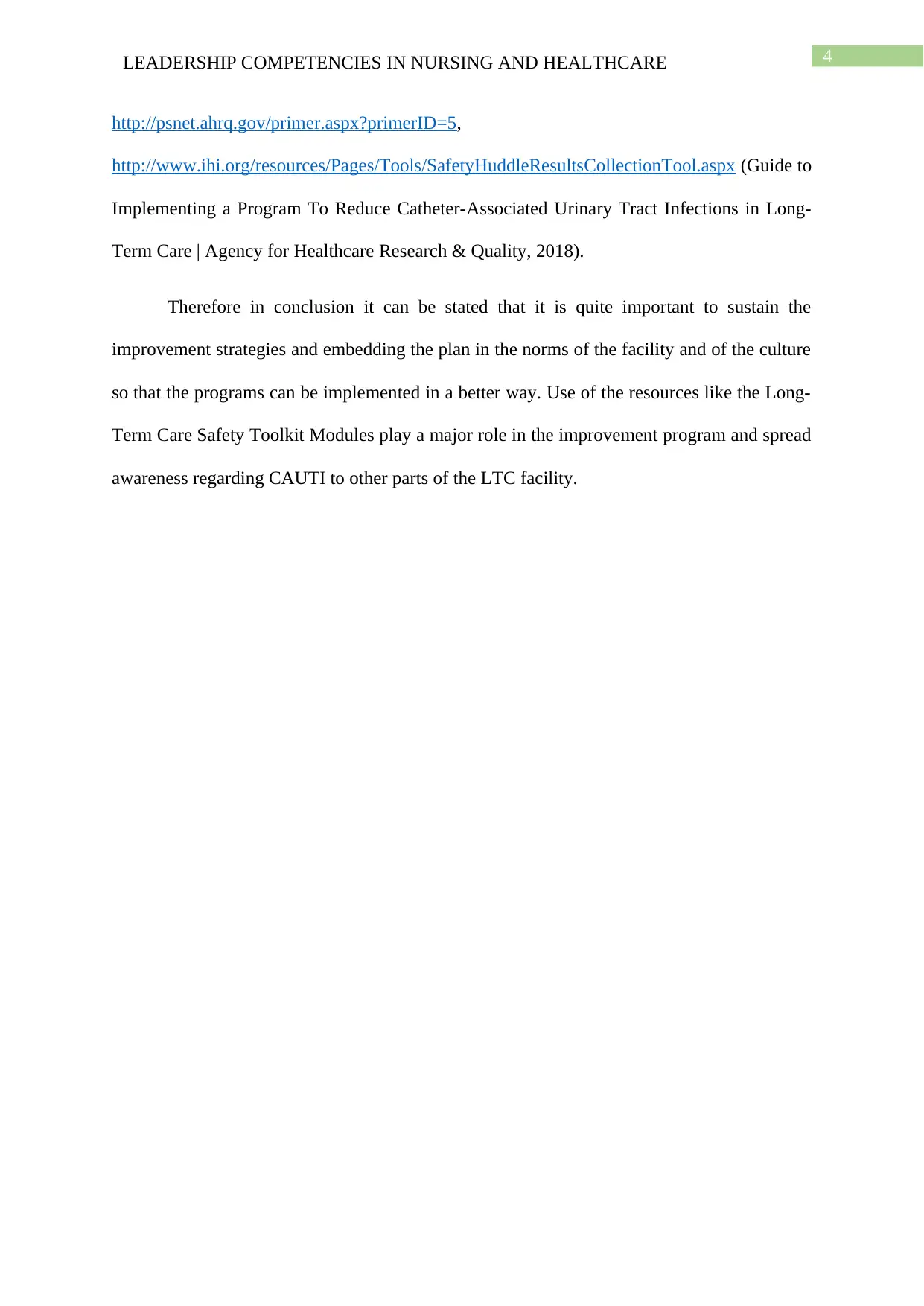
http://psnet.ahrq.gov/primer.aspx?primerID=5,
http://www.ihi.org/resources/Pages/Tools/SafetyHuddleResultsCollectionTool.aspx (Guide to
Implementing a Program To Reduce Catheter-Associated Urinary Tract Infections in Long-
Term Care | Agency for Healthcare Research & Quality, 2018).
Therefore in conclusion it can be stated that it is quite important to sustain the
improvement strategies and embedding the plan in the norms of the facility and of the culture
so that the programs can be implemented in a better way. Use of the resources like the Long-
Term Care Safety Toolkit Modules play a major role in the improvement program and spread
awareness regarding CAUTI to other parts of the LTC facility.
Document Page
5LEADERSHIP COMPETENCIES IN NURSING AND HEALTHCARE
References
Guide to Implementing a Program To Reduce Catheter-Associated Urinary Tract Infections
in Long-Term Care | Agency for Healthcare Research & Quality. (2018). Retrieved from
https://www.ahrq.gov/professionals/quality-patient-safety/quality-resources/tools/cauti-ltc/
modules/implementation/guide.html#toolkit
Clarke, K., Tong, D., Pan, Y., Easley, K. A., Norrick, B., Ko, C., ... & Stein, J. (2013).
Reduction in catheter-associated urinary tract infections by bundling
interventions. International Journal for Quality in Health Care, 25(1), 43-49.
Mody, L., Krein, S. L., Saint, S., Min, L. C., Montoya, A., Lansing, B., ... & Rye, R. A.
(2015). A targeted infection prevention intervention in nursing home residents with
indwelling devices: a randomized clinical trial. JAMA internal medicine, 175(5), 714-723.
Galiczewski, J. M. (2016). Interventions for the prevention of catheter associated urinary tract
infections in intensive care units: an integrative review. Intensive and Critical Care
Nursing, 32, 1-11.
Taha, H., Raji, S. J., Khallaf, A., Hija, S. A., Mathew, R., Rashed, H., ... & Ellahham, S.
(2017). Improving catheter associated urinary tract infection rates in the medical units. BMJ
Open Quality, 6(1), u209593-w7966.
Cdc.gov (2018). Retrieved from https://www.cdc.gov/infectioncontrol/pdf/guidelines/cauti-
guidelines.pdf
Document Page
6LEADERSHIP COMPETENCIES IN NURSING AND HEALTHCARE
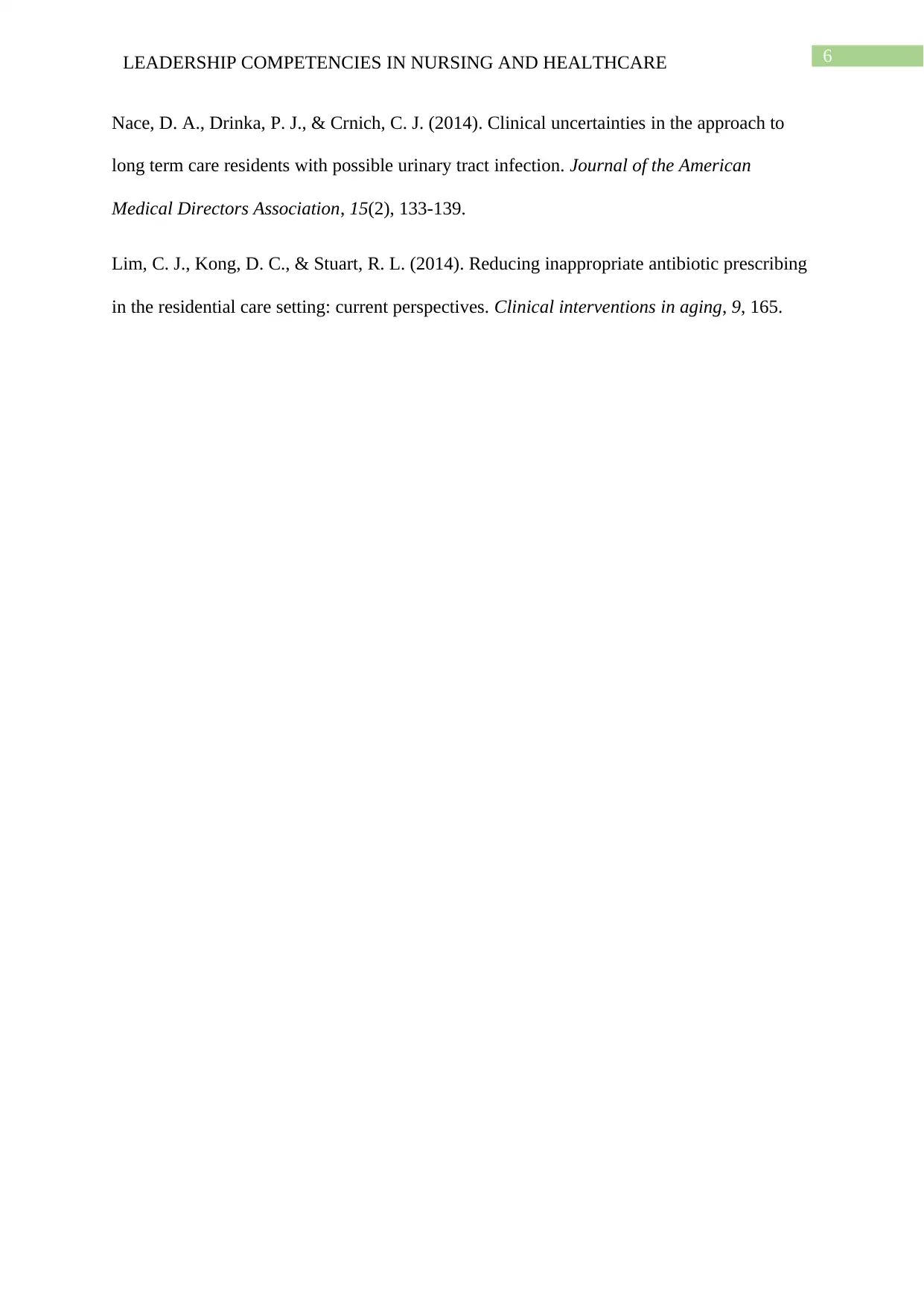
Nace, D. A., Drinka, P. J., & Crnich, C. J. (2014). Clinical uncertainties in the approach to
long term care residents with possible urinary tract infection. Journal of the American
Medical Directors Association, 15(2), 133-139.
Lim, C. J., Kong, D. C., & Stuart, R. L. (2014). Reducing inappropriate antibiotic prescribing
in the residential care setting: current perspectives. Clinical interventions in aging, 9, 165.
chevron_up_icon
1 out of 7
circle_padding
hide_on_mobile
zoom_out_icon
[object Object]