ECE350 Transition Plan: Aiding Preschoolers in Transition
VerifiedAdded on 2023/06/15
|17
|4275
|100
Report
AI Summary
This ECE350 assignment outlines a comprehensive transition plan for preschoolers, designed to facilitate a smooth transition to school. The plan is structured around the Victorian Early Years Learning and Development Framework (VEYLDF) and incorporates activities and strategies across four terms to support children's social, emotional, and cognitive development. It emphasizes the importance of understanding children's cultural and literacy backgrounds, addressing the needs of children with English as an Additional Language (EAL), and fostering strong parent-teacher relationships. The plan includes activities to enhance communication, teamwork, and problem-solving skills, as well as strategies for assessing children's readiness for transition and addressing any challenges they may face. The Transition Learning and Development Statement (TLDS) is used to summarize children’s learning and development to assist primary educators. The assignment highlights the role of educators in creating a positive and supportive environment that promotes children's well-being and prepares them for future academic success.
Running head: LESSON PLAN FOR PRESCHOOLERS
LESSON PLAN FOR PRESCHOOLERS
Name of the student
Name of the university
Author note
LESSON PLAN FOR PRESCHOOLERS
Name of the student
Name of the university
Author note

Paraphrase This Document
Need a fresh take? Get an instant paraphrase of this document with our AI Paraphraser
2LESSON PLAN FOR PRESCHOOLERS
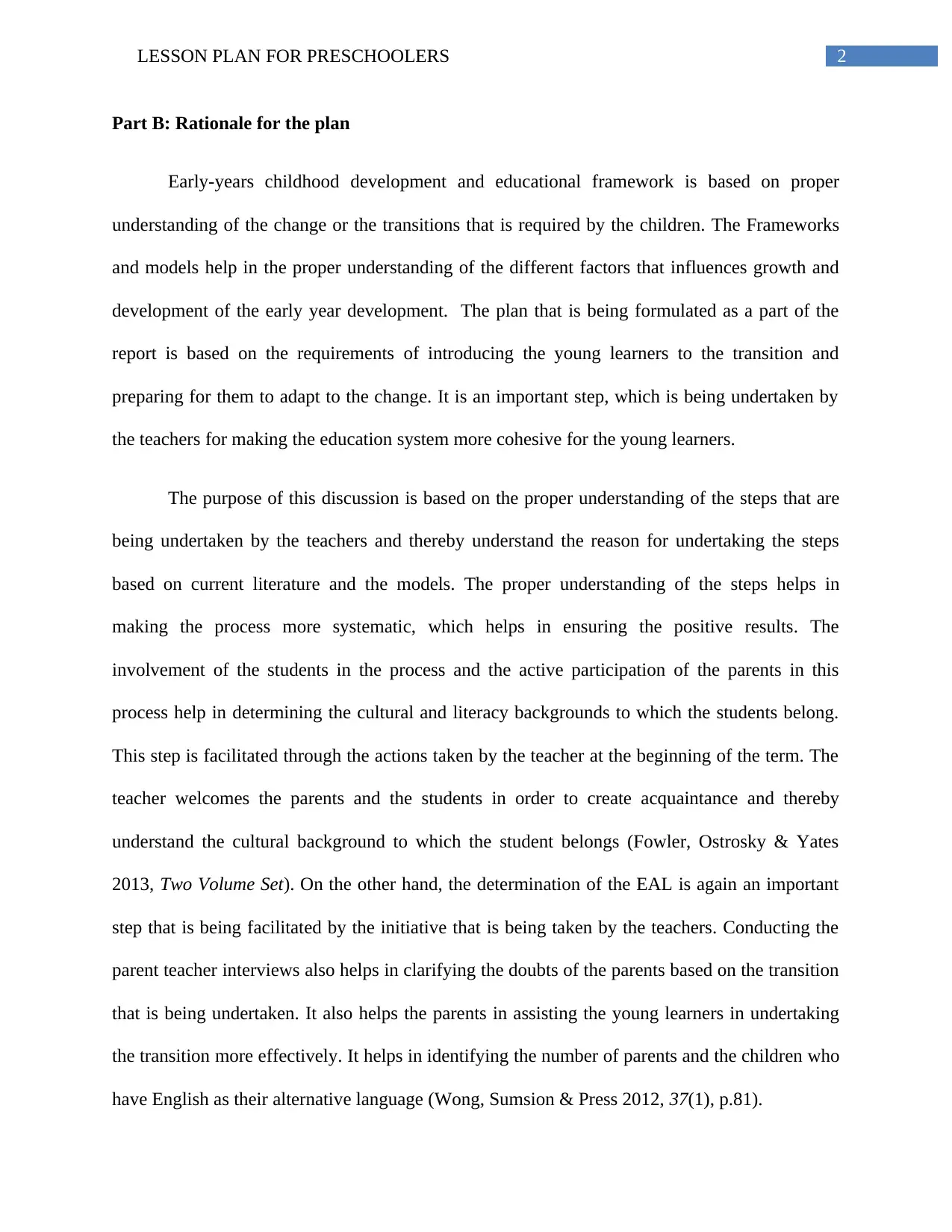
Part B: Rationale for the plan
Early-years childhood development and educational framework is based on proper
understanding of the change or the transitions that is required by the children. The Frameworks
and models help in the proper understanding of the different factors that influences growth and
development of the early year development. The plan that is being formulated as a part of the
report is based on the requirements of introducing the young learners to the transition and
preparing for them to adapt to the change. It is an important step, which is being undertaken by
the teachers for making the education system more cohesive for the young learners.
The purpose of this discussion is based on the proper understanding of the steps that are
being undertaken by the teachers and thereby understand the reason for undertaking the steps
based on current literature and the models. The proper understanding of the steps helps in
making the process more systematic, which helps in ensuring the positive results. The
involvement of the students in the process and the active participation of the parents in this
process help in determining the cultural and literacy backgrounds to which the students belong.
This step is facilitated through the actions taken by the teacher at the beginning of the term. The
teacher welcomes the parents and the students in order to create acquaintance and thereby
understand the cultural background to which the student belongs (Fowler, Ostrosky & Yates
2013, Two Volume Set). On the other hand, the determination of the EAL is again an important
step that is being facilitated by the initiative that is being taken by the teachers. Conducting the
parent teacher interviews also helps in clarifying the doubts of the parents based on the transition
that is being undertaken. It also helps the parents in assisting the young learners in undertaking
the transition more effectively. It helps in identifying the number of parents and the children who
have English as their alternative language (Wong, Sumsion & Press 2012, 37(1), p.81).
Part B: Rationale for the plan
Early-years childhood development and educational framework is based on proper
understanding of the change or the transitions that is required by the children. The Frameworks
and models help in the proper understanding of the different factors that influences growth and
development of the early year development. The plan that is being formulated as a part of the
report is based on the requirements of introducing the young learners to the transition and
preparing for them to adapt to the change. It is an important step, which is being undertaken by
the teachers for making the education system more cohesive for the young learners.
The purpose of this discussion is based on the proper understanding of the steps that are
being undertaken by the teachers and thereby understand the reason for undertaking the steps
based on current literature and the models. The proper understanding of the steps helps in
making the process more systematic, which helps in ensuring the positive results. The
involvement of the students in the process and the active participation of the parents in this
process help in determining the cultural and literacy backgrounds to which the students belong.
This step is facilitated through the actions taken by the teacher at the beginning of the term. The
teacher welcomes the parents and the students in order to create acquaintance and thereby
understand the cultural background to which the student belongs (Fowler, Ostrosky & Yates
2013, Two Volume Set). On the other hand, the determination of the EAL is again an important
step that is being facilitated by the initiative that is being taken by the teachers. Conducting the
parent teacher interviews also helps in clarifying the doubts of the parents based on the transition
that is being undertaken. It also helps the parents in assisting the young learners in undertaking
the transition more effectively. It helps in identifying the number of parents and the children who
have English as their alternative language (Wong, Sumsion & Press 2012, 37(1), p.81).
3LESSON PLAN FOR PRESCHOOLERS
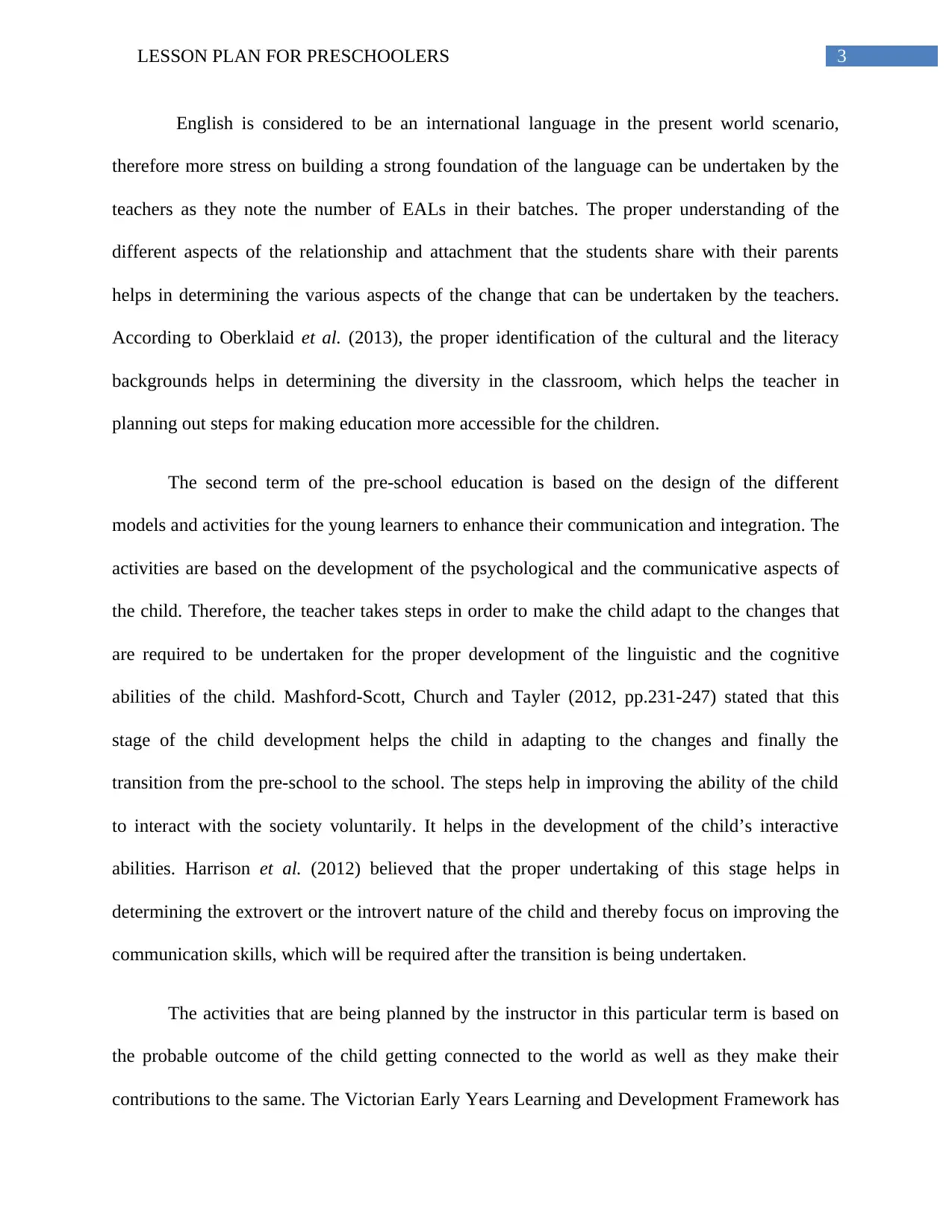
English is considered to be an international language in the present world scenario,
therefore more stress on building a strong foundation of the language can be undertaken by the
teachers as they note the number of EALs in their batches. The proper understanding of the
different aspects of the relationship and attachment that the students share with their parents
helps in determining the various aspects of the change that can be undertaken by the teachers.
According to Oberklaid et al. (2013), the proper identification of the cultural and the literacy
backgrounds helps in determining the diversity in the classroom, which helps the teacher in
planning out steps for making education more accessible for the children.
The second term of the pre-school education is based on the design of the different
models and activities for the young learners to enhance their communication and integration. The
activities are based on the development of the psychological and the communicative aspects of
the child. Therefore, the teacher takes steps in order to make the child adapt to the changes that
are required to be undertaken for the proper development of the linguistic and the cognitive
abilities of the child. Mashford-Scott, Church and Tayler (2012, pp.231-247) stated that this
stage of the child development helps the child in adapting to the changes and finally the
transition from the pre-school to the school. The steps help in improving the ability of the child
to interact with the society voluntarily. It helps in the development of the child’s interactive
abilities. Harrison et al. (2012) believed that the proper undertaking of this stage helps in
determining the extrovert or the introvert nature of the child and thereby focus on improving the
communication skills, which will be required after the transition is being undertaken.
The activities that are being planned by the instructor in this particular term is based on
the probable outcome of the child getting connected to the world as well as they make their
contributions to the same. The Victorian Early Years Learning and Development Framework has
English is considered to be an international language in the present world scenario,
therefore more stress on building a strong foundation of the language can be undertaken by the
teachers as they note the number of EALs in their batches. The proper understanding of the
different aspects of the relationship and attachment that the students share with their parents
helps in determining the various aspects of the change that can be undertaken by the teachers.
According to Oberklaid et al. (2013), the proper identification of the cultural and the literacy
backgrounds helps in determining the diversity in the classroom, which helps the teacher in
planning out steps for making education more accessible for the children.
The second term of the pre-school education is based on the design of the different
models and activities for the young learners to enhance their communication and integration. The
activities are based on the development of the psychological and the communicative aspects of
the child. Therefore, the teacher takes steps in order to make the child adapt to the changes that
are required to be undertaken for the proper development of the linguistic and the cognitive
abilities of the child. Mashford-Scott, Church and Tayler (2012, pp.231-247) stated that this
stage of the child development helps the child in adapting to the changes and finally the
transition from the pre-school to the school. The steps help in improving the ability of the child
to interact with the society voluntarily. It helps in the development of the child’s interactive
abilities. Harrison et al. (2012) believed that the proper undertaking of this stage helps in
determining the extrovert or the introvert nature of the child and thereby focus on improving the
communication skills, which will be required after the transition is being undertaken.
The activities that are being planned by the instructor in this particular term is based on
the probable outcome of the child getting connected to the world as well as they make their
contributions to the same. The Victorian Early Years Learning and Development Framework has
⊘ This is a preview!⊘
Do you want full access?
Subscribe today to unlock all pages.

Trusted by 1+ million students worldwide
4LESSON PLAN FOR PRESCHOOLERS
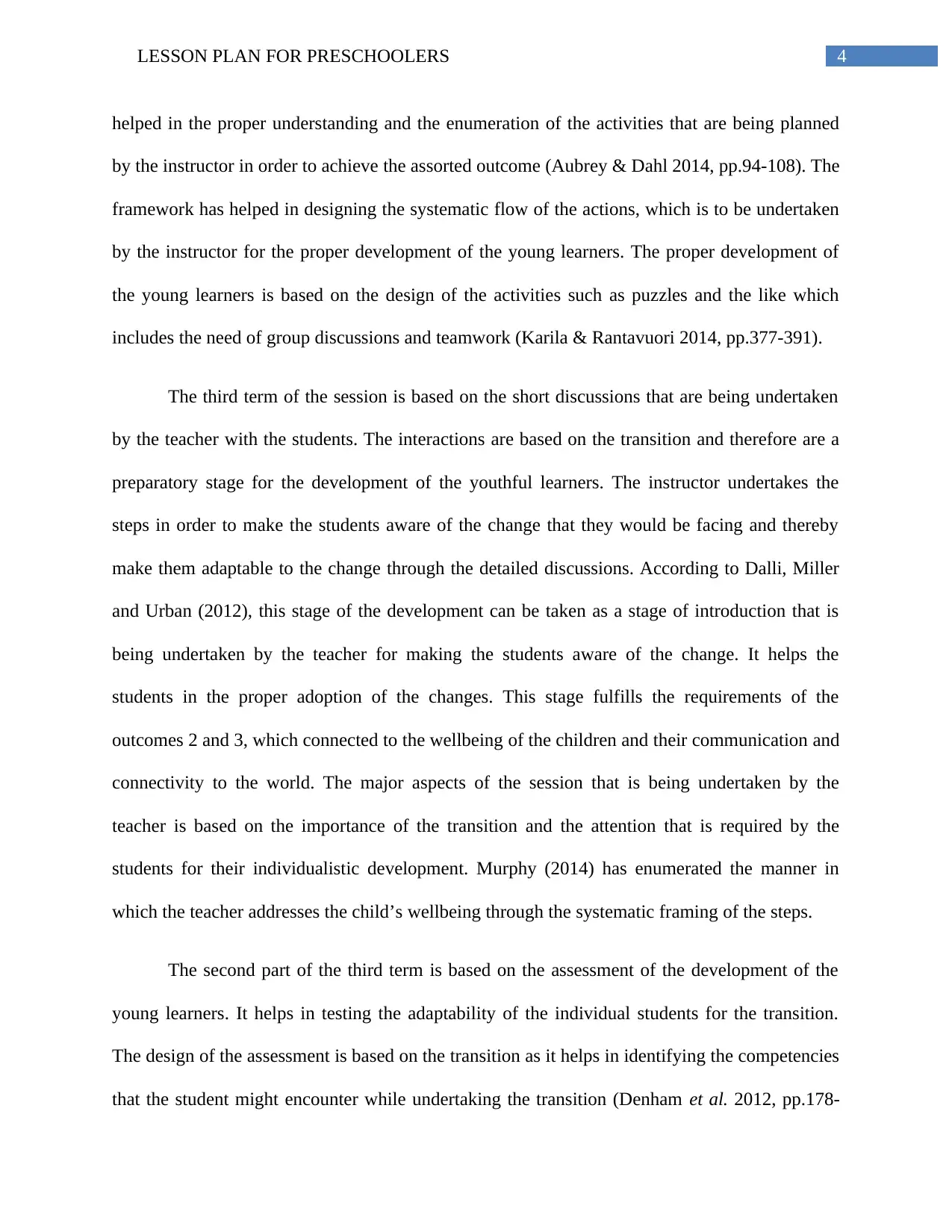
helped in the proper understanding and the enumeration of the activities that are being planned
by the instructor in order to achieve the assorted outcome (Aubrey & Dahl 2014, pp.94-108). The
framework has helped in designing the systematic flow of the actions, which is to be undertaken
by the instructor for the proper development of the young learners. The proper development of
the young learners is based on the design of the activities such as puzzles and the like which
includes the need of group discussions and teamwork (Karila & Rantavuori 2014, pp.377-391).
The third term of the session is based on the short discussions that are being undertaken
by the teacher with the students. The interactions are based on the transition and therefore are a
preparatory stage for the development of the youthful learners. The instructor undertakes the
steps in order to make the students aware of the change that they would be facing and thereby
make them adaptable to the change through the detailed discussions. According to Dalli, Miller
and Urban (2012), this stage of the development can be taken as a stage of introduction that is
being undertaken by the teacher for making the students aware of the change. It helps the
students in the proper adoption of the changes. This stage fulfills the requirements of the
outcomes 2 and 3, which connected to the wellbeing of the children and their communication and
connectivity to the world. The major aspects of the session that is being undertaken by the
teacher is based on the importance of the transition and the attention that is required by the
students for their individualistic development. Murphy (2014) has enumerated the manner in
which the teacher addresses the child’s wellbeing through the systematic framing of the steps.
The second part of the third term is based on the assessment of the development of the
young learners. It helps in testing the adaptability of the individual students for the transition.
The design of the assessment is based on the transition as it helps in identifying the competencies
that the student might encounter while undertaking the transition (Denham et al. 2012, pp.178-
helped in the proper understanding and the enumeration of the activities that are being planned
by the instructor in order to achieve the assorted outcome (Aubrey & Dahl 2014, pp.94-108). The
framework has helped in designing the systematic flow of the actions, which is to be undertaken
by the instructor for the proper development of the young learners. The proper development of
the young learners is based on the design of the activities such as puzzles and the like which
includes the need of group discussions and teamwork (Karila & Rantavuori 2014, pp.377-391).
The third term of the session is based on the short discussions that are being undertaken
by the teacher with the students. The interactions are based on the transition and therefore are a
preparatory stage for the development of the youthful learners. The instructor undertakes the
steps in order to make the students aware of the change that they would be facing and thereby
make them adaptable to the change through the detailed discussions. According to Dalli, Miller
and Urban (2012), this stage of the development can be taken as a stage of introduction that is
being undertaken by the teacher for making the students aware of the change. It helps the
students in the proper adoption of the changes. This stage fulfills the requirements of the
outcomes 2 and 3, which connected to the wellbeing of the children and their communication and
connectivity to the world. The major aspects of the session that is being undertaken by the
teacher is based on the importance of the transition and the attention that is required by the
students for their individualistic development. Murphy (2014) has enumerated the manner in
which the teacher addresses the child’s wellbeing through the systematic framing of the steps.
The second part of the third term is based on the assessment of the development of the
young learners. It helps in testing the adaptability of the individual students for the transition.
The design of the assessment is based on the transition as it helps in identifying the competencies
that the student might encounter while undertaking the transition (Denham et al. 2012, pp.178-
Paraphrase This Document
Need a fresh take? Get an instant paraphrase of this document with our AI Paraphraser
5LESSON PLAN FOR PRESCHOOLERS
189). The major aspects of the assessment are based on the understanding of the different issues
faced by the children while undertaking the transition. It helps the instructor in focusing more on
the issues and thereby resolves them in order to make the growth process smooth for the young
learners. The identification of the issues faced by the children helps the instructor in taking steps
for the systematic movement. The steps also help in instilling the different emotions for the
growth of the children in their academic life. Emotions like curiosity and efforts like integration
and cooperation helps in the proper development of the children before they undertake the
change. Skouteris, Watson and Lum (2012, p.78) believed that the proper understanding of the
children’s needs helps the instructor in resolving the issues that helps in the smooth and the
systematic functioning of the education system.
The last or the fourth term is based on the establishment of the proper interaction between
the students. The pre-school authorities take steps in order to facilitate the communication
between the students and the primary educators as an introductory for making them known to
one another. It helps in the proper understanding of the different needs of the students by the
primary educators. On the other hand, it helps in maintaining the smooth interaction of the
students with their instructors. The initiative that is being undertaken by the instructor is based
on the necessity of the young learners to interact with the society and the people at large. It helps
in the proper formation of the identity. On the other hand, the teacher’s documentation of the
aboriginal children helps in understanding the diverse needs of the children. The pre-school
teachers take steps in order to maintain the documents and the details of the aboriginal children,
which is used as a reference for the primary educators. Therefore, the teacher takes steps to
undertake one-to-one communication process in order to facilitate the interactive teamwork,
which will be helping the young learners while the transition is over. The proper undertaking of
189). The major aspects of the assessment are based on the understanding of the different issues
faced by the children while undertaking the transition. It helps the instructor in focusing more on
the issues and thereby resolves them in order to make the growth process smooth for the young
learners. The identification of the issues faced by the children helps the instructor in taking steps
for the systematic movement. The steps also help in instilling the different emotions for the
growth of the children in their academic life. Emotions like curiosity and efforts like integration
and cooperation helps in the proper development of the children before they undertake the
change. Skouteris, Watson and Lum (2012, p.78) believed that the proper understanding of the
children’s needs helps the instructor in resolving the issues that helps in the smooth and the
systematic functioning of the education system.
The last or the fourth term is based on the establishment of the proper interaction between
the students. The pre-school authorities take steps in order to facilitate the communication
between the students and the primary educators as an introductory for making them known to
one another. It helps in the proper understanding of the different needs of the students by the
primary educators. On the other hand, it helps in maintaining the smooth interaction of the
students with their instructors. The initiative that is being undertaken by the instructor is based
on the necessity of the young learners to interact with the society and the people at large. It helps
in the proper formation of the identity. On the other hand, the teacher’s documentation of the
aboriginal children helps in understanding the diverse needs of the children. The pre-school
teachers take steps in order to maintain the documents and the details of the aboriginal children,
which is used as a reference for the primary educators. Therefore, the teacher takes steps to
undertake one-to-one communication process in order to facilitate the interactive teamwork,
which will be helping the young learners while the transition is over. The proper undertaking of
6LESSON PLAN FOR PRESCHOOLERS
the steps by the teacher helps the students in identifying the different aspects of the change that
they might adapt in order to face the transition. According to Kolb (2014), the steps that are
being taken by the teacher to help the students in adapting themselves to the change are
facilitating the identification of the different aspects of the change. The proper undertaking of the
communication is an important activity that is required to be promoted among the young learners
in order to facilitate the teamwork and the unity. It also helps them in shaping their sociable
nature, which is greatly helpful in the making of responsible citizens of the nation in future.
VEYLDF has taken steps to explore the outcomes that are attained through the smooth
and systematic functioning of the pre-school instructors and thereby defined the format through
which the proper functioning must be undertaken. It has helped in the understanding of the
different necessary steps that the teacher might undertake in order to create an awareness among
the children of the transition. The transition is not meagerly based on the education that the
young learners would be receiving but is a lot more of the psychological constrains that they
might face while undertaking the transition. Therefore, to sum up, the teachers are bestowed with
the responsibility of making the students aware of the different aspects of the constrains that they
might face while undertaking the change. According to Lynch and Redpath (2014), the
framework has helped the teachers in understanding the various needs of the young learners
based on the diverse culture, nationality and the language. Therefore, teachers must take steps in
order to better understand the various needs of the children based on their nature and the
background (Fleer 2015, p.1810).
The Transition Learning and Development Statement summarises the children’s learning
situation before they start school. It provides specific strategies for school teachers after they
analyse the statements in three different levels. Through these the teachers understand how much
the steps by the teacher helps the students in identifying the different aspects of the change that
they might adapt in order to face the transition. According to Kolb (2014), the steps that are
being taken by the teacher to help the students in adapting themselves to the change are
facilitating the identification of the different aspects of the change. The proper undertaking of the
communication is an important activity that is required to be promoted among the young learners
in order to facilitate the teamwork and the unity. It also helps them in shaping their sociable
nature, which is greatly helpful in the making of responsible citizens of the nation in future.
VEYLDF has taken steps to explore the outcomes that are attained through the smooth
and systematic functioning of the pre-school instructors and thereby defined the format through
which the proper functioning must be undertaken. It has helped in the understanding of the
different necessary steps that the teacher might undertake in order to create an awareness among
the children of the transition. The transition is not meagerly based on the education that the
young learners would be receiving but is a lot more of the psychological constrains that they
might face while undertaking the transition. Therefore, to sum up, the teachers are bestowed with
the responsibility of making the students aware of the different aspects of the constrains that they
might face while undertaking the change. According to Lynch and Redpath (2014), the
framework has helped the teachers in understanding the various needs of the young learners
based on the diverse culture, nationality and the language. Therefore, teachers must take steps in
order to better understand the various needs of the children based on their nature and the
background (Fleer 2015, p.1810).
The Transition Learning and Development Statement summarises the children’s learning
situation before they start school. It provides specific strategies for school teachers after they
analyse the statements in three different levels. Through these the teachers understand how much
⊘ This is a preview!⊘
Do you want full access?
Subscribe today to unlock all pages.
Trusted by 1+ million students worldwide
7LESSON PLAN FOR PRESCHOOLERS
the students are ready for learning. The TLDS provides an overall concept about the children’s
responses from the parents’ perspectives as well as teachers. This is how the teachers come to
know the area of their weakness which need to be developed. Transition Learning and
Development Statement directly helps to frame strategies and focus the learning process more
specifically. The teacher’s interaction with the family mates of the students helps in undertaking
the correct procedure of the growth and development of the students. The teacher therefore takes
the initiative of keeping the parents informed of the different aspects of the growth of the child in
varied situations (Sumsion & Grieshaber 2012). On the other hand, the interaction of the teacher
with the parents also helps in keeping a good track of the progress made by every individual
child. The different aspects of the child development as discussed in the VEYLDF have helped
in the systematic and smooth functioning of the teachers. According to the framework, the
resources that is required by the teachers in order to initiate the practice of the early childhood
transition are approved Legislation and Standards, Information and Evidence of the elements of
the change and the manner in which the change is affecting the wellbeing and the future of the
young learners (O'Gorman & Hard 2013). Victorian Early Years Learning and Development
Framework helps in the understanding of the various determinants of the change. The smooth
functioning of the teachers and the determination of the needs and the requirements of the
students are the basic elements of the framework.
Therefore, it can be stated from the above discussion that the proper understanding of the
framework will be helping the teacher in understanding the individualistic needs of the students.
The distribution of the curriculum and the proper planning of the steps have made it a systematic
process that is being undertaken by the teachers. The psychological aspects of the child who is
facing the transition determine the major aspects that are covered by the framework. The
the students are ready for learning. The TLDS provides an overall concept about the children’s
responses from the parents’ perspectives as well as teachers. This is how the teachers come to
know the area of their weakness which need to be developed. Transition Learning and
Development Statement directly helps to frame strategies and focus the learning process more
specifically. The teacher’s interaction with the family mates of the students helps in undertaking
the correct procedure of the growth and development of the students. The teacher therefore takes
the initiative of keeping the parents informed of the different aspects of the growth of the child in
varied situations (Sumsion & Grieshaber 2012). On the other hand, the interaction of the teacher
with the parents also helps in keeping a good track of the progress made by every individual
child. The different aspects of the child development as discussed in the VEYLDF have helped
in the systematic and smooth functioning of the teachers. According to the framework, the
resources that is required by the teachers in order to initiate the practice of the early childhood
transition are approved Legislation and Standards, Information and Evidence of the elements of
the change and the manner in which the change is affecting the wellbeing and the future of the
young learners (O'Gorman & Hard 2013). Victorian Early Years Learning and Development
Framework helps in the understanding of the various determinants of the change. The smooth
functioning of the teachers and the determination of the needs and the requirements of the
students are the basic elements of the framework.
Therefore, it can be stated from the above discussion that the proper understanding of the
framework will be helping the teacher in understanding the individualistic needs of the students.
The distribution of the curriculum and the proper planning of the steps have made it a systematic
process that is being undertaken by the teachers. The psychological aspects of the child who is
facing the transition determine the major aspects that are covered by the framework. The
Paraphrase This Document
Need a fresh take? Get an instant paraphrase of this document with our AI Paraphraser
8LESSON PLAN FOR PRESCHOOLERS
sessions that are being undertaken by the instructor and the distribution of the terms has helped
in achieving the goal of making the child aware of the transition. Moreover, the proper
understanding of the communicative ability of the child is an important factor that is being
covered in the sessions. The integrated and cooperative functioning of the child is being initiated
through the processes that are being undertaken by the instructor in the sessions. The adherence
to the framework has helped in simplifying the task of the instructor in understanding the
diversified needs of the children.
sessions that are being undertaken by the instructor and the distribution of the terms has helped
in achieving the goal of making the child aware of the transition. Moreover, the proper
understanding of the communicative ability of the child is an important factor that is being
covered in the sessions. The integrated and cooperative functioning of the child is being initiated
through the processes that are being undertaken by the instructor in the sessions. The adherence
to the framework has helped in simplifying the task of the instructor in understanding the
diversified needs of the children.
9LESSON PLAN FOR PRESCHOOLERS
References
Aubrey, C & Dahl, S 2014, The confidence and competence in information and communication
technologies of practitioners, parents and young children in the Early Years Foundation
Stage. Early years, vol. 34, no. 1, pp. 94-108, retrieved 21 February 2018,
<http://www.tandfonline.com/doi/abs/10.1080/09575146.2013.792789>
Dalli, C, Miller, L & Urban, M, 2012, Early childhood grows up: Towards a critical ecology of
the profession. In Early Childhood Grows Up, pp. 3-19, retrieved 21 February 2018, Springer,
Dordrecht.
Denham, S.A, Bassett, H, Mincic, M, Kalb, S, Way, E, Wyatt, T & Segal, Y, 2012, Social–
emotional learning profiles of preschoolers' early school success: A person-centered
approach. Learning and individual differences, vol. 22, no. 2, pp. 178-189, retrieved 21 February
2018, <https://www.sciencedirect.com/science/article/pii/S1041608011000604>
Fleer, M, 2015, Pedagogical positioning in play–teachers being inside and outside of children's
imaginary play. Early Child Development and Care, vol. 185, no. 12, pp. 1801-1814, retrieved
21 February 2018, < http://www.tandfonline.com/doi/abs/10.1080/03004430.2015.1028393 >
Fowler, SA, Ostrosky, MM & Yates, TJ, 2013, Teaching and learning in the early years. The
SAGE Handbook of Special Education: Two Volume Set, retrieved 21 February 2018,
<https://in.sagepub.com/en-in/sas/the-sage-handbook-of-special-education/book237524>
Harrison, L, Goldfeld, S, Metcalfe, E & Moore, T, 2012, Early learning programs that promote
children's developmental and educational outcomes, no. 15, retrieved 21 February 2018,
References
Aubrey, C & Dahl, S 2014, The confidence and competence in information and communication
technologies of practitioners, parents and young children in the Early Years Foundation
Stage. Early years, vol. 34, no. 1, pp. 94-108, retrieved 21 February 2018,
<http://www.tandfonline.com/doi/abs/10.1080/09575146.2013.792789>
Dalli, C, Miller, L & Urban, M, 2012, Early childhood grows up: Towards a critical ecology of
the profession. In Early Childhood Grows Up, pp. 3-19, retrieved 21 February 2018, Springer,
Dordrecht.
Denham, S.A, Bassett, H, Mincic, M, Kalb, S, Way, E, Wyatt, T & Segal, Y, 2012, Social–
emotional learning profiles of preschoolers' early school success: A person-centered
approach. Learning and individual differences, vol. 22, no. 2, pp. 178-189, retrieved 21 February
2018, <https://www.sciencedirect.com/science/article/pii/S1041608011000604>
Fleer, M, 2015, Pedagogical positioning in play–teachers being inside and outside of children's
imaginary play. Early Child Development and Care, vol. 185, no. 12, pp. 1801-1814, retrieved
21 February 2018, < http://www.tandfonline.com/doi/abs/10.1080/03004430.2015.1028393 >
Fowler, SA, Ostrosky, MM & Yates, TJ, 2013, Teaching and learning in the early years. The
SAGE Handbook of Special Education: Two Volume Set, retrieved 21 February 2018,
<https://in.sagepub.com/en-in/sas/the-sage-handbook-of-special-education/book237524>
Harrison, L, Goldfeld, S, Metcalfe, E & Moore, T, 2012, Early learning programs that promote
children's developmental and educational outcomes, no. 15, retrieved 21 February 2018,
⊘ This is a preview!⊘
Do you want full access?
Subscribe today to unlock all pages.
Trusted by 1+ million students worldwide
10LESSON PLAN FOR PRESCHOOLERS
<https://www.aihw.gov.au/getmedia/86b877c6-6b06-49b5-8078-f02b98310276/ctgc-
rs15.pdf.aspx?inline=true>.
Karila, K & Rantavuori, L, 2014, Discourses at the boundary spaces: Developing a fluent
transition from preschool to school. Early Years, vol. 34, no. 4, pp. 377-391, retrieved 21
February 2018, <http://www.tandfonline.com/doi/abs/10.1080/09575146.2014.967663>
Kolb, DA, 2014, Experiential learning: Experience as the source of learning and development.
FT press, retrieved 21 February 2018, <https://academic.regis.edu/ed205/kolb.pdf>
Lynch, J & Redpath, T 2014, ‘Smart ‘technologies in early years literacy education: A meta-
narrative of paradigmatic tensions in iPad use in an Australian preparatory classroom. Journal of
Early Childhood Literacy, vol. 14, no. 2, pp. 147-174, retrieved 21 February 2018,
<http://journals.sagepub.com/doi/abs/10.1177/1468798412453150>
Mashford-Scott, A, Church, A & Tayler, C, 2012, Seeking children’s perspectives on their
wellbeing in early childhood settings. International Journal of Early Childhood, vol. 44, no. 3,
pp. 231-247, retrieved 21 February 2018, <https://link.springer.com/article/10.1007/s13158-012-
0069-7>
Murphy, VA, 2014, Second Language Learning in the Early School Years: Trends and Contexts-
Oxford Applied Linguistics. Oxford University Press, retrieved 21 February 2018, <
http://onlinelibrary.wiley.com/doi/10.1111/ijal.12116/pdf>
Oberklaid, F, Baird, G, Blair, M, Melhuish, E & Hall, D 2013, Children's health and
development: approaches to early identification and intervention. Archives of disease in
<https://www.aihw.gov.au/getmedia/86b877c6-6b06-49b5-8078-f02b98310276/ctgc-
rs15.pdf.aspx?inline=true>.
Karila, K & Rantavuori, L, 2014, Discourses at the boundary spaces: Developing a fluent
transition from preschool to school. Early Years, vol. 34, no. 4, pp. 377-391, retrieved 21
February 2018, <http://www.tandfonline.com/doi/abs/10.1080/09575146.2014.967663>
Kolb, DA, 2014, Experiential learning: Experience as the source of learning and development.
FT press, retrieved 21 February 2018, <https://academic.regis.edu/ed205/kolb.pdf>
Lynch, J & Redpath, T 2014, ‘Smart ‘technologies in early years literacy education: A meta-
narrative of paradigmatic tensions in iPad use in an Australian preparatory classroom. Journal of
Early Childhood Literacy, vol. 14, no. 2, pp. 147-174, retrieved 21 February 2018,
<http://journals.sagepub.com/doi/abs/10.1177/1468798412453150>
Mashford-Scott, A, Church, A & Tayler, C, 2012, Seeking children’s perspectives on their
wellbeing in early childhood settings. International Journal of Early Childhood, vol. 44, no. 3,
pp. 231-247, retrieved 21 February 2018, <https://link.springer.com/article/10.1007/s13158-012-
0069-7>
Murphy, VA, 2014, Second Language Learning in the Early School Years: Trends and Contexts-
Oxford Applied Linguistics. Oxford University Press, retrieved 21 February 2018, <
http://onlinelibrary.wiley.com/doi/10.1111/ijal.12116/pdf>
Oberklaid, F, Baird, G, Blair, M, Melhuish, E & Hall, D 2013, Children's health and
development: approaches to early identification and intervention. Archives of disease in
Paraphrase This Document
Need a fresh take? Get an instant paraphrase of this document with our AI Paraphraser
11LESSON PLAN FOR PRESCHOOLERS
childhood, pp.archdischild-2013, retrieved 21 February 2018,
<http://adc.bmj.com/content/early/2013/08/22/archdischild-2013-304091.full.pdf>
O'Gorman, L & Hard, L 2013, Looking back and looking forward: Exploring distributed
leadership with Queensland Prep teachers. Australasian Journal of Early Childhood, vol. 38, no.
3, p. 77, retrieved 21 February 2018,
<https://search.informit.com.au/payPerView;action=addOrderItem;dn=611760268364098;res=IE
LHSS;type=pdf >
Skouteris, H, Watson, B & Lum, J, 2012, Preschool children's transition to formal schooling:
The importance of collaboration between teachers, parents and children. Australasian Journal of
Early Childhood, vol. 37, no. 4, p. 78, retrieved 21 February 2018,
<https://search.informit.com.au/payPerView;action=addOrderItem;dn=062050350304682;res=IE
LHSS;type=pdf>
Sumsion, J & Grieshaber, S 2012, Pursuing better childhoods and futures through curriculum:
Utopian visions in the development of Australia's Early Years Learning Framework. Global
Studies of Childhood, vol. 2, no. 3, pp. 230-244. retrieved 21 February 2018,
<http://journals.sagepub.com/doi/abs/10.2304/gsch.2012.2.3.230>
Wong, S, Sumsion, J & Press, F 2012, Early childhood professionals and inter-professional work
in integrated early childhood services in Australia. Australasian Journal of Early Childhood, vol.
37, no. 1, p.81. retrieved 21 February 2018,
<https://search.informit.com.au/payPerView;action=addOrderItem;dn=216896027650458;res=IE
LHSS;type=pdf >
childhood, pp.archdischild-2013, retrieved 21 February 2018,
<http://adc.bmj.com/content/early/2013/08/22/archdischild-2013-304091.full.pdf>
O'Gorman, L & Hard, L 2013, Looking back and looking forward: Exploring distributed
leadership with Queensland Prep teachers. Australasian Journal of Early Childhood, vol. 38, no.
3, p. 77, retrieved 21 February 2018,
<https://search.informit.com.au/payPerView;action=addOrderItem;dn=611760268364098;res=IE
LHSS;type=pdf >
Skouteris, H, Watson, B & Lum, J, 2012, Preschool children's transition to formal schooling:
The importance of collaboration between teachers, parents and children. Australasian Journal of
Early Childhood, vol. 37, no. 4, p. 78, retrieved 21 February 2018,
<https://search.informit.com.au/payPerView;action=addOrderItem;dn=062050350304682;res=IE
LHSS;type=pdf>
Sumsion, J & Grieshaber, S 2012, Pursuing better childhoods and futures through curriculum:
Utopian visions in the development of Australia's Early Years Learning Framework. Global
Studies of Childhood, vol. 2, no. 3, pp. 230-244. retrieved 21 February 2018,
<http://journals.sagepub.com/doi/abs/10.2304/gsch.2012.2.3.230>
Wong, S, Sumsion, J & Press, F 2012, Early childhood professionals and inter-professional work
in integrated early childhood services in Australia. Australasian Journal of Early Childhood, vol.
37, no. 1, p.81. retrieved 21 February 2018,
<https://search.informit.com.au/payPerView;action=addOrderItem;dn=216896027650458;res=IE
LHSS;type=pdf >
12LESSON PLAN FOR PRESCHOOLERS
Appendix
Part A: - The plan
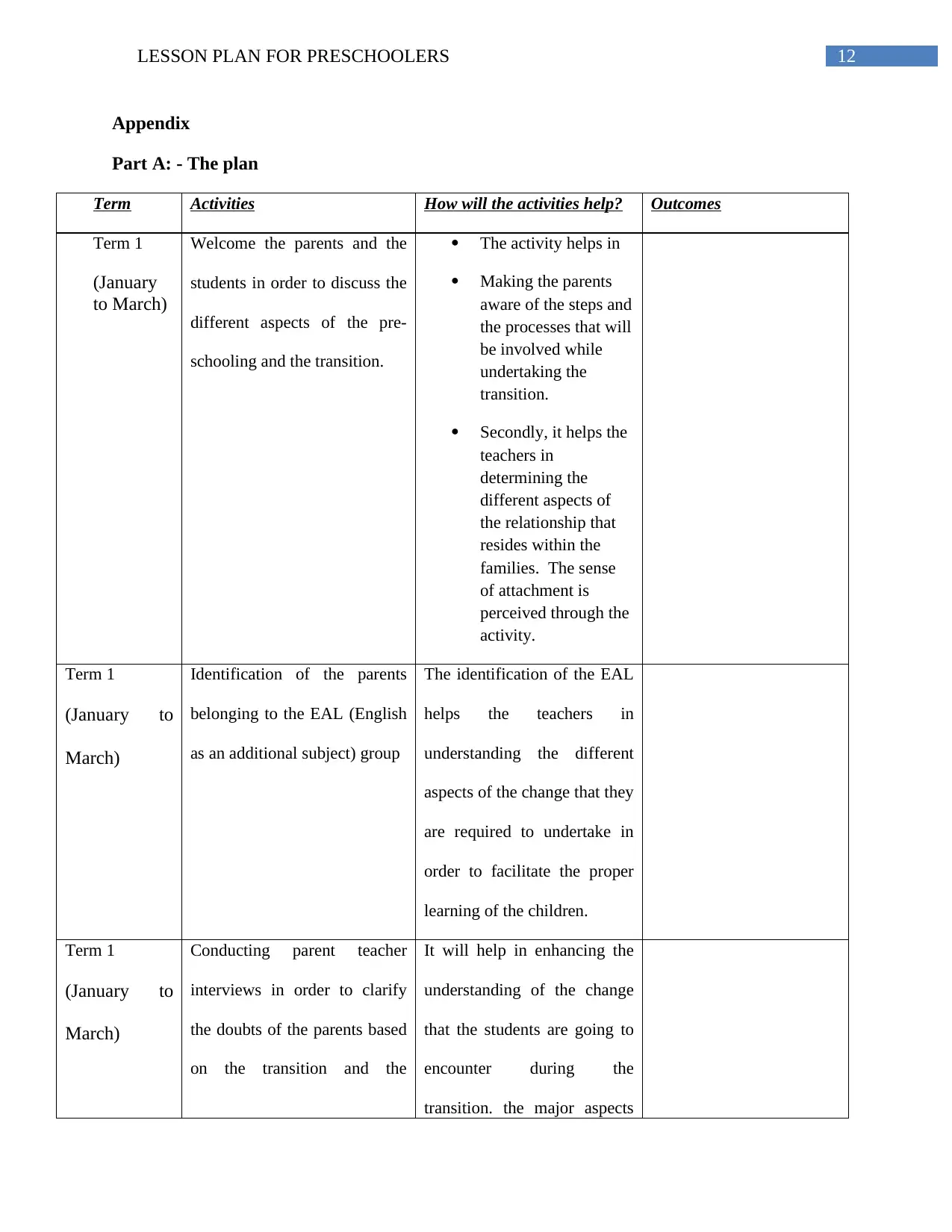
Term Activities How will the activities help? Outcomes
Term 1
(January
to March)
Welcome the parents and the
students in order to discuss the
different aspects of the pre-
schooling and the transition.
The activity helps in
Making the parents
aware of the steps and
the processes that will
be involved while
undertaking the
transition.
Secondly, it helps the
teachers in
determining the
different aspects of
the relationship that
resides within the
families. The sense
of attachment is
perceived through the
activity.
Term 1
(January to
March)
Identification of the parents
belonging to the EAL (English
as an additional subject) group
The identification of the EAL
helps the teachers in
understanding the different
aspects of the change that they
are required to undertake in
order to facilitate the proper
learning of the children.
Term 1
(January to
March)
Conducting parent teacher
interviews in order to clarify
the doubts of the parents based
on the transition and the
It will help in enhancing the
understanding of the change
that the students are going to
encounter during the
transition. the major aspects
Appendix
Part A: - The plan
Term Activities How will the activities help? Outcomes
Term 1
(January
to March)
Welcome the parents and the
students in order to discuss the
different aspects of the pre-
schooling and the transition.
The activity helps in
Making the parents
aware of the steps and
the processes that will
be involved while
undertaking the
transition.
Secondly, it helps the
teachers in
determining the
different aspects of
the relationship that
resides within the
families. The sense
of attachment is
perceived through the
activity.
Term 1
(January to
March)
Identification of the parents
belonging to the EAL (English
as an additional subject) group
The identification of the EAL
helps the teachers in
understanding the different
aspects of the change that they
are required to undertake in
order to facilitate the proper
learning of the children.
Term 1
(January to
March)
Conducting parent teacher
interviews in order to clarify
the doubts of the parents based
on the transition and the
It will help in enhancing the
understanding of the change
that the students are going to
encounter during the
transition. the major aspects
⊘ This is a preview!⊘
Do you want full access?
Subscribe today to unlock all pages.
Trusted by 1+ million students worldwide

1 out of 17


Related Documents


Your All-in-One AI-Powered Toolkit for Academic Success.
+13062052269
info@desklib.com
Available 24*7 on WhatsApp / Email
![[object Object]](/_next/static/media/star-bottom.7253800d.svg)
Unlock your academic potential
Copyright © 2020–2026 A2Z Services. All Rights Reserved. Developed and managed by ZUCOL.