ECEC, the Basis for Shaping Future Professionals: My View

Verified

Added on  2022/08/20

|5
|1377
|10
Essay
AI Summary
This essay reflects on the author's journey and perspective on becoming an Early Childhood Education and Care (ECEC) professional. It emphasizes the crucial role of values, beliefs, attitude, and commitment in shaping a successful ECEC educator. The author discusses the importance of instilling strong moral values in children, highlighting fairness, truthfulness, dignity, and responsibility as essential qualities. The essay also underscores the significance of formal education, professional development, and continuous research in enhancing the quality of ECEC. The author explains how these elements contribute to effective teaching, improved communication skills, and the ability to adapt to evolving regulations within the field. The conclusion reinforces the respect ECEC deserves as a profession that lays the foundation for children's growth and development, advocating for rigorous vetting of professionals to ensure they possess the necessary qualifications and ethical standards.
Document Page
Running head: ECEC 1
ECEC
Student Name
Institution
tabler-icon-diamond-filled.svg

Paraphrase This Document

Need a fresh take? Get an instant paraphrase of this document with our AI Paraphraser
Document Page
ECEC 2
ECEC, the basis for shaping professionals
The world is dynamic and what makes it so is the fact that its occupants are professionals
in different fields that support each other directly or indirectly. Each child has a right to basic
education as stipulated by the children's rights as advocated for by various organizations such as
the United Nations. The child at the school is shaped and modeled to fit the desired profession.
Profession refers to an occupation that enables someone to get paid for performing a certain
work and there is usually training and formal qualification for someone to be called a
professional (Hughes, & Hughes, 2013). ECEC educators are professionals and the profession
should be respected just like other professions as it is the basis for children's growth and
development in terms of education and profession. A choice in a certain profession is influenced
by various factors and this article is about highlighting what makes me ECEC professional.
Values and beliefs
Children should be taught the right morals at their foundation education and this will
enable them to grow to have strong moral values which will enable them to be disciplined in
different aspects of their development. I have strong values and beliefs which only being an
ECEC educator will enable me to pass them to children in different facilities. Values and beliefs
influence how we act and relate with other people and having the right values will enable
anybody to act in the right manner at all times. I am an ECEC educator as I have ethics that are
needed in ensuring I have the right relationship with my learners, the learner's parents, and my
fellow educators. This helps me to act in the right manner to avoid compromising the interests of
my learners due to other forces such as the confrontation between myself and learners' parents
(Irvine, & Price, 2014). This helps me to always perform my duties objectively and this enables
me to educate my learners effectively. I possess basic values such as fairness, truthfulness,
dignity, and responsibility which enables me to be a complete ECEC professional. Fairness helps
me to treat all the learners equally without discrimination regardless of the learner's skin color,
race or religion and this helps me to discharge my duties effectively without bias or favoritism.
Attitude and commitment
Document Page
ECEC 3
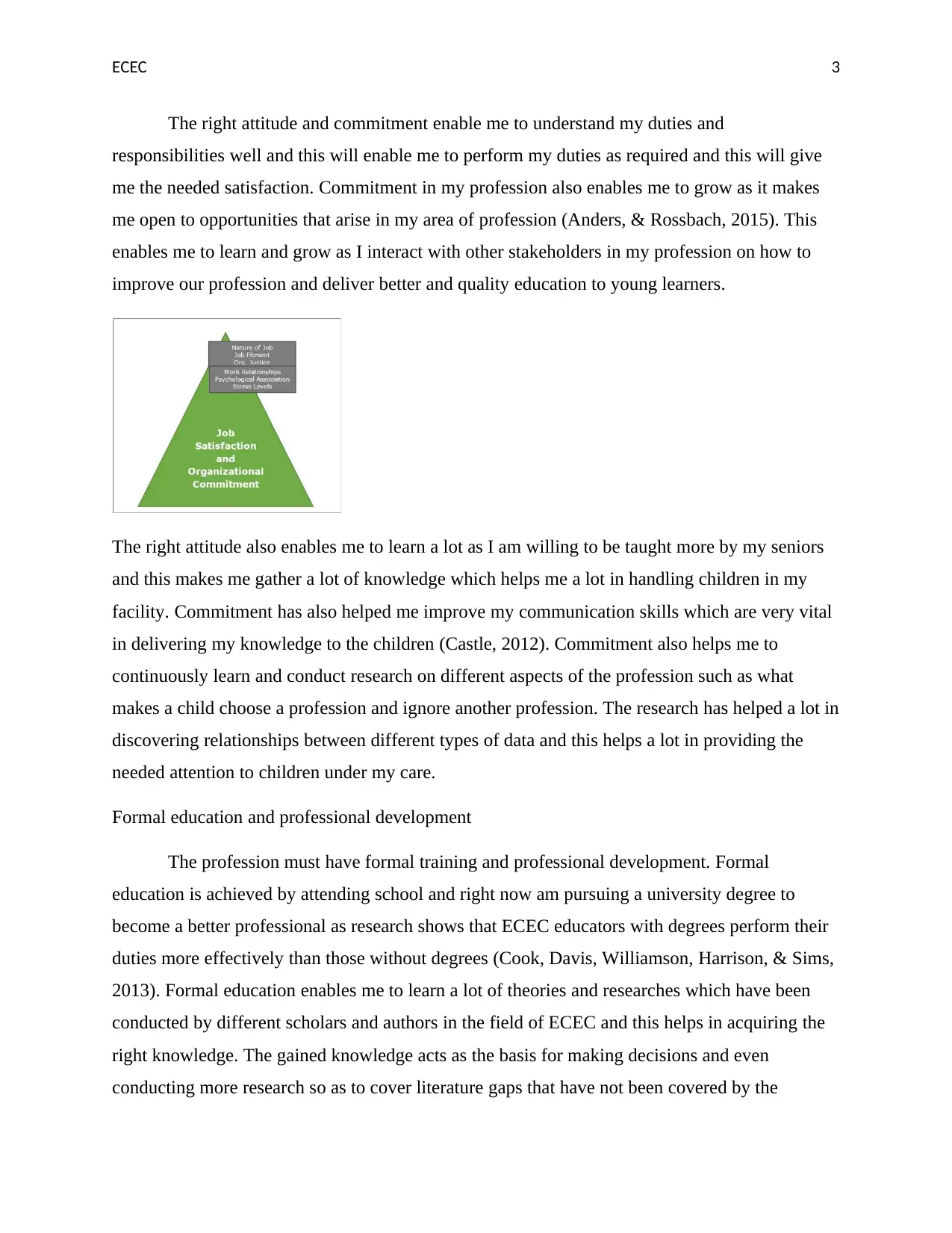
The right attitude and commitment enable me to understand my duties and
responsibilities well and this will enable me to perform my duties as required and this will give
me the needed satisfaction. Commitment in my profession also enables me to grow as it makes
me open to opportunities that arise in my area of profession (Anders, & Rossbach, 2015). This
enables me to learn and grow as I interact with other stakeholders in my profession on how to
improve our profession and deliver better and quality education to young learners.
The right attitude also enables me to learn a lot as I am willing to be taught more by my seniors
and this makes me gather a lot of knowledge which helps me a lot in handling children in my
facility. Commitment has also helped me improve my communication skills which are very vital
in delivering my knowledge to the children (Castle, 2012). Commitment also helps me to
continuously learn and conduct research on different aspects of the profession such as what
makes a child choose a profession and ignore another profession. The research has helped a lot in
discovering relationships between different types of data and this helps a lot in providing the
needed attention to children under my care.
Formal education and professional development
The profession must have formal training and professional development. Formal
education is achieved by attending school and right now am pursuing a university degree to
become a better professional as research shows that ECEC educators with degrees perform their
duties more effectively than those without degrees (Cook, Davis, Williamson, Harrison, & Sims,
2013). Formal education enables me to learn a lot of theories and researches which have been
conducted by different scholars and authors in the field of ECEC and this helps in acquiring the
right knowledge. The gained knowledge acts as the basis for making decisions and even
conducting more research so as to cover literature gaps that have not been covered by the
Document Page
ECEC 4
available researchers (Peleman, Lazzari, Budginaitė, Siarova, Hauari, Peeters, & Cameron,
2018). A professional is also supposed to be registered with the body of professionals in the
country or even in the world. The professional body sets a code of conduct that should be
followed by all members and dictates how members should carry themselves when performing
their duties. The body issues, suspend and cancels licenses for rogue members. Professional
development will help me to be at my best and provide the best childhood care. The development
will also enable me to be updated on the upcoming regulations and this will help me to avoid
lawsuits due to going against the set regulations.
Conducting research
Research helps in identifying the relationship between two sets of data and also
unlocking new knowledge that had not been identified by other scholars in the profession (Moss,
2012). Research also involves reading a lot of theories from different scholars and in the process,
new knowledge is gained for improving service delivery in ECEC. As a student pursuing my
degree, I am actively involved in research so as to gain more knowledge in my profession and
this commitment makes me a professional ECEC educator.
In conclusion, ECEC is a profession that should be respected like other professions
because it involves dealing with delicate human beings in the name of children. The professional
should, therefore, be vetted well to ensure that they have the needed values, commitments and
professional qualifications. This is because ECEC sets the foundation for the growth and
development of children.
tabler-icon-diamond-filled.svg

Paraphrase This Document

Need a fresh take? Get an instant paraphrase of this document with our AI Paraphraser
Document Page
ECEC 5
References
Anders, Y., & Rossbach, H. G. (2015). Preschool teachers’ sensitivity to mathematics in
children’s play: The influence of math-related school experiences, emotional attitudes,
and pedagogical beliefs. Journal of Research in Childhood Education, 29(3), 305-322.
Castle, K. (2012). Professional development through early childhood teacher research. Voices of
Practitioners, 7(2), 1.
Cook, K., Davis, E., Williamson, L., Harrison, L. J., & Sims, M. (2013). Discourses of
professionalism in family day care. Contemporary Issues in Early Childhood, 14(2), 112-
126.
Hughes, W., & Hughes, C. (2013). Professionalism and professional institutions in times of
change. Building Research & Information, 41(1), 28-38.
Irvine, S., & Price, J. (2014). Professional conversations: A collaborative approach to support
policy implementation, professional learning and practice change in ECEC. Australasian
journal of early childhood, 39(3), 85-93.
Moss, P. (2012). Caring and learning together: Exploring the relationship between parental leave
and early childhood education and care. European Journal of Education, 47(4), 482-493.
Peleman, B., Lazzari, A., Budginaitė, I., Siarova, H., Hauari, H., Peeters, J., & Cameron, C.
(2018). Continuous professional development and ECEC quality: Findings from a
European systematic literature review. European Journal of Education, 53(1), 9-22.
chevron_up_icon
1 out of 5
circle_padding
hide_on_mobile
zoom_out_icon
[object Object]