Comprehensive Evaluation of Human Machine Interface for ECG Machines
VerifiedAdded on 2022/09/08
|9
|2891
|30
Report
AI Summary
This report provides a comprehensive evaluation of the Human Machine Interface (HMI) for an ECG machine. It begins with an introduction to HMIs, highlighting their role in facilitating user interaction with machines. The report then delves into a requirements analysis, identifying the users (doctors, technicians, and paramedical staff), the goals of the HMI, required tasks, nature of interaction, and context of use. A detailed evaluation of the ECG machine's HMI follows, discussing both its positive aspects, such as usability, data filtering, and user-friendly environment, and its negative aspects, including potential process slowdowns, hardware costs, and complexity. Finally, the report offers design recommendations, focusing on simplicity, clarity, and user-centric approaches to improve the HMI's effectiveness and user experience. The report emphasizes the importance of HMI design in enhancing the usability and efficiency of medical devices.
[Company address]
Human Machine Interface
Human Machine Interface

Paraphrase This Document
Need a fresh take? Get an instant paraphrase of this document with our AI Paraphraser

Contents
Introduction...........................................................................................................................................2
Task 1: Requirements Analysis..............................................................................................................2
(1) Who are the users?......................................................................................................................2
(2) What is the goal to be achieved using the HMI?..........................................................................3
(3) What tasks are required to engage with the HMI to achieve that goal?......................................3
(4) What is the nature of the interaction with the HMI?...................................................................3
(5) What is the context of using the HMI?.........................................................................................3
Task 2: Evaluation of HMI......................................................................................................................4
Good Aspects of HMI:-.......................................................................................................................4
1. Usability.................................................................................................................................4
2. Filter data input.....................................................................................................................4
3. Easy-to-use environment.......................................................................................................4
4. No need for deep understanding...........................................................................................5
Bad Aspects of HMI...........................................................................................................................5
1 HMI slow down the process:..................................................................................................5
2 Need to install or download large files:.................................................................................5
3 Need an expensive system:...................................................................................................5
4 Complexity and excessiveness:..............................................................................................6
Task 3: Design recommendations..........................................................................................................6
1 Simple and Special:....................................................................................................................6
2 Light and Bright:........................................................................................................................6
3 New and Neo:............................................................................................................................6
4 Layered and wizard:...................................................................................................................7
5 Full and pull:..............................................................................................................................7
Reference:.............................................................................................................................................7
Introduction...........................................................................................................................................2
Task 1: Requirements Analysis..............................................................................................................2
(1) Who are the users?......................................................................................................................2
(2) What is the goal to be achieved using the HMI?..........................................................................3
(3) What tasks are required to engage with the HMI to achieve that goal?......................................3
(4) What is the nature of the interaction with the HMI?...................................................................3
(5) What is the context of using the HMI?.........................................................................................3
Task 2: Evaluation of HMI......................................................................................................................4
Good Aspects of HMI:-.......................................................................................................................4
1. Usability.................................................................................................................................4
2. Filter data input.....................................................................................................................4
3. Easy-to-use environment.......................................................................................................4
4. No need for deep understanding...........................................................................................5
Bad Aspects of HMI...........................................................................................................................5
1 HMI slow down the process:..................................................................................................5
2 Need to install or download large files:.................................................................................5
3 Need an expensive system:...................................................................................................5
4 Complexity and excessiveness:..............................................................................................6
Task 3: Design recommendations..........................................................................................................6
1 Simple and Special:....................................................................................................................6
2 Light and Bright:........................................................................................................................6
3 New and Neo:............................................................................................................................6
4 Layered and wizard:...................................................................................................................7
5 Full and pull:..............................................................................................................................7
Reference:.............................................................................................................................................7
Introduction
The human-machine interface is an abstract level between the machine and the user. Users cannot
interact with the machine directly because human beings could not understand the machine codes and
vice versa (Ranasingh et al 2020). To get interact and allow the user to communicate with the
machine, an interface is used to design for better communication and working flow. The different
graphics and geometric sharps are used to design the interface, the interface indicates and keep us
track regarding our process. The dashboard is one of the common examples of HMI that is used to
control and monitor the processes in any digital system (Zhang et al 2020). The placement and design
of different components make the interface easy to understand for even those who are no properly
literate for technical studies. The use of HMI brings usability and accessibility because users get the
experience of a user-friendly environment that helps them to do their work without taking any stress
(Young et al 2020).The use of HMI introduces new changes and it also changes the paradigm of work
especially in the field of taking inputs and show outputs.
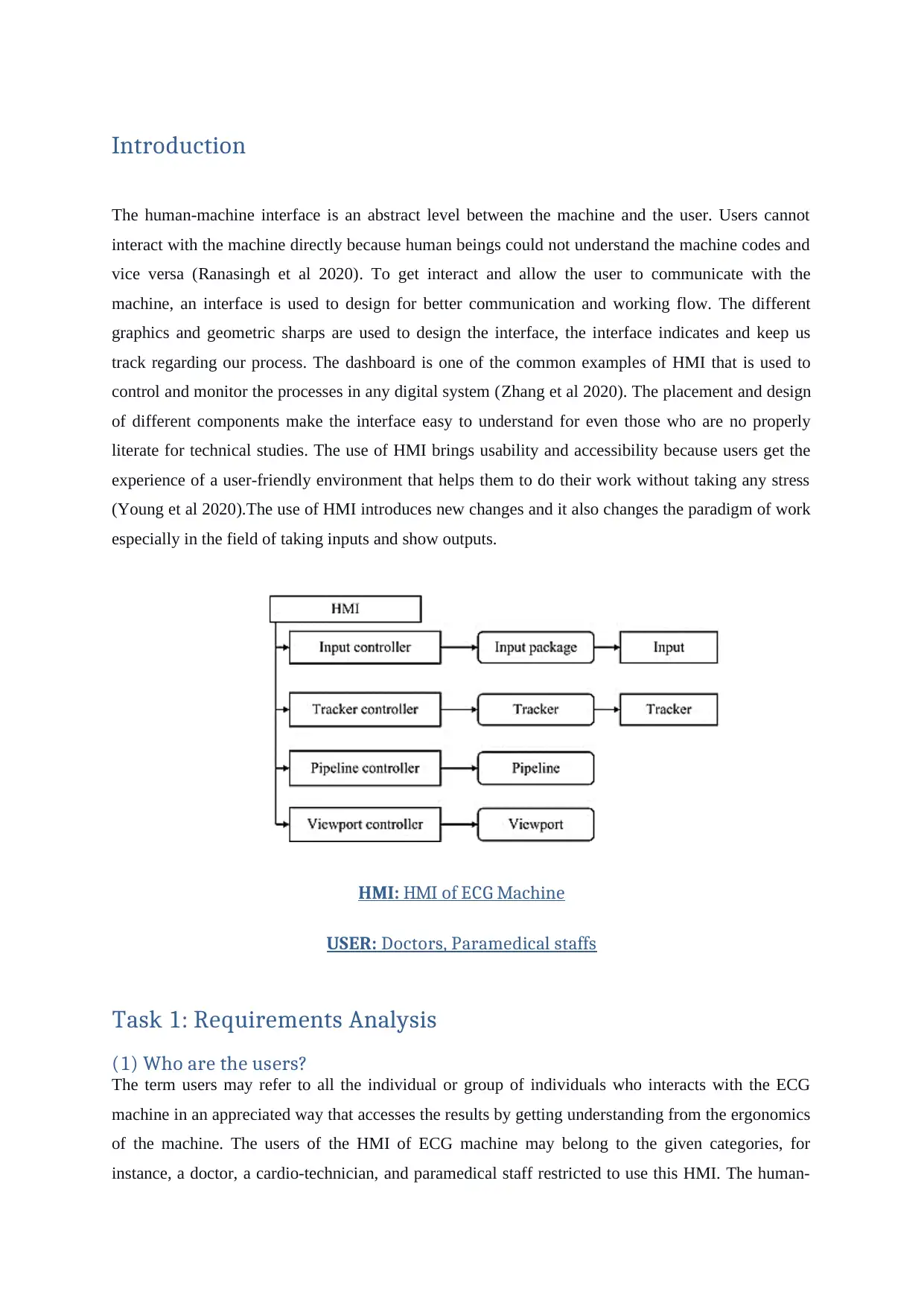
HMI: HMI of ECG Machine
USER: Doctors, Paramedical staffs
Task 1: Requirements Analysis
(1) Who are the users?
The term users may refer to all the individual or group of individuals who interacts with the ECG
machine in an appreciated way that accesses the results by getting understanding from the ergonomics
of the machine. The users of the HMI of ECG machine may belong to the given categories, for
instance, a doctor, a cardio-technician, and paramedical staff restricted to use this HMI. The human-
The human-machine interface is an abstract level between the machine and the user. Users cannot
interact with the machine directly because human beings could not understand the machine codes and
vice versa (Ranasingh et al 2020). To get interact and allow the user to communicate with the
machine, an interface is used to design for better communication and working flow. The different
graphics and geometric sharps are used to design the interface, the interface indicates and keep us
track regarding our process. The dashboard is one of the common examples of HMI that is used to
control and monitor the processes in any digital system (Zhang et al 2020). The placement and design
of different components make the interface easy to understand for even those who are no properly
literate for technical studies. The use of HMI brings usability and accessibility because users get the
experience of a user-friendly environment that helps them to do their work without taking any stress
(Young et al 2020).The use of HMI introduces new changes and it also changes the paradigm of work
especially in the field of taking inputs and show outputs.
HMI: HMI of ECG Machine
USER: Doctors, Paramedical staffs
Task 1: Requirements Analysis
(1) Who are the users?
The term users may refer to all the individual or group of individuals who interacts with the ECG
machine in an appreciated way that accesses the results by getting understanding from the ergonomics
of the machine. The users of the HMI of ECG machine may belong to the given categories, for
instance, a doctor, a cardio-technician, and paramedical staff restricted to use this HMI. The human-
⊘ This is a preview!⊘
Do you want full access?
Subscribe today to unlock all pages.

Trusted by 1+ million students worldwide
machine interface of ECG machine should be quite capable of entertaining all users under the
category of its audiences. Consequently, the user is the one, to whom the HMI is designed and
developed.
(2) What is the goal to be achieved using the HMI?
The goal of the human-machine interface quite relies on the fundamental factors of the human-
machine interaction. The use of HMI of ECG machines brings some problems which solved by the
approaches of human-machine interaction. The first and basic problem is to communicate with the
ECG apparatus to get specific results. The communication may refers to the input instruction for
configure the ECG machine to start cardiography. The HMI of ECG machine introduces few ideals
that how communication between machine and user that would be more reliable and efficient. The
understanding of factors that how users use the machine and on the bases of usage how better
interface should be developed which can give more usability and help for effective interaction.
(3) What tasks are required to engage with the HMI to achieve that goal?
The fundamental theory of the human-machine interaction belief that the users who use the machine
should consider first. The HMI of ECG designed and developed in such a way that paramedical staff
should not need to learn the technicalities to use the ECG apparatus, but the HMI itself provides an
easy-to-use environment by the implementation of modern technological aided elements (Zhang et al
2020). To achieve the ECG apparatus’s goal of usability, it should increase up to the optimum level
which could be attained by implementing the custom approaches of ergonomics, principals of
psychology and linguistics of interfaces of the machines. Moreover, the interface of ECG machine
provided high performance, accurate results and low latency with incredible ergonomics.
(4) What is the nature of the interaction with the HMI?
The HMI refers to all how paramedical staff communicate with the ECG and get response
respectively (Zhang et al 2020). The interface between the ECG apparatus and the paramedical staff
need to act as the translator for bilateral translation for both machine and users. The users interact and
give commands by custom designed interface, which gets information and configuration from the
paramedical staff and transfer it to the elector-cardio circuit to process and generate the results. The
result generated by machine transfer to the interface as the output for the paramedical staff. All this
process initiate and ends from and by a user from the given category, the HMI make interaction with
ECG apparatus successfully.
category of its audiences. Consequently, the user is the one, to whom the HMI is designed and
developed.
(2) What is the goal to be achieved using the HMI?
The goal of the human-machine interface quite relies on the fundamental factors of the human-
machine interaction. The use of HMI of ECG machines brings some problems which solved by the
approaches of human-machine interaction. The first and basic problem is to communicate with the
ECG apparatus to get specific results. The communication may refers to the input instruction for
configure the ECG machine to start cardiography. The HMI of ECG machine introduces few ideals
that how communication between machine and user that would be more reliable and efficient. The
understanding of factors that how users use the machine and on the bases of usage how better
interface should be developed which can give more usability and help for effective interaction.
(3) What tasks are required to engage with the HMI to achieve that goal?
The fundamental theory of the human-machine interaction belief that the users who use the machine
should consider first. The HMI of ECG designed and developed in such a way that paramedical staff
should not need to learn the technicalities to use the ECG apparatus, but the HMI itself provides an
easy-to-use environment by the implementation of modern technological aided elements (Zhang et al
2020). To achieve the ECG apparatus’s goal of usability, it should increase up to the optimum level
which could be attained by implementing the custom approaches of ergonomics, principals of
psychology and linguistics of interfaces of the machines. Moreover, the interface of ECG machine
provided high performance, accurate results and low latency with incredible ergonomics.
(4) What is the nature of the interaction with the HMI?
The HMI refers to all how paramedical staff communicate with the ECG and get response
respectively (Zhang et al 2020). The interface between the ECG apparatus and the paramedical staff
need to act as the translator for bilateral translation for both machine and users. The users interact and
give commands by custom designed interface, which gets information and configuration from the
paramedical staff and transfer it to the elector-cardio circuit to process and generate the results. The
result generated by machine transfer to the interface as the output for the paramedical staff. All this
process initiate and ends from and by a user from the given category, the HMI make interaction with
ECG apparatus successfully.
Paraphrase This Document
Need a fresh take? Get an instant paraphrase of this document with our AI Paraphraser
(5) What is the context of using the HMI?
The context of using the human-machine interface to introduce an intermediate layer between the
complex electrical circuits and the paramedical staff. The machine could not understand the human
language and the paramedical staff could not decode the machine language and mnemonics which
immediately demonstrate the need for any translating stage where human language could be converted
into the configuration that machine can understand. It is also pertinent to mention that why it is
necessary to convert human language into machine language, the reason is to get required results in
the form of cardiograph. The ECG machines are designed to do so, what they could do, the
paramedical staff needs to configure it according to the need of patient. To increase usability, the
interface ergonomics design in such a way that paramedical staff can use in human-understandable
language, signs or toggles and machine process the machine-understandable configuration. Hence the
interface of ECG machine act as the translator to both paramedical and the ECG machine.
Task 2: Evaluation of HMI
Good Aspects of HMI:-
1. Usability:
The ECG apparatus is engineered for completion of the cardiography and generate printed
matrix of results, the HMI creates an interface between machine and users to communicate
accordingly. In the early times with the use of the non-digital medical equipment, there is no
proper graphical user interface but a paramedical staff needs to configure the apparatus
manually that are not easy to do, a single mistake in the instruction cause to seize the whole
process or generate the unreliable results. (Zhang et al 2020). With the use of digital and
computerized interface of apparatus, the usability of the machine become quite easy, even a
person having zero knowledge about the complex electrical circuits and configuration running
behind, could easily get assistance by ECG machine and use it without wasting time. Hence,
the computerized HMI of ECG machines increases usability due to its easy access to the
required function to perform.
2. Filter data input:
The ECG machine fundamentally working on complex electrical circuits. The configurations
and instruction in the shape of the pressing buttons or swipe the touch screen also acts as an
input from the user to ECG machine by HMI. The process of insert instruction without HMI
is a much difficult task. The result of cardiophragy solely depend on the instructions and its
accuracy of configuration which is enter by paramedical staff. The HMI provides the best
filtered and filter mechanism to ensure the configuration entered by the paramedical staff is
The context of using the human-machine interface to introduce an intermediate layer between the
complex electrical circuits and the paramedical staff. The machine could not understand the human
language and the paramedical staff could not decode the machine language and mnemonics which
immediately demonstrate the need for any translating stage where human language could be converted
into the configuration that machine can understand. It is also pertinent to mention that why it is
necessary to convert human language into machine language, the reason is to get required results in
the form of cardiograph. The ECG machines are designed to do so, what they could do, the
paramedical staff needs to configure it according to the need of patient. To increase usability, the
interface ergonomics design in such a way that paramedical staff can use in human-understandable
language, signs or toggles and machine process the machine-understandable configuration. Hence the
interface of ECG machine act as the translator to both paramedical and the ECG machine.
Task 2: Evaluation of HMI
Good Aspects of HMI:-
1. Usability:
The ECG apparatus is engineered for completion of the cardiography and generate printed
matrix of results, the HMI creates an interface between machine and users to communicate
accordingly. In the early times with the use of the non-digital medical equipment, there is no
proper graphical user interface but a paramedical staff needs to configure the apparatus
manually that are not easy to do, a single mistake in the instruction cause to seize the whole
process or generate the unreliable results. (Zhang et al 2020). With the use of digital and
computerized interface of apparatus, the usability of the machine become quite easy, even a
person having zero knowledge about the complex electrical circuits and configuration running
behind, could easily get assistance by ECG machine and use it without wasting time. Hence,
the computerized HMI of ECG machines increases usability due to its easy access to the
required function to perform.
2. Filter data input:
The ECG machine fundamentally working on complex electrical circuits. The configurations
and instruction in the shape of the pressing buttons or swipe the touch screen also acts as an
input from the user to ECG machine by HMI. The process of insert instruction without HMI
is a much difficult task. The result of cardiophragy solely depend on the instructions and its
accuracy of configuration which is enter by paramedical staff. The HMI provides the best
filtered and filter mechanism to ensure the configuration entered by the paramedical staff is
valid and without any omission or mistake. The design of interface is restrict user to enter
wrong instruction of configuration to the machine.
3. Easy-to-use environment:
The user is the individual who interacts with the ECG machine when results are needed on
then paper as the cardio-graph (Zhang et al 2020). The cardiograph and user experience drive
from the factor of how easy to use the interface is. The easy to use, specific and accurately
designed ECG machine interface provides easy-to-use environment and stress-free working
experience due to the ease in the use of ECG by interface. The nature of work, type of
audience and layout for outputs have a great impact on the best user experience, so if the
design, process, and phases, collectively called the environment of any HMI which provides
ease of performing the task (Young et al 2020). The well designed, deeply engineered HMI of
ECG apparatus provides an easy-to-use environment that makes working easy, efficient and
effective.
4. No need for deep understanding:
The nature of medical equipment are different from each other, even a single medical unit
have multiple machines for a different task (Young et al 2020). If only the technical educated
persons or technicians could only interact with the specific type of medical equipment, it
introduces a major hurdle in the treatment of every patient. There is an ideal intermediate
layer which is used to provide some graphical user interface by keeping in view the
paramedical staff as the audience of the system. The ergonomics and design of the interface
provide a self-explanatory feature that leads the medical staff towards required configuration.
The HMI provides the feature that with less knowledge of internal circuits and complex
process paramedical staff can interact with the ECG machine.
Bad Aspects of HMI
1 HMI slow down the process:
A fundamental and more critical drawback of any self-assistance system including HMI is
that these interfaces use graphics which leads to slow down the process because of
transmission o and rendering of result (Ranasingh et al 2020). The custom ergonomics of the
ECG machine provides self-explanatory tutorial that how to use the apparatus but the
designed interface which used visual data, continuity of the usage of resources of the
machine, which result as the slow down the processing of showing the results in real time and
introduce latency that introduce unreliability.
wrong instruction of configuration to the machine.
3. Easy-to-use environment:
The user is the individual who interacts with the ECG machine when results are needed on
then paper as the cardio-graph (Zhang et al 2020). The cardiograph and user experience drive
from the factor of how easy to use the interface is. The easy to use, specific and accurately
designed ECG machine interface provides easy-to-use environment and stress-free working
experience due to the ease in the use of ECG by interface. The nature of work, type of
audience and layout for outputs have a great impact on the best user experience, so if the
design, process, and phases, collectively called the environment of any HMI which provides
ease of performing the task (Young et al 2020). The well designed, deeply engineered HMI of
ECG apparatus provides an easy-to-use environment that makes working easy, efficient and
effective.
4. No need for deep understanding:
The nature of medical equipment are different from each other, even a single medical unit
have multiple machines for a different task (Young et al 2020). If only the technical educated
persons or technicians could only interact with the specific type of medical equipment, it
introduces a major hurdle in the treatment of every patient. There is an ideal intermediate
layer which is used to provide some graphical user interface by keeping in view the
paramedical staff as the audience of the system. The ergonomics and design of the interface
provide a self-explanatory feature that leads the medical staff towards required configuration.
The HMI provides the feature that with less knowledge of internal circuits and complex
process paramedical staff can interact with the ECG machine.
Bad Aspects of HMI
1 HMI slow down the process:
A fundamental and more critical drawback of any self-assistance system including HMI is
that these interfaces use graphics which leads to slow down the process because of
transmission o and rendering of result (Ranasingh et al 2020). The custom ergonomics of the
ECG machine provides self-explanatory tutorial that how to use the apparatus but the
designed interface which used visual data, continuity of the usage of resources of the
machine, which result as the slow down the processing of showing the results in real time and
introduce latency that introduce unreliability.
⊘ This is a preview!⊘
Do you want full access?
Subscribe today to unlock all pages.
Trusted by 1+ million students worldwide
2 Dual feature introduce confuse results:
The best user experience comes from the ideally designed interface with custom graphics
additional for make it self-describing interface. The touch screen that is able to get
configuration from the medical staff to the ECG apparatus. The issue here that the custom
showing real-time cardiography and simultaneously printing in a special cardio-graph bring
minor but countable latency which may confuse the results. This proves as the worse effect of
any graphically equipped medical equipment such as ECG machine.
3 Need an expensive system:
The intermediate layer called the human-machine interface provides extraordinary help to
learn the usage of any ECG machine. The best user-friendly designs of medical equipment
need more expensive hardware resources to project the complete trajectory of its visuals
output (Albers 2020). This will need more expensive and up to date hardware and even
software resources which quite capable of the execution of graphically designed HMI.
4 Complexity and excessiveness:
The ECG machine interface provides a lot of effective performance where these HMI(s) could
design on two basic principles, either the HMI is designed complex or it will in abundance in
number (Albers, 2020). The theory bases on the occupation of the machine feature in the
interface. The complex ECG HMI provides more than functions and features (Ranasingh et al
2020). This also makes user panic while finding the exact feature to perform during the
treatment of patient.
Task 3: Design recommendations
The design of the ECG HMI sustains its importance as the key player in the usage of ECG machine.
The previous comparative analysis of use of HMI in ECG apparatus leaves some unclear points, in the
recommendation task, those points will be clarified under the light of theory and principle of human
computer interaction (Ranasingh et al 2020). The observation told that the highly graphical designed
HMI of medical equipment introduce delayed result and minor unreliable results. It is also a fact that
confusedly draw HMI make a mess for the medical staff at the time of emergency which also brings
consequents. The given two results give one thing precisely that the Interface of any ECG apparatus
must be inherent from both but smartly and efficiently so that the advantages of HMI could be fully
enjoyed and bad aspects could maximum be avoided(Ranasingh et al 2020). The given
recommendation is based on the above-mentioned hypothesis with the existing examples.
The best user experience comes from the ideally designed interface with custom graphics
additional for make it self-describing interface. The touch screen that is able to get
configuration from the medical staff to the ECG apparatus. The issue here that the custom
showing real-time cardiography and simultaneously printing in a special cardio-graph bring
minor but countable latency which may confuse the results. This proves as the worse effect of
any graphically equipped medical equipment such as ECG machine.
3 Need an expensive system:
The intermediate layer called the human-machine interface provides extraordinary help to
learn the usage of any ECG machine. The best user-friendly designs of medical equipment
need more expensive hardware resources to project the complete trajectory of its visuals
output (Albers 2020). This will need more expensive and up to date hardware and even
software resources which quite capable of the execution of graphically designed HMI.
4 Complexity and excessiveness:
The ECG machine interface provides a lot of effective performance where these HMI(s) could
design on two basic principles, either the HMI is designed complex or it will in abundance in
number (Albers, 2020). The theory bases on the occupation of the machine feature in the
interface. The complex ECG HMI provides more than functions and features (Ranasingh et al
2020). This also makes user panic while finding the exact feature to perform during the
treatment of patient.
Task 3: Design recommendations
The design of the ECG HMI sustains its importance as the key player in the usage of ECG machine.
The previous comparative analysis of use of HMI in ECG apparatus leaves some unclear points, in the
recommendation task, those points will be clarified under the light of theory and principle of human
computer interaction (Ranasingh et al 2020). The observation told that the highly graphical designed
HMI of medical equipment introduce delayed result and minor unreliable results. It is also a fact that
confusedly draw HMI make a mess for the medical staff at the time of emergency which also brings
consequents. The given two results give one thing precisely that the Interface of any ECG apparatus
must be inherent from both but smartly and efficiently so that the advantages of HMI could be fully
enjoyed and bad aspects could maximum be avoided(Ranasingh et al 2020). The given
recommendation is based on the above-mentioned hypothesis with the existing examples.
Paraphrase This Document
Need a fresh take? Get an instant paraphrase of this document with our AI Paraphraser

1 Simple and Special:
The ECG HMI must be in the simpler form of its graphics and audio-video support. Because
it brings very bad implications on the performance. The first blueprint of the design must be
simple and focus on a specific result of cardiograph. Moreover, the design of HMI visualized
and implement in such an extraordinary way that brings this to the optimum level.
2 Light and Bright:
The matter of latency and the unreliable results related problems must be resolved by making
the design of interface lightweight as there is no extra graphics but just those who are
essentially needed to understand the purpose interface of ECG machine. The bright HMI are
all those who use white color tone to avoid high definition graphics format. The bright tone
provides an efficient look and conventional low size visual format could give excellent
ergonomics.
3 New and Neo:
The technology and innovation in the inventions of new medical equipment or improvised
versions of existing ECG apparatus create a version compatibility issue either in hardware or
interfaces. The ECG HMI just follow the basic principle and try to design as simple as it
could possible so that it can be run on a large range of apparatus.
4 Layered and wizard:
The ECG HMI must have layered for configure the apparatus to get validate data by diving
instruction entering module in small chunks. This will provide validation and verification of
data before interacting with the ECG machine by the human-machine interface. The layered
prevent ECG HMI from complexity and bring a natural structural flow of commands to get
reliable results. The wizard for configure and receiving the outputs are also need to be
included, the wizard make the output directional to the specific output which introduce the
fast and feasible human-machine interface.
5 Full and pull:
The issue of having an abundance of small HMI of ECG machine could be resolved if every
HMI has all the necessary access and option for all function perform by ECG apparatus. The
signal HMI equipped with maximum resources and pulled by strong designed which never let
medical staff in finding the specific option to get ECG.
Reference:
1. Ranasinghe, C. M. E., Holländer, K., Schneegass, S., Currano, R., Sirkin, D., Moore, D., &
Ju, W. (2020). Autonomous Vehicle-Pedestrian Interaction Across Cultures: Towards
The ECG HMI must be in the simpler form of its graphics and audio-video support. Because
it brings very bad implications on the performance. The first blueprint of the design must be
simple and focus on a specific result of cardiograph. Moreover, the design of HMI visualized
and implement in such an extraordinary way that brings this to the optimum level.
2 Light and Bright:
The matter of latency and the unreliable results related problems must be resolved by making
the design of interface lightweight as there is no extra graphics but just those who are
essentially needed to understand the purpose interface of ECG machine. The bright HMI are
all those who use white color tone to avoid high definition graphics format. The bright tone
provides an efficient look and conventional low size visual format could give excellent
ergonomics.
3 New and Neo:
The technology and innovation in the inventions of new medical equipment or improvised
versions of existing ECG apparatus create a version compatibility issue either in hardware or
interfaces. The ECG HMI just follow the basic principle and try to design as simple as it
could possible so that it can be run on a large range of apparatus.
4 Layered and wizard:
The ECG HMI must have layered for configure the apparatus to get validate data by diving
instruction entering module in small chunks. This will provide validation and verification of
data before interacting with the ECG machine by the human-machine interface. The layered
prevent ECG HMI from complexity and bring a natural structural flow of commands to get
reliable results. The wizard for configure and receiving the outputs are also need to be
included, the wizard make the output directional to the specific output which introduce the
fast and feasible human-machine interface.
5 Full and pull:
The issue of having an abundance of small HMI of ECG machine could be resolved if every
HMI has all the necessary access and option for all function perform by ECG apparatus. The
signal HMI equipped with maximum resources and pulled by strong designed which never let
medical staff in finding the specific option to get ECG.
Reference:
1. Ranasinghe, C. M. E., Holländer, K., Schneegass, S., Currano, R., Sirkin, D., Moore, D., &
Ju, W. (2020). Autonomous Vehicle-Pedestrian Interaction Across Cultures: Towards

Designing Better External Human Machine Interfaces (HMIs). In Conference on Human
Factors in Computing Systems 2020.
2. Zhang, Q., Liu, X., Duan, L., & Gao, G. (2020). Nucleotide-driven skin-attachable hydrogels
toward visual human-machine interfaces. Journal of Materials Chemistry A, 8(8), 4515-4523.
3. Young, S. N., & Peschel, J. M. (2020). Review of Human–Machine Interfaces for Small
Unmanned Systems With Robotic Manipulators. IEEE Transactions on Human-Machine
Systems.
4. Rettenmaier, M., Albers, D., & Bengler, K. (2020). After you?!–Use of external human-
machine interfaces in road bottleneck scenarios. Transportation Research Part F: Traffic
Psychology and Behaviour, 70, 175-190.
5. Rettenmaier, Bengler, K. (2020). After you?!–Use of external human-machine interfaces in
road bottleneck scenarios. Transportation Research Part F: Traffic Psychology and
Behaviour, 70, 175-190.
Factors in Computing Systems 2020.
2. Zhang, Q., Liu, X., Duan, L., & Gao, G. (2020). Nucleotide-driven skin-attachable hydrogels
toward visual human-machine interfaces. Journal of Materials Chemistry A, 8(8), 4515-4523.
3. Young, S. N., & Peschel, J. M. (2020). Review of Human–Machine Interfaces for Small
Unmanned Systems With Robotic Manipulators. IEEE Transactions on Human-Machine
Systems.
4. Rettenmaier, M., Albers, D., & Bengler, K. (2020). After you?!–Use of external human-
machine interfaces in road bottleneck scenarios. Transportation Research Part F: Traffic
Psychology and Behaviour, 70, 175-190.
5. Rettenmaier, Bengler, K. (2020). After you?!–Use of external human-machine interfaces in
road bottleneck scenarios. Transportation Research Part F: Traffic Psychology and
Behaviour, 70, 175-190.
⊘ This is a preview!⊘
Do you want full access?
Subscribe today to unlock all pages.
Trusted by 1+ million students worldwide

1 out of 9


Related Documents


Your All-in-One AI-Powered Toolkit for Academic Success.
+13062052269
info@desklib.com
Available 24*7 on WhatsApp / Email
![[object Object]](/_next/static/media/star-bottom.7253800d.svg)
Unlock your academic potential
Copyright © 2020–2026 A2Z Services. All Rights Reserved. Developed and managed by ZUCOL.