ECO202 Economic Ideas and Models for Business: Tutor Marked Assignment
VerifiedAdded on 2023/06/18
|22
|2531
|346
Homework Assignment
AI Summary
This assignment solution for ECO202 Economic Ideas and Models for Business analyzes various economic scenarios and government interventions in the market. It examines the impact of price increases in electronic vaporizers on the demand for cigarettes, the effects of wage increases for cigarette industry workers, and the influence of research linking smoking to cancer on consumer behavior. The assignment further discusses government measures for controlling smoking, such as price ceilings, price floors, and taxes, evaluating their effectiveness in reducing cigarette consumption. It also considers the use of aggregate consumption measures and household survey data in studying the impact of price and tax on tobacco consumption, providing a comprehensive overview of economic principles applied to the cigarette market. Desklib offers a wide range of study resources, including past papers and solved assignments, to support students in their academic endeavors.
ECONOMIC IDEAS AND
MODELS FOR BUSINESS
MODELS FOR BUSINESS

Paraphrase This Document
Need a fresh take? Get an instant paraphrase of this document with our AI Paraphraser
TABLE OF CONTENTS
Q1.)a................................................................................................................................................3
Q1.b)................................................................................................................................................4
REFERENCES................................................................................................................................8
Q1.)a................................................................................................................................................3
Q1.b)................................................................................................................................................4
REFERENCES................................................................................................................................8
Q1.)a
Electronic vaporisers’ price increase
As rise occurs in costs of e-vaps, demand for cigarettes will increase with decrease in demand for
e-vaps. Rise in costs shall discourage people to buy it when they have option for purchasing less
expensive cigarettes. This can be explained with price of related goods in consumption. As the
price of a product changes, it can influence buying decision of another product where the price of
other product did not change. Demand of a product may get affected by another product’s price
that is in relation with consumption. Here, it can be said that the products are substitutes of each
other. These are substitutes where price increase in one commodity shall increase price rise in
other (Corrigan, O'Connor and Rousu, 2020).
Two products can be called substitutes if an increase in price of one good increases demand for
other. Considering e-vap and cigarettes to be substitutes. If price of e-vap increase then
consumers who were consuming e-vap will switch over to cigarettes. And even if price of
cigarettes do not change, there will be more of consumers who buy them now and the entire
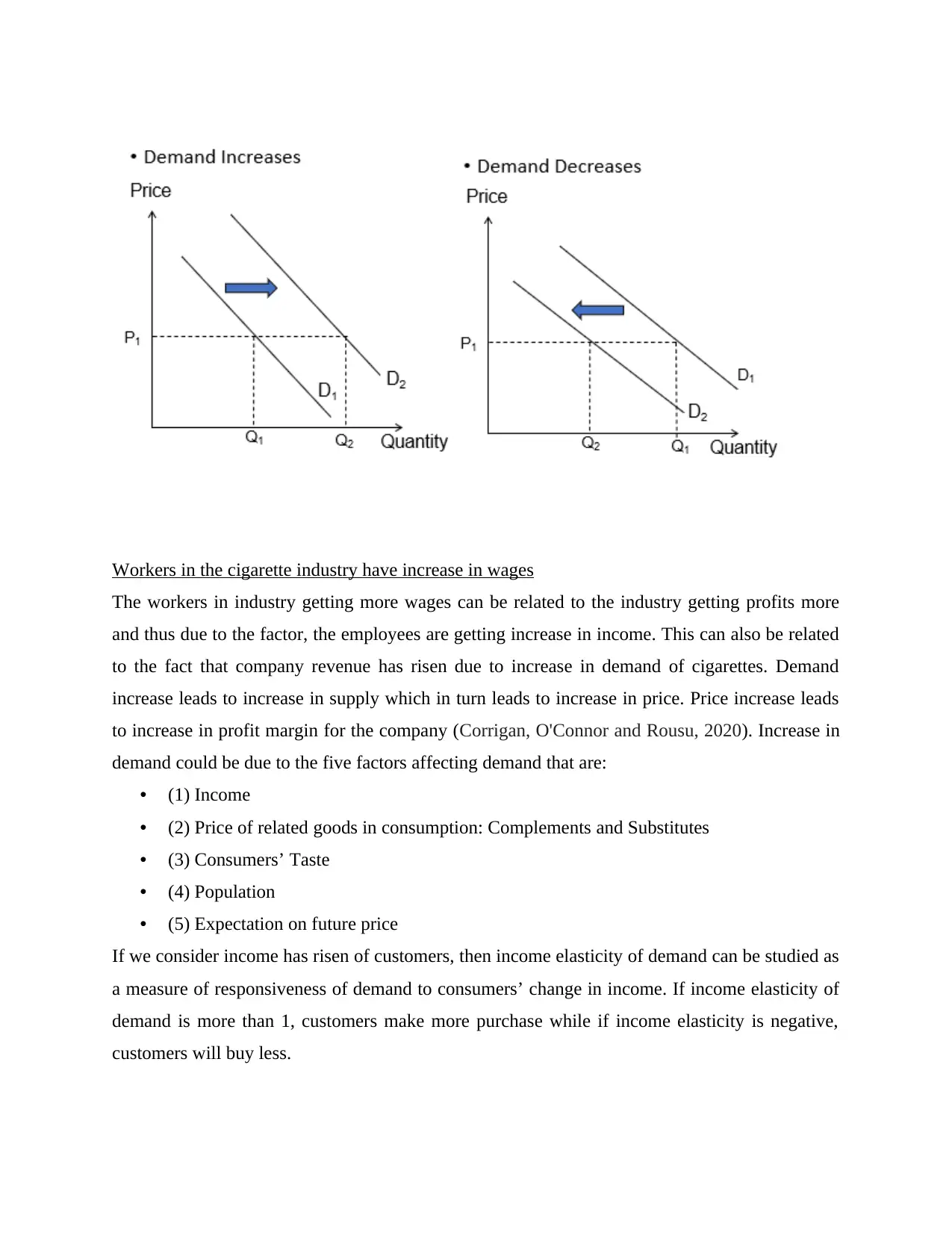
demand curve of cigarette will be shifting to right. Demand for cigarette will increase as the
price of its substitute increases.
Demand curve will rise giving an increase or rise in supply curve too of cigarettes. As there is a
shift in demand, it will affect the price of cigarettes to increase. This can be seen by illustration
in demand curve.
As there is increase in price, supply being positively related with price, it shall too increase. The
supply curve will see an upward shift illustrated through the graph.
The equilibrium price can be reached when demand equals supply and is denoted by graph where
the demand and supply axis meet.
Electronic vaporisers’ price increase
As rise occurs in costs of e-vaps, demand for cigarettes will increase with decrease in demand for
e-vaps. Rise in costs shall discourage people to buy it when they have option for purchasing less
expensive cigarettes. This can be explained with price of related goods in consumption. As the
price of a product changes, it can influence buying decision of another product where the price of
other product did not change. Demand of a product may get affected by another product’s price
that is in relation with consumption. Here, it can be said that the products are substitutes of each
other. These are substitutes where price increase in one commodity shall increase price rise in
other (Corrigan, O'Connor and Rousu, 2020).
Two products can be called substitutes if an increase in price of one good increases demand for
other. Considering e-vap and cigarettes to be substitutes. If price of e-vap increase then
consumers who were consuming e-vap will switch over to cigarettes. And even if price of
cigarettes do not change, there will be more of consumers who buy them now and the entire
demand curve of cigarette will be shifting to right. Demand for cigarette will increase as the
price of its substitute increases.
Demand curve will rise giving an increase or rise in supply curve too of cigarettes. As there is a
shift in demand, it will affect the price of cigarettes to increase. This can be seen by illustration
in demand curve.
As there is increase in price, supply being positively related with price, it shall too increase. The
supply curve will see an upward shift illustrated through the graph.
The equilibrium price can be reached when demand equals supply and is denoted by graph where
the demand and supply axis meet.
⊘ This is a preview!⊘
Do you want full access?
Subscribe today to unlock all pages.

Trusted by 1+ million students worldwide
Workers in the cigarette industry have increase in wages
The workers in industry getting more wages can be related to the industry getting profits more
and thus due to the factor, the employees are getting increase in income. This can also be related
to the fact that company revenue has risen due to increase in demand of cigarettes. Demand
increase leads to increase in supply which in turn leads to increase in price. Price increase leads
to increase in profit margin for the company (Corrigan, O'Connor and Rousu, 2020). Increase in
demand could be due to the five factors affecting demand that are:
• (1) Income
• (2) Price of related goods in consumption: Complements and Substitutes
• (3) Consumers’ Taste
• (4) Population
• (5) Expectation on future price
If we consider income has risen of customers, then income elasticity of demand can be studied as
a measure of responsiveness of demand to consumers’ change in income. If income elasticity of
demand is more than 1, customers make more purchase while if income elasticity is negative,
customers will buy less.
The workers in industry getting more wages can be related to the industry getting profits more
and thus due to the factor, the employees are getting increase in income. This can also be related
to the fact that company revenue has risen due to increase in demand of cigarettes. Demand
increase leads to increase in supply which in turn leads to increase in price. Price increase leads
to increase in profit margin for the company (Corrigan, O'Connor and Rousu, 2020). Increase in
demand could be due to the five factors affecting demand that are:
• (1) Income
• (2) Price of related goods in consumption: Complements and Substitutes
• (3) Consumers’ Taste
• (4) Population
• (5) Expectation on future price
If we consider income has risen of customers, then income elasticity of demand can be studied as
a measure of responsiveness of demand to consumers’ change in income. If income elasticity of
demand is more than 1, customers make more purchase while if income elasticity is negative,
customers will buy less.
Paraphrase This Document
Need a fresh take? Get an instant paraphrase of this document with our AI Paraphraser
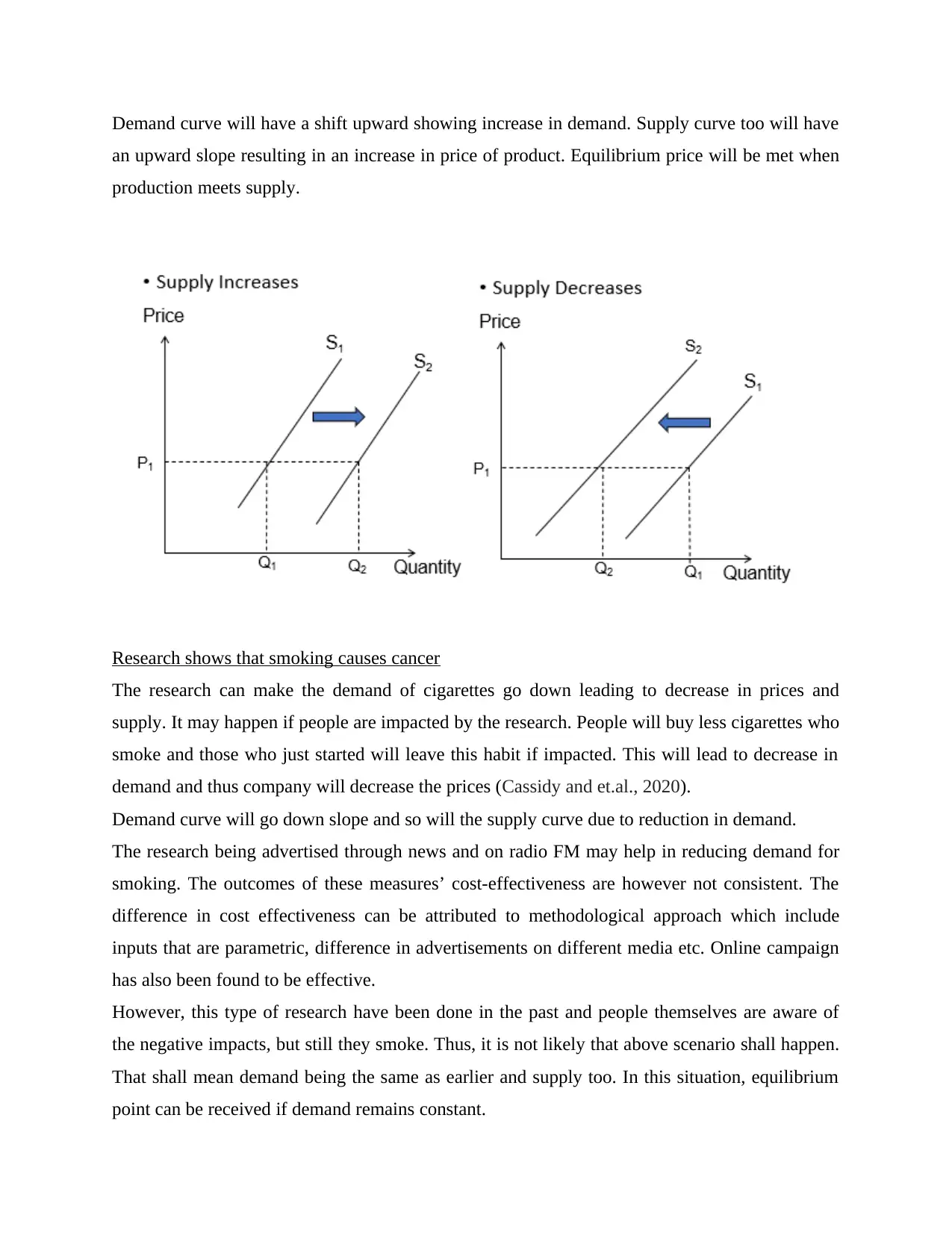
Demand curve will have a shift upward showing increase in demand. Supply curve too will have
an upward slope resulting in an increase in price of product. Equilibrium price will be met when
production meets supply.
Research shows that smoking causes cancer
The research can make the demand of cigarettes go down leading to decrease in prices and
supply. It may happen if people are impacted by the research. People will buy less cigarettes who
smoke and those who just started will leave this habit if impacted. This will lead to decrease in
demand and thus company will decrease the prices (Cassidy and et.al., 2020).
Demand curve will go down slope and so will the supply curve due to reduction in demand.
The research being advertised through news and on radio FM may help in reducing demand for
smoking. The outcomes of these measures’ cost-effectiveness are however not consistent. The
difference in cost effectiveness can be attributed to methodological approach which include
inputs that are parametric, difference in advertisements on different media etc. Online campaign
has also been found to be effective.
However, this type of research have been done in the past and people themselves are aware of
the negative impacts, but still they smoke. Thus, it is not likely that above scenario shall happen.
That shall mean demand being the same as earlier and supply too. In this situation, equilibrium
point can be received if demand remains constant.
an upward slope resulting in an increase in price of product. Equilibrium price will be met when
production meets supply.
Research shows that smoking causes cancer
The research can make the demand of cigarettes go down leading to decrease in prices and
supply. It may happen if people are impacted by the research. People will buy less cigarettes who
smoke and those who just started will leave this habit if impacted. This will lead to decrease in
demand and thus company will decrease the prices (Cassidy and et.al., 2020).
Demand curve will go down slope and so will the supply curve due to reduction in demand.
The research being advertised through news and on radio FM may help in reducing demand for
smoking. The outcomes of these measures’ cost-effectiveness are however not consistent. The
difference in cost effectiveness can be attributed to methodological approach which include
inputs that are parametric, difference in advertisements on different media etc. Online campaign
has also been found to be effective.
However, this type of research have been done in the past and people themselves are aware of
the negative impacts, but still they smoke. Thus, it is not likely that above scenario shall happen.
That shall mean demand being the same as earlier and supply too. In this situation, equilibrium
point can be received if demand remains constant.
Q1.b)
Government measures for controlling smoking
Price ceiling to be put by government and taxes can help in reducing the usage of cigarettes in
public. The price control policy will help in government imposing a price ceiling for reduction in
market price or use a price floor which can increase the product’s market price. This can result in
a small quantity traded in market with occurrence of deadweight loss occurring (Hiscock and
et.al.., 2018).
Government can influence the market also by imposition of taxes on the product. Tax may be
kept on the side of consumer that can reduce the marginal benefit consumption and make the
demand curve shift downwards. Tax may also be kept on producer or company’s side increasing
the marginal cost of production and shifting the supply curve upwards. In the two cases,
consumers will have to pay higher price, producers receiving lower price, government getting
revenue of tax and decrease in the market quantity. Tax too creates a deadweight loss resulting in
an out come that is inefficient.
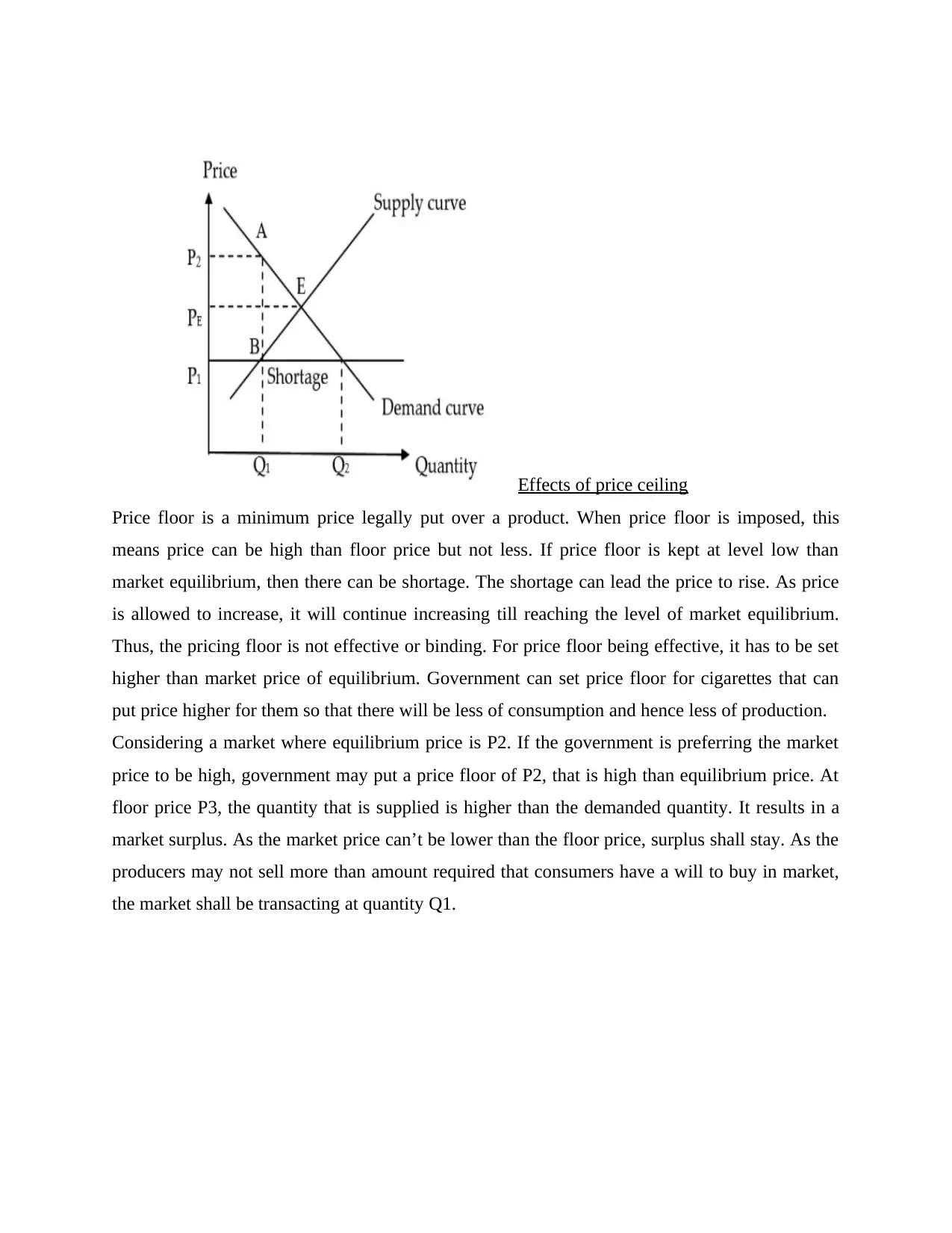
Price ceiling is maximum price that can be legally put up. The term means price in market can be
lower than the ceiling price but cannot be on high side. If ceiling is higher than market
equilibrium then there can be a surplus. The surplus causes decrease in price. As price is allowed
for decreasing, it shall decrease till reaching the market’s equilibrium level. The price ceiling is
not effective or binding. Government for making the price ceiling effective, has to set it below
the market equilibrium. Government here won’t be using this method as it wants to price the
cigarettes higher (Cassidy and et.al., 2020).
With shortage occurring in price ceiling, there will be present mechanisms for responding to it.
Government measures for controlling smoking
Price ceiling to be put by government and taxes can help in reducing the usage of cigarettes in
public. The price control policy will help in government imposing a price ceiling for reduction in
market price or use a price floor which can increase the product’s market price. This can result in
a small quantity traded in market with occurrence of deadweight loss occurring (Hiscock and
et.al.., 2018).
Government can influence the market also by imposition of taxes on the product. Tax may be
kept on the side of consumer that can reduce the marginal benefit consumption and make the
demand curve shift downwards. Tax may also be kept on producer or company’s side increasing
the marginal cost of production and shifting the supply curve upwards. In the two cases,
consumers will have to pay higher price, producers receiving lower price, government getting
revenue of tax and decrease in the market quantity. Tax too creates a deadweight loss resulting in
an out come that is inefficient.
Price ceiling is maximum price that can be legally put up. The term means price in market can be
lower than the ceiling price but cannot be on high side. If ceiling is higher than market
equilibrium then there can be a surplus. The surplus causes decrease in price. As price is allowed
for decreasing, it shall decrease till reaching the market’s equilibrium level. The price ceiling is
not effective or binding. Government for making the price ceiling effective, has to set it below
the market equilibrium. Government here won’t be using this method as it wants to price the
cigarettes higher (Cassidy and et.al., 2020).
With shortage occurring in price ceiling, there will be present mechanisms for responding to it.
⊘ This is a preview!⊘
Do you want full access?
Subscribe today to unlock all pages.
Trusted by 1+ million students worldwide
Effects of price ceiling
Price floor is a minimum price legally put over a product. When price floor is imposed, this
means price can be high than floor price but not less. If price floor is kept at level low than
market equilibrium, then there can be shortage. The shortage can lead the price to rise. As price
is allowed to increase, it will continue increasing till reaching the level of market equilibrium.
Thus, the pricing floor is not effective or binding. For price floor being effective, it has to be set
higher than market price of equilibrium. Government can set price floor for cigarettes that can
put price higher for them so that there will be less of consumption and hence less of production.
Considering a market where equilibrium price is P2. If the government is preferring the market
price to be high, government may put a price floor of P2, that is high than equilibrium price. At
floor price P3, the quantity that is supplied is higher than the demanded quantity. It results in a
market surplus. As the market price can’t be lower than the floor price, surplus shall stay. As the
producers may not sell more than amount required that consumers have a will to buy in market,
the market shall be transacting at quantity Q1.
Price floor is a minimum price legally put over a product. When price floor is imposed, this
means price can be high than floor price but not less. If price floor is kept at level low than
market equilibrium, then there can be shortage. The shortage can lead the price to rise. As price
is allowed to increase, it will continue increasing till reaching the level of market equilibrium.
Thus, the pricing floor is not effective or binding. For price floor being effective, it has to be set
higher than market price of equilibrium. Government can set price floor for cigarettes that can
put price higher for them so that there will be less of consumption and hence less of production.
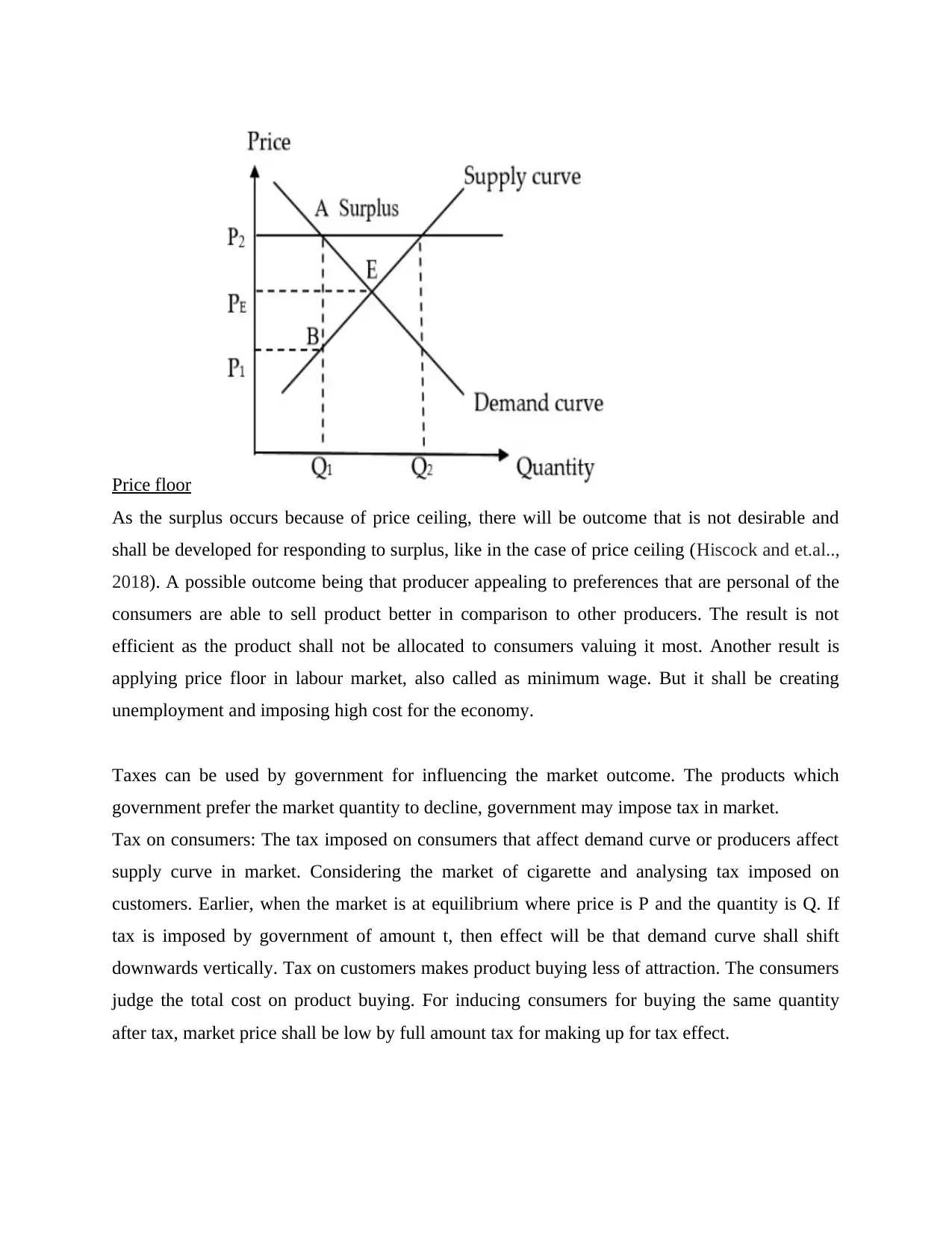
Considering a market where equilibrium price is P2. If the government is preferring the market
price to be high, government may put a price floor of P2, that is high than equilibrium price. At
floor price P3, the quantity that is supplied is higher than the demanded quantity. It results in a
market surplus. As the market price can’t be lower than the floor price, surplus shall stay. As the
producers may not sell more than amount required that consumers have a will to buy in market,
the market shall be transacting at quantity Q1.
Paraphrase This Document
Need a fresh take? Get an instant paraphrase of this document with our AI Paraphraser
Price floor
As the surplus occurs because of price ceiling, there will be outcome that is not desirable and
shall be developed for responding to surplus, like in the case of price ceiling (Hiscock and et.al..,
2018). A possible outcome being that producer appealing to preferences that are personal of the
consumers are able to sell product better in comparison to other producers. The result is not
efficient as the product shall not be allocated to consumers valuing it most. Another result is
applying price floor in labour market, also called as minimum wage. But it shall be creating
unemployment and imposing high cost for the economy.
Taxes can be used by government for influencing the market outcome. The products which
government prefer the market quantity to decline, government may impose tax in market.
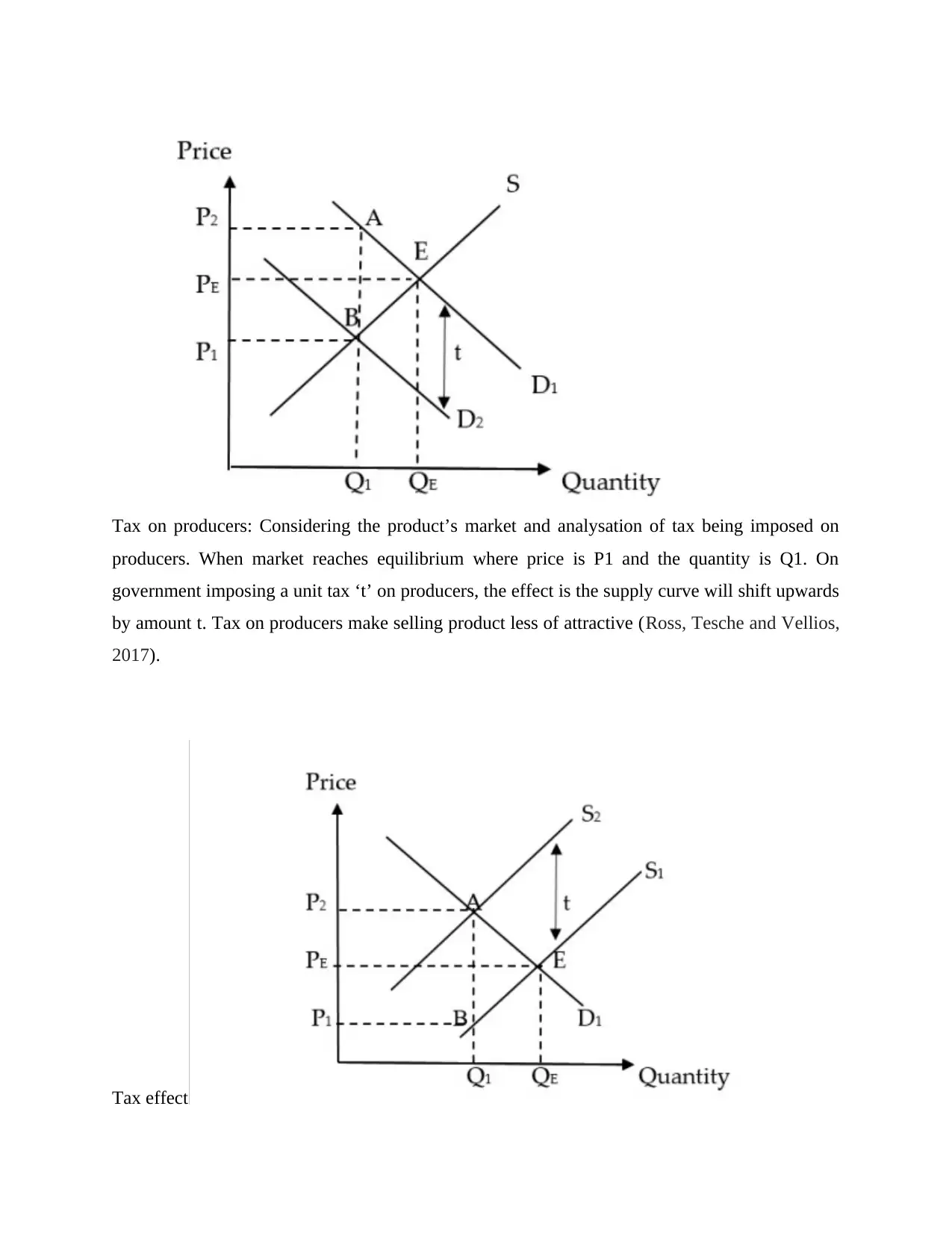
Tax on consumers: The tax imposed on consumers that affect demand curve or producers affect
supply curve in market. Considering the market of cigarette and analysing tax imposed on
customers. Earlier, when the market is at equilibrium where price is P and the quantity is Q. If
tax is imposed by government of amount t, then effect will be that demand curve shall shift
downwards vertically. Tax on customers makes product buying less of attraction. The consumers
judge the total cost on product buying. For inducing consumers for buying the same quantity
after tax, market price shall be low by full amount tax for making up for tax effect.
As the surplus occurs because of price ceiling, there will be outcome that is not desirable and
shall be developed for responding to surplus, like in the case of price ceiling (Hiscock and et.al..,
2018). A possible outcome being that producer appealing to preferences that are personal of the
consumers are able to sell product better in comparison to other producers. The result is not
efficient as the product shall not be allocated to consumers valuing it most. Another result is
applying price floor in labour market, also called as minimum wage. But it shall be creating
unemployment and imposing high cost for the economy.
Taxes can be used by government for influencing the market outcome. The products which
government prefer the market quantity to decline, government may impose tax in market.
Tax on consumers: The tax imposed on consumers that affect demand curve or producers affect
supply curve in market. Considering the market of cigarette and analysing tax imposed on
customers. Earlier, when the market is at equilibrium where price is P and the quantity is Q. If
tax is imposed by government of amount t, then effect will be that demand curve shall shift
downwards vertically. Tax on customers makes product buying less of attraction. The consumers
judge the total cost on product buying. For inducing consumers for buying the same quantity
after tax, market price shall be low by full amount tax for making up for tax effect.
Tax on producers: Considering the product’s market and analysation of tax being imposed on
producers. When market reaches equilibrium where price is P1 and the quantity is Q1. On
government imposing a unit tax ‘t’ on producers, the effect is the supply curve will shift upwards
by amount t. Tax on producers make selling product less of attractive (Ross, Tesche and Vellios,
2017).
Tax effect
producers. When market reaches equilibrium where price is P1 and the quantity is Q1. On
government imposing a unit tax ‘t’ on producers, the effect is the supply curve will shift upwards
by amount t. Tax on producers make selling product less of attractive (Ross, Tesche and Vellios,
2017).
Tax effect
⊘ This is a preview!⊘
Do you want full access?
Subscribe today to unlock all pages.
Trusted by 1+ million students worldwide
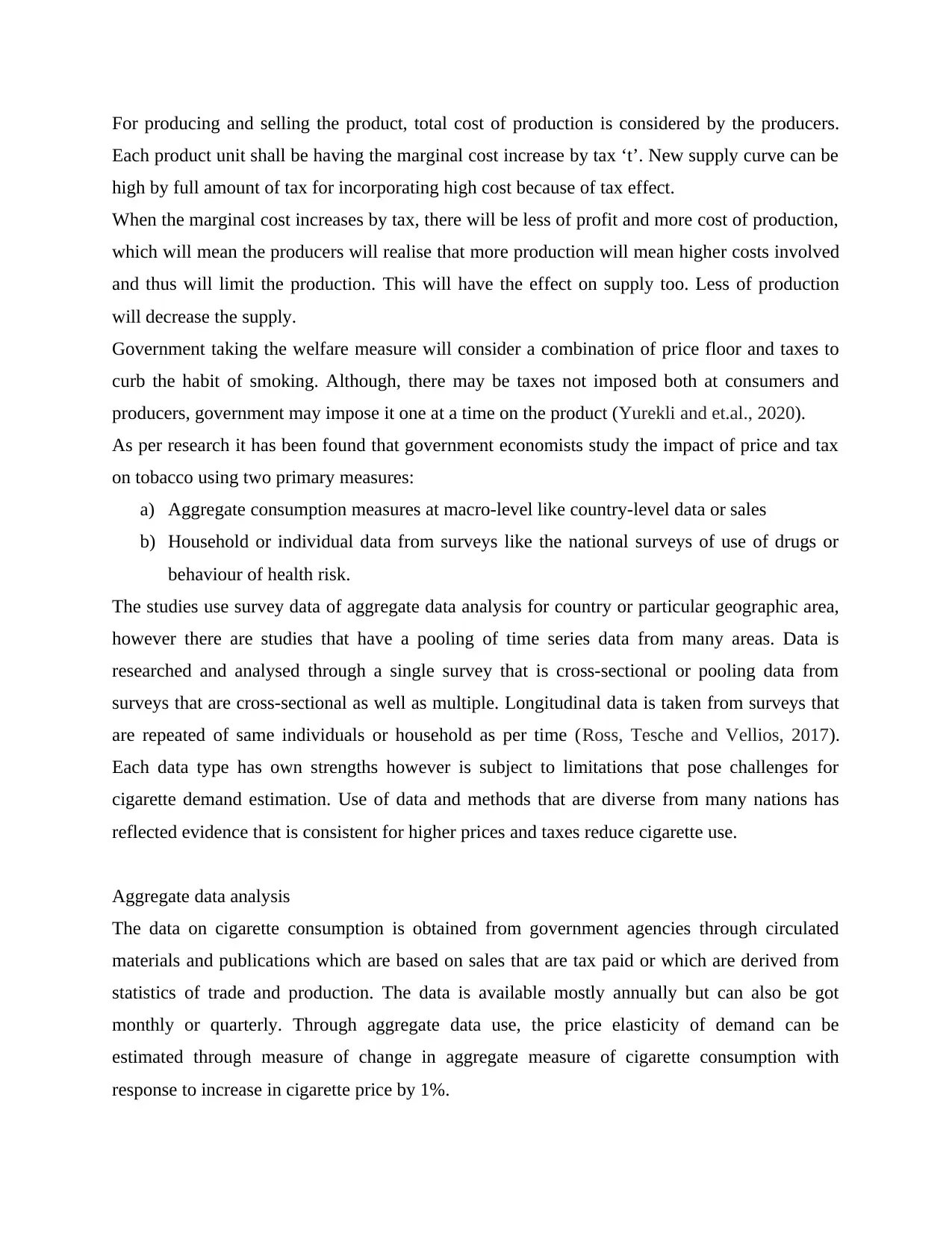
For producing and selling the product, total cost of production is considered by the producers.
Each product unit shall be having the marginal cost increase by tax ‘t’. New supply curve can be
high by full amount of tax for incorporating high cost because of tax effect.
When the marginal cost increases by tax, there will be less of profit and more cost of production,
which will mean the producers will realise that more production will mean higher costs involved
and thus will limit the production. This will have the effect on supply too. Less of production
will decrease the supply.
Government taking the welfare measure will consider a combination of price floor and taxes to
curb the habit of smoking. Although, there may be taxes not imposed both at consumers and
producers, government may impose it one at a time on the product (Yurekli and et.al., 2020).
As per research it has been found that government economists study the impact of price and tax
on tobacco using two primary measures:
a) Aggregate consumption measures at macro-level like country-level data or sales
b) Household or individual data from surveys like the national surveys of use of drugs or
behaviour of health risk.
The studies use survey data of aggregate data analysis for country or particular geographic area,
however there are studies that have a pooling of time series data from many areas. Data is
researched and analysed through a single survey that is cross-sectional or pooling data from
surveys that are cross-sectional as well as multiple. Longitudinal data is taken from surveys that
are repeated of same individuals or household as per time (Ross, Tesche and Vellios, 2017).
Each data type has own strengths however is subject to limitations that pose challenges for
cigarette demand estimation. Use of data and methods that are diverse from many nations has
reflected evidence that is consistent for higher prices and taxes reduce cigarette use.
Aggregate data analysis
The data on cigarette consumption is obtained from government agencies through circulated
materials and publications which are based on sales that are tax paid or which are derived from
statistics of trade and production. The data is available mostly annually but can also be got
monthly or quarterly. Through aggregate data use, the price elasticity of demand can be
estimated through measure of change in aggregate measure of cigarette consumption with
response to increase in cigarette price by 1%.
Each product unit shall be having the marginal cost increase by tax ‘t’. New supply curve can be
high by full amount of tax for incorporating high cost because of tax effect.
When the marginal cost increases by tax, there will be less of profit and more cost of production,
which will mean the producers will realise that more production will mean higher costs involved
and thus will limit the production. This will have the effect on supply too. Less of production
will decrease the supply.
Government taking the welfare measure will consider a combination of price floor and taxes to
curb the habit of smoking. Although, there may be taxes not imposed both at consumers and
producers, government may impose it one at a time on the product (Yurekli and et.al., 2020).
As per research it has been found that government economists study the impact of price and tax
on tobacco using two primary measures:
a) Aggregate consumption measures at macro-level like country-level data or sales
b) Household or individual data from surveys like the national surveys of use of drugs or
behaviour of health risk.
The studies use survey data of aggregate data analysis for country or particular geographic area,
however there are studies that have a pooling of time series data from many areas. Data is
researched and analysed through a single survey that is cross-sectional or pooling data from
surveys that are cross-sectional as well as multiple. Longitudinal data is taken from surveys that
are repeated of same individuals or household as per time (Ross, Tesche and Vellios, 2017).
Each data type has own strengths however is subject to limitations that pose challenges for
cigarette demand estimation. Use of data and methods that are diverse from many nations has
reflected evidence that is consistent for higher prices and taxes reduce cigarette use.
Aggregate data analysis
The data on cigarette consumption is obtained from government agencies through circulated
materials and publications which are based on sales that are tax paid or which are derived from
statistics of trade and production. The data is available mostly annually but can also be got
monthly or quarterly. Through aggregate data use, the price elasticity of demand can be
estimated through measure of change in aggregate measure of cigarette consumption with
response to increase in cigarette price by 1%.
Paraphrase This Document
Need a fresh take? Get an instant paraphrase of this document with our AI Paraphraser
REFERENCES
Books and Journals
Corrigan, J.R., O'Connor, R.J. and Rousu, M.C., 2020. Which smokers adopt e-cigarettes and at
what price? An experimental estimation of price elasticity of demand and factors
correlated with e-cigarette adoption. Addictive behaviors, 105, p.106324.
Cassidy, R.N., Aston, E.R., Tidey, J.W. and Colby, S.M., 2020. Behavioral economic demand
and delay discounting are differentially associated with cigarette dependence and use in
adolescents. Addictive behaviors, 103, p.106225.
Stokes, A.C., 2020. Declines in electronic cigarette use among US youth in the era of COVID-19
—a critical opportunity to stop youth vaping in its tracks. JAMA network open, 3(12),
pp.e2028221-e2028221.
Hiscock, R., Branston, J.R., McNeill, A., Hitchman, S.C., Partos, T.R. and Gilmore, A.B., 2018.
Tobacco industry strategies undermine government tax policy: evidence from
commercial data. Tobacco control, 27(5), pp.488-497.
Yurekli, A.A., Kovacevic, P., Sunley, E. and Ranganathan, K., 2020. Government intervention in
the market for electronic nicotine delivery systems (ends). The known, the unknown and
challenges. Drugs and Alcohol Today.
Ross, H., Tesche, J. and Vellios, N., 2017. Undermining government tax policies: common legal
strategies employed by the tobacco industry in response to tobacco tax
increases. Preventive medicine, 105, pp.S19-S22.
Campus, B., Fafard, P., St Pierre, J. and Hoffman, S.J., 2021. Comparing the regulation and
incentivization of e-cigarettes across 97 countries. Social Science & Medicine, p.114187.
Deng, X. and Zheng, Y., 2019. Estimating the Effects of Electronic Cigarettes Excise Taxes on
the Demand of Tobacco Products.
Books and Journals
Corrigan, J.R., O'Connor, R.J. and Rousu, M.C., 2020. Which smokers adopt e-cigarettes and at
what price? An experimental estimation of price elasticity of demand and factors
correlated with e-cigarette adoption. Addictive behaviors, 105, p.106324.
Cassidy, R.N., Aston, E.R., Tidey, J.W. and Colby, S.M., 2020. Behavioral economic demand
and delay discounting are differentially associated with cigarette dependence and use in
adolescents. Addictive behaviors, 103, p.106225.
Stokes, A.C., 2020. Declines in electronic cigarette use among US youth in the era of COVID-19
—a critical opportunity to stop youth vaping in its tracks. JAMA network open, 3(12),
pp.e2028221-e2028221.
Hiscock, R., Branston, J.R., McNeill, A., Hitchman, S.C., Partos, T.R. and Gilmore, A.B., 2018.
Tobacco industry strategies undermine government tax policy: evidence from
commercial data. Tobacco control, 27(5), pp.488-497.
Yurekli, A.A., Kovacevic, P., Sunley, E. and Ranganathan, K., 2020. Government intervention in
the market for electronic nicotine delivery systems (ends). The known, the unknown and
challenges. Drugs and Alcohol Today.
Ross, H., Tesche, J. and Vellios, N., 2017. Undermining government tax policies: common legal
strategies employed by the tobacco industry in response to tobacco tax
increases. Preventive medicine, 105, pp.S19-S22.
Campus, B., Fafard, P., St Pierre, J. and Hoffman, S.J., 2021. Comparing the regulation and
incentivization of e-cigarettes across 97 countries. Social Science & Medicine, p.114187.
Deng, X. and Zheng, Y., 2019. Estimating the Effects of Electronic Cigarettes Excise Taxes on
the Demand of Tobacco Products.

⊘ This is a preview!⊘
Do you want full access?
Subscribe today to unlock all pages.
Trusted by 1+ million students worldwide

1 out of 22


Related Documents


Your All-in-One AI-Powered Toolkit for Academic Success.
+13062052269
info@desklib.com
Available 24*7 on WhatsApp / Email
![[object Object]](/_next/static/media/star-bottom.7253800d.svg)
Unlock your academic potential
Copyright © 2020–2026 A2Z Services. All Rights Reserved. Developed and managed by ZUCOL.