Ecology of Polar Seas: Form and Function of Marine Organisms

Verified

Added on  2023/06/04

|1
|817
|192
Essay
AI Summary
This essay explores the unique adaptations of marine organisms in the Arctic and Antarctic environments. It details how creatures like ice fish, polar bears, Weddell seals, and narwhals have evolved both behavioral and physiological mechanisms to survive in extreme conditions. The essay discusses the crucial role of phytoplankton in the polar food web and how changes in temperature and ice cover affect the entire ecosystem. Specific adaptations, such as the antifreeze proteins in ice fish and the ability of narwhals to dive to extreme depths, are highlighted, demonstrating the diversity and resilience of life in the polar seas. Desklib provides access to similar essays and study tools for students.
Document Page
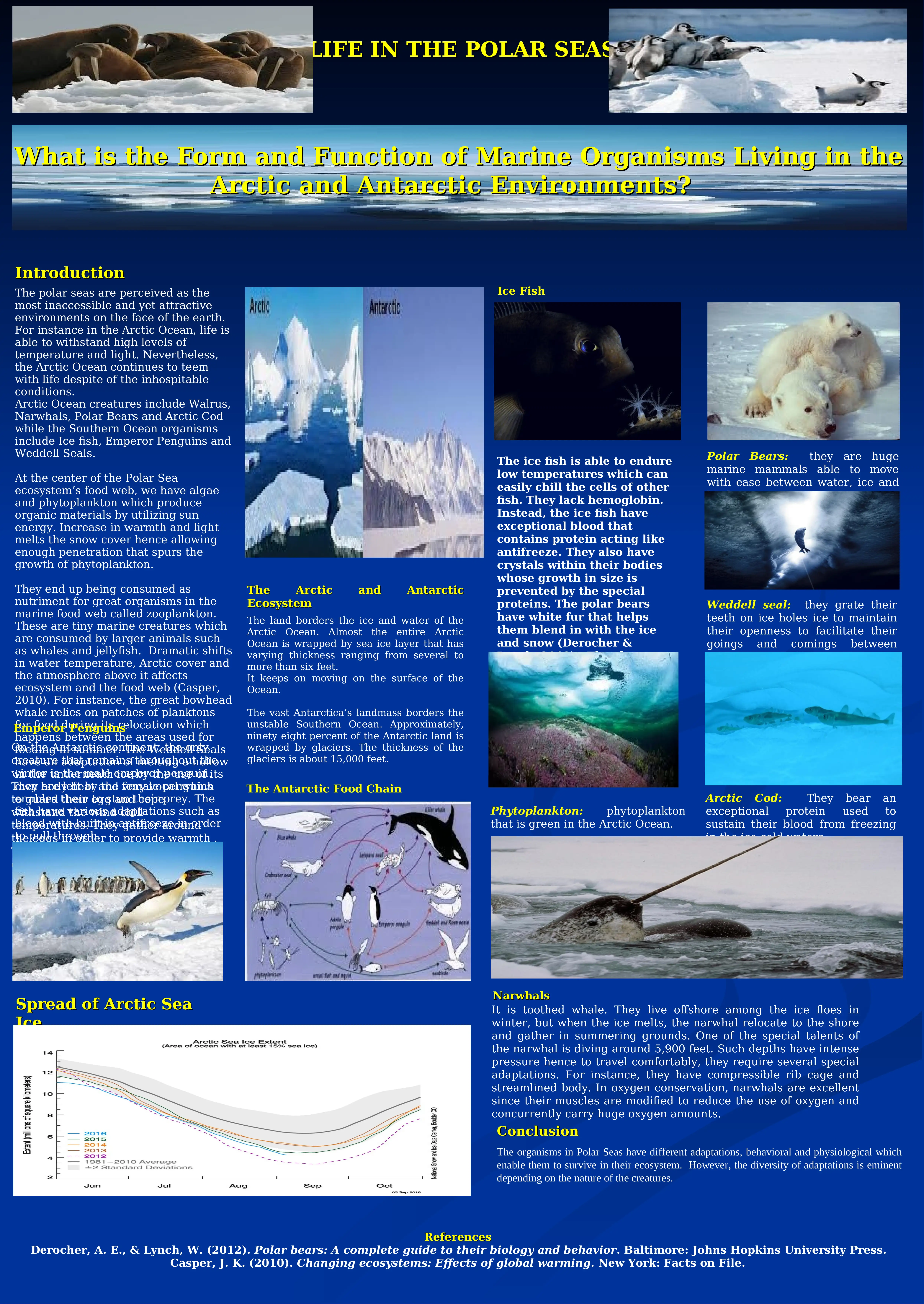
What is the Form and Function of Marine Organisms Living in theWhat is the Form and Function of Marine Organisms Living in the
Arctic and Antarctic Environments?Arctic and Antarctic Environments?
LIFE IN THE POLAR SEASLIFE IN THE POLAR SEAS
IntroductionIntroduction
The polar seas are perceived as the
most inaccessible and yet attractive
environments on the face of the earth.
For instance in the Arctic Ocean, life is
able to withstand high levels of
temperature and light. Nevertheless,
the Arctic Ocean continues to teem
with life despite of the inhospitable
conditions.
Arctic Ocean creatures include Walrus,
Narwhals, Polar Bears and Arctic Cod
while the Southern Ocean organisms
include Ice fish, Emperor Penguins and
Weddell Seals.
At the center of the Polar Sea
ecosystem’s food web, we have algae
and phytoplankton which produce
organic materials by utilizing sun
energy. Increase in warmth and light
melts the snow cover hence allowing
enough penetration that spurs the
growth of phytoplankton.
They end up being consumed as
nutriment for great organisms in the
marine food web called zooplankton.
These are tiny marine creatures which
are consumed by larger animals such
as whales and jellyfish. Dramatic shifts
in water temperature, Arctic cover and
the atmosphere above it affects
ecosystem and the food web (Casper,
2010). For instance, the great bowhead
whale relies on patches of planktons
for food during its relocation which
happens between the areas used for
feeding in summer. The Weddell Seals
have an adaptation of melting a hollow
in the underneath ice by the use of its
own body heat and very vocal which
enables them to stun their prey. The
fish have various adaptations such as
blood with built-in antifreeze in order
to pull through.
The Arctic and AntarcticThe Arctic and Antarctic
EcosystemEcosystem
The land borders the ice and water of the
Arctic Ocean. Almost the entire Arctic
Ocean is wrapped by sea ice layer that has
varying thickness ranging from several to
more than six feet.
It keeps on moving on the surface of the
Ocean.
The vast Antarctica’s landmass borders the
unstable Southern Ocean. Approximately,
ninety eight percent of the Antarctic land is
wrapped by glaciers. The thickness of the
glaciers is about 15,000 feet.
Spread of Arctic SeaSpread of Arctic Sea
IceIce
Phytoplankton: phytoplankton
that is green in the Arctic Ocean.
Polar Bears: they are huge
marine mammals able to move
with ease between water, ice and
land.
Weddell seal: they grate their
teeth on ice holes ice to maintain
their openness to facilitate their
goings and comings between
ocean and air.
Arctic Cod: They bear an
exceptional protein used to
sustain their blood from freezing
in the ice cold waters.
NarwhalsNarwhals
It is toothed whale. They live offshore among the ice floes in
winter, but when the ice melts, the narwhal relocate to the shore
and gather in summering grounds. One of the special talents of
the narwhal is diving around 5,900 feet. Such depths have intense
pressure hence to travel comfortably, they require several special
adaptations. For instance, they have compressible rib cage and
streamlined body. In oxygen conservation, narwhals are excellent
since their muscles are modified to reduce the use of oxygen and
concurrently carry huge oxygen amounts.
ConclusionConclusion
The organisms in Polar Seas have different adaptations, behavioral and physiological which
enable them to survive in their ecosystem. However, the diversity of adaptations is eminent
depending on the nature of the creatures.
ReferencesReferences
Derocher, A. E., & Lynch, W. (2012). Polar bears: A complete guide to their biology and behavior. Baltimore: Johns Hopkins University Press.
Casper, J. K. (2010). Changing ecosystems: Effects of global warming. New York: Facts on File.
Emperor Penguins
On the Antarctic continent, the only
creature that remains throughout the
winter is the male emperor penguin.
They are left by the female penguins
to guard their egg and cope
withstand the wind chill
temperatures. They gather around
the eggs in order to provide warmth .
They use their feet to balance the
eggs their skin to cover.
The Antarctic Food Chain
Ice Fish
The ice fish is able to endure
low temperatures which can
easily chill the cells of other
fish. They lack hemoglobin.
Instead, the ice fish have
exceptional blood that
contains protein acting like
antifreeze. They also have
crystals within their bodies
whose growth in size is
prevented by the special
proteins. The polar bears
have white fur that helps
them blend in with the ice
and snow (Derocher &
Lynch, 2012). They have
layers of fat under their skin
to help them keep warm.
tabler-icon-diamond-filled.svg

Paraphrase This Document

Need a fresh take? Get an instant paraphrase of this document with our AI Paraphraser
[object Object]